Mediation Analysis in SmartPLS 4: Indirect Effects and Mediation Types
Read specific and total indirect effects from the bootstrapping report, compute them by hand and classify mediation following Zhao et al. (2010)


Key takeaways
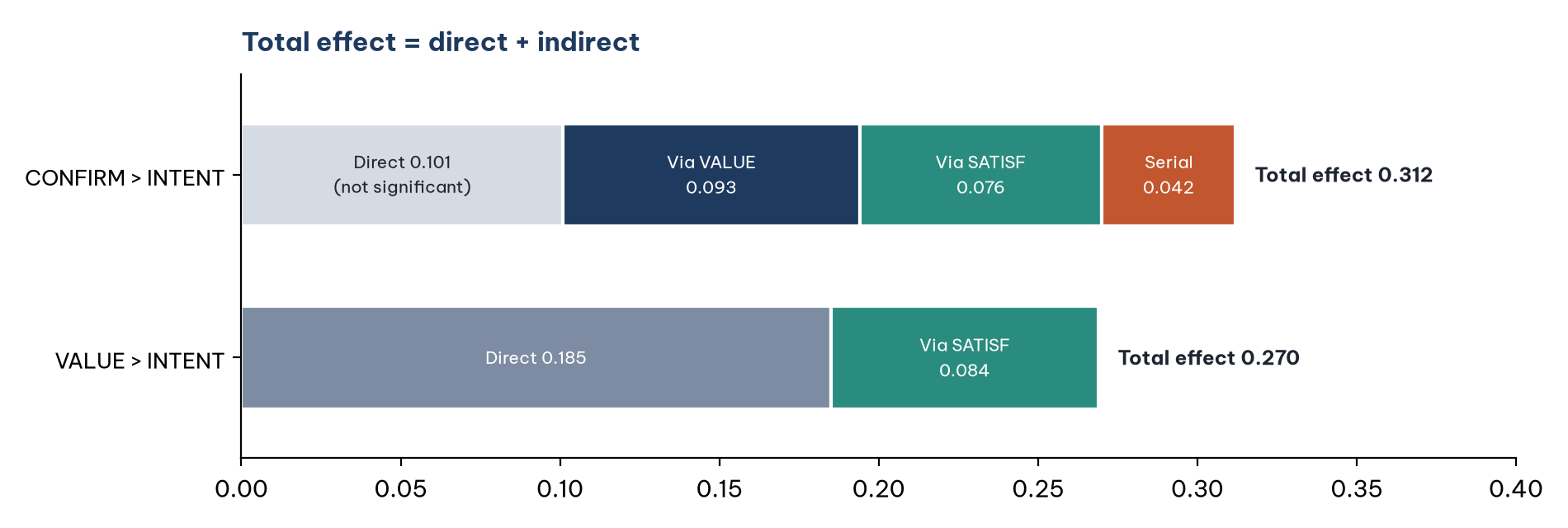
A specific indirect effect is the product of the path coefficients along that path; the total effect is the direct effect plus the total indirect effect.
SmartPLS computes every indirect effect automatically each time you run Bootstrapping; an indirect effect is significant when its confidence interval excludes 0.
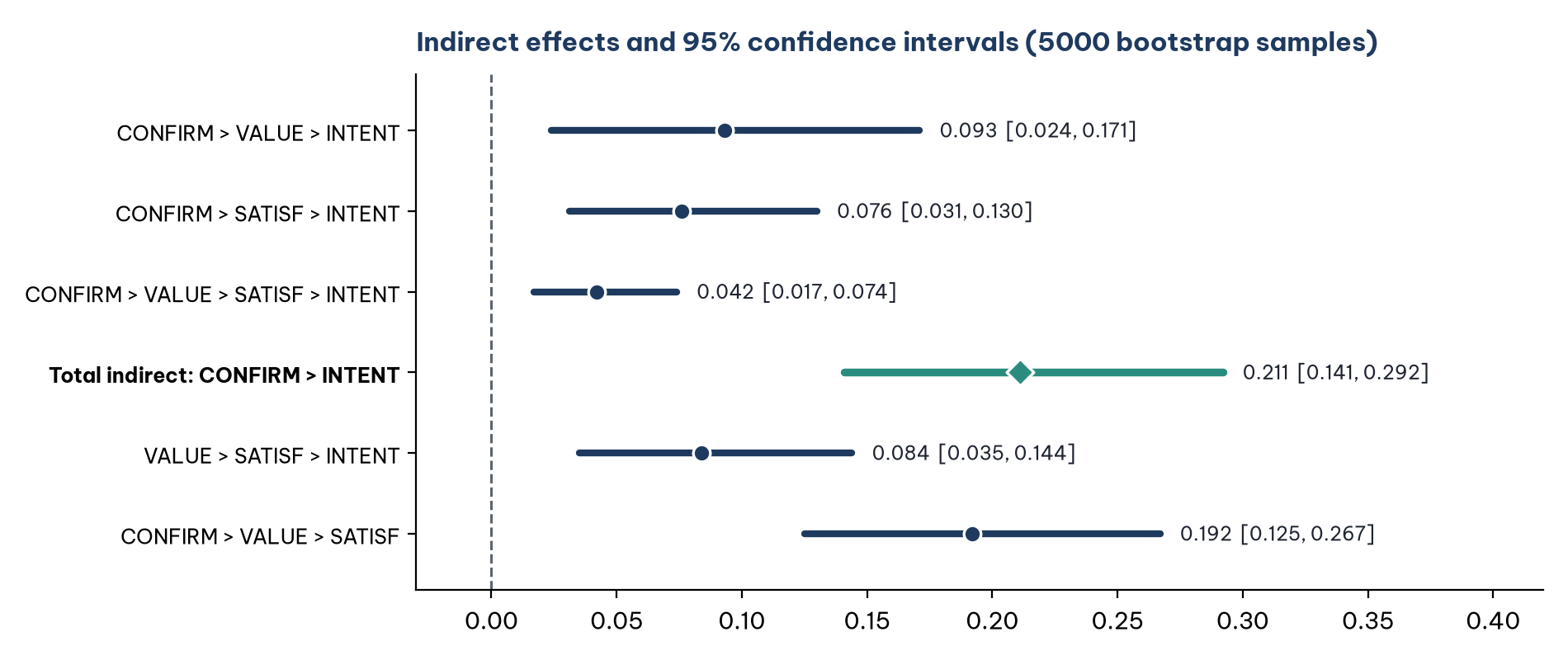
Expectation confirmation affects repurchase intention only indirectly: the total indirect effect is 0.211 [0.141, 0.292], while the direct effect is not significant (p = 0.085).
Classify mediation by the significance of the indirect and direct effects (Zhao et al., 2010), not by the Baron and Kenny conditions or by VAF.
PLS-SEM indirect effects are smaller than CB-SEM ones on the same model, but the conclusions are the same.
Post 39 showed that the direct effect of expectation confirmation on repurchase intention is not significant (H4: p = 0.085). But in the Marketplace X model, confirmation also affects perceived value and satisfaction, and these two constructs in turn affect intention. Does confirmation then influence intention through these two constructs? That is the question of mediation analysis.
Post 28 ran this analysis with CB-SEM in JASP. This post repeats it in SmartPLS 4, using the same bootstrapping report as Post 39, and compares the results.
Sample data and scripts. The data file and scripts for this post are in the research-data-analysis repository on GitHub (folder
data/andscripts/). Download the whole repository with Code > Download ZIP.
About the figures and numbers. The figures are real screenshots of the SmartPLS 4.1.2.1 bootstrapping report (Ringle et al., 2026; 30-day trial) for the model
marketplace-x-model: 5000 samples, percentile confidence intervals, two-tailed test, casewise deletion, 254 respondents (Post 39). According to the SmartPLS license comparison page, the Student license does not include mediation analysis. Section 5 checks the results in R (scriptmediation.Rin the repository'sscripts/folder, package cSEM). SmartPLS uses its own row order in these tables, so the order of the rows differs from the tables in this post.
1. Types of effects in the model
The Marketplace X model has two mediators (VALUE and SATISF) in sequence. From CONFIRM to INTENT there are four paths:
A specific indirect effect is the product of the coefficients along that path.
The total indirect effect is the sum of the specific indirect effects between two constructs.
The total effect = direct effect + total indirect effect.
Hand calculation
Using the path coefficients from Post 39 (H1 = 0.501; H2 = 0.345; H3 = 0.383; H4 = 0.101; H5 = 0.185; H6 = 0.221):
Via VALUE: 0.501 x 0.185 = 0.093.
Via SATISF: 0.345 x 0.221 = 0.076.
Via the serial path VALUE then SATISF: 0.501 x 0.383 x 0.221 = 0.042.
Total indirect effect: 0.093 + 0.076 + 0.042 = 0.211.
Total effect: 0.101 + 0.211 = 0.312.
Multiplying rounded coefficients can differ from SmartPLS by one unit in the third decimal place, because SmartPLS multiplies the unrounded coefficients.
Why bootstrapping?
The product of two coefficients is not normally distributed, so the Sobel test (which assumes a normal distribution) is inaccurate (Preacher & Hayes, 2008). Bootstrapping computes the product in each of the 5000 bootstrap samples and takes the 2.5% and 97.5% cut-off points as the confidence interval. An indirect effect is significant when the confidence interval does not contain 0.
In SmartPLS, no separate setup is needed for indirect effects. Every time you run Bootstrapping, SmartPLS automatically computes all specific indirect effects, total indirect effects and total effects of the model.
2. Reading the indirect effects in SmartPLS 4
Step 1. Run Calculate > Bootstrapping with the settings of Post 39 (5000 samples, Percentile bootstrap, Two-tailed, Fixed seed, Casewise deletion). If the report from Post 39 is still open, use that report.
Step 2. Open Final results > Specific indirect effects > Mean, STDEV, T values, p values (Figure 1).

The table has five specific indirect effects. The name in the second row is truncated; the full name is CONFIRM -> VALUE -> SATISF -> INTENT (serial mediation). The row CONFIRM -> VALUE -> SATISF is the indirect effect of CONFIRM on SATISF through VALUE; it has nothing to do with INTENT.
Step 3. Open Specific indirect effects > Confidence intervals (Figure 2).

Step 4. Open Final results > Total indirect effects > Mean, STDEV, T values, p values (Figure 4).

Step 5. Open Total indirect effects > Confidence intervals to get the confidence interval of the total indirect effect (Figure 5).

Step 6. Open Final results > Total effects > Mean, STDEV, T values, p values (Figure 6).

3. Types of mediation
The approach of Baron and Kenny (1986) requires a significant total effect before mediation is examined, and uses the Sobel test. Zhao et al. (2010) showed that this condition is not necessary: what matters is whether the indirect effect is significant. Nitzl et al. (2016) brought this classification into PLS-SEM, and Hair et al. (2022) follow it:
Applied to the Marketplace X model:
CONFIRM to INTENT: indirect-only. The total indirect effect of 0.211 is significant, all three indirect paths are significant and the direct effect is not significant. Expectation confirmation affects repurchase intention through perceived value and satisfaction. So the fact that H4 is not supported does not mean that confirmation is unimportant.
VALUE to INTENT: complementary. The indirect effect through SATISF (0.084) and the direct effect (0.185) are both significant and both positive. Satisfaction is a partial mediator: perceived value acts both directly and through satisfaction.
CONFIRM to SATISF: complementary. The indirect effect through VALUE (0.192) and the direct effect (0.345) are both significant and have the same sign.
Variance accounted for (VAF)
Some theses also report the VAF (variance accounted for) = total indirect effect / total effect, to describe what share of the effect runs through the mediators:
CONFIRM to INTENT: 0.211 / 0.312 = 67.6%.
VALUE to INTENT: 0.084 / 0.270 = 31.1%.
CONFIRM to SATISF: 0.192 / 0.537 = 35.8%.
VAF is descriptive only. The type of mediation is decided by the significance of the indirect and direct effects, as in the table above (Nitzl et al., 2016). For example, for CONFIRM to INTENT the VAF is 67.6%, not 100%, because in the sample the direct effect is 0.101, not 0. Even so, this direct effect is not significantly different from 0, so the type of mediation is still indirect-only.
4. Comparison with CB-SEM (Post 28)
Both columns are standardized coefficients (the CB-SEM column comes from Post 28, Standardized estimates = All). Post 28 used FIML on 267 respondents and 2000 bootstrap samples; this post uses the 254 complete responses and 5000 samples, so the two columns cannot be compared exactly. Even so, the conclusions are the same: all three indirect paths are significant, and CONFIRM to INTENT is indirect-only mediation. The PLS-SEM indirect effects are smaller, because PLS-SEM path coefficients are smaller than CB-SEM coefficients when the constructs are common factors (Posts 31 and 37).
Post 28 also noted that with CB-SEM on the 254 complete responses (unstandardized coefficients, percentile bootstrap), the confidence interval of the path via VALUE is [0.003, 0.250], with a lower bound very close to 0; an earlier bootstrap run even gave an interval touching 0. With PLS-SEM on the same 254 respondents, this interval is [0.024, 0.171] and does not contain 0. This path still has the largest p value (0.014) of the three indirect paths to INTENT, so interpret it with caution.
5. Checking the results in R
The script mediation.R computes each specific indirect effect as the product of the coefficients in each of the 5000 bootstrap samples of the cSEM package, then takes the 2.5% and 97.5% cut-off points:
The coefficients match exactly; the confidence intervals differ by at most 0.002 because the random bootstrap samples are different.
6. Reporting the results
Indirect effects were tested with bootstrapping using 5000 samples and 95% percentile confidence intervals (Nitzl et al., 2016). Expectation confirmation has positive, significant indirect effects on repurchase intention through perceived value (0.093; 95% CI [0.024, 0.171]), through satisfaction (0.076; [0.031, 0.130]) and through the serial path from perceived value to satisfaction (0.042; [0.017, 0.074]). The total indirect effect is 0.211 ([0.141, 0.292]), while the direct effect is not significant (0.101; p = 0.085), indicating indirect-only mediation (Zhao et al., 2010): the effect of expectation confirmation on repurchase intention runs through perceived value and satisfaction. Satisfaction is a complementary mediator in the relationship between perceived value and repurchase intention (indirect 0.084; [0.035, 0.144]; direct 0.185; p = 0.008).
The mediation table in a thesis should include, for each path: the specific indirect effect, t or p, the 95% confidence interval, the corresponding direct effect and the type of mediation.
Five common mistakes
Stopping the analysis because the direct or total effect is not significant (the Baron and Kenny condition). For CONFIRM to INTENT, stopping at H4 would miss the most important result of this post.
Reporting only the total indirect effect. When there are several mediators, report each specific indirect effect to show which paths are significant.
Misreading the row CONFIRM -> VALUE -> SATISF as an effect on INTENT. It is an indirect effect on SATISF.
Concluding that "full mediation" means there are no other paths. Zhao et al. (2010) point out that there may be mediators not included in the model; write "indirect-only mediation" instead.
Using the Sobel test instead of bootstrap confidence intervals.
Frequently asked questions
Do I need to declare the mediators in SmartPLS?
No. SmartPLS computes all indirect effects from the structure of the model. You only need to draw the paths correctly and run Bootstrapping.
Why does the p value of an indirect effect sometimes disagree with the confidence interval?
SmartPLS computes p from t (coefficient / standard deviation), while the percentile confidence interval is taken directly from the bootstrap distribution, which is skewed for products of coefficients. When the two give different conclusions for a value close to the threshold, rely on the confidence interval (Preacher & Hayes, 2008). In this post, both give the same conclusion.
Should I use bias-corrected confidence intervals?
SmartPLS also offers the item Bias-corrected confidence intervals. This post uses percentile intervals to stay consistent with Post 39. Post 28 compared the two types of confidence interval in CB-SEM.
Do the mediators have to be measured with reflective scales?
No. The analysis is the same for reflective and formative measurement, as long as the scales met the requirements of the measurement model evaluation (Posts 34 to 36).
References
Baron, R. M., & Kenny, D. A. (1986). The moderator–mediator variable distinction in social psychological research: Conceptual, strategic, and statistical considerations. Journal of Personality and Social Psychology, 51(6), 1173–1182. https://doi.org/10.1037/0022-3514.51.6.1173
Hair, J. F., Hult, G. T. M., Ringle, C. M., & Sarstedt, M. (2022). A primer on partial least squares structural equation modeling (PLS-SEM) (3rd ed.). SAGE Publications.
Nitzl, C., Roldán, J. L., & Cepeda, G. (2016). Mediation analysis in partial least squares path modeling: Helping researchers discuss more sophisticated models. Industrial Management & Data Systems, 116(9), 1849–1864. https://doi.org/10.1108/IMDS-07-2015-0302
Preacher, K. J., & Hayes, A. F. (2008). Asymptotic and resampling strategies for assessing and comparing indirect effects in multiple mediator models. Behavior Research Methods, 40(3), 879–891. https://doi.org/10.3758/BRM.40.3.879
Ringle, C. M., Wende, S., & Becker, J.-M. (2026). SmartPLS 4 (Version 4.1.2.1) [Computer software]. SmartPLS GmbH. https://www.smartpls.com
Zhao, X., Lynch, J. G., Jr., & Chen, Q. (2010). Reconsidering Baron and Kenny: Myths and truths about mediation analysis. Journal of Consumer Research, 37(2), 197–206. https://doi.org/10.1086/651257
Discussion about this post