Xerox PARC and the Future It Missed: A Business Model Lesson
How a pay-per-copy model built Xerox, then stopped it from profiting on the graphical interface and Ethernet its own lab invented


Key takeaways
Xerox's first great innovation was a business model, not a machine: the 914 copier was leased for $95 a month with 2,000 copies included and 4 cents for each extra copy, which turned heavy office use into a stream of revenue.
The same company's research center, PARC, built the Alto with a graphical interface and mouse, Ethernet, the laser printer and Smalltalk in the 1970s, yet most of the value from these inventions went to Apple, Microsoft, 3Com and Adobe.
Chesbrough and Rosenbloom (2002) explain the gap with a business-model filter: technologies that fit Xerox's model of leasing office equipment and earning per page (the laser printer) were developed; those that needed a different model (cheap personal computers, networking gear, software) were set aside or left the company.
The popular story that Steve Jobs "stole" the graphical interface in 1979 is simplified: Xerox received Apple shares for the visit, and Apple redesigned the ideas into a product people could afford.
The lasting lesson is that owning an invention is not enough. A firm needs a unit, a person and a business model willing to take the invention to market, even when it competes with today's revenue.
Almost every office worker in the world uses a mouse, moves windows around a screen, plugs into an Ethernet network and prints on a laser printer. All four of those habits trace back to a single research center that one company founded in 1970 and paid for out of copier profits. Yet when people hear the name Xerox today, most of them think of a copier in the corner of the office, not of the personal computer. The company that held so many keys to the digital office watched Apple, Microsoft, 3Com and Adobe build fortunes on ideas first worked out in its own lab.
The story is told often, usually as a tale about a giant that was too slow or too blind. That version misses the more useful point. The Xerox case contains two lessons that pull in opposite directions, and both are about business models rather than technology. The first lesson is that an inventive business model can turn a product that seemed impossible to sell into a money machine. The second is that the very business model that made a company rich can stop it from seeing the value of inventions that do not fit that model. Managers in any industry facing a new technology, from generative AI to digital payments, are living through some version of the same tension.
This article follows the timeline in Figure 1. Section 1 explains the Xerox 914 and the pay-per-copy lease that financed everything else. Section 2 introduces PARC and what it actually invented. Section 3 retells Steve Jobs's 1979 visit and why calling it a "heist" is a simplification. Section 4 asks why Xerox did not become Apple and sets out the business-model filter. Section 5 asks whether Xerox really failed. Section 6 turns the case into questions any established business can ask itself today.
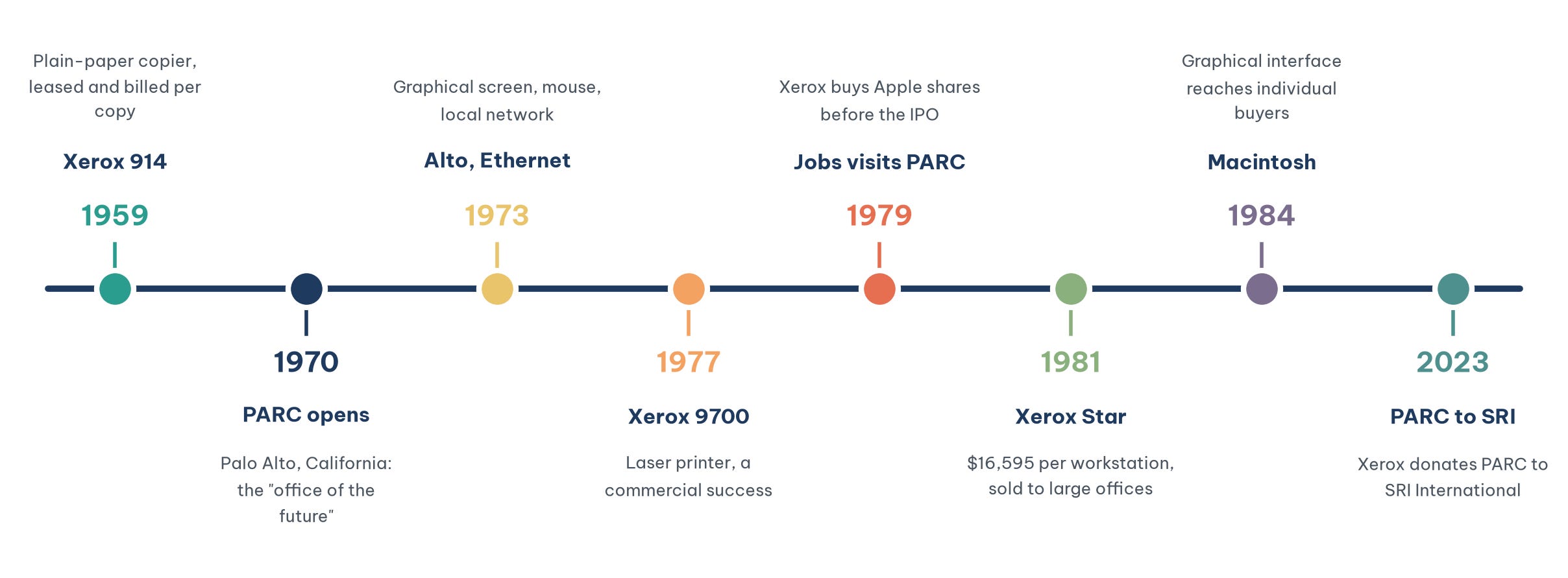
1. The origin: a bet on leasing and a copier that printed money
This section explains where Xerox's financial power came from, because that source of money later shaped what the company could and could not see.
In the 1950s, copying a document was slow and messy. Offices used carbon paper, stencil duplicators or special coated photographic papers that smelled of chemicals. After years of difficult research on a process its inventor Chester Carlson called electrophotography, later named xerography, the small Rochester company Haloid Xerox (renamed Xerox Corporation in 1961) launched the Xerox 914 in 1959. It was the first automatic office copier to make copies on ordinary paper.
The machine had one large problem: cost. It was far more expensive than the copying devices offices already owned. Before launch, Haloid had approached IBM about a partnership to build and sell it. IBM asked the consulting firm Arthur D. Little to assess the market, and the report concluded that demand would be very limited, since few firms would pay so much just to replace carbon paper. IBM declined (Chesbrough & Rosenbloom, 2002). The story is often told as "consultants, including IBM, told Xerox to give up". A more accurate version is that a potential partner said no on the basis of a consultant's report. Xerox then had to find its own way to sell the machine.
1.1. A business model revolution
Instead of giving up, Xerox's chief executive Joseph C. Wilson and his team made a decision that business schools still teach: do not sell the machine, sell the use of the machine. Xerox offered a lease that had no precedent in office equipment (Chesbrough & Rosenbloom, 2002):
The customer paid $95 a month to rent the machine.
The rent included the first 2,000 copies each month.
Every copy beyond that cost 4 cents.
Service was included and the customer could cancel with 15 days' notice.
Each machine carried a meter that counted copies. The change in customer psychology was dramatic: the barrier of a large up-front purchase disappeared, and the short cancellation period removed the fear of being stuck with an expensive mistake. Once a fast, convenient copier sat in the office, people copied far more than anyone had predicted. Chesbrough and Rosenbloom (2002) contrast the 15 to 20 copies a day that a typical office copier of the time produced with installed 914 machines that averaged about 2,000 copies a day, many times the 2,000 copies a month included in the rent. Figure 2 shows what that meant for revenue.
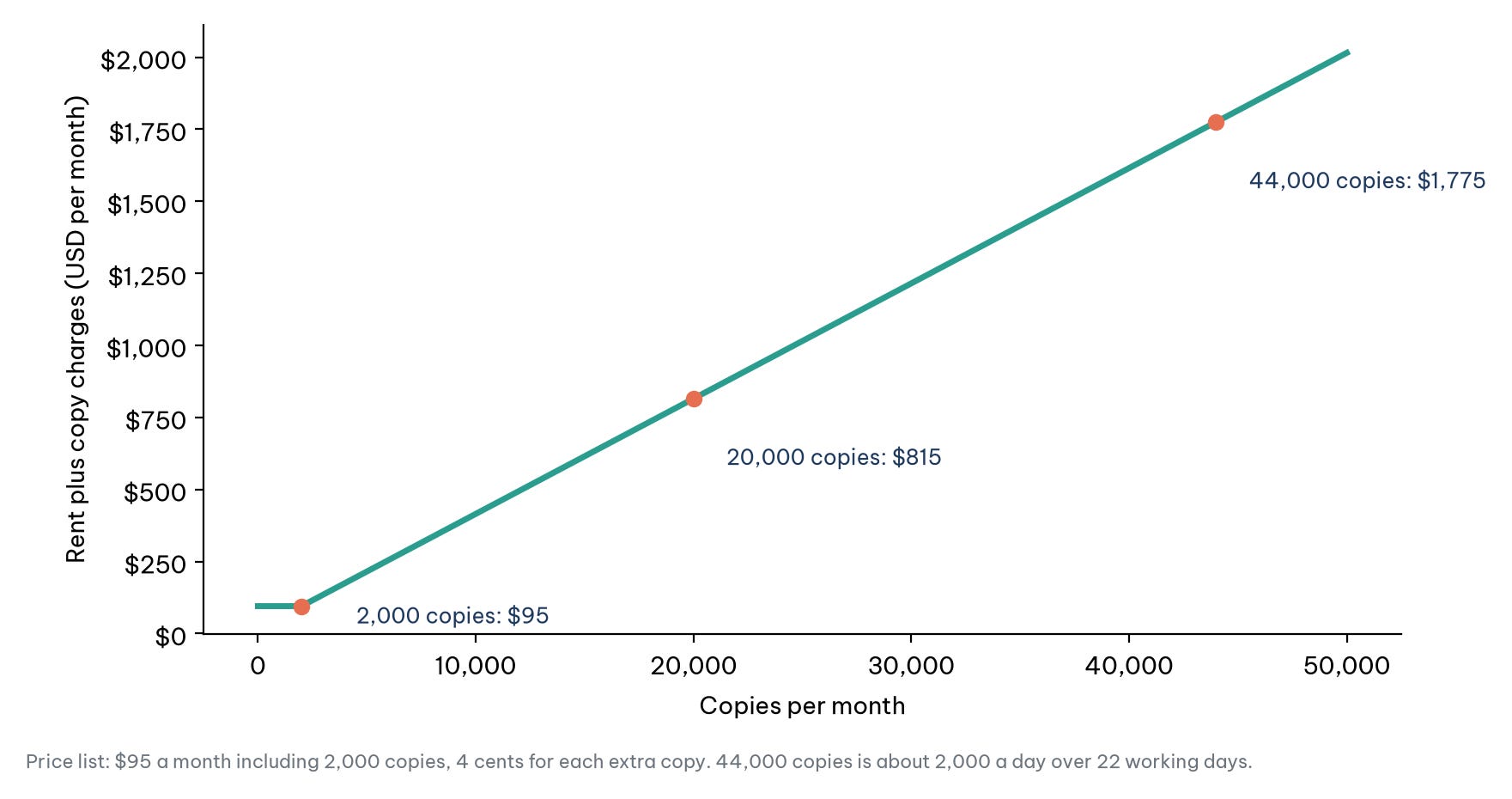
At 2,000 copies a month, the customer paid only $95. At 2,000 copies a day, which is about 44,000 copies over 22 working days, the monthly bill rose to $95 + (44,000 − 2,000) × $0.04 = $1,775, almost 19 times the base rent. The pennies added up to a torrent of cash and made Xerox one of the fastest-growing companies in the United States in the 1960s. Table 1 describes the 914 business model with the blocks of the Business Model Canvas.
The 914 lease is an ancestor of many models that feel modern today: pay-per-use pricing, cheap printers with expensive ink, software sold as a subscription per user, cloud services billed by the server hour and AI services billed by the token. In each case the seller lowers the price of entry and earns more as the customer uses more. The important detail for the rest of the story is what the 914 model rewarded: more pages printed on Xerox machines in large offices.
2. PARC: where the "office of the future" was built
This section describes the research center that the copier money paid for and separates what it truly invented from what it improved.
With cash pouring in from copiers, Xerox founded the Palo Alto Research Center (PARC) in California in 1970, thousands of kilometers from its headquarters and factories in the eastern United States. Its mission was vague but ambitious: create the "office of the future". Xerox gathered many of the best computer scientists of the time and gave them unusual freedom, protected from sales pressure by the steady flow of copier revenue. In that setting PARC engineers produced work that was years ahead of the market, as Table 2 shows.
The Alto and the graphical interface. The first Alto ran in 1973. At a time when most computers were operated by typing commands, the Alto had a bitmapped screen that could show text and graphics, a mouse for pointing and, as PARC's software matured over the next few years, windows, menus and an editor that showed text on screen the way it would look on paper. It was meant as a computer for one person, decades before that idea became normal. One correction matters here: PARC did not invent the mouse. Douglas Engelbart's team at the Stanford Research Institute (SRI) had demonstrated a mouse in 1968. PARC turned it into a tool for daily work (Gladwell, 2011).
Ethernet and email. Once there were many Altos, Robert Metcalfe and David Boggs developed Ethernet in 1973 to connect them into a local area network, and later described it in a widely cited paper (Metcalfe & Boggs, 1976). Ethernet remains the most common wired local network standard today. PARC staff used email over their internal network very early. But email was not a PARC invention either: messages were already being sent between computers on the ARPANET in 1971.
The laser printer. Gary Starkweather had the idea of using a laser to "draw" an image onto a copier drum, so that a computer could print directly. Some managers resisted at first, but Starkweather moved to PARC in 1971 to pursue it, and the Xerox 9700, launched in 1977, became one of the most profitable products Xerox ever sold (Hiltzik, 1999).
3. 1979: Steve Jobs visits PARC
This section retells the most famous scene of the story and then checks it against what is known.
In 1979 Xerox's venture capital arm was allowed to buy shares in Apple before Apple's public offering, about 100,000 shares for roughly $1 million. In return, Steve Jobs, then 24, and a group of Apple engineers were allowed to visit PARC and see what was being developed (Gladwell, 2011). The visits took place in December 1979. Larry Tesler, the PARC engineer who demonstrated the Alto's interface, later recalled that Jobs was excited by the graphical display and kept asking why Xerox was not doing anything with it. Many articles also attribute to Jobs a remark that Xerox was sitting on a gold mine; the accounts differ on the exact words, but they agree that Jobs was captivated by the graphical interface and the mouse far more than by Ethernet or object-oriented programming.
After the visits, the direction of Apple's Lisa and Macintosh projects changed visibly. The usual version of the story then runs quickly: the Macintosh arrived in 1984, Microsoft followed with Windows, the world changed and Xerox watched.
Calling this "the greatest heist in history" is a simplification. Xerox was not robbed; it was paid in Apple stock for the visits. Apple's Lisa project had started in 1978, before the visits, and several Apple people already knew of PARC's work. Most important, Apple did not copy the Alto. It redesigned the ideas so that a computer selling for a few thousand dollars could do what the Alto needed much more expensive hardware to do, and it added pull-down menus, drag-and-drop and a cheap, durable single-button mouse that could be made in large numbers. According to Gladwell (2011), PARC's mouse cost about $300 to build, while Jobs asked the design firm Hovey-Kelley for one that cost about $15. Several PARC engineers, Tesler among them, later moved to Apple. Gladwell (2011) uses the episode to argue that the largest share of value lies in turning an invention into a product that people can buy and use, not only in the invention itself.
4. Why did Xerox not become Apple?
This section moves from the story to the explanation, from corporate culture to the logic of the business model.
Xerox had the technology, the money and the talent. Why did it not succeed with the personal computer? There are three layers of explanation.
4.1. The "toner heads"
By the 1970s, Xerox's corporate headquarters had moved from Rochester, New York, to Stamford, Connecticut, and many of its senior managers came from finance, sales and the copier business that remained centered in Rochester. They were earning billions of dollars from leased copiers, paper and toner. Revenue came from every page that was printed. When PARC scientists enthused about a "paperless office" built on email and screens, the idea was both foreign and threatening to the core business: if people read on screens, who would print? Inside Xerox, the researchers called the managers who thought this way "toner heads" (Smith & Alexander, 1988).
4.2. The business model as a filter
A deeper explanation comes from research on what happened to the technologies that left Xerox. Between 1979 and 1998, 35 technology-based organizations emerged from Xerox's research centers (Chesbrough, 2002). Chesbrough and Rosenbloom (2002) studied several of them in depth, including 3Com, Adobe, SynOptics and Documentum, and concluded that a successful business model works as a cognitive filter. Technologies that fit Xerox's existing model (selling or leasing office equipment to large firms and earning money per page) received investment. Technologies that needed a different model (cheap personal computers sold through retail, networking equipment, software) were set aside or allowed to leave, even though Xerox owned some of the best technology in the world. Xerox judged each spin-off's potential through its own business model, while the spin-offs that succeeded did so by finding business models that differed substantially from Xerox's. Figure 3 illustrates the mechanism.
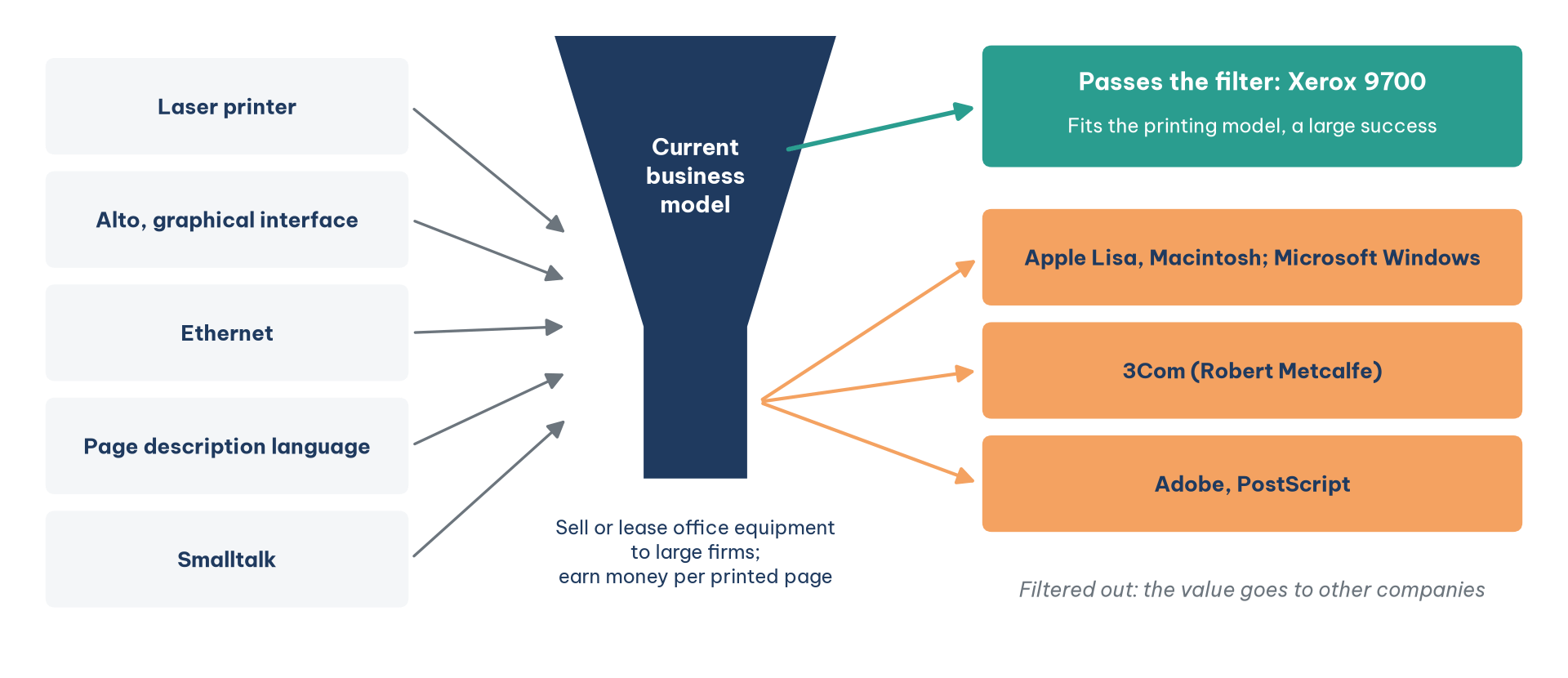
Figure 3 explains why the laser printer succeeded in Xerox's hands while the graphical interface, Ethernet and the page description language succeeded in other hands. The laser printer was "one more printing machine for large offices", a perfect fit for the existing model. The others were not. Table 3 makes the comparison explicit by setting the business model each technology needed against the one Xerox had.
4.3. Xerox Star: the right technology for the wrong market
Xerox did try. In April 1981 it launched the Xerox Star 8010 workstation, with a graphical interface built around icons, folders and a "desktop". But each workstation cost $16,595, and to get the full benefit an office needed several of them plus file servers and network printers. The Star was designed as an office system sold to large organizations by a direct sales force, exactly the way Xerox sold copiers, while the market was shifting to cheap personal computers bought one at a time (the IBM PC in 1981, the Macintosh in 1984). The Star was also relatively closed and slow compared with the flexibility competitors offered.
The case is often linked to the idea of the innovator's dilemma (Christensen, 1997): leading firms fail in the face of disruptive technologies because they serve their current customers too well and fear that new technology will cannibalize old revenue. Xerox shows some of that pattern (the fear that computers would reduce printing), but it differs in one important respect: Xerox itself created the new technology. The closer lesson is therefore Chesbrough's: the problem was not a lack of technology, but the lack of a business model suited to that technology.
5. Did Xerox really fail?
This section tests the popular verdict against the evidence and finds it only partly right.
The story that "Xerox fumbled the future" is true in part, but incomplete. Three points are often left out.
The laser printer was a major commercial success for Xerox itself. It earned money for many years, and Hiltzik (1999) argues that it repaid the cost of running PARC many times over.
The companies that spun out of PARC, such as 3Com and Adobe, created value far larger than Xerox's investment in the lab. That value was real; most of it simply did not belong to Xerox (Chesbrough & Rosenbloom, 2002). Chesbrough (2002) also shows that Xerox learned from the experience, moving from letting projects drift away to a formal internal venture capital structure for its spin-offs.
PARC itself survived. It became an independent subsidiary of Xerox in 2002, and in 2023 Xerox donated PARC to SRI International (SRI International, 2023), the same institute where Engelbart had demonstrated the mouse in 1968.
The more accurate lesson, perhaps, is that a good invention does not turn itself into a product. It needs a person, a unit and a business model willing to take it to market, even when that competes with the company's current revenue.
6. The questions the Xerox case asks of any business today
This section turns the case into a set of questions that an established business can ask about its own technology choices.
Xerox's question is still open for many organizations. Should a bank that earns fees on branch transactions invest heavily in a digital bank where most transactions are free? Should a telecom operator that made money from text messages and calls build a free messaging app? Should a publisher of printed books invest in e-books and audiobooks? Should a software company that sells perpetual licenses move to subscriptions, or further still, to charging for the outcomes its AI produces?
Every successful company has its own "toner heads": the people who defend the model that pays everyone's salary. They are not wrong to do so; that model really does pay the bills. But a company that looks at new opportunities only through the lens of the old model will see very few of them. Table 4 turns the business-model filter into questions a management team can ask before it rejects or shelves an internal invention.
Companies use several routes to escape the filter: setting up a separate unit with its own business model and its own targets, investing in outside startups or licensing technology to others who can commercialize it. Each route accepts that some of the value will be shared, which is better than watching an invention walk out of the door with little or no return, as happened to Xerox with the graphical interface.
Conclusion
Xerox remains a large company in office technology and document services, but the role of "builder of the future" for personal computing went to others. The case is one of the most valuable lessons in management, and it can be summed up in three points.
Business model innovation can build an empire, as the pay-per-copy lease of the Xerox 914 did.
Yet a successful business model and the culture around it can become a filter that keeps a company from seeing the value of inventions that do not fit it.
Owning an invention is not enough. It takes vision and a suitable business model to turn an invention into an innovation that customers buy.
People like to say that Xerox planted the apple tree while Steve Jobs and Bill Gates picked the fruit. The image is only partly right: Xerox picked some large fruit itself, such as the laser printer, and many of the people who picked fruit elsewhere had once tended the tree at Xerox. The next time you click a mouse, remember that this ordinary gesture once lay in the hands of a company that sold copies on paper, and that what decided who would profit from it was not who invented it first, but who found a way to bring it to users.
References
Chesbrough, H. (2002). Graceful exits and missed opportunities: Xerox's management of its technology spin-off organizations. Business History Review, 76(4), 803–837. https://doi.org/10.2307/4127710
Chesbrough, H., & Rosenbloom, R. S. (2002). The role of the business model in capturing value from innovation: Evidence from Xerox Corporation's technology spin-off companies. Industrial and Corporate Change, 11(3), 529–555. https://doi.org/10.1093/icc/11.3.529
Christensen, C. M. (1997). The innovator's dilemma: When new technologies cause great firms to fail. Harvard Business School Press. https://store.hbr.org/product/the-innovator-s-dilemma-with-a-new-foreword-when-new-technologies-cause-great-firms-to-fail/10706
Gladwell, M. (2011, May 16). Creation myth: Xerox PARC, Apple, and the truth about innovation. The New Yorker. https://www.newyorker.com/magazine/2011/05/16/creation-myth
Hiltzik, M. A. (1999). Dealers of lightning: Xerox PARC and the dawn of the computer age. HarperBusiness. https://www.amazon.com/s?k=Dealers+of+lightning+Hiltzik&i=stripbooks
Metcalfe, R. M., & Boggs, D. R. (1976). Ethernet: Distributed packet switching for local computer networks. Communications of the ACM, 19(7), 395–404. https://doi.org/10.1145/360248.360253
Smith, D. K., & Alexander, R. C. (1988). Fumbling the future: How Xerox invented, then ignored, the first personal computer. William Morrow. https://www.amazon.com/s?k=Fumbling+the+future+Smith&i=stripbooks
SRI International. (2023, April 24). Palo Alto Research Center (PARC) to join SRI International [Press release]. https://www.sri.com/press/press-release/the-palo-alto-research-center-parc-will-join-sri-international/
Discussion about this post