What Are Customers Really Buying?
Rethinking the product concept in the digital age, from Philip Kotler’s three levels of value to a positioning framework built on value cores and directed axes


Key takeaways
Customers buy value, not objects. Kotler's three levels (core value, actual product, augmented product) remain the best starting point for any product decision.
Listing product types never ends. A sturdier approach describes every product as one value core plus a set of coordinates on independent axes.
Nine value cores follow from one question: where does the value the customer pays for reside? In a thing, in a job, in information, in relationships, or in a foundation.
Eight positioning axes, each a directed spectrum with an underlying quantity, describe how that core is realized, delivered and monetized.
Most of digital transformation is a slide along the axes rather than a change of core. Familiar labels such as e-commerce, platform and marketplace answer different questions and sit at different levels of the framework.
For business-model designers, the axes are degrees of freedom, and the core is the anchor: a wrong core cannot be rescued by any axis.
How to read this article. On a first pass, focus on Kotler's three levels, Table 1 (nine cores), Table 2 (eight axes) and Table 4 (digital transformation as slides along the axes). On a second pass, read the description of each core and each axis, and try plotting the coordinates of a product you know well.
There is a classic line in marketing: customers don't buy a drill, they buy a hole in the wall. And they don't really need the hole either. What they want is the shelf put up, the family photo hung, the feeling of a tidy home. This deceptively simple idea is the root of modern product thinking, and Theodore Levitt gave it its canonical form in his essay on marketing myopia: companies fail not because their products are bad, but because they define themselves by what they sell rather than by the value customers seek (Levitt, 1960).
The question "what are customers really buying?" becomes more pressing as digital technology changes both what is sold and how it is bought. A car now gains features after it has been delivered. Software can complete a whole job on the user's behalf. A buyer can be an AI agent. To describe these forms, business keeps adding labels (e-commerce, e-business, platform, marketplace, super-app) and classification schemes such as Ron Meyer's Digital Platform Map (Meyer, 2023). Each label and each scheme illuminates something, but they sit at different levels and are easily confused with one another.
This article starts from Philip Kotler's three levels of product and extends that frame across the full range of products in the digital economy. Instead of listing product forms, an endless race that always leaves something out, it proposes a more rigorous approach: every product is described by one value core plus a set of coordinates on independent axes. Any product, old or new, then has a definite place in the same space; digital transformation appears as movement along the axes; and the familiar labels find their proper place.
The article moves in four stages. Sections 1 and 2 define a product as a bundle of value and present Kotler's three levels. Section 3 shows what digitalization did to products and transactions, and why a framework is needed rather than another list. Sections 4 to 7 are the heart of the article: a positioning framework of nine value cores and eight positioning axes, and how to plot a product's coordinates. Sections 8 to 11 use the framework to reread digital transformation, put familiar labels in their place, test coverage against hard cases and against Meyer's Digital Platform Map, and set admission criteria for new axes and cores. Section 12 merges the framework with Kotler's three levels, and Section 13 draws implications for product and marketing teams. Many examples come from Vietnam; each is briefly introduced for readers who do not know the brand.
1. A product is not an object but a bundle of value
Before turning to the model, one foundational definition. For Kotler and Armstrong, a product is anything that can be offered to a market for attention, acquisition, use or consumption that might satisfy a want or need; a service is a form of product that is essentially intangible and does not result in the ownership of anything (Kotler & Armstrong, 2018). The definition is deliberately broad: a product can be a physical object (a bottle of water), a service (a haircut), an experience (a concert), a place (a holiday in Da Lat), an organization, a person (an athlete's personal brand) or an idea (a "wear your helmet" campaign).
The crux is that what a company produces and what a customer buys are rarely the same thing. The company makes an object; the customer buys a change in their life. The gap between the two is the space in which marketing works.
2. Three levels of product: Kotler's foundational frame
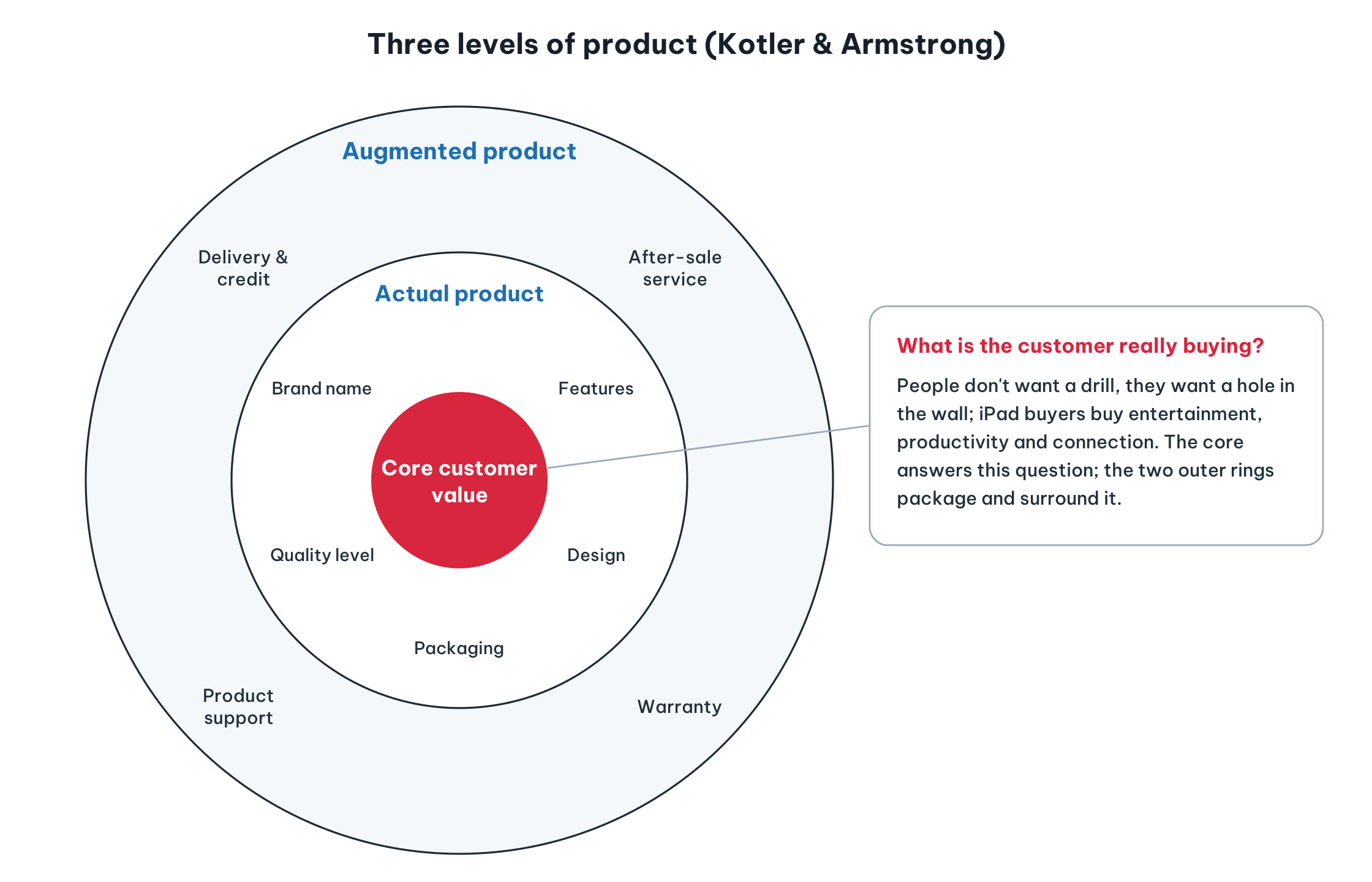
To systematize that gap, Kotler and Armstrong (2018) propose viewing every product on three concentric levels, from the inside out: core customer value, the actual product and the augmented product (Figure 1).
2.1. Core customer value
At the deepest level, a product team must answer one question: what is the customer really buying? Not features, but the core benefit that solves their real problem. Kotler's own example: people who buy an iPad are buying more than a tablet. They are buying entertainment, self-expression, productivity and connectivity; "a mobile and personal window to the world" (Kotler & Armstrong, 2018).
This thinking meets Clayton Christensen's theory of jobs to be done head-on: customers "hire" a product to get a job done in their particular circumstances (Christensen et al., 2016). The well-known milkshake study at a fast-food chain found that most milkshakes were sold in the morning, not to quench thirst, but to give commuters something filling that kept one hand busy and lasted through a boring drive. Once the real job was understood, the company knew what to improve: a thicker shake that lasts longer, not more flavours.
For product teams in Vietnam, try asking: what is a Grab user buying on a night of heavy rain? Not "a ride", but the certainty of getting home safely, without getting soaked and without haggling. That is the core value.
2.2. Actual product
Core value has to be "packaged" into a concrete product that customers can recognize and buy. This is the level of designable attributes: quality level, features, design, brand name and packaging (Kotler & Armstrong, 2018). If the core value is "connection and self-expression", the actual product is the iPhone with its sharp display, iOS, minimalist design language, the apple logo and a box crafted down to the last detail.
This is where most engineering and design teams spend their time. But features are only valuable when they serve the core benefit. A long feature list does not automatically make a good product; it is good only when each feature helps customers do their job better.
2.3. Augmented product
Around the actual product sits a layer of additional services and benefits: delivery and credit, installation, warranty, after-sale service and customer support (Kotler & Armstrong, 2018). This is often where competition is really fought, because in mature markets competitors' actual products look more and more alike.
Look at the car or motorbike market in most countries: mechanical quality among the major brands no longer differs much, so customers decide on the service network, warranty terms, roadside assistance, spare-part availability and resale value. Tesla sells electric cars, but the augmentation (the fast-charging network, over-the-air software updates, the remote-control app) is what creates difference and loyalty. Here the augmented layer is no longer an "add-on"; it is becoming part of the core experience.
3. What digitalization did to products and transactions
The three-level model was born in a world centred on physical goods. To see why it needs extending, put two worlds side by side: before and after digital technology permeated products and transactions.
3.1. Before the digital era: products tied to atoms, transactions tied to places
In the pre-digital world, most value resided in physical matter or in effort delivered in person. Books were paper, music lived on tapes and discs, banking happened at the counter, learning happened in the classroom. Every additional unit sold cost more production, storage and transport. Products were mass-made, rarely tailored to the individual, and their value was "frozen" when they left the factory. The relationship between seller and buyer usually ended at the till, extended only by the warranty.
Transactions were bound by space and time: buyers had to travel, during opening hours; payment was by cash, cheque or a transfer at the counter; contracts and receipts were paper. Goods passed through a multi-tier chain of intermediaries, from manufacturer through wholesaler and agent to retailer. Buyers faced heavy information asymmetry: prices were hard to compare, and they relied on the seller's word, brands and word of mouth.
3.2. After digitalization: products leave the object behind
Digital technology changed products in five overlapping directions. First, full digitization: e-books, streamed music and software have near-zero marginal cost and can be sold without limit. Second, smartness: cars, watches and televisions are connected, updated remotely and constantly generate data. Third, from owning to using: buying discs gives way to a Spotify subscription, perpetual software licences give way to software-as-a-service, owning a car gives way to ride-hailing. Fourth, personalization: recommendations, prices and content are tailored to each person from their behaviour. Fifth, data as an asset: user data both helps the product improve itself and sometimes becomes the main source of revenue. A sixth direction is now emerging: products that act, as AI agents complete whole jobs for their users.
In theoretical terms, Pine and Gilmore (1998) describe a progression of economic value: from commodities to goods, to services, then to experiences, and at the top transformations, where a company sells not a thing but a change in the customer. Each stage is a higher level of value and a way out of commoditization, the state in which offerings become alike and compete only on price. In parallel, Vargo and Lusch (2004) identify a shift to a new dominant logic: value is not embedded in a product when it leaves the factory (value-in-exchange) but is created as the customer uses it (value-in-use), through co-creation between firm and customer. The trend towards servitization makes this concrete: Rolls-Royce sells not only aircraft engines but "Power by the Hour", in which airlines pay for the hours the engine runs while Rolls-Royce takes responsibility for maintenance and performance. The "product" becomes a promise of an outcome sustained over time.
3.3. Transactions transformed: disintermediation and reintermediation
Digital transactions run 24/7, across borders, on a phone; payment is by e-wallet, QR code or card; contracts and invoices are electronic. Transactions that used to be uneconomic appear: micro-payments of a few cents, exchanges between private individuals. Information asymmetry falls sharply thanks to reviews from earlier buyers and price-comparison tools.
The most interesting change happened to intermediaries. When the internet spread, many predicted that intermediaries would be cut out (disintermediation), since producers could sell directly to consumers. That did happen, but alongside it came a wave of reintermediation: new kinds of intermediary arose to aggregate supply, match it with demand and secure trust online (Sarkar et al., 1995). Meyer (2023) names the phenomenon precisely: instead of disappearing, intermediaries were reborn as digital platforms, systems that facilitate many-to-many interactions. Shopee, Grab and Booking produce nothing, yet they hold the centre of the transaction. At the newest frontier, the buyer itself is changing: AI agents are beginning to search, compare and order on people's behalf.
3.4. Why we need a framework, not another list
This variety has spawned a stream of new labels, and every time practice produces a new form, the list grows by a line. The approach has two weaknesses. It always lags behind practice, and it mixes different questions: "platform" describes how value is created, "subscription" describes how money is collected, "e-commerce" describes the transaction channel, and "AI software" describes the technology inside. The next part proposes separating these questions into a positioning framework.
4. A positioning framework: value cores and positioning axes
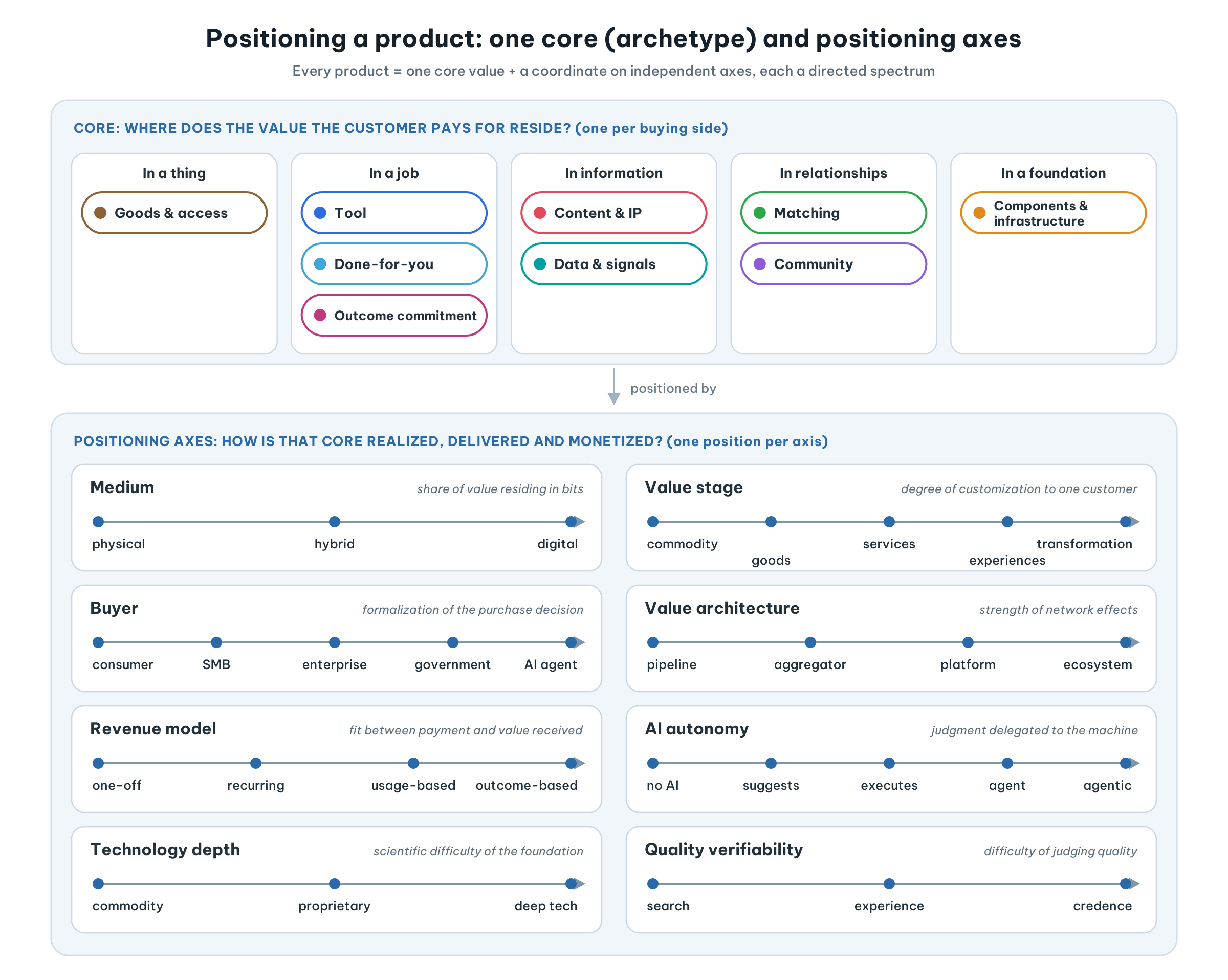
The key is positioning rather than listing. Split any product into two independent questions. The first is the core: what kind of value is the customer buying? The answer is an archetype, and it connects directly to the core customer value at the centre of Kotler's model. The second is positioning: how is that core realized, delivered and monetized? The answer is the product's position on a set of positioning axes. Every product is therefore one archetype plus a set of coordinates on the axes (Figure 2). The sections below present the archetypes, the innermost level, first, then the axes around them. Both are open sets: the number of cores and axes presented below is the result of the present analysis, not a fixed figure, and the framework has explicit criteria for admitting more as practice produces new forms.
5. Archetypes: where does the value the customer pays for reside?
The list of archetypes is not an arbitrary enumeration; it is derived from a single question: where does the value the customer pays for mainly reside? The answers form five families. Value can reside in a thing the customer owns or gets to use. It can reside in a job that gets done, and this family splits three ways according to two questions, "who does the work?" and "who bears the risk if the result falls short?": the customer does it (tool), the seller does it but the customer still carries the result (done-for-you), or the seller both does it and guarantees the result (outcome commitment). Value can reside in information: a work to be enjoyed (content) or a signal to decide with (data). It can reside in relationships with others: being matched with a party to transact (matching) or belonging to a group (community). And finally it can reside in a foundation on which customers build their own products (components and infrastructure). The present derivation yields nine archetypes, presented in the order of their families (Table 1). That number reflects the residences of value identified so far, not a limit: the set of archetypes grows when a new residence of value meets the admission criteria set out at the end of this section.
Because the axes are independent of the core, an archetype can take almost any position on every axis: the same tool core can be physical or digital, bought outright or subscribed to, AI-free or run by an AI agent.
Goods and access. This is the most classic archetype and Kotler's original example: the customer buys a thing to own, or the right to use a thing for a period. Value lies in the item itself plus access to it: selection, availability, price, convenience, reliability. The archetype has three faces. Manufacturers sell items they make (a bottle of mineral water, a VinFast electric car from Vietnam, clothing from a direct-to-consumer brand). Retailers and distributors provide access to other people's goods (Amazon, or industrial supplier Grainger in B2B); Amazon's classic value proposition of "unmatched selection and convenience" is exactly this core. And lessors sell access rather than ownership: car rental, apartment rental, equipment hire, even a consumer loan, where the customer in effect "rents" money and the interest rate is the price of that access. Three levels: the core is the desired item or access; the actual product is assortment, quality, price, stock and delivery; the augmentation is returns, warranty, personalized recommendations and loyalty programmes.
Tool. The product gives users the capability to do a job themselves: Excel and Google Sheets for calculation, Figma and Canva for design, Notion for organizing work, ChatGPT for drafting and analysis, WhatsApp or Zalo for keeping in touch, and in the physical world the drill, the washing machine, the coffee maker. In business software, accounting packages and team-management suites are typical B2B tools. The defining feature of this core: the customer does the work and owns the result. A tool is only useful if people know how to use it and choose to, so onboarding and learnability are vital. Three levels: the core is that capability; the actual product is features, interface and reliability; the augmentation is support, integrations, training, template libraries and user communities.
Done-for-you. The customer pays for someone else to apply effort and expertise on their behalf: haircuts, medical care, legal advice, car repair, cleaning, delivery, outsourced accounting, creative agencies. This is the largest part of the service economy. Lovelock (1983) classifies such services by the nature of the service act, tangible or intangible, and by its direct recipient: a haircut acts on people's bodies, a repair on their possessions, advice on their minds, accounting on their intangible assets. What separates done-for-you from its two neighbours is where effort and risk sit. Unlike a tool, the seller does the work. Unlike an outcome commitment, the seller sells work performed diligently and competently, while the customer still carries the risk of the final result: a doctor follows the right protocol but does not guarantee a cure, a lawyer argues hard but does not guarantee a win. This core is also where artificial intelligence is causing the biggest shift. When an AI agent processes claims, answers customers or writes code in place of people, software moves from the tool core to the done-for-you core, from "software for you to work with" to "software that does the work for you". Three levels: the core is a job completed by someone with expertise; the actual product is the team, process, turnaround time and professional credentials; the augmentation is booking, progress tracking, workmanship guarantees and after-service care.
Outcome commitment. The company sells a guaranteed result, not a tool for customers to work with, nor just effort. What defines this archetype is not that the customer is changed (a course or a retreat changes people too), but that the provider commits to and prices on the result itself, bearing the risk if it is not achieved. Examples: Rolls-Royce's TotalCare (airlines pay for engine flying hours while Rolls-Royce carries the risk of breakdowns), Michelin's tyres billed by the kilometre, Hilti's tools-as-a-service, weight-loss programmes that refund if targets are missed, agencies paid only when performance targets are met. This core also contains contingent commitments: insurance and guarantees sell a state of being compensated if a risk materializes, the same essence of pricing on risk and bearing it for the customer. Shifting outcome risk from buyer to seller transforms both the business model and the basis of trust. Three levels: the core is the guaranteed result; the actual product is the processes, tools and measurement systems that produce it; the augmentation is transparent reporting, risk-sharing mechanisms and long-term partnership.
Content and IP. Value lies in the work itself, enjoyed or learned from (entertainment, knowledge, emotion): film and music (Netflix, Spotify, YouTube), games (Arena of Valor, published in Vietnam by VNG as Liên Quân Mobile), pre-recorded courses (Coursera, Udemy), news and newsletters (VnExpress, paid newsletters on Substack), books, and live performances. What sets content apart: value lies in the work and is usually protected by intellectual property (IP); hits are hard to predict; and because catalogues are vast, discoverability, recommending the right thing at the right moment, becomes the competitive front. TikTok is the clearest proof: it does not wait for viewers to search but uses an algorithm to push works to each person. Three levels: the core is the story or knowledge; the actual product is the catalogue, its quality and the recommendation engine; the augmentation is multi-device viewing, offline downloads, fan communities and live events.
Data and signals. Data, signals or analysis are themselves the product: financial data (Bloomberg, Refinitiv), credit data (credit bureaus and scoring firms), market and consumer data (Nielsen and the like), location data, rankings and indices. Unlike content, which is enjoyed, data is used to decide: the core value is "better decisions thanks to information you could not get yourself", so accuracy, freshness and coverage decide everything. A Bloomberg terminal is expensive because it is faster and more trusted than the alternatives. Three levels: the core is a decision advantage; the actual product is the dataset, its accuracy and freshness; the augmentation is integration, regulatory compliance and transparency about provenance.
Matching. The product is the match between two or more groups, and value comes mainly from network effects: each participant makes the product more valuable for those on the other side (Rochet & Tirole, 2003; Parker et al., 2016). Examples span daily life: ride-hailing (Uber, Grab), marketplace e-commerce (Shopee, Lazada, eBay), lodging (Airbnb, Booking), recruitment and freelancing platforms, peer-to-peer resale, app distribution (App Store, Google Play), search (Google matching people who ask with sources of information). The subtlety is that the core value differs for each side: drivers need steady income and orders, riders need fast, safe trips. The platform must therefore design value for both at once and solve the "chicken-and-egg" problem at launch. Three levels: the core is a trusted fit between supply and demand; the actual product is the app, matching algorithm, rating system and payment mechanism; the augmentation is trip insurance, refund policies and dispute resolution.
Community. Value comes from relationships, identity and interaction among members rather than from a transaction: Discord, Reddit, Facebook groups, Stack Overflow, Strava, enthusiast forums, or paid membership clubs on Patreon. Unlike matching, where two parties meet to complete a transaction and leave, the unit of value in a community is belonging and repeated engagement. What makes a community (its culture, moderation and core members) is very hard to copy, which makes it both a moat and an operating burden. Three levels: the core is belonging; the actual product is the space for interaction and the tools for running groups; the augmentation is events, perks and status for active members.
Components and infrastructure. The product is sold to others so they can build their own products or operations: payments (Stripe, VNPAY for merchants), cloud computing (AWS, Google Cloud), communications (Twilio), maps and digital identity (Google Maps API, eKYC providers), operating systems and foundation AI models opened to developers. In the physical world, they are components inside other people's products (Intel chips in laptops, Gore-Tex in jackets) together with utilities such as electricity, water and telecoms. This is also home to what Gawer and Cusumano (2014) call innovation platforms: third parties do not merely transact on them but build products on them. The core value is "so you don't have to build the hard part yourself"; and because the customer's whole product rests on it, reliability is paramount: an hour of infrastructure downtime takes down thousands of customers' products at once. Three levels: the core is a capability the customer does not have to build; the actual product is specifications, stability, application programming interfaces (APIs) and documentation; the augmentation is service-level agreements (SLAs), technical support, security and scalability.
5.1. Rules for assigning a core
So that every product receives exactly one core without ambiguity, the framework uses three rules. First, one core per buying side: a platform serving several customer groups can have a different core for each, and each side must be assigned separately. Facebook is the clearest example: for users the core is community; for advertisers it is matching with the right audience. Second, a removal test for hybrid products: the core is the element without which the customer would stop buying. A restaurant sells food, service and a setting; remove the service and setting and customers still buy the food as takeaway. The core is therefore goods, while the staging of the setting lifts the restaurant to the experience stage on the value-stage axis. Third, cores are not coordinates: archetype names are chosen so that none coincides with a step on any axis. Done-for-you is not the services step of the value-stage axis, and outcome commitment is neither the transformation step of the value-stage axis nor the outcome-based step of the revenue-model axis; matching is not the platform step of the value-architecture axis. The question "what does the customer buy?" thus never gets confused with "where is the product positioned?".
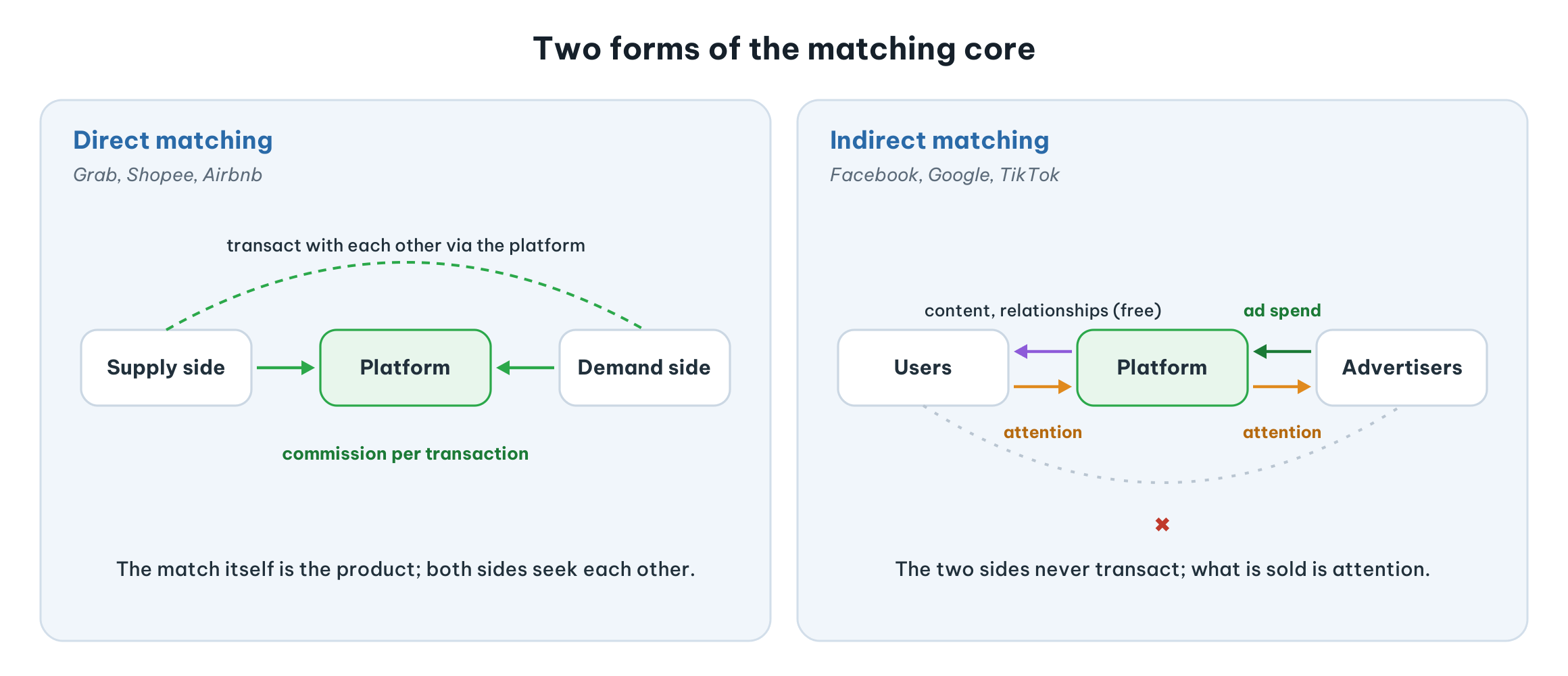
The first rule matters most for the matching core, which takes two very different forms (Figure 3). In direct matching, the platform matches two identified sides to complete a transaction: drivers with riders (Grab), sellers with buyers (Shopee); both sides actively use the product to find each other, and the match itself is the product. In indirect matching, users come for a different core (friends and content on Facebook, answers on Google), while the platform matches advertisers with audience segments based on attention and data; the two sides never transact with each other. Both rest on network effects, but they capture value very differently: Grab takes a commission on every ride, Facebook collects advertising money from a side that is not its users. This is also the mechanism behind the claim that "data becomes an asset": in indirect matching, data about users' attention is precisely what is sold to the other side.
6. Positioning axes: each axis a directed spectrum
If the core answers what the customer buys, the axes describe how that core is realized, delivered and monetized. The axes are independent descriptive dimensions: on each, a product takes exactly one position, and a position on one axis does not constrain the position on another. They may correlate in practice, but none can be derived from another. Independence alone does not make a dimension an "axis": each must also be a directed spectrum, with two opposite poles and an underlying quantity that increases from left to right. That quantity is what distinguishes an axis from a list of labels, and it lets us talk about movement: a product does not merely sit at a coordinate but can slide along an axis over time. As a later section shows, digital transformation is exactly a series of such slides. The present synthesis of the literature establishes eight axes that meet both conditions; like the set of cores, the set of axes is open. Table 2 summarizes the spectrum and underlying quantity of each axis.
Medium: from physical to digital. This axis measures tangibility; the underlying quantity is the share of value residing in bits rather than atoms. Picture a sequence: a bag of coffee beans (purely physical), a car or a Garmin watch that updates its software over the air and syncs data (a hybrid, or "phygital", product), then a payments app or Google Docs (purely digital). Position on this axis determines very practical things. Physical products have high marginal cost (each additional car costs nearly as much as the last), their value is "frozen" at the moment of sale, and they move through warehouses. Digital products have near-zero marginal cost, keep improving after sale and use customer data to get better. Hybrids are especially interesting: the object becomes a "door" into a lasting digital service. A Tesla improves through software after you buy it; a Kindle is hardware plus a content service. Shostack (1977) reminds us that almost no product is "pure" at either end: a restaurant meal is tangible food plus intangible service and atmosphere.
Value stage: from commodity to transformation. Pine and Gilmore (1998) arrange economic value as a progression of commodities, goods, services, experiences and transformations. Their own coffee example shows the power of this axis: the beans for one cup are worth a cent or two as a traded commodity, 5 to 25 cents once roasted, ground and packaged as a good, 50 cents to a dollar when brewed and served in a diner, and two to five dollars in a carefully staged café. The same raw material is priced a hundred times apart or more purely because of its stage. The pattern recurs everywhere: a gym can sell memberships (a service), move up to boutique classes rich in experience, and further to a coaching programme that changes each person's physique and habits (a transformation). The underlying quantity is the degree to which value is customized around one specific customer, and this is where personalization and customization live in the framework. They are not a separate axis but upward movement along the value-stage axis. For Pine and Gilmore, customization is precisely the force that pushes an offering to the next stage, while commoditization pulls it down: customizing a service around each person turns it into an experience; customizing so deeply that it changes the person makes it a transformation. When the customizing is done by machines (Netflix recommendations, the TikTok feed), the means of personalization sits on the AI-autonomy axis, while its result shows up on this axis. Note that the transformation stage does not require a guarantee: a coaching programme can change people without promising anything. Only when the provider also guarantees the result and refunds failures does the product carry the outcome-commitment core as well. This axis is tied to the idea of value-in-use, value created in use rather than stored in the thing (Vargo & Lusch, 2004).
Buyer: who makes the purchase decision. The underlying quantity is the degree of formalization and automation of the purchase decision. At the left pole are consumers and households (B2C: Starbucks, Netflix), who decide in seconds on feel. Next come small and medium businesses (SMBs: a café buying point-of-sale software, a shop buying an advertising package), where the owner is both user and decision-maker: quick decisions, but with costs weighed. Then come enterprises (Salesforce, SAP), where no single person decides. Employees are users, IT evaluates, the finance director approves the budget, leadership signs: a whole buying center of users, influencers, deciders, buyers and gatekeepers (Webster & Wind, 1972). Value is measured in business impact, selling becomes "solution selling", and the augmented layer (service-level commitments, implementation, training, account management) often decides the deal. Further right is government (B2G: public-service systems built by large IT contractors), where purchasing is bound by procurement law and public process. And at the right pole is a new frontier: AI agents as buyers (B2A, business-to-agent). Once agents are given economic autonomy, they will search, compare and order against criteria set by people: an assistant that reorders office supplies when stock runs low, an agent that picks the cheapest flight. Gartner calls these machine customers and predicts that by 2030 around 20% of monetary transactions will be programmable, with terms and conditions of use embedded, giving AI agents the ability to transact on their own (Gartner, 2025). The marketing consequences are concrete. Agents do not browse like people but scan, analyse and decide instantly, so products must expose machine-readable information: structured data, APIs, real-time price and stock. The familiar labels D2C (direct to consumer) and B2B2C (through another business to end users) are not steps on this axis; they describe the route to the buyer, the distribution channel, not the buyer. Likewise, C2C describes the seller being an individual, which is captured by the matching core and the value-architecture axis. Buyers must also be kept apart from users: citizens use a public-service portal for free, but the buyer of that system is the state. Buyers cut across every archetype: an enterprise product can be a tool (Salesforce), infrastructure (AWS), data (Bloomberg) or an outcome commitment (managed services paid against targets).
Value architecture: from pipeline to ecosystem. This axis asks how value is created; the underlying quantity is the strength of network effects, that is, how far participants create value for one another (Katz & Shapiro, 1985; Rochet & Tirole, 2003; Parker et al., 2016). Network effects come in two forms: same-side (the more of my friends use Zalo, the more valuable Zalo is to me) and cross-side (the more drivers, the more valuable Grab is to riders, and vice versa). At the pipeline pole, the company makes and sells, and value flows one way from producer to customer: Apple makes iPhones, VinFast builds cars, Netflix produces or licenses films and streams them. The second step is the aggregator: it gathers fragmented supply into one place and owns the relationship with demand. Traveloka aggregates hotels and flights, Google aggregates the web; network effects appear but mostly in one direction. The third step is the platform, where participants interact directly. In its full form it is a multi-sided platform such as Grab, Shopee or the App Store, with cross-side network effects; in its simplest form it is a one-sided network such as a pure messaging app, with only same-side effects. Furthest right is the ecosystem or super-app, where many services and many sides interlock: Grab expanding from rides into food delivery, wallets and finance; Zalo from messaging into business accounts, payments and mini-apps; WeChat in China as the classic case. The further right, the deeper the competitive moat, at the price of a chicken-and-egg problem at launch. This axis must be kept apart from the matching core: the core says the customer buys a match, the axis says how many parties create value. Netflix is content with a pipeline architecture, YouTube is content with a platform architecture: one core, two coordinates.
Revenue model: from one-off to outcome-based. The same product can be monetized in many ways, and that choice is a strategic decision separate from the product itself (Osterwalder & Pigneur, 2010). The underlying quantity is the fit between what the customer pays and the value they actually receive, in timing and in amount. At the left pole is one-off payment: buying a drill or a perpetual software licence outright, where the customer pays in full before receiving any value. Recurring payment spreads the money over time but stays fixed regardless of use: Netflix, Spotify and Microsoft 365 subscriptions, monthly insurance premiums. Usage-based payment ties money to consumption: AWS bills by server hours, Stripe per transaction, Twilio per message, and marketplaces take a commission on each order. At the right pole is outcome-based payment: the customer pays only when the result occurs. Examples are affiliate fees paid only on a sale, cost-per-action advertising, and Rolls-Royce's "Power by the Hour" paid per hour of reliable engine operation. The spectrum runs from "single" to "regular" to "continuous", and the further right, the more the risk of paying without receiving value shifts from buyer to seller. The two remaining familiar formulas are variations on the same spectrum. Advertising is not a step but a move of the payer to a different side: advertisers pay per impression (usage-based) or per action (outcome-based). Freemium is a path leading users from free to recurring payment (Spotify, Canva, Zoom). The weight of this axis became obvious when Adobe moved from perpetual licences to subscriptions: the product barely changed, but recurring revenue sent the company's valuation soaring. The axis is also independent of the core: insurance has an outcome-commitment core but recurring revenue, while a customer-service agent billed per resolved case has a done-for-you core but outcome-based revenue.
AI autonomy: how much is delegated to the machine. The underlying quantity is the share of judgment and action delegated to the machine. At the left pole are products with no AI (a mechanical washing machine, traditional accounting software). The first step is AI that suggests (AI-assisted): the machine proposes, people decide. Gmail suggests replies, Netflix suggests films, dashboards forecast maintenance. Next is AI that executes: the machine completes an assigned or predefined step on its own but does not set goals. It drafts text on request, generates images from a description, blocks suspicious transactions, dispatches drivers. The fourth step is the AI agent: given a goal, it plans multiple steps and uses tools to complete it within a defined scope, such as booking a trip against criteria or handling a refund request end to end. At the right pole is agentic AI: multiple agents collaborating, decomposing goals dynamically, with persistent memory and minimal human oversight (Sapkota et al., 2026). The higher a product sits, the more judgment it takes on for its users, with matching demands for guardrails, explainability and human approval. The common labels AI-native (built around an AI model) and AI-enhanced (an existing product with AI added) describe a product's architectural history rather than how much is delegated: an AI-native search engine may only answer on request, while legacy software can have an agent bolted on.
Technology depth: from commodity to deep tech. This dimension is independent of AI autonomy; the underlying quantity is the scientific difficulty of the foundation and the distance from lab to market. At the commodity technology pole, products are built on technology anyone can access: most apps, websites and online stores. In the middle is proprietary engineering: hard-won, proprietary technology that takes teams and years to accumulate but no scientific breakthrough. Jet engines, real-time dispatch algorithms and payment systems that handle massive load belong here. At the deep tech pole are scientific breakthroughs (solid-state batteries, mRNA vaccines, quantum computing, new materials), characterized by large capital needs, high risk and long commercialization timelines (Portincaso et al., 2019). The AI-autonomy and technology-depth axes do not overlap. mRNA vaccines are deep tech without AI; an app wrapped around an off-the-shelf language model can be an AI agent on commodity technology; a drug-discovery platform running machine learning on quantum hardware is high on both. Most products sit at commodity or proprietary depth. Deep tech is the rare exception, but where it exists it builds a very deep moat.
Quality verifiability: from search to credence. This axis measures an asymmetry every buyer faces: can you tell whether the product is good before buying, after using it, or never? The underlying quantity is the difficulty of judging quality. Nelson (1970) distinguishes search goods, whose quality can be checked before purchase (the cut of a shirt, a TV's specifications), from experience goods, which can only be judged after use (the taste of a dish, the durability of shoes, the quality of a film). Experience goods should not be confused with the experiences stage of the value-stage axis. Darby and Karni (1973) add a third pole: credence goods, whose quality is hard to verify even after use. Surgery, a repair inside an engine, legal advice, a dietary supplement, a credit dataset and an AI's answer all fall here. The axis is independent of the others: a shirt and a supplement are both physical yet at opposite poles; design software and antivirus software are both digital yet also at opposite poles. It governs how customers can be persuaded. Search goods sell on information and price comparison; experience goods sell on trials, reviews from earlier users, return policies and freemium; credence goods sell on brand, credentials, professional reputation, third-party certification and guarantees. In other words, the quality-verifiability axis tells us what shape Kotler's augmented layer must take, and why the trust layer of AI products is becoming a matter of survival.
7. A product is a set of coordinates
Combining core and axes, every real product is one archetype plus a point in the multidimensional space formed by the axes. Table 3 plots a number of familiar products, one for each archetype. The table is not for memorizing but for practice: any product of yours can be plotted the same way. You will then see clearly what kind of value you are really selling and on which axis your competition will be decided. None of the products in the table sits at the deep-tech pole, just as deep tech is the exception in practice.
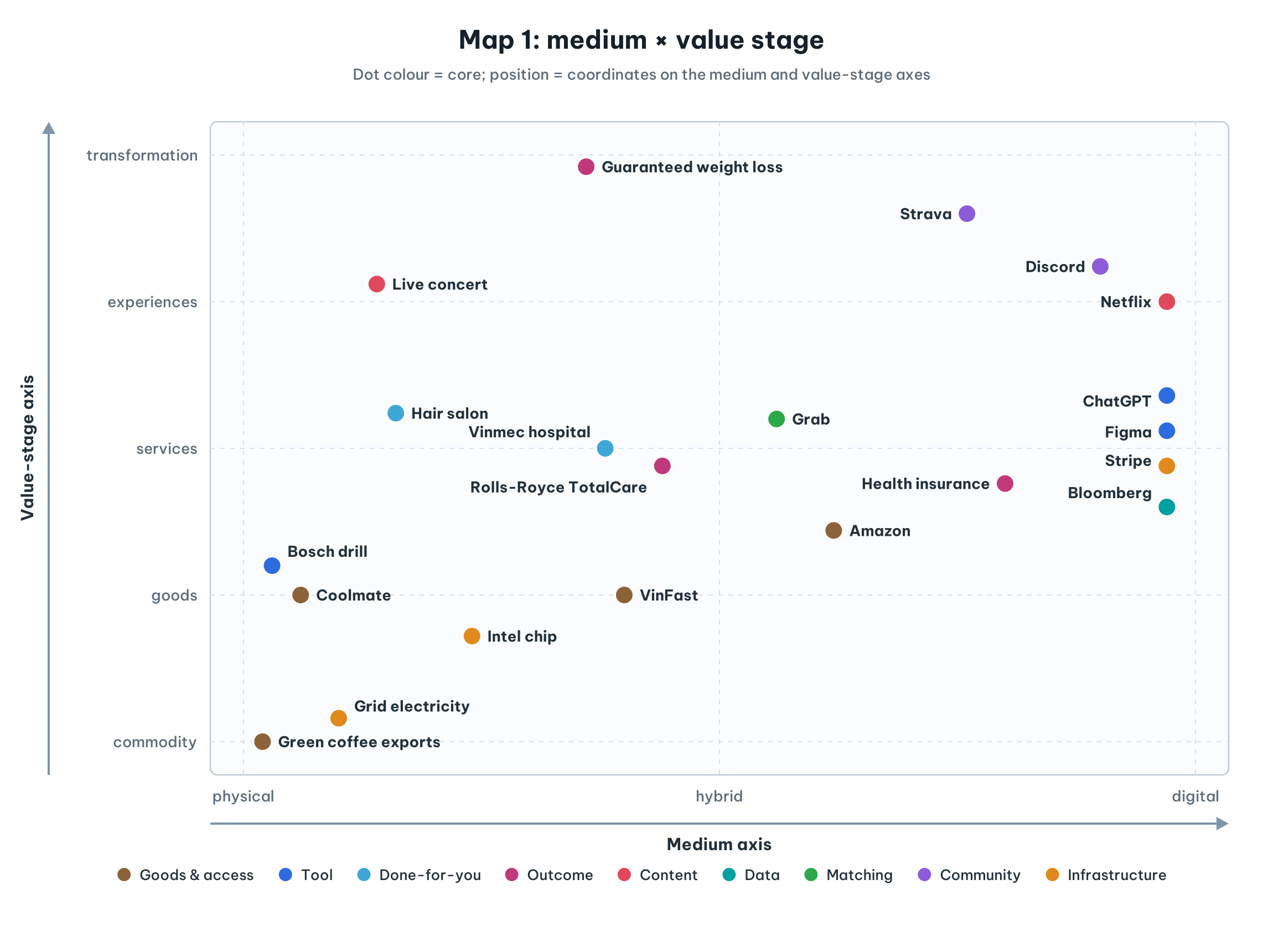
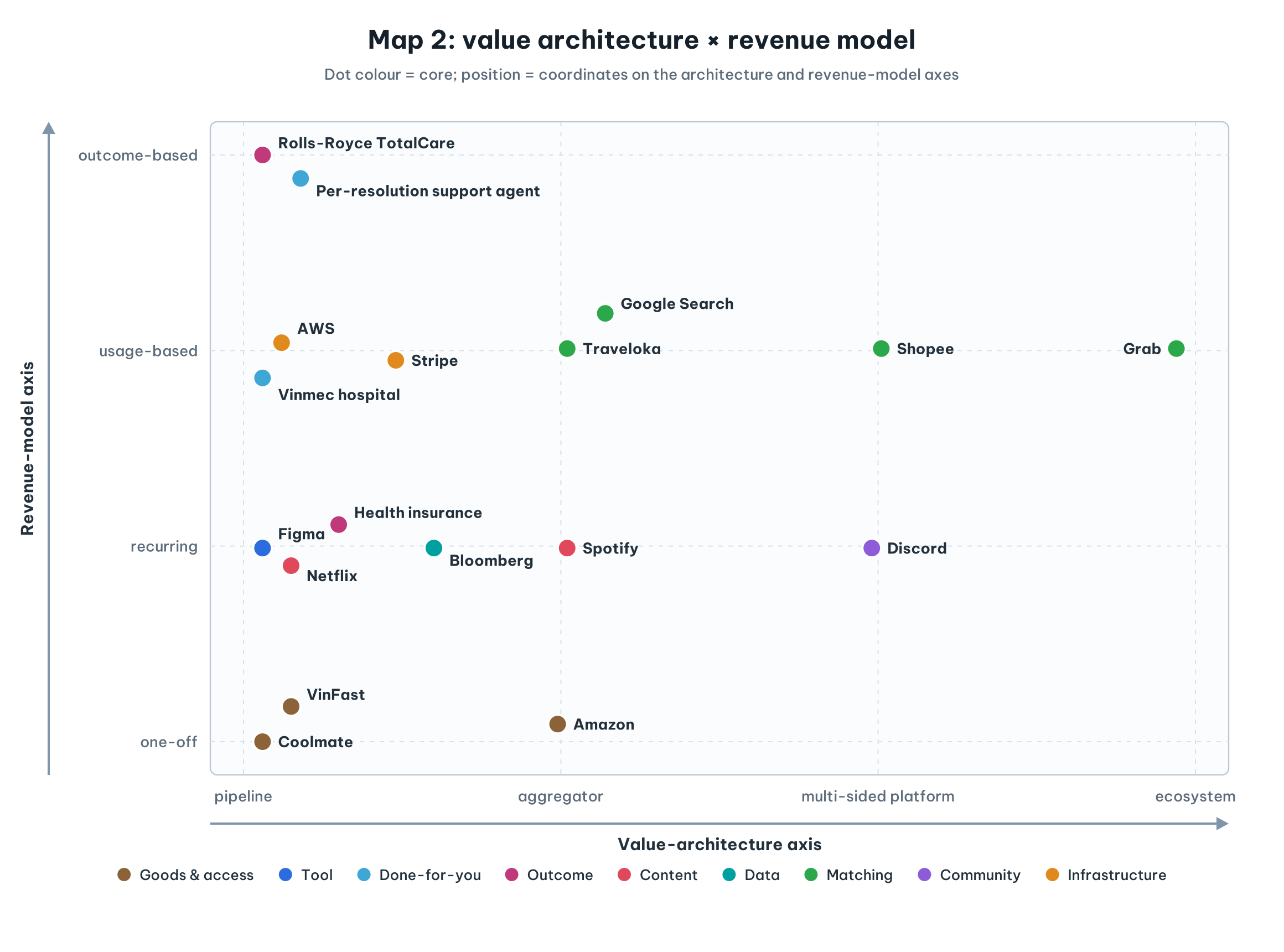
The two maps below (Figures 4 and 5) visualize "every product is a coordinate" by projecting the multidimensional space onto two readable planes. In both, each dot is a product; its colour shows the core and its position shows the coordinates on the two chosen axes. Figure 4 uses the medium axis horizontally and the value-stage axis vertically. High-stage digital products cluster top right, while goods and infrastructure cores sit bottom left, and the same outcome-commitment core can sit at the services stage (Rolls-Royce) or the transformation stage (a guaranteed weight-loss programme). Figure 5 uses the value-architecture axis and the revenue-model axis, revealing strategic zones. Pipeline software and content subscriptions crowd the recurring row on the left, transaction platforms occupy the usage-based band to the right, and the top-left corner is where outcome-based models (engines billed per flying hour, AI agents billed per case) are taking shape. Since each map can show only two axes, each is just a slice; it takes many slices to see the whole picture, which is exactly why we need the full multi-axis framework rather than a flat diagram.
8. Digital transformation through the framework: sliding along the axes
With the coordinates in hand, we can reread the changes described at the start more precisely. Each shift we habitually call "digital transformation" is in fact a slide along a specific axis (Table 4 and Figure 6). Digitization and smartness are slides from physical to hybrid and digital on the medium axis. "From owning to using" is a slide on the revenue-model axis, from one-off to recurring and usage-based, and sometimes in the core, from owning goods to buying access. Personalization is a slide up the value-stage axis. Reintermediation is a slide from pipeline to aggregator, platform and ecosystem on the value-architecture axis. AI agents slide on two axes at once: the AI-autonomy axis on the product side and the buyer axis on the customer side.
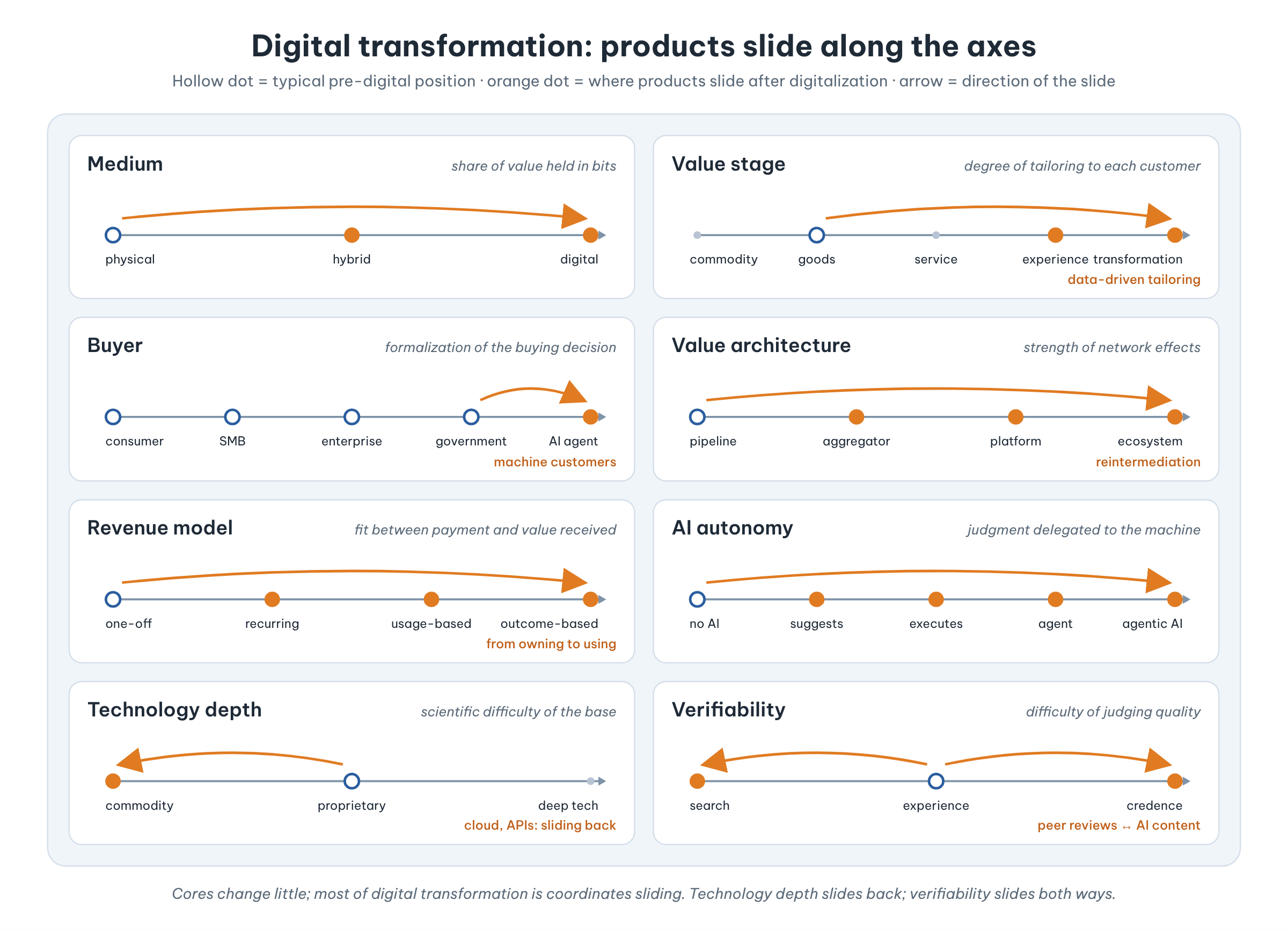
Two observations follow from this reading. First, not every axis slides the same way. Technology depth slides back toward commodity for most products, because cloud computing and APIs turn once-hard capabilities into something anyone can rent; advantage therefore moves to other axes. Quality verifiability slides in both directions: peer reviews turn many experience goods into near-search goods, but fake reviews and AI-generated answers push many things back toward credence, making brands and third-party certification matter again.
Second, and more important: digitalization changes coordinates far more than it changes cores. The buyer of music on disc and the Spotify listener buy the same thing, content; the passenger hailing a taxi and the passenger hailing a Grab both want to get home safely. What Levitt said in 1960 still holds: the need lies in the hole in the wall, not in the drill, so technology changes how we drill far more often than it changes the hole. The occasions when the core truly moves, such as Tiki moving from retail to matching, or software moving from tool to done-for-you thanks to AI agents, are the biggest strategic moves of all, and much rarer than slides in coordinates.
And where do transactions sit in the framework? A transaction is not an axis of its own but the meeting point of four axes: who buys (the buyer axis), through what intermediary structure (the value-architecture axis), how payment is made (the revenue-model axis) and on what basis of trust (the quality-verifiability axis). When all four slide together, as from a shopper paying cash in a store to an AI agent ordering through a marketplace with usage-based payment, we have a revolution in transactions, even though the value core stays exactly the same.
9. Putting familiar labels in their place
The framework also untangles a common confusion: labels such as e-commerce, e-business, platform and marketplace are often compared as if they were the same kind of thing, when in fact they answer different questions (Table 5).
E-commerce is buying and selling online (Chaffey, 2015). It describes a transaction channel, at the same level as D2C or B2B2C, not what the customer buys. Coolmate selling shirts through its website still has a goods core and a pipeline architecture. The accompanying codes B2C, B2B and B2G are simply positions on the buyer axis, while C2C describes an individual seller.
E-business is broader: using digital technology for all of a company's operations, including supply chain, enterprise resource planning (ERP), customer relationship management (CRM), human resources and partner coordination (Chaffey, 2015). Most of e-business sits behind the product, so it does not change its coordinates. But it is what makes many coordinates feasible: without metering systems, a company cannot charge by usage or by outcome.
Digital business or digital transformation goes further still: not merely digitizing old processes but redesigning the business model. In the language of the framework, it means deliberately choosing new coordinates, and sometimes a new core.
A platform is not a type of product, still less a core, but a coordinate on the value-architecture axis: the platform and ecosystem steps. A platform can carry any core: matching (Grab), content (YouTube), community (Discord), tool (Zalo), infrastructure (the App Store for developers). The opposite of a platform is a pipeline, and an online store that buys stock and resells it is still a pipeline even if it operates entirely online.
A marketplace is a special case: a direct-matching core plus a multi-sided platform coordinate. A super-app is the ecosystem coordinate. Tiki is a textbook example of how these levels differ: it began as an online book retailer (goods core, pipeline architecture), then opened as a marketplace for other sellers (matching core, platform architecture). Both phases count as "e-commerce", yet the core and coordinates changed.
10. Coverage tests
A classification framework is only trustworthy if it handles hard cases without inventing exceptions, and if it can contain other classification schemes without being broken by them. This part puts the framework through two such tests.
10.1. First test: the hard cases
Table 6 runs a set of commonly disputed cases through the cores and three assignment rules. Each finds exactly one core per buying side, and whatever makes them "hard" turns out to be coordinates on the axes, not a missing core.
10.2. Second test: Meyer's Digital Platform Map
Meyer (2023) defines a platform as any system that facilitates many-to-many interactions, unlike a store, which works one-to-many, and distinguishes six types of digital platform by the form of exchange facilitated: marketplace, search, repository, communication, community and payment. It is a compact and sharp kick-starter for thinking. Meyer's map also sees two things this article shares: the value of platforms lies in their ability to match supply with demand, and platforms tend to invade neighbouring categories to become "platforms of everything". Table 7 places Meyer's six types in the positioning framework.
The comparison shows three things. First, the two frameworks answer different questions. Meyer classifies by mechanism of exchange; the positioning framework classifies by where value resides and then positions the mechanism on the axes. All six of Meyer's types therefore sit inside one region of the space: architecture from aggregator rightward. The whole world of pipeline products, from Coolmate to Rolls-Royce, lies outside Meyer's scope, by design.
Second, the positioning framework fills gaps that Meyer's map, published in early 2023, leaves in today's context: innovation platforms such as operating systems, cloud and foundation AI models (the components-and-infrastructure core); the growing role of AI, including AI unsettling the "search" type itself (the AI-autonomy axis and the core moving to done-for-you); algorithmic discovery and social commerce (the one-core-per-side rule); the revenue and advertising side (the revenue-model axis and indirect matching); super-apps (the ecosystem step); and digital finance beyond payments (lending, insurance and investment spread across the goods-and-access, outcome-commitment and data cores).
Third, Meyer's map also makes the positioning framework better. The "digital communication" type fits neither the matching core, since people message those they already know rather than being matched with anyone, nor the community core. It forces the framework to state clearly that messaging is a tool core whose enormous value comes from same-side network effects. That is why the definition of the value-architecture axis in this article has been widened to cover same-side effects (Katz & Shapiro, 1985) alongside cross-side effects.
11. An open framework: admission criteria for new axes and cores
The axes and archetypes are not frozen lists; they are open sets with admission criteria. A dimension qualifies as a new axis only if it meets three conditions: it carries its own underlying quantity with two clear poles; it is independent, that is, not derivable from existing axes; and it genuinely distinguishes real products in ways that change business decisions.
The strongest candidate today is the decentralization of control: from one company holding full control, through platforms with shared governance, to protocols co-owned and governed by a user community. Decentralized finance shows why this dimension is needed: the core of a lending protocol is still access to money, but the absence of an intermediary holding control changes how trust is built, how risk is governed and how the product is regulated, and no current axis measures that. The second candidate is circularity: from single-use and discard to design for repair, reuse and recycling.
The admission criteria also screen out candidates that look attractive but fail. A typical example is a product's degree of regulation. Today, whether a platform is designated a "gatekeeper" with special obligations, as under the European Union's Digital Markets Act (European Union, 2022), weighs heavily on strategy. But the degree of regulation is not independent: it is derived from existing coordinates (ecosystem architecture, scale, a position between buyers and sellers) combined with each jurisdiction's legal framework. It is therefore a consequence of the set of coordinates that a business-model designer must anticipate, not an axis.
Likewise, a new archetype is admitted only when we find a residence of value that none of the existing cores contains, that is, a genuinely different buying logic, not a new combination of coordinates for an existing core. The clearest candidate today is risk transfer: this framework places insurance in the outcome-commitment core as a contingent commitment, but anyone working deeply in finance and insurance could well split it off as a core of its own. Conversely, "communication", "payment" and "social commerce", though familiar platform types, do not meet the admission criteria for a core, because, as the two tests showed, they are fully explained by existing cores plus coordinates. With a clearly defined entry gate, the framework covers today's forms of value and stays current as tomorrow produces new ones.
12. A unified frame: three levels for every archetype
Whatever the archetype, Kotler's three questions stay the same: What is the customer really buying? How do we package it into a concrete product? What do we surround it with to create difference and trust? Table 5 shows how the three levels are filled differently for each core.
For products at the agent and agentic-AI steps of the AI-autonomy axis in particular, the augmented layer takes a new form called trust: guardrails, explainable decisions, human oversight and approval, audit logs. This is also the answer the quality-verifiability axis calls for. When a product acts on the user's behalf, the quality of its judgment becomes a credence good, and trust is no longer an add-on but a condition of acceptance. Kotler et al. (2021) call this stage Marketing 5.0, "technology for humanity": AI handles execution at scale while people keep judgment, ethics and relationships.
13. Implications for product and marketing teams
This framework is not just for classification; it is an operating map. Value passes through three big jobs: creating value, delivering value and capturing value. In each, product and marketing play different but interlocking roles; and above them, the business-model designer uses the same framework to choose the whole set of coordinates.
13.1. Creating value: choose the right core, set coordinates on purpose
Start from the innermost level. Every decision about features, design or service makes sense only when anchored to a clearly stated core value. A useful exercise is to write exactly one sentence: "Customers hire this product to ______, in the situation of ______." Choosing the archetype is a joint decision. Product teams turn the core into the actual product, while marketing brings the outside-in view (real needs, the buyer axis, positioning) to ensure that what is built is what the market needs, avoiding marketing myopia (Levitt, 1960). The core question is often sharpest in the job family: do you sell a tool for customers to do it themselves, effort to do it for them, or dare you commit to the result? These three choices demand three different capabilities, cost structures and risk profiles. Once the core is chosen, set coordinates on every axis deliberately: each axis is a design choice. Product teams own most of the how choices (medium, architecture, AI autonomy, technology depth); marketing leads on the value-stage and buyer axes the market will pay for.
13.2. Delivering value: where value-in-use actually happens
Value exists only when customers use the product (Vargo & Lusch, 2004). For the higher stages such as experiences and transformations, or for the done-for-you, outcome-commitment and community cores, delivery is the product. Product teams build the delivery mechanisms: onboarding, stability, integrations, service-level commitments; for products at the agent step, delivery also includes the trust layer of guardrails, oversight and audit logs. Marketing manages experience and expectations along the customer journey, and here the quality-verifiability axis becomes the compass. Search goods need clear, comparable information; experience goods need trials, genuine reviews from earlier users and return policies to lower the barrier to a first purchase; credence goods need brand, credentials, third-party certification and guarantees. An outcome commitment is the strongest answer to a credence good: when customers cannot verify quality themselves, the seller bears the risk for them. The value-architecture axis changes delivery too: a pipeline delivers one way, while a platform must deliver value to both sides, and direct matching differs fundamentally from indirect matching. When the buyer is an AI agent, delivery also means exposing the product in machine-readable form. With enterprise or government buyers, solution delivery (implementation, training, account management) is a shared job for both roles.
13.3. Capturing value: a separate decision
Value capture is the revenue-model axis, and it is separate from the value created: it is entirely possible to create a great deal of value and capture very little, or the reverse. Product teams design for capture to be feasible and consistent with the core: the line between free and paid, usage metering, outcome measurement, feature tiering. Product structure enables or blocks a revenue model. Marketing owns most of capture: pricing, packaging, measuring willingness to pay, optimizing customer lifetime value and communicating value to justify price, because pricing and packaging are, at heart, marketing decisions. The key is that capture must fit the core and the delivery model. Facebook creates community value for users but collects money from advertisers; a ride-hailing platform creates matching value and captures it through commission. Both are built on network effects, with two different ways of capturing value.
13.4. The higher implication: the business-model designer chooses the whole set of coordinates
The business-model designer stands above both roles. Their job is to choose the whole set of coordinates (the archetype plus positions on every axis) as one coherent system, so that creating, delivering and capturing value reinforce each other. Four implications follow.
First, the axes are degrees of freedom: a business model is a choice of coordinates, and advantage often comes from an unusual but coherent combination (Rolls-Royce: an outcome-commitment core with outcome-based revenue; Netflix: pipeline content with subscriptions).
Second, creating is not capturing: most business-model innovation lies in designing where and how value is captured, such as creating free value on one side and capturing it on another, or, like Adobe, keeping the product almost unchanged and shifting the revenue-model axis from one-off to recurring, with the company's valuation leaping as a result.
Third, unbundle the axes: because the axes are independent, you can innovate on one while holding the others, keeping a tool core but changing revenue, moving architecture from pipeline to platform to unlock network effects, or turning a credence good into an experience good by publishing outcome data. Seen this way, digital transformation is not a technology project but a chain of deliberate slides on individual axes.
Fourth, the core is the anchor: a wrong core cannot be rescued by any axis, and moving the core is the biggest move of all. From tool to done-for-you, then to outcome commitment, is the path enterprise software is now taking as AI agents make it possible to "sell work done" rather than "sell software to do the work"; from retail to matching is the path Amazon and Tiki have taken.
Fifth, coordinates carry responsibilities: the further a company moves toward ecosystem on the architecture axis and the more central its position in transactions, the more it must anticipate the legal obligations and social expectations that come with it.
At the newest frontier, the agent step of the AI-autonomy axis meets the agent pole of the buyer axis. AI agents are both a delivery channel and a customer, so business-model designers must prepare for a world in which both seller and buyer may be machines. In the spirit of Marketing 5.0 (Kotler et al., 2021), AI handles execution while people keep judgment, ethics and relationships, and the axes of the framework show at which coordinates that division of labour takes place.
Conclusion
Philip Kotler's three-level model is more than half a century old, yet it remains one of marketing's most durable thinking tools, because it is not about any particular kind of product but about a universal truth: customers always buy value, not objects. Digital technology has changed almost everything around the product: it has left the object behind, is sold by subscription or by outcome, is created on platforms, is tailored by AI, and is sometimes bought by an AI agent. Yet, as this article has shown, most of those changes are slides in coordinates, while the value core, what customers truly need, changes far more slowly.
As the economy keeps producing new forms and new labels, the answer is not a longer list but a positioning framework: value cores derived from the question "where does value reside?", and positioning axes, each a directed spectrum, so that every product becomes a set of coordinates with nothing missed and nothing confused. The framework puts familiar labels such as e-commerce, e-business, platform and marketplace at their proper level, contains other classification schemes such as Meyer's Digital Platform Map, and remains open, with ready admission criteria for new axes and cores as reality produces them. Whatever the coordinates, the root question stays the same: what are your customers really buying? Answering it honestly and deeply, then building all three levels of value around it, remains the starting point of every product worth making.
References
Chaffey, D. (2015). Digital business and e-commerce management: Strategy, implementation and practice (6th ed.). Pearson.
Christensen, C. M., Hall, T., Dillon, K., & Duncan, D. S. (2016). Know your customers' "jobs to be done." Harvard Business Review, 94(9), 54–62. https://hbr.org/2016/09/know-your-customers-jobs-to-be-done
Darby, M. R., & Karni, E. (1973). Free competition and the optimal amount of fraud. The Journal of Law and Economics, 16(1), 67–88. https://doi.org/10.1086/466756
European Union. (2022). Regulation (EU) 2022/1925 of the European Parliament and of the Council of 14 September 2022 on contestable and fair markets in the digital sector (Digital Markets Act). Official Journal of the European Union, L 265, 1–66. https://eur-lex.europa.eu/eli/reg/2022/1925/oj
Gartner. (2025, October 21). Gartner unveils top predictions for IT organizations and users in 2026 and beyond [Press release]. https://www.gartner.com/en/newsroom/press-releases/2025-10-21-gartner-unveils-top-predictions-for-it-organizations-and-users-in-2026-and-beyond
Gawer, A., & Cusumano, M. A. (2014). Industry platforms and ecosystem innovation. Journal of Product Innovation Management, 31(3), 417–433. https://doi.org/10.1111/jpim.12105
Katz, M. L., & Shapiro, C. (1985). Network externalities, competition, and compatibility. The American Economic Review, 75(3), 424–440. https://www.jstor.org/stable/1814809
Kotler, P., & Armstrong, G. (2018). Principles of marketing (17th ed.). Pearson.
Kotler, P., Kartajaya, H., & Setiawan, I. (2021). Marketing 5.0: Technology for humanity. Wiley.
Levitt, T. (1960). Marketing myopia. Harvard Business Review, 38(4), 45–56. https://hbr.org/2004/07/marketing-myopia
Lovelock, C. H. (1983). Classifying services to gain strategic marketing insights. Journal of Marketing, 47(3), 9–20. https://doi.org/10.1177/002224298304700303
Meyer, R. (2023, March 1). Digital platform map. TIAS Business School. https://www.tias.edu/en/artikelen/digital-strategy-digital-platform-map
Nelson, P. (1970). Information and consumer behavior. Journal of Political Economy, 78(2), 311–329. https://doi.org/10.1086/259630
Osterwalder, A., & Pigneur, Y. (2010). Business model generation: A handbook for visionaries, game changers, and challengers. Wiley.
Parker, G. G., Van Alstyne, M. W., & Choudary, S. P. (2016). Platform revolution: How networked markets are transforming the economy and how to make them work for you. W. W. Norton & Company.
Pine, B. J., II, & Gilmore, J. H. (1998). Welcome to the experience economy. Harvard Business Review, 76(4), 97–105. https://hbr.org/1998/07/welcome-to-the-experience-economy
Portincaso, M., de la Tour, A., & Soussan, P. (2019). The dawn of the deep tech ecosystem. Boston Consulting Group & Hello Tomorrow. https://hello-tomorrow.org/the-dawn-of-the-deep-tech-ecosystem/
Rochet, J.-C., & Tirole, J. (2003). Platform competition in two-sided markets. Journal of the European Economic Association, 1(4), 990–1029. https://doi.org/10.1162/154247603322493212
Sapkota, R., Roumeliotis, K. I., & Karkee, M. (2026). AI agents vs. agentic AI: A conceptual taxonomy, applications and challenges. Information Fusion, 126, 103599. https://doi.org/10.1016/j.inffus.2025.103599
Sarkar, M. B., Butler, B., & Steinfield, C. (1995). Intermediaries and cybermediaries: A continuing role for mediating players in the electronic marketplace. Journal of Computer-Mediated Communication, 1(3). https://doi.org/10.1111/j.1083-6101.1995.tb00167.x
Shostack, G. L. (1977). Breaking free from product marketing. Journal of Marketing, 41(2), 73–80. https://doi.org/10.1177/002224297704100219
Vargo, S. L., & Lusch, R. F. (2004). Evolving to a new dominant logic for marketing. Journal of Marketing, 68(1), 1–17. https://doi.org/10.1509/jmkg.68.1.1.24036
Webster, F. E., Jr., & Wind, Y. (1972). A general model for understanding organizational buying behavior. Journal of Marketing, 36(2), 12–19. https://doi.org/10.1177/002224297203600204
Discussion about this post