The Seven Fits: A Startup Roadmap from Idea to Scale
From founder–problem fit to scale-up fit: the question, the evidence and the tools at each stage of validating a startup


Key takeaways
A startup's journey can be read as seven "fits", each a level of evidence that must be earned: founder–problem, customer–problem, problem–solution, product–market, go-to-market, business model and scale-up.
The fits form a chain of dependencies, not a to-do list. A weak link can break the whole chain.
Each stage has a clear "enough to move on" test, from a written co-founder agreement to an LTV/CoCA ratio of about 3:1 or better on real cohort data.
The order matters, but the road is not perfectly straight: some fits are tested in parallel, some must be revisited, and buying growth before stages 2–4 are proven is a common cause of failure.
Most startups fail. It is an uncomfortable truth, but it is also a reason for founders to prepare more carefully. Instead of rushing to build a product and spending on instinct, successful startups usually follow a disciplined path and keep testing their assumptions. That path can be described as seven "fits": seven kinds of alignment a startup needs to achieve.
This is not a checklist of tasks but a chain of interdependent links. One weak link can break the whole chain. Understanding the sequence, the relationships and the supporting tools for each stage reduces risk and builds a more durable business. The seven-fit framework is a synthesis of ideas from several authors, from Marc Andreessen's (2007) notion of product–market fit and the problem–solution fit of Ash Maurya's (2012) lean method, to the growth-channel tools of Weinberg and Mares (2015). Figure 1 shows the seven stages as a staircase, each step tied to one question.
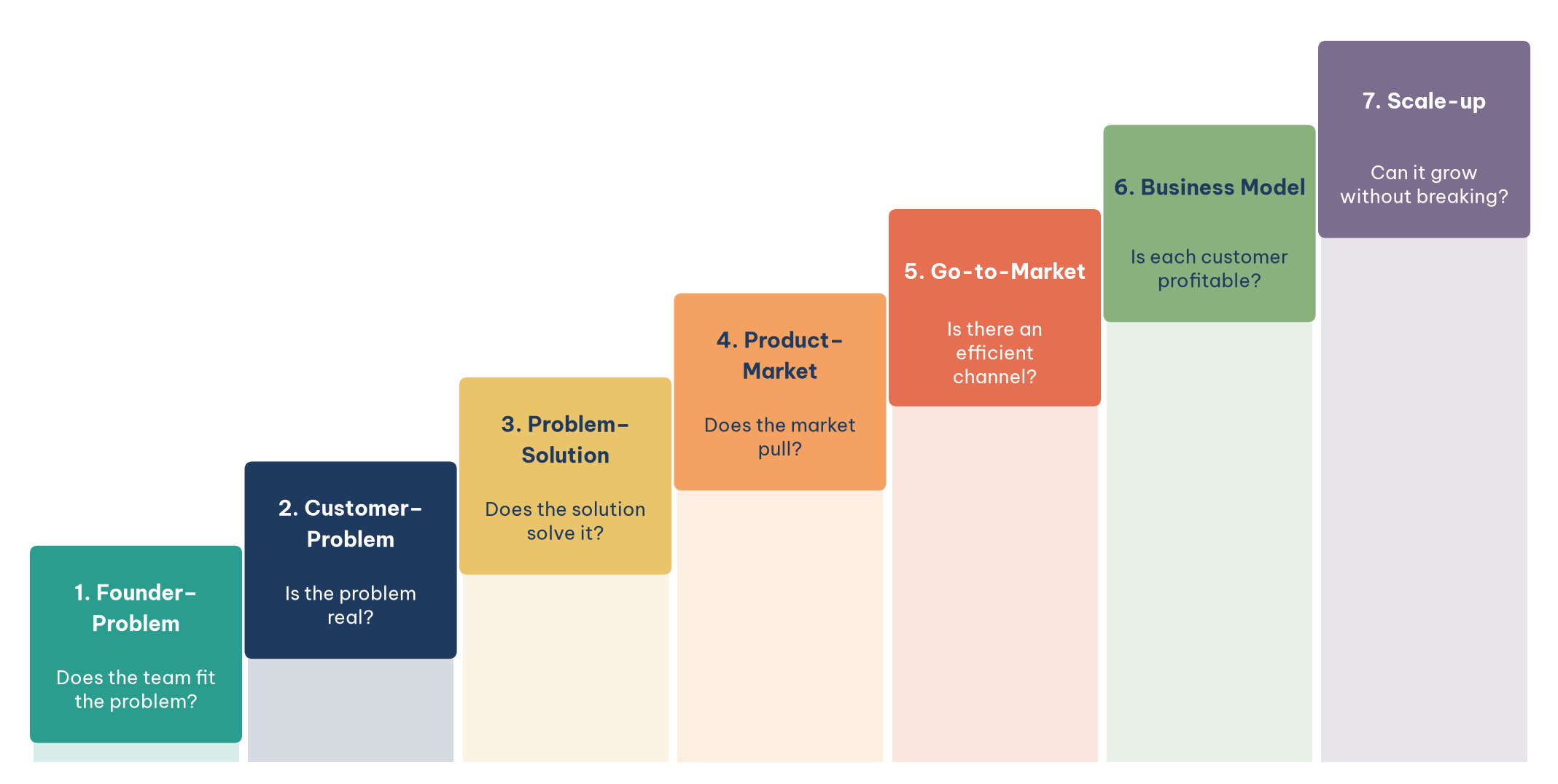
The question entrepreneurship students ask most often is: "When do we have enough to move on?". Table 1 answers that question for each stage, with the main tools; the seven sections that follow go into detail, using one running example of two founders building a project-management app. Section 8 notes that the path is ordered but not perfectly straight. Section 9 places the seven fits in a bigger picture: the entities they connect, the supporting conditions that are not fits in themselves, and where startups most often break.
1. Founder–Problem Fit: does the team fit the problem?
Core question: Am I, are we, the right people to solve this problem?
Goal: Build a founding team with enough passion, capability and commitment to pursue the problem for the long term, five to ten years.
What it means. This is the foundation of the whole startup house. Before thinking about customers or solutions, you have to look at yourself. This fit is the fuel that keeps you going through the countless difficulties of the later stages; without it, you are likely to give up.
Example. Two founders want to build a project-management app. One is a seasoned project manager who has felt the pain of existing tools. The other is an experienced software engineer. The combination creates a strong founder–problem fit: one deeply understands the "pain", the other has the technical ability to build the solution.
Actions and tools. To assess capability and passion, the team can use a SWOT analysis of themselves and the team, the Ikigai framework (the intersection of what you are good at, what you love, what the world needs and what can earn money), and the unfair-advantage framework. To find co-founders, they can use matching platforms such as Y Combinator's co-founder matching programme or startup communities, and they should write a co-founder agreement setting out roles, responsibilities, equity split and how disagreements will be handled.
Enough to move on: each member can answer "why me, why this problem", and the co-founder agreement has been written down.
Transition. The commitment made at this stage is what drives the team to start testing whether the problem they care about actually exists out in the world.
2. Customer–Problem Fit: is the problem real?
Core question: Does this problem really exist, and is it painful and urgent enough for a specific group of customers? Is the market large enough?
Goal: Obtain evidence, based on data rather than intuition, that the problem is real and worth solving.
What it means. This stage shifts the focus from "I think" to "I know". Many startups fail because they build a perfect solution to a problem nobody cares about. Customer–problem fit ensures you are aiming at the right target.
Example. The two founders run in-depth interviews with 50 project managers at technology companies. Most say they feel overwhelmed tracking the work of several teams and find current tools too complex; many are building their own spreadsheets to fill the gap. That "patching it together themselves" behaviour is stronger evidence than any compliment.
Actions and tools. Interview customers following the principles of The Mom Test: ask about past behaviour instead of asking for opinions on your idea (Fitzpatrick, 2013). Use the 5 Whys technique to find the root of the problem, and listen on social media (forums, online groups, professional communities) to see what users complain about. Describe customers with personas, empathy maps and the Jobs-To-Be-Done framework; estimate market size with TAM, SAM and SOM; and use survey or keyword-research tools to understand what problems competitors are solving.
Enough to move on: many independent people describe the same problem, rank it as a high priority, and have already taken real action to solve it.
Transition. Only once a clear and urgent problem has been identified do you have grounds to start building a solution.
3. Problem–Solution Fit: does the solution solve the right problem?
Core question: Does the proposed solution really solve the identified problem? Is it effective and different?
Goal: Test the solution idea technically, in user experience and in early demand, through experimental versions.
What it means. This is the stage that turns understanding of the problem into a tangible solution. The aim is not to build a complete product but to test assumptions as quickly and cheaply as possible through a three-step sequence, shown in Figure 2.
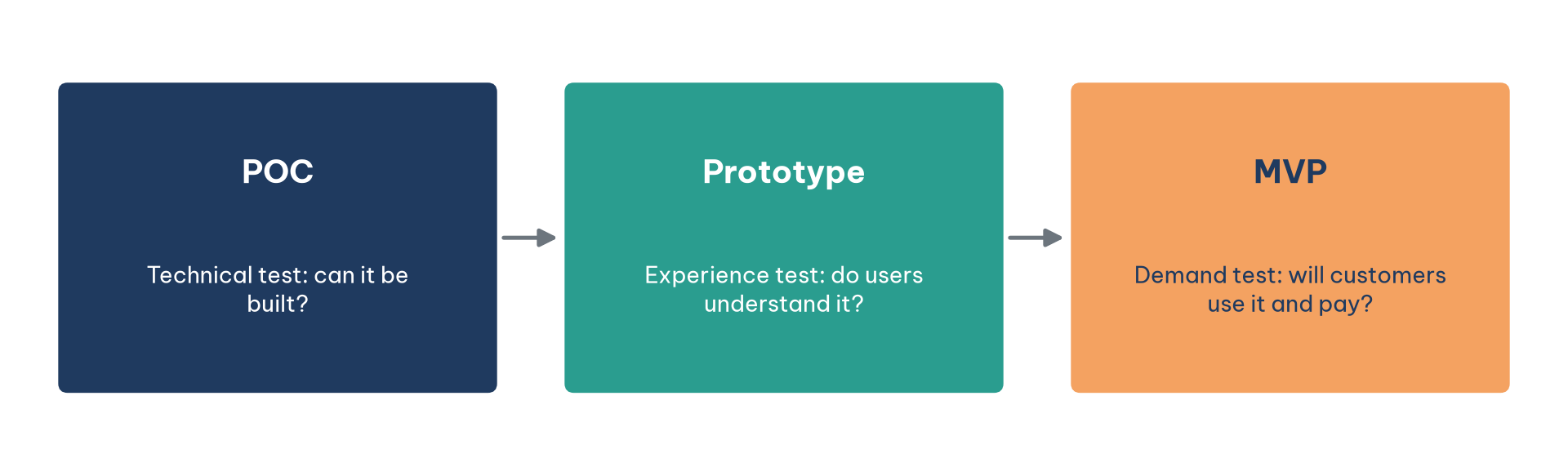
A POC (proof of concept) tests technical feasibility: "Can we build it?". A prototype tests the user experience: "Do users understand how to use it?". An MVP (minimum viable product) tests real demand: "Will customers actually use it and pay?". Smoke tests, such as a landing page or a pre-order button, can test demand even more cheaply than an MVP.
Example. For the POC, the engineer writes a piece of code proving that the algorithm for automatically prioritizing tasks works. For the prototype, they use Figma to create a clickable interface design that simulates the user flow and let users try it. For the MVP, they build a web app with only three core features: sign in, add tasks, and see the prioritized list.
Actions and tools. No-code and low-code platforms (Bubble, Webflow) or AI app builders can produce an MVP quickly; Figma serves for prototypes. To decide the MVP's scope, use the RICE prioritization framework (Reach, Impact, Confidence, Effort) and the MoSCoW matrix (Must-have, Should-have, Could-have, Won't-have).
Enough to move on: test users complete the main task without instructions, and some of them commit through action: paying a deposit, signing up for a paid plan, referring colleagues.
Transition. The MVP is the most important bridge, taking a validated problem and an initial solution out to be tested in the real market and opening the way to product–market fit.
4. Product–Market Fit: does the market pull the product?
Core question: Does the market really need this product and is it willing to spend money and time to use it widely?
Goal: Achieve natural "pull" from the market, where the product attracts users on its own.
What it means. This is the milestone every startup is looking for. Marc Andreessen (2007) describes product–market fit (PMF) as being in a good market with a product that can satisfy that market. With PMF, you no longer need to "push" the product to users; the market "pulls" it. The signs are organic growth, high retention, and customers who would be very disappointed if the product disappeared.
Example. After launching the MVP, the team sees 40% of users returning every week and the retention curve flattening after a month. They start receiving requests to pay for the feature that invites more team members, and users recommend the product to colleagues on their own. These are strong signs of PMF.
Actions and tools. Quantitatively, use analytics tools such as Google Analytics, Mixpanel or Amplitude to track retention, activation and engagement; the most important is the cohort retention curve: if the curve flattens instead of declining towards zero, you are approaching PMF. Qualitatively, use the Sean Ellis test: ask users "How would you feel if you could no longer use this product?"; if 40% or more answer "very disappointed", that is a good signal (Ellis & Brown, 2017). The NPS measures how likely users are to recommend the product to others.
Enough to move on: the retention curve is stable for a clearly defined customer group, and part of the growth comes from organic referrals.
Transition. Once you have PMF, the question is no longer "What should we build?" but "How do we grow?".
5. Go-to-Market Fit: is there an efficient channel?
Core question: How can we reach, attract and retain customers efficiently and in a way that scales?
Goal: Find one or a few marketing and sales channels that are repeatable, predictable and scalable.
What it means. A good product is not enough; you need efficient routes to get it into customers' hands. Trying to scale before finding the right channel only wastes money.
Example. The team tries search advertising, but the cost is too high. They then write in-depth blog posts on project-management techniques and attract good-quality organic traffic. They realize that content marketing is their most efficient channel and focus their resources there.
Actions and tools. The Bullseye framework from Traction by Gabriel Weinberg and Justin Mares (2015) suggests listing the nineteen traction channels, choosing the three most promising to test, then focusing on the one that works best. Use A/B testing to compare messages and landing pages; a CRM system such as HubSpot or Salesforce to manage the sales funnel; and email marketing to nurture prospects.
Enough to move on: at least one channel where the cost of acquiring a customer stays stable as the budget grows.
A note on emerging markets. In markets such as Vietnam and much of Southeast Asia, social channels (Facebook groups, local messaging apps such as Zalo, TikTok) and direct sales teams often matter more than search advertising, especially when customers are household businesses and small firms. Put these channels on the test list from the start.
Transition. With an efficient channel, you have half of a growth engine. The next question is: does that engine make money?
6. Business Model Fit: is each customer profitable?
Core question: Does the business model generate sustainable profit?
Goal: Build a financial engine in which the value earned from a customer (LTV) is significantly higher than the cost of acquiring that customer (CoCA).
What it means. This is the link that ensures long-term survival. If go-to-market fit builds the growth engine, business model fit makes sure that engine is financially efficient. You can have a good product and an efficient way to sell it, but if costs always exceed the value earned, the company will sooner or later run out of money.
Example. Table 2 calculates the LTV and the LTV/CoCA ratio for the project-management app, taking gross margin into account.
Many investors use a reference point of an LTV/CoCA ratio of about 3 : 1 or higher. If you take revenue alone (15 × 24 = USD 360) and ignore gross margin, you will overestimate the health of the model.
Actions and tools. Test pricing strategies (value-based, competitor-based); use a recurring-billing platform; build a financial model in Excel or Google Sheets to project revenue, costs and cash flow; and use cohort analysis to track LTV over time. The Business Model Canvas helps you see the whole model on one page.
Enough to move on: LTV/CoCA and the payback period reach acceptable thresholds on real data from several cohorts, not just in projections.
Transition. Business model fit proves that the growth engine not only runs but is profitable, giving the financial confidence to move on to full-scale expansion.
7. Scale-up Fit: can the organization grow without breaking?
Core question: How can we expand the team, processes and culture efficiently without the system collapsing?
Goal: Build an organization that grows fast in people, operations and finances while keeping its performance, culture and stability.
What it means. This is the stage of moving from an agile startup to a structured company. The challenge is no longer finding fit but managing growth. Mass hiring, entering new markets or developing new products without solid operational foundations leads to chaos, lower performance and a diluted culture.
Example. After becoming profitable and growing steadily, the company decides to expand internationally. It has to build local teams, standardize the sales process, upgrade its technical infrastructure to handle ten times as many users, and redefine its core values so the culture is not diluted when it hires a hundred more people in a year.
Actions and tools. For organization and people: use an applicant tracking system (ATS) such as Greenhouse or Lever; build a competency framework and career paths; and have an onboarding process for new employees. For operations: adopt OKRs to align goals; automate processes with tools such as Zapier or Make (Integromat's name since 2022); and build internal documentation in Notion or Confluence.
Enough to move on: as scale grows several times over, the retention, acquisition-cost and margin metrics from stages 4–6 do not deteriorate.
8. An ordered path, but not a perfectly straight one
The seven fits are presented in order because each stage builds on the evidence of the one before. In practice, however, the stages often overlap, as Figure 3 shows.
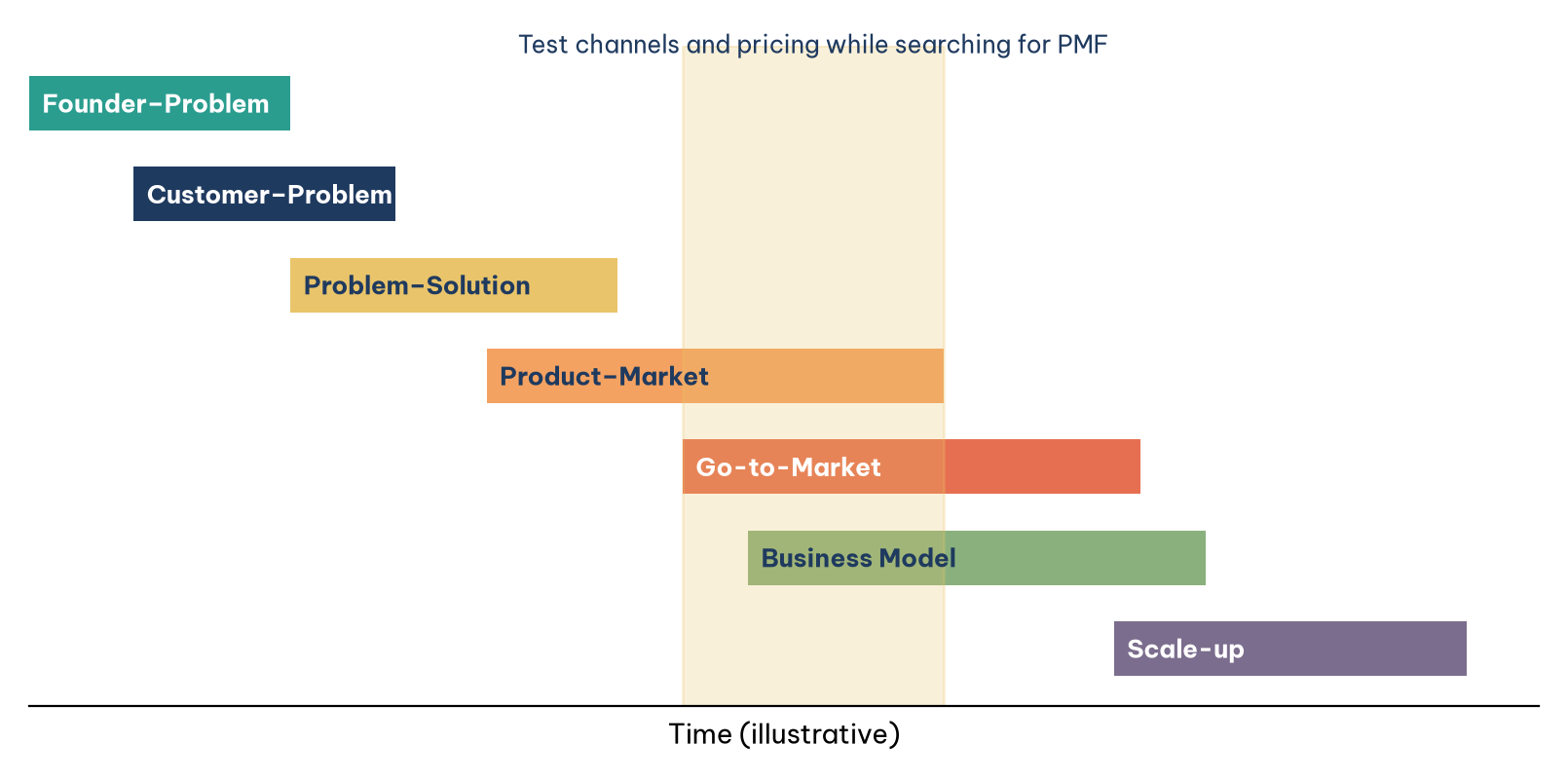
Three points deserve attention. First, some fits are tested in parallel: startups often test pricing (stage 6) and channels (stage 5) as soon as the MVP is running, because how you price and how you sell affect who will use the product. Second, you may have to go back: when entering a new segment, customer–problem fit and product–market fit must be re-validated for that segment. Third, what you should not do is skip ahead with money: using advertising budgets or hiring to "buy" growth before there is evidence at stages 2–4 is a very common cause of failure. Most of the commonly cited reasons for startup failure correspond to skipping one of the fits above.
9. The seven fits in the bigger picture
The seven fits do not stand alone. They connect the main entities of the startup journey, they need certain supporting conditions alongside them, and they show where startups are most likely to break.
9.1. Eight entities and two transformations
The whole journey can be pictured as eight entities linked by the seven fits, as Figure 4 shows. It starts with the founder and the customer, moves through the problem and the solution (two sides of one idea), on to the product and the market, then to the startup as an organization, and finally to an established company. Each fit is a bridge between two entities: founder–problem fit links the founder to the problem, customer–problem fit links the customer to the problem, and so on.
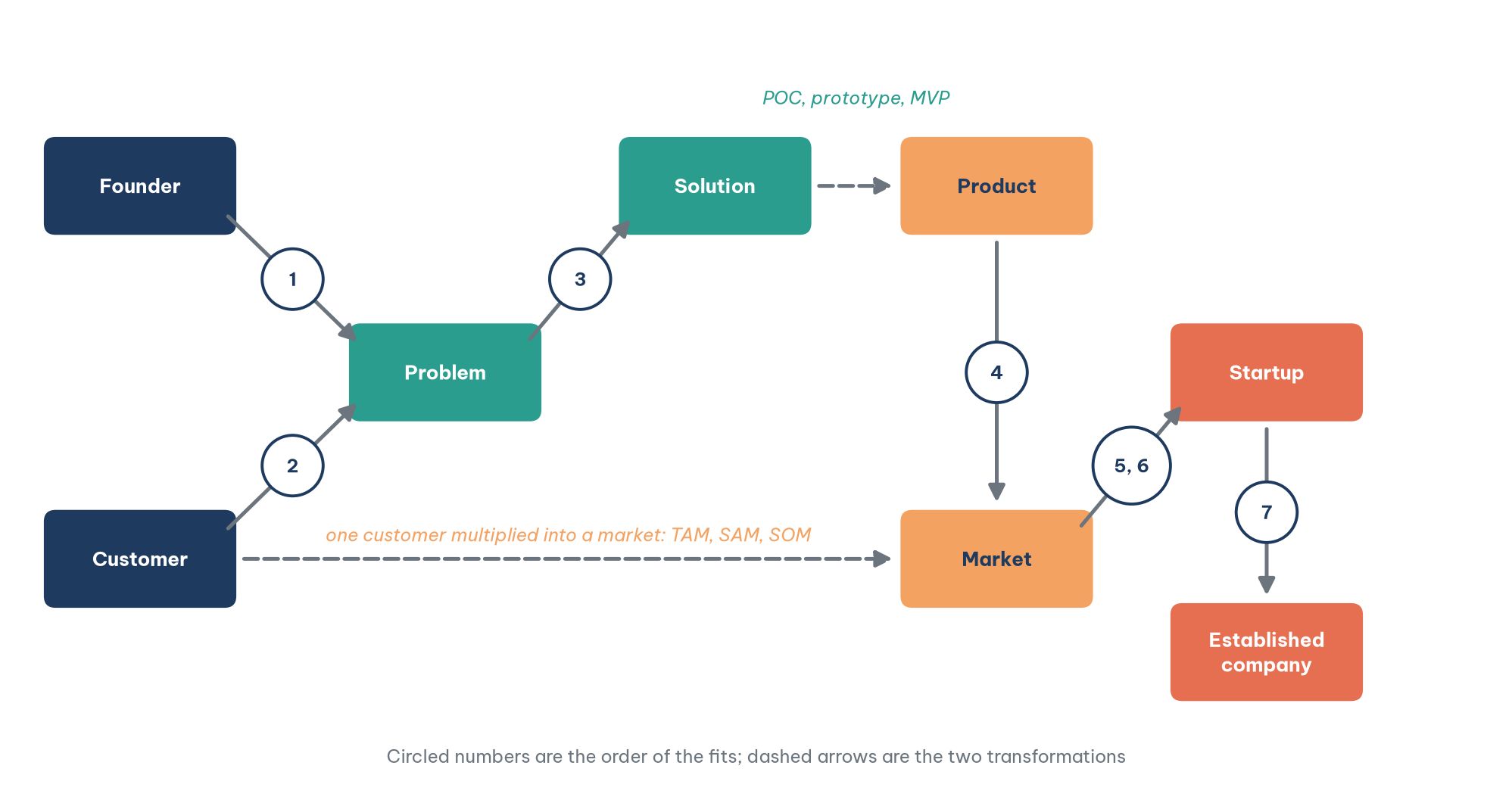
Two core transformations happen along the way. The solution matures into a product through the sequence of POC, prototype and MVP described in stage 3. One customer is multiplied into a whole market through market sizing with TAM, SAM and SOM. Product–market fit is the moment the two transformations meet: a real product pulled by a real market.
9.2. Why go-to-market comes before business model
Placing stage 5 before stage 6 is not arbitrary. The LTV/CoCA ratio in stage 6 needs the cost of acquiring a customer, and that number only becomes real once a channel has been found in stage 5. Calculating LTV/CoCA without a stable channel means dividing by a guess.
9.3. Supporting conditions that are not fits
Beyond the seven fits, a startup needs several conditions that cut across many stages. They are not "fits" in themselves, because they do not test an assumption about the market, but without them the startup cannot move forward. Table 3 summarizes four groups of such conditions.
9.4. Where startups usually break
When CB Insights (2019) analysed 101 post-mortems written by founders of startups that had shut down, the most frequently cited reason was no market need, mentioned in 42% of them, which is a break at the customer–problem stage. Mapping the twenty reasons to the fits they violate reveals two clear patterns. First, most failures cluster in the earliest stages (founder–problem, customer–problem) and in the money stage (business model). Second, almost none belong to scale-up: most startups do not live long enough to face the problems of growth. That is why founders should put their effort into the early fits rather than worrying in advance about scaling.
Conclusion: build a house, not a sandcastle
Picture the startup journey as building a house. You need a committed and capable building crew (founder–problem fit). They must build on a plot of land where there is real demand (customer–problem fit). They put up a solid frame that meets the need for shelter (problem–solution fit). They finish it into a house people want to move into (product–market fit). They find ways to introduce the house to the right people (go-to-market fit). They sell or rent it at a profit, with enough left over for maintenance (business model fit). Finally, they replicate the model into a whole neighbourhood that runs smoothly (scale-up fit).
Skipping a step, especially by using money to jump ahead, is like building a house on sand. Following the seven-fit roadmap with discipline, while staying flexible enough to test in parallel whatever can be tested, helps founders turn assumptions into evidence step by step, reduce risk, and build a durable business.
References
Andreessen, M. (2007, June 25). The only thing that matters. Pmarchive. https://pmarchive.com/guide_to_startups_part4.html
CB Insights. (2019). The top 20 reasons startups fail. https://www.cbinsights.com/research/startup-failure-post-mortem/
Ellis, S., & Brown, M. (2017). Hacking growth: How today's fastest-growing companies drive breakout success. Crown Business.
Fitzpatrick, R. (2013). The Mom Test: How to talk to customers and learn if your business is a good idea when everyone is lying to you. CreateSpace.
Maurya, A. (2012). Running lean: Iterate from plan A to a plan that works (2nd ed.). O'Reilly Media.
Weinberg, G., & Mares, J. (2015). Traction: How any startup can achieve explosive customer growth. Portfolio.
Discussion about this post