The Power of a Waitlist: A Field Guide
Using a waitlist to test demand, build launch momentum, and recognize what a list of email sign-ups can never prove on its own


Key takeaways
A waitlist plays three roles at once: a cheap demand test, a pool of warm prospects, and launch momentum. Its marketing power is also why it is easily misread as evidence.
Famous campaigns run on four mechanisms: real scarcity, visible ranking, referral rewards tied to core value, and deliberate screening.
A campaign has three steps: a conversion-focused landing page, a referral loop, and nurturing the list until launch.
An email is the lowest rung on a commitment ladder. Stronger evidence comes from interviews, referrals, deposits and design partners.
Scarcity must be real, personal data must be respected, and fake-door tests must be transparent and never take money.
Before a finished product exists, founders face a hard question: does anyone really want what we are building? Customer interviews tell you whether the problem is real, but not how many people will act once a solution appears. A waitlist is one of the cheapest and fastest ways to start answering that question.
Technically, a waitlist is just a landing page with a form where interested people leave an email address, sometimes a phone number or job title, in exchange for early access to an upcoming product. Strategically, it is the first campaign that connects an idea with the real market before the product is finished. From Gmail in 2004 to Superhuman, many famous products have used waitlists not just to count interested people but to create desire, select users and build momentum for launch day. Figure 1 captures the spirit of such a campaign.

This article takes the waitlist from strategy to practice. Section 1 analyses its three roles. Section 2 draws out the mechanisms behind famous campaigns. Section 3 shows how to build a campaign step by step, and Section 4 suggests how to choose promotion channels. Section 5 covers the most important point that many people skip: what a waitlist can and cannot measure. Section 6 deals with ethical and legal issues.
1. Three roles of a waitlist
A good waitlist does three different jobs at the same time, and each has its own trap. Understanding them helps founders know what they are using the waitlist for and how to measure it. Table 1 summarizes the three roles and their caveats.
The first role in Table 1 places the waitlist in the family of landing-page experiments, or smoke tests, one of the cheapest ways to test demand (Ries, 2011). The other two roles turn the waitlist from a measurement into a marketing tool. That combination is both its strength and the source of confusion: a successful marketing campaign is easily misread as evidence of demand.
2. Famous campaigns and the mechanisms behind them
Many waitlist campaigns have become classic cases. What is worth learning is not the number of sign-ups but the mechanism that made people want to join the list and invite others. Table 2 summarizes six cases, with results and lessons, including some where the initial buzz did not keep users.
Reading Table 2 down the "mechanism" column reveals four recurring mechanisms. The first is real scarcity: Gmail limited invitations because its infrastructure really was limited, not for show. The second is visible ranking: Mailbox and Robinhood showed sign-ups where they stood, turning waiting into a game. The third is referral rewards tied to core value: Dropbox gave storage, the very thing users needed, rather than unrelated gifts (Houston, 2010). The fourth is deliberate screening: Superhuman used a long survey to pick the best-fit users, part of the process for finding product–market fit that the company has described publicly (Vohra, 2018).
The "lesson" column for Mailbox and Clubhouse makes the opposite point: waitlist mechanics can line up millions of people for a product that later fails to keep them. A waitlist measures the appeal of a promise, not the value of a product.
3. Building a waitlist campaign step by step
From the mechanisms in Section 2, you can build a waitlist campaign for your own project. It has three consecutive steps: a conversion-focused landing page, a referral loop, and a programme to nurture the list. The three subsections below go through each step, then introduce supporting tools.
3.1. A conversion-focused landing page
The landing page is where a stranger decides in a few seconds whether to leave an email. The most important thing is therefore a sharp value proposition: the reader immediately understands what the product is and which pain it solves.
The rest of the page should be minimal: a clear headline, a short description, a mock-up of the interface or a demo video, and only one call-to-action button. Every extra field in the form lowers the sign-up rate, so asking for an email is usually enough.
3.2. The referral loop
The second step turns every sign-up into a promotion channel. Figure 2 shows a typical referral loop: a sign-up receives a rank and a personal link, shares the link to move up, friends sign up, the referrer earns a reward, and the loop continues with the new people.
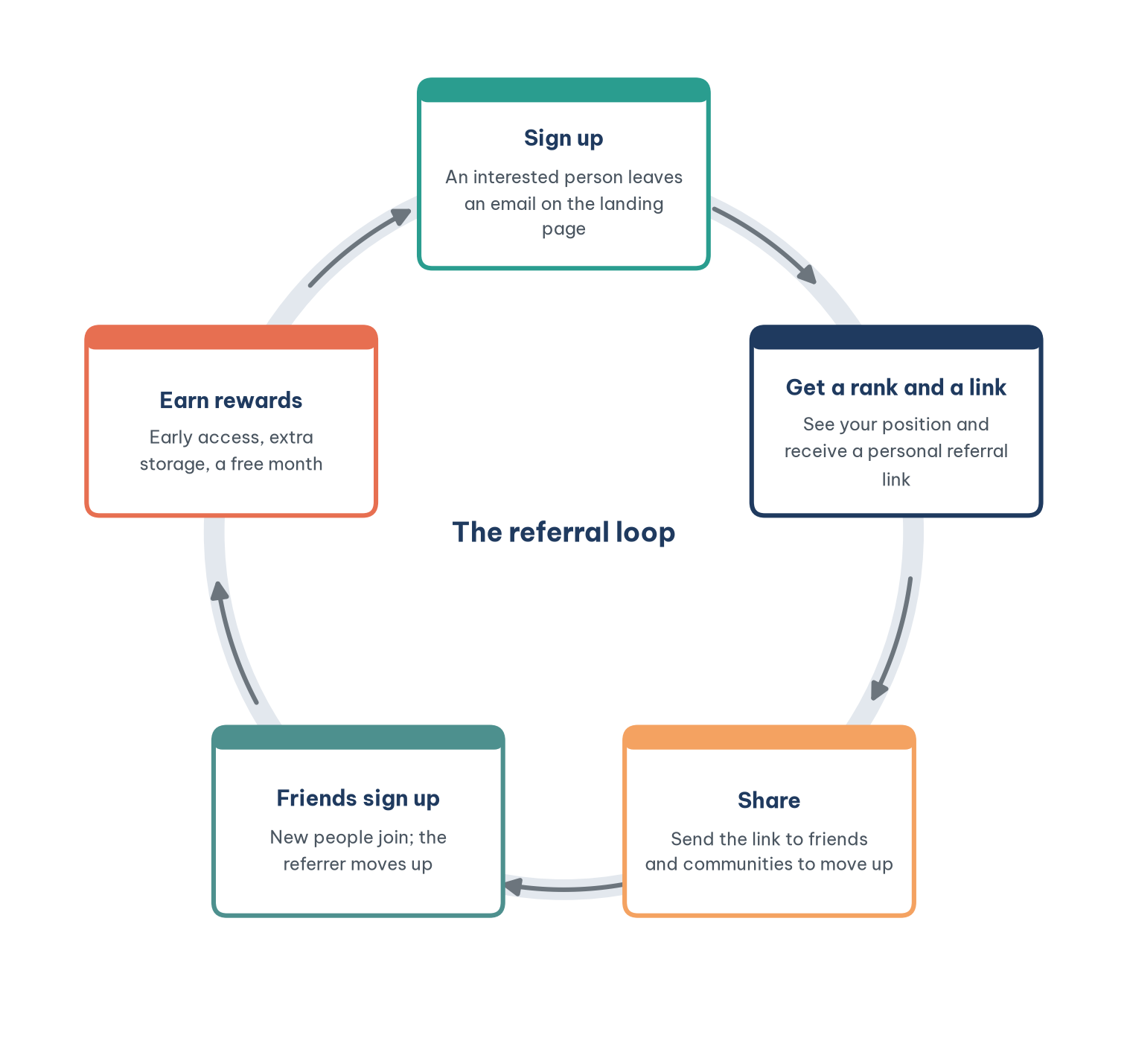
The loop in Figure 2 can be driven by two sources. The first is milestone rewards: for example, invite three people for early access, five for a month of the paid plan, ten for a limited-edition gift. The second is social actions, such as following the page or joining the community to move up, which let people without many friends to invite still take part. As the Dropbox lesson shows, the more closely rewards are tied to the product's core value, the more the loop attracts the right people.
3.3. Nurturing the list
A list that is not looked after slowly goes cold: by launch day, many people have forgotten why they signed up. The third step is therefore to stay in valuable contact with the list.
The first thing is a welcome email from the founder, talking about the project's vision and how to get a referral link. After that, the team can build in public, sharing regular progress updates, including the difficulties; send exclusive previews, such as short videos of key features only for people on the list; and, most importantly, ask for opinions through short surveys about features, naming and the price people would be willing to pay. The data from these answers is often worth more than the number of emails.
3.4. Supporting tools
You do not need to code to build a waitlist with ranking and referrals. Platforms such as Waitlister, Viral Loops, Prefinery (strong on fraud prevention and filtering fake emails) and KickoffLabs (with a landing-page builder and milestone rewards) offer these features out of the box. For a student project, their free tiers are usually enough. Features and prices change often, so check again before choosing.
4. Choosing promotion channels
A good landing page still needs visitors. In most markets, early users of new products are found in niche online communities more than through paid advertising. Table 3 suggests six channel types, each suited to a different kind of product and requiring its own approach.
What the channels in Table 3 have in common is that communities react badly to disguised advertising. The effective approach is to show up as someone trying to solve a problem and wanting feedback, not as a salesperson.
5. What a waitlist does and does not measure
This is the most important part of the article, because it is where many startup teams fool themselves. An email is a very small commitment: the person signing up loses nothing but a few seconds. Thousands of sign-ups therefore do not prove that anyone will pay. The right way to read a waitlist is as the first rung on a commitment ladder, as in Figure 3.
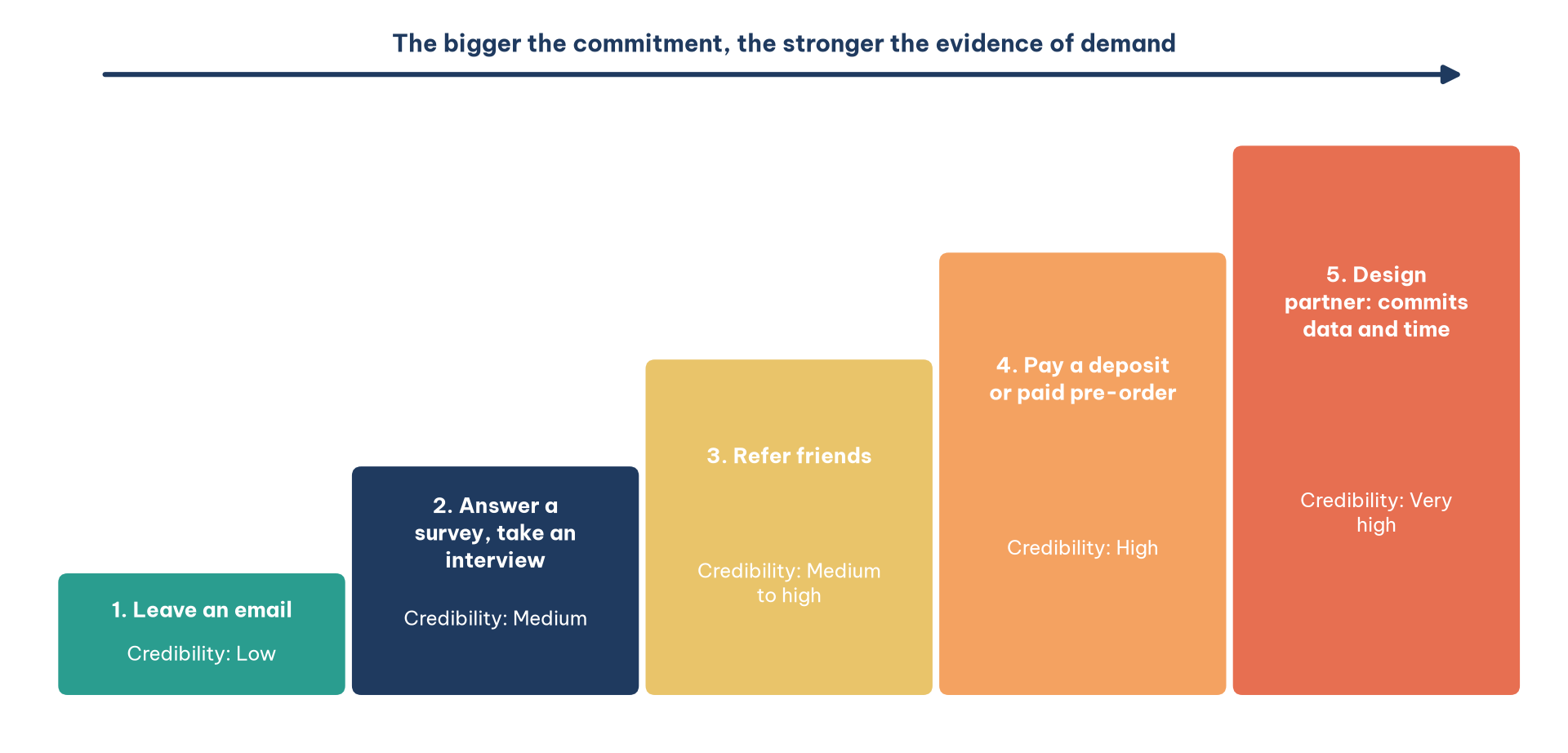
Each rung in Figure 3 asks more of the user: time to answer a survey or take an interview at rung 2, personal reputation when referring friends at rung 3, real money when paying a deposit at rung 4, and data, time and changes to how they work when becoming a design partner at rung 5. The bigger the commitment, the stronger the evidence of demand. Rung 4 corresponds to Bill Aulet's minimum viable business product, a minimal product with real paying customers (Aulet, 2013); rung 5 corresponds to the design partner that Steve Blank (2026) now uses as evidence of customer validation.
Beyond the commitment ladder, a waitlist campaign should track four metrics: landing-page conversion rate (emails divided by visits), viral coefficient (how many additional sign-ups each person brings on average), nurture-email open rate, and conversion from waitlist to users and paying customers at launch. The last one is the real measure of the campaign, and the one that Mailbox and Clubhouse failed to sustain.
6. Ethics and law
The attention-grabbing mechanisms in Section 2 slide easily into manipulation if misused. Three principles should guide any waitlist.
The first is that scarcity must be real. Announcing "only 50 spots left" when it is not true is misleading information for consumers, which consumer-protection laws in many countries prohibit, Vietnam's 2023 Law on Consumer Rights Protection among them (National Assembly of Vietnam, 2023), and it destroys trust the moment it is discovered. The second is respect for personal data: emails and phone numbers are personal data, so you must state clearly what you collect them for, obtain consent and allow it to be withdrawn, as data-protection laws such as the EU's General Data Protection Regulation (European Parliament & Council of the European Union, 2016) and Vietnam's 2025 Personal Data Protection Law (National Assembly of Vietnam, 2025) require. The third concerns fake-door tests, which promote a product that does not yet exist to measure demand: this is acceptable when you are transparent with people after they sign up, and you must never take money for something that does not exist.
Conclusion
A waitlist is a small tool with great power: with just a landing page and a form, founders can measure the market's reaction, gather their first users and build momentum for launch day. The campaigns of Gmail, Dropbox and Superhuman show that this power comes from specific mechanisms: real scarcity, visible ranking, rewards tied to core value and deliberate screening.
But Mailbox and Clubhouse remind us that buzz is no substitute for value. A long list proves only that the promise is attractive; whether the product is worth it must be tested on the higher rungs of the commitment ladder. Using a waitlist well means treating it as the first rung, then climbing on: interviews, referrals, deposits and, finally, customers willing to stay for the long term.
References
Aulet, B. (2013). Disciplined entrepreneurship: 24 steps to a successful startup. Wiley.
Blank, S. (2026, September 30). Lean LaunchPad – The next generation. Steve Blank. https://steveblank.com/2026/09/30/lean-launchpad-the-next-generation/
Ellis, S., & Brown, M. (2017). Hacking growth: How today's fastest-growing companies drive breakout success. Crown Business.
European Parliament & Council of the European Union. (2016). Regulation (EU) 2016/679 (General Data Protection Regulation). https://eur-lex.europa.eu/eli/reg/2016/679/oj
Houston, D. (2010). Dropbox startup lessons learned [Presentation]. Startup Lessons Learned Conference. https://www.slideshare.net/gueste94e4c/dropbox-startup-lessons-learned-3836587
National Assembly of Vietnam. (2023). Law on Consumer Rights Protection No. 19/2023/QH15. https://caselaw.vn/van-ban-phap-luat/411464-luat-bao-ve-quyen-loi-nguoi-tieu-dung-so-19-2023-qh15-ngay-20-06-2023-cua-quoc-hoi
National Assembly of Vietnam. (2025). Law on Personal Data Protection No. 91/2025/QH15. https://chinhphu.vn/?pageid=27160&docid=214590&classid=1&typegroupid=3
Ries, E. (2011). The lean startup. Crown Business.
Vohra, R. (2018). How Superhuman built an engine to find product/market fit. First Round Review. https://review.firstround.com/how-superhuman-built-an-engine-to-find-product-market-fit/
Discussion about this post