The Economics of Livestream Selling with KOLs and KOCs
Why a record 600-order livestream can still lose money and how net cost per new customer compares KOLs with KOCs


Key takeaways
The numbers on screen during a livestream (orders, viewers, session sales) are the easiest to see and the least useful for judging results. Returns, the share of new customers and repeat purchases only show up weeks later.
In a worked example, a celebrity session with a record 600 orders loses about US$1,470 once returns, marketplace fees, a 15% discount and the host's fee are counted.
A loss is not automatically a failure. Treating the net loss as the price paid for new customers gives a net cost of about US$4.28 per new customer, which can be compared with the acquisition cost of other channels.
A program of 20 everyday creators (KOCs) brings fewer orders but costs about US$1.27 per new customer, under a third of the celebrity session, because of a smaller fixed fee, a shallower discount and fewer returns.
KOLs and KOCs buy different things: KOLs buy fast, broad awareness; KOCs buy customers cheaply. Rules on host identity, paid endorsements and AI-generated hosts are tightening in Asia, Europe and the United States.
Livestream selling has moved from novelty to mainstream in much of East and Southeast Asia. In China, the gross merchandise value of livestream e-commerce was estimated to have exceeded CNY 4.5 trillion (about US$644 billion) in 2024, large enough for regulators to issue a dedicated set of supervision measures for the sector (Zhang, 2026). In Southeast Asia, sessions on TikTok Shop and Shopee Live are a routine sales channel for small brands as well as large ones. Western retailers are testing the same format. Wherever it is used, livestream selling produces a striking set of numbers in real time, and that is precisely its danger: it is the channel where sellers most easily confuse sales with results.
Consider a story that repeats itself across many sellers. A livestream with a well-known host ends at 11 p.m. The screen shows 600 orders, a record for Moc Son, a hypothetical specialty coffee brand that sells through a large marketplace and its own website. The team posts screenshots in the group chat. Three weeks later, when cancellations and returns have come back, marketplace fees have been deducted and the host's invoice has been paid, the accountant reports that the session lost almost US$1,500.
Yet the conclusion "livestreams lose money, so stop" is just as hasty as "600 orders, so it worked". The right question is not whether the session made or lost money, but whether it was a cheap way to win new customers. This article works through that question in five sections. Section 1 distinguishes celebrity hosts, everyday creators and affiliate marketing by their cost structure and risk. Section 2 builds the full result of one session with a celebrity host. Section 3 introduces the net cost per new customer, a measure that turns the wrong question into the right one. Section 4 compares the celebrity session with a program of everyday creators. Section 5 looks at the new rules that apply to livestream selling and at what AI can and cannot do for the analysis.
1. KOLs, KOCs and affiliate marketing
This section separates the three main ways of working with people who sell on a brand's behalf and shows that the key difference between them is who carries the risk.
A key opinion leader (KOL) is a well-known personality with a large following, usually paid a fixed fee per post or per livestream, sometimes with a commission on top. A key opinion consumer (KOC) is an ordinary user with a much smaller following who is seen as "a real person who really uses the product". KOCs are typically paid a commission per order through a marketplace's affiliate marketing program, sometimes with a small fixed fee or free product samples. Both terms are widely used in Asian e-commerce; in Western markets the same distinction is often described as celebrity or macro-influencers versus micro-influencers and creators.
The core difference between the two groups is not the size of their audience but their cost structure and risk. With a KOL, the brand pays a large amount up front and bears the risk that the session does not sell. With a KOC, the cost is mostly variable per order, so part of the risk shifts to the person making the recommendation. Table 1 compares the three forms of collaboration.
The last row of Table 1 points to a problem familiar from paid advertising. Anyone paid per order has an incentive to stand at the end of the journey of customers who would have bought anyway, collecting credit for sales they did not create. The same logic applies to livestreams, and it returns in Section 4 as the question of how many "new" customers are truly new.
2. One livestream session with a KOL
This section builds the complete profit and loss of the record session from the opening story, line by line, using an exchange rate of 25,000 Vietnamese dong to the US dollar for the underlying cost data.
The assumptions are as follows. The session takes 600 orders. The selling price is discounted by 15% from the normal US$12.80 to US$10.88. The cancellation and return rate is 18%, higher than the usual 15% because livestream purchases are impulsive, leaving 492 successful orders. The KOL receives a fixed fee of US$2,000 plus a 10% commission on realized revenue. Other costs are the same as for any Moc Son order: cost of goods of US$5.12 per order, marketplace fees of 22% of revenue, packing and shipping of US$0.88 per successful order and US$1.48 to process each returned order. Table 2 calculates the result.
Figure 1 redraws Table 2 as a waterfall to show which items eat into revenue.
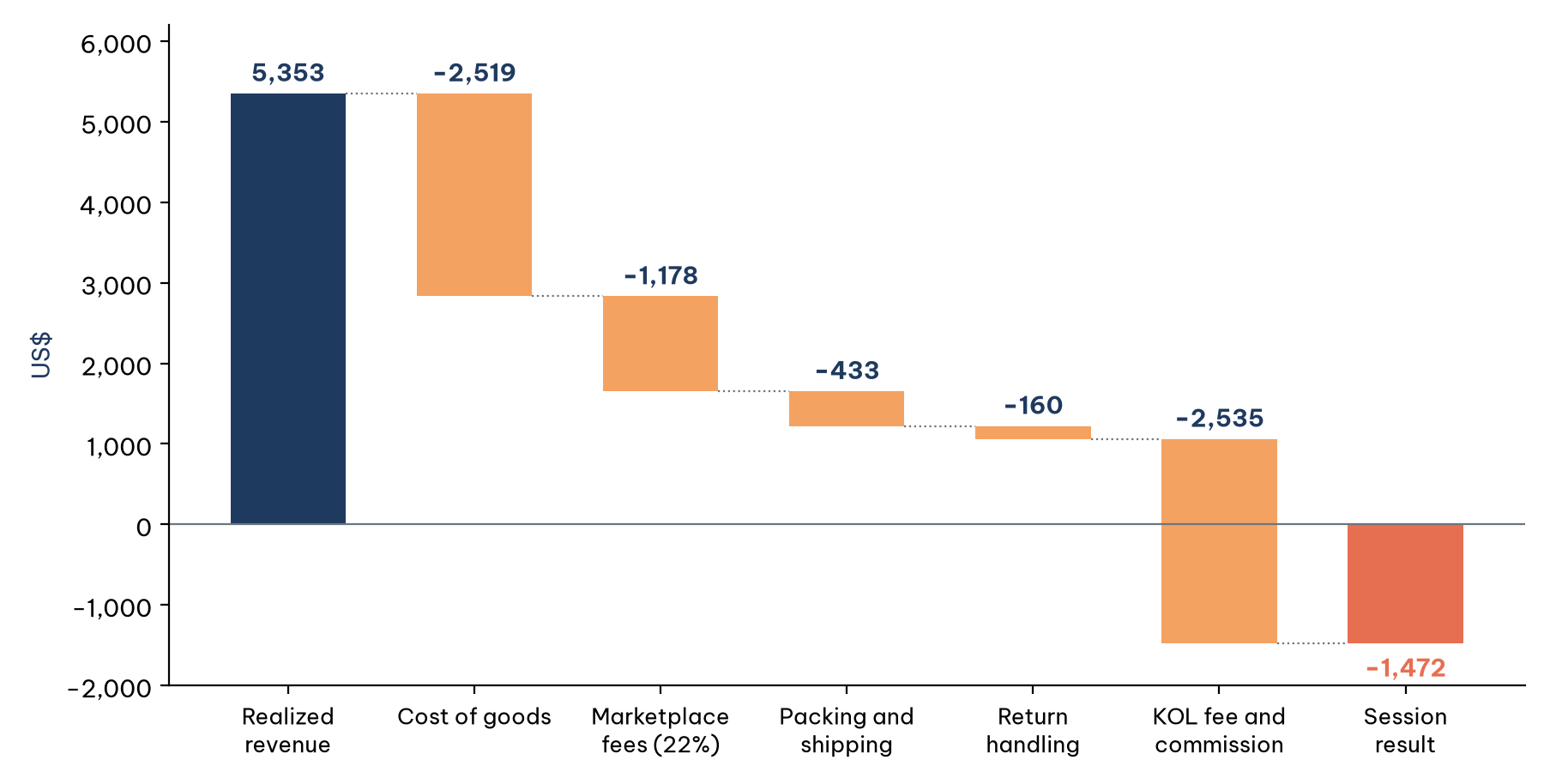
As Figure 1 shows, the session's revenue is enough to pay for the coffee, the marketplace fees and shipping, but not for the host. The KOL's fee and commission alone are slightly larger than the entire cost of goods sold. The second culprit, less often mentioned, is the 15% discount. At the normal price, each order leaves a contribution margin of US$3.98 after cost of goods, marketplace fees and shipping, and that margin is the cushion that pays for marketing. At the livestream price, the margin falls to about US$2.49, so the discount removes more than a third of the cushion on every order. Finally, the 108 cancellations and returns not only cost money to process: they also make the order count on screen about 22% higher than the number of orders that actually stick (600 against 492).
The central trap here is judging a livestream by session sales and viewer counts. Session sales, concurrent viewers and order counts appear on screen while the session is running, so they become the default measure of success. The mechanism behind the trap is availability: the most visible number is the one used most, even though it does not answer the management question. The three things that determine the real result only appear days or weeks later: the return rate, the share of new customers and the repeat purchase rate. A session that sells mostly to existing customers at a 15% discount is a session that loses money on the very customers who would otherwise have paid full price.
3. Net cost per new customer
This section reframes the loss: instead of asking whether the session made money, it asks how much each new customer cost.
A loss does not automatically mean the session was a mistake. Suppose order data show that 70% of successful buyers were new to the brand, about 344 customers. The right question is then: how much did each new customer cost?
The way to answer is to treat the campaign's net loss, that is total costs minus realized revenue, as the "purchase price" of the new customers it brought in, and divide it by the number of new customers. This article calls the result the net cost per new customer:
Net cost per new customer = (total campaign costs − realized revenue) / number of new customers.
This is the customer acquisition cost (CAC) of the campaign itself, except that it has already subtracted the revenue the campaign brought back. It is not a standard industry term, but it is easy to compute from data every seller has. For the KOL session, the net cost per new customer is 1,471.83 / 344 ≈ US$4.28. Under Moc Son's assumed unit economics, that is more than the CAC of advertising inside the marketplace (US$2.40) but less than the CAC of bringing customers to the brand's own website (US$7.20).
The comparison is rough rather than exact. A channel CAC is usually counted before the first order's margin, while the net cost per new customer has already netted that margin off. On a strictly like-for-like basis the ordinary channels would therefore look somewhat cheaper than the figures above suggest, which is one more reason to treat the livestream figure as a benchmark to be tested rather than a verdict.
Whether the session pays off depends on what the new customers do next. If they behave like ordinary marketplace customers and place on average 1.5 more orders at full price, each leaving a contribution margin of US$3.98, the future value of each customer is about 1.5 × 3.98 ≈ US$5.98, more than the US$4.28 it cost to acquire them. The session could therefore be a reasonable investment, but only on condition that the new customers actually come back. That condition has to be checked with repeat purchase data three to six months later, tracking the group of customers who arrived through the livestream as a separate cohort and comparing their repeat rate with that of customers from other channels.
4. Comparison with a KOC program
This section puts the KOL session next to its most common alternative, a program of everyday creators, and computes both on the same basis.
Suppose that in the same month Moc Son runs a KOC program instead. Twenty KOCs each receive US$60 and product samples, plus a 10% commission on revenue. The discount is only 5%, giving a price of US$12.16. The program is expected to generate 450 orders with a return rate of 8%, much lower because buyers have watched detailed reviews before buying, leaving 414 successful orders. Sixty percent of buyers are new customers, about 248 people. Calculated the same way as Table 2, realized revenue is US$5,034.24, total costs are US$5,348.24 and the program loses about US$314, so the net cost per new customer is 314 / 248 ≈ US$1.27. Figure 2 places the net cost per new customer of both options next to the CAC of the two ordinary channels.
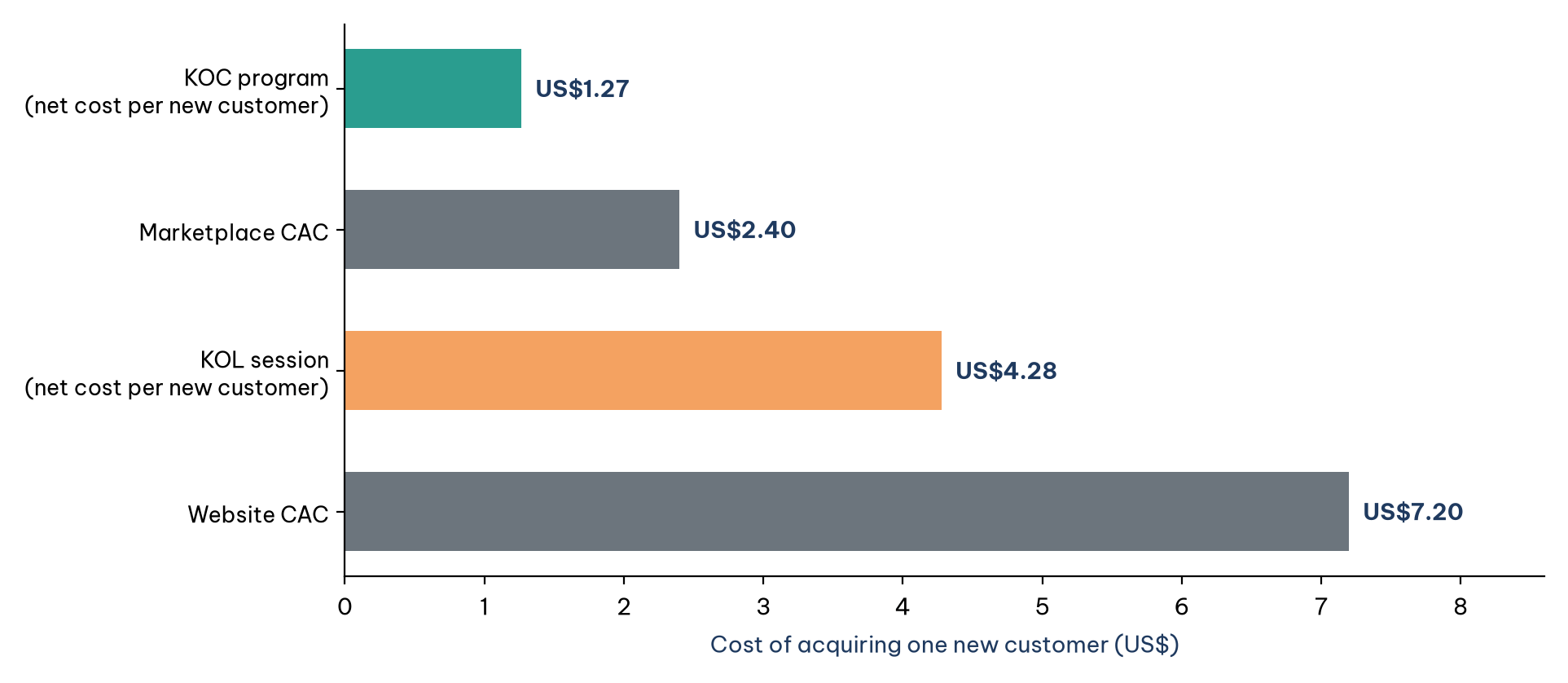
Figure 2 shows that the KOC program brings fewer orders but costs less than a third as much per new customer as the KOL session. Three reasons add up: a lower fixed cost, a shallower discount and a lower return rate. Table 3 summarizes the two options.
The conclusion is not that "KOCs are always better than KOLs". A KOL delivers something KOCs cannot: brand awareness at large scale in a short time, which is valuable when launching a new product or entering a new market, and that effect does not show up in the session's net cost per new customer. What the analysis shows is that each option buys something different, and the manager has to know what is being bought. A common strategy is to use KOLs sparingly, for moments that need awareness, and to maintain a standing network of KOCs to acquire customers at low cost.
One more deduction is needed before trusting the net cost per new customer: some of the "new" customers would have found the brand anyway. If a substantial share of the buyers in the session already knew Moc Son and were only waiting for a discount, the true number of new customers is lower and the true cost per new customer is higher than the figures above. Two simple checks are to compare the number of new customers in months with a livestream against comparable months without one, or to run the session for one product line while keeping the others unchanged and comparing the two groups.
5. New rules for livestream selling and the role of AI
This section surveys how regulators in several major markets are tightening the rules on livestream selling and what that means for the cost of each session, before turning to what AI can contribute.
Three kinds of rules are converging. The first concerns who the host is. Vietnam's Law on E-commerce, in force from 1 July 2026, requires identity verification for sellers and for people who sell through livestreams, including KOLs and KOCs engaged to promote products, together with obligations to disclose product information and duties for platforms (National Assembly of Vietnam, 2025). China's new supervision measures for livestream e-commerce, announced in January 2026, require livestream operators to strengthen identity checks and require platforms and talent agencies to manage the hosts they recruit (Zhang, 2026). The second concerns paid endorsement. In the United States, the Federal Trade Commission's revised Endorsement Guides state that a material connection between an endorser and a brand, such as payment or free products, must be clearly disclosed, and they treat influencers' statements as endorsements for which both the influencer and the brand can be responsible (Federal Trade Commission, 2023). The third concerns synthetic hosts. China's measures require AI-generated hosts to be clearly labeled and to remind viewers that they are produced by AI (Zhang, 2026), and the European Union's AI Act requires those who deploy AI systems to disclose image, audio or video content that is a deepfake (European Parliament & Council of the European Union, 2024). Table 4 summarizes these rules.
These rules raise the compliance cost of each session, but they also erode the advantage of competitors who use fake identities or fake content; over time they favor sellers who operate honestly. For a brand that hires influencers, the practical consequence is twofold: vet the person before signing, and keep evidence of the product information supplied to them, because cases of hosts making false claims about products are exactly what has led lawmakers to spell out the responsibilities of each party.
AI can help with two tasks in the economics of livestreaming. Before a session, an AI assistant can quickly build a results table like Table 2 for many scenarios of discount and return rate, to find the maximum KOL fee that still keeps the net cost per new customer acceptable. After the session, it can summarize viewers' comments and questions into a list of product concerns for the next session or the product page. But the numbers that decide the outcome, the share of new customers and the repeat purchase rate, must come from real order data, not from an AI model's guesses.
Conclusion
Moc Son's 600-order livestream lost about US$1,470 for three reasons that add up: a large fixed fee for the KOL, a 15% discount that removed more than a third of the contribution margin cushion on every order and an 18% return rate among impulse buyers. But a loss is not yet a failure. Treating the loss as the price paid for new customers, the session's net cost per new customer was about US$4.28, cheaper than the CAC of the brand's website, and the session is worth repeating if the new customers actually come back.
Compared with a KOC program at about US$1.27 per new customer, the KOL session was more than three times as expensive, but it bought something the KOC program could not: broad awareness in a short time. The general lesson applies in any market where livestream selling has taken hold: judge a livestream by the cost of each new customer and by repeat purchases a few months later, not by the number on screen at 11 p.m.
References
European Parliament & Council of the European Union. (2024). Regulation (EU) 2024/1689 laying down harmonised rules on artificial intelligence (Artificial Intelligence Act). Official Journal of the European Union. https://eur-lex.europa.eu/eli/reg/2024/1689/oj
Federal Trade Commission. (2023). Guides concerning the use of endorsements and testimonials in advertising. Federal Register, 88(142), 48092–48112. https://www.federalregister.gov/documents/2023/07/26/2023-14795/guides-concerning-the-use-of-endorsements-and-testimonials-in-advertising
Laudon, K. C., & Traver, C. G. (2023). E-commerce 2023–2024: Business, technology, society (18th ed., Global ed.). Pearson. https://www.pearson.com/en-gb/subject-catalog/p/e-commerce-2023-2024-business-technology-society-global-edition/P200000010016/9781292449722
National Assembly of Vietnam. (2025). Law on E-commerce No. 122/2025/QH15 [Luật Thương mại điện tử]. https://chinhphu.vn/?pageid=27160&docid=216503&classid=1&typegroupid=3
Zhang, Y. (2026, January 8). China stiffens oversight of USD644 billion livestream e-commerce sector, includes AI hosts for first time. Yicai Global. https://www.yicaiglobal.com/news/china-steps-up-regulation-of-livestream-e-commerce-includes-ai-hosts-for-first-time
Discussion about this post