Ten Kinds of AI Bias and How to Prevent Them
Why machines are not naturally objective, where bias enters across the life cycle of an AI system, and what organisations can do about it


Key takeaways
AI learns from data created by people, pursues goals set by people and is used by people. Bias can enter at every step and is then repeated consistently, quickly and at scale.
Ten common biases can be organised by the life cycle of an AI system: five from data (historical, sampling, selection, measurement, label), three from models and objectives (algorithmic, confirmation, overgeneralisation) and two from human–machine interaction (feedback loops, automation bias).
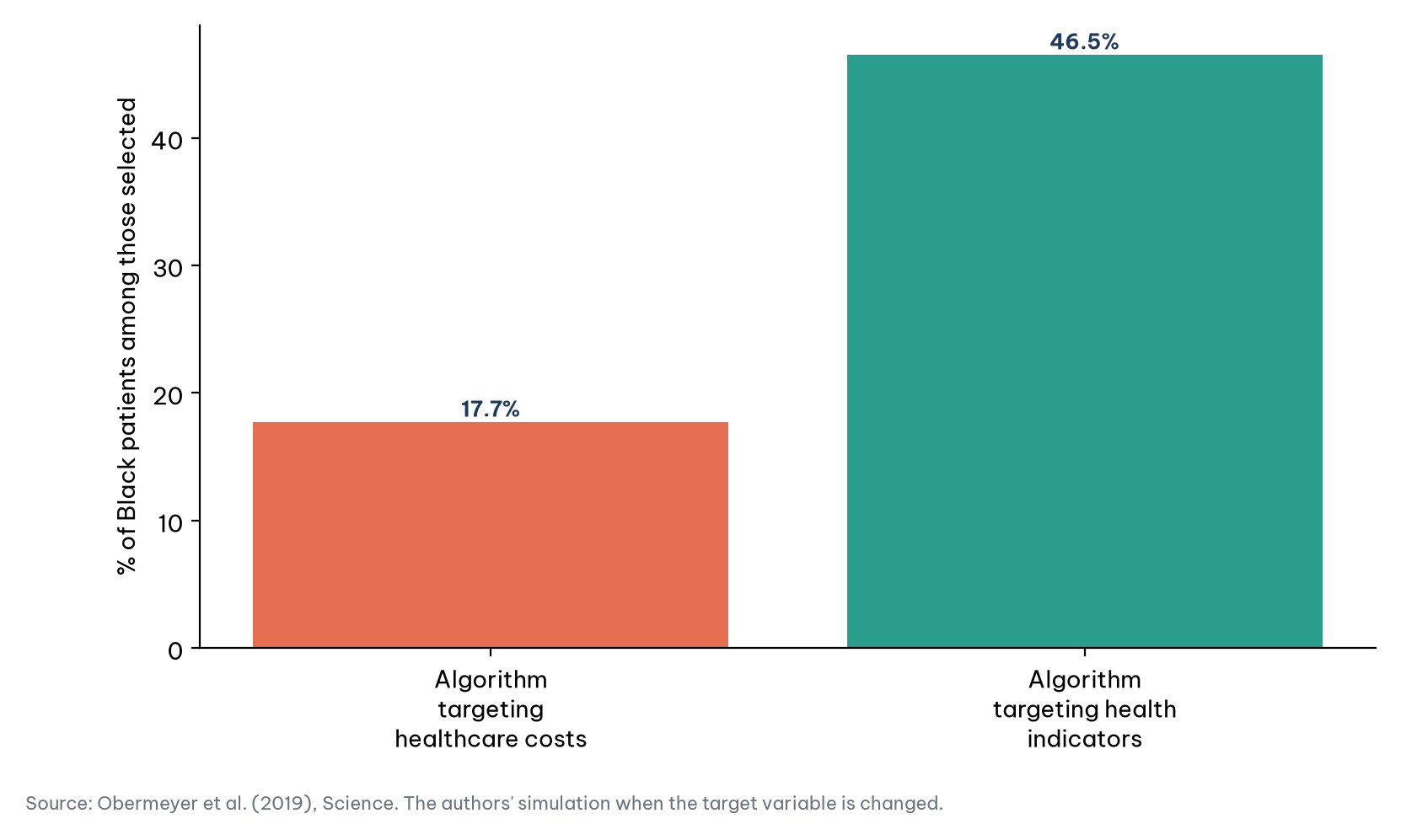
Documented cases range from Amazon's abandoned recruiting tool to a US healthcare algorithm whose choice of target variable cut the share of Black patients selected from 46.5% to 17.7%.
The biases link like dominoes. Breaking the chain requires action on four fronts: data, algorithms, human oversight and organisational governance.
Measuring fairness forces a choice: one fraud model can satisfy two fairness definitions and fail two others. Changing how a flag is used is often cheaper and kinder than changing the threshold.
Better than asking "Is the machine objective?" is asking: whose data did it learn from, whose goals does it optimise, and who pays if it is wrong?
Artificial intelligence is moving into important decisions in our lives: which job applications get an interview, which loans are approved, which patients receive priority care, which content appears on millions of phone screens. Behind this spread lies a popular assumption: decisions made by machines are objective, because machines rely on data and logic rather than human emotion or prejudice.
The assumption sounds reasonable but is wrong. An AI system learns from data created by people in the past, pursues goals set by people and is used by people in specific contexts. At each of these steps distortions can creep in, and once inside the system they are repeated consistently, quickly and at a scale no biased individual could reach. A prejudiced recruiter affects a few dozen applications a week; a prejudiced screening system affects hundreds of thousands.
Bias in AI is therefore not a single technical bug that can be patched in an afternoon, but a systemic problem. This article analyses the ten most common kinds. Instead of a loose list, they are arranged along the life cycle of an AI system: bias that arises from data, bias that arises from model design and objectives, and bias that arises when people use the system. For each, the article explains what it is, gives examples (preferring cases documented by research), describes the consequences and sets out remedies. The final sections look at bias beyond the Western context and at how to break the "domino chain" the biases form.
1. Where does bias enter an AI system?
To see why a machine can be biased, picture an AI system passing through six stages, as in Figure 1. Data is collected; variables are defined and data is labelled; a model is designed with an objective to optimise and then trained; the model is evaluated and deployed; people use its results to make decisions; and finally those decisions generate new data that flows back to train the model. Each stage is a door through which bias can walk in.
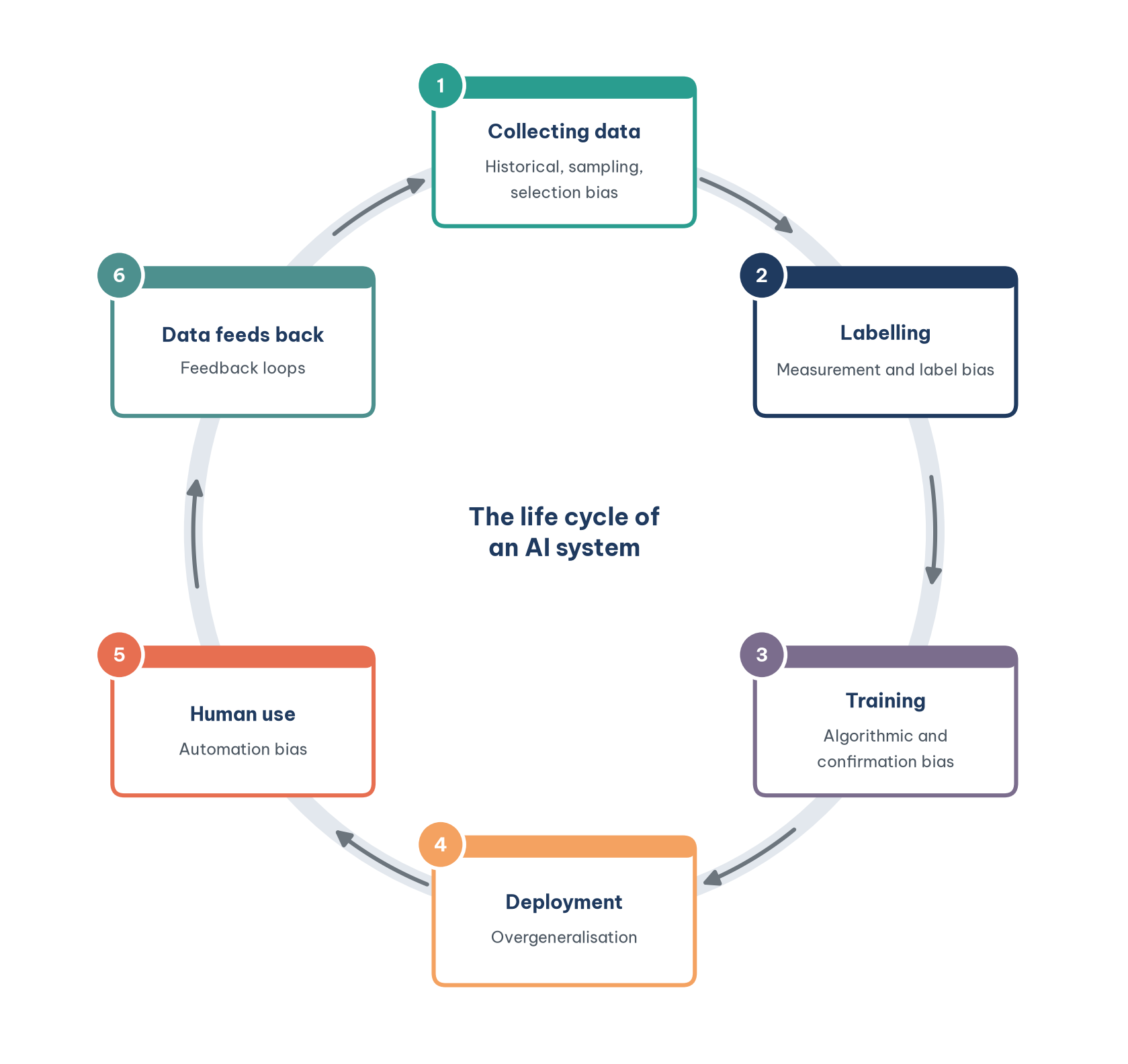
The life-cycle view has two benefits. First, it shows that bias is not only a matter of "bad data": some biases lie in how we choose an algorithm's objective, and some belong entirely to the humans using the machine. Second, it shows that biases connect: skewed data produces a skewed model, a skewed model produces skewed decisions, and skewed decisions produce even more skewed data. The next three sections take each group in turn.
2. Group one: bias from data
Data is an AI system's "world view": everything the model knows about reality comes from it. If that world view is distorted, the model has no way of noticing. The five biases in this group differ in where the distortion comes from: social history itself, sampling, a screening process, how things are measured, or the people doing the labelling.
2.1. Historical bias: the shadow of the past
Historical bias arises when data faithfully reflects a world that was already unfair. The data is not wrong, but what it records are past prejudices about gender, race, region or social status. The model, like a pupil with no critical faculty, treats those patterns as laws and turns them into decision rules.
The most cited example is Amazon's recruiting tool. In 2018 Reuters reported that Amazon had abandoned an AI system for scoring job applicants because it learned from ten years of hiring data, a period when the tech industry was dominated by men. The system "learned" that male candidates were more suitable and automatically downgraded CVs containing the word women's, as in "women's chess club captain" (Dastin, 2018). Another example comes from image search: Kay et al. (2015) showed that image-search results for many occupations, including "CEO", under-represented women relative to reality, and that viewing these results shifted people's perceptions of the gender balance in those jobs. In lending, the US practice of "redlining" once led banks to refuse loans in areas with many ethnic-minority residents; a model trained on lending data from that era risks continuing to disadvantage those areas even when borrowers are financially sound.
Historical bias turns past injustices into automated barriers today. Organisations deploying such systems also face legal risks of discrimination and the loss of customer trust. Remedies include auditing data before training to detect gaps between groups; reweighting (giving more weight to disadvantaged groups) or oversampling under-represented groups; fairness-constrained algorithms during training; and monitoring the system's decisions after deployment. Crucially, "the data reflects reality" is not a sufficient defence: the question is whether we want the system to reproduce that reality.
2.2. Sampling bias: the expert's blind spot
Imagine that an AI system's entire understanding of the world fits in one room: its training data. Sampling bias occurs when that room is not a faithful miniature of the world but a distorted universe, where some groups, environments or situations appear far too often and others are almost invisible. The model becomes an expert in its small universe but fails when it steps into a more diverse real world.
The examples are well documented. Public dermatology image datasets used to train AI for skin-cancer diagnosis consist mainly of images of light skin (Adamson & Smith, 2018), so models risk being less accurate on lesions on darker skin. Koenecke et al. (2020) tested the speech-recognition systems of five large technology companies and found error rates for Black speakers nearly double those for white speakers. The "Gender Shades" study by Buolamwini and Gebru (2018) found that commercial systems classifying gender from faces made very few errors for lighter-skinned men but erred on more than a third of darker-skinned women. One can also imagine a pedestrian-detection system trained almost entirely on North American and European streets struggling in the dense, motorbike-heavy traffic of cities such as Hanoi or Jakarta.
The consequences can be serious: in self-driving cars or medical diagnosis, a model's blind spot is a risk to life; in digital services it creates a class of users forgotten by technology; for businesses it means customer segments missed because the product "has never seen" them. The main remedy is stratified sampling, deliberately ensuring under-represented groups have enough data, even at higher-than-real proportions, and evaluating the model separately for each group instead of looking at a single overall accuracy figure.
2.3. Selection bias: the illusion of success
If sampling bias is about "people missing from the room", selection bias is about an invisible filter on the door into the room. It stems not from the data itself but from the process that screened the data. The easiest form to picture is survivorship bias: we analyse only the people or companies that passed a harsh selection process and hear nothing from the "silent graveyard" of those who failed.
In finance, a bank trains a default-prediction model only on customers who were granted loans. The model never learns the characteristics of people who would have repaid well but were rejected by some rigid criterion, so it keeps rejecting them. In business, studying a hundred "unicorn" companies and concluding that successful founders often dropped out of university ignores the thousands of companies whose dropout founders failed. Even online product reviews are filtered: people with very good or very bad experiences write reviews, while the moderately satisfied "silent majority" is absent.
Selection bias produces models naive about risk, encourages copying success formulas built on luck, and creates "closed clubs" when systems only look for copies of current employees or customers. Prevention starts with investigating the process that generated the data, asking: "Who or what was excluded from this dataset, and why?" In some cases statistical techniques such as the Heckman correction help estimate and adjust for selection; in lending, some institutions deliberately grant a small share of loans to applicants just below the rejection threshold to gather data on this group.
2.4. Measurement bias: the streetlight illusion
There is a familiar story of a man searching for his keys under a streetlight, not because he dropped them there but because that is where the light is. Measurement bias is this mistake in the world of data: we measure what is easy to measure, not what really matters. We pick a tangible proxy for a complex concept, and the AI, with complete naivety, treats the proxy as the truth. It measures the shadow without knowing the object that casts it.
The most thoroughly studied case is the algorithm analysed by Obermeyer et al. (2019) in Science. It was widely used by US hospitals to select patients for intensive care-management programmes. Because "health need" is hard to measure, the developers used healthcare costs paid as a proxy. The problem was that, in that health system, Black patients at the same level of illness typically incurred lower costs because of poorer access to care, so the algorithm judged them to "need less care" than they did. When the researchers simulated replacing the target with direct health indicators, the share of Black patients among those selected rose from 17.7% to 46.5% (Figure 2).
Measurement bias is not confined to healthcare. A school that uses "hours logged into the e-learning system" to measure pupils' progress rewards those who look busy rather than those who learn. A city that measures air quality only with a few monitors in parks gets a "clean" report while the industrial zone chokes. The common result is that organisations pour resources into improving a number, creating an illusion of progress while reality worsens, and judging people unfairly by their shadows. Remedies are to work with field experts (doctors, teachers, environmental scientists) to choose measures that capture the substance, and to use a dashboard of several indicators instead of one number, so that it becomes visible when one indicator rises while other important ones fall.
2.5. Label bias: the wrong signpost
In supervised learning, raw data (an image, a paragraph) must be labelled by people for the model to learn. The raw data may be free of prejudice, but a label is an act of interpretation: it simplifies a complex reality, and in that simplification the labeller's implicit prejudices, fatigue, cultural differences or inconsistency are "injected" into the data. These subjective interpretations become the "ground truth" the model faithfully learns. That is label bias.
Sap et al. (2019) found that in datasets used to train models detecting "toxic" language, posts written in African American English, with its dialect expressions, were labelled toxic more often, and models learned to do the same. Similarly, if labellers repeatedly mark comments criticising a policy as "toxic", the system will learn that dissent equals toxicity. In medicine, wrong labels from an inexperienced reader of scans, repeated many times, teach the model to raise false alarms; one person's bias is multiplied into thousands of diagnoses.
To reduce label bias, organisations need a detailed labelling guide with many examples of edge cases; multiple labellers for the same sample, with disagreements escalated to experts; and regular quality checks that detect labellers drifting from the consensus. For culturally sensitive tasks, the labelling team must be diverse and understand the end users' context.
3. Group two: bias from models and objectives
Even with good data, a system can be biased because of how it is designed (Mehrabi et al., 2021). This group has three types: bias from a poorly chosen objective, bias from a model that only seeks to confirm what it already "believes", and bias from applying a model in a context different from where it was built.
3.1. Algorithmic bias: the machine's wrong shortcut
Algorithmic bias, in the narrow sense used here, comes not from data but from the objective the algorithm is programmed to optimise. It arises when an objective that sounds reasonable on paper (maximise engagement, minimise cost) leads to harmful behaviour in practice. The algorithm does not malfunction; it works too well at pursuing a short-sighted goal.
The typical example is social-media ranking algorithms optimised for "engagement". Internal Facebook documents published by the press in 2021 showed that the company's own researchers had warned that algorithm changes meant to increase engagement had unintentionally favoured outrage and divisive content. Another, hypothetical example: a cost-optimising delivery dispatch system may find that giving nearby, convenient orders to experienced drivers is most efficient, so new or suburban drivers keep getting long, inefficient routes and incomes diverge sharply. In lending, using "years at the current address" as a measure of stability can unintentionally disadvantage young people who move for study or work.
This bias is hard to spot because it sits in the core logic of complex models. Remedies include greater explainability (explainable AI) so humans understand why the model decides as it does; red teaming, a team dedicated to finding ways the system could cause harm before deployment; and, most importantly, building hard-to-measure long-term values (satisfaction, mental health, fairness) into the objective itself and into the monitoring metrics.
3.2. Confirmation bias: the prophecy machine
Confirmation bias is originally a psychological concept: people tend to seek and believe evidence that supports what they already think. An AI system can make the same mistake when it is designed, trained or used in ways that only reinforce an initial assumption. Instead of an objective analyst, it behaves like a lawyer collecting only evidence favourable to the client and ignoring contrary data.
Picture an automated investment assistant built on the assumption that "tech stocks always grow": when markets turn volatile, it keeps looking for signals supporting this assumption instead of diversifying. Or a screening tool seeded with the belief that "graduates of prestigious universities perform better" will quickly learn and amplify that pattern, overlooking talented people from lesser-known schools. At the scale of society, confirmation bias contributes to filter bubbles, trapping users in information that reinforces their existing views.
The result is tunnel vision in businesses, which miss new market signals, and greater polarisation in society. Remedies are to deliberately introduce counter-examples that cut against the model's assumptions, test the model on scenarios contrary to expectation and, in recommender systems, balance "exploiting" what is known about users' tastes with "exploring" new content.
3.3. Overgeneralisation: judging others by yourself
A model that performs very well in the data environment where it was built may fail when moved to another context. This happens when we assume what the model learned is universal, when in fact it holds only within a particular data "domain". Technically, this is domain shift.
The study by Zech et al. (2018) is a classic illustration. The authors trained deep-learning models to diagnose pneumonia from chest X-rays at several US hospitals. The models performed well on data from the same hospitals but noticeably worse when tested at other hospitals. Analysis showed the models had also learned "shortcuts": recognising which hospital an image came from, or whether it had been taken with a portable X-ray machine (often used for seriously ill bedridden patients), rather than only learning signs of disease. Similarly, self-driving systems tested mostly in good weather and orderly traffic struggle with heavy snow or mixed traffic, and a mental-health chatbot built from conversations in Western cultures, where direct emotional expression is encouraged, may misread the more reserved expressions common among users in Asia.
The result is a model that is "perfect in the lab" but fails in deployment, causing costs, lost trust and, in medicine, dangerous misdiagnoses. Prevention includes out-of-distribution testing on data from many environments and populations before deployment; fine-tuning the model on a small amount of data from the new context; and diversifying data sources from the start.
4. Group three: bias from human–machine interaction
The first two groups concern what happens inside the system. But an AI system does not exist alone: it is placed in human hands and in an environment that reacts. The last two biases arise from that interaction.
4.1. Feedback loops: the amplifying spiral
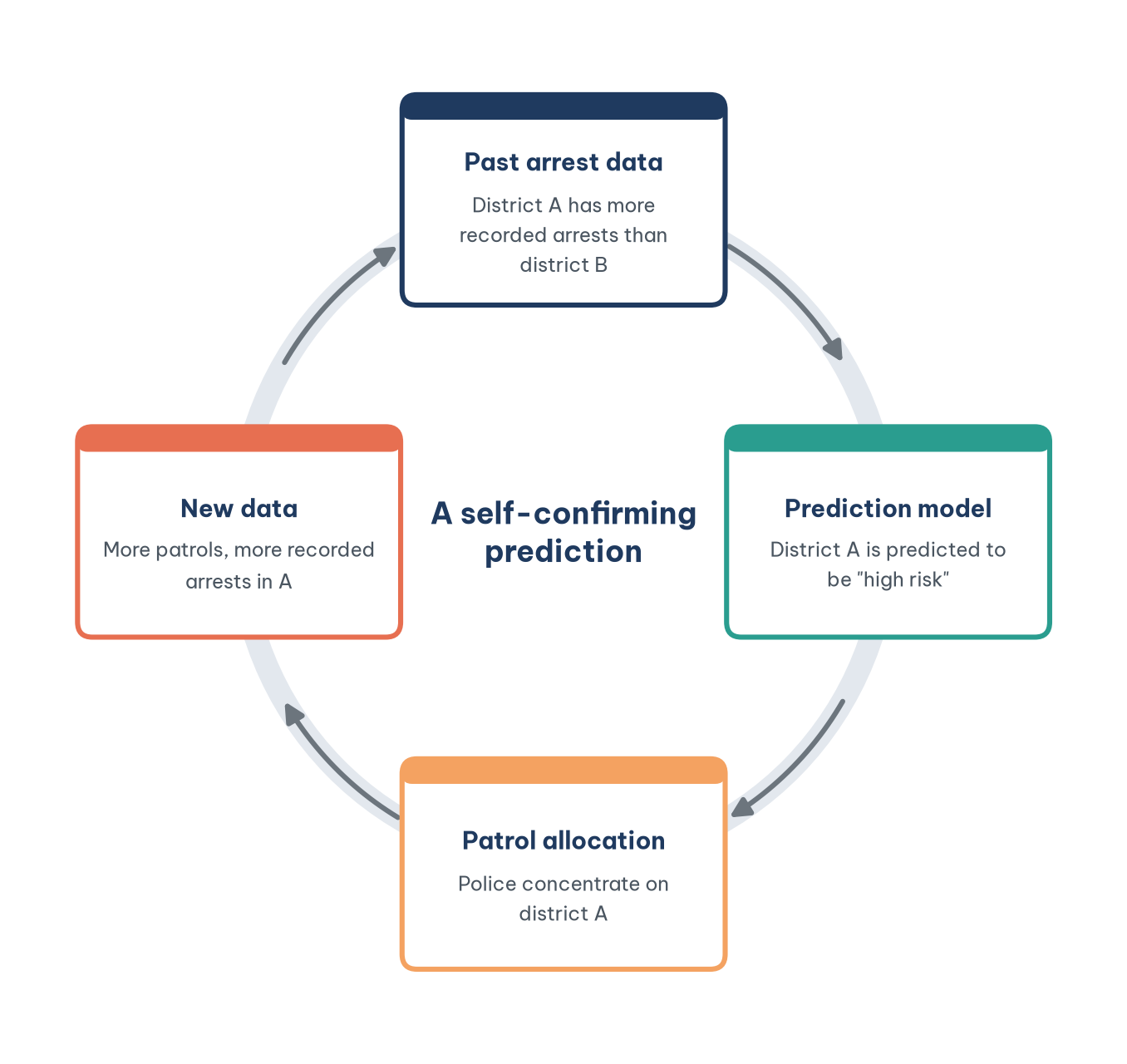
A feedback loop is one of the most dangerous and hardest-to-see forms of bias, acting like a self-fulfilling prophecy at scale. It begins when an AI's output changes the behaviour of people or the environment; that change generates new data; and the new data is used to retrain the same model, seemingly confirming the original prediction. The AI no longer just reflects reality but constructs a version of reality that matches its own assumptions.
The classic example is predictive policing, illustrated in Figure 3. If past data records more arrests in district A than in district B (perhaps only because A was already patrolled more), the model predicts that A is "high risk"; police are concentrated there; more patrols find and record more arrests, including minor offences; and the new data "proves" A is dangerous. Lum and Isaac (2016) simulated this loop with real data from Oakland, California, and showed the algorithm repeatedly concentrating patrols in poor neighbourhoods with many residents of colour, even though survey data on drug use showed it was spread across the city.
Similar loops appear in many fields. On social media, an algorithm does not "know" you like conspiracy theories; it only sees you pause for three seconds on a video and recommends more like it, until your feed is full of extreme content and the algorithm has "evidence" that this is what you want. On e-commerce marketplaces, a product lucky enough to be pushed into "best sellers" sells more because it is prominently displayed, while a better but less lucky product is buried. In criminal justice, recidivism risk tools such as COMPAS in the United States were investigated for disparities in prediction errors between racial groups (Angwin et al., 2016); if someone rated "high risk" is denied bail and loses their job and relationships, their chance of reoffending may genuinely rise.
Breaking the loop requires deliberate measures: introducing exploration and randomness into recommendations to gather data beyond what the model already believes; creating a delay between when data is generated and when it is used to update the model, long enough for human analysis; monitoring drift in data and predictions over time; and above all, identifying where a model's predictions might change the very phenomenon they predict.
4.2. Automation bias: blind trust in the machine
The last bias belongs entirely to humans. Automation bias is the tendency to over-rely on automated systems and hand them our critical thinking, based on an implicit assumption that machines are objective and err less than people. We act as if "the computer is always right".
Aviation shows the price of a poorly designed human–machine relationship. In the two Boeing 737 MAX crashes of 2018 and 2019, the automated MCAS system (control software, not machine-learning AI) repeatedly pushed the aircraft's nose down because of faulty data from a single sensor, while pilots had not been adequately trained on how the system worked. In medicine, a doctor used to trusting an AI screening tool's "negative" results may start skimming those images and miss a small tumour the AI misclassified. In the courts, a sentence suggested by a system can become a psychological "anchor" that judges find hard to depart from.
Automation bias erodes professional skills, creates blind spots where machine error meets human inattention, and diffuses responsibility when everyone blames "the algorithm". Countermeasures include human-in-the-loop processes in which AI only recommends and an authorised person decides; displaying uncertainty in results to signal when special attention is needed; and training on the system's limitations, not just how to use it, to cultivate healthy scepticism.
5. AI bias beyond the West
Most of the examples above come from the United States and Europe, where these problems have been studied most. But the mechanisms know no borders, and as AI spreads in emerging markets they need to be seen in local contexts. Vietnam offers clear illustrations.
In Vietnamese speech recognition, training data tends to concentrate on the accents of the big cities, so systems err more with central-region accents, ethnic-minority speakers or older people: a form of sampling bias. In credit scoring with alternative data (mobile top-up history, e-wallet transactions, app behaviour), models can widen access to finance for people with no borrowing history but can also disadvantage freelancers with irregular income or people who use few digital services: forms of measurement and selection bias. Large language models trained mainly on English may give inaccurate or foreign-centred answers about local law, culture and history: overgeneralisation. And face recognition used in national digital identity systems must be tested on the populations that actually use it.
Legal frameworks are taking shape as well. Vietnam's 2025 Personal Data Protection Law (National Assembly of Vietnam, 2025) and its implementing decree (Government of Vietnam, 2025) set requirements on legal basis, consent and the protection of sensitive personal data (such as health and biometric data) and financial and credit data, the kinds of data often used to train models. For businesses there, as elsewhere, assessing bias is not only an ethical matter but also one of legal compliance and brand reputation.
6. Breaking the domino chain: four fronts
Looking back over the ten biases, they do not exist independently but connect like a chain of dominoes. Historical bias in social data sows the seed; sampling and selection bias make data unrepresentative; label and measurement bias add a layer of subjective interpretation. The model learns from this, is optimised for a possibly short-sighted objective, tends to confirm what it already "believes", then fails when moved to a new context. Its decisions create feedback loops that amplify the distortion, and excessive human trust closes the circle. Table 1 summarises the ten biases and their main remedies.
To break the chain, organisations need to act on four fronts at once. The data foundation is where historical, sampling and labelling biases converge; diverse, representative, regularly audited data is a must. The algorithmic engine needs machine-learning techniques that account for fairness and explainability, so people understand why the system decides as it does. The human safeguard is a process with human oversight for important decisions, together with training users in critical thinking. The organisational ecosystem includes diverse development teams, a clear AI ethics code, audit mechanisms and an oversight board.
Organisations do not have to start from scratch. Table 2 lists widely used tools and reference frameworks.
7. Measuring fairness on a real model
The four fronts in Section 6 share one requirement: measurement. Without it, an organisation cannot know whether a system is biased, let alone which remedy works. This section walks through a fairness check on a fraud-detection model and the decisions that measurement forces.
7.1. One model, four answers
An online shop uses a model to flag suspected fraudulent orders; flagged orders are held for a few days for verification. In one quarter the model reviews 8,000 orders from large cities and 2,000 from the provinces. The true fraud rate differs: 2% in cities and 6% in the provinces, perhaps because remote deliveries are harder to verify. Table 3 sets the model's results against four common definitions of fairness.
Table 3 shows the same model to be both "fair" and "unfair", depending on the definition. An honest provincial customer is three times as likely to have an order held by mistake as a city customer, even though the model catches fraud equally well and its flags are equally reliable in both groups. Two research teams proved independently that when base rates differ between groups, no model can satisfy these definitions at once unless it predicts perfectly (Chouldechova, 2017; Kleinberg et al., 2016).
7.2. Change the threshold, or change how the result is used
Because not every definition can be met, fairness becomes a reasoned choice rather than a calculation. The right question is: in this context, which mistake does the most harm, and to whom? The engineering team's first instinct is often to raise the flagging threshold for the provincial group until its false positive rate approaches the city level. Figure 4 prices that choice under two assumptions: missing a fraudulent order costs 8 million VND, and wrongly holding a genuine order costs 300,000 VND (cancellation costs, extra customer care and lost goodwill).
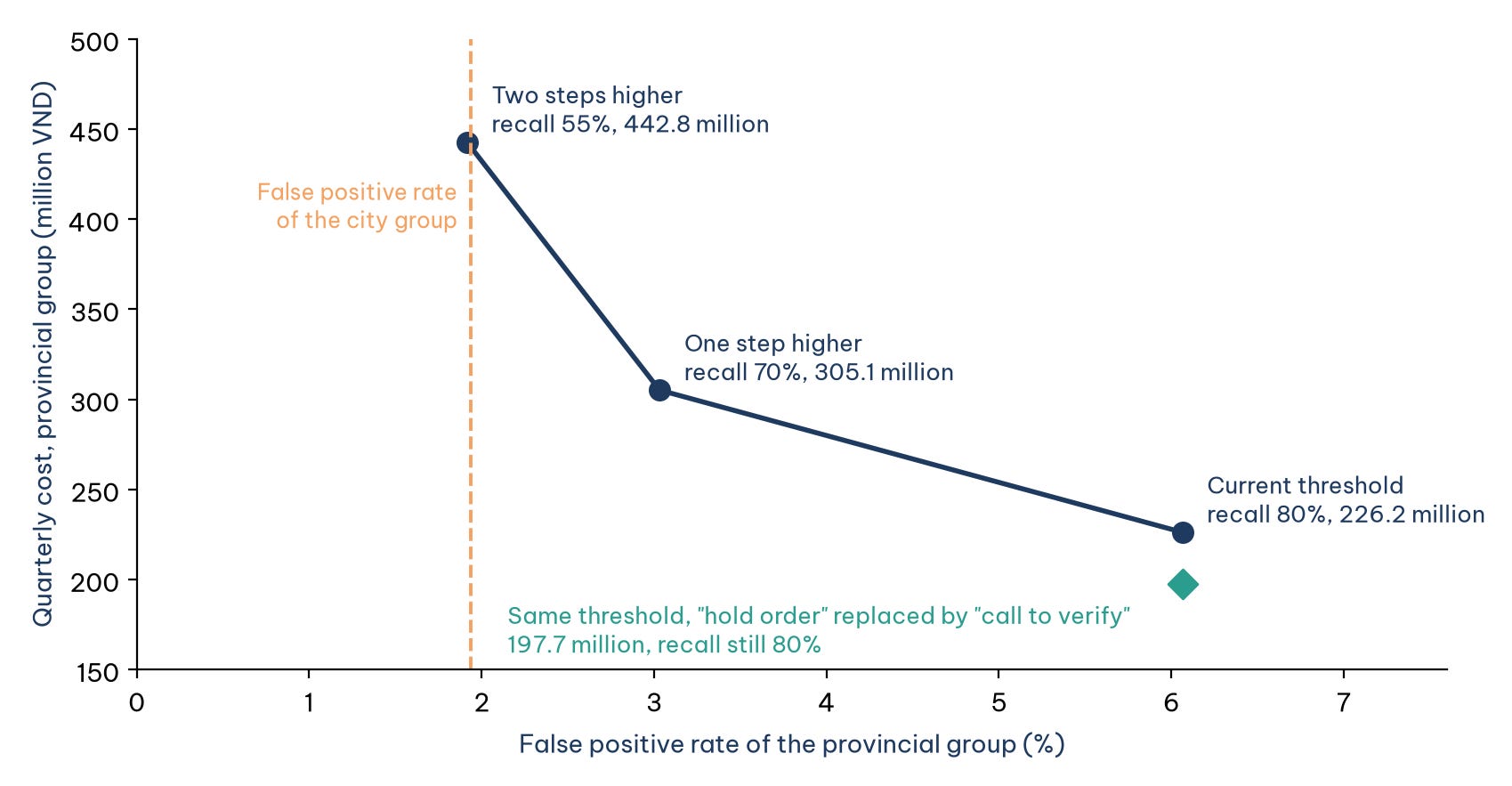
Raising the threshold two steps brings the provincial false positive rate from 6.1% down to 1.9%, level with the cities, but recall falls from 80% to 55% and the quarterly cost rises from about 226 million to 443 million VND, because missed frauds rise from 24 to 54. Changing the threshold trades one group of harmed people for another: honest provincial customers held by mistake against a business losing goods to undetected fraud.
The green point in Figure 4 is a different way out: keep the threshold but replace "hold the order for three days" with "call to verify within two hours". If a call costs about 50,000 VND of staff time and barely annoys the customer, the cost of false positives falls from 34.2 million to 5.7 million VND without missing a single extra fraud. The total drops to about 198 million VND, lower than any threshold option. The provincial false positive rate is still 6.1%, but "being bothered" now means a short call rather than a three-day wait. Many fairness problems are best solved in how results are used, not in the model. The longer-term remedy is better data for the provincial group, so that the model can tell cases apart more accurately.
7.3. A five-step fairness check
The example yields a five-step process for any classification model that affects people, summarised in Table 4.
Step 2 in Table 4 runs against many people's intuition. The usual reflex is to drop variables such as gender, ethnicity or place of residence from the model to "ensure fairness". But postcode, payment method or time of order can carry almost the same information about where someone lives. The model still learns the difference; it simply can no longer be measured, because the group variable has gone. Tools such as Fairlearn or AI Fairness 360 in Table 2 automate step 3, but step 4 remains a human decision.
Conclusion
Bias in AI does not come from an "evil machine" but from very ordinary human choices: using the data at hand, choosing an easy-to-collect measure, setting a reasonable-sounding goal, trusting a number on a screen. Each choice looks harmless, but multiplied by the speed and scale of machines, they can reproduce and amplify the injustices societies are trying to eliminate.
The ten biases in this article, arranged along the system's life cycle, show that there is no single technical fix. Fighting bias is a continuous process: checking data before training, setting objectives carefully, evaluating models for each group of people, monitoring after deployment, and keeping people in the final decision-making seat for consequential matters. For businesses, that is at once an ethical responsibility, a legal requirement and a condition for keeping customers' trust.
Perhaps the most important lesson is to change the question. Instead of asking "Is the machine objective?", ask: "Whose data did this system learn from, whose goals does it optimise, and who pays if it is wrong?" Asking that question is the first step towards building AI systems that truly deserve trust.
References
Adamson, A. S., & Smith, A. (2018). Machine learning and health care disparities in dermatology. JAMA Dermatology, 154(11), 1247–1248. https://doi.org/10.1001/jamadermatol.2018.2348
Angwin, J., Larson, J., Mattu, S., & Kirchner, L. (2016, May 23). Machine bias. ProPublica. https://www.propublica.org/article/machine-bias-risk-assessments-in-criminal-sentencing
Buolamwini, J., & Gebru, T. (2018). Gender shades: Intersectional accuracy disparities in commercial gender classification. Proceedings of Machine Learning Research, 81, 77–91. https://proceedings.mlr.press/v81/buolamwini18a.html
Chouldechova, A. (2017). Fair prediction with disparate impact: A study of bias in recidivism prediction instruments. Big Data, 5(2), 153–163. https://doi.org/10.1089/big.2016.0047
Dastin, J. (2018, October 10). Amazon scraps secret AI recruiting tool that showed bias against women. Reuters. https://www.reuters.com/article/us-amazon-com-jobs-automation-insight-idUSKCN1MK08G
Government of Vietnam. (2025). Nghị định số 356/2025/NĐ-CP quy định chi tiết một số điều và biện pháp thi hành Luật Bảo vệ dữ liệu cá nhân [Decree No. 356/2025/ND-CP detailing the Law on Personal Data Protection]. https://chinhphu.vn/?pageid=27160&docid=216387
Kay, M., Matuszek, C., & Munson, S. A. (2015). Unequal representation and gender stereotypes in image search results for occupations. Proceedings of CHI 2015, 3819–3828. https://doi.org/10.1145/2702123.2702520
Kleinberg, J., Mullainathan, S., & Raghavan, M. (2016). Inherent trade-offs in the fair determination of risk scores (arXiv:1609.05807). arXiv. https://arxiv.org/abs/1609.05807
Koenecke, A., Nam, A., Lake, E., Nudell, J., Quartey, M., Mengesha, Z., Toups, C., Rickford, J. R., Jurafsky, D., & Goel, S. (2020). Racial disparities in automated speech recognition. PNAS, 117(14), 7684–7689. https://doi.org/10.1073/pnas.1915768117
Lum, K., & Isaac, W. (2016). To predict and serve? Significance, 13(5), 14–19. https://doi.org/10.1111/j.1740-9713.2016.00960.x
Mehrabi, N., Morstatter, F., Saxena, N., Lerman, K., & Galstyan, A. (2021). A survey on bias and fairness in machine learning. ACM Computing Surveys, 54(6), 1–35. https://doi.org/10.1145/3457607
National Assembly of Vietnam. (2025). Luật Bảo vệ dữ liệu cá nhân số 91/2025/QH15 [Law on Personal Data Protection No. 91/2025/QH15]. https://chinhphu.vn/?pageid=27160&docid=214590&classid=1&typegroupid=3
National Institute of Standards and Technology. (2023). Artificial Intelligence Risk Management Framework (AI RMF 1.0). https://doi.org/10.6028/NIST.AI.100-1
Obermeyer, Z., Powers, B., Vogeli, C., & Mullainathan, S. (2019). Dissecting racial bias in an algorithm used to manage the health of populations. Science, 366(6464), 447–453. https://doi.org/10.1126/science.aax2342
Sap, M., Card, D., Gabriel, S., Choi, Y., & Smith, N. A. (2019). The risk of racial bias in hate speech detection. Proceedings of ACL 2019, 1668–1678. https://doi.org/10.18653/v1/p19-1163
Zech, J. R., Badgeley, M. A., Liu, M., Costa, A. B., Titano, J. J., & Oermann, E. K. (2018). Variable generalization performance of a deep learning model to detect pneumonia in chest radiographs. PLOS Medicine, 15(11), e1002683. https://doi.org/10.1371/journal.pmed.1002683
Discussion about this post