Taobao's Three Business Model Reinventions
How one e-commerce platform kept redefining its own customers, value proposition and way of making money, and what other markets can learn


Key takeaways
Taobao is often called "the eBay of China", but in its first decade it built three different business models, each with its own main customers, value proposition and revenue stream.
Phase 1 (2003–2006) sold trust before services: Alipay escrow, the Aliwangwang chat tool and zero seller fees beat eBay EachNet.
Phase 2 (2006–2009) empowered micro-entrepreneurs, giving rise to "Taobao villages" in rural China.
Phase 3 (2009–2013) turned its user base into a foundation for advertising and spun off Tmall for authentic brands: free to be present, pay to stand out.
Search marketplaces, group buying and content commerce turn attention into orders in different ways, and each demands different seller capabilities; that is why even Taobao had to add livestreaming.
The lesson for e-commerce elsewhere: treat the business model as a hypothesis to be re-tested whenever customers, competitors or technology change.
Launched in 2003 inside the Alibaba Group, Taobao is often simplified as "the eBay of China". That description misses the most important point: in roughly its first ten years, Taobao built three different business models in succession, each with its own main customer group, value proposition and way of making money. Each change reflected the maturing of both the company and the market it served.
Taobao's story is worth studying not for its size but because it shows that a business model is not a blueprint drawn once and kept forever. A platform at the start-up stage has to solve very different problems from one with hundreds of millions of users; keeping the old model after the problem has changed is the fastest way to be overtaken by competitors.
The article follows the chronology. Section 1 gives an overview of the three phases. Sections 2, 3 and 4 analyse each phase in turn: building trust, empowering small sellers, and turning the user base into the foundation of a new model. Section 5 reviews the changes of the 2020s, Section 6 compares three routes from attention to order (search marketplace, group buying and content commerce), and Section 7 draws lessons for e-commerce in other markets, especially emerging ones.
1. The three phases at a glance
Before going into detail, it helps to see the whole journey on one timeline and through one analytical frame. This section presents an illustration of the Taobao ecosystem, a timeline of the main milestones and a table comparing the three phases using the blocks of the Business Model Canvas.
Figure 1 illustrates the ecosystem Taobao built: sellers, buyers and supporting services such as payment and logistics, all operating on one platform.
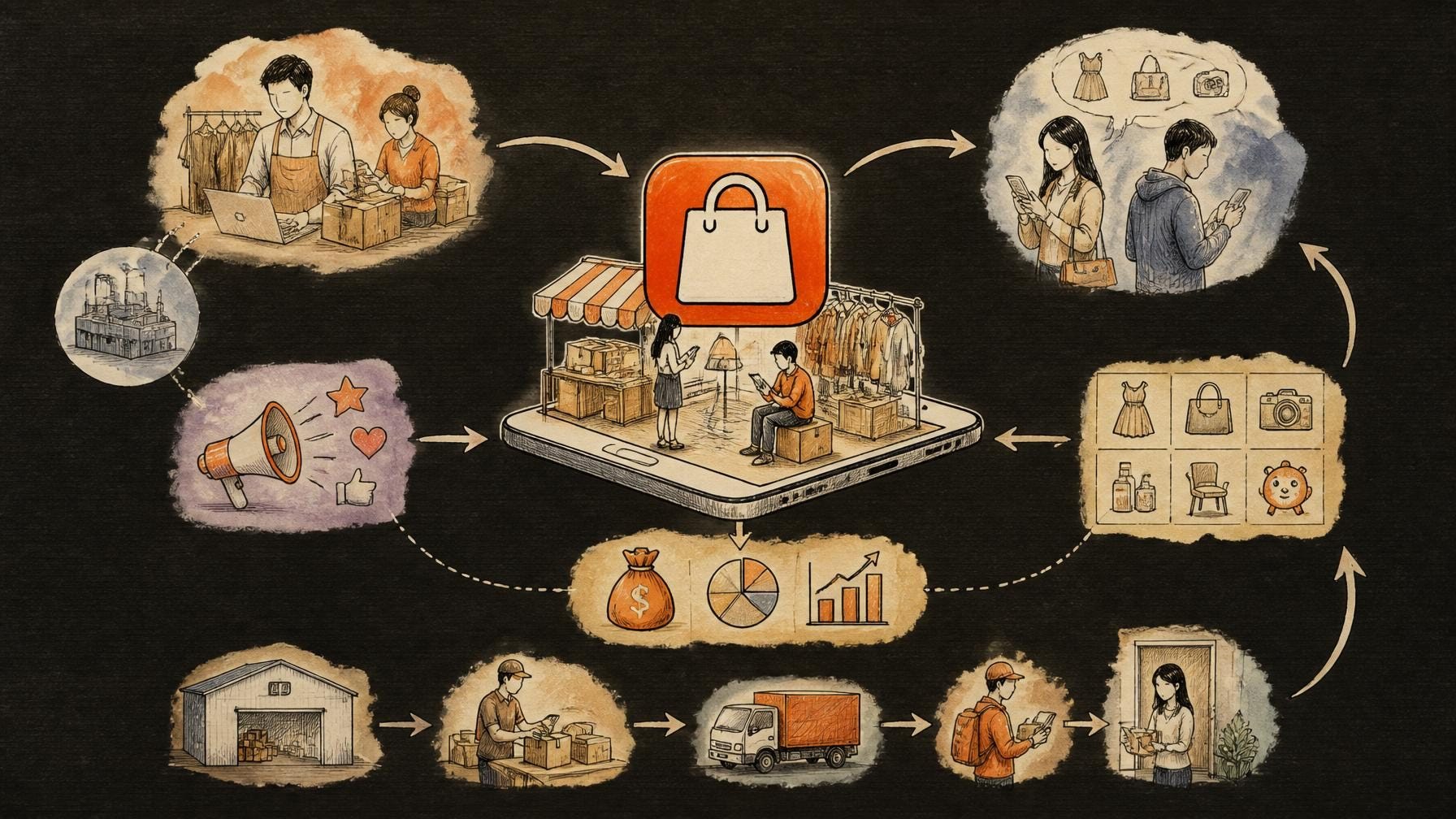
Figure 2 places the most important milestones on a timeline, from Taobao's launch to Alibaba's restructuring in 2023.
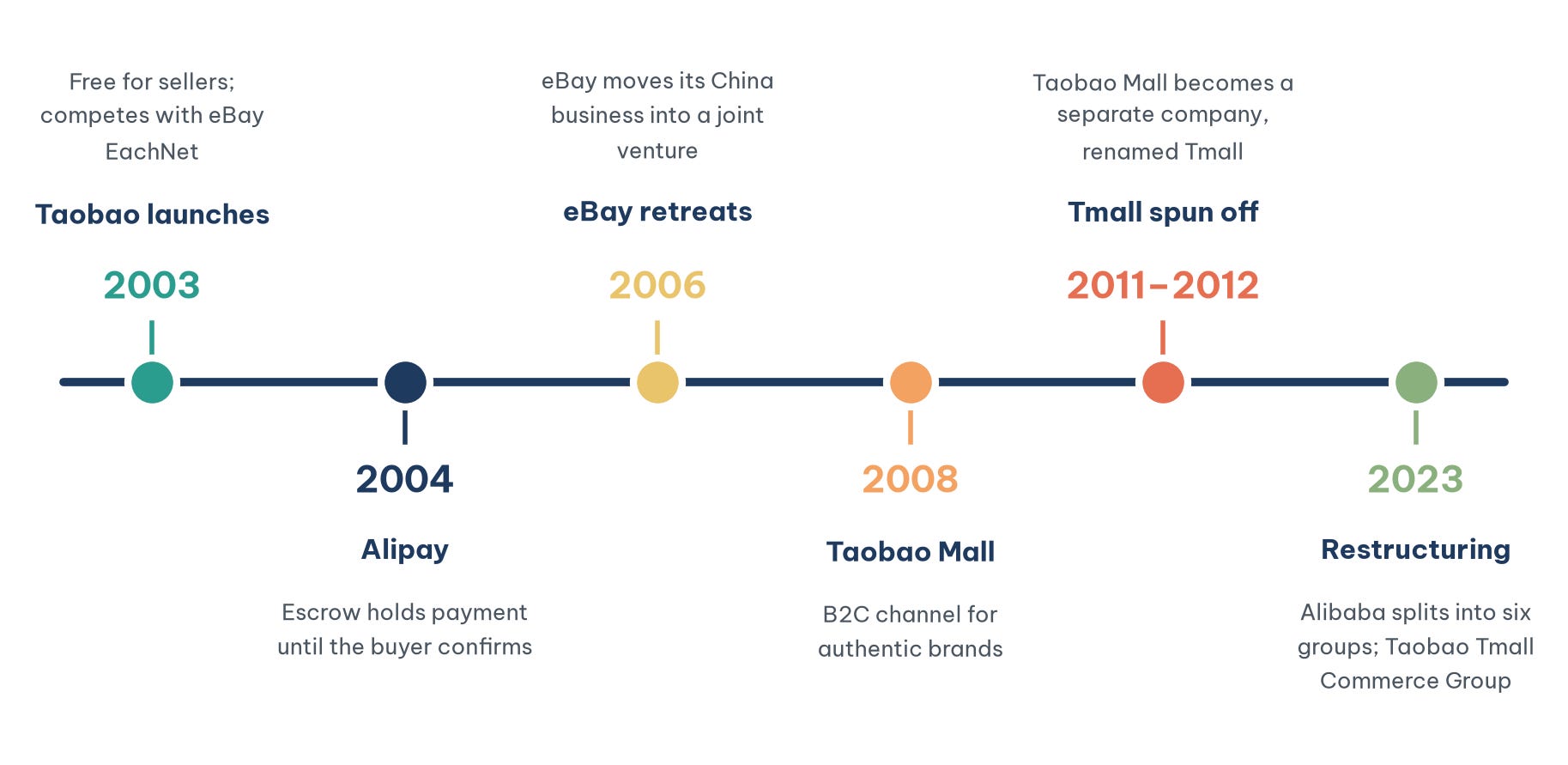
The timeline in Figure 2 shows that the milestones are not isolated but follow from one another: Alipay solved trust, trust drew in small sellers, and a large base of sellers and buyers opened the way to advertising and to a separate channel for authentic brands. Table 1 summarises the three phases on five aspects of the business model, following the Business Model Canvas approach (Osterwalder & Pigneur, 2010).
Reading Table 1 across the rows, the revenue stream is the block that changes most: from charging almost nothing, to charging for services, to advertising. But that change was only possible because the blocks above it, customers and value proposition, had changed first. The next three sections analyse each of these shifts.
2. Phase 1: building trust from zero (2003–2006)
When Taobao was born, the biggest barrier to e-commerce in China was not technology but trust. Buyers feared paying and never receiving the goods; sellers feared shipping and never getting paid. The market also already had a big player, eBay, operating through EachNet, an auction site eBay had acquired. This section analyses the two ways Taobao solved the trust problem and the pricing strategy that helped it beat eBay.
2.1. Filling in the missing infrastructure
Taobao did not try to persuade users to trust each other with promises; it built tools that turned trust into a structured guarantee. The most important was Alipay, launched in late 2004: an escrow payment service that held the buyer's money until the buyer confirmed receiving goods as described. Buyers no longer had to bet on a stranger's honesty, and sellers knew the money was already in the system.
The second tool was Aliwangwang, a direct messaging app between buyers and sellers. It recreated the habit of asking, chatting and haggling that is so familiar in Chinese market shopping culture, something Western-style marketplaces paid little attention to. Being able to talk to the seller made online transactions feel less foreign and helped buyers judge reliability for themselves.
2.2. Free for sellers as a platform strategy
To attract sellers, Taobao charged sellers nothing, while eBay EachNet charged listing fees. On the surface this looks like costly generosity. Through the lens of platform economics, it was a strategy of subsidising one side to solve the "chicken-and-egg" problem: buyers come only when there are many sellers, and sellers come only when there are many buyers (Parker et al., 2016). With sellers' cost of joining at zero, the supply side grew quickly, pulling demand along with it.
The result was that Taobao soon overtook eBay in both sellers and buyers. In 2006, eBay withdrew from mainland China by moving its operations into a joint venture. The lesson of this phase is that in a young market, the first thing to sell is not a service but trust, and the first thing to optimise is not revenue but the scale of participation.
3. Phase 2: a launch pad for micro-entrepreneurs (2006–2009)
Once the platform was stable and trust had been built, the strategic question shifted from "how do we get people to dare to trade?" to "how do we help sellers do better business on the platform?". This section describes how Taobao moved from being an intermediary to being an enabler, and the social phenomenon that shift created.
3.1. From intermediary to enabler
In this phase, Taobao invested in tools for sellers: store and order management, marketing services and customer analytics. More importantly, it opened access to a huge consumer market that had previously been entirely out of reach for a small business in a remote area. A rural household making handicrafts, which used to sell only to customers in its own county, could now sell to buyers in big cities.
The value proposition therefore shifted from "a safe place to trade" to "a place where you can create your own livelihood". Sellers were no longer just one side of a transaction; they became the central customers the platform needed to serve, and later to charge.
3.2. The Taobao village phenomenon
This phase is linked to the phenomenon of "Taobao villages": rural villages where many households run online businesses together, turning the countryside into production and retail clusters. Studies of Taobao villages show that they create rural income and jobs, but the benefits are unevenly spread across regions, concentrating in places that already have transport infrastructure and production clusters (Wei et al., 2020).
Taobao villages are evidence that a platform can create social value beyond transactions. But they also show the conditions for this to happen: logistics infrastructure, payments and a distinctive product the whole village can make together.
4. Phase 3: the user base as a foundation for a new model (2009–2013)
After the first two phases, Taobao owned something no rival could easily copy: huge numbers of buyers and sellers together with data on their behaviour. The third phase was when the platform realised that its most valuable asset was not individual transactions but that attention and data themselves. This section analyses the change in revenue structure and the decision to spin off a channel for big brands.
4.1. Advertising instead of transaction fees
When a marketplace has millions of sellers, the sellers' problem is no longer being present but being seen. Taobao turned that problem into its main source of revenue: sellers pay to make their products stand out in search results and recommendation slots. Behavioural data serves both sides, personalising the experience for buyers and optimising ad performance for sellers.
This is a classic example of the advertising-sponsored tactic, in which one side of a platform uses it for free while the other pays for access. Phase 1's "free for sellers" strategy was not abandoned but transformed into "free to be present, pay to stand out".
4.2. A separate channel for authentic brands
At the same time, Taobao resolved a tension within its own ecosystem: buyers wanted guaranteed authentic goods, while an open marketplace for everyone made quality hard to control. Taobao Mall was launched in 2008 as a separate channel for brands and official retailers. In June 2011, Taobao Mall was spun off as a separate company and in early 2012 renamed Tmall, with deposits and fees required of brands; Taobao continued to serve individual and small sellers (Clark, 2016).
This decision was a form of platform segmentation: the same base of buyers, but two models for two groups of sellers with different needs and ability to pay. It let Alibaba charge big brands more without losing the advantage it had built with small sellers.
5. The 2020s: livestreaming, AI and instant retail
The first three phases were not the end of the story. Under competitive pressure from Pinduoduo, a low-price group-buying platform, and Douyin, the Chinese version of TikTok, Taobao kept changing. This section reviews four main directions of change and shows that they still build on the "DNA" of earlier phases.
The first direction is livestream commerce. Taobao Live became a major sales channel, especially during shopping festivals such as Singles' Day on 11 November. In one sense, it is a new version of the direct-conversation spirit that Aliwangwang brought in the early phase: buyers want to see, ask and interact with sellers before deciding.
The second direction is generative AI, used for smarter search, personalised recommendations, shopping assistants and tools that help sellers create content, images and product descriptions. This continues Phase 3, when data became the central asset.
The third direction is instant retail: same-day or within-hours delivery, competing directly with food and grocery delivery platforms. The fourth is restructuring: in 2023, Alibaba announced it would split into six business groups, with domestic e-commerce under the Taobao Tmall Commerce Group (Alibaba Group, 2023), and the group has continued to adjust its structure in the years since.
What these four directions have in common is that they do not replace the old foundations but add layers of value on top: the trust infrastructure, the user base and the data are still what let Taobao test new models faster than a business starting from scratch.
6. Three routes to an order: marketplace, group buying and content
The pressure from Pinduoduo and Douyin in Section 5 is not just competition between companies. It is competition between three ways of turning user attention into orders. This section sets them side by side to show why even a platform as strong as Taobao had to change, and what capabilities sellers need.
6.1. What social commerce is
Social commerce is e-commerce conducted through social media, combining e-commerce, marketing and user-generated content; its core is that social features such as groups, sharing, recommendations and reviews are used before, during and after purchase, not just for advertising (Turban et al., 2017). Unlike social media marketing, which uses social networks to send customers to a separate sales channel, social commerce turns the social network itself into the place of sale. Figure 3 compares the route from attention to order in three models.
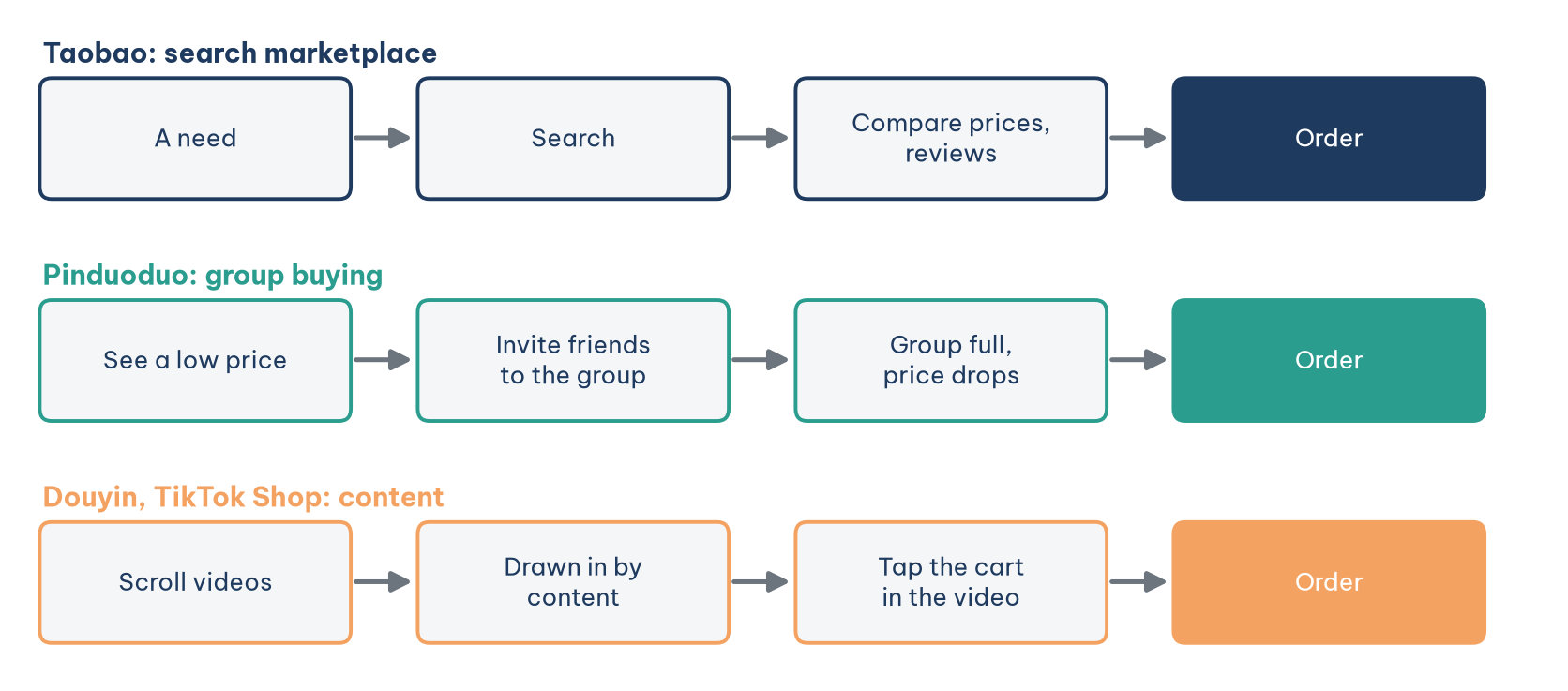
In a search marketplace such as Taobao, buyers arrive with a need; the platform works like a vast market with ready-arranged shelves, and competition happens on search ranking, price and reviews. In group buying such as Pinduoduo, a low price is the bait and buyers themselves recruit more buyers; the model had little success in the United States because groups were hard to organise, but became very popular in China (Turban et al., 2017). In content commerce such as Douyin or TikTok Shop, users do not look for products; products find users through video and livestreams, and demand is often created while watching.
6.2. Where the three models differ
Table 2 compares the three models on the points that matter to sellers.
Read by column, Table 2 shows why Taobao had to add Taobao Live: as more attention moves to video, a marketplace that waits for buyers to search loses orders that are created by inspiration. Read along the last row, it shows that a small seller can hardly excel at all three at once. A small specialty coffee brand might sell on a marketplace to serve buyers who already know what they want, use livestreams to tell the story of its farm and harvest, and use workplace or neighbourhood chat groups as a form of group buying: when five colleagues order one shared parcel, the delivery fee per person drops sharply, and the saving can be returned to the group as free delivery. As content commerce grows, regulators are also catching up, with rules on seller identity verification for livestream sales and labels for AI-generated presenters, which raise compliance costs but reward sellers who trade honestly.
7. Lessons for e-commerce in other markets
Other markets are not China, but many of the problems Taobao faced are appearing, or have already appeared, elsewhere, especially in emerging markets in Southeast Asia, South Asia, Africa and Latin America: from trust in online buying to competition between traditional marketplaces and short-video platforms. Table 3 sets out five lessons from Taobao and how they show up in other markets, with examples from Vietnam.
The third row of Table 3 has direct consequences for sellers: when ad spending becomes a compulsory cost of being seen, the real profit margin can be much lower than first calculated. Sellers need to include this cost when they compare customer lifetime value (CLV) with customer acquisition cost (CAC). The last row is a reminder that adjusting the business model should be a regular activity, not a one-off reaction to crisis.
Conclusion
Taobao's three reinventions can be summed up as three questions the platform answered in turn. In the first phase, the question was how to get strangers to dare to trade with each other, and the answer was Alipay, Aliwangwang and free listings for sellers. In the second phase, the question was how to help small sellers make a living, and the answer was tools and access to a market. In the third phase, the question was how to turn the user base into sustainable revenue, and the answer was advertising, data and a separate channel for big brands.
What is most worth learning is not any one of those answers, but the fact that Taobao recognised the question had changed before it was forced to change. For e-commerce businesses everywhere, and especially for start-ups, that lesson means treating the business model as a hypothesis to be re-tested whenever customers, competitors or technology change.
References
Alibaba Group. (2023). Alibaba Group announces organizational restructuring [Press release]. https://www.sec.gov/Archives/edgar/data/1577552/000110465923037408/tm2310734d1_ex99-1.htm
Clark, D. (2016). Alibaba: The house that Jack Ma built. Ecco. https://www.amazon.com/s?k=Alibaba+Clark&i=stripbooks
Osterwalder, A., & Pigneur, Y. (2010). Business model generation. Wiley. https://www.wiley.com/en-us/Business+Model+Generation:+A+Handbook+for+Visionaries,+Game+Changers,+and+Challengers-p-9780470876411
Parker, G. G., Van Alstyne, M. W., & Choudary, S. P. (2016). Platform revolution. W. W. Norton. https://wwnorton.com/books/Platform-Revolution/
Turban, E., Whiteside, J., King, D., & Outland, J. (2017). Introduction to electronic commerce and social commerce (4th ed.). Springer. https://doi.org/10.1007/978-3-319-50091-1
Wei, Y. D., Lin, J., & Zhang, L. (2020). E-commerce, Taobao villages and regional development in China. Geographical Review, 110(3), 380–405. https://doi.org/10.1111/gere.12367
Discussion about this post