Systems Thinking for Managers: The Iceberg and Ten Archetypes
The iceberg model, feedback loops and ten system archetypes that reveal the structure behind problems that keep coming back


Key takeaways
Linear thinking assumes A causes B. In complex systems, causes and effects are separated in space and time, and results loop back to become causes.
The iceberg model moves from events to patterns, structures and mental models; lasting change happens at the bottom of the iceberg.
Every system runs on two engines: reinforcing loops (the accelerator) and balancing loops (the brake), often with delays.
Ten archetypes, from "fixes that fail" to "tragedy of the commons", recur across business, economics and daily life. Each has a recognisable signature and a leverage point.
The most powerful leverage points rarely lie in surface numbers; they lie in the rules, information flows and mental models of the system.
The business environment is often described with the acronym VUCA: volatile, uncertain, complex and ambiguous. In such an environment every decision has tangled, hard-to-predict consequences. Yet our default habit of mind is linear thinking: we believe every problem has one direct cause and a matching effect (A leads to B).
Reality rarely runs in straight lines. You believe that raising employees' pay (A) will directly raise productivity (B). But in a complex system, that move can spark hidden, toxic competition, break team spirit and finally drag down the whole company's performance (C).
When cause and effect no longer sit side by side in space and time, linear thinking collapses. That is when we need a sharper lens: systems thinking. This article introduces its three core tools: the iceberg model, feedback loops and ten system archetypes, each archetype with five examples.
The article has five parts. Section 1 explains what systems thinking is and how it differs from linear thinking. Section 2 introduces the iceberg model, a tool for looking from events down to structures and mental models. Section 3 presents the two "engines" of every system: reinforcing and balancing loops. Section 4, the longest, analyses the ten archetypes, each with a diagram, a leverage point and five examples from daily life, the economy and business; it can be read one archetype at a time. Section 5 sums up and suggests three steps for practising systems thinking at work.
1. What is systems thinking?
Systems thinking is not an attempt to cram every detail into your head. It is a holistic approach focused on the links, interactions and dynamics between the parts of a whole, rather than dissecting each piece in isolation.
Recall the classic parable of the blind men and the elephant. The one who touches the trunk says the elephant is like a snake; the one who touches a leg insists it is a pillar. Linear thinking is those blind men: clinging to a local symptom and mistaking it for the whole truth. Systems thinking asks you to step back ten paces and see the whole elephant. More than seeing, it asks you to understand how its nerves, muscles, eating habits and habitat work together to let it move and survive.
2. The iceberg model
The first tool is the iceberg model, widely used in teaching systems thinking and often associated with Peter Senge and his colleagues at MIT. It helps us see beneath the surface of messy events, dividing reality into four layers from shallow to deep:
Layer 1: Events (the tip). What strikes us immediately. Example: this month's report shows revenue down 20%. Linear reflex: launch a flash sale to "put out the fire".
Layer 2: Patterns and trends (below the waterline). Events that repeat over time and form a pattern. Example: looking back over three years, revenue always dips in Q3, and the customer-complaint rate is rising steadily.
Layer 3: System structures. The invisible forces producing those patterns: processes, policies or physical constraints. Example: warehouse capacity jams every rainy season (Q3), combined with a KPI policy that rewards only new sales and neglects care for existing customers.
Layer 4: Mental models (the base). The core beliefs, assumptions and cultural DNA that generate the structures above. Example: management holds a proud belief that "if our product is good, customers will come without after-sales service".
Figure 1 illustrates the four layers.
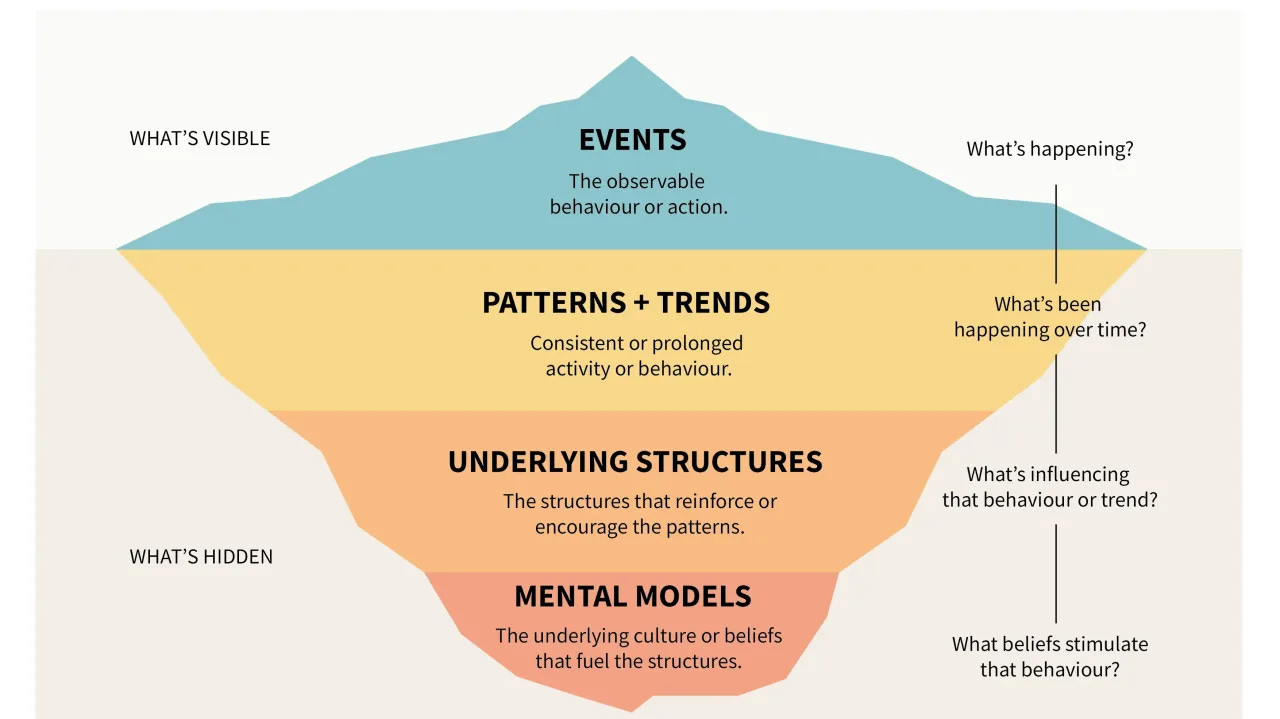
The leverage point. If you keep fighting fires at the level of events, the fire will always come back and you will forever be chasing problems. Real, lasting change only happens when you dare to intervene in the structures and reshape the mental models at the bottom of the iceberg.
3. Feedback loops: the engines of a system
If the iceberg helps you see the depth of a problem, feedback loops help you see how it moves over time. In linear thinking, the arrow of cause and effect points one way (A → B). Through the systems lens, things interact and bend into closed loops (A → B → A): every result today loops back to become a cause shaping tomorrow. To decode any complex system, you need to recognise two engines.
3.1. Reinforcing loops (R)
The reinforcing loop drives explosive growth or catastrophic decline. It amplifies any initial movement, so the system rolls like a snowball downhill.
Virtuous cycle: compound interest. Capital earns profit; profit is added to capital, so capital grows; next period's profit is larger still. The system takes off.
Vicious cycle: panic in a financial crisis. A few people sell shares; prices dip and others take fright; the crowd dumps shares; the market crashes. The system destroys itself.
3.2. Balancing loops (B)
If the reinforcing loop is the accelerator, the balancing loop is the brake. It keeps the system stable, resists excessive swings and pulls everything back towards a set goal. A classic example is an air conditioner: the room rises above 25°C, a sensor detects the gap, the compressor pumps cold air, the room cools back to 25°C, and the compressor switches off.
Every complex entity, from the human heartbeat to the stock market to Earth's ecosystems, is an intricate dance of thousands of reinforcing and balancing loops. Understand them and you know when to press the accelerator and when to brake. Table 1 summarises the difference. Every archetype in the next section is a combination of these two building blocks, usually with a delay.
4. Ten system archetypes: the classic traps
In The Fifth Discipline, Peter Senge (1990), drawing on system dynamics work at MIT, showed that complex systems tend to repeat a small number of patterns called system archetypes. Recognising them helps us predict consequences and find the leverage point for intervention. The diagrams below come from Wikimedia Commons.
4.1. Balancing process with delay
A system tries to reach equilibrium (supply equals demand, a room at 25°C). In the real world, there is always a time delay between action and result. Not seeing results immediately, people lose patience, decide they "haven't done enough" and keep intervening (overcorrecting). When the delay passes, all those actions land at once, throwing the system to the opposite extreme and creating violent oscillation. Figure 2 shows the structure.
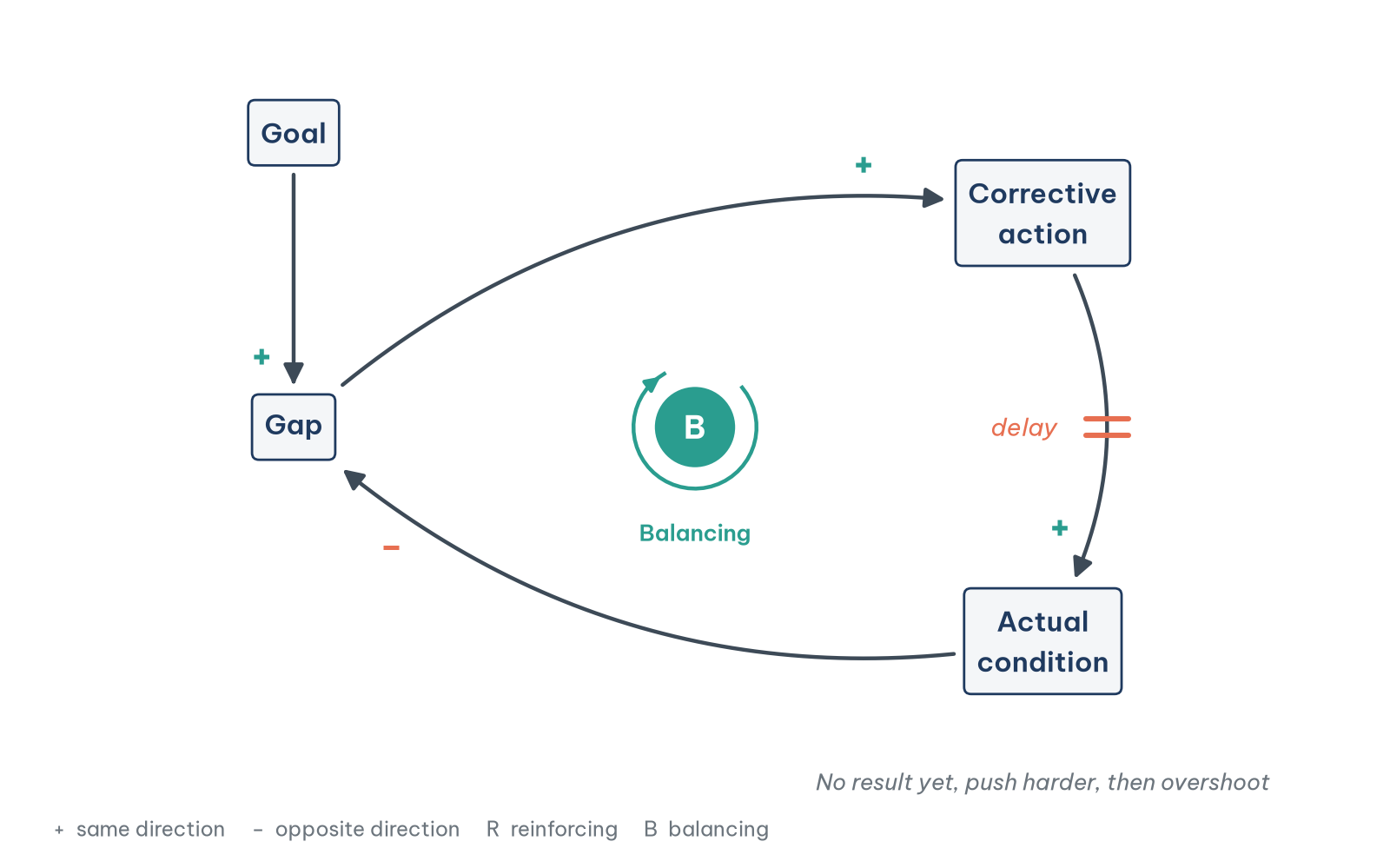
Leverage point. Know how long your system's delays are. In a slow system, drastic action is suicidal: make small adjustments and wait patiently for the full response before acting again, or improve information systems to shorten the delay.
Example 1 (daily life): the shower tap. The water is a little cold, so you turn the tap towards hot. After two seconds nothing changes (the delay), so you turn it all the way. Five seconds later scalding water pours down; you yank it back to cold. You end up dancing between boiling and freezing. Leverage: turn the tap a little, wait 5–10 seconds for the water in the pipe to run through, then decide.
Example 2 (macroeconomics): central-bank interest rates. Inflation is high, so the central bank raises rates. But monetary policy takes 6–12 months to work through (the delay). Seeing no fall in inflation next month, the bank keeps raising rates. A year later the accumulated rises crush businesses and trigger recession and mass unemployment. Leverage: in normal times, modern central banks such as the Fed move in small steps (0.25 percentage points), then pause to watch leading indicators for a few months before the next move.
Example 3 (agriculture): the pork cycle. Economists call this the cobweb model; in Vietnam, the collapse of live-pig prices in 2017 after a period of high prices is a much-cited case. Pork prices soar and farmers profit, so everyone expands their herds. But pigs take 6–8 months to grow (the delay), and during that time prices stay high, encouraging still more breeding. When all the pigs reach market together, supply floods in, prices crash, farmers go bankrupt and the government appeals to the public to "rescue" farmers by buying pork. Leverage: government or farmers' associations should provide forecasts (removing the information delay), warn immediately when sales of breeding piglets exceed market demand, and use forward contracts to lock in prices.
Example 4 (supply chains): the bullwhip effect (Lee et al., 1997; figures illustrative). A retailer sees demand for toilet paper jump 10%. Fearing shortages, it orders 20% more from its distributor. The distributor, fearing slow deliveries from the factory, orders 40% more; the factory produces 80% more. A few months later demand returns to normal and the whole chain is stuck with mountains of unsold paper. Leverage: share point-of-sale (POS) data in real time across the chain, so the factory knows the moment a roll is sold, removing guesswork and information delays.
Example 5 (labour market): a glut of IT graduates. Tech booms, programmers are scarce and salaries soar. Tens of thousands of students enrol in computer science, but they need four years to graduate (the delay). Four years later the tech market cools while all of them graduate at once, and IT unemployment rises while salaries fall. Leverage: individuals should choose a field based on core strengths and long-term trends rather than today's heat; companies should build continuous internal training pipelines instead of hiring frantically when short-staffed.
4.2. Fixes that fail
Fixes that fail, sometimes called the cobra effect, happen when a symptom appears and demands attention. A quick fix is applied, and in the short term it seems to work. But it quietly triggers an unintended consequence that, over time, makes the original problem worse, forcing more of the same fix. The short-term balancing loop runs problem → fix → problem eases; the long-term reinforcing loop runs fix → side effect → problem grows. Figure 3 shows the structure.
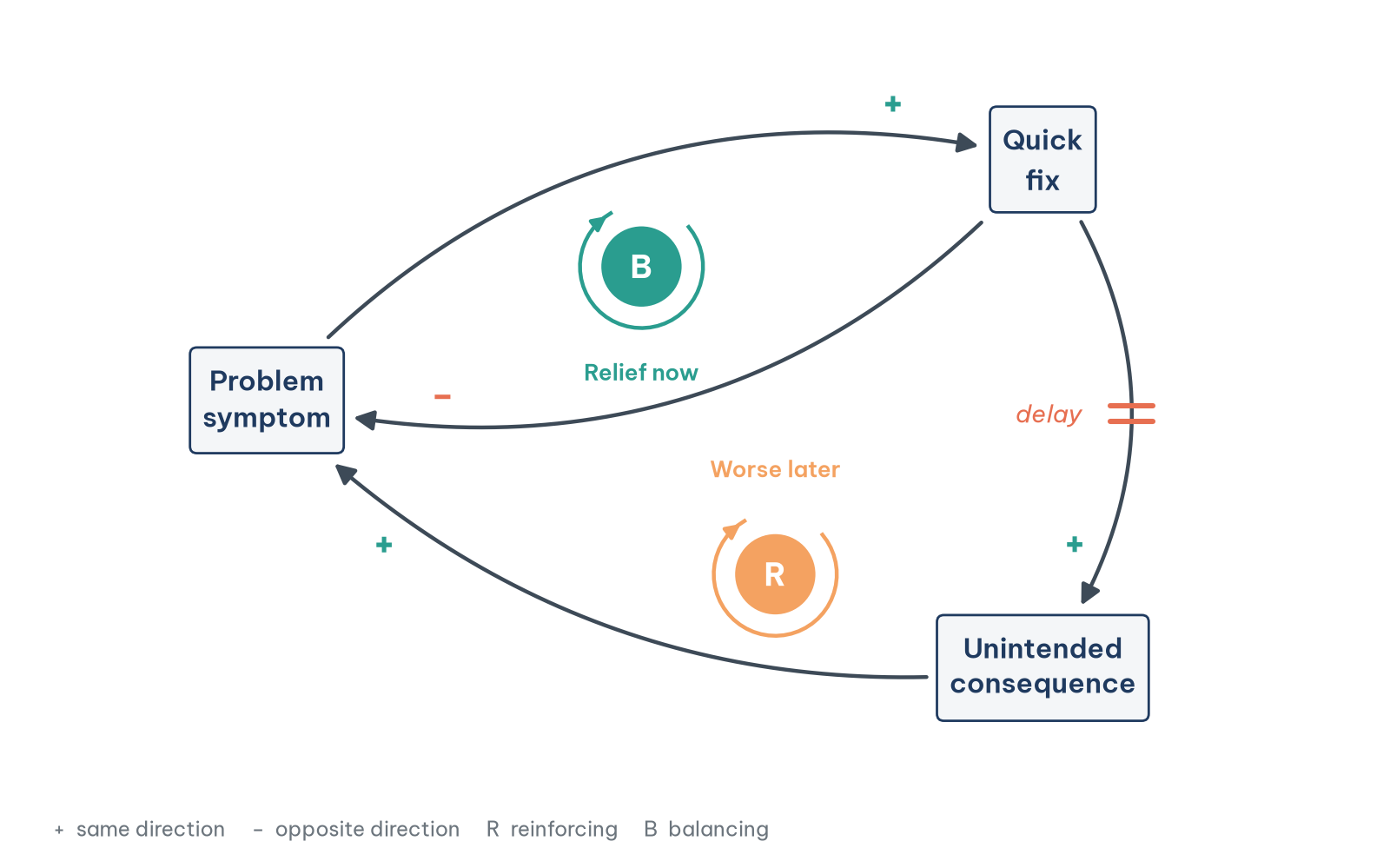
Leverage point. Admit that the current fix is a plaster on an infected wound. Keep it if necessary to survive, but put resources into finding and solving the root cause, and accept that things may get a little worse before they get better.
Example 1 (history): rat-tail bounties in Hanoi, 1902. The story of cobras in Delhi is often told to illustrate this archetype but has almost no historical documentation. A better-recorded case happened in Vietnam: in 1902 the French colonial authorities in Hanoi, facing plague and rats in the newly built sewers, paid a bounty for every rat tail handed in. Tails poured in, but tailless rats began to appear all over the city: catchers cut off the tails and released the rats to keep breeding, and some people even farmed rats for their tails (Vann, 2003). The policy was scrapped. Leverage: rewarding a surface indicator (tails) instead of the real outcome (fewer rats) creates an incentive to game the indicator. The root solution is better sanitation and waste handling; any bounty must measure the real result, such as rat density at survey points.
Example 2 (business): cutting maintenance to save profit. A factory's profit is down this quarter, so the director cuts scheduled maintenance. Profit rises as hoped. Six months later machines break down badly and the line stops; repairs and lost production cost far more than the savings. Leverage: never cut foundational costs; to raise profit, find the root cause (falling revenue because of product quality or weak marketing?) and fix it there.
Example 3 (daily life): coffee against sleep deprivation. You work late and feel sleepy, so you drink two cups of coffee and keep going. But the caffeine keeps you awake the next night, so you are even more tired the next morning and need four cups. The loop continues until you are exhausted. Leverage: coffee borrows energy from the future; reorganise your workload and daytime schedule to sleep 7–8 hours a night.
Example 4 (urban policy): widening roads to cut congestion. The city is congested, so the road is widened from two lanes to four. Traffic flows for a year or two, but the wider road encourages people to buy cars and developers to build along it (induced demand). A few years later the four-lane road is jammed again. Duranton and Turner (2011) estimated that in US cities vehicle-kilometres travelled rise almost one-for-one with new road-kilometres built, which they called the "fundamental law of road congestion". Leverage: the root solutions are urban planning that spreads schools, hospitals and offices more evenly, and heavy investment in public transport.
Example 5 (software): spaghetti code. Software has a bug. Instead of reviewing the architecture, a developer writes a quick patch to meet a deadline. The bug disappears, but the patch makes the system more complex, and at the next update it clashes with a new feature, producing three worse bugs. Leverage: accept a slightly late deadline to refactor and pay down technical debt.
4.3. Shifting the burden
This pattern is subtler than fixes that fail. Facing a hard problem, a system has two options: a fundamental solution (slow, effortful, painful) and a symptomatic one (quick and easy). People usually choose the symptomatic fix. The danger is that with repeated use, the capacity to apply the fundamental solution withers, and the system becomes addicted to the symptomatic fix. Figure 4 shows the structure.
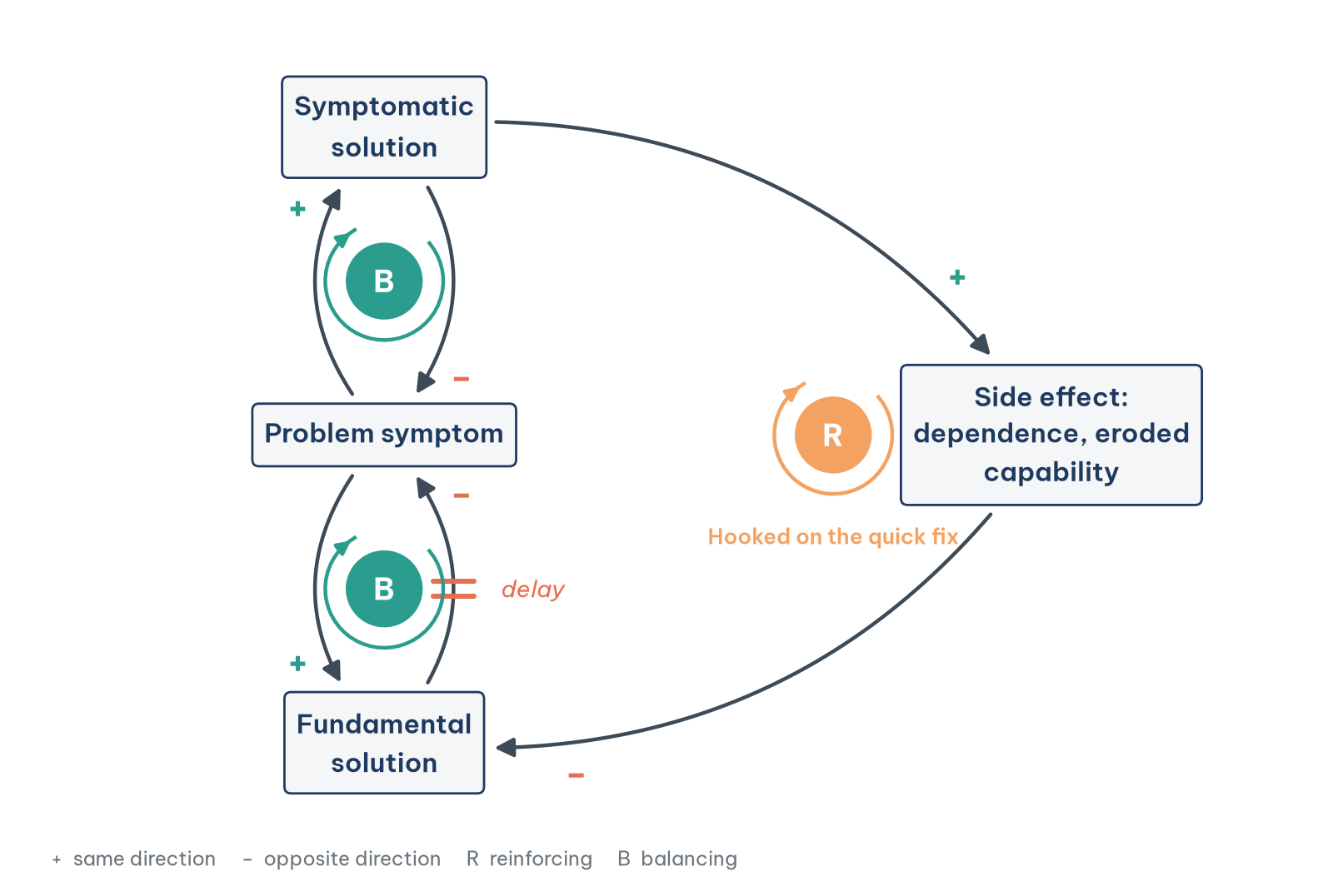
Leverage point. Ask, "What or whom are we increasingly dependent on to solve this?" Then act on two fronts: strengthen commitment to the fundamental solution while weaning off the symptomatic one.
Example 1 (psychology): addiction. Someone faces heavy pressure at work. The fundamental solution is learning to manage emotions, talking to the boss or changing jobs, but that is hard, so they drink to forget. Relief comes at once, but over time their ability to face difficulty disappears; they become dependent on alcohol, and the work pressure remains, or worsens as performance drops. Leverage: outside help (therapists, treatment programmes) to break the dependency while rebuilding coping capacity through exercise, mindfulness and stronger professional skills.
Example 2 (business): overreliance on agencies and consultants. The in-house marketing team is weak. Instead of training staff or hiring a strong leader, the company hires a top agency, whose campaign succeeds. Next time it hires the agency again. After three years the in-house team only forwards emails and has lost all creativity, and the company is held hostage by the agency at huge cost. Leverage: if you hire an agency, include knowledge-transfer clauses and have staff shadow the experts, aiming to run similar campaigns in-house within a year.
Example 3 (parenting): doing children's homework for them. A child cries over a hard maths problem. The fundamental solution is patiently explaining the method so the child can think it through, but a busy or soft-hearted parent simply gives the answer. The child gets a good mark, cries for help next time too, and gradually loses independent thinking and confidence. Leverage: accept a few bad marks in the short term and act as coach, not doer.
Example 4 (international development): food aid. A country faces famine because of weak agriculture. Food aid saves lives in a crisis and is necessary. But if free food is distributed for too long, local crop prices can fall, farmers struggle to sell and produce less, domestic farming withers and dependence on aid grows. Economists still debate how large this effect is, but many aid agencies acknowledge the risk. Leverage: save lives in the crisis; in the long run, shift to buying food locally or regionally (supporting domestic farmers), and provide cash, seeds, irrigation and technical training.
Example 5 (personal finance): living on credit cards. Income doesn't cover spending. The fundamental solution is cutting unnecessary spending or learning skills to earn more; instead, you use your credit card and keep your lifestyle. Interest compounds, and you work ever harder just to pay it, with no time left to develop yourself. Leverage: cut up the card, set a strict budget below your income and spend spare time learning a skill that raises your pay.
4.4. Drifting goals
Also likened to the "boiling frog" (a metaphor; real frogs jump out as the water warms), this pattern appears when there is a gap between current reality and the ideal goal. To close it, the system should work to improve reality, which is hard and slow. Under pressure, people take the easier route: lower the goal to match reality. It happens gradually and unconsciously; each small cut seems harmless, but after years the whole system's standards have collapsed. Figure 5 shows the structure.
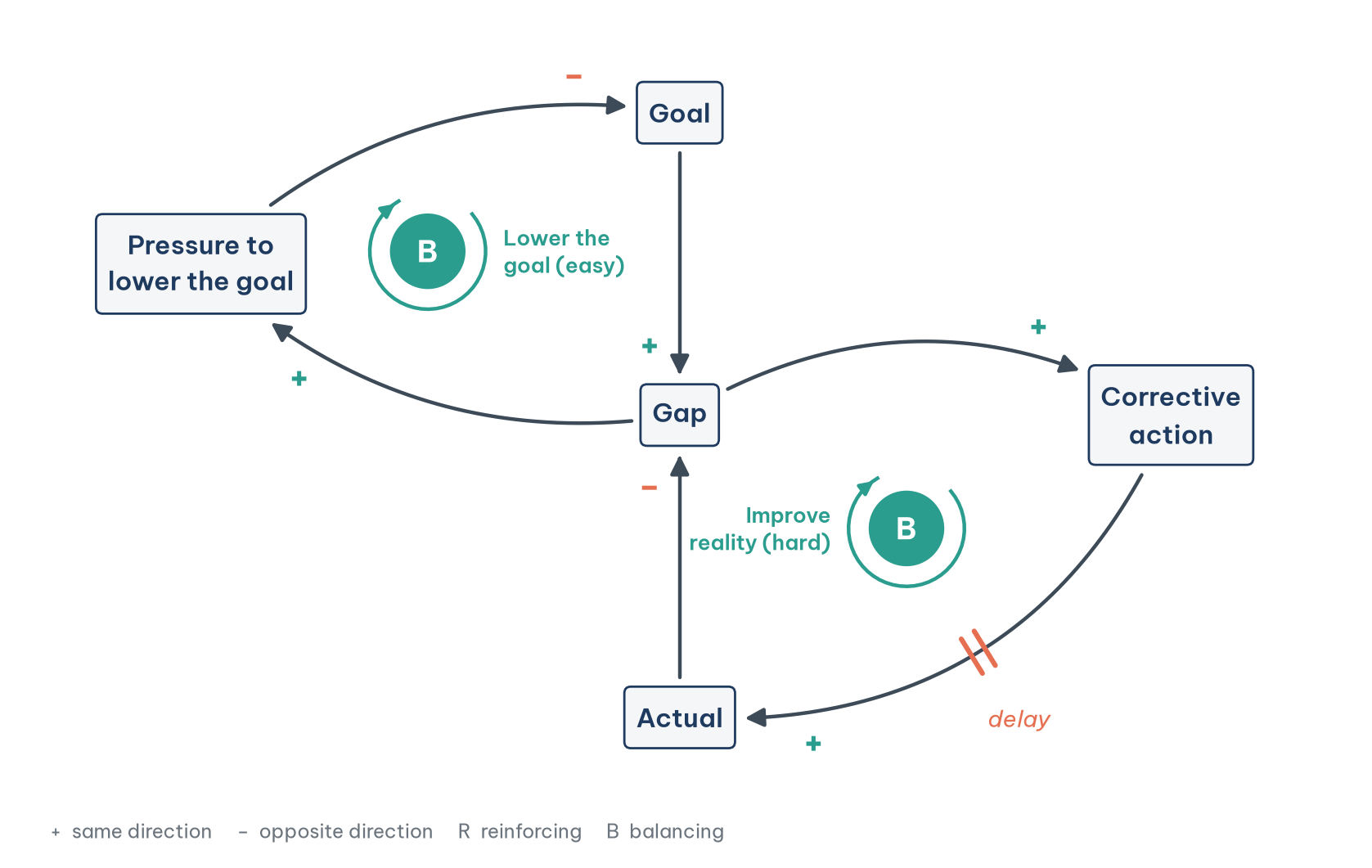
Leverage point. Recognise that "flexibly" lowering a standard once sets a precedent. Anchor core goals to external standards that cannot be changed (laws, professional ethics) or to past best performance; never let goals be adjusted to today's weakness.
Example 1 (services): restaurant waiting times. A new restaurant promises food within 15 minutes. As it gets busier, waits reach 20 minutes and the manager shrugs: "Twenty is acceptable." Months later it is 30: "Customers must be patient when it's busy." Eventually it is 45 minutes, angry customers leave, and the restaurant empties. Leverage: treat 15 minutes as sacred; if it can't be met, fix the cause by hiring cooks, simplifying the menu or turning customers away when the kitchen is at capacity.
Example 2 (health): weight-loss goals. You aim to lose 5 kg in two months. After a hard month you've lost 1 kg, get discouraged and tell yourself 2 kg is fine; you relax your diet and regain 2 kg; then you decide "a bit of weight is healthier". Leverage: anchor goals to habits (actions) rather than the number on the scale (outcomes), for example "vegetables at every meal and a 30-minute walk daily", a standard that is never lowered.
Example 3 (manufacturing): tolerating defects. A garment factory's standard is a maximum 1% defect rate. To hit month-end output targets, the floor manager lets through batches with 3% defects. The customer doesn't complain at once, so 3% becomes the unspoken standard, then 10%, until the customer returns the whole order and the company is ruined by compensation. Leverage: give quality assurance an independent veto, reporting directly to the CEO; nobody may change quality standards under schedule pressure.
Example 4 (education): grade inflation. A university wants graduates to find jobs easily and asks lecturers to be lenient. At first only 4.5s are nudged to 5.0 (on a 10-point scale); a few years later 8.0 is common while student quality falls, and the degree loses value with employers. Leverage: use external standardised tests (TOEIC, IELTS, independent professional certificates) as graduation requirements, which the university cannot influence.
Example 5 (environment): air-quality indices (hypothetical). An industrial city grows more polluted. Instead of tackling polluting factories, the authorities change the air-quality scale, raising the "safe" threshold so reports look greener. Residents breathe toxic air believing it is clean. Leverage: enshrine environmental standards in law based on World Health Organization guidelines, with monitoring by independent organisations.
4.5. Limits to growth
No growth lasts forever. This pattern describes a system that grows explosively thanks to a driver (a reinforcing loop); success breeds complacency. As the system grows, it hits invisible limits (a balancing loop): resources, market size, management capacity or quality. Growth stalls, flattens or even collapses. Figure 6 shows the structure.
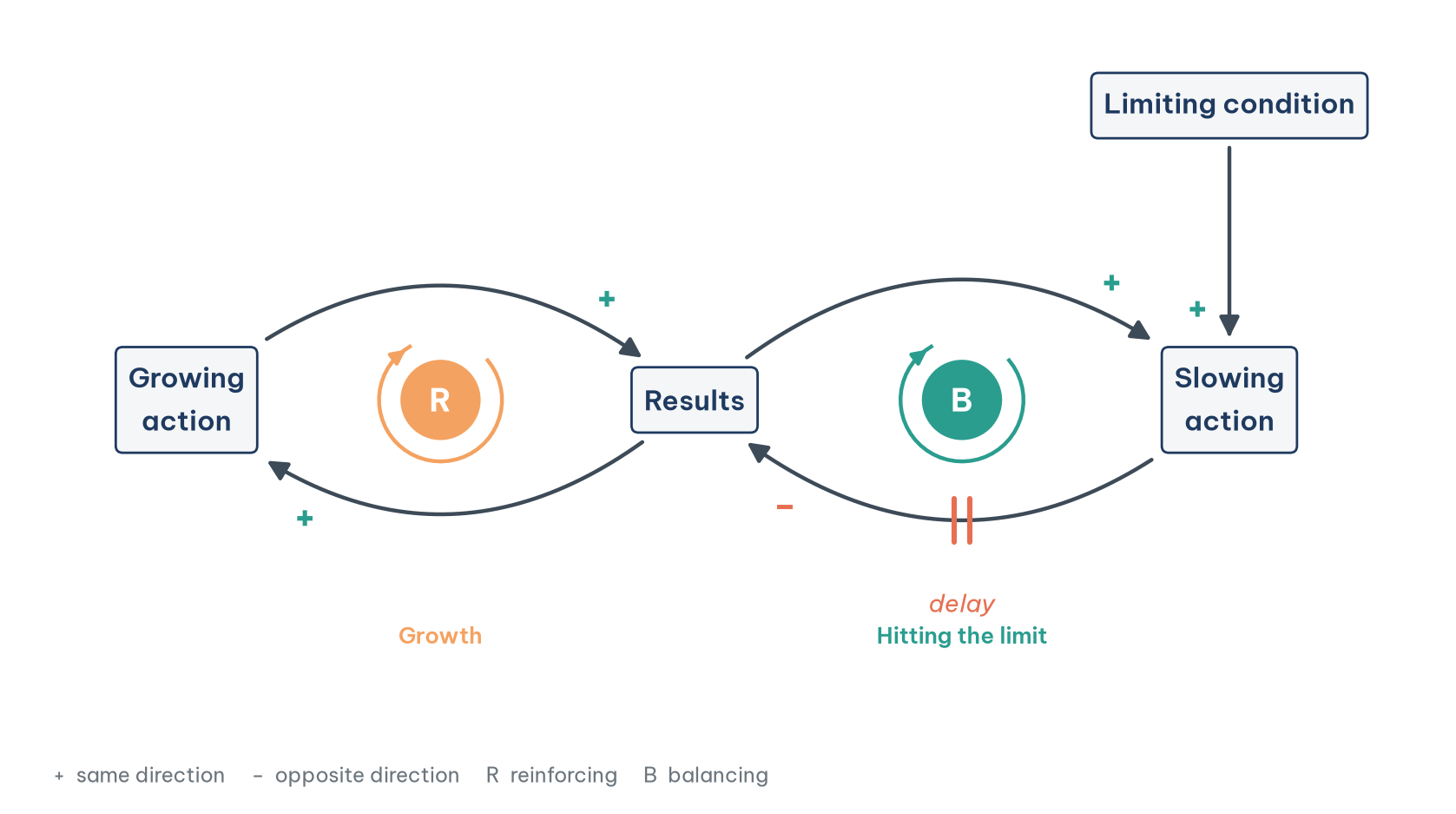
Leverage point. When growth slows, people tend to press the accelerator harder (more marketing spend, more overtime), which only brings collapse sooner. Instead, stop pushing the growth loop and focus on identifying and widening or removing the limits (bottlenecks) before the system hits them, for example hiring drivers and upgrading servers before a big promotion.
Example 1 (biology): bacteria in a Petri dish. Bacteria double exponentially, but the dish and the nutrients are finite. When they cover the dish, food runs out, waste builds up, and the whole population dies. Leverage: move them to a larger environment (widen the limit) or control their reproduction to reach equilibrium.
Example 2 (start-ups): overheated growth. A delivery app launches huge promotions and users jump from 10,000 to 1,000,000 in a month. But its servers and customer-service team can handle only 50,000. The app crashes, complaints go unanswered, angry users delete it and leave one-star reviews, and it dies at its peak. Leverage: scale capacity first, then growth.
Example 3 (fitness): training injuries. A new gym-goer sees fast muscle gains in the first month, gets excited, keeps adding weight and trains seven days a week. But tendons, joints and recovery have limits; overtraining tears a muscle or injures the spine, six months of rest follow, and the gains vanish. Leverage: recovery matters as much as training; widen the limit with nutrition, sleep and rest days.
Example 4 (consumer trends): the life cycle of a fad. A shop selling hand-pounded lemon tea draws long queues, and the owner opens 20 branches across the city. But the number of people who love this drink is limited and curiosity fades. By the twentieth branch, customers are spread too thin to cover rent, and many branches close. Leverage: don't expand blindly on a trend; when you hit the market limit, innovate with new products to start a new S-curve.
Example 5 (social media): the decline of a platform. Social network A booms; its appeal is that "only cool young people are here". As it grows, parents, teachers and advertisers pour in (a limit on privacy and coolness). Young people feel watched and move to TikTok or Instagram. Leverage: this limit is hard to widen because it lies in crowd psychology. Tech companies often respond by buying rising platforms, as Facebook bought Instagram in 2012, which is also why antitrust authorities later re-examined such deals.
4.6. Growth and underinvestment
This is a dangerous variant of limits to growth. A growing organisation hits a capacity limit, such as too few machines or skilled staff. It should invest heavily in capacity, but because the system is overloaded, service quality falls and revenue stalls. Seeing revenue stall, management panics: "Business is falling, we must cut investment to save money." That decision strangles the organisation: weaker capacity drives customers away, revenue falls further, and there is even less money to invest. A death spiral begins. Figure 7 shows the structure.
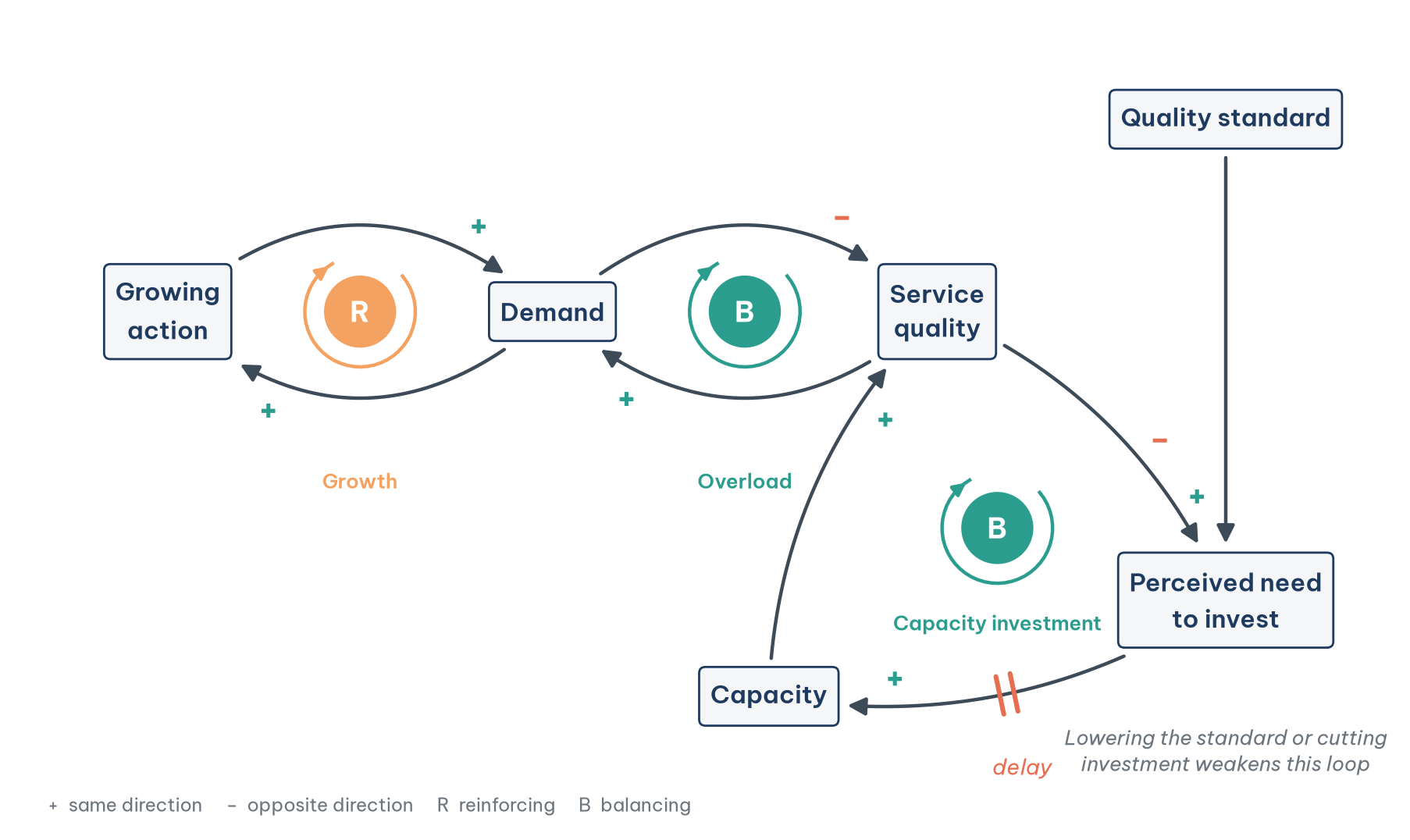
Leverage point. Distinguish a revenue fall caused by market saturation (demand is exhausted) from one caused by weak capacity (supply cannot deliver quality). Invest in capacity before demand exceeds the limit, basing decisions on long-term market potential rather than short-term dips. If there is truly no money to invest, deliberately slow growth (raise prices, limit customers) to protect quality.
Example 1 (airlines): the fall of People Express. In the 1980s, People Express was a fast-growing US low-cost airline. Demand overwhelmed its booking system, staff burned out and flights were constantly late. Instead of investing in IT and people, management saw margins shrink and cut costs. Customers left, losses mounted, and in 1986 the airline was sold to Texas Air. It is a famous teaching case in system dynamics (Sterman, 2000). Leverage: pausing new routes and pouring money into systems and training until service recovered might have saved it.
Example 2 (technology): ignoring technical debt. A start-up keeps pushing developers to ship new features to attract users, neglecting server upgrades and code optimisation. The app gets slower and buggier and users start deleting it. Seeing users fall, the CEO cuts the IT budget and pours money into marketing to attract new users, and the app collapses faster. Leverage: a mandatory-maintenance rule, reserving 20% of every sprint for cleaning code and upgrading servers regardless of how business is going.
Example 3 (careers): the overloaded freelancer. A talented freelance designer is swamped with clients. Unable to keep up, quality falls and deadlines slip; clients leave. Seeing income fall, the freelancer is afraid to hire an assistant (underinvestment) and works day and night instead, until health and career decline. Leverage: when overload begins, use part of the profit to hire an assistant for routine tasks, or double prices to filter clients and keep those willing to pay for top quality.
Example 4 (cities): declining public transport. A city's population grows, buses get crowded and slow, and people switch to private motorbikes and cars. Fare revenue falls; seeing losses, the authorities cut subsidies and buy no new buses. Buses decay further, people shun them more, and private traffic paralyses the city. Leverage: treat public transport as essential infrastructure, not a profit centre; keep investing in new vehicles and dedicated lanes because the city-wide benefit far exceeds fare revenue.
Example 5 (retail): stores versus e-commerce. A supermarket chain sees revenue fall as customers move online. Instead of investing in an app and delivery (which needs big capital), it cuts store staff and air-conditioning to save money. The miserable shopping experience drives away even its last loyal customers. Leverage: accept short-term losses to restructure: shrink physical space and put capital into digital transformation and an omnichannel experience.
4.7. The attractiveness principle
This archetype states a harsh truth: you cannot have it all. As a system (a product, a city, a company) grows, it attracts more users and resources, which puts pressure on several limits. Solve one bottleneck and the pressure immediately shifts to another. Try to please everyone and the system becomes mediocre, loses its identity and finally collapses. Figure 8 shows the structure.
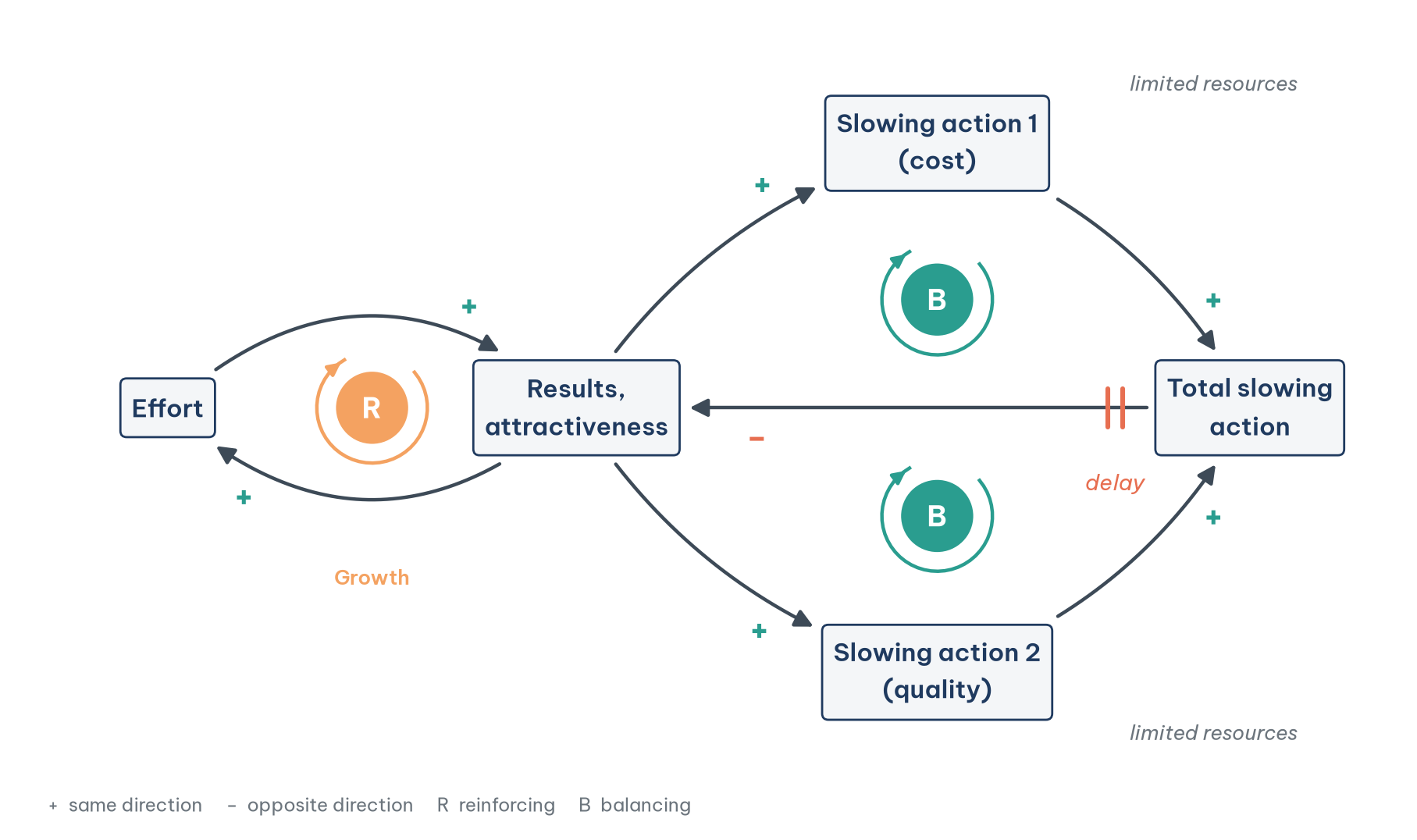
Leverage point. Accept trade-offs: perfection in every dimension is an illusion. The leverage lies not in widening every limit but in deliberately choosing which limits you will accept: decide which elements are your core identity to protect at all costs and which can be sacrificed.
Example 1 (project management): the iron triangle. Projects have three elements: fast (time), cheap (cost) and good (quality). Clients want all three. Make it fast and cheap and quality suffers; good and fast, and cost explodes; promise all three and the project will fail and your reputation with it. Leverage: set expectations transparently from the start: "We offer the highest quality and fastest delivery, so our prices are among the highest. If you need a lower price, we'll need more time."
Example 2 (tourism): the paradox of unspoilt destinations. A beautiful, quiet, cheap island attracts crowds and becomes overloaded with waste (an environmental limit). Authorities build hotels, widen roads and add cable cars to fit more people. Capacity is solved, but the island becomes noisy, concreted and expensive, losing the quiet wildness that attracted nature lovers, who never return. Leverage: choose your limit. Bhutan chose to protect its environment and culture by charging international visitors a daily sustainable development fee (USD 200 a day from 2022, reduced to USD 100 from September 2023 to win visitors back). It accepts fewer tourists (a self-imposed limit) to preserve its core appeal.
Example 3 (technology): super-app bloat. A fast, smooth messaging app attracts millions of users. To raise revenue, the company adds news, shopping, ride-hailing, a wallet and games. The app becomes heavy, drains batteries, has a cluttered interface and occasionally freezes. Users who only wanted to chat switch to a simpler app. Leverage: say "no" to features that don't serve the core value. WhatsApp kept a minimal interface for over a decade, focused on fast, end-to-end-encrypted messaging and accepted slow monetisation. Even when it began showing ads in 2025, Meta placed them only in the Updates tab, away from chats, to protect the core experience.
Example 4 (lifestyle): trying to do everything at once. Someone wants a soaring career, to be a perfect parent (cooking three meals a day and tutoring the children every night), an ideal physique (two hours at the gym daily) and a rich social life, and sleeps four hours a night to manage it all. The result is burnout, irritability with the children and mistakes at work. Leverage: accept imperfection and set priorities by life stage, for example hiring help or buying prepared food (giving up the ideal of doing everything yourself) to have quality time with the children and work well.
Example 5 (food and beverage): the family noodle shop. A family-recipe noodle shop is so good that queues stretch down the street, and customers complain about waiting and cramped seating. The owner opens five branches and hires cooks instead of cooking personally. Space and speed improve, but the broth is no longer as rich (a quality limit); connoisseurs leave and the brand fades. Leverage: accept being slow and cramped as part of the attraction (the feeling of eating something rare and delicious); keep one shop, cook personally and raise prices instead of scaling.
4.8. Success to the successful
This archetype describes the Matthew effect: the rich get richer and the poor get poorer. Two people, projects or organisations compete for a limited resource (money, time, attention). A gains a small early success, by chance or a slight initial edge. The system judges A to be better and gives A more resources, cutting B's. With more resources A succeeds more; B, starved, performs worse, reinforcing the belief that B is a failure. B is finally eliminated, even though A and B may have been equally capable. Figure 9 shows the structure.
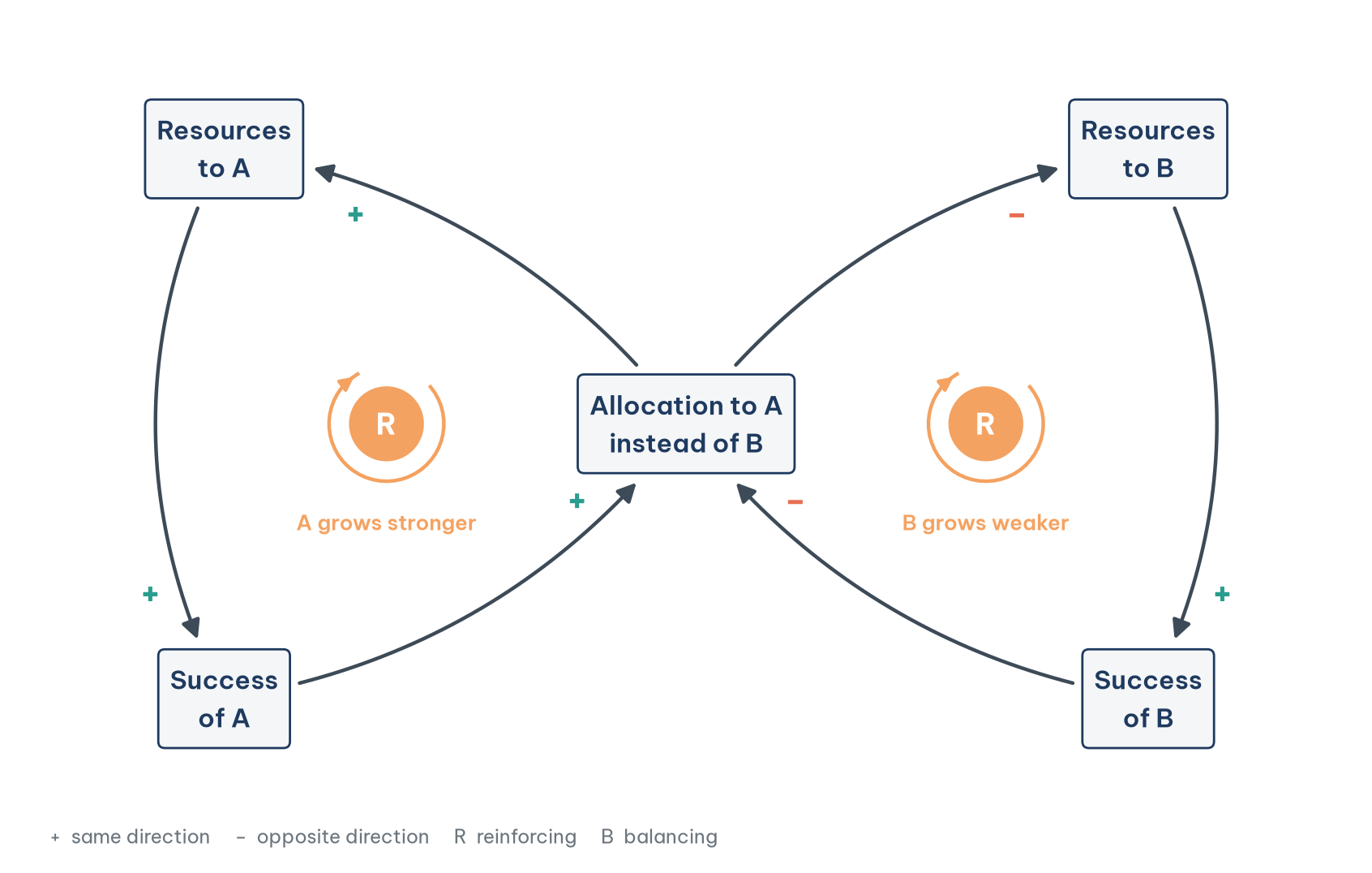
Leverage point. Recognise that B's failure comes from unfair resource allocation, not lack of ability. Separate the two from direct competition, set overarching goals for the whole system, or allocate resources by future potential rather than only past performance.
Example 1 (education): the Pygmalion effect. Rosenthal and Jacobson (1968) famously told teachers that certain pupils (chosen at random) were about to "bloom". Later research suggests the effect is real but usually smaller than first reported. The mechanism looks like this: a teacher hears that pupil A is very bright (although A is as ordinary as B), unconsciously calls on A more and praises A more. A gains confidence and improves; B, ignored, loses heart and falls behind. At year's end the teacher concludes, "A really is smarter than B." Leverage: teachers should recognise their unconscious bias and use methods such as random calling to give every pupil equal attention and encouragement.
Example 2 (business): the cash cow starves the rising star. A company has product X (selling well, ageing technology) and product Y (future technology, newly launched, low revenue). When setting the marketing budget, the director gives 90% to X because "it makes the money" and 10% to Y. Y, unpromoted, doesn't sell, and the next year the director kills it as "ineffective". A few years later a competitor launches something just like Y and destroys the outdated X. Leverage: separate R&D budgets from operating budgets, with a protected fund for innovation projects that do not compete on revenue KPIs with mature products.
Example 3 (family): work–family imbalance. You spend a little extra time at work, your boss praises you and you get a raise. Pleased, you work even more. Family time shrinks, your partner complains and home becomes tense. Tired at home, you escape to the office where you feel respected. The loop continues until the marriage breaks down. Leverage: recognise that work and family cannot share the same yardstick (money and status) and set firm boundaries, for example "after 7 p.m. and weekends belong to the family", however attractive work is.
Example 4 (economy): inequality. The rich have spare money to invest in property and shares, which grow faster than the economy; they send their children to elite schools and build strong networks. The poor work hard just to get by, cannot invest and send their children to weaker schools. Over generations the gap becomes a chasm. Leverage: state intervention is essential: progressive taxes (high incomes, inheritance, wealth) on the very rich, invested in public education, healthcare and infrastructure to create equality of opportunity.
Example 5 (technology): QWERTY versus Dvorak. A popular story says QWERTY was designed to slow typing (to stop old typewriters jamming), and that the later Dvorak keyboard (1936) was much faster; but because QWERTY came first, more people learned it, manufacturers made only QWERTY and new users had to learn it. The economist Paul David (1985) used this as the classic example of path dependence. Liebowitz and Margolis (1990), however, showed that the evidence for Dvorak's superiority was weak (some studies were run by its own inventor) and that QWERTY's origins were more complex. The systems lesson still holds: whatever comes first and has the most users can win without necessarily being best. But the example is also a reminder to check "classic" stories before using them as evidence. Leverage: in technology this is called network effects or lock-in. To break it, a new technology must be not slightly better but ten times better, or be imposed as a new standard by a giant such as Apple or Google.
4.9. Tragedy of the commons
This pattern occurs when a resource is shared (owned by no one, or open to all) but limited. Each individual, maximising their own gain, tries to take as much as possible, thinking: "If I don't take it, someone else will." Exploitation exceeds the resource's ability to recover, the whole system collapses and everyone loses. Figure 10 shows the structure.
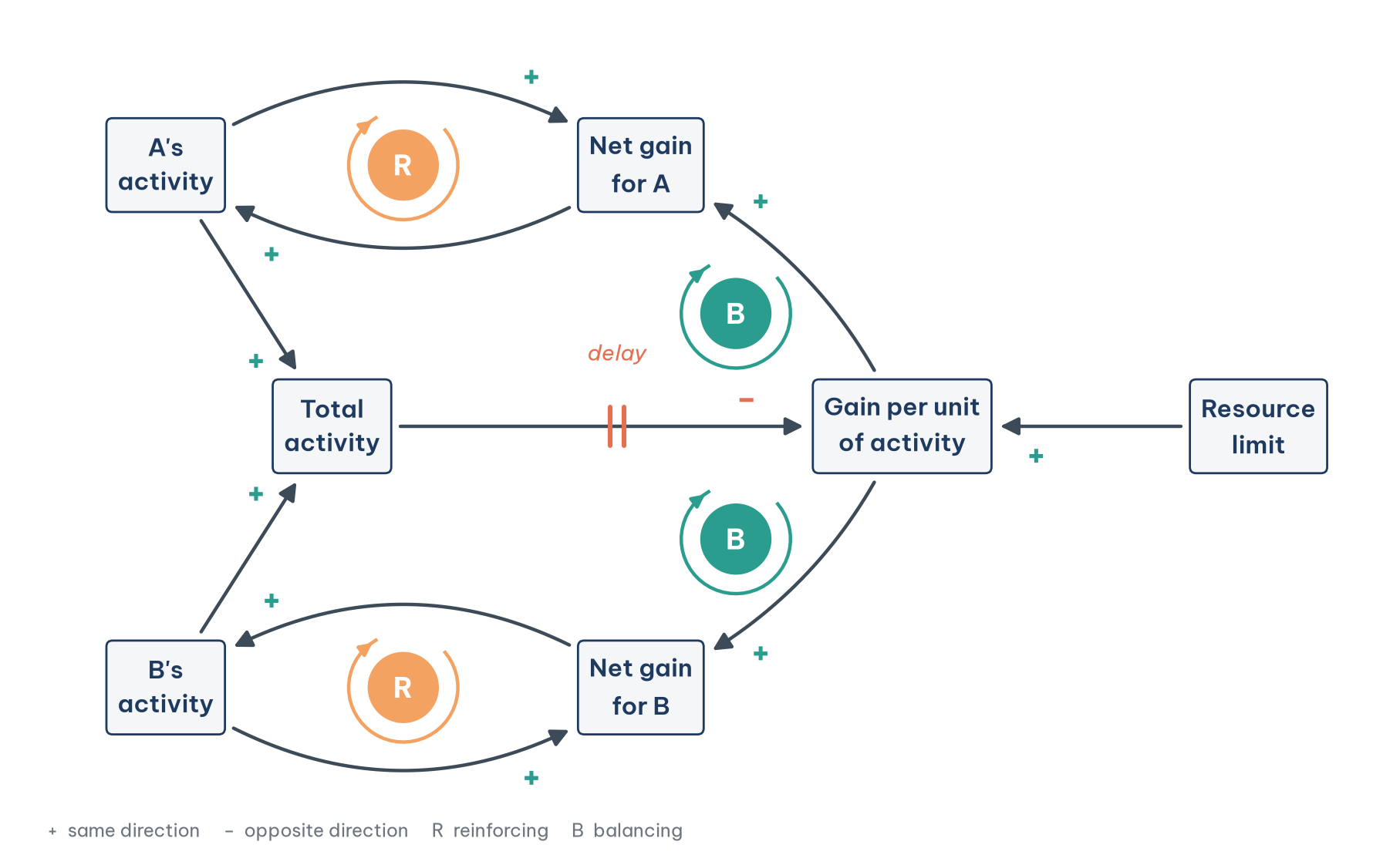
Leverage point. Garrett Hardin (1968) popularised the concept and argued there were only two ways out: privatisation or state control. Elinor Ostrom, winner of the 2009 Nobel Prize in Economics, studied hundreds of communities around the world, including pastures, fisheries and irrigation systems, and identified a third path: community self-governance succeeds when there are clear boundaries, rules made with the users' participation, monitoring with graduated sanctions, and conflict-resolution mechanisms (Ostrom, 1990). The leverage lies in changing how the commons is governed, in three directions: dividing ownership or use rights; a managing authority with powers to monitor and sanction; or shared rules and quotas set and monitored by the users themselves.
Example 1 (environment): overfishing on the high seas. The high seas belong to no country. Fishing companies from many nations send giant trawlers to sweep them clean, each wanting the largest catch. Fish cannot reproduce fast enough, marine ecosystems collapse, and eventually all the companies go bust for lack of fish. Leverage: international treaties setting catch quotas by country, banning fishing in breeding seasons and creating joint patrols to punish violators. The 2023 agreement on marine biodiversity beyond national jurisdiction (BBNJ, often called the High Seas Treaty) is a step in this direction.
Example 2 (business): an overloaded IT support team. One IT support team serves five departments. Because it costs nothing, department heads push every problem to IT, from broken mice and forgotten passwords to installing random apps. IT is overloaded, stressed and slow, and when a truly critical server failure happens, it cannot respond in time and the whole company grinds to a halt. Leverage: internal chargebacks. Each department gets a monthly IT support budget; calls beyond it come out of the department's bonus pool, and heads immediately ask staff to fix trivial problems themselves.
Example 3 (daily life): the shared fridge. Five housemates share one fridge and nobody is responsible for cleaning it. Everyone stuffs food in and ignores rotting leftovers because "it's not mine". The fridge becomes a breeding ground for bacteria that no one dares use. Leverage: divide the space (one shelf each, individually responsible) or set a weekly cleaning rota with fines paid into a shared kitty.
Example 4 (global): climate change and carbon emissions. The atmosphere is humanity's common property. Industrial nations emitted CO2 freely to grow fast; the planet warms, seas rise, and storms and floods devastate those same nations. Leverage: a carbon tax or cap-and-trade system, turning emissions (once free) into a real cost and pushing countries and companies towards clean energy.
Example 5 (networks): congested shared Wi-Fi. A café offers free Wi-Fi. A few customers download torrents or play bandwidth-hungry games, hogging 90% of the bandwidth. Dozens of others cannot send an email, leave annoyed and never come back. Leverage: the network administrator sets a per-device bandwidth limit, say 2 Mbps, so everyone can do basic tasks.
4.10. Escalation
Escalation happens when two parties (people, organisations, nations) see each other as rivals in a zero-sum game. A takes an action to gain advantage; B feels threatened and retaliates more strongly; A feels its position slipping and raises the stakes again. This reinforcing loop becomes an arms race that drains both sides' resources, time and sanity. In the end nobody wins, and both are badly hurt. Figure 11 shows the structure.
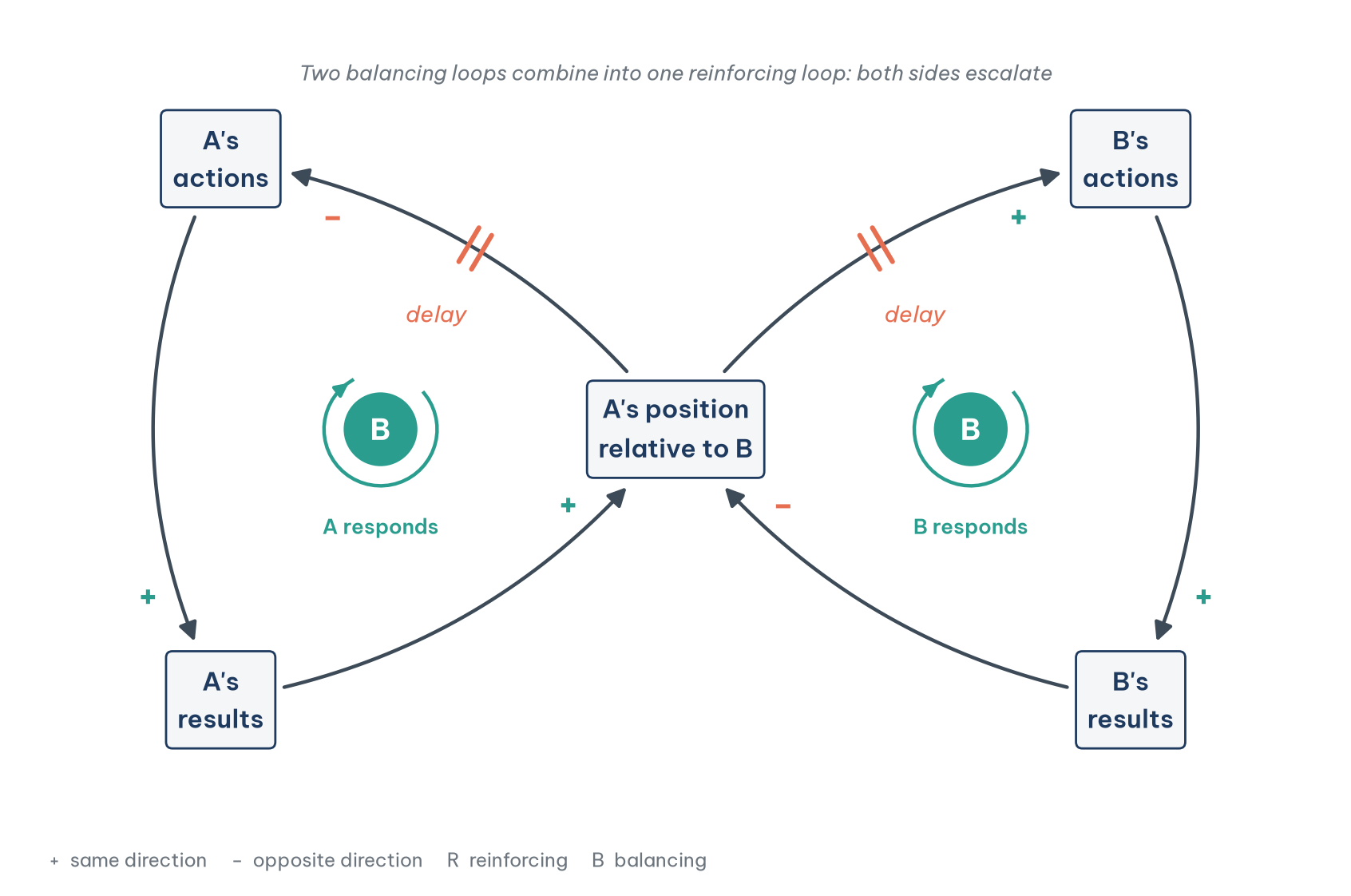
Leverage point. Recognise that trying to "beat" the opponent under the same rules leads only to mutual destruction. The best way to break escalation is unilateral disarmament or changing the rules: instead of competing on price (a zero-sum game), compete on service quality or customer experience, or target different niches.
Example 1 (history): the Cold War arms race. The United States built the atomic bomb; the Soviet Union, threatened, poured money into bigger bombs. The US developed intercontinental ballistic missiles; the USSR followed. Trillions of dollars went into weapons instead of development, pushing the world to the brink. Leverage: arms-control treaties such as SALT and START, in which both sides agreed to cut warheads and allow mutual inspection, moving from blind confrontation to bounded control.
Example 2 (business): price wars. Airline A cuts fares by 10% to win customers; airline B immediately cuts 20%; A, furious, cuts 30% and drops in-flight meals. Customers benefit briefly, but both airlines lose heavily, service quality hits bottom and maintenance suffers. Leverage: A withdraws from the price war, keeps its prices and competes on experience (more comfortable seats, punctuality, loyalty programmes), accepting the loss of price-sensitive customers to keep the most profitable ones.
Example 3 (relationships): family arguments. One partner complains the other spends too much. The other, stung, brings up late nights out. The first, angrier, says the other neglects the children. Voices rise, insults sharpen, and a small issue escalates into talk of divorce. Leverage: one person must be calm enough to disarm unilaterally: "We're both losing our temper. I'm going out for 15 minutes; let's talk again when we've cooled down." Then replace "You always…" with "I feel…".
Example 4 (workplace): a toxic overtime culture. Employee A stays until 7 p.m. to impress the boss. Employee B, afraid of looking worse, stays until 8; A then stays until 9. Eventually nobody dares leave at 5:30 even when their work is done; everyone is exhausted and browses aimlessly waiting for others to leave first. Leverage: the manager changes the rules, stating clearly that "performance is judged on results, not hours in the chair", and may even switch off the lights and lock the office at 6 p.m.
Example 5 (marketing): keyword bidding wars. Company X bids USD 0.40 for the keyword "sports shoes"; company Y bids USD 0.50; X raises to USD 0.60. Customer acquisition cost soars beyond the margin on a pair of shoes. Both companies are enriching the ad platform while losing money. Leverage: stop bidding on generic keywords; focus on less competitive long-tail keywords (such as "men's waterproof running shoes size 9") and optimise website conversion so that every click earns money.
Table 2 summarises the ten archetypes so you can quickly recognise which one is driving a situation and where the leverage lies.
5. Systems thinking in a VUCA world
The ten archetypes point to one core truth: the complex world never runs in tidy straight lines; it is a dense web of intertwined causal loops. And across all ten traps runs one warning: the obvious, easy, local "fire-fighting" solutions are often the most dangerous seeds of destruction.
Don't panic at the laws of time. Every action needs time to bear fruit; don't overreact to natural setbacks (balancing process with delay).
Don't take shortcuts or compromise. Never put a plaster on a wound that is rotting inside, or lower your standards just because of present pressure (fixes that fail, shifting the burden, drifting goals).
Don't chase unlimited growth blindly. Don't try to optimise everything at once in a limited world, or strangle yourself by forgetting to keep investing in the core (limits to growth, growth and underinvestment, attractiveness principle).
Don't let greed and favouritism drain the group. Don't destroy yourself in pointless arms races, starve promising people through blind favouritism, or exhaust precious shared resources (escalation, success to the successful, tragedy of the commons).
5.1. The humility of a systems architect
Systems thinking offers no silver bullets. Instead, it teaches intellectual humility before the scale and complexity of the world. Facing a crisis, instead of flailing with the linear question "How do I put this out right now?", a systems thinker steps back and asks: "What hidden structure is producing this symptom? Which archetype are we in? Which reinforcing and balancing loops are quietly shaping the situation? Where is the real leverage point?"
5.2. Three steps to practise systems thinking
Memorising the theory is not enough. To make systems thinking an operating system for your mind, apply three steps to every real problem.
Step 1: zoom out. When a problem appears in the marketing department, don't search only inside marketing. Ask how finance's policies, the product team's processes or macroeconomic shifts are quietly affecting it.
Step 2: draw causal loop diagrams. Drop linear bullet points. Write the factors on paper and connect them with arrows, marking (+) when one factor amplifies another and (−) when it dampens it. Visualising forces you to see loops that ordinary language cannot express.
Step 3: locate leverage points. For the systems scientist Donella Meadows (1999), leverage points are places in a system where a small intervention can produce a large change. She listed twelve kinds, from the weakest (numbers and parameters) to the strongest (the system's goals and the paradigm that gives rise to them). The most powerful leverage rarely lies in changing surface numbers (more budget, higher taxes, lower prices); it lies in changing the rules, the information flows and, above all, the outdated mental models of the whole system.
Conclusion
By looking at the world through the deep lens of the iceberg, understanding the rhythm of feedback loops and recognising the ten system archetypes, you can escape the life of a firefighter forever cleaning up after short-term problems. You begin to see the big picture, and from it to build sharper, more durable and wiser strategies in business and in life.
The world is not a collection of separate fragments but a vast, vibrating, tightly connected web. In a volatile environment, the advantage belongs to those who see the threads before they act.
References
David, P. A. (1985). Clio and the economics of QWERTY. American Economic Review, 75(2), 332–337. https://www.jstor.org/stable/1805621
Duranton, G., & Turner, M. A. (2011). The fundamental law of road congestion: Evidence from US cities. American Economic Review, 101(6), 2616–2652. https://doi.org/10.1257/aer.101.6.2616
Hardin, G. (1968). The tragedy of the commons. Science, 162(3859), 1243–1248. https://doi.org/10.1126/science.162.3859.1243
Lee, H. L., Padmanabhan, V., & Whang, S. (1997). The bullwhip effect in supply chains. MIT Sloan Management Review, 38(3), 93–102. https://sloanreview.mit.edu/article/the-bullwhip-effect-in-supply-chains/
Liebowitz, S. J., & Margolis, S. E. (1990). The fable of the keys. Journal of Law and Economics, 33(1), 1–25. https://doi.org/10.1086/467198
Meadows, D. H. (1999). Leverage points: Places to intervene in a system. The Sustainability Institute. https://donellameadows.org/archives/leverage-points-places-to-intervene-in-a-system/
Meadows, D. H. (2008). Thinking in systems: A primer. Chelsea Green. https://www.chelseagreen.com/product/thinking-in-systems/
Ostrom, E. (1990). Governing the commons: The evolution of institutions for collective action. Cambridge University Press. https://www.cambridge.org/core/books/governing-the-commons/7AB7AE11BADA84409C34815CC288CD79
Rosenthal, R., & Jacobson, L. (1968). Pygmalion in the classroom. Holt, Rinehart & Winston. https://www.amazon.com/s?k=Pygmalion+in+the+classroom+Rosenthal&i=stripbooks
Senge, P. M. (1990). The fifth discipline: The art and practice of the learning organization. Doubleday. https://www.penguinrandomhouse.com/books/163984/the-fifth-discipline-by-peter-m-senge/
Sterman, J. D. (2000). Business dynamics: Systems thinking and modeling for a complex world. McGraw-Hill. https://www.mheducation.com/highered/product/business-dynamics-sterman.html
Vann, M. G. (2003). Of rats, rice, and race: The great Hanoi rat massacre, an episode in French colonial history. French Colonial History, 4, 191–203. https://doi.org/10.1353/fch.2003.0027
Discussion about this post