Sunk Cost and Opportunity Cost: Deciding Better
Two ideas that change how you decide: count the best option you give up, and ignore the money that is already gone


Key takeaways
Opportunity cost is the value of the best alternative you give up. Using your own premises or time is never free: economic profit subtracts these implicit costs, accounting profit does not.
The opportunity cost of capital underlies the minimum attractive rate of return (MARR) and the discount rate, as long as you compare with an alternative of similar risk.
A sunk cost is money already spent that cannot be recovered. Only relevant costs, future cash flows that differ between options, belong in a decision.
Loss aversion, the wish to be consistent and ego keep people trapped in sunk costs; in organizations this becomes escalation of commitment.
The two ideas work as a pair: look forward at what you will miss, and ignore what you cannot get back.
Two of the most useful ideas in economics are also two of the most often misused. One concerns what you give up when you choose; the other concerns what you have already spent. Together they explain why a business plan that "pays for itself" can make you poorer, why a student's master's degree costs far more than its tuition, and why teams keep pouring money into projects they should have stopped long ago.
The first idea is opportunity cost: the value of the best alternative forgone when you make a choice. Mankiw (2021) lists it among the foundational principles of economics, because every decision is made with limited resources. The second is sunk cost: a cost already incurred that cannot be recovered whatever you do next. Economics says it should play no part in future decisions; human psychology makes sure it often does.
This article treats the two ideas as a pair. Section 1 introduces opportunity cost through a simple story about two barrels of apples. Section 2 defines opportunity cost and separates accounting profit from economic profit, with a worked restaurant example. Section 3 explains the opportunity cost of capital and the MARR, and Section 4 calculates the true cost of a master's degree. Section 5 turns to sunk costs and how to tell what is sunk from what is not. Section 6 explains the psychology of the sunk cost trap and escalation of commitment, and Section 7 looks at examples from business, investing and everyday life. Section 8 proposes five ways out of the trap and explains when continuing is the right call. Section 9 lists common mistakes, and Section 10 applies both ideas to a classroom attendance policy.
1. A story of two barrels of apples
You have two barrels of apples: one fresh, one with a few apples starting to rot. Which should you eat first? The question sounds trivial, but it holds one of the most important ideas in economics. Whichever way you choose, you are giving something up, and what you give up is usually invisible; it appears on no receipt.
If you eat the bad apples first, you cut away the rotten parts and eat the rest, so nothing is wasted. But by the time you finish the bad barrel, the good one has started to go soft, and the cycle continues: you almost never eat an apple at its best. If you eat the good apples first, you always enjoy good apples, but some of the others may have to be thrown away. Table 1 summarizes what each approach gains and gives up.
As Table 1 shows, there is no right answer for everyone; the choice depends on each person's values. What matters is to see what you are giving up, not only what you get. People who eat the bad apples first often think they are "saving", without noticing that they are paying another, less visible price.
2. Opportunity cost and economic profit
From the apple story we can move to a precise definition and tools for measurement. This section defines opportunity cost, distinguishes two kinds of cost and introduces two ways of calculating profit, then works through an example.
2.1. Defining opportunity cost
Opportunity cost is the value of the best alternative forgone when an option is chosen (Buchanan, 2008). The words "the best" matter: opportunity cost is not the sum of all the options you give up, only the most valuable of them, because you could not do them all at once.
Opportunity cost exists because resources are limited. The same sum of money, the same evening, the same premises cannot be used for two things at once. It can be measured in money, but also in time, experience, health or satisfaction, things that are hard to convert but no less real.
2.2. Explicit and implicit costs
When costing a project, you need to separate two kinds of cost: the money actually paid out, and the value of your own resources that you put to use. Table 2 distinguishes them using the example of opening a restaurant on the ground floor of your own house.
Table 2 shows that implicit costs are the opportunity costs of resources you already own. The family's premises are not "free", because they could be rented out; the founder's time is not "free", because it could be spent earning a salary.
2.3. Accounting profit and economic profit
The two kinds of cost lead to two ways of calculating profit. Accounting profit equals revenue minus explicit costs; it is the figure in the books. Economic profit equals revenue minus explicit costs minus implicit costs; it tells you whether the project creates more value than the best alternative you gave up.
A project is only worth doing in economic terms when economic profit is greater than or equal to zero. Zero economic profit does not mean no profit; it means the project yields exactly as much as the best alternative, so you are no worse off by choosing it.
2.4. A worked example: a restaurant at home
The gap between the two profit measures is clearest when founders use their own assets and time. Suppose you earn USD 900 a month in a job and rent out the ground floor of your house for USD 600 a month. You plan to quit your job and take back the premises to open a restaurant. Table 3 shows the expected monthly results.
Table 3 can be pictured as a chain of deductions, shown in Figure 1: from revenue, subtract explicit costs to get accounting profit, then subtract the two implicit costs.
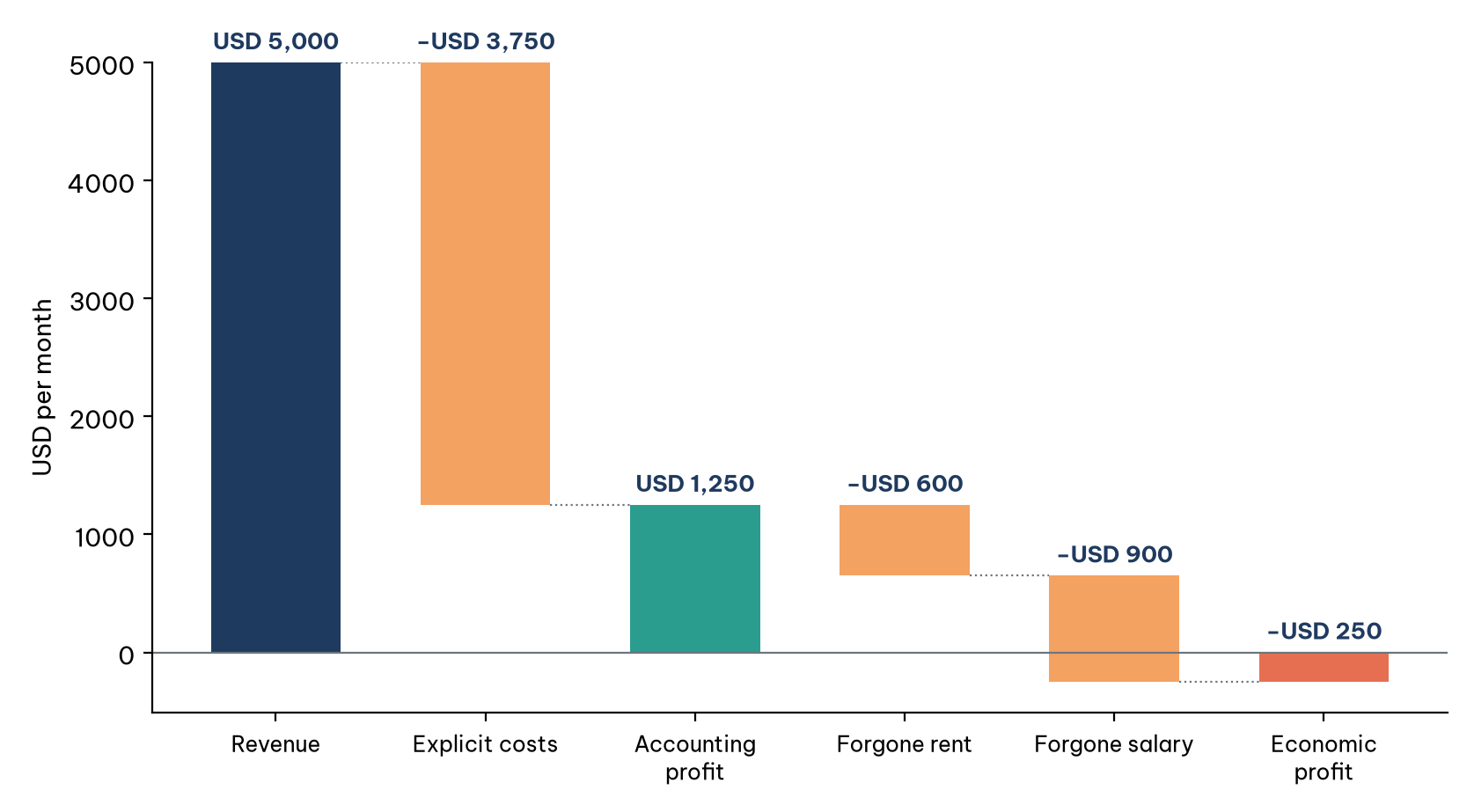
Figure 1 shows that the books report a profit of USD 1,250, but in economic terms you are USD 250 a month poorer than if you had kept things as they were. If your business plan records "premises cost: zero", it will make the project look too good.
This does not mean you should not open the restaurant. You may expect revenue to grow after a year, or value being your own boss more than the USD 250 difference. But you need to know the price you are paying. Economic profit should also be kept apart from cash flow: not paying rent eases the restaurant's monthly cash pressure, which is a cash-flow benefit, not an economic-profit one. The same principle applies to any startup plan: include the founders' salaries and the market rent of assets you already own as costs.
3. The opportunity cost of capital and the MARR
Opportunity cost applies not only to premises and time but to the investment money itself. This section explains the opportunity cost of capital, its role in engineering economics, and the requirement of comparable risk.
3.1. From the opportunity cost of capital to the MARR
Money invested in a project always has alternatives: a bank deposit, paying off debt, investing in another project. The return of the best alternative with comparable risk is the opportunity cost of capital. It is the basis on which firms set their MARR (minimum attractive rate of return) and the discount rate used to compute a project's net present value (NPV) (Park, 2019).
Two decision rules then become intuitive. If NPV at a discount rate equal to the MARR is positive, the project creates more value than the alternative. If the project's internal rate of return (IRR) is below the MARR, it does not cover the opportunity cost of capital, and the money should be used elsewhere.
3.2. Risk must be comparable
A common mistake is to compare the returns of two options with very different risks. You cannot simply say "the opportunity cost of a savings deposit is the return on stocks", because stocks are far riskier. The right comparison is with an alternative of comparable risk.
That is why different firms, and different projects within one firm, use different MARRs. A project extending a product with an established market can use a lower MARR; a completely new product, with higher risk, needs a higher MARR to compensate.
4. A worked example: start working or study for a master's?
Opportunity cost matters especially in education decisions, where people tend to see only the tuition. This section works through an example with illustrative figures, ignoring discounting for simplicity.
A new graduate has a job offer paying USD 4,000 a month, or could study full time for a two-year master's degree with tuition of USD 60,000. Table 4 calculates the total economic cost of the degree.
Figure 2 sets the two numbers side by side: the cost students usually see and the true economic cost.
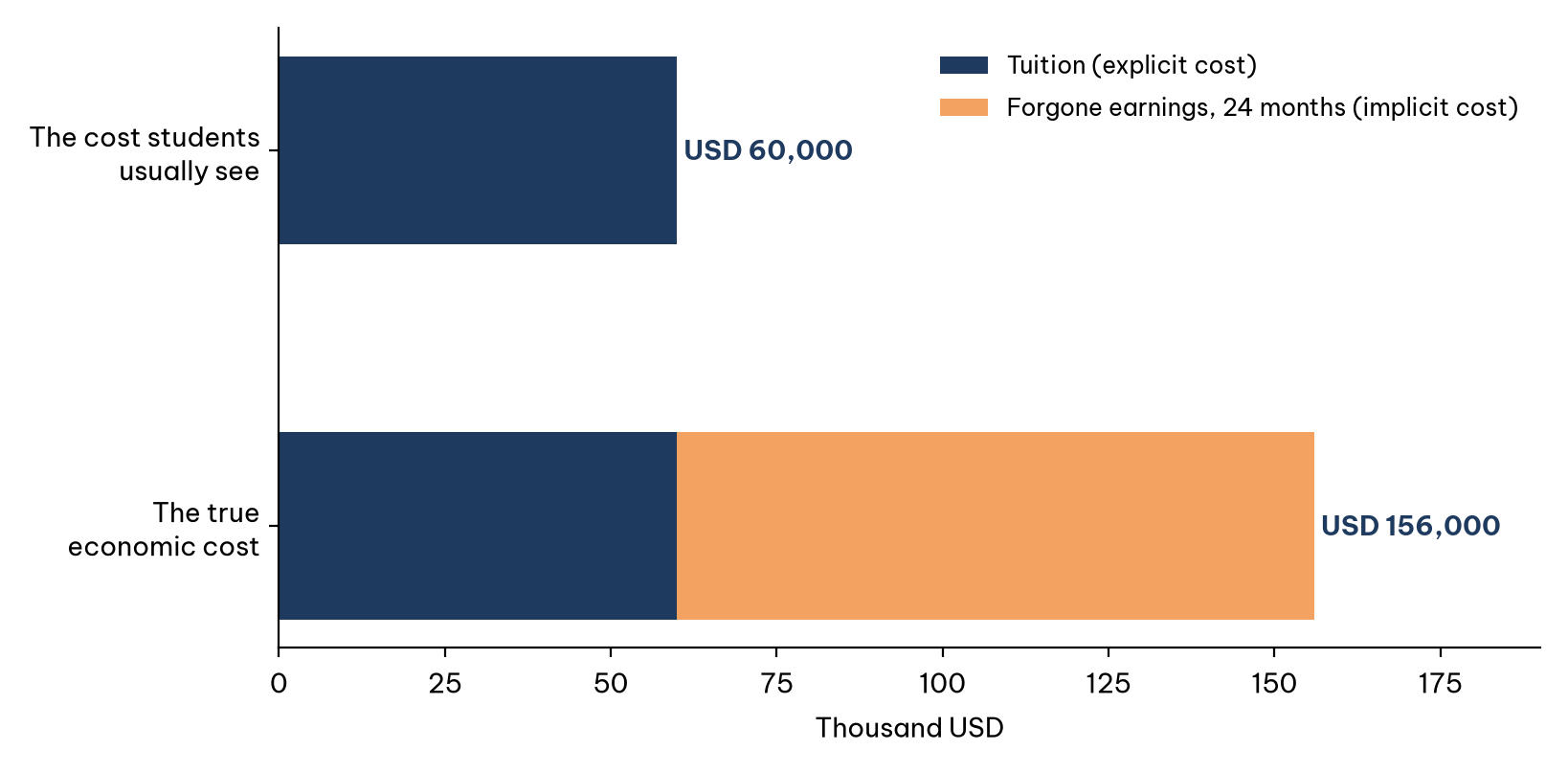
As Figure 2 shows, the real cost is more than two and a half times the tuition. If the degree raises the salary by USD 2,000 a month, it takes about 156,000 ÷ 2,000 = 78 months, more than six years, to break even, before discounting. The decision of course also depends on non-monetary value such as knowledge, networks and experience, and on whether the degree opens jobs that would otherwise be out of reach.
5. Sunk costs: what is already gone
Opportunity cost looks forward, at what you will miss. Its counterpart looks backward. You buy a cinema ticket, sit through 20 minutes and realize the film is terrible. Most of us think: "I've paid, I might as well watch the rest." So you spend 90 more unhappy minutes just so as not to "waste" the ticket, even though the money is gone whether you stay or leave. Staying recovers nothing; it only costs you 90 more minutes.
5.1. Definition
That ticket is a sunk cost: a cost already incurred that cannot be recovered whatever decision comes next (Park, 2019). Table 5 summarizes the two properties that define it.
Both properties must hold. A drug company that has spent USD 50 million researching a drug will not see that money again whether it continues or cancels the project, so it is a sunk cost. But a machine bought three years ago that can still be sold for part of its value is sunk only in the part that cannot be recovered.
5.2. Sunk costs and relevant costs
The opposite of a sunk cost is a relevant cost: a cost that lies in the future and differs between the options. Only relevant costs should be used in a decision. Figure 3 shows the boundary between the two: the moment of decision splits the past from the future.
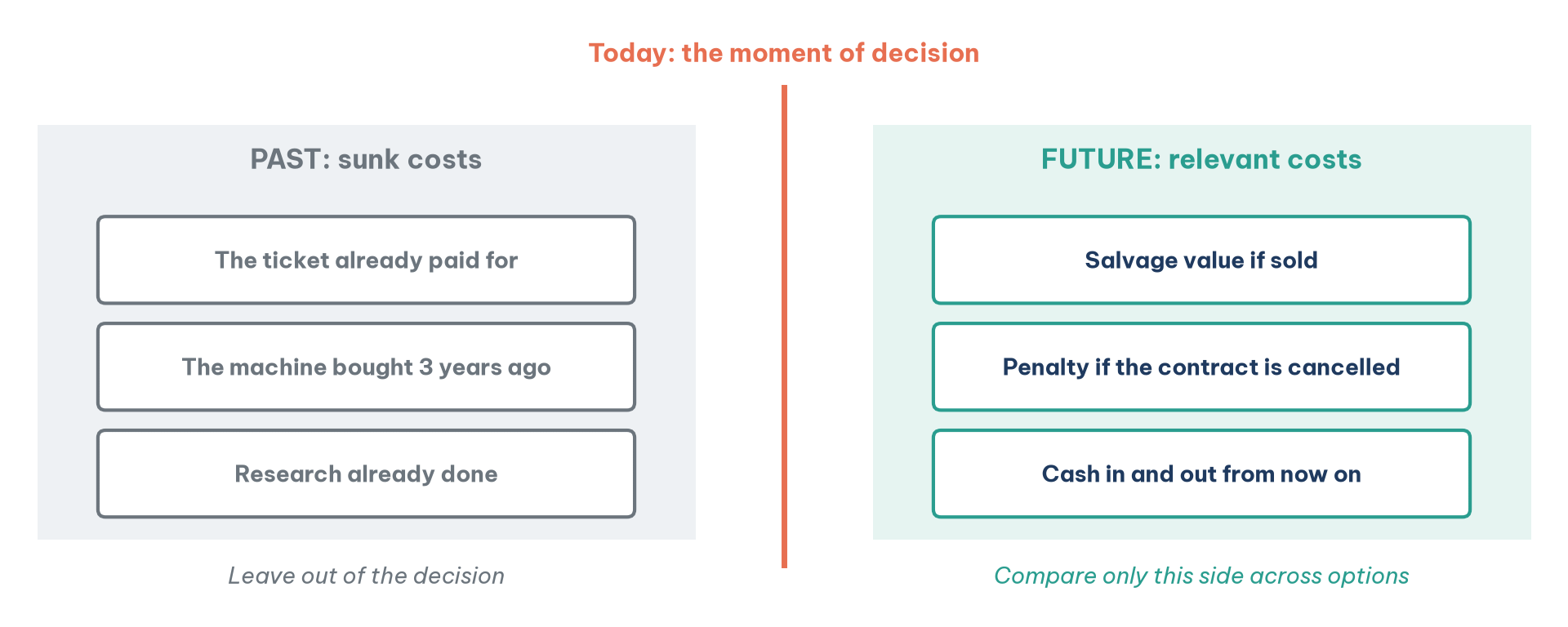
As Figure 3 shows, the only question to ask when deciding is: from today on, what cash comes in and goes out under each option? Everything to the left of the "today" line has already happened in the same way for every option, so it cannot help you tell which option is better.
5.3. What is sunk and what is not
In practice, the line between sunk and relevant costs is not always clear, and it is a frequent source of errors in engineering economics exercises. Some items look as if they belong to the past but actually create future cash flows, and vice versa. Table 6 classifies five items that often cause confusion.
Table 6 shows that the two items most often missed are salvage value and the penalty for stopping. Both are future cash flows that occur only under a specific option, so they must be included in the comparison.
5.4. Example: should you replace an old machine?
Equipment replacement is the classic way to see how sunk costs are kept out of the analysis. Suppose a workshop bought machine A three years ago for USD 50,000. A new machine B costs USD 40,000 and saves USD 12,000 a year in operating costs compared with A. Machine A can be sold for USD 10,000. Both machines can be used for four more years; for simplicity, ignore discounting and tax. Table 7 compares the future cash flows of the two options.
Table 7 shows that the machine should be replaced, even though machine A is "only three years old and cost USD 50,000". The regret over USD 50,000 is real, but it changes no number in either column. In a real analysis you would discount the cash flows at the MARR and account for tax, following the principles in Section 3.
6. The sunk cost trap
If the principle is so simple, why do people still fall into the trap? This section presents the experimental evidence for the sunk cost trap, the three psychological mechanisms behind it, and its organizational version, escalation of commitment.
6.1. Evidence from experiments
The sunk cost fallacy is the tendency to continue something because you have invested a lot in it, even though current information says stopping would be better. Arkes and Blumer (1985) demonstrated it in a well-known experiment: people randomly assigned to buy season theatre tickets at full price attended more performances than those given a discount, even though the plays were the same. Having paid more made people feel they had to "get their money's worth", although going to more plays recovered nothing.
6.2. Three psychological mechanisms
The sunk cost trap is not caused by ignorance but by very common psychological mechanisms. Table 8 presents the three main ones.
The three mechanisms in Table 8 usually act together. For a founder, stopping a project means accepting the loss, admitting to family and investors that the original decision was wrong, and facing a sense of personal failure. No wonder continuing often feels better emotionally, even though it costs more economically.
6.3. Escalation of commitment
In organizations, the sunk cost trap has a stronger version called escalation of commitment. Staw (1976) showed that people personally responsible for a failing decision tend to invest more in that same decision than people who are not responsible. Figure 4 shows the loop that produces this.
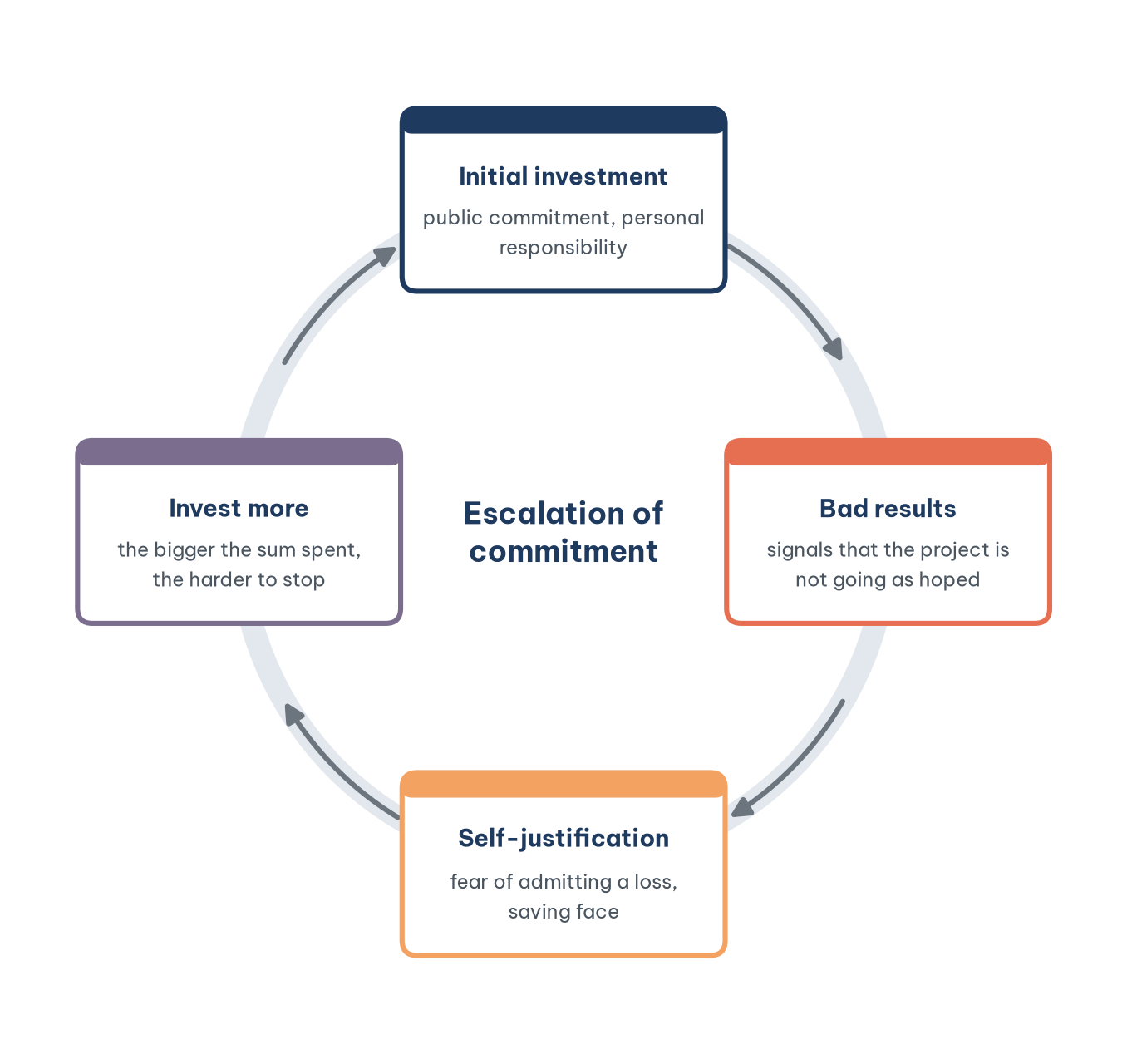
Figure 4 shows why escalation is hard to stop: each additional investment makes the sum already spent larger, which makes admitting the mistake more painful, which drives further investment. The loop is broken only by something from outside, such as a new decision-maker or a stopping rule set in advance, as Section 8 discusses.
7. Examples from business, investing and everyday life
The sunk cost trap appears at every scale, from a software project or a national project to personal portfolios and everyday choices. This section looks at four groups of examples.
7.1. An almost finished software project
Suppose a company has spent USD 1 million on a software project. Near completion, the market changes and a competitor already has a better solution. It would take another USD 500,000 to finish; expected revenue, after reassessment, is only USD 200,000. Table 9 compares the two options using only future cash flows.
Table 9 shows that the USD 1 million already spent appears in neither column. Stopping avoids losing another USD 300,000. The argument "we've already spent a million, just half a million more and it's done" sounds reasonable but rests entirely on a sunk cost.
7.2. Concorde
Concorde, the supersonic airliner developed jointly by Britain and France, kept being funded despite poor commercial prospects. The phenomenon is sometimes called the "Concorde effect" (Arkes & Ayton, 1999). There is a nuance, though: the treaty between the two countries made unilateral withdrawal very costly, so part of the reason to continue was a future cost of withdrawing, not purely a sunk cost. The example is a reminder to check for future costs of the "stop" option before concluding that someone has fallen into the trap.
7.3. Holding on to losing stocks
An investor buys a stock at USD 100; its price falls to USD 40 on poor business results, but the investor holds on, waiting to "get back to even". The USD 100 purchase price is a sunk cost; the right question is: at USD 40 today, would I buy this stock? If the answer is no, continuing to hold it amounts to deciding to buy it again at today's price. Shefrin and Statman (1985) called the tendency to sell winning stocks too early and hold losing stocks too long the disposition effect.
7.4. Students and startup teams
The sunk cost trap shows up in many everyday decisions: overeating at a buffet to "get your money's worth", finishing a bad book because you are halfway through, staying in an unhappy relationship because you have "invested" years in it. For students, a familiar example is continuing in a major that is clearly a poor fit "because I've already done two years".
For startup teams, the most common form is sticking with the original idea even when customer interviews show nobody needs it, which is the "failure to pivot" reason in studies of startup failure. The months spent building the product are sunk; the only valuable thing they leave behind is the information gained, and that information may be saying it is time to pivot.
8. Five ways out of the trap, and when to keep going
Knowing about the sunk cost trap is not enough to avoid it, because the mechanisms in Section 6 keep working. This section proposes five concrete ways out, from reframing the question to designing the decision process, then clarifies when persisting is the right choice.
8.1. Five ways out
The first is to reframe the question: if today were day one, with the information I have now, would I start this project? The question puts the decision-maker back at the "today" line in Figure 3, where money already spent plays no role.
The second is to think in terms of opportunity cost: what could the extra money and time put into this project create elsewhere? Sunk costs make people look backward; opportunity costs force them to look forward.
The third is to ask an outsider. Someone without an emotional attachment to the money already spent will see more objectively. In organizations, the decision to stop or continue can be given to someone other than the project's originator, the most direct way to cut the loop in Figure 4.
The fourth is to separate the person from the decision. Admitting that an old decision was wrong does not mean you have failed; the decision may have been right given the information at the time. Continuing when you know it is wrong is the real failure.
The fifth is to set stopping points in advance. Before starting, write down criteria for time, budget and results, for example: "after 8 weeks, if fewer than 20 customers have paid, we stop or pivot". When the milestone arrives, the decision follows criteria agreed while everyone was clear-headed, and is less driven by emotion.
8.2. When is continuing the right decision?
Understanding the sunk cost trap does not mean every project in difficulty should be stopped. Continuing is right when the future benefits of continuing exceed the future costs, regardless of how much has been spent. A project that has cost a great deal should still be finished if the remaining spending is small and the remaining benefit large. The difference between persistence and the trap lies not in the decision to continue or stop but in the reason: persistence rests on future cash flows and new evidence; the trap rests on money already spent and the wish not to admit a loss.
For startup teams, a useful test is: what evidence from the past month makes us believe more in this project? If the only answer is "we've built a lot", that is the sunk cost talking. If the answer is "three customers have paid and our retention rate is rising", that is evidence to continue.
9. Common mistakes with opportunity cost
Opportunity cost sounds simple but is easy to misuse. Table 10 summarizes the three most common mistakes, with examples and the right approach.
The third mistake is more common than you might think. Frederick et al. (2009) found that consumers often do not think of alternatives when deciding to buy; but simply being reminded, with a phrase such as "keep this money for other purchases", noticeably reduced the share who chose to buy. In other words, the habit of asking "what else could this money do?" on its own changes decisions.
The two ideas of this article also guard against each other's misuse. Opportunity cost looks to the future, at what you will miss; sunk cost belongs to the past, at what is gone for good. Good decisions count opportunity costs and ignore sunk costs.
10. A classroom application: absences and opportunity cost
Opportunity cost is also the basis of the attendance policy in the author's courses. This section explains how two kinds of absence are distinguished and handled.
10.1. Voluntary absence
A voluntary absence is when a student chooses to miss class to do something else: a job interview, an internship, part-time work, an event, a trip home or a holiday. The opportunity cost of that choice is the full value of the missed class: direct instruction, interaction, attendance marks and information shared in class.
Asking for attendance to be restored, a test to be retaken or materials to be provided individually after a voluntary absence is therefore asking for the benefit of option A without paying the price of giving up B. That is neither economically sound nor fair to classmates who accepted the opportunity cost of coming to class. Students take responsibility for their choices: if the interview was worth it, it must be worth losing the attendance mark and catching up on their own.
10.2. Involuntary absence
An involuntary absence is when a student or their family faces an unexpected event beyond their control, such as illness. This is not a trade-off for a better benefit but an unwanted loss, and adding a penalty to that loss would be inhumane.
The handling is therefore quite different. The student notifies the instructor promptly with valid evidence, such as a medical certificate. The absence is excused from the attendance mark; a missed test is retaken or replaced, because this restores a fair opportunity rather than granting a favour. Responsibility for learning still lies with the student: the instructor provides materials such as slides, videos and readings; the student studies independently, borrows notes or joins a study group; and the instructor answers specific questions after the student has studied, rather than re-teaching the whole class.
10.3. Why this is fair
Distinguishing the two kinds of absence protects all three parties. Students facing emergencies are not penalized for what they cannot control. Students who attend keep the irreplaceable benefit of live instruction and interaction. Instructors have a clear procedure instead of deciding case by case.
Conclusion
Opportunity cost is the value of the best alternative forgone, and it is present in every decision because resources are always limited. Using your own assets and time does not make their cost zero: economic profit, revenue minus explicit and implicit costs, is the right measure of whether a project is worth doing. For capital, opportunity cost underlies the MARR and the discount rate, provided you compare with an alternative of comparable risk.
A sunk cost is a cost already incurred that cannot be recovered; it should not influence future decisions. Only relevant costs, the future cash flows that differ between options, belong in the analysis, and salvage values, cancellation penalties and tax effects, which look as if they belong to the past, are in fact future cash flows. The sunk cost trap persists because of very human mechanisms (loss aversion, the wish to be consistent, ego), which in organizations become escalation of commitment. The most effective way out is not willpower but process: reframe the question from today, think in opportunity costs, ask an outsider, separate the person from the decision, and set stopping points before you begin.
Taken together, the two ideas give one habit worth keeping: ask what the best thing you are giving up is, and refuse to let what you cannot get back decide what you do next.
References
Arkes, H. R., & Ayton, P. (1999). The sunk cost and Concorde effects: Are humans less rational than lower animals? Psychological Bulletin, 125(5), 591–600. https://doi.org/10.1037/0033-2909.125.5.591
Arkes, H. R., & Blumer, C. (1985). The psychology of sunk cost. Organizational Behavior and Human Decision Processes, 35(1), 124–140. https://doi.org/10.1016/0749-5978(85)90049-490049-4)
Buchanan, J. M. (2008). Opportunity cost. In S. N. Durlauf & L. E. Blume (Eds.), The new Palgrave dictionary of economics (2nd ed.). Palgrave Macmillan.
Frederick, S., Novemsky, N., Wang, J., Dhar, R., & Nowlis, S. (2009). Opportunity cost neglect. Journal of Consumer Research, 36(4), 553–561. https://doi.org/10.1086/599764
Kahneman, D., & Tversky, A. (1979). Prospect theory: An analysis of decision under risk. Econometrica, 47(2), 263–291. https://doi.org/10.2307/1914185
Mankiw, N. G. (2021). Principles of economics (9th ed.). Cengage.
Park, C. S. (2019). Contemporary engineering economics (6th ed.). Pearson.
Shefrin, H., & Statman, M. (1985). The disposition to sell winners too early and ride losers too long: Theory and evidence. Journal of Finance, 40(3), 777–790. https://doi.org/10.1111/j.1540-6261.1985.tb05002.x
Staw, B. M. (1976). Knee-deep in the big muddy: A study of escalating commitment to a chosen course of action. Organizational Behavior and Human Performance, 16(1), 27–44. https://doi.org/10.1016/0030-5073(76)90005-290005-2)
Discussion about this post