How Startup Valuation and Dilution Work, From Pre-Money to the VC Method
Reading the numbers and terms that decide how much of the company founders still own after every funding round


Key takeaways
Post-money valuation equals pre-money valuation plus the new investment, and the investor's stake equals the investment divided by the post-money value. "An $800,000 valuation" means two different deals depending on whether it is pre or post.
Dilution comes from issuing new shares, not from selling old ones. In the worked example the founders fall from 100% to 56% over two rounds while the value of their stake triples from $560,000 to $1.68 million between the seed and the Series A.
An option pool created inside the pre-money valuation dilutes only the existing shareholders, so the founders' real price is lower than the headline pre-money figure.
Early-stage valuation is negotiated, not calculated. The VC method works backward from an expected exit and a target multiple, and expected dilution from later rounds pushes today's valuation down.
Terms can matter as much as price: liquidation preference, anti-dilution, board seats and protective provisions decide who gets paid and who decides, especially when the exit is disappointing.
Two founders have just received their first investment offer: $160,000 for 20% of the company. One of them is pleased that the company is "worth $800,000". The other is uneasy about "giving away a fifth of the company". Two years later, after a Series A, their combined stake has fallen from 100% to 56%, yet that stake is now worth $1.68 million. Neither first reaction was aimed at the right target. What matters is not the percentage alone but the value of what the founders own and the terms that come attached to the money.
This conversation happens thousands of times a year, from Silicon Valley to Lagos, Bangalore and Ho Chi Minh City, and it usually happens between parties with very unequal experience. A venture capitalist may negotiate dozens of term sheets a year; a first-time founder may sign one or two in a lifetime. Valuation sits at the center of every negotiation: how much the business is worth and how many shares the investor receives in exchange for the money. For a startup with no profits, the question has no objective answer. The number comes out of a negotiation shaped by the company's potential, the bargaining power of each side and the supply of and demand for capital at that moment. Understanding the mechanics lets founders negotiate with confidence and avoid deals that remain painful for years.
The article has five sections. Section 1 defines pre-money and post-money valuation. Section 2 explains dilution and the cap table through a two-round example, including where the employee option pool sits. Section 3 presents three ways investors value early-stage startups, with a worked version of the venture capital (VC) method. Section 4 covers the most important investment terms, with a liquidation preference example and a note on SAFEs and convertible notes. Section 5 draws together five principles for negotiating well.
1. Pre-money and post-money valuation
This section introduces the two numbers that every funding conversation starts from and the one confusion that causes the most avoidable mistakes.
Pre-money valuation is the value of the company immediately before the new money comes in. Post-money valuation is the pre-money valuation plus the amount the investors put in. The share of the company that the new investors receive equals their investment divided by the post-money valuation:
Post-money valuation = Pre-money valuation + New investment
Investor ownership = New investment / Post-money valuation
In the offer from the opening, the pre-money valuation is $640,000, the investment is $160,000 and the post-money valuation is $800,000. The investor receives 160,000 / 800,000 = 20%, and the founders and other existing shareholders keep 80% (Table 1).
A very common mistake is to mix the two numbers up. "A valuation of $800,000" and "a valuation of $640,000" for the same $160,000 are two different deals. If $800,000 is the pre-money figure, the post-money valuation is $960,000 and the investor receives only about 16.7%. In every discussion, ask whether the number on the table is pre-money or post-money.
2. Dilution and the cap table
This section follows the same company through two rounds to show what dilution is, why it is not a loss in itself and where the option pool hides.
A single deal is only the beginning. Each funding round issues new shares to new investors, which reduces the percentage held by existing shareholders. This is dilution. To track ownership across rounds, companies keep a capitalization table (cap table), which records the number of shares and the percentage held by founders, investors and holders of employee stock options.
2.1. A two-round example
Suppose the two founders hold 10,000,000 shares at founding. In the seed round, the investor puts in $160,000 at a pre-money valuation of $640,000 and asks the company to set up an employee option pool equal to 10% of the post-money shares, to attract and keep good people. Two years later, a Series A raises $600,000 at a pre-money valuation of $2.4 million. Table 2 and Figure 1 show how ownership changes.
After the seed round the founders must hold 70% (100% minus the 20% investor stake and the 10% pool), so the total is 10,000,000 / 0.70 = 14,285,714 shares. The price per share is the pre-money valuation divided by the shares that exist before the money arrives, pool included: $640,000 / 11,428,571 = $0.056. At the Series A, the price is $2,400,000 / 14,285,714 = $0.168, and $600,000 buys 3,571,429 new shares.
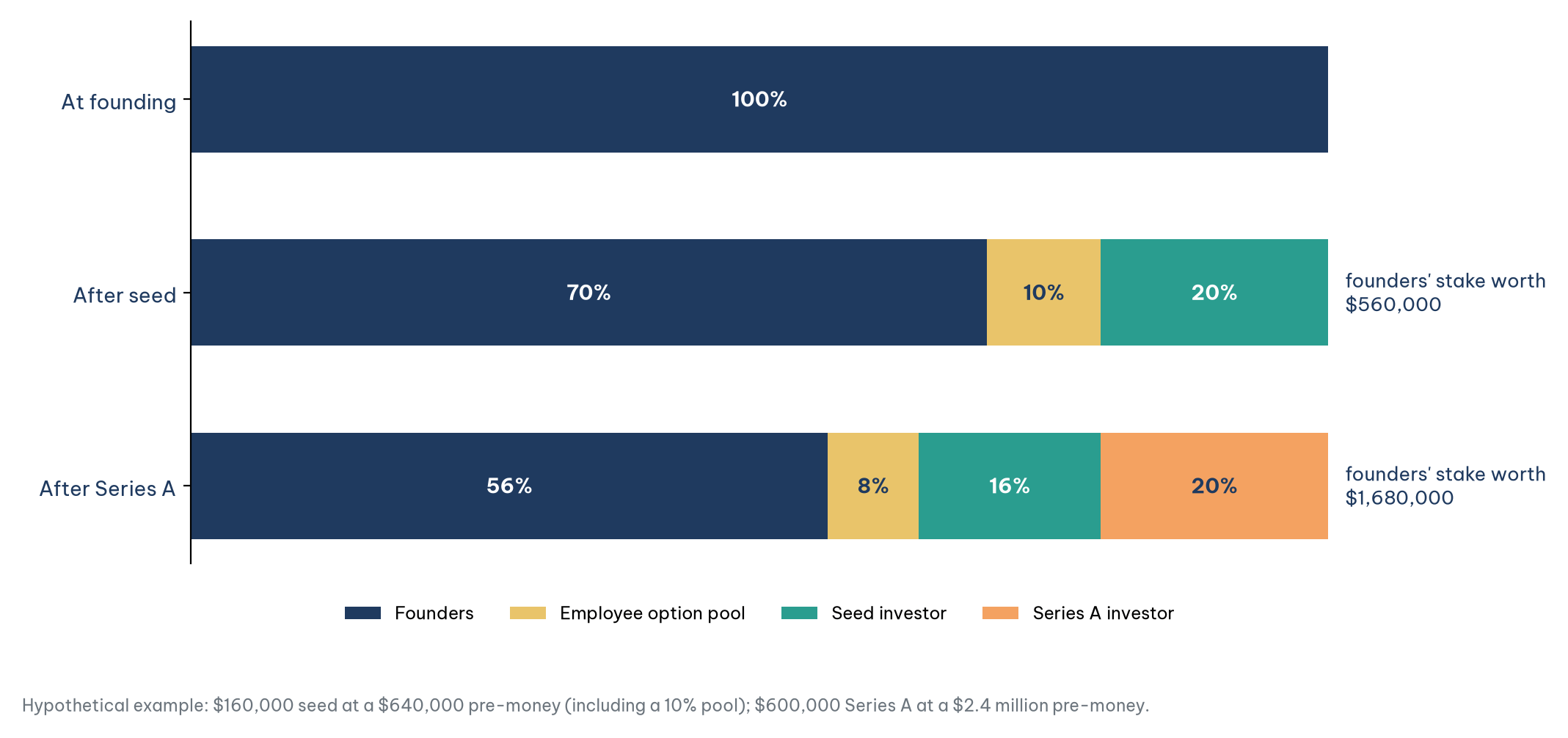
Two points stand out. First, the founders did not sell a single share; their percentage fell because the total number of shares grew. Second, their percentage dropped from 70% to 56% between the two rounds, yet the value of their stake tripled, because the price per share rose from $0.056 to $0.168. This is what healthy dilution looks like: a smaller slice of a much larger pie. Notice also that every earlier holder was diluted by the same proportion in the Series A: each kept 80% of its previous percentage (70% to 56%, 10% to 8%, 20% to 16%), because the new investor bought 20% of the enlarged company.
2.2. Where the option pool sits
One detail in the example is easy to miss: the option pool was created before the investor came in, which means it sits inside the pre-money valuation. So although the headline pre-money valuation is $640,000, the part that really belongs to the founders is only 10,000,000 shares × $0.056 = $560,000; the remaining $80,000 is the pool reserved for future employees. Investors usually propose this structure because a pool created in the pre-money dilutes the founders, not the incoming investor (Feld & Mendelson, 2019).
This is not a trick, and a company does need a pool to hire. But founders should understand the arithmetic well enough to negotiate the size of the pool on the basis of a real hiring plan for the period until the next round, rather than accepting a default number. A pool that is larger than the hiring plan needs simply transfers value from the founders to the new investor.
3. Valuing an early-stage startup
This section turns from the arithmetic to the harder question of where the pre-money number comes from in the first place.
The formula in Section 1 is simple; the difficult part is the pre-money figure itself. An early-stage startup has no stable cash flows, a short history and a highly uncertain future, so traditional discounted cash flow analysis is of limited use (Damodaran, 2018). In practice, investors combine several approaches.
3.1. Comparable deals
The most widely used approach is to look at recent deals by startups in the same industry, at the same stage and in the same market to establish a reasonable range. This approach reflects actual conditions in the capital market at the time of the raise, but it depends on deal data, which is published unevenly. In large venture markets, databases and investor networks make comparables relatively easy to find; in smaller and emerging markets, few deals are disclosed and the range is often set by a handful of anecdotes.
3.2. The venture capital method
The VC method works backward from the future to the present (Figure 2). The investor estimates what the company will be worth at exit, say $8 million in five years, and divides that by a target return multiple, say 10 times, to arrive at today's post-money valuation: $800,000. Subtracting the $160,000 investment gives a pre-money valuation of $640,000, the same figure as in the seed deal of Sections 1 and 2.
A tenfold multiple sounds greedy, but it reflects the reality that most early-stage investments fail, so the few winners have to pay for the whole portfolio (Gompers & Lerner, 2004). An investor who expects only a minority of the portfolio to return meaningful money cannot price each deal as if it were a safe bet.
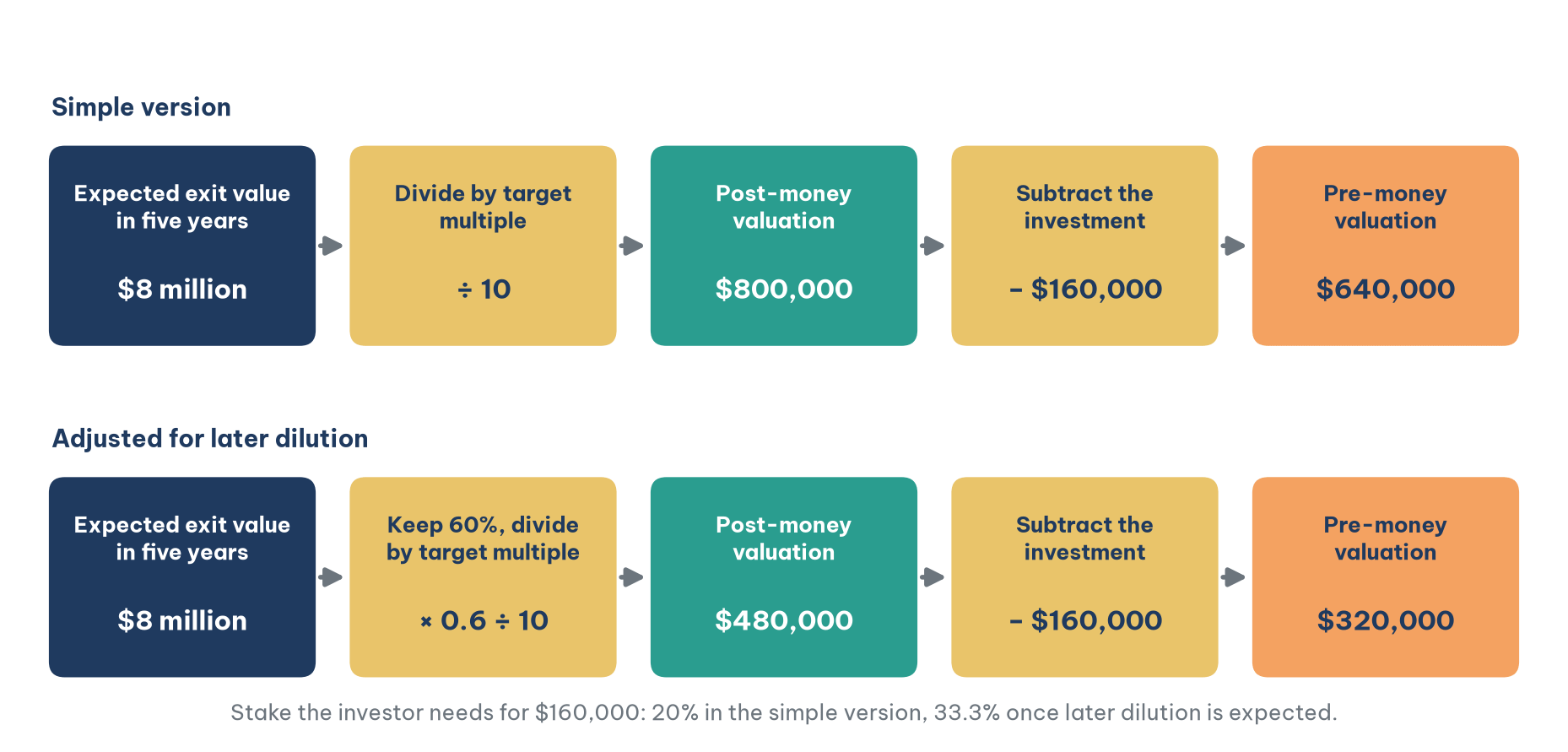
A more careful version also accounts for dilution in later rounds. If the investor expects its stake to shrink to about 60% of its original size through future rounds, it will collect only 60% of the exit value that its initial percentage implies. Today's post-money valuation therefore falls to $8,000,000 × 0.6 / 10 = $480,000, and the pre-money valuation to $320,000. Put differently, to reach the same target return on $160,000, the investor now needs a 33.3% stake rather than 20%. Founders who understand this calculation will see why investors care about the financing plan for future rounds from the very first one: a plan that needs many more rounds means more dilution ahead and a lower price today.
3.3. Scorecard methods
Some angel investors use a scoring approach, often called the scorecard method. They take the average valuation of startups at the same stage in the same region as a baseline, then adjust it up or down according to the quality of the team, the size of the market, the maturity of the product, the competition and the evidence of customer demand. The weights are subjective, but the method forces both sides to argue about concrete factors rather than impressions.
Table 3 summarizes the three approaches. Whichever one is used, a startup valuation is the outcome of a negotiation, not an objective fact. A very high valuation looks attractive now but creates pressure on the next round: if the company does not grow fast enough to justify it, the next raise may have to happen at a lower valuation (a down round), which dilutes the founders heavily, can trigger anti-dilution protection for earlier investors and damages the morale of the whole team.
4. Investment terms: more than the valuation
This section shows why the price is only one line of a term sheet and walks through the terms that most often change who receives what.
Once the two sides agree on the main points, they are written into a term sheet, which becomes the basis for the definitive legal documents. Many founders focus almost entirely on the valuation and skim the rest, even though the other terms can matter just as much (Feld & Mendelson, 2019). In most venture deals the investor buys preferred stock, a class of shares whose extra rights are defined by exactly these terms, while the founders and employees hold common stock.
4.1. Economic terms and control terms
Feld and Mendelson (2019) divide the terms into two groups. Economic terms decide who receives how much money when there is a liquidity event, such as a sale of the company. Control terms decide who has the right to make or block decisions (Table 4).
Anti-dilution deserves a word because its name misleads. It does not protect investors against the ordinary dilution shown in Table 2; it protects them against a lower price in a later round. The common "broad-based weighted average" form adjusts the conversion price moderately, while the rarer "full ratchet" form resets it all the way down to the new price and can transfer a large share of the company away from the founders (Feld & Mendelson, 2019).
4.2. Liquidation preference, worked through
The term founders most often misunderstand is the liquidation preference. In its most common form, a 1x non-participating preference, the seed investor in our example ($160,000 for 20%) chooses one of two options when the company is sold: take back its $160,000 first, or convert to common stock and share the proceeds pro rata at 20%. To keep the example simple, assume the sale happens before any Series A.
If the company is sold for $400,000, 20% would be only $80,000, so the investor takes back its $160,000 and the remaining $240,000 is shared among the common shareholders. If the company is sold for $2 million, 20% is $400,000, so the investor converts. The switching point is the sale price at which 20% equals the preference: $160,000 / 0.20 = $800,000, which is exactly the post-money valuation (Figure 3). Below it the preference protects the investor; above it the investor simply shares like everyone else.
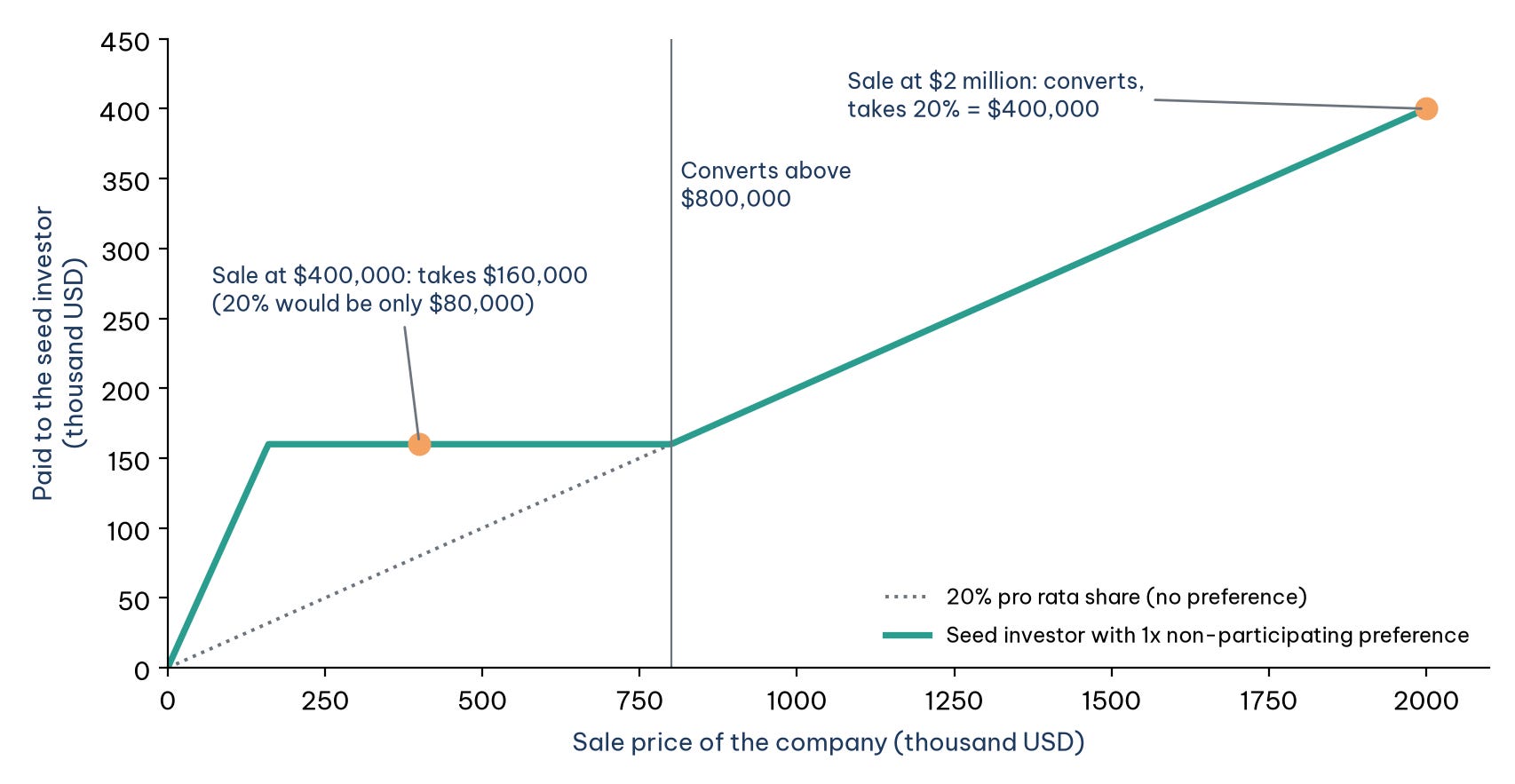
The preference therefore matters only when the exit disappoints, but disappointing exits are the common case. Variants such as a multiple preference (2x or 3x) or a participating preference, where the investor takes its money back and then also shares in the rest pro rata, are far less favorable to founders. Every additional preference layered on by later rounds also stacks in front of the common shareholders, so in a modest sale the founders and employees can receive little or nothing even when the headline price sounds respectable.
4.3. Vesting protects the founders too
Vesting often irritates founders at first: why should their own shares have to be earned over time? The usual practice is four years with a one-year cliff: a founder who leaves before the first anniversary keeps none of the unvested shares, at the cliff a quarter vests, and the rest vests monthly over the following three years (Feld & Mendelson, 2019). The clause protects investors, but it also protects the founders from each other. If one co-founder leaves after six months, those who stay do not have to carry a large shareholder who no longer contributes.
What share classes and investor rights are available, and how they must be documented, depends on the legal form of the company and the law of the place where it is incorporated. This is one reason why many startups that raise money from international investors set up a holding company in a jurisdiction familiar to those investors. Before signing, founders should have a lawyer experienced in startup financing review the whole term sheet.
4.4. Before the priced round: SAFEs and convertible notes
Many very early rounds are not priced at all. Instead of agreeing on a valuation and issuing preferred shares, the investor signs a contract that converts into shares at the next priced round. The most widely used instrument is the SAFE (simple agreement for future equity), whose post-money version has been Y Combinator's standard form since 2018 (Y Combinator, n.d.).
A SAFE is not a loan: it carries no interest and has no maturity date. Its main economic term is usually a post-money valuation cap, and the ownership a SAFE buys is the investment divided by that cap. Had the seed investor in our example invested $160,000 on a SAFE with an $800,000 post-money cap, it would own 20% of the company as it stands just before the next priced round. The cap is "post" all the money raised on SAFEs and the options that already exist, but not "post" the new money in the priced round or any new or enlarged option pool created as part of that round, so the SAFE holder is then diluted by those alongside the founders (Y Combinator, n.d.). Two consequences follow for founders. Ownership sold on SAFEs adds up: two $160,000 SAFEs on the same $800,000 cap sell 40% of the company, and all of that dilution falls on the existing holders. And if the priced round comes in below the cap, the SAFE converts at the round's lower price, so it ends up with more than the estimated percentage.
A convertible note works in a similar way but is legally debt: it accrues interest and has a maturity date, and it usually converts at a discount to the next round's price, a cap or both. Whatever the instrument, the discipline is the same: keep a pro forma cap table that shows what every SAFE and note will turn into at the next round, before signing the next one.
5. Principles for negotiating well
This section condenses the mechanics into five practical rules.
First, maximize value, not percentage. Holding 56% of a company with a $3 million post-money valuation is far better than holding 90% of a company that never grows because it lacked capital. Second, always ask whether a valuation is pre-money or post-money and where the option pool sits, and size the pool from a real hiring plan. Third, read the economic and control terms carefully, especially liquidation preference, protective provisions and anti-dilution. A high valuation with harsh terms can be worse than a moderate valuation with clean terms.
Fourth, do not maximize the valuation at any cost. A valuation the company can grow into makes the next round easier and avoids a down round; many experienced founders value the quality and goodwill of an investor more than the headline number. Fifth, keep the cap table clean from day one: split equity among the founders clearly, put vesting in place, record every equity promise in writing and track every SAFE and note. A messy cap table is a common reason why due diligence drags on or a deal falls apart.
Conclusion
Valuation and dilution are not topics only for finance specialists. Every founder who takes outside money will sign numbers and terms that decide who owns what and who decides what for years to come. The pre-money and post-money formula takes a few minutes to learn, and a cap table can be built in an ordinary spreadsheet. The terms take longer to read and deserve a good lawyer. The most important idea to keep is that dilution is nothing to fear when each round makes the pie grow faster than your slice shrinks. In the worked example the founders' share fell by a fifth between the seed and the Series A while its value tripled. That only happens when every round is built on real evidence about customers and revenue, so that the next investor has a reason to pay a higher price per share than the last one.
References
Damodaran, A. (2018). The dark side of valuation: Valuing young, distressed, and complex businesses (3rd ed.). Pearson FT Press. https://www.informit.com/store/dark-side-of-valuation-valuing-young-distressed-and-9780134854243
Feld, B., & Mendelson, J. (2019). Venture deals: Be smarter than your lawyer and venture capitalist (4th ed.). John Wiley & Sons. https://www.wiley.com/en-us/Venture+Deals:+Be+Smarter+Than+Your+Lawyer+and+Venture+Capitalist,+4th+Edition-p-9781119594826
Gompers, P. A., & Lerner, J. (2004). The venture capital cycle (2nd ed.). MIT Press. https://mitpress.mit.edu/9780262072557/the-venture-capital-cycle/
Y Combinator. (n.d.). Safe financing documents. Retrieved November 19, 2026, from https://www.ycombinator.com/documents
Discussion about this post