Startup Ideas Are Recognized, Not Invented: Learning to Notice Problems
Why good startup ideas come from noticing real problems around you, and a seven-day discomfort journal to train that habit


Key takeaways
Ideas thought up in a meeting room tend to be "sitcom ideas": plausible on paper, praised by friends and needed urgently by nobody.
Research describes opportunity recognition as pattern recognition: people notice what their prior knowledge of markets, customers and ways of serving them lets them see. Noticing can be trained.
Paul Graham's three principles point the eye: solve a problem you have and "live in the future", start with a narrow but deep well rather than a broad but shallow hole and switch off the filter that hides tedious, unglamorous work.
Generative AI makes inventing ideas almost free, so its real value lies elsewhere: analyzing real complaints, lowering the cost of tedious work and building toy prototypes quickly.
A seven-day discomfort journal turns these principles into a habit, with a clear stopping rule: go further only when someone is already spending money or time to cope with the problem.
Ask a room of aspiring founders anywhere in the world how they plan to find a startup idea, and most will describe a brainstorm: a whiteboard, a few hours, a team trying to think of something. According to Paul Graham, cofounder of the accelerator Y Combinator, that is the method most likely to lead to failure. In his essay How to Get Startup Ideas, he argues that the best ideas are rarely thought up. They are noticed, in real problems the founders are living with (Graham, 2012a).
The difference between "thinking up" and "noticing" sounds like wordplay, but it leads to two very different ways of working. Someone who thinks up an idea starts with a solution and goes looking for people who need it. Someone who notices an idea starts with a problem they have seen clearly, and the solution comes later. The second way is slower at first, but it avoids the most common startup trap: building something nobody needs.
This article is about the act of noticing. Section 1 dissects the trap of the "sitcom idea". Section 2 explains why some people see opportunities that others walk past, drawing on research that treats opportunity recognition as pattern recognition. Sections 3 to 5 present Graham's three principles: solve your own problem, choose a narrow but deep market and switch off the schlep filter. Section 6 shows how generative AI can help founders notice faster instead of producing ideas in bulk. Section 7 walks through a seven-day discomfort journal with a worked example.
1. The trap of the "sitcom idea"
This section describes the most dangerous kind of startup idea and why it fools both the person who proposes it and the people asked for an opinion.
1.1. Ideas that sound plausible but that nobody needs
Imagine a television writer who needs a scene in which the main character starts a company. The writer is not an entrepreneur, so they invent something that sounds reasonable: a social network for pet owners. On the surface it is convincing. There are millions of pet owners, they love their animals and they like sharing pictures of them.
Graham calls these made-up ideas, or sitcom ideas: sensible on paper, but nobody needs them urgently. Pet owners already share photos on the social networks they use, with the friends they already have. A separate network relieves none of their pain and asks them to start over from scratch.
1.2. Why praise from friends is misleading
When a founding team takes a sitcom idea out for feedback, almost everyone says something like "sounds good, I bet people would use that". Yet the person answering does not use it. The praise is not a lie: listeners genuinely find the idea reasonable. The problem is that "reasonable" is not the same as "needed badly enough to spend time and money on it".
The lesson is to stop starting with a search for ideas and to start with a search for problems. When the time comes to test a problem, ask people about what they did in the past rather than what they think they might do in the future. Past behavior costs the speaker something; opinions about the future cost nothing.
2. Noticing as pattern recognition
If good ideas are noticed rather than invented, an obvious question follows: why do some people notice them while others, looking at the same world, see nothing? This section summarizes two lines of research that give a practical answer.
2.1. Prior knowledge decides what you can see
Scott Shane (2000) studied eight attempts by different entrepreneurs to commercialize the same invention, a three-dimensional printing process developed at MIT. The technology was identical, yet the entrepreneurs saw very different opportunities in it, among them producing drugs, making rapid prototypes and manufacturing artificial bone. What each of them noticed depended on what they already knew. Shane concluded that opportunities are not equally visible to everyone, and that three kinds of prior knowledge shape what a person can recognize: knowledge of markets, knowledge of ways to serve markets and knowledge of customer problems. Table 1 turns these three kinds into questions a founder can ask about themselves.
The rows of Table 1 are not a ranking. They are three different windows, and most people have at least one open without realizing it.
2.2. Connecting the dots
Robert Baron (2006) took the argument a step further. He described opportunity recognition as pattern recognition: the ability to "connect the dots" between events that seem unrelated, such as a change in technology, a shift in regulation and a recurring customer complaint, and to see a meaningful pattern in them. Experienced entrepreneurs are better at this not because they are more creative in general but because they have stored more patterns, or prototypes, of what a business opportunity looks like, and they match new information against them. Baron also argued that alertness and active search work together rather than against each other: patterns are found more often by people who keep looking in a domain they know well.
The practical consequence is encouraging. If noticing depends on stored knowledge and on the habit of looking, it can be trained. The three principles in the next sections tell a founder where to point their attention, and the journal in Section 7 turns that attention into a routine.
3. Principle 1: solve your own problem
The surest way to know that a problem is real is to have it yourself. This section presents Graham's first principle and extends it with the advice to "live in the future".
3.1. Companies that began with the founders' own needs
Graham notes that Apple, Yahoo, Google and Facebook all started as things their founders built because they wanted them. Steve Wozniak wanted a computer and could not afford one, so he built his own, the machine that became the Apple I. Yahoo began as Jerry Yang and David Filo's list of web sites they liked. Google grew out of Larry Page and Sergey Brin's graduate research at Stanford on how to find things on the web.
What these examples share is that the founders did not need market research to know the problem existed, because they were the first market. They also knew at once whether the product was good, because they were its first users. The learning loop between building and using was almost instantaneous.
3.2. Live in the future, then build what's missing
Graham borrows an observation from Paul Buchheit, the creator of Gmail: people at the leading edge of a rapidly changing field "live in the future". Graham combines it with a line from Robert Pirsig to produce his advice: live in the future, then build what's missing. People at the frontier of a technology, a profession or even a niche hobby see gaps that others cannot yet see. To everyone else those gaps are minor inconveniences nobody has noticed; to the person at the frontier they are opportunities.
For students, "the frontier" need not mean advanced technology. A student who plays competitive video games, one who works part time in a warehouse and one who runs a club with hundreds of members are all living in the future of some small field. In Shane's terms, each has prior knowledge that most outsiders lack. The question is whether they notice what is missing.
4. Principle 2: dig a well, not a shallow hole
Many founding teams assume a good idea must serve a great many people from day one. This section presents Graham's image of the well and explains why a small but deep market is a better starting point.
4.1. Broad but shallow, narrow but deep
Graham uses the image of a hole in the ground to describe a starting market. An idea can be liked a little by a very large number of people, like a hole that is broad but shallow. Or it can be wanted intensely by a small group, like a well that is narrow but deep. Made-up ideas almost always produce the first shape; most good startups begin with the second. Figure 1 shows the two shapes.
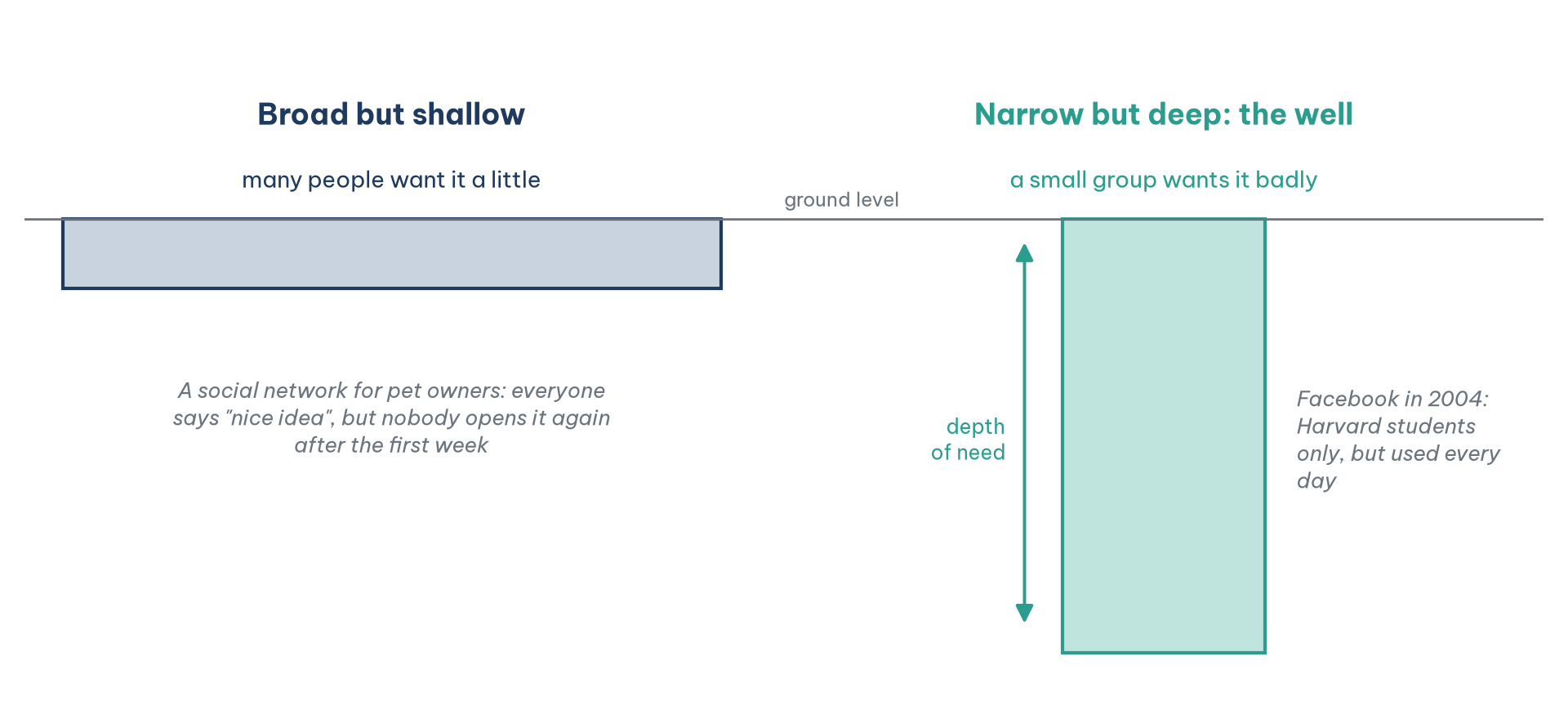
Figure 1 makes the point that depth of need, not breadth of audience, keeps users coming back. Table 2 compares the two shapes on four dimensions.
Facebook did not launch for the whole world but for the students of one university. The market was small, but the need was intense: students used it every day. Because universities resemble one another, it could spread from Harvard to other campuses and then beyond them. Graham gives an older example of the same shape: Microsoft's first product, a version of BASIC for the Altair computer, served only a few thousand hobbyists, but they wanted it badly. A product that is "fine" for everyone struggles to survive; a product that is indispensable for a small group has a foundation to grow from. Graham adds a caution: a well shape is necessary but not sufficient, because the well must also lead somewhere larger.
4.2. The link with the beachhead market
Graham's well meets the idea of the beachhead market in the disciplined entrepreneurship method of Bill Aulet (2013). Both advise choosing a group of customers small enough to dominate, with a need strong enough that they will pay, and with links to neighboring groups that make later expansion possible.
The difference is one of timing. Graham is talking about the very early stage, when a team is still looking for a problem worth solving. Aulet is talking about choosing a market once the team already has a direction. The well is how you notice that a problem runs deep; the beachhead is how you decide where to land.
5. Principle 3: switch off the schlep filter
Why do people so often overlook good ideas lying right in front of them? This section presents Graham's concept of "schlep blindness" and suggests where to look for the problems it hides.
5.1. Schlep blindness
In his essay Schlep Blindness, Graham explains that the mind automatically filters out ideas that would require tedious, messy or unglamorous work (Graham, 2012b). He calls such work a "schlep", and the failure to see it "schlep blindness". In How to Get Startup Ideas he names a second, related filter, the "unsexy filter", which steers people away from problems they find distasteful, and he argues that switching off the schlep filter matters more, because the fear behind it is more often an illusion (Graham, 2012a).
His main example is Stripe. Before Stripe, accepting payments online was something many programmers knew to be painful: dealing with banks, working through legal and compliance requirements, integrating with old systems. Everyone saw the problem, but few wanted to touch it. The Collison brothers accepted the schlep, and the schlep itself became the wall that protected them from competitors.
5.2. Where schleps tend to hide
The schlep filter is strongest in fields with heavy paperwork, many parties involved and little glamour. Table 3 suggests areas worth watching in most economies. They are places to look for problems, not ready-made ideas.
The last row of Table 3 is often ignored, yet it is the easiest to reach. The tasks that your parents, your siblings or you yourself still handle by hand are where Principle 1 and Principle 3 meet: the problem is both your own and a schlep that others avoid. It is also where Shane's third kind of prior knowledge, knowledge of customer problems, comes free of charge.
6. Generative AI: a tool for noticing faster
Graham's ideas date from 2012, but they fit the generative AI era even better, now that "thinking up" ideas costs almost nothing. This section describes four ways to use generative AI in the right direction, under one rule: use AI to find problems, not to invent ideas.
6.1. Use AI to live in the future sooner
The first way is to become a skilled user of AI tools in your own field. Daily use reveals what AI still cannot do, where it gets things wrong and which steps of a process remain manual even with AI in place. Those limits are hints about tomorrow's products, exactly in the spirit of Buchheit's "living in the future".
6.2. Use AI to analyze pain in real data
The second way starts by refusing to ask an AI "give me a startup idea", which is a reliable way to mass-produce sitcom ideas. Instead, the team collects real data, such as one- and two-star reviews of apps, posts in online communities and interview notes, and asks AI to organize it. A sample prompt might read:
Below are 300 negative reviews of sales management apps. Group the complaints by theme, count how often each theme appears and point out the complaints for which users say they have no alternative. Quote two examples verbatim for each group.
What comes back is a set of hypotheses, not conclusions. AI can merge themes wrongly or invent quotes, so the team must check the output against the original data and then test it in direct interviews. Used this way, AI widens the stream of raw material from which patterns are recognized; the recognizing is still done by people.
6.3. AI lowers the cost of the schlep
The third way is to revisit ideas once abandoned because they cost too much to operate. Basic legal guidance for people on low incomes, for example, has long been hard to run profitably because every case takes hours of a lawyer's time. AI can help answer common questions and draft standard documents, freeing lawyers for the complex cases.
In fields such as law, health and finance, however, the team must design human review into the process and make clear who is responsible when the AI answers wrongly. The schlep does not disappear; it moves from doing the work by hand to controlling quality and compliance.
6.4. Build toys faster than ever
The fourth way rests on another piece of Graham's advice: do not dismiss things that look like toys, because a toy has everything an idea needs except the appearance of importance, and many large products began as projects done for fun. With AI, a student team can build a working prototype in hours rather than weeks. The faster a team experiments, the better its chances of running into a problem worth solving, provided each experiment reaches real users and is not just a demonstration.
7. The seven-day discomfort journal
The three principles are only useful once they become a habit of observation. This section describes a simple way to build that habit and applies it to a concrete example.
7.1. The steps
The method has five steps and takes about two weeks: one week of logging and one week of selecting and checking. Figure 2 shows the five steps and the condition for starting over.
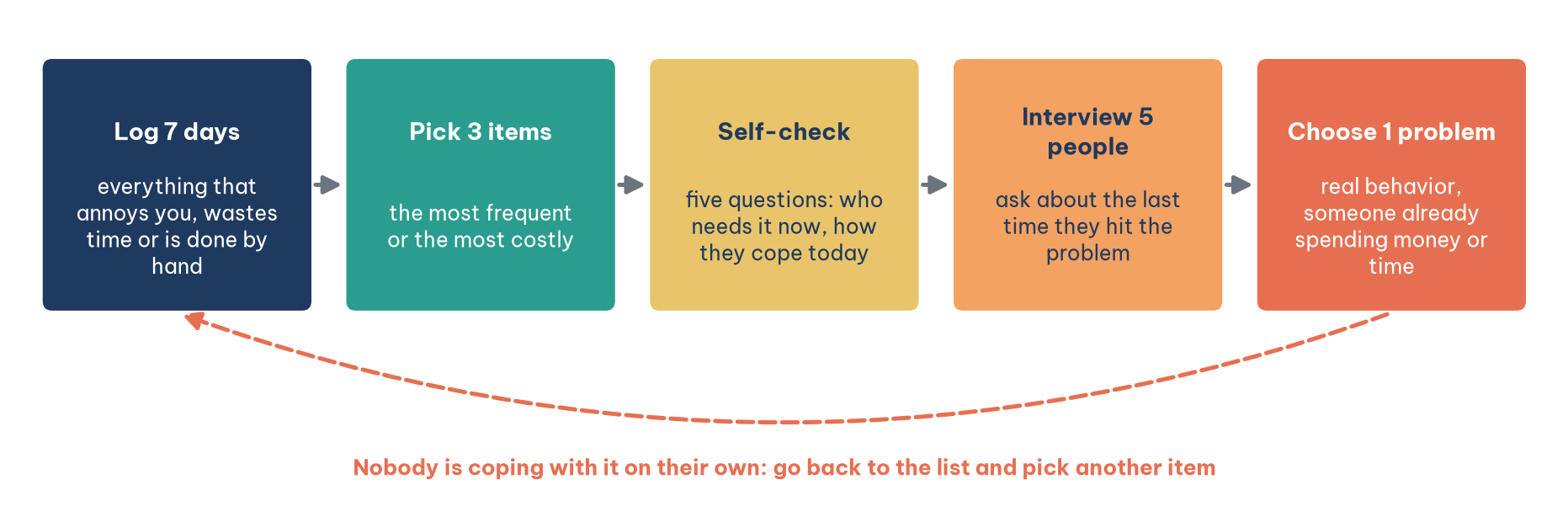
As Figure 2 shows, the first step lasts seven days. Each time something annoys you, wastes your time or forces you to do work by hand, write down what it was, where it happened, how long it took, how you dealt with it and whether anyone else has the same problem. At the end of the week, choose the three items that recurred most often or cost the most, and put each through five self-check questions. The first is whether you, or someone you know well, really has this problem. The second is who needs a solution right now, badly enough to use a rough first version. The third is how they cope today and how much money and time that costs them. The fourth is whether this is a schlep that others are avoiding. The fifth is whether you stand further in the "future" of this field than most people do.
For each item that survives the self-check, interview five people who share the problem and ask about the most recent time they ran into it. If none of them is doing anything to cope with it, the problem may not hurt enough; go back to the list and pick another item.
7.2. Example: a student renting a room
Consider a second-year student renting a room in a privately run building with 12 rooms. Over seven days the student logs 14 items. Table 4 shows the three that recurred most, together with the result of the self-check (a hypothetical example).
Table 4 shows that the first item is the most promising. Both sides bear the cost, people already spend time on a workaround and the problem returns every month. The student's next step is to interview five landlords who own ten or more rooms about the last time they settled utility bills, rather than interviewing tenants, because landlords are the ones able to pay. The journal has done its job: it has turned a vague feeling of irritation into a specific, testable problem with a named group of people behind it.
Conclusion
Good startup ideas are rarely invented; they are recognized in real problems. A sitcom idea sounds reasonable and wins praise from friends, but nobody needs it urgently. Research on opportunity recognition explains why noticing is uneven: people see the patterns their prior knowledge of markets, ways of serving them and customer problems allows them to see, and experienced founders have simply stored more of those patterns. Graham's three principles tell a founder where to direct attention: solve your own problem and live in the future of a field, start with a narrow but deep well before expanding and switch off the filter that hides tedious work, because the schlep itself is often the barrier that protects a company.
Generative AI makes thinking up ideas cheaper than ever, but used well it also makes noticing problems faster: analyzing real data about pain, lowering the cost of schleps and building toy prototypes in hours. The seven-day discomfort journal turns all of this into a habit of observation, with a clear rule for when to stop: go further only when you can see someone already spending money or time to cope with the problem.
References
Aulet, B. (2013). Disciplined entrepreneurship: 24 steps to a successful startup. Wiley. https://www.wiley.com/en-gb/Disciplined+Entrepreneurship%3A+24+Steps+to+a+Successful+Startup-p-9781118720813
Baron, R. A. (2006). Opportunity recognition as pattern recognition: How entrepreneurs "connect the dots" to identify new business opportunities. Academy of Management Perspectives, 20(1), 104–119. https://doi.org/10.5465/amp.2006.19873412
Graham, P. (2012a, November). How to get startup ideas. http://paulgraham.com/startupideas.html
Graham, P. (2012b, January). Schlep blindness. http://paulgraham.com/schlep.html
Shane, S. (2000). Prior knowledge and the discovery of entrepreneurial opportunities. Organization Science, 11(4), 448–469. https://doi.org/10.1287/orsc.11.4.448.14602
Discussion about this post