The Journey of Knowledge: Six Revolutions in Learning
From oral tradition, print, mass schooling, broadcasting and the internet to AI tutors, and how to learn well in the age of AI


Key takeaways
How people learn has gone through six overlapping revolutions: memory and manuscripts, print, mass education, audio-visual media, the internet and AI.
Each technology changed who holds knowledge, how cheap it is, and what learners must do to turn information into understanding.
Each also solved the previous stage's risk while creating a new one: print spread errors too, the internet brought overload, AI can make learners stop thinking.
Controlled studies show AI tutors can help or harm. Design decides: AI that makes learners think helps; AI that hands out answers hurts exam performance.
Five habits help: try first, ask AI to question you, re-explain in your own words, review with spacing, verify anything important.
The history of civilization is also the history of learning. From the first efforts to survive to the ambition of reaching the stars, humans have been driven by a primal instinct: the desire to understand. Along the way, not only the content of knowledge has changed, but the very methods by which we receive, process and spread it have gone through deep revolutions that reshaped society and the way we think.
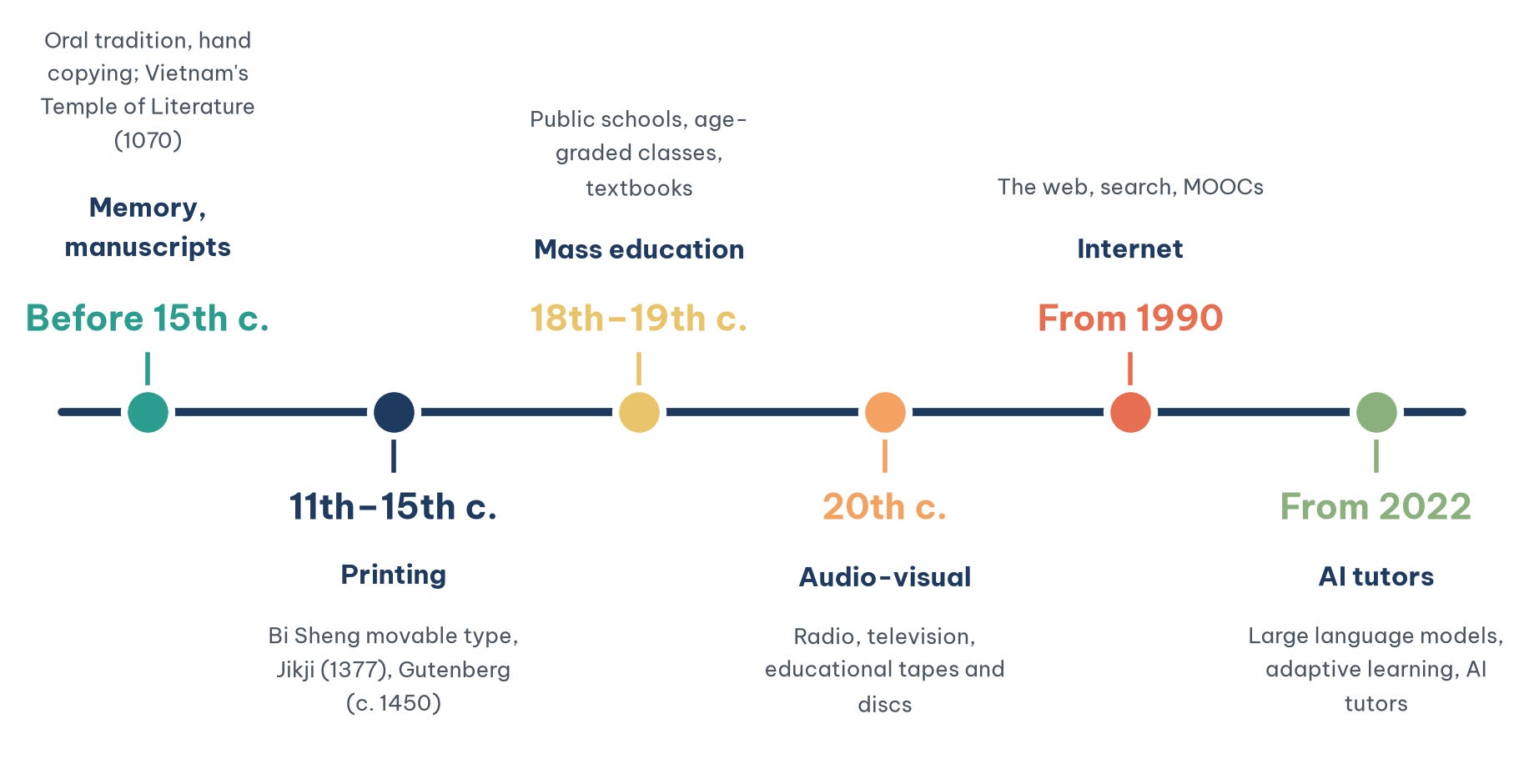
For convenience, the journey can be sketched as six great revolutions: memory and manuscripts, print, mass education, audio-visual media, the internet, and artificial intelligence. These stages have no hard boundaries. They overlap like waves: a student today still memorizes (stage 1), reads printed textbooks (stage 2), sits in a timetabled class (stage 3), watches lecture videos (stage 4), searches online (stage 5) and asks a chatbot (stage 6), sometimes all in one evening. The stages also happened at different times in different places, so this article sets Western milestones beside those of Asia, including Vietnam. Even so, the division remains a useful lens for looking back at the remarkable change in how people learn.
Each stage is analysed with the same framework: nature and method (what form knowledge takes and how it is transmitted) and characteristics (what changes for the learner). After the six stages, Section 7 proposes research-based principles for learning well in the age of AI, Section 8 discusses the role of people, and Section 9 sums up with a comparison table. Figure 1 is a timeline of the whole journey.
1. Stage 1: The age of memory and manuscripts
Before technology made it possible to copy knowledge at scale, knowledge was a fragile asset held by a few.
Nature and method. Knowledge existed in two main forms: oral tradition and hand-written records. In early societies, knowledge of history, law, medicine and ritual was woven into songs, epics and stories. Bards and elders were not only artists; they were living libraries who used rhythm and rhyme as sophisticated memory aids. In Vietnam, folk verses and proverbs about weather and seasons ("When dragonflies fly low it will rain, high it will be sunny, in between it will be overcast") are a store of agricultural knowledge preserved precisely through rhyme. When writing appeared, it did not spread at once. Copying was laborious work done by monks, scholars and Confucian literati. In medieval Europe, monks sat in monastery scriptoria copying word by word onto parchment (treated sheep or goat skin), an expensive material. In East Asia, books were copied by brush on handmade paper.
Characteristics.
Knowledge is a privilege. A hand-written book could take months or even years to complete and was worth a fortune. The Library of Alexandria in ancient Egypt, whose holdings are estimated very differently, from tens to hundreds of thousands of scrolls, was still the preserve of an elite of scholars. In Vietnam, the Temple of Literature was founded in 1070 and the Imperial Academy in 1076, a school for the children of the nobility that later opened to talented commoners; Confucian learning was passed on through hand-copied classics and the teacher's spoken explanations.
Learning is fidelity and memorization. The focus of learning was the ability to remember exactly what was taught, or to copy it faithfully. A student of Plato had to engrave his teacher's dialogues in memory. A monk had to follow strict rules so that a copy of scripture would not deviate. A Confucian candidate had to know the Four Books and Five Classics by heart to sit the examinations. Interestingly, Plato himself, through Socrates in the Phaedrus, worried that writing would make people lazy at remembering, a worry that recurs at every later stage.
Fragility. Knowledge was extremely vulnerable. A fire or an invasion could wipe out for ever knowledge accumulated over generations. The loss of a library meant the loss of part of humanity's memory. Vietnamese history, too, records the loss of many ancient texts through war.
That fragility and scarcity began to change only when people found a way to reproduce writing.
2. Stage 2: The printing press and reproducible knowledge
Printing was not just a technical advance; it made it possible to reproduce knowledge on an unprecedented scale. The story is usually told as starting with Johannes Gutenberg in Germany in the mid-15th century, but printing has a longer history in Asia, as Table 1 shows.
Gutenberg's distinction was not being "the first to print books", but assembling the components into a production system that could print quickly and cheaply, in a social context (commerce, cities, a Latin alphabet with few characters) that let it spread fast. In China and Vietnam, with thousands of Chinese characters, carving whole pages on wooden blocks remained more practical than movable type for centuries.
Nature and method. For the first time, knowledge could be mass-produced, standardized and widely distributed. A book could be printed in hundreds or thousands of identical copies in the time it took a monk to copy one. Learning shifted from listening and memorizing to reading and analysing.
Characteristics.
The democratization of knowledge. Books were no longer the monopoly of the clergy or the nobility. Cheap printed matter, pamphlets and booklets appeared, letting new ideas spread faster than ever. Martin Luther's Ninety-five Theses (1517), printed and distributed across the German-speaking lands within weeks, helped spark the Protestant Reformation, an event hard to imagine at that scale in the manuscript age.
The foundation of modern science. Science requires precision and verifiability. The printing press provided both. Scientists such as Copernicus, Galileo and Newton could disseminate their work, with drawings and mathematical diagrams identical in every copy, letting colleagues across Europe read, check and build on each other's work (Eisenstein, 1979). Learning was no longer just trusting a master but verifying evidence in a standardized text.
The rise of critical thinking. When a scholar could set several books by different authors side by side, they began to compare, cross-check and spot contradictions. This nurtured analytical and critical skills instead of accepting a single source of knowledge.
Printed books made knowledge cheaper, but literacy became truly widespread only when states organized schooling for everyone.
3. Stage 3: Mass education and the standardized classroom
The Industrial Revolution of the 18th and 19th centuries created an urgent need for a workforce with basic education, and modern states needed literate citizens. This gave birth to the modern public school system, a model that remains deeply influential today.
Nature and method. Learning became systematized, structured and available to the many. The aim was to produce citizens and workers with a common foundation (reading, writing, arithmetic). The main method was direct classroom teaching, with the teacher at the centre, a common curriculum and textbooks.
Characteristics.
The "one-size-fits-all" model. The image of a classroom with neat rows of desks, a teacher at the blackboard and pupils listening and taking notes became iconic. Pupils in the same class learned the same content, on the same timetable and at the same pace, regardless of individual ability or interest.
Learning as compliance and completion. Success was measured by mastering textbook content and passing standardized examinations. The system was very effective at raising general literacy quickly, but is often criticized for not encouraging creativity and individual difference.
A concrete example. The Prussian model of education in the 18th and 19th centuries, with compulsory schooling, a national curriculum and standardized teacher training, became a reference for public school systems in many countries, including the United States and Meiji Japan. Note that the image of "schools as factories", often used to criticize this model, is a simplification still debated by historians of education: the motives for mass education were not only economic but also nation-building, religion and citizenship. In Vietnam, a landmark of mass education was the Bình dân học vụ (popular education) movement, launched right after the August Revolution of 1945 to eradicate illiteracy using the national Latin-based script.
If the classroom brought knowledge to everyone through teachers, the next wave brought knowledge straight into every family's living room.
4. Stage 4: The audio-visual revolution
Before the internet spread, mass media such as radio, film and television opened a new channel for learning, taking knowledge off the page and making it vivid and engaging.
Nature and method. Knowledge was conveyed visually and through several senses, through sound and moving images. Learning was not only reading but watching and listening, usually passively and according to a broadcast schedule.
Characteristics.
Visualizing concepts. Abstract scientific concepts such as the structure of a cell or the formation of a storm became easier to grasp through animation and documentaries. David Attenborough's natural-history documentaries brought the whole planet into millions of living rooms, nurturing a love of nature across generations.
Bringing history to life. History was no longer just words and dates. Documentaries using archive footage let viewers "witness" key moments, such as the Normandy landings or Martin Luther King Jr.'s "I Have a Dream" speech, creating a strong emotional connection.
Learning anywhere. BBC radio language programmes let people practise listening while doing housework. Cassettes, then CDs and video discs became popular self-study tools, including in Vietnam in the 1990s and 2000s. Television also became a "back-up classroom": in 2020, when schools closed because of COVID-19, broadcasters in many countries, Vietnam among them, aired lessons for pupils.
The weakness of this stage was that it was one-way: viewers could not ask the presenter a question. The internet would change that.
5. Stage 5: The internet, a library at your fingertips
The internet is not just a new channel. It broke down the top-down hierarchy of the previous stages and gave learners an unprecedented degree of control.
Nature and method. Knowledge moved from scarcity to abundance, decentralization and interconnection. Learning became an act of actively searching, navigating and participating.
Characteristics.
From "library" to "global brain". If print created libraries, the internet created a living, chaotic web of knowledge. With one click, a student anywhere can listen to an MIT professor's lecture through OpenCourseWare, read a newly published paper, and discuss it in a forum with interested people around the world. Massive open online courses (MOOCs) such as Coursera and edX promised to bring higher education to everyone.
Just-in-time learning. You no longer need a six-month course to solve a problem. A programmer stuck on a bug can find a solution on Stack Overflow in minutes. Someone who wants to fix a tap can watch a YouTube tutorial and follow along at once.
Filtering becomes the key skill. The biggest challenge is no longer finding information but coping with overload and telling true from false, deep expertise from surface opinion. The skills of evaluating sources and synthesizing information matter more than ever.
This stage also showed that access does not equal learning. Two pieces of research illustrate this. First, Sparrow et al. (2011) proposed the "Google effect": when people know information will always be available online, they tend to remember where to find it rather than the information itself. The finding has not replicated consistently in later studies, but it raises a question that still matters: how far are we outsourcing memory to machines? Second, although MOOCs attract millions of enrolments, completion rates are only a few per cent and have not improved much over the years (Reich & Ruipérez-Valiente, 2019). Those who finish are mostly already highly educated. The internet opened the door to knowledge for everyone, but walking through it and reaching the end still depends on motivation, self-study skills and support.
6. Stage 6: AI tutors and personalization
We are at the beginning of this stage. AI is not just a smarter search engine; it is becoming a companion, a tutor that can answer questions at any time and patiently explain again and again.
Nature and method. AI makes personalized learning at scale possible. It can act as a one-to-one tutor, continually adjusting content and explanations for each person, through adaptive learning and natural-language dialogue.
The idea has a long research pedigree. In 1984, Benjamin Bloom reported that pupils tutored one-to-one (combined with mastery learning) performed about two standard deviations better than pupils taught in conventional classes: the average tutored pupil outperformed about 98% of the control class. Bloom called this the "two sigma problem": how to achieve the effectiveness of one-to-one tutoring at the cost of group instruction (Bloom, 1984). AI tutors are seen as a potential answer to this forty-year-old problem.
Characteristics.
An individual learning path for each person. A maths platform such as Khan Academy can identify each pupil's knowledge gaps (for example weak on fractions but solid on decimals) and suggest exercises and videos to fill them. Since 2023, Khan Academy has been piloting an AI assistant, Khanmigo, designed to give step-by-step hints rather than handing over answers.
Instant feedback. Instead of waiting for a teacher to mark their work, a learner programmer can get immediate feedback from an AI assistant that not only points out errors but explains why they are wrong and suggests fixes. Duolingo uses a machine-learning model to estimate when each person is about to forget a word and prompts a review at the right moment, a personalized form of spaced repetition (Settles & Meeder, 2016).
AI as a creative partner. A writer can use AI to discuss ideas and develop characters. A researcher can ask AI to summarize many papers to grasp a field quickly, then read the important ones closely. Learning can shift from absorbing to co-constructing knowledge.
However, unlike earlier stages, we already have controlled trials showing that AI tutors can help, and can also harm, depending on how they are used. Table 2 summarizes two notable studies.
Both studies carry the same message: design determines the outcome. An AI tutor designed to make learners think for themselves (asking open questions, giving step-by-step hints, checking understanding) can help them learn better. AI used as an answer machine easily leads to "ghost-learning": high homework scores but inability to perform without AI. In addition, AI can hallucinate, confidently giving wrong solutions, and the digital divide may widen: learners with good devices and skills will benefit more than those without.
7. How to learn in the age of AI
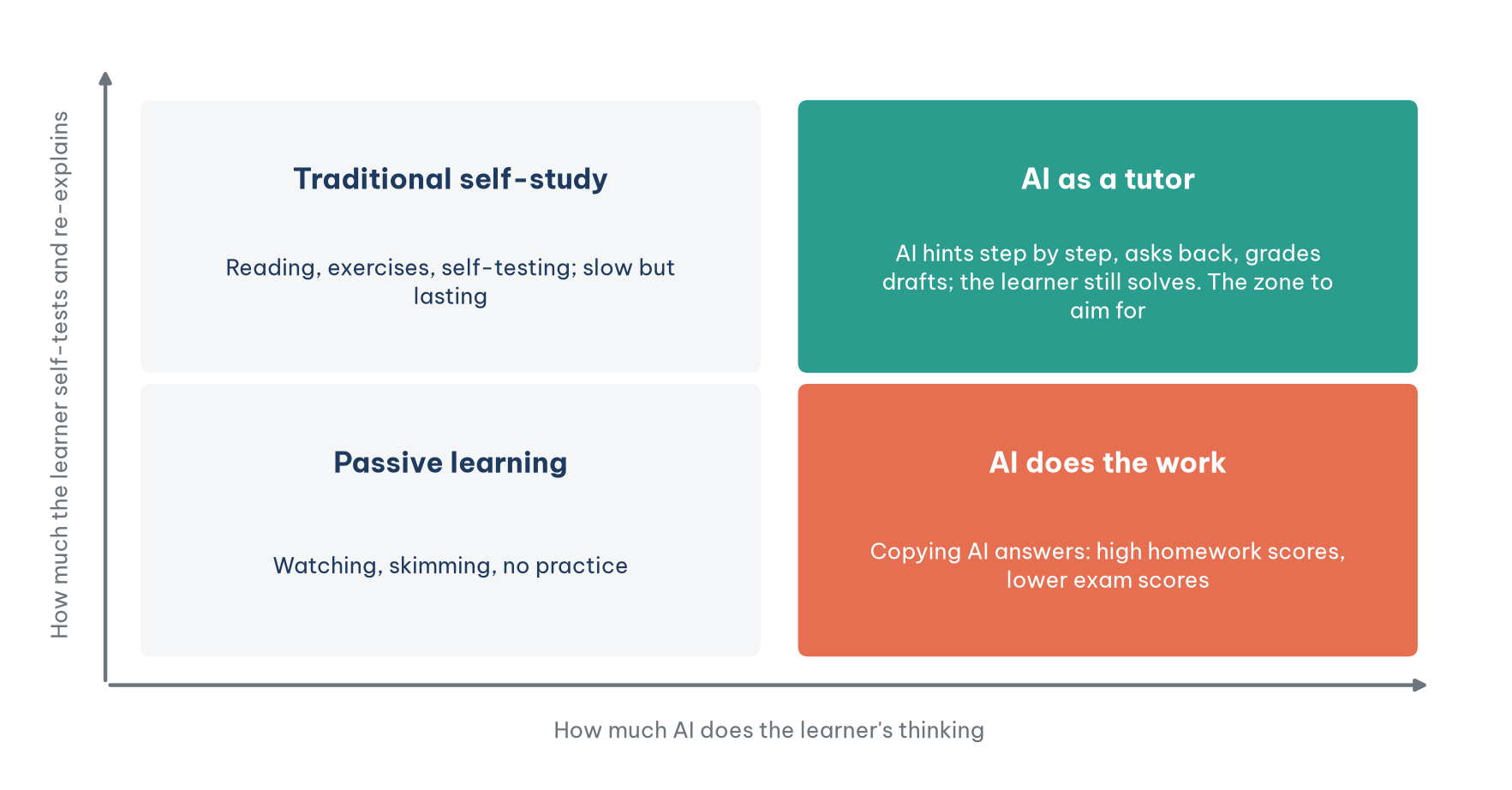
If design determines the outcome, learners can also "design" how they use AI. Figure 2 suggests a simple view: the horizontal axis is how much AI does the learner's thinking, the vertical axis is how much the learner tests and re-explains for themselves. The zone to aim for is the top right: using AI a lot, but as a tutor rather than a ghostwriter.
From research in the learning sciences, five practical principles follow.
First, try first, ask AI afterwards. Attempt the problem, outline or code yourself first, then ask AI for feedback. The effort of recalling and solving things yourself is one of the most effective ways to learn; experiments show that self-testing produces much longer-lasting memory than rereading (Roediger & Karpicke, 2006).
Second, ask AI to question you instead of answering you. A prompt such as "Don't give me the answer. Ask me one question at a time so I can work it out" turns an ordinary chatbot into a Socratic tutor, much like the tutor version in Bastani et al.'s study.
Third, re-explain in your own words. After AI explains something, write the main idea in your own words or teach it to a friend. If you cannot explain it, you have not really understood it.
Fourth, space your reviews. Ask AI to create review questions and come back to them after a day, a week and a month. This is the spaced-repetition principle that Duolingo has automated.
Fifth, verify anything important. For figures, citations, formulas and regulations, check against the original source. AI is a good starting point, not an end point.
8. The human role in a changing world
As tools become ever smarter, many worry that the human role will fade. But looking back over all six stages, each time technology took over part of the work (remembering, copying, transmitting, searching), people moved on to higher-order abilities. Technology increasingly takes over "knowing", while people concentrate on "understanding" and "being human". With AI, there are five roles that machines still find hard to replace, and that people need to hold on to deliberately.
The question-asker. AI can produce a great many answers, but questions such as "Why does this matter?", "What are the ethical consequences?" and "Is there a better approach?" usually come from human curiosity, purpose and real context. The ability to ask deep, well-targeted questions is a core capability.
The context-maker. Knowledge does not exist in a vacuum. People connect numbers with emotions, events with culture, theory with lived experience. We understand irony, implication and nuances that algorithms often do not fully capture. We turn information into understanding.
The ethical judge. AI is a powerful tool, but responsibility for how knowledge is used lies with people: drawing the line between right and wrong, and ensuring fairness and humanity in an increasingly automated world.
The breakthrough creator. Real creativity often comes from connecting seemingly unrelated fields, a flash of intuition, a lucky mistake. AI is good at optimizing and generating variations from existing data; the leaps that open entirely new fields have, so far, come mainly from people.
The inspirer and guide. Learning is a social and emotional process. A teacher's encouraging look, a friend's pat on the shoulder, the passion that radiates from a mentor are hard to replace. The ability to empathize, build trust and inspire is the deepest essence of teaching and learning.
9. The journey in one comparison table
The evolution of learning methods is a story of collaboration between human intelligence and the tools we create. From bamboo strips and handmade paper to algorithms in the cloud, each stage opened new possibilities while placing new demands, and new risks, on learners. Table 3 compares the six stages.
Reading the last column of Table 3 from top to bottom, each technology solves the previous stage's risk but creates a new one. Print countered the loss of manuscripts but also reproduced errors. The internet broke television's passivity but brought overload and distraction. AI solves the personalization problem but can make learners lazy thinkers.
Conclusion: learn with AI, don't let AI learn for you
The six revolutions in how people learn share one thing: each new technology changed who holds knowledge, how cheap it is, and what learners must do to turn information into understanding. From those who memorized the classics to readers of printed books, from pupils in class to television viewers, from web searchers to people chatting with AI tutors, the learner's role has kept moving up to higher-order abilities.
The future of learning is not people against AI but people learning with AI, using it to free themselves from rote memorization and focus on what gives us lasting value: curiosity, creativity, critical thinking and compassion. But as recent trials show, that benefit does not come automatically. It comes when learners use AI as a tutor that makes them think more, not as a machine that thinks for them.
References
Bastani, H., Bastani, O., Sungu, A., Ge, H., Kabakcı, Ö., & Mariman, R. (2024). Generative AI can harm learning (Working paper). The Wharton School, University of Pennsylvania. https://doi.org/10.2139/ssrn.4895486
Bloom, B. S. (1984). The 2 sigma problem: The search for methods of group instruction as effective as one-to-one tutoring. Educational Researcher, 13(6), 4–16. https://doi.org/10.3102/0013189X013006004
Eisenstein, E. L. (1979). The printing press as an agent of change. Cambridge University Press.
Kestin, G., Miller, K., Klales, A., Milbourne, T., & Ponti, G. (2024). AI tutoring outperforms active learning (Preprint). Research Square. https://doi.org/10.21203/rs.3.rs-4243877/v1
Reich, J., & Ruipérez-Valiente, J. A. (2019). The MOOC pivot. Science, 363(6423), 130–131. https://doi.org/10.1126/science.aav7958
Roediger, H. L., & Karpicke, J. D. (2006). Test-enhanced learning: Taking memory tests improves long-term retention. Psychological Science, 17(3), 249–255. https://doi.org/10.1111/j.1467-9280.2006.01693.x
Settles, B., & Meeder, B. (2016). A trainable spaced repetition model for language learning. In Proceedings of the 54th Annual Meeting of the Association for Computational Linguistics (pp. 1848–1858). Association for Computational Linguistics. https://doi.org/10.18653/v1/p16-1174
Sparrow, B., Liu, J., & Wegner, D. M. (2011). Google effects on memory: Cognitive consequences of having information at our fingertips. Science, 333(6043), 776–778. https://doi.org/10.1126/science.1207745
Discussion about this post