Scale-Up Fit: Knowing When to Scale and How to Grow
Five questions to answer before pressing the accelerator, then a map of organic and inorganic paths for growing without losing control


Key takeaways
Scale-up fit is a gate with five criteria: repeatable product-market fit, a profitable channel, operations that can carry the load, a model that improves with scale and enough runway. Missing any one turns growth into premature scaling.
The real limit on growth is usually managerial capacity, not ideas or demand. New managers take time to absorb, rapid hiring raises the odds of bad hires and newcomers need supervision.
Founders must move from working in the business to working on it: writing processes down, building a management team and knowing when to brake.
Once through the gate, firms grow organically (penetration, new products, new markets, international expansion) or inorganically (acquisitions, licensing, alliances, joint ventures).
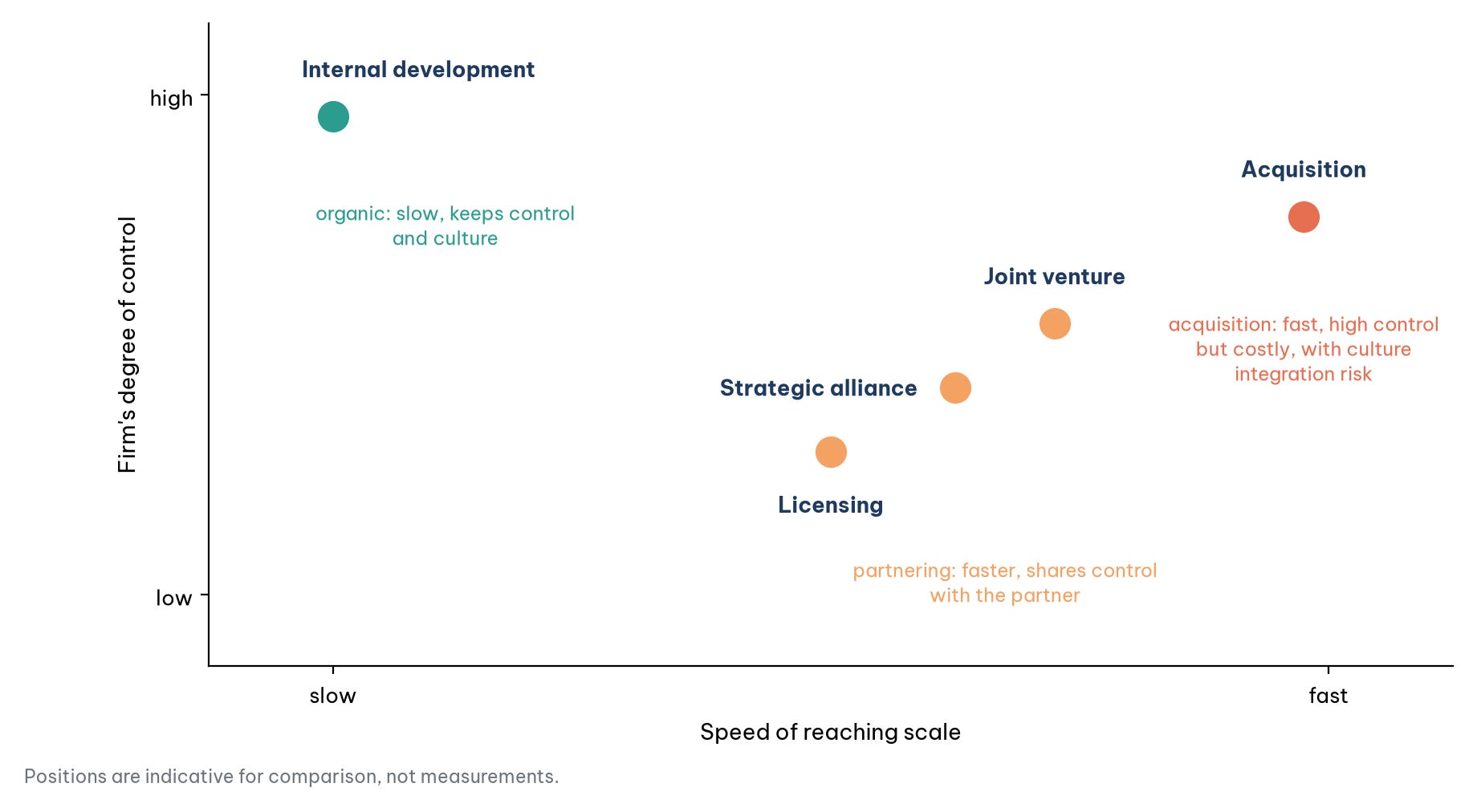
Organic growth is slower but keeps control and culture; inorganic growth is faster but costs money, shares control or brings integration risk. Choose inorganic routes only when speed truly matters more than control.
Strong demand is not a reason to scale. Around the world, a familiar pattern repeats itself in startup post-mortems: the product worked, customers were asking for more and the company had just raised money, yet within a year or two it ran out of cash. The cause was not a lack of demand but growth that arrived before the company could carry it. Marketing budgets were raised before the sales channel was profitable, dozens of people were hired before anyone had written down how the work should be done and new cities were opened before the first one ran smoothly. Each new customer added to the losses instead of the profits.
Consider a healthy-meal delivery startup that serves two hundred lunches a day to office workers. Its corporate clients are happy and it has just closed a seed round. The founder wants to triple volume in six months. But the kitchen can cook about two hundred meals a day at most; the founder still plans the menu, runs the kitchen and personally looks after the largest clients; and the organic vegetable supplier may not be able to deliver three times as much. If the company accelerates now, what breaks first? The answer to that question, not the size of the market, decides whether the company should press the accelerator. And once it is ready, a second question follows: which path should it take to grow? Build step by step on its own, or partner with and buy other companies to move faster?
This article answers both questions. Section 1 defines scale-up fit and its five criteria. Section 2 examines the danger of scaling too early and the warning signs of growing too fast. Section 3 describes the organizational life cycle and the founder's change of role. Section 4 explains the managerial capacity problem and the everyday challenges of growth. Section 5 asks why firms grow at all and why they should stay close to their core. Section 6 covers organic growth through products, markets and international expansion. Section 7 covers inorganic growth through acquisitions, licensing, alliances and joint ventures. Section 8 compares the two paths, returns to the meal startup and discusses what AI can and cannot do in growth planning.
1. Scale-up fit and its five criteria
This section defines scale-up fit and turns it into five testable criteria.
Scale-up fit is the state in which a business is ready to expand efficiently and profitably: each additional dollar of capital and each additional employee creates proportionate value instead of diluting quality or eroding margins. It is the last stage of a startup's validation journey, which runs from founder-problem fit through product-market fit and go-to-market fit to a profitable business model. The earlier stages help a company do the right things; scale-up fit confirms that it is ready to do them at a much larger scale. It works like a gate: only after passing through it does pouring resources into growth become a reasoned bet rather than a leap in the dark.
The assessment can be reduced to five criteria, each tied to something the company should already have validated (Figure 1, Table 1). When all five are met, the company can pass through the gate with confidence. When even one is missing, accelerating is premature scaling.
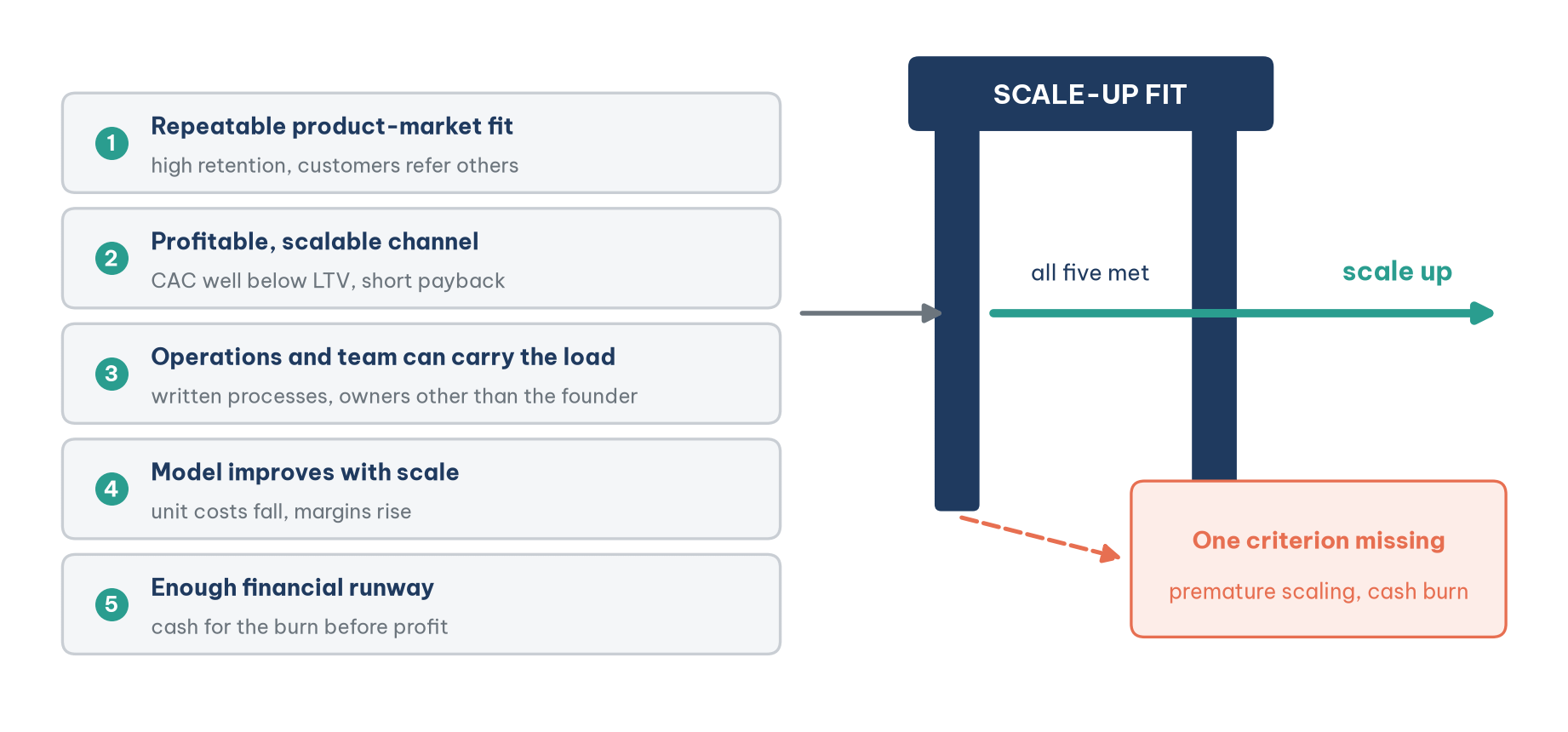
The first two criteria are the familiar territory of product-market fit and unit economics. This article concentrates on the third, because it is the one that startups most often underestimate.
2. The danger of scaling too early
This section explains why growth can destroy a company and how to recognize when it is growing faster than it can handle.
The most common and most dangerous mistake at this stage is premature scaling: pouring money into marketing, mass hiring or geographic expansion before the company has reached scale-up fit. When the product has not yet been embraced by the market, more spending only drains capital faster. When the acquisition channel is not yet profitable, scaling it means each new customer deepens the loss.
2.1. Growth is a double-edged sword
Sustainable growth means growing both revenue and profit over a long period (Barringer & Ireland, 2024). The definition rules out short bursts of revenue that never turn a profit. But even real growth cuts both ways, for three reasons. First, not every business has the potential to grow fast; as most firms get larger, their growth rate drifts toward the industry average. Second, a business can grow faster than its infrastructure. Third, success does not always scale: a business loved for its personal attention can lose exactly that quality when it serves ten times as many customers.
The story of The Pampered Chef, a company that sells kitchen tools through in-home parties, is a classic illustration of the second reason. Just as the company was gaining momentum, founder Doris Christopher realized it would not have enough stock for the Christmas season, and its suppliers had run out too. Against the advice of almost everyone around her, she temporarily stopped recruiting new sales consultants to slow sales down to a level at which every order could be delivered on time. After the holidays the company reopened recruiting and the number of consultants jumped; she believed the decision had strengthened the company's credibility with its sales force, customers and suppliers (Barringer & Ireland, 2024). The lesson is that a business can grow only as fast as its infrastructure allows, and knowing when to brake is itself a management skill.
2.2. Signs that a business is growing too fast
Table 2 lists signs that growth is outrunning a company's capacity. When two or three appear at the same time, it is time to stop and recheck the scale-up fit gate instead of accelerating further.
Navdy, a maker of head-up displays that projected navigation and phone information onto a car's windshield, shows that a good product is not enough. Its device was well reviewed; the company took more than $2.4 million in pre-orders and raised a total of $42 million, yet it closed in 2017. The price was too high, the model had no recurring revenue so the company constantly had to find new buyers, it built its own software and maps instead of using existing solutions and cheaper substitutes appeared. Together these meant Navdy could not grow fast enough to carry its cost structure (Barringer & Ireland, 2024). In terms of Figure 1, it failed the second and fourth criteria of the gate.
3. The organizational life cycle and the founder's shift
This section shows what each stage of a firm's life demands and why the founder's own role must change.
Intuition says that once revenue is growing steadily and the company is profitable, management gets easier. In practice the opposite is usually true: the pace becomes more relentless, resource needs swell and the founder is busier than ever. Understanding the organizational life cycle helps a founder anticipate what each stage will require.
3.1. Five stages
Most businesses pass through five stages: introduction, early growth, continuous growth, maturity and decline (Figure 2, Table 3).
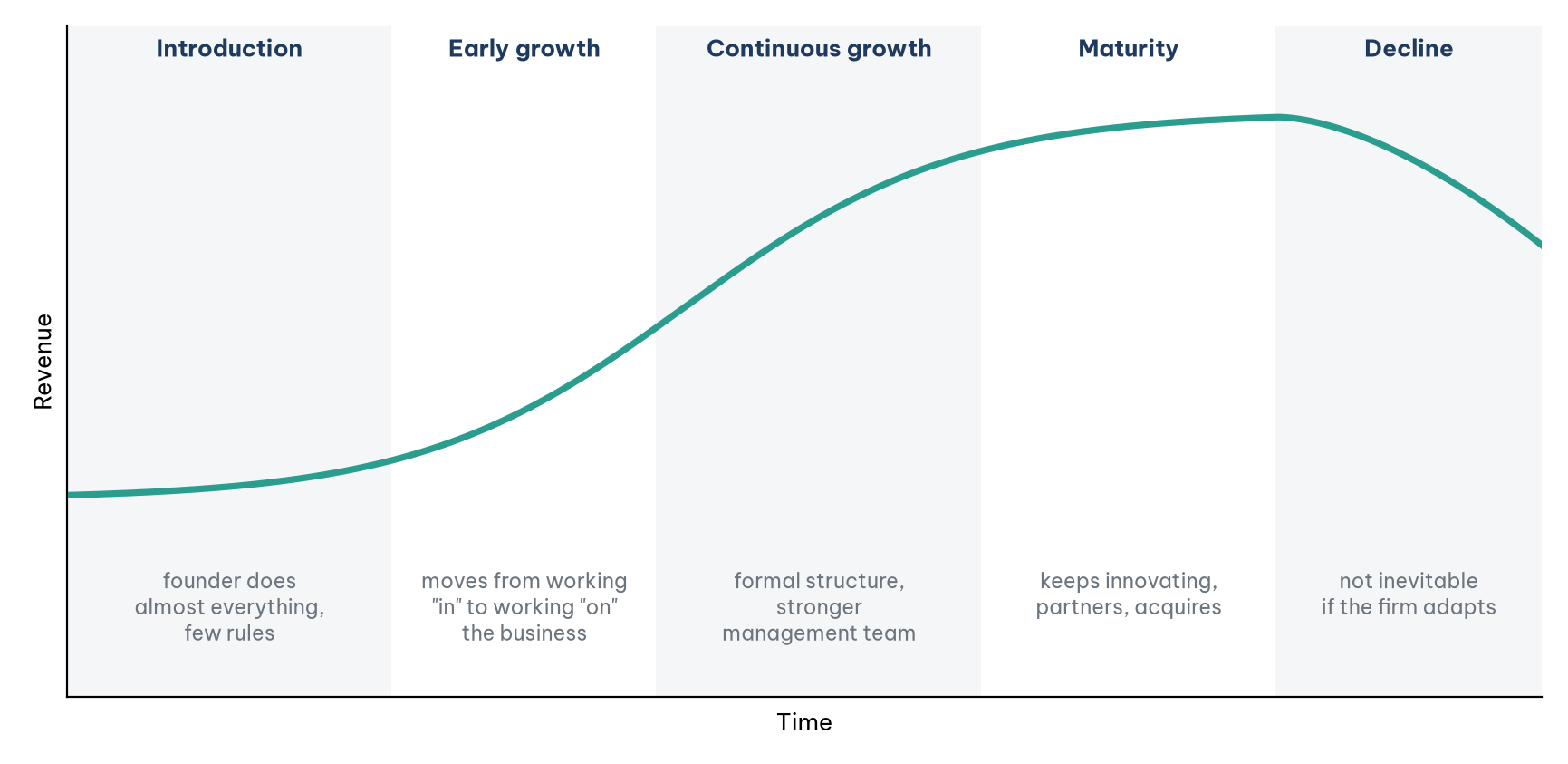
Bombas, the sock brand, illustrates the spirit of not rushing in the early stages: the company sold only one product, socks, for six years before adding T-shirts, underwear and slippers, because it needed that time to expand its operations and management team before accelerating (Barringer & Ireland, 2024).
3.2. Working on the business instead of in it
The hardest transition happens in the early growth stage. At first, the founder personally makes or delivers the product. As the company grows, the founder must let go of that role and learn to manage and build the business. Michael Gerber calls this the shift from working in the business to working on the business (Gerber, 1995). If the founder does not make the shift, the company cannot grow beyond what one person can directly supervise. The way out is not longer hours. It is writing down what already works, hiring and empowering other people and then concentrating on the decisions that only the owner can make.
At the same time, the company needs to formalize its operations. Policies and procedures tell employees what to do when their manager is not in the room, much as franchise chains run smoothly even with new staff. In the meal startup, this means a written recipe and portioning standard, a packing checklist and a delivery schedule that a shift supervisor can run without calling the founder.
4. The managerial capacity problem
This section explains why growth is usually limited by management rather than by ideas or demand, and it reviews the everyday challenges that come with getting bigger.
Why do so many businesses with attractive growth ideas and plenty of demand still fail to grow? The economist Edith Penrose gave a classic answer that remains as relevant as ever.
4.1. Ideas need managerial capacity to become reality
According to Penrose (2009), a firm is a collection of resources organized within an administrative framework, and it supplies two kinds of services. Entrepreneurial services generate new ideas about markets and products; managerial services run the daily work and make sure new opportunities are actually carried out. The paradox is that every new idea requires a great deal of managerial capacity to implement, and that capacity cannot be bought quickly on the market. Hiring new managers is expensive, and they need time to absorb the culture, understand the business and build relationships of trust. When managerial capacity cannot keep up with opportunities, a bottleneck forms. This is the managerial capacity problem.
4.2. Adverse selection and moral hazard
When a business grows fast, two further problems appear. The first is adverse selection: the more people a company must hire and the faster it must hire them, the less time managers have to assess candidates and the more likely they are to choose the wrong people. The second is moral hazard: newcomers usually do not share the founding team's ownership mindset, so the company must add supervisors, which builds a costly hierarchy and distances leaders from frontline staff (Barringer & Ireland, 2024). In short, a firm's ability to expand its managerial capacity is constrained by four factors: the time it takes to absorb new managers, the growth motivation of the founders and management team, adverse selection and moral hazard.
This is the core of the third criterion of the scale-up fit gate. The limit on growth usually lies not in ideas or demand but in the operational and managerial capacity to carry the load. The most practical question is: "If tomorrow brought 1,000 orders instead of 100, what would collapse first?" For the meal startup, the answer in order is kitchen capacity, delivery times at the lunch peak, the vegetable supplier's capacity and the founder herself. Reaching scale-up fit means removing those bottlenecks one by one (investing in a central kitchen, writing processes down, hiring and empowering a management team) before accelerating for real. AI tools can help simulate these breaking points and draft standard operating procedures, but deciding where to expand, with whom and when to brake remains a human judgment.
4.3. Four everyday challenges of growth
Alongside the managerial capacity problem, almost every growing business meets four everyday challenges (Table 4). No company grows in a vacuum: when it takes market share from rivals, their retaliation grows in proportion to the threat it poses (Barringer & Ireland, 2024).
The cash flow challenge deserves emphasis. A company can have hundreds of thousands of dollars in receivables and still be unable to meet this month's payroll. Growth usually makes this worse rather than better, because the faster sales rise, the more cash must be spent before customers pay. A meal startup that buys ingredients weekly but invoices corporate clients monthly feels this gap every time a new client signs.
5. Why grow, and in which direction
This section moves from when to grow to why, and argues that the safest direction stays close to what the company already does best.
Once a company has passed through the gate, it faces a menu of growth options. Before choosing among them, it helps to be clear about the reasons for growing at all. Growth is not an end in itself, but it brings benefits that small businesses find hard to obtain.
5.1. Six reasons firms pursue growth
Table 5 summarizes six common reasons. Sometimes a business cannot choose its pace: a flood of orders or a sudden new competitor can force it to grow faster than planned.
5.2. Staying with the core strategy
A common mistake when preparing to grow is chasing every opportunity and drifting into fields where the company is at a disadvantage. eBags, an online retailer of bags and luggage, once bought a website selling shoes and sold it three years later, because shoes were too far from its core capabilities (Barringer & Ireland, 2024). Jim Collins uses the parable of the fox and the hedgehog to explain the point: the fox knows many tricks, while the hedgehog knows only one, to roll into a spiky ball, and the hedgehog always wins. Companies that succeed over the long run resemble the hedgehog: they do one thing extremely well and ignore the rest (Collins, 2001). Most firms grow by stepping into areas related to their core capabilities, the way Warby Parker added sunglasses and contact lenses while remaining an eyewear company.
Broadly, there are two families of growth strategy. Organic (internal) growth relies on the company's own capabilities, people and ways of working. Inorganic (external) growth relies on relationships with third parties through mergers, acquisitions, licensing, strategic alliances and joint ventures (Barringer & Ireland, 2024). Almost every business grows organically in its early stages; inorganic growth usually comes later, when the organic path starts to slow or when an opportunity demands speed. The next two sections take each family in turn.
6. Organic growth: products, markets and international expansion
This section organizes organic growth strategies around products and markets, then treats international expansion as a special case.
Organic strategies can be sorted by two questions: will the company sell existing products or new ones, and to current markets or new ones? This is the logic of the product-market matrix that Ansoff (1957) proposed decades ago (Figure 3). The farther a strategy sits from the top-left cell, the higher the risk, because the company must do more things it has never done before.
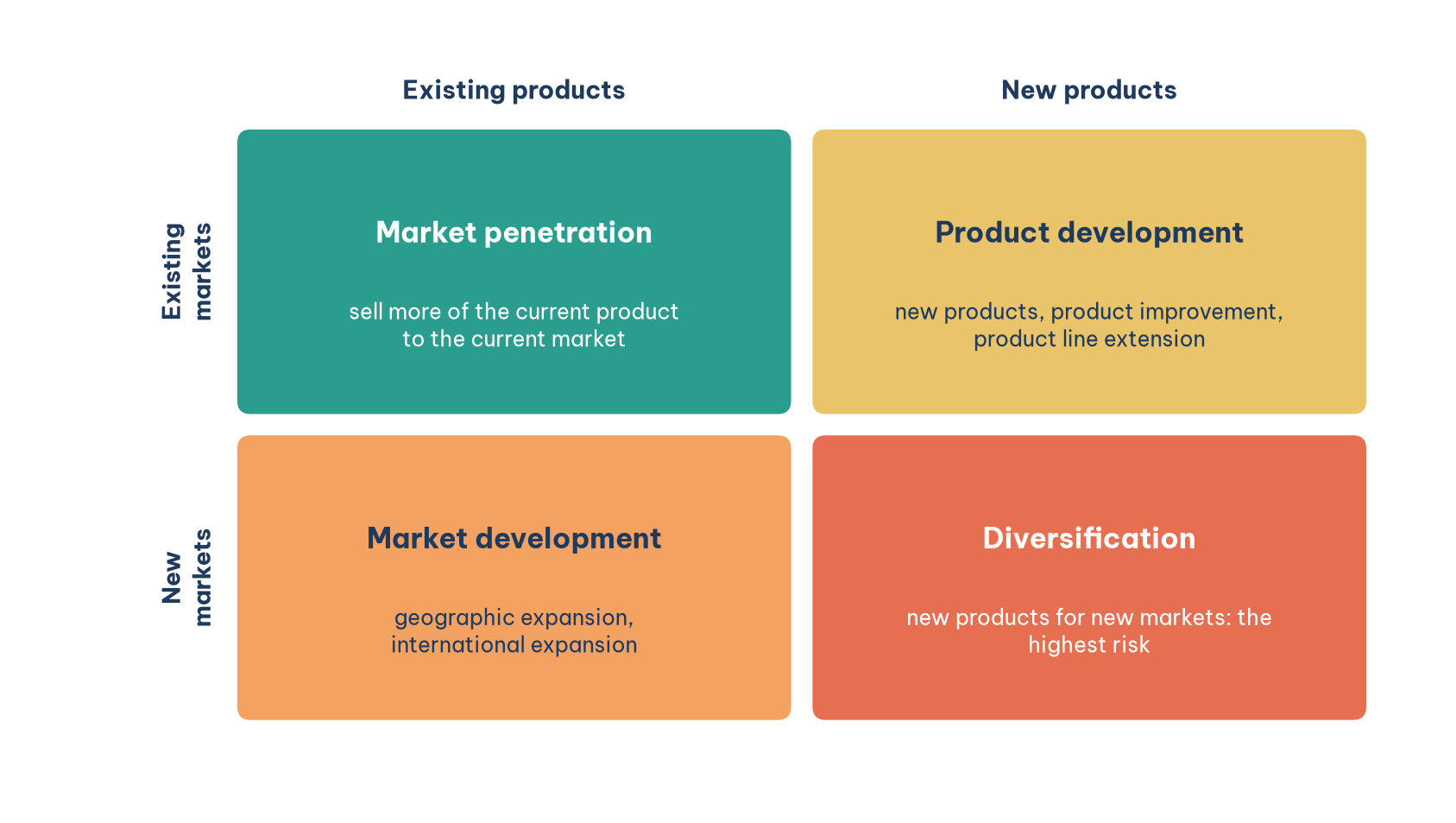
6.1. Product-based growth
New product development means designing, producing and selling new products. The rewards can be large but so are the risks, and the key is a genuinely new product rather than a copy. Principles for success include finding an unmet need, creating real added value for customers, striking the right balance between quality and price, focusing on one target market and continuing to test after launch. Boosted, a maker of electric skateboards, is a cautionary tale: it launched half a dozen models in many configurations over six years on a tight budget, lost focus, had to recall battery packs and ran out of money in 2020 (Barringer & Ireland, 2024).
Improving an existing product raises the value of what the company already sells by making it more durable, more convenient or richer in features. Extending a product's life is usually cheaper than creating a completely new one. Product line extension creates additional versions for different customer groups (basic, advanced and premium tiers) or related products for the same customers, drawing on core capabilities without heavy development costs. Oracle is a long-horizon example: after selling its database to most large corporations, it developed applications that ran on that database, and after almost seven years the applications business was generating substantial revenue (Barringer & Ireland, 2024).
6.2. Market-based growth
Market penetration means selling more of an existing product to the current market through stronger marketing, broader channels or more production capacity. It is the least risky direction and should usually be exploited first. Geographic expansion means opening new locations beyond the original one, most common in retail and services. Three keys to success are doing very well at the first location, not assuming that what works in one place will automatically work in another and not neglecting the new location, whose staff need the same training and supervision that built the original (Barringer & Ireland, 2024).
The advantages of organic growth are that its step-by-step pace allows continual adjustment, maximum control over quality, a preserved culture and opportunities for internal promotion. Its main drawback is speed. In some industries, the incremental path is not fast enough to stay competitive, and a company that keeps selling one product to the same customers risks "hitting the wall".
6.3. International expansion
International expansion is a form of market development that deserves separate attention. More and more startups are "born global", selling in several countries from their founding, especially with digital products. Before going abroad, founders should review three groups of issues (Barringer & Ireland, 2024). The first is management and organization: does the leadership team have international commitment and experience, and will the move distract from the home market? The second is product and distribution: does the product suit that market, what must change to meet local regulations and expectations and is there a reliable, affordable shipping channel? The third is finance and risk: how will export activity be funded, how will foreign customers pay and how exposed is the company to exchange rates? Because intellectual property rights are territorial, it is also wise to register the trademark in a new market before selling there.
There are several ways to enter a foreign market, each trading off cost, risk and control (Table 6).
Most startups begin with exporting. When selling abroad, three simple habits make a large difference: respond quickly and clearly to inquiries, even when the other party's wording is imperfect; keep promises, especially delivery dates, because the first order shapes the whole relationship; and respect local cultural norms.
7. Inorganic growth: acquisitions, licensing and alliances
This section explains the external routes to growth and what makes each one work.
Inorganic growth is usually faster and helps small firms close the gap with large ones. Pixar is an example: it had important alliances with Disney, using Disney's distribution and capabilities to grow, before Disney acquired it in 2006 (Barringer & Ireland, 2024). Figure 4 places the main options on two axes, speed and control.
7.1. Mergers and acquisitions
A merger combines two or more businesses into one; an acquisition is one business buying another outright. Acquisitions can extend a product line or provide access to distribution channels, technology or talent. Finding the right target takes discipline: draw up a short list, then screen candidates for openness to being acquired, strength of management, cultural fit, financial performance, the ability to retain key staff and customers and any legal or intellectual property complications. The most common mistake is overpaying, and the most common cause of failure after the deal is a clash of cultures.
For startups, the more frequent position is actually being acquired. Justin's, a nut butter brand, agreed in 2016 to be bought by the food company Hormel for three reasons. It needed resources to grow (Hormel's products were in almost every U.S. supermarket, while Justin's flagship product was in only about 35% of them). It found a partner committed to preserving its mission and core capabilities. And the sale created a liquidity event for shareholders, including employees who had been paid partly in equity (Barringer & Ireland, 2024).
7.2. Licensing
Licensing allows another company to use one's intellectual property under specified conditions, usually in exchange for an upfront fee plus ongoing royalties. The two main types are technology licensing (often tied to patents) and merchandise and character licensing (allowing a brand or trademark to appear on other products). Licensing suits startups that have a new product but lack production and distribution resources. The key is not to license too broadly, because indiscriminate licensing can cost the company control over quality and weaken its brand.
7.3. Strategic alliances and joint ventures
A strategic alliance is a partnership between two or more firms to achieve a specific goal, usually without creating a new entity. Two common forms are technology alliances (joint research or production) and marketing alliances (pairing a firm that has a product with a firm that has distribution). Michael Dell recalled that in its early years, lacking the money to make its own components, Dell chose to buy them from specialists so that it could focus on what it did best (design and direct selling). He regarded early alliances with suppliers as the right strategy for a fast-growing company (Dell & Fredman, 1999). A joint venture is created when the parties pool resources to form a separate, jointly owned organization, often to enter a foreign market.
Because a failed alliance is costly and hard to exit, it pays to approach it in three steps: choose a partner with genuine synergy and a good reputation; settle the critical issues early in the agreement, including terms that allow each side to leave relatively easily; and make the alliance work, with clear decision rules and one person on each side directly responsible for its health (Barringer & Ireland, 2024).
8. Choosing a path, and what AI can do
This section compares the two families of strategy, applies them to the meal startup and sets out the limits of AI in growth decisions.
Neither path is better in absolute terms. Table 7 summarizes the trade-offs.
Return to the meal startup, now assumed to have passed through the gate with a central kitchen, written processes and a small management team. It sees five options. Adding snacks and cold-pressed juices for the same office clients is product line extension, close to its core and moderate in risk. Opening a second kitchen in another city is geographic expansion, which requires proof that the model works somewhere new and the same training and supervision that built the first site. Selling its packaged sauces abroad is international expansion, best started with small-scale exporting and a trademark registered in advance. Letting a gym chain serve meals under its brand is licensing: fast and light on capital, but only with tight quality clauses. Buying the struggling organic farm that supplies its vegetables is inorganic, vertical growth: it would secure the supply that was one of its bottlenecks, but it costs capital and brings the risk of integrating a very different kind of business. There is no answer that is right for every company, only an answer that fits a company's core capabilities, resources and the speed it needs.
AI is making growth planning faster and cheaper at several points: simulating demand and bottlenecks before expansion, automating operations to lighten the managerial load, scanning markets for acquisition targets or partners, pre-screening due diligence documents and researching and localizing content for foreign markets. But the decisions that shape strategy remain human: which path to take, how to integrate cultures after a deal, how to build trust with partners and how fast to go. Every market figure or claim about competitors that an AI tool supplies needs to be verified before it enters a decision.
Conclusion
Scale-up fit is not a single number but an honest answer to five questions. Is the market pulling the product? Is there a channel that sells at a profit? Can operations carry the load? Does the model improve with scale? Is there enough cash for the burn? Scaling before those questions are answered is the fastest road to failure, however strong the demand. Because the real limit on growth usually lies in managerial capacity, the founder's most important job at this stage is to move from working in the business to working on it: writing processes down, building a management team and knowing when to brake, as Doris Christopher did before one Christmas season.
Once through the gate, the question becomes how to grow. Organic growth through market penetration, new products, new locations and careful international expansion is slower but keeps control, quality and culture in the company's hands. Inorganic growth through acquisitions, licensing, alliances and joint ventures buys speed at the price of capital, shared control or integration risk. The common principle is to behave like the hedgehog: step into areas close to what the company does best, avoid chasing too many directions at once and choose the inorganic route only when speed truly matters more than control.
References
Ansoff, H. I. (1957). Strategies for diversification. Harvard Business Review, 35(5), 113–124.
Barringer, B. R., & Ireland, R. D. (2024). Entrepreneurship: Successfully launching new ventures (7th ed.). Pearson. https://www.pearson.com/en-us/subject-catalog/p/entrepreneurship-successfully-launching-new-ventures/P200000010335/9780138287696
Collins, J. (2001). Good to great: Why some companies make the leap… and others don't. HarperBusiness. https://www.amazon.com/s?k=Good+to+great+Collins&i=stripbooks
Dell, M., & Fredman, C. (1999). Direct from Dell: Strategies that revolutionized an industry. HarperBusiness. https://www.amazon.com/s?k=Direct+from+Dell&i=stripbooks
Gerber, M. E. (1995). The E-myth revisited: Why most small businesses don't work and what to do about it. HarperBusiness. https://www.amazon.com/s?k=The+E-myth+revisited+Gerber&i=stripbooks
Penrose, E. T. (2009). The theory of the growth of the firm (4th ed.). Oxford University Press. (Original work published 1959) https://global.oup.com/academic/product/the-theory-of-the-growth-of-the-firm-9780199573844
Discussion about this post