Pricing for Startups: Finding the Price Between Cost and Customer Value
How to design a revenue model, find the price corridor between unit cost and customer value and test prices before committing


Key takeaways
Pricing starts with the revenue model, not with a number: what customers pay for (revenue stream), how the amount is set (pricing mechanism) and when and how they pay (payment mechanism).
Cost-based, value-based and competitor-based pricing differ in their starting point; freemium, tiered and dynamic pricing are structures layered on top of them.
A price corridor runs from unit cost (the floor) through the price of existing alternatives (the reference) to the economic value delivered to the customer (the ceiling). A new product usually belongs a little above the reference and far below the ceiling.
In a landing page price test, the price with the highest click rate is often not the price that brings in the most revenue, and with about 1,000 visitors per price many differences are still within the noise.
Set the list price for the pragmatic early majority, make early-adopter discounts explicitly temporary and plan for existing customers before every price change.
Ask a group of first-time founders why their product costs $4, and the two most common answers are "because the competitor charges $5" and "because it costs us about $2.40 to make, plus a margin". Both answers sound reasonable, yet both skip the most important question: how much value does the product create for the customer, and how much is the customer actually willing to pay? Many startups price low because they are afraid nobody will buy, then discover that at that price they will never earn enough to pay for finding the next customer.
Pricing is one of the most consequential decisions a business makes. It drives revenue and margin directly, it determines which sales channels the company can afford and it shapes how the brand is perceived. Yet pricing does not start with a number. It starts with the revenue model: where the money comes from, what the customer pays for, how and when they pay. Only after those questions are answered does a price figure have somewhere to stand.
This article has five sections. Section 1 explains the revenue model and its three components. Section 2 presents six common pricing methods and the psychology that surrounds every price. Section 3 builds a price corridor between cost and customer value, using a worked example. Section 4 shows how to test prices with landing pages before committing, and how to read the results without fooling yourself. Section 5 brings together pricing principles for startups, pricing by adopter group and the lessons of changing a price once customers have already paid.
1. The revenue model and its three components
This section separates two meanings of "revenue model" and then breaks the model into three components so it can be designed systematically.
1.1. Two meanings of revenue model
A revenue model is the way a business generates cash from its activities: where money flows in from, when it arrives and at what rhythm. The term is used in two senses. In the first sense it names a generic way of earning money shared by many businesses, such as advertising, subscription or a commission on transactions. In the second sense it describes how one specific business earns its money, which is usually a combination of several revenue streams running side by side.
An e-commerce marketplace, for example, may at the same time take a commission on each seller's transaction, sell advertising placements inside the marketplace, charge delivery fees and sell membership plans to buyers. The lesson for a startup is to think of the revenue model as a portfolio of complementary streams, but in the early stage to focus on one main stream that can validate the market, and to add the others later.
1.2. Revenue stream, pricing mechanism and payment mechanism
To design a revenue model systematically, it helps to split it into three relatively independent components, each answering its own set of questions (Gassmann et al., 2014; Aulet, 2024). Table 1 summarizes the three components with the options most often seen in practice.
Because the three components are fairly independent, the same revenue stream can be combined with many pricing and payment mechanisms. A subscription software product can charge per user or per feature tier, and it can bill monthly or annually. This lets a startup assemble a model that fits its customers rather than copying the first model it sees.
Among payment mechanisms, collecting cash before you have to spend it is especially valuable for a startup. When customers pay in advance, for example by buying an annual plan or paying a deposit, they finance part of the company's working capital, which reduces the pressure to raise outside money early.
1.3. Four factors in choosing a revenue model
To fit the three components together, Aulet (2024) suggests that founders work through a series of questions grouped around four factors (Table 2).
Aulet (2024) warns that once a revenue model is in place, moving to a different one is usually hard, because customers and the company's own systems have grown used to the old way. It is worth spending time on this choice at the start and testing it before committing.
2. Six pricing methods
Once you know what customers pay for and how, the next question is how the price itself is formed. This section presents the six pricing methods startups use most often and then the psychology that colors every price a customer sees.
2.1. Three foundational methods
The three foundational methods differ in where they start. Cost-plus pricing takes the unit cost and adds a percentage margin; it is simple and transparent and suits standardized products with little differentiation. Value-based pricing estimates the economic value the product creates for the customer and sets the price at a fraction of that value; it suits differentiated products, especially software, where the cost of serving one more customer is close to zero. Competitor-based pricing uses the price of the alternatives as a benchmark and then sets the price above, at or below it depending on the positioning the company wants (Barringer & Ireland, 2024).
2.2. Three price structures common in technology startups
The remaining three are really price structures, usually combined with one of the foundational methods. Freemium gives the basic version away and charges for advanced features, lowering the barrier to trial so the user base can grow quickly. Tiered pricing offers two to four plans with different benefits and prices, so each customer group chooses the plan that fits it. Dynamic pricing changes the price with demand and timing, as with airline seats, hotel rooms or ride-hailing fares at rush hour.
Table 3 compares the six methods. The fuller list of Gassmann et al. (2014) also includes auctions, reverse auctions, pay what you want, flat rates and performance-based contracts, but the six below cover most situations a startup will face.
2.3. The psychology of price
A price is not only a number; it is also a signal. Buyers tend to assume that a higher price means higher quality, a tendency known as price-quality attribution. Cutting the price to win market share therefore does more than erode margin: it can also tell customers, without meaning to, that the product is of lower quality (Barringer & Ireland, 2024). The anchoring effect described by Tversky and Kahneman (1974) also shapes how buyers judge prices: the first number they see becomes the reference point for every number that follows. This is why many pricing pages put the most expensive plan in a prominent position, so the middle plan looks sensible by comparison.
3. The price corridor between cost and value
The methods in Section 2 are not mutually exclusive. This section combines them into one simple tool, the price corridor, for locating a reasonable price zone before any test is run.
3.1. Floor, reference and ceiling
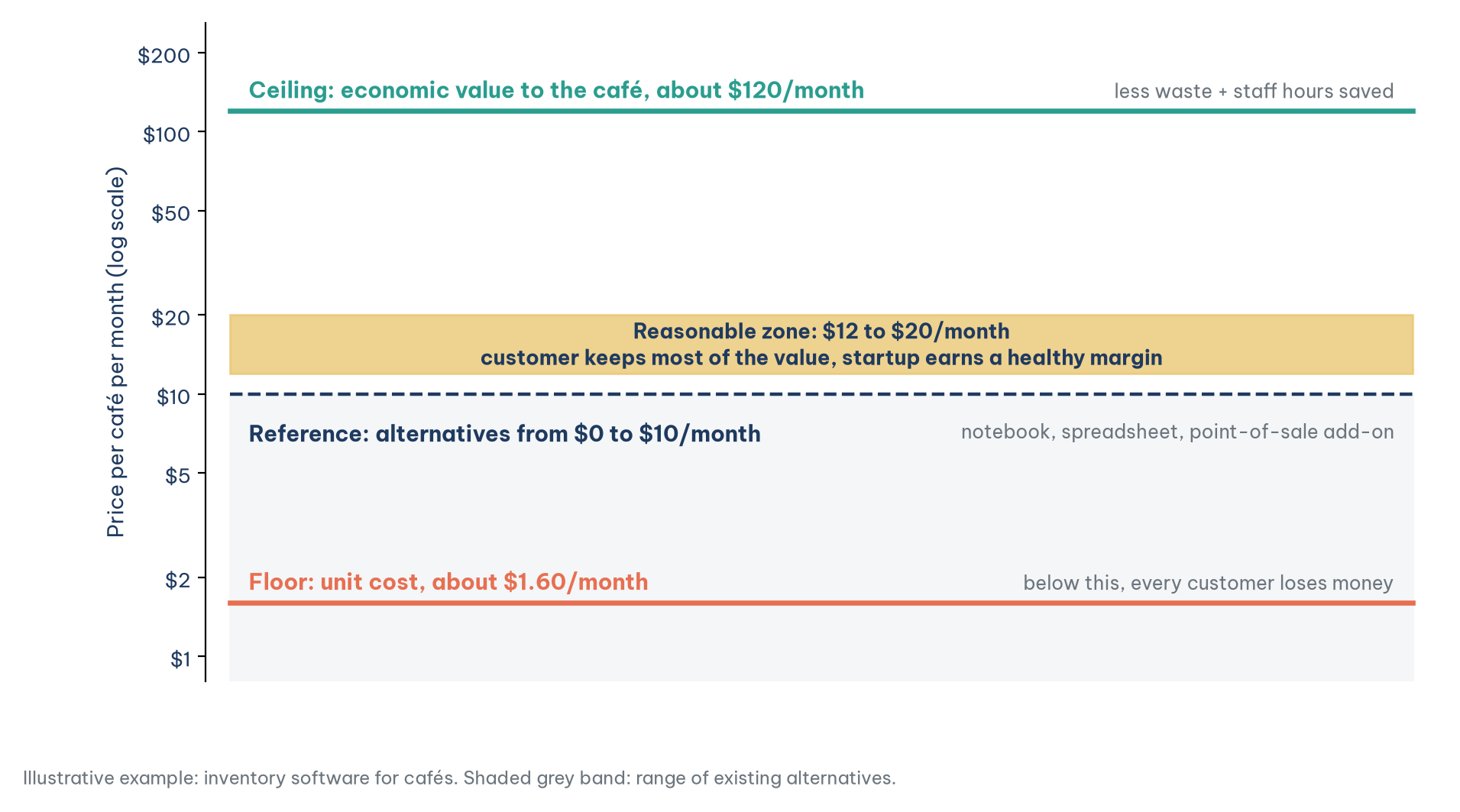
The price corridor has three markers. The floor is the unit cost: below it, the business loses money on every customer. The ceiling is the economic value the product delivers to the customer: above it, the customer has no reason to buy. Between them sits the reference, the price of the alternatives the customer already uses, including "do nothing" and "do it ourselves in a spreadsheet". In the principle set out by Aulet (2024), cost is only the floor; the value the customer perceives is what determines the price.
Figure 1 draws the price corridor for an illustrative inventory app for cafés. The unit cost, covering servers, support and payment fees, is about $1.60 per café per month. The alternatives range from $0 (a notebook or a spreadsheet) to about $10 (a point-of-sale system with a basic inventory add-on). The economic value for a mid-sized café is estimated at about $120 a month: roughly $80 in reduced ingredient waste plus about $40 from time and errors saved: about 10 hours a month the owner no longer spends checking stock and reconciling records, worth about $20 at roughly $2 an hour of the owner's time, and about $20 of losses from ordering too little or too much.
3.2. Choosing a zone inside the corridor
Figure 1 shows how wide the corridor is: from $1.60 to $120, a factor of 75. Because the price axis is logarithmic, the distance from the reference to the ceiling looks modest, but in dollars it is more than ten times the distance from the floor to the reference. A team pricing on cost would land at about $2.40 (a 50% markup); a team pricing on competitors would land at about $8. Both leave most of the value on the table. Pricing close to the ceiling makes no sense either, because the customer needs a clear reason to switch from a familiar solution and may not yet fully believe the estimated value.
A reasonable zone for a new product usually sits a little above the reference and far below the ceiling, for example $12 to $20 a month in this case. At $16, the middle of the zone, the café still keeps about $104 of the $120 in monthly value, while the startup earns a margin of about $14.40 per café per month, wide enough to pay for finding new customers. The zone should also be checked against the spending limit the decision maker can approve alone. If a café owner can sign off on anything under about $20 a month without asking anyone, a price inside that limit can shorten the sales cycle considerably.
4. Testing prices with landing pages
The price corridor gives a reasonable zone in theory. This section shows how to check that zone against what customers actually do before the price is fixed. It deals only with the price question; the broader craft of validating demand and designing landing pages is a separate topic.
4.1. Designing a price test
The simplest and cheapest method is a landing page price test. The team builds two or three versions of the same product page that differ only in price, then splits traffic from the same ad source evenly across the versions. Each page carries a call to action such as "Pre-order" or "Start a paid trial". Asking customers "Would you pay $12 a month?" produces far less reliable answers than watching whether they press a button that commits them to paying.
Three design rules keep the test about price. First, change only the price: the same headline, the same feature list and the same plan names, otherwise you are testing a different offer. Second, space the test prices far enough apart that a difference in behavior has a chance to show up with modest traffic (in the example below, neighboring prices differ by a third to a half), and include at least one price inside the corridor's reasonable zone. Third, decide in advance which metric will choose the winner. For a price test that metric should be revenue (or better, contribution after serving cost) per visitor, not the click rate.
When visitors click, the page can take a real deposit if the product is about to launch, or state honestly that the product is still being finished and offer an early sign-up benefit. Transparency is essential: do not take money for something you have no plan to deliver.
4.2. Reading the results: the highest click rate is not always the best price
Figure 2 shows the results of testing three prices, $8, $12 and $16 a month, with about 1,000 visitors each. Table 4 sets out the arithmetic behind the right-hand panel.
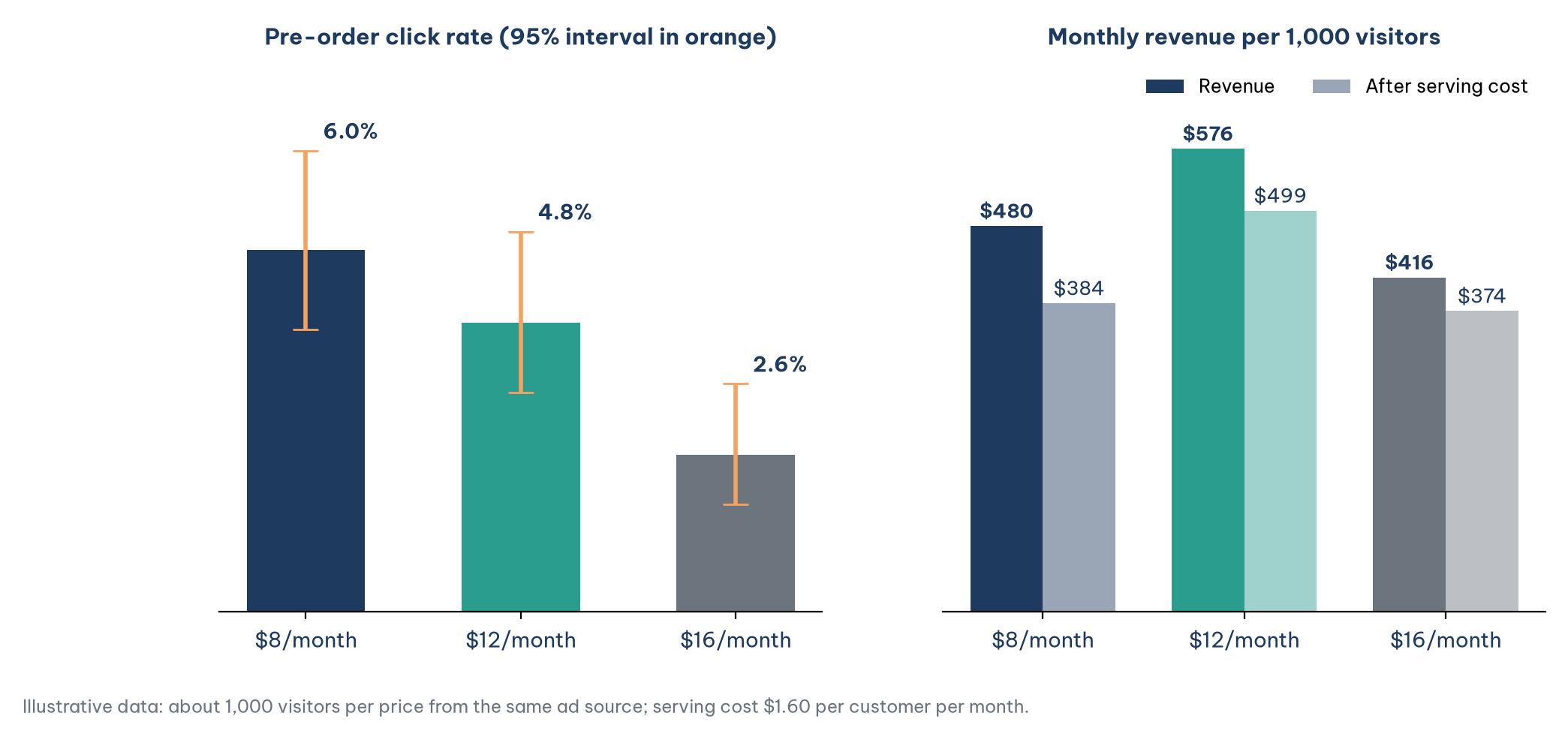
The $8 price has the highest pre-order rate, but revenue per 1,000 visitors is highest at $12: $576 against $480, or 20% more. Once serving costs are included the gap widens to about 30% ($499 against $384), because the lower price needs more customers, each of whom must be served, to reach the same revenue. The $16 price has a markedly lower rate, a sign that customers start to hesitate. Even so, $16 could still be tested as a premium tier with extra benefits for larger cafés, following the tiered structure from Section 2.
The results need careful reading. With about 1,000 visitors per version, the difference between 6.0% and 4.8% could be partly due to chance: a standard two-proportion test gives a p-value of about 0.24, and the 95% intervals in Figure 2 overlap widely. The drop from 4.8% to 2.6% is more convincing (p about 0.009). More importantly, the gap that actually matters for the decision, revenue per visitor of $0.576 at $12 against $0.48 at $8, is itself not statistically clear at this sample size (p about 0.34). The test supports a cautious conclusion: $16 is probably too high for most cafés at this stage, and $12 is at least as good as $8 while earning more per customer. Where possible, extend the test or repeat it with another traffic source before treating $12 as settled. Finally, a click on "Pre-order" is not a payment. The rate at which pre-orders turn into real payments at each price should be tracked too, because a higher price may filter out casual clickers and convert better at the payment step.
5. Pricing principles for startups
The final section brings together the pricing principles of Aulet (2024), how to price for customer groups who adopt at different times and the lessons of changing a price.
5.1. Six principles
Aulet (2024) sets out several foundational principles. First, base the price on the value delivered to the customer, not on cost. Second, use what you know about the buying decision (who approves, who pays, what the budget looks like) to choose a fitting price. Third, understand the alternatives and the prices customers are already used to. Fourth, build a flexible pricing policy for different customer groups. Fifth, start high and lower the price if necessary, because a price cut is far easier for customers to accept than a price rise. Sixth, have separate policies for early testers and for lighthouse customers, the influential customers whose adoption others in the industry watch and follow.
5.2. Pricing by adopter group
When pricing a technology product, it helps to understand the customer groups along the technology adoption life cycle (Moore, 2014). Innovators and early adopters are not very price sensitive, but they expect special attention and a voice in shaping the product. The early majority is the group that creates scale: pragmatic, in need of evidence and careful in comparing alternatives. Table 5 suggests a pricing approach for each group.
The key point of Table 5 is that the official list price should be designed for the early majority. Discounts for the first group should be stated clearly as temporary and conditional, so they do not become the reference price that every later customer expects to receive.
5.3. When the price changes
Changing the price structure is normal for a startup still searching for its revenue model. The problem lies in how existing customers are treated. When a company launches a better, cheaper plan without any upgrade path for people who bought the old plan at a higher price, the message existing customers hear is that those who arrive later are treated better than those who came first.
One customer's experience with a widely used AI language-learning app shows what this can cost. In 2024 the customer paid the equivalent of about $224 for a lifetime bundle, after being told by the sales adviser that no cheaper or better plan would follow. Two years later the company launched an all-inclusive lifetime plan at about $156, roughly 30% less, and later promoted it at about $112. The customer's request to switch was refused. A paying user who had recommended the app to others became a critic of it.
Three practical lessons follow. First, do not let the sales team promise anything about future prices that the company has not committed to in writing. Second, when changing prices, prepare a policy for existing customers in advance, such as keeping the old price for a period, allowing a switch with credit for what they have already paid or adding extra benefits. Third, be wary of lifetime plans: the most loyal customers are exactly the ones who make such plans unprofitable over time, which pushes the company into changing them later.
Conclusion
Pricing a startup product does not begin with a number. It begins with the revenue model (which revenue stream, which pricing mechanism and which payment mechanism) and with whether the four factors of customer, value, competition and operations support those choices. The six pricing methods, from cost-plus to dynamic pricing, are the toolkit for forming a price, while the price corridor between unit cost and customer value narrows down the reasonable range.
The step many teams skip is checking the price against real behavior before committing to it. A landing page test of a few weeks can show that the price bringing in the most revenue is not the price with the most clicks, and an honest reading of the numbers will also show how much of the difference may still be noise. Once customers exist, every price change tests their trust. A company that thinks first about the customers who have already paid keeps its most valuable supporters.
References
Aulet, B. (2024). Disciplined entrepreneurship: 24 steps to a successful startup (Expanded & updated ed.). John Wiley & Sons. https://www.wiley.com/en-us/Disciplined+Entrepreneurship:+24+Steps+to+a+Successful+Startup,+Expanded+&+Updated,+2nd+Edition-p-9781394222513
Barringer, B. R., & Ireland, R. D. (2024). Entrepreneurship: Successfully launching new ventures (7th ed.). Pearson. https://www.pearson.com/en-us/subject-catalog/p/entrepreneurship-successfully-launching-new-ventures/P200000010335/9780138287696
Gassmann, O., Frankenberger, K., & Csik, M. (2014). The business model navigator: 55 models that will revolutionise your business. Pearson. https://www.pearson.com/store/p/the-business-model-navigator-55-models-that-will-revolutionise-your-business/P100000686948/9781292065847
Moore, G. A. (2014). Crossing the chasm: Marketing and selling disruptive products to mainstream customers (3rd ed.). HarperBusiness. https://www.amazon.com/dp/0062292986
Tversky, A., & Kahneman, D. (1974). Judgment under uncertainty: Heuristics and biases. Science, 185(4157), 1124–1131. https://doi.org/10.1126/science.185.4157.1124
Discussion about this post