Platform Business Models: Network Effects, Types and Design
Why companies that own no cars, rooms or goods can still lead their markets, and how a startup should design a platform from the start


Key takeaways
A platform creates value by connecting and orchestrating outside groups, rather than producing value inside the firm as a pipeline does. Real companies often mix both.
Cross-side network effects drive platforms, but they have limits: they do not grow forever, they can turn negative, and they are often local.
Six launch strategies solve the chicken-and-egg problem; for a resource-poor startup, starting in a narrow niche and offering standalone value first are usually the most realistic.
Four platform types (transaction, interaction and content, innovation, payment) make money in different ways.
Design rests on three pillars: the core interaction, governance and trust, and value capture. Most failures come from missing critical mass, multi-homing, disintermediation or negative network effects.
Every day, millions of people book rides through Uber or Grab, shop on Amazon or Shopee, chat on WhatsApp or WeChat, and watch YouTube. The companies behind these services share a striking trait: Uber does not own most of the cars that carry passengers, marketplaces do not own most of the goods they list, and Airbnb does not own the rooms it rents out. What they own is a network of users, data on interactions, and a set of rules that let strangers transact with each other.
This way of doing business is called the platform business model: the company does not produce most of the value itself but builds the infrastructure and rules that let two or more groups of outside users interact and exchange value. Parker et al. (2016) call the shift from firms that produce to firms that orchestrate a "platform revolution", because it changes both where value comes from and how companies grow. A survey by Evans and Gawer (2016) recorded hundreds of platform companies across continents, and Cusumano et al. (2019) show that many of the world's most valuable companies run on this model.
For founders, understanding platforms has practical consequences. Many student startup ideas are platforms of some kind: connecting tutors with parents, farmers with restaurants, people who rent out equipment with people who need it. Such ideas sound attractive because they need few assets, but they run into challenges traditional businesses do not face: how to get users on both sides at the same time, how to keep them when a rival is one tap away, and how to charge without driving them away.
The article has nine parts. Section 1 compares pipeline and platform models. Section 2 explains network effects, the main engine of platforms, and their limits. Section 3 presents six strategies for solving the chicken-and-egg problem at launch. Section 4 classifies four types of platform and how each makes money. Section 5 covers the three pillars of platform design. Section 6 analyses why many platforms fail, and Section 7 summarizes how regulators are responding. Section 8 analyses Google as a system of platforms, and Section 9 applies the whole framework to a specific startup idea.
1. From pipelines to networks
To see what makes platforms different, set them beside the business model that dominated two centuries of industrialization. This section describes each model, then shows that in practice the two often coexist within one company.
1.1. The pipeline model
The pipeline model works like a pipe: value is created at one end and pushed to customers at the other. A carmaker buys steel and components, assembles cars in its factory, ships them to dealers, and dealers sell them to buyers. Each stage adds value, and the company controls almost the whole process.
A pipeline's advantage comes from doing each stage well: buying inputs more cheaply, producing more efficiently, distributing more widely. Its limit lies there too: to sell twice as much, the company must build more factories, hire more people and open more dealerships. Growth is bound by the pace of asset investment.
1.2. The platform model
The platform model does not push value one way; it creates a place where outside groups exchange value with each other. Figure 1 sets the two models side by side: in the top half, value flows through four stages inside the company; in the bottom half, the supply and demand sides meet through the platform.
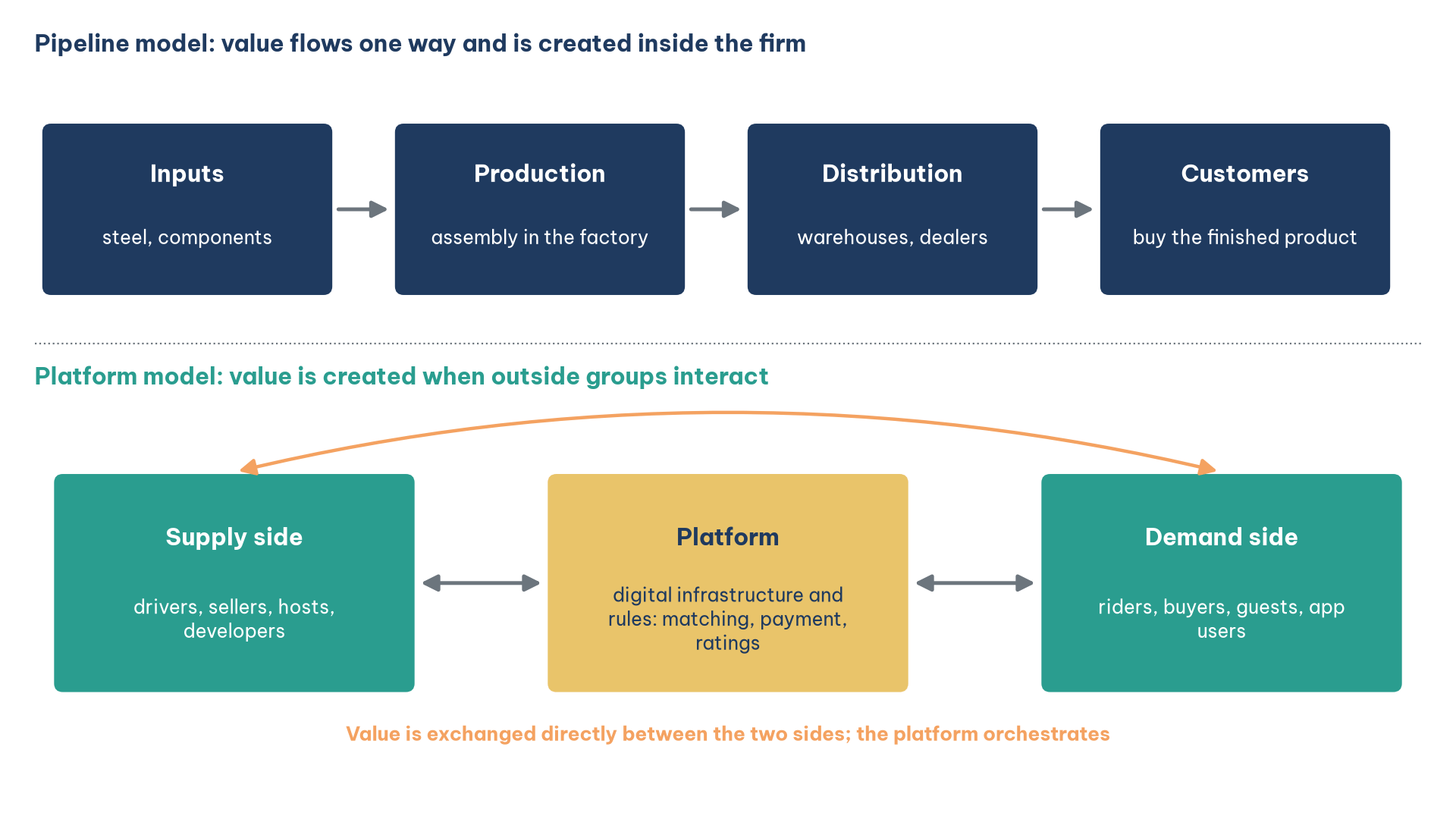
As Figure 1 shows, the platform sits in the middle as an orchestrator: it provides the digital infrastructure for the two sides to find each other, a payment mechanism for them to transact, and a rating system for them to trust each other. Airbnb did not build hotels; it built a market for empty rooms. The core value Airbnb creates is not the room but the connection and trust between two strangers.
Because supply comes from outside, platforms are "asset-light". When a thousand more drivers sign up, a ride-hailing app does not have to buy a thousand more cars. That is why platforms can scale much faster than pipeline firms in the same industry, and also why they depend on the goodwill of participants they do not directly control.
1.3. The two models intertwined
In practice, few companies belong purely to one model. Table 1 summarizes the differences between the two models on five criteria, with examples of each.
Table 1 presents the two models as two poles, but many companies sit in between. Amazon both buys goods to resell (pipeline) and opens its marketplace to third-party sellers (platform). The practical question for a startup is therefore usually not "platform or not?" but "which parts should we do ourselves to guarantee quality, and which should we open to others to scale fast?".
2. Network effects: the engine of platforms
If platforms have one core advantage, it is network effects. This section distinguishes two kinds of network effect, then points to three limits that popular accounts often ignore.
2.1. Same-side and cross-side network effects
Network effects occur when a product becomes more valuable to each user as more users join. The world's first telephone was useless; the second made the first useful; with millions of phones, the telephone network became indispensable infrastructure. Table 2 distinguishes two kinds of network effect.
As Table 2 indicates, cross-side network effects are the hallmark of two-sided or multi-sided platforms (Eisenmann et al., 2006). They create a self-reinforcing loop, illustrated in Figure 2 with a ride-hailing app.
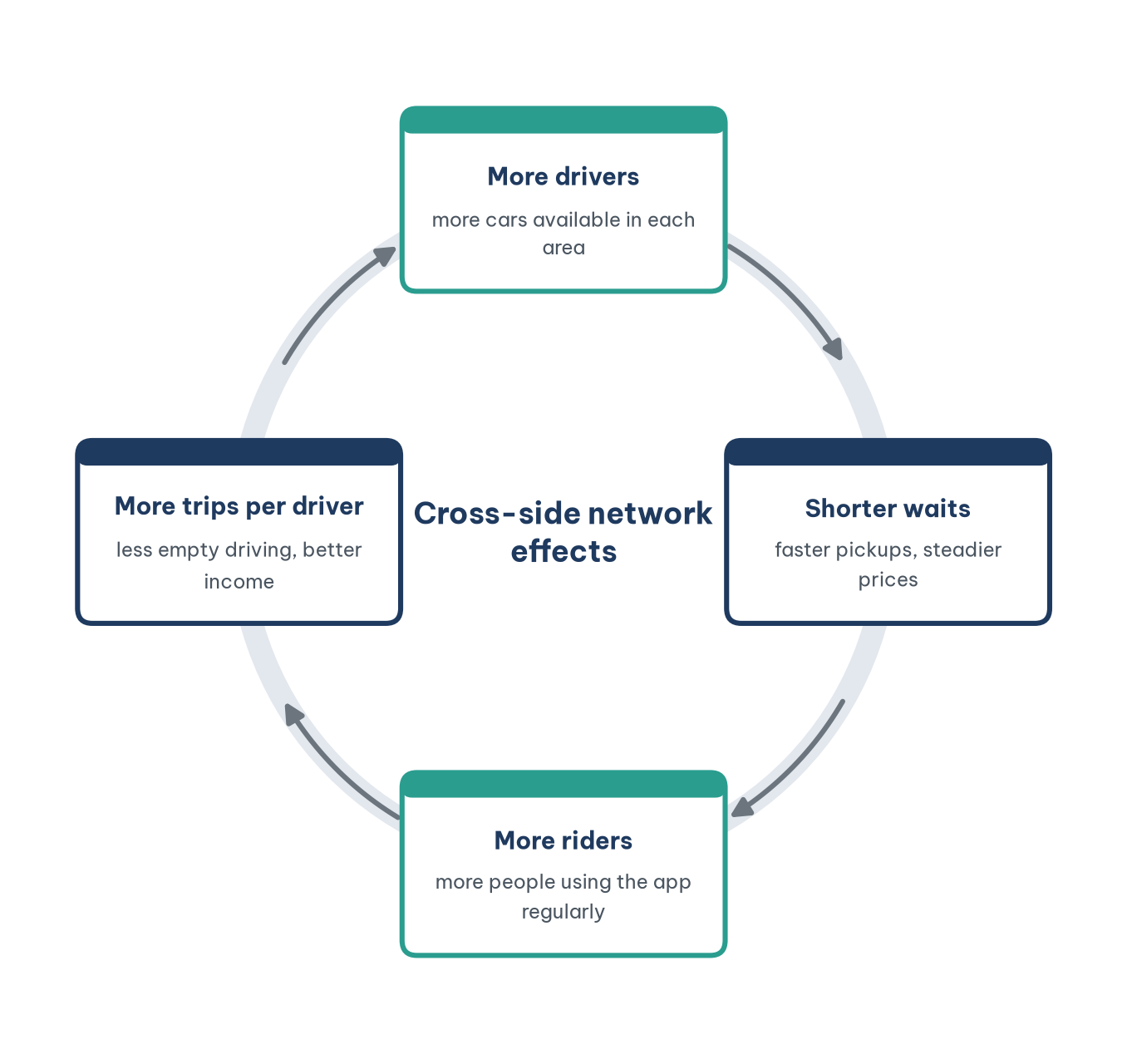
Figure 2 shows why a platform that passes a certain threshold can grow very fast: each new driver makes the app more attractive to riders, and each new rider makes it more attractive to drivers. Once the loop is running, it creates an advantage that is hard to copy, a form of economic moat. A latecomer must not only build a better app but persuade both drivers and riders, at the same time, to leave a network that is working well.
2.2. Three limits of network effects
Network effects are often described as an engine of unlimited growth, but reality is more complicated. Founders should understand three limits before betting their whole strategy on them.
The first limit is that network effects do not grow without bound. Metcalfe's law holds that a network's value grows with the square of its users, but Briscoe et al. (2006) show that this is too optimistic: most users interact with only a small group of others, so the millionth user does not add as much value as the hundredth. Beyond a certain size, the extra benefit from each new user declines.
The second limit is that network effects can turn negative. When a marketplace has too many low-quality sellers, buyers waste time filtering and start to leave; when a social network gets too crowded, feeds fill with junk. Scale is not automatically good; it is good only when the platform has mechanisms to maintain quality, a topic covered in Section 5.2.
The third limit is that network effects are often local. Plenty of drivers in one city do nothing for a rider in another. That is why ride-hailing and food-delivery platforms must "win" city by city, and competitors can attack city by city too. By contrast, a messaging app's network effects are national or global, because people message friends wherever they are, so it is much harder to dislodge.
3. The chicken-and-egg problem
The loop in Figure 2 is powerful once it is running, but at the start it creates a paradox: no drivers means no riders, and no riders means no drivers. This section presents six strategies for solving it and how to choose among them.
3.1. Six launch strategies
Successful platforms rarely wait for both sides to arrive together; they actively break the paradox with a launch strategy. Table 3 summarizes six common strategies, based on Parker et al. (2016) and Eisenmann et al. (2006).
The strategies in Table 3 are not mutually exclusive. A new food-delivery platform can start in a few central districts, subsidize customers and invite a well-known restaurant chain to join on preferential terms, all at once.
3.2. Choosing a strategy for the context
Each strategy has its own costs and risks, so the choice depends on the startup's resources and the market. Subsidies are the most expensive and most dangerous strategy for a startup with little capital: they attract price-sensitive users who leave as soon as the promotions stop. Several ride-hailing and food-delivery platforms in Southeast Asia withdrew after years of subsidies without reaching a strong enough position, as Section 6 shows.
For student startups, the two most feasible strategies are usually starting in a narrow niche and offering standalone value first. A narrow niche concentrates scarce resources in one place to reach high enough density, such as one university or one district. Standalone value brings users even when the other side is not there yet, because the tool is useful in its own right. Playing one side yourself is also worth considering at the testing stage: it does not scale, but it helps the team understand needs deeply before building the system.
4. Four types of platform and how they make money
Platforms differ greatly in what is exchanged and how they charge. This section introduces four common types of platform, each with its main money-making mechanism. Table 4 gives an overview before going into each type.
Table 4 assigns each example to one main type, but many large platforms belong to several. Grab is both a transaction platform (rides, food delivery) and a payments and finance business; TikTok is both a content platform and a marketplace through TikTok Shop. The subsections below look at each type in turn.
4.1. Transaction platforms
Transaction platforms are digital markets where the value exchanged is goods or services. There are two main branches. The goods branch (Amazon, eBay, Shopee, Lazada) connects sellers with buyers and provides a complete toolkit: search, cart, payment, shipping and reviews. The services branch (Uber, Grab, Airbnb, Upwork) connects people with idle skills or assets to people who need them, turning a car, a room or working hours into a source of income.
The basic revenue is a commission or service fee on each successful transaction, usually a percentage of the order value or fare. Increasingly as important is advertising for sellers: sellers pay for their products to appear in "sponsored" positions when customers search. Large marketplaces also sell fulfilment services (Amazon calls this Fulfillment by Amazon) and charge fees for official brand stores.
Seller fees on marketplaces change several times a year and include fixed fees by category, payment fees, service fees and more. When analysing a marketplace, look up the current fee schedule on its seller pages rather than using figures from old news reports.
4.2. Interaction and content platforms
On interaction and content platforms, what is exchanged is information, content and relationships created by users themselves. Social networks (Facebook, LinkedIn, WeChat) revolve around digital identity and relationships; media-sharing platforms (YouTube, TikTok, Instagram, Spotify) revolve around posting and discovering content; knowledge-sharing platforms (Reddit, Quora, Wikipedia) revolve around questions, answers and pooled knowledge.
Targeted advertising is the dominant revenue source for this group, because platforms hold data on users' interests and behaviour. Alongside it are subscriptions: ad-free plans (YouTube Premium, Spotify Premium) or professional plans (LinkedIn Premium, LinkedIn Recruiter). Revenue sharing with creators is a key mechanism for keeping a supply of quality content, and in-content commerce (TikTok Shop) turns attention directly into transactions.
Not every content platform lives on advertising. Wikipedia is non-profit, carries no ads and survives mainly on donations. This example is a reminder that how a platform makes money is a design choice, not an inevitable consequence of its type.
4.3. Innovation platforms
Innovation platforms provide the technological foundations (operating systems, development kits and application programming interfaces) on which third-party developers build complementary apps and services. Typical examples are iOS with the App Store, Android with Google Play, and Salesforce with AppExchange. Each new app makes the platform more attractive to end users, and each new user makes it more attractive to developers.
The classic money-making mechanism is revenue sharing: the app store keeps a percentage, usually 15% to 30%, of revenue from app sales and in-app purchases. Some platforms also charge participation fees, such as Apple's Developer Program fee of USD 99 a year. App stores' revenue shares are under pressure from regulators in many countries, as Section 7 notes.
4.4. Payment platforms
Payment platforms are the financial infrastructure layer of the digital economy, connecting consumers, businesses and financial institutions to process payments safely and quickly. Globally there are PayPal and Stripe; across Asia, mobile wallets such as Alipay, GCash and MoMo serve hundreds of millions of people. The core value is reducing friction: buyers do not need cash, and sellers do not worry about counterfeit notes or making change.
The main revenue is a processing fee on each transaction, usually a percentage of its value, sometimes plus a fixed fee. Payment platforms also expand into value-added services such as fraud prevention, currency exchange and especially lending, where transaction data help them assess users' creditworthiness better.
5. Three pillars of platform design
Knowing which type a platform is only the first step; the harder question is how to design it. Parker et al. (2016) propose designing a platform around three pillars: the core interaction, governance and trust, and value capture. This section presents each pillar in turn.
5.1. The core interaction
The core interaction is the most important, most frequently repeated exchange of value on the platform. Every other feature matters only if it makes the core interaction easier, faster or more frequent. Table 5 analyses the three components of the core interaction through two examples, YouTube and a ride-hailing app.
As Table 5 shows, the filter is where a platform creates the most value that users rarely notice. A marketplace with millions of products that does not help customers find what they need is as useless as an empty one. When designing a new platform, a startup team should write down the core interaction in one sentence, then check whether every planned feature serves that sentence.
5.2. Governance and trust
In an open environment where two strangers transact, trust is a prerequisite. A platform must set the rules of the game like a small government, with four main groups of tools.
The first is identification and verification: checking drivers, sellers and hosts before letting them join. The second is reputation systems: star ratings, reviews and "top seller" badges that let users regulate each other's quality. The third is guarantees and insurance: holding buyers' money until they receive the goods, refund policies, trip insurance. The fourth is moderation: filtering counterfeit goods, violating content and fake reviews.
Governance is a balancing act. Too loose, and negative network effects appear as fakes, scams and junk, and quality users leave. Too strict, and the supply side finds it a hassle and moves to another platform. There is no common equilibrium for all platforms; startup teams must experiment and adjust continuously.
5.3. Value capture
The final pillar is capturing part of the value the platform creates. The main principle is to charge where the platform creates the clearest value, and to avoid charging the most sensitive side. Many platforms subsidize one side, usually end users, and charge the other, usually sellers or advertisers.
Charging too much has two consequences. Users may move to another platform, or worse, they use the platform to meet and then transact "off-platform" to avoid fees, a phenomenon analysed in Section 6.
6. Why many platforms fail
Success stories such as Uber or Shopee make it easy to think the platform model is a sure path. In reality, failed platforms far outnumber successful ones. Table 6 summarizes five main risks, with examples and warning signs.
The five risks in Table 6 often occur together. The three subsections below look more closely at the three risks startup platforms face most.
6.1. Failing to reach critical mass
Every platform has a critical mass: the number of users on each side needed for the loop in Figure 2 to run without subsidies. Before that point, the platform must spend money to keep both sides. If the money runs out first, or a competitor reaches the threshold first, the platform has almost no chance.
Ride-hailing and food delivery in Southeast Asia are clear examples. Several companies backed by large parent groups still withdrew after years of competition, because they did not win a large enough share in the main cities for the loop to run on its own. The lesson for startups is to measure critical mass early: how many drivers are needed in a district to keep waits under five minutes, how many tutors so that each parent has at least three choices.
6.2. Multi-homing and disintermediation
Multi-homing happens when the cost of joining one more platform is low. A driver can install three ride-hailing apps and take rides from whichever pays more; a seller can open stores on every marketplace. Network effects then stop being one platform's private advantage, and competition reverts to a price war.
Disintermediation is more dangerous for platforms where the two sides have repeat relationships. After the first lesson, a parent and a tutor have each other's phone numbers; after the first repair, the customer and the tradesperson know each other. If the platform charges per transaction, both sides have an incentive to go around it. The most effective defence is not prohibition but continuous value that makes both sides want to stay: insurance, convenient payment, rating histories, help with disputes.
6.3. Negative network effects
Negative network effects are the dark side of rapid growth. When a marketplace grows fast by loosening conditions for sellers, counterfeit and poor-quality goods grow with it; when an app chases users at any cost, the community becomes noisy and less trustworthy. Quality users are the first to leave, and they are usually hard to win back.
Early signs of negative network effects can be measured: complaints per thousand orders, average ratings, repeat-user rates. A platform that tracks these alongside growth metrics will spot problems before they become crises.
7. How regulators are responding to platforms
The size and influence of large platforms have brought them under increasingly close regulatory scrutiny. This section summarizes global trends and what they mean for a startup platform.
7.1. Global trends
The focus of platform regulation worldwide is competition. In 2024, a U.S. federal court ruled that Google had illegally monopolized the market for search services; Apple and Google have both been sued in many countries over app-store fees and rules. The European Union applies the Digital Markets Act (European Parliament & Council of the European Union, 2022), which imposes specific obligations on large platforms designated as "gatekeepers", for example prohibiting them from favouring their own services on their platforms.
Beyond competition, governments are also concerned with personal-data protection, liability for infringing content and goods on platforms, and the labour relationship between platforms and drivers or couriers. These issues directly affect operating costs and can change the business model itself.
7.2. What this means for a startup platform
Emerging markets are moving in the same direction. Vietnam, for instance, passed a new e-commerce law in 2025 that requires marketplace operators to verify sellers before letting them open stores (National Assembly of Vietnam, 2025), and from July 2025 made marketplaces with payment functions withhold and remit tax on behalf of household businesses and individuals selling on them.
For startups, this means compliance costs are part of the platform business model, not something to deal with later. A tutor-matching platform must verify tutors' identities, protect the data of underage students and consider tutors' tax obligations from the design stage.
8. Case study: Google as a system of platforms
Google is a prime example of how several platforms can support each other within one system. This section analyses the role of each sub-platform and how they connect. Table 7 assigns Google's sub-platforms to the four types presented in Section 4.
Table 7 shows that each sub-platform plays a different role; Figure 3 shows how they link into a chain.
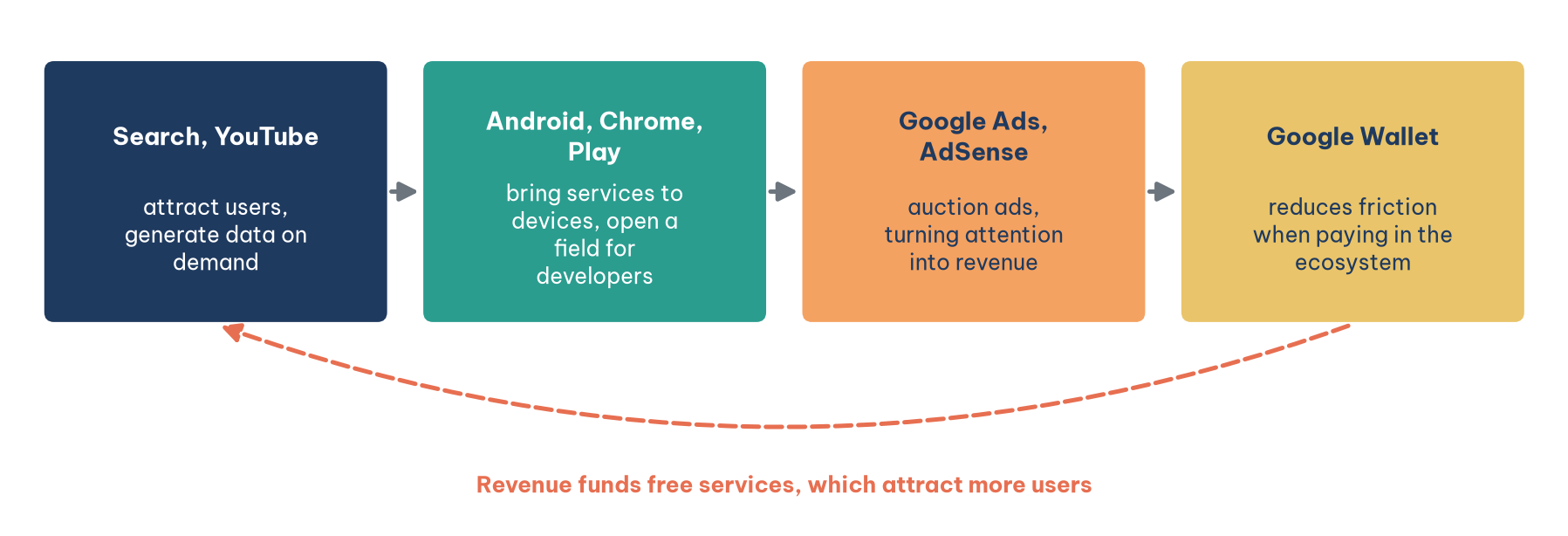
As Figure 3 shows, Search and YouTube attract users; Android and Chrome bring more users into Search; more users make ad placements more valuable to advertisers; and advertising revenue in turn funds free Search, YouTube and Android. This loop explains how Google can offer such costly services for free.
The same loop is why Google is investigated by regulators in many countries. An advantage in one platform can be used to reinforce another, for example by making Search the default on Android and Chrome, which makes it hard for rivals to compete even with good products. The Google case shows that the power of a multi-platform system always comes with matching legal risk.
9. Application: a student tutoring platform
To see how these concepts work in a startup project, this section applies the whole framework to a hypothetical idea: a group of students wants to build a platform connecting university-student tutors with parents of lower-secondary pupils in one district. Table 8 summarizes the main design decisions.
What stands out in Table 8 is that the charging model is chosen to counter the biggest risk. Because parents and tutors will have a repeat relationship, a commission on every lesson almost certainly leads to disintermediation. A one-off fee on a successful match accepts that the two sides will deal directly afterwards, but ensures the platform earns revenue from the value it really creates: the initial connection. The team could also test a monthly paid plan with progress reports and lesson insurance, to see whether enough parents want to stay on the platform.
Conclusion
The platform model creates value by connecting and orchestrating outside groups, unlike the pipeline model, which produces value internally. The main engine of a platform is network effects, especially cross-side network effects, but this engine has limits: it does not grow without bound, it can turn negative, and it is often local. Launching a platform means solving the chicken-and-egg problem, with six strategies ranging from subsidies, standalone value, playing one side, starting in a niche and attracting marquee participants to piggybacking on an existing network.
Designing a platform revolves around three pillars: the core interaction, governance and trust, and value capture. All three must be weighed alongside platform-specific risks such as failing to reach critical mass, multi-homing, disintermediation and compliance costs. For founders, perhaps the most important lesson is this: a platform does not win by the idea of connecting people, but by making one core interaction happen better than any alternative, good enough that both sides want to stay.
References
Briscoe, B., Odlyzko, A., & Tilly, B. (2006). Metcalfe's law is wrong. IEEE Spectrum, 43(7), 34–39. https://doi.org/10.1109/MSPEC.2006.1653003
Cusumano, M. A., Gawer, A., & Yoffie, D. B. (2019). The business of platforms: Strategy in the age of digital competition, innovation, and power. Harper Business.
Eisenmann, T., Parker, G., & Van Alstyne, M. W. (2006). Strategies for two-sided markets. Harvard Business Review, 84(10), 92–101. https://hbr.org/2006/10/strategies-for-two-sided-markets
European Parliament & Council of the European Union. (2022). Regulation (EU) 2022/1925 on contestable and fair markets in the digital sector (Digital Markets Act). https://eur-lex.europa.eu/eli/reg/2022/1925/oj
Evans, P. C., & Gawer, A. (2016). The rise of the platform enterprise: A global survey. The Center for Global Enterprise. https://www.thecge.net/archived-papers/the-rise-of-the-platform-enterprise-a-global-survey/
National Assembly of Vietnam. (2025). Law on E-commerce No. 122/2025/QH15. https://chinhphu.vn/?pageid=27160&docid=216503&classid=1&typegroupid=3
Parker, G. G., Van Alstyne, M. W., & Choudary, S. P. (2016). Platform revolution: How networked markets are transforming the economy and how to make them work for you. W. W. Norton.
Discussion about this post