Three Early Startup Checks: Pain, Advantage and Timing
Is your product a painkiller or a vitamin, what unfair advantage do you bring, and why is now the right moment? Three questions every investor asks


Key takeaways
Painkillers relieve urgent pain that customers actively seek to fix; vitamins offer real but non-urgent benefits. The difference shows up directly in acquisition cost, retention and pricing power.
Adding frequency of use gives four positions: daily painkillers, seasonal painkillers, the habit zone and occasional vitamins, the riskiest. Crises, new regulations and behaviour changes can turn vitamins into painkillers overnight.
The MILES framework (Money, Intelligence and insight, Location and luck, Education and expertise, Status) helps founders recognise advantages others cannot easily copy, which must later be turned into company moats.
Timing works at three nested levels: the macro window (why now?), the micro window (why buy now?) and the nudge, the only level the seller fully controls.
Each check has an ethical edge: designing habits is not manufacturing pain, "unfair" advantages raise questions of fairness, and a good nudge is one customers will thank you for.
In early-stage pitch meetings, investors return again and again to three questions. Is your product a painkiller or a vitamin? Why are you the right person to build it? Why now? They sound like quick tests, but together they predict a great deal about a start-up's future: how much it will cost to win a customer, whether the founders can do what rivals cannot, and whether the market is ready.
This article takes the three questions in turn. Section 1 looks at the product: painkiller or vitamin, how frequency of use changes the picture, how context moves a product from one category to the other, and three strategies for bringing a vitamin closer to real pain. Section 2 looks at the founder: the unfair advantages captured by the MILES framework, how to score them honestly and how to turn them into advantages the company owns. Section 3 looks at the moment: the window of opportunity at three levels, from the big wave that lets a company exist to the nudge that closes a sale. Each section ends at the same place: the ethical line that the check should not cross.
1. The product: painkiller or vitamin?
The painkiller-versus-vitamin metaphor has been used widely in venture capital since the 2000s. Someone with toothache at midnight will do anything to buy medicine, rarely haggles and remembers exactly which pharmacy is open. Someone who wants to be healthier might buy vitamins, but might also put it off until next month, and vitamins are the first thing cut when money is tight.
1.1. Two kinds of product
A painkiller solves a specific, urgent pain that customers actively look to fix. A vitamin delivers a real but non-urgent benefit, so customers must be persuaded to use it and are quick to drop it. Table 1 compares the two on five criteria.
The same product can be a painkiller for one group and a vitamin for another. A ride-hailing app is a painkiller for someone late for a meeting in the rain, but just a convenience for someone strolling at leisure. Classification is therefore always tied to a specific customer group and situation.
The difference has economic weight in three metrics. Customer acquisition cost (CAC): painkiller customers find you through search and referrals, so less is spent on advertising; vitamin customers must have their need "awakened" with content and promotions. Retention: customers keep using a product while the pain persists, but drop one that is only "a bit better". Pricing power: someone losing money to a problem will pay part of that loss to stop it. Together these determine customer lifetime value relative to acquisition cost, the foundation of every business model. A vitamin can succeed, but it must offset high acquisition costs and churn with another mechanism, usually habit or network effects.
1.2. Why founders love vitamins and investors look for painkillers
Many founders love their solution and think: who wouldn't want to be healthier, better at English, more organised? The honest answer is that everyone does, but people tend to postpone "becoming better" while acting immediately to "stop the pain". Eyal and Hoover (2014), studying habit-forming products, note that vitamin products struggle to retain users unless they become part of a daily routine. The second trap lies in how founders test their idea. Ask friends, "Would you like an app that helps you live more healthily?" and almost everyone says yes. That measures desire, not behaviour. A vitamin product easily collects lots of praise and few paying customers.
The strongest painkillers solve what Michael Seibel of Y Combinator calls "hair on fire" problems. When your hair is on fire, you don't care about the colour or brand of the bucket; you just need the fire out. Customers with such problems will use a rough, buggy product as long as it puts out the fire. For investors, that means a painkiller start-up can reach the market earlier with a simpler product, learn faster from real customers and burn less capital before proving demand.
1.3. A second axis: frequency of use
Classifying products only by pain is not enough, because some products relieve no pain yet still succeed. Eyal and Hoover (2014) describe a "habit zone": a behaviour readily becomes a habit when it is performed often enough and perceived as useful. Combining this with the pain axis divides products into four groups, as in Figure 1.
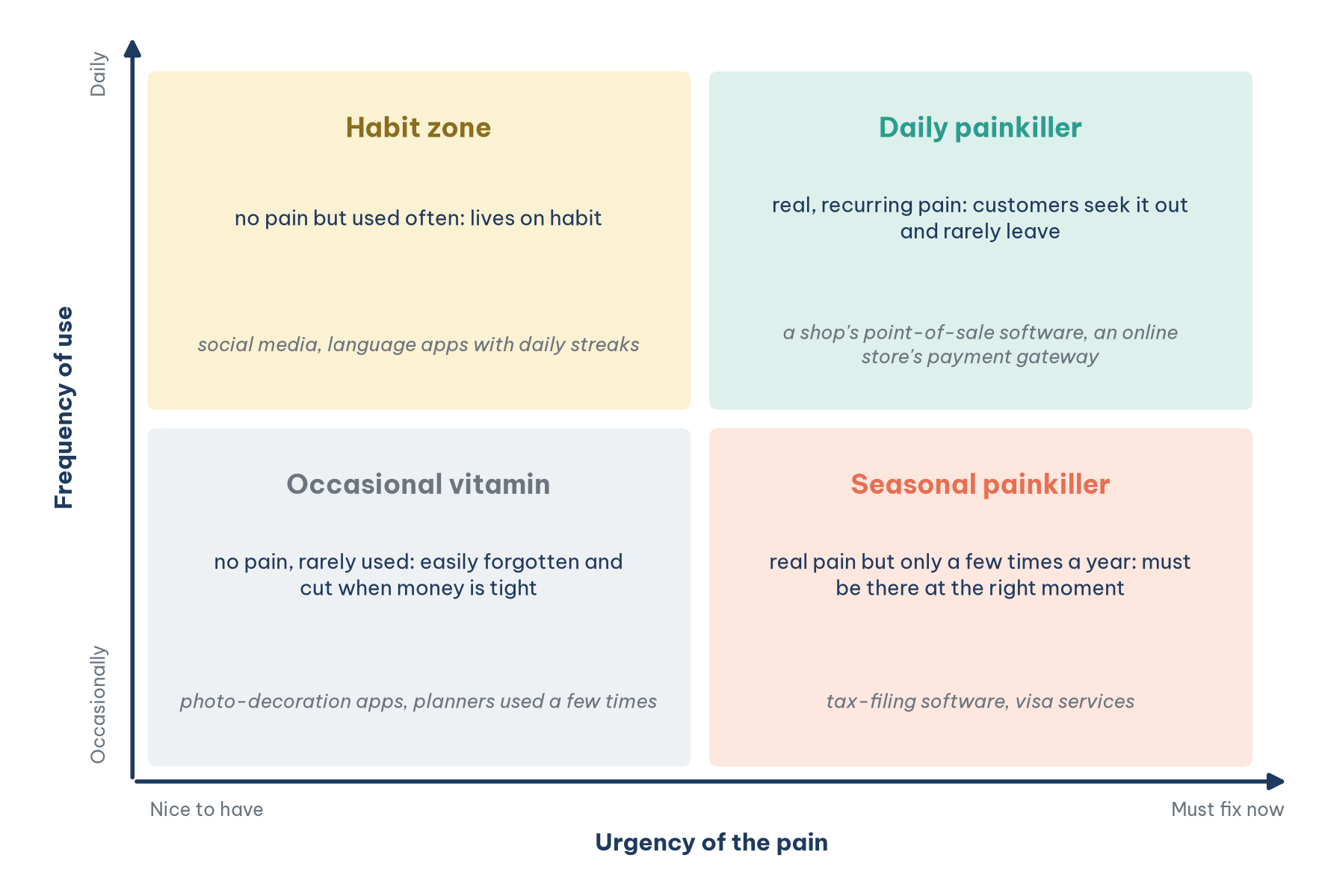
The safest position is the daily painkiller and the riskiest is the occasional vitamin. The other two can succeed, but in different ways, as Table 2 summarises.
The seasonal painkiller is often underrated. Tax-filing software, visa services and removal companies all solve real pains customers will pay well for, but each person needs them only a few times a year or a lifetime. The difficulty is not persuasion but being remembered at the right moment. Businesses here invest in being present when customers need them: appearing first in search, partnering with whoever meets the customer first (estate agents for removals, schools for student visas), or moving to subscriptions to stay in touch between seasons.
1.4. When context turns a vitamin into a painkiller
A product's position is not fixed. Three kinds of change can turn a vitamin into a painkiller almost overnight.
External shocks. Before 2020, video conferencing was a convenience for most companies. When COVID-19 forced businesses and schools to work remotely, it became indispensable: Zoom's revenue for fiscal year 2021, ending 31 January 2021, grew 326% year on year (Zoom Video Communications, 2021). The lesson is not to wait for a pandemic but to watch for events that change customers' level of pain: a prolonged power cut makes generators and home batteries painkillers; a record heatwave sells air purifiers and evaporative coolers.
New regulations. Regulation is often the clearest force turning vitamins into painkillers, whether it is a data-protection law, a new reporting standard or a tax change. Vietnam offers two vivid examples. E-invoicing software was a "nice to have" for many small businesses until Decree 123/2020 made e-invoices mandatory from 1 July 2022, turning it into a need with a hard deadline (VnEconomy, 2022). More recently, Vietnam decided to abolish the flat "presumptive" tax for household businesses, which move to declaring tax on actual revenue from 1 January 2026 (Nhân Dân, 2025). For millions of household businesses, sales and bookkeeping software went from "nice to have" to necessary. A start-up offering bookkeeping for household businesses before and after that date sells the same product, but on one side of the date it sells a vitamin and on the other a painkiller.
Behaviour change. The third kind of change is slower but no less important. Slack and Trello were once seen as "more fun than email"; for remote, distributed teams they became infrastructure without which the team cannot function. Conversely, Netflix is entertainment, a vitamin, yet it can feel indispensable during long holidays at home. The line between the two categories is thin; the founder's job is to notice when it moves and be ready when it moves their way.
1.5. Six questions to classify your product
Founders are usually confident their product is a painkiller. Table 3 offers six questions to test that belief against observable customer behaviour rather than opinions.
If a product leans vitamin on four or more of the six, the founder should consider the strategies below. Question 3 usually discriminates best: customers already paying for a patchy solution are the clearest evidence of real pain.
Consider a hypothetical student team building a personal expense-tracking app and assessing it for two groups: students who want to manage pocket money, and small sole traders who must now declare tax on actual revenue. For students, the answers all lean vitamin: they come at the start of the month when in the mood to get organised; if the app vanished they would simply stop tracking; they do nothing today; there is no budget, no deadline, and they use it a few times a month. For sole traders, all six lean painkiller: they come when a filing period approaches or when the tax office asks for explanations; without the app they would need other software or an accountant; today they keep notebooks or ask an acquaintance to help, sometimes getting it wrong; they already pay for bookkeeping help; there are fixed filing deadlines; and they use it every day, with every sale. The team does not need to change much technology; it needs to change its target customer and value proposition, from "smart spending management" to "compliant sales records for your tax return in five minutes a day". Of course, a product for traders must meet bookkeeping and invoicing requirements, which means learning the rules or finding an expert adviser.
1.6. Three strategies to bring a vitamin closer to real pain
Discovering that your product is a vitamin does not mean abandoning it. Three strategies are commonly used.
Find the moment customers need you most. Identify when the customer truly needs the product, then build messages and channels around that moment. Figure 2 illustrates this with an English-learning app.
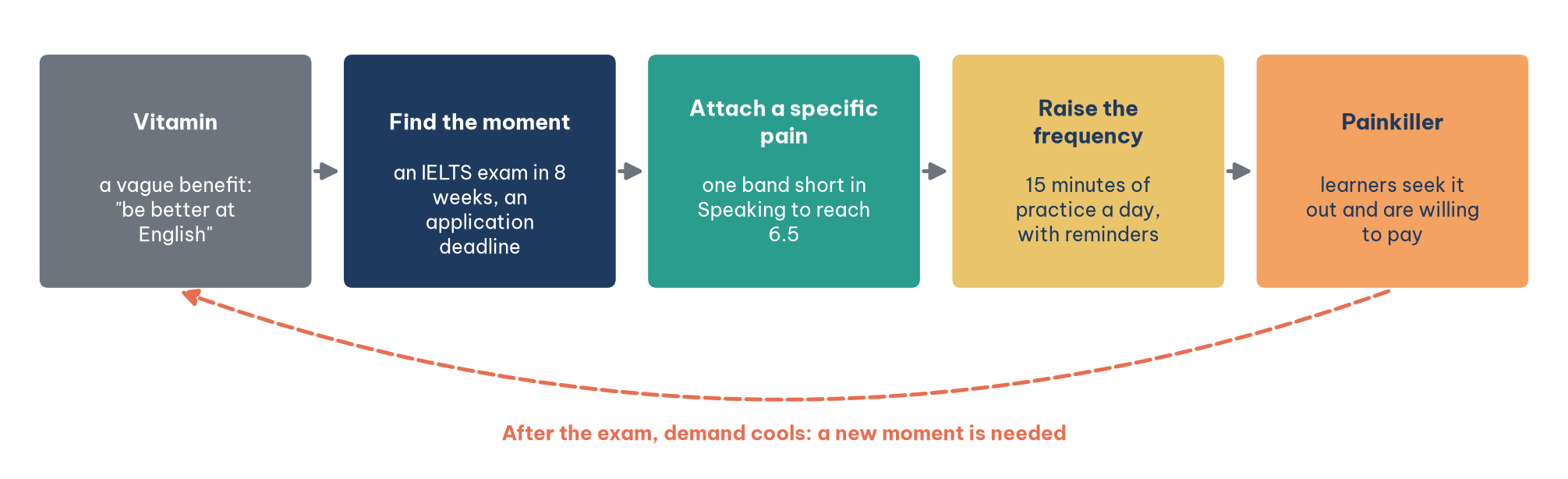
An English app is a vitamin for someone who "wants to be good at English", but a painkiller for someone with an IELTS exam in eight weeks for a study-abroad application who is one band short in Speaking. The return arrow is a reminder that the moment expires: once the exam is over, demand cools. The business therefore needs a chain of moments, for example from certificate exams to job interviews in English.
Attach the product to a specific pain. Instead of selling a general benefit, choose one concrete task that hurts and speak directly to it. HR software is a vitamin when sold as "modern people management" but a painkiller when it fixes specific problems: payroll errors, manual timekeeping, late social-insurance reports. Meditation apps such as Calm and Headspace are a textbook case. Meditation is the classic vitamin: everyone knows it is good, few do it. Rather than "meditate for inner peace", these apps speak to concrete pain: you can't sleep, you're stressed about work. They shifted from selling vague long-term calm to selling a good night's sleep tonight.
Raise the frequency of use. If a product does not relieve enough pain, it must be used often enough to become a habit. Instagram began as a tool for making photos look better, nice to have but not essential. Through habit loops, it became the place people go when bored, afraid of missing out or seeking recognition, attaching itself to a psychological pain. Duolingo uses streaks: after 100 days in a row, missing a day feels like a loss, and users can spend in-app items to protect the streak. This turns a vitamin, language learning, into a daily habit.
1.7. The ethical line: habit design versus manipulation
All three strategies raise how much users need the product. Designing a product to become a habit is a legitimate skill; creating pain in order to sell its cure is manipulation. Eyal and Hoover (2014) suggest founders ask themselves two questions: do I use this product myself, and does it genuinely improve users' lives? If the answer to the second is no, the founder is in dangerous territory however fast the product grows. Fake countdown timers, cancellation made far harder than sign-up, and exploiting teenagers' fear of being left out can lift short-term metrics, but they destroy long-term trust and in many countries now fall under consumer-protection law.
A practical test is to imagine explaining your mechanism to users themselves. If the team is comfortable saying, "We remind you every evening because you set a goal of 15 minutes a day," the mechanism is probably healthy habit design. If it would be embarrassed to say, "We hid the cancel button so you keep paying," that is a sign of manipulation. Theodore Levitt (1983) repeated a familiar marketing idea: people don't buy a drill, they buy the hole in the wall. The best painkiller makes exactly the hole the customer needs; it does not convince customers their walls are cracking.
2. The founder: what is your unfair advantage?
The start-up world is full of success stories painted with sleepless nights, extraordinary effort and a never-give-up spirit. That is true but not enough. If hard work were all it took, why do so many talented, hard-working people still fail? In The Unfair Advantage, Ali and Kubba (2020) give a blunt, practical answer: success is not a level playing field. A start-up's fate depends not only on effort but on unfair advantages, things you have that others cannot easily get. The good news is that everyone has some. The question is not whether you have them but whether you recognise and use them.
2.1. Definition and the MILES framework
"Unfair" can sound shady, so the definition matters. For Ali and Kubba (2020), an unfair advantage is a condition, asset or circumstance that gives you a competitive edge others cannot easily copy or buy. The definition rules out two things founders often count as advantages. "Working harder" is not one: anyone can work hard, so it is necessary but not distinctive. "A unique idea" is not one either: ideas are copied quickly, especially once presented publicly. An unfair advantage is foundational, tied to who you are and your circumstances. To identify such advantages, the authors propose the MILES framework, summarised in Figure 3.
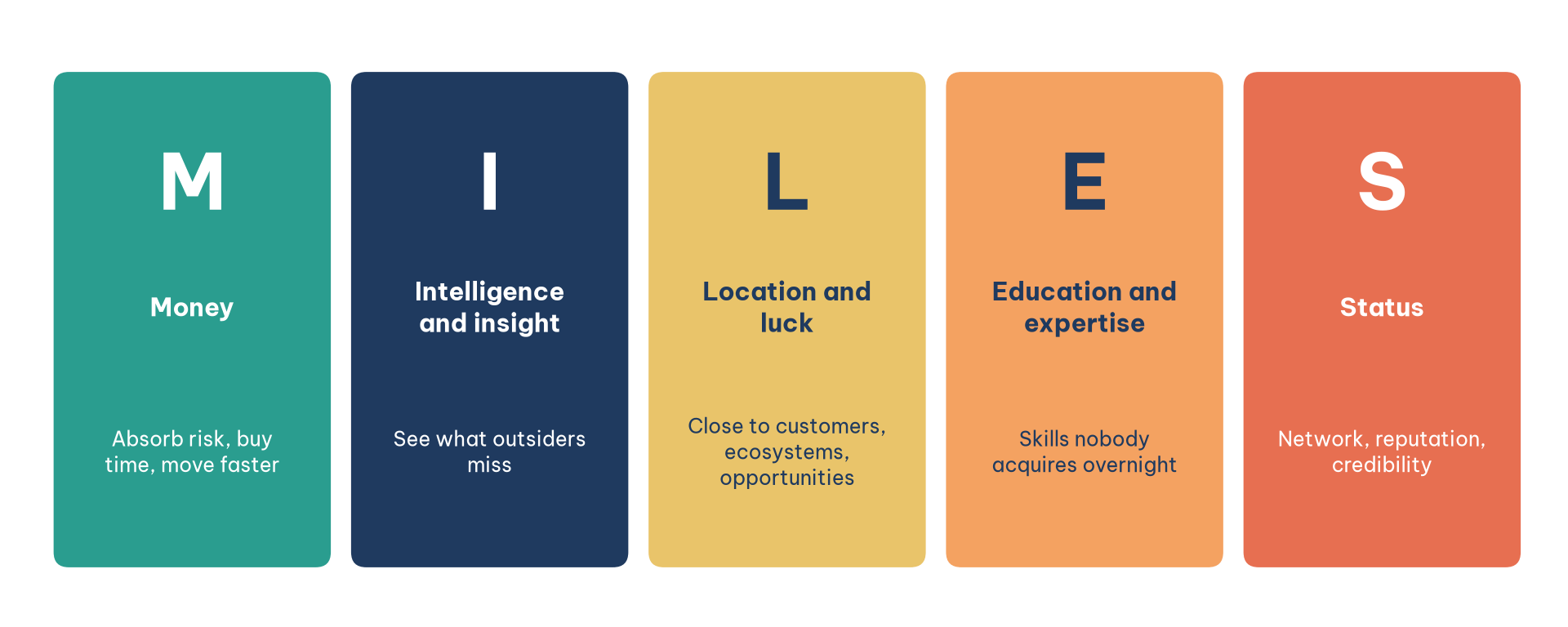
The five letters are not equally visible. Money is the most obvious; insight is the hardest to recognise but often the most important for an early-stage start-up.
M: Money. Money lets you absorb risk, pursuing an idea without worrying about monthly bills; buy time, working full time on the project instead of alongside a job; and accelerate, hiring, marketing and building faster than rivals. It may come from savings, family support or the ability to raise money from your network. A graduate whose family lets them live at home rent-free for the first twelve months has an M advantage over a classmate who must take a job immediately to pay rent, even with the same idea and ability.
I: Intelligence and insight. This is not just IQ or grades. Ali and Kubba distinguish book smarts, the ability to learn fast and process complex information; street smarts, sharpness in communication, negotiation and reading people; and insight, the ability to see a problem or solution others miss. Insight matters most for founders and usually comes from long, direct experience in a field. Someone who grew up in a family fruit-wholesale business understands post-harvest losses, seasonal prices and how middlemen operate, knowledge an outsider would need months of interviews to learn and might never fully grasp.
L: Location and luck. Where and when you are is an advantage. Location may mean being in a start-up ecosystem close to talent, investors and customers, or being in the right online community where target customers talk. Luck sounds random, but the authors argue you can "make" it by increasing your exposure to opportunity: meeting many people, trying new things, sharing your work publicly and being ready when a chance appears. Living in a specialised farming region, such as Vietnam's Central Highlands coffee belt, is an L advantage for an agritech start-up; studying at a university with an incubator is an L advantage for a student.
E: Education and expertise. A degree from a respected institution can open doors and create initial trust with investors and partners, but expertise matters more than credentials: a strong developer, a marketer with ten years' experience or a pharmacist who knows the regulations all have something nobody acquires overnight. Expertise is most valuable when it matches the problem: a strong software engineer building a software start-up has a powerful E; the same engineer opening a restaurant chain has almost none.
S: Status. Status is how the outside world sees you, in three forms: your network, who you know and who will introduce, advise or become a first customer; your personal brand, whether people trust what you say and whether you have an audience; and inner status, your confidence and communication. Ali and Kubba observe that sometimes simply "looking like a founder" creates a halo effect that makes persuasion easier, a candid and uncomfortable point we return to below.
2.2. Scoring your advantages honestly
Understanding the letters is one thing; looking honestly at yourself is another. The most useful approach is to score each letter, on one condition: score it in relation to the specific problem you have chosen. A strong advantage unrelated to the problem does not count. Table 4 is a suggested scoresheet, from 0 to 3 per letter.
The total is only a rough indicator: 10–15 suggests a very strong foundation, 6–9 a reasonable one, and under 6 a signal to choose a problem closer to you or find co-founders to fill the gaps. These thresholds are practical suggestions, not standards. More important, as Ali and Kubba stress, nobody is strong in all five; the task is to recognise your one or two strongest letters and build strategy around them. Next to each score, write one piece of concrete evidence, because people tend to overrate their own advantages.
2.3. From founder advantage to company advantage
MILES describes the advantages of the founder. That is a good starting point, but a business resting only on personal advantages is fragile: if the founder leaves, burns out or loses relationships, the advantage goes too. Over time, a company needs to convert its people's advantages into organisational ones, moats that exist independently of the founder. Figure 4 suggests what each letter can become.
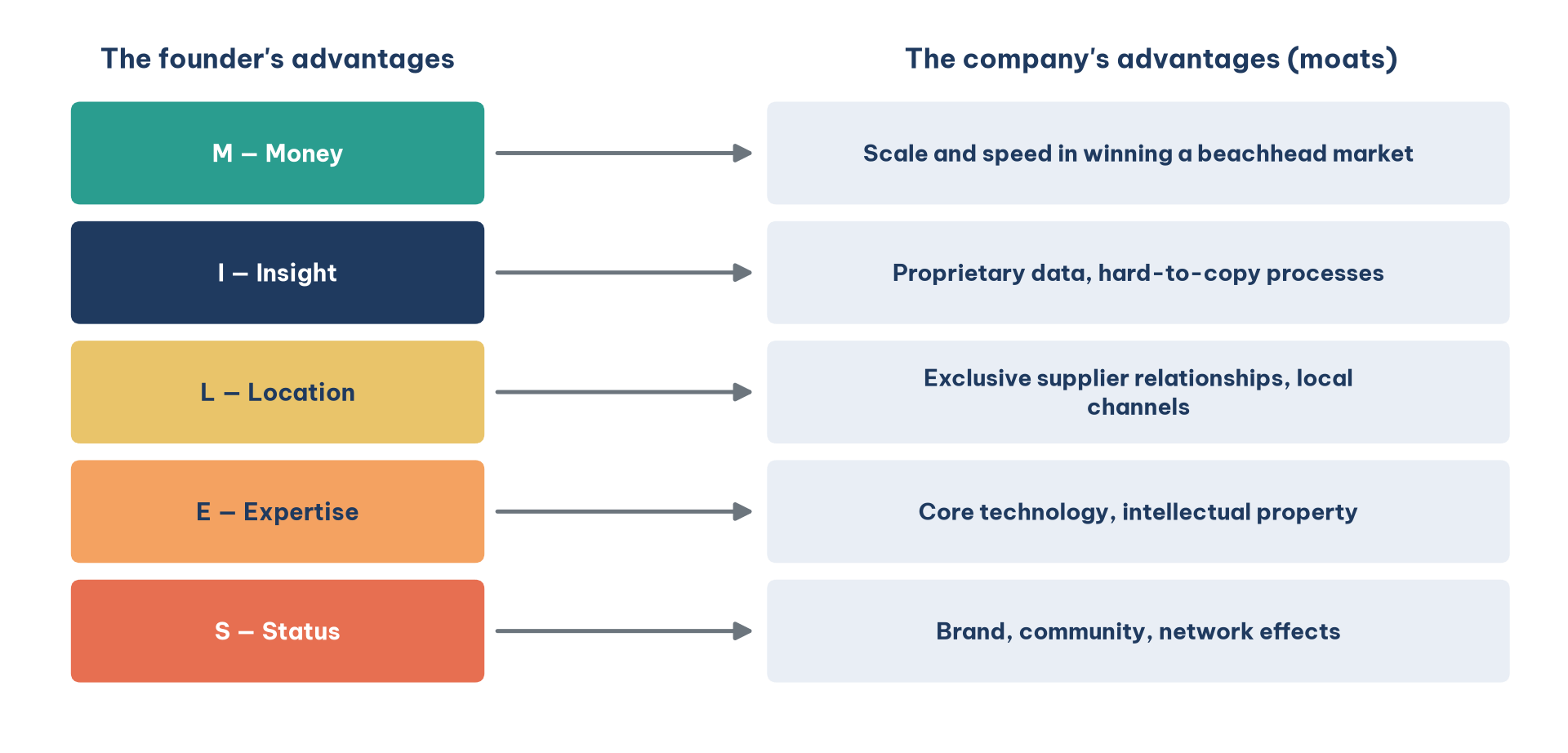
Each pair in Figure 4 is a specific conversion. A founder's industry insight becomes proprietary data and hard-to-copy processes once it is recorded, systematised and built into the product. Personal networks and reputation become brand, a user community and network effects once customers come for the company rather than the founder. Expertise becomes core technology and intellectual property once it is passed to the team and protected. Location becomes exclusive supplier relationships or local distribution channels. Money becomes scale and speed in winning a beachhead market.
The distinction also avoids a common mistake in start-up plans: listing "an experienced team" as the company's competitive advantage. That is the founders' advantage today; it becomes the company's only after a conversion like those above.
2.4. A critical view: "unfair" to whom?
The concept has a commendable honesty: it admits that people start from different places. But that honesty raises hard questions. The first is accumulation. Family money, good schools and networks tend to go together: people with M often find E and S easier too. Read superficially, MILES may discourage those without these letters and make those who have them complacent. In practice, for someone without M or S, the most feasible path is usually I and E: going deep into a problem they understand better than others through life experience, work or where they come from. Those are advantages money cannot buy.
The second question concerns ecosystems. Incubators, start-up funds, competitions and student programmes exist partly to offset unequal starting points: they provide M through grants, L through workspace and S through mentors and connections. Knowing how to use them is itself a way to build advantage. The third concerns the halo effect: that someone who "looks like a founder" persuades more easily reflects listeners' biases more than the speaker's ability. For investors and entrepreneurship educators, recognising this bias is the first step to judging projects more fairly.
3. The moment: why now?
The start-up world likes to say that ideas are worth a penny and execution is everything. But between an idea and successful execution lies an invisible, decisive factor: timing. A great idea launched at the wrong time can fail; a decent idea that arrives at the right moment can change an industry.
There is empirical support for this. Analysing around two hundred companies, both successes and failures, Bill Gross, founder of the incubator Idealab, found that timing explained more of the difference between success and failure than team, idea, business model or funding (Gross, 2015). His analysis is not a controlled scientific study, but it suggests timing deserves to be treated as a strategic variable rather than luck. Timing is captured in the concept of the window of opportunity, a component of classic models of the entrepreneurial process (Spinelli & Adams, 2016). To master it, founders need to see that the concept has three levels.
3.1. Three nested levels
The three levels of the window of opportunity are nested, as in Figure 5. The outer level is the condition for a business model to exist; the middle level is when a particular customer is ready to buy; the inner level is the seller's action in that moment.
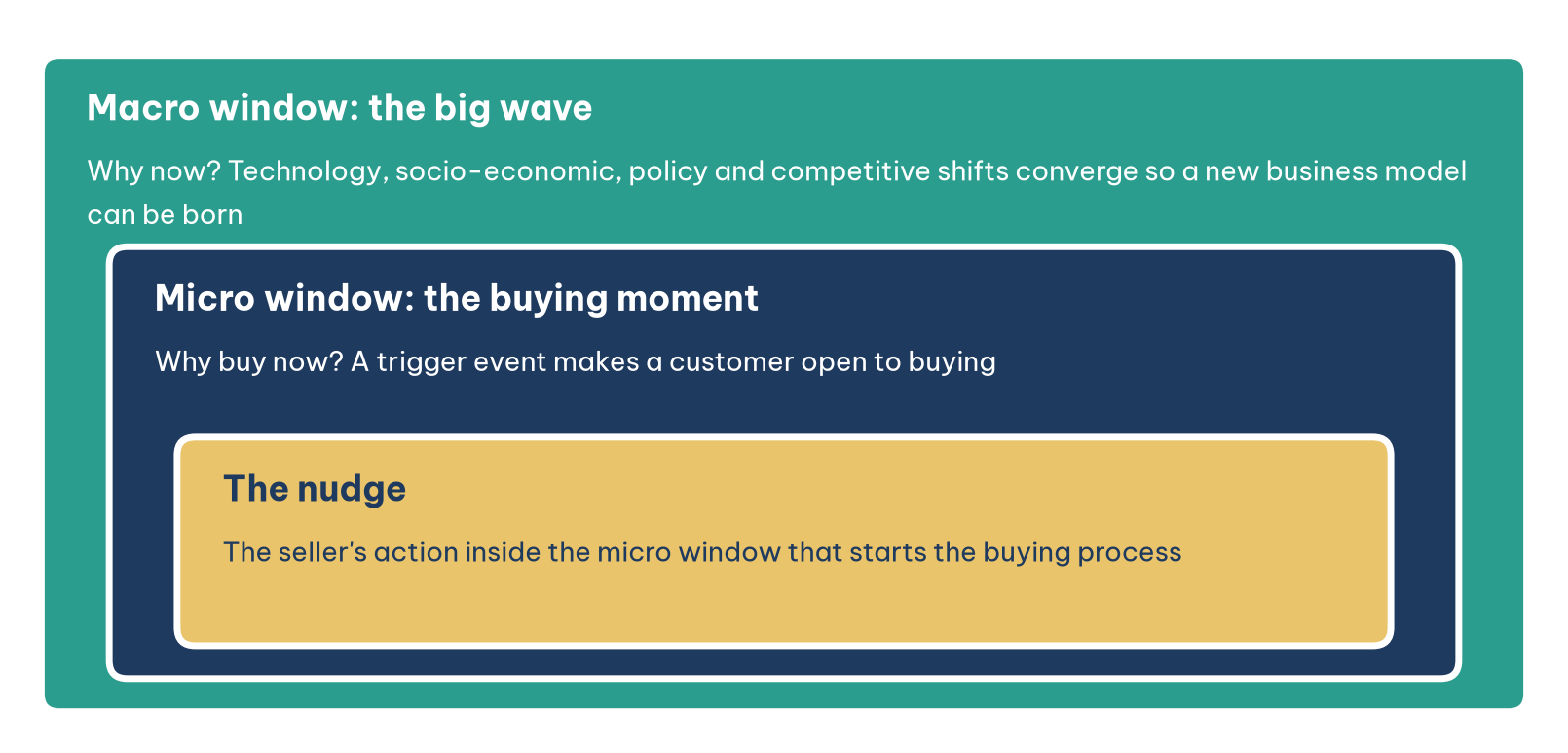
The levels differ in how much control the founder has. At the macro level, founders cannot create the wave, only recognise it and ride it. At the micro level, they cannot create events in customers' lives, but they can watch for them and be present at the right time. Only at the level of the nudge is the seller truly in control, and that is therefore where ethical care matters most.
3.2. The macro window: the wave that lets a company exist
At the highest level, the window of opportunity is a limited period in which the big forces of market and resources converge enough for a new business model to be born and grow. It answers the question every investor asks, "Why now?", which is also a mandatory slide in any pitch deck. Macro windows are usually opened by the convergence of four big shifts, as Table 5 shows.
Successful examples rarely rest on a single wave. Grab needed both smartphones (technology) and frustration with traditional taxis (social); Netflix needed both broadband (technology) and a slow competitor (competition). The window opens widest when several waves arrive together.
Timing can be wrong in two ways. Too early, and a start-up may run out of cash before the market forms: the technology is not cheap enough, users are not ready, infrastructure is missing. Too late, and the window has closed, with incumbents enjoying economies of scale. No one predicts waves precisely, but three habits help spot them earlier: read constantly across technology, economics, policy and industry reports; live in the future, asking what the world will look like in five years and what will become cheap, widespread or mandatory; and listen to frustration, because long-standing complaints, like those about traditional taxis before ride-hailing, often signal opportunity.
3.3. The micro window: the moment a customer is ready to buy
If the macro window answers "why should this company exist?", the micro window answers a tactical question: "Why buy now?" It is the period when a target customer is especially open to considering a purchase, usually opened by a trigger event in the customer's work or life. This is something that happens to the customer, not something the seller does. Table 6 summarises five common types.
Trigger events differ in how predictable they are. Budget cycles and regulatory deadlines are known in advance; leadership changes can be tracked through appointment announcements; crises usually come as a surprise. When the EU's General Data Protection Regulation took effect in 2018, many firms went looking for compliance help; Vietnam's Personal Data Protection Law, effective from the start of 2026 (National Assembly of Vietnam, 2025), opened a similar micro window for providers there.
In business-to-business sales, the micro window is also tied to a specific person: the champion, the person inside the customer organisation who benefits most from the solution and has the influence to push the deal. The newly appointed marketing director in Table 6 is a typical potential champion. Spotting micro windows is a skill that can be trained. Set up buying signals: track when a company hires for a key role, raises funding, enters a new market or is affected by a new regulation. More importantly, build relationships before you need them: don't wait for a customer's crisis to get in touch. A seller who has been a useful source of information all along is the first person the customer thinks of when the window opens, and is less likely to be seen as exploiting the situation.
3.4. The nudge, and where it must stop
Finding a micro window is not enough; an open customer may still procrastinate. The nudge is the specific action a seller takes inside the micro window to get the customer to start buying. If the micro window is a door ajar, the nudge is the invitation to step in. There are five common forms: turning up at the right time, with a concrete offer of help just after a problem appears; a time-limited offer, to counter procrastination; limited availability, such as taking only a few more clients this month; extra value for a quick decision, such as a bonus support package; and, often strongest, helping the customer avoid an immediate risk, such as a free assessment to check vulnerabilities now.
It helps to separate two things often lumped together as "triggers". The trigger event in Section 3.3 happens to the customer and is neutral; the nudge is what the seller does, and it can be reasonable or cross a line. Table 7 sets each form beside that line.
The right-hand column is not only an ethical matter. Misleading information about price, quantity or deadlines can breach consumer-protection law in many countries, including Vietnam's Consumer Protection Law (National Assembly of Vietnam, 2023), and contacting people with their personal data requires a lawful basis under data-protection laws such as the GDPR or Vietnam's 2025 law. More importantly, business customers remember for a long time who helped them in a crisis and who exploited them. The best nudge is one the customer will thank you for, not one they regret.
3.5. Putting the three levels together
The three levels complement one another. Picture a surfer: the macro window is a big ocean wave that nobody creates and that you can only recognise and paddle out to meet; the micro window and the nudge are the moment the surfer chooses to stand up, which takes skill, precision and decisiveness. The macro window answers "why does this start-up exist now?" at the strategic, industry-wide level, focused on technology, socio-economic, policy and competitive shifts, with the goal of building a lasting company. The micro window answers "why does this customer buy now?" at the tactical, customer-by-customer level, focused on trigger events and champions, with the goal of closing a deal. Figure 6 shows all three in a hypothetical cybersecurity start-up.
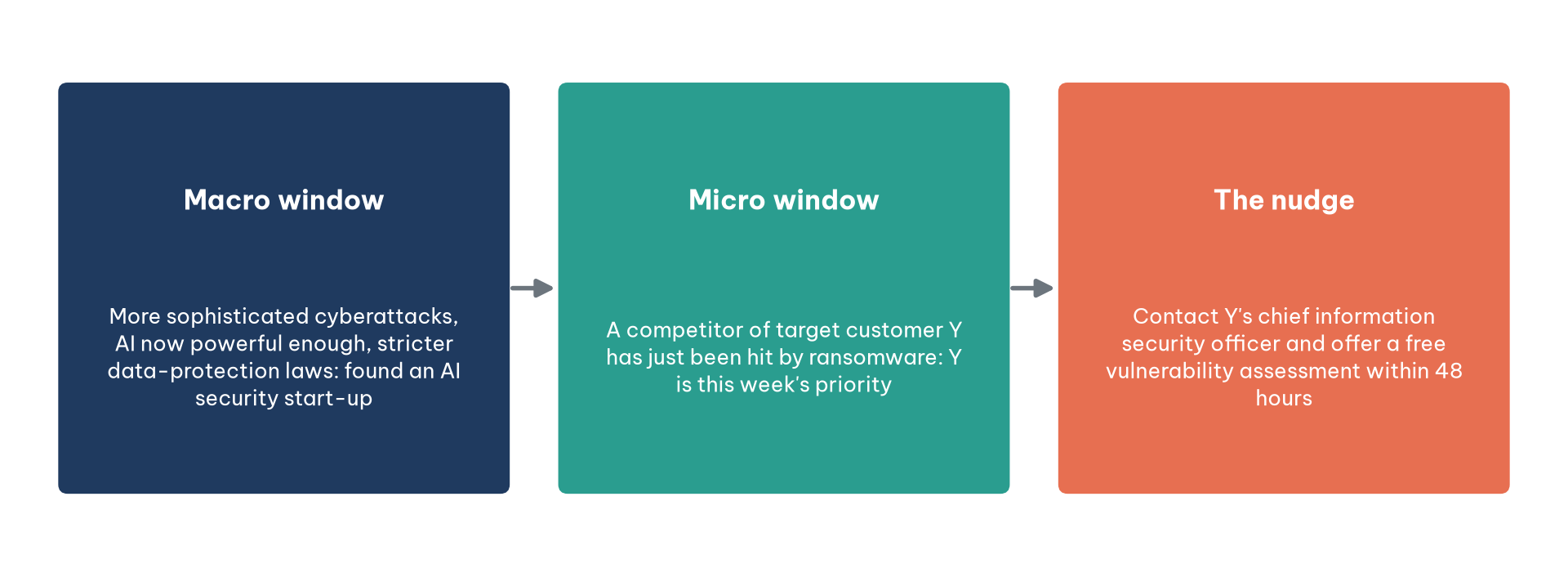
First, the founders recognise the macro window: cyberattacks are growing more sophisticated (need), AI is powerful enough to help defend against them (technology) and data-protection rules are tightening (law). They found an AI-based security company. Second, the team spots a micro window: a competitor of target customer Y has just been hit by ransomware that paralysed its systems, so Y becomes this week's priority, because its leadership is now acutely aware of the risk. Third, the nudge: the seller contacts Y's chief information security officer, a potential champion, and offers a free vulnerability assessment within 48 hours, with a genuine time-limited discount if Y decides to upgrade. What makes this nudge reasonable, by Table 7, is that it delivers concrete value even if the customer does not buy and does not exaggerate fear. If the relationship was built beforehand, the call will be received as help rather than an opportunistic pitch.
Conclusion
The three checks look at a start-up from three sides. Pain asks whether customers need the product urgently enough to seek it out and pay: a painkiller or a vitamin, how often it is used, how context can shift it, and how a vitamin can be brought closer to real pain without manufacturing pain. Advantage asks why this founding team can do what others cannot: the five letters of MILES, scored honestly against the chosen problem, and the work of turning personal advantages into moats the company owns. Timing asks why now: the big wave that lets the business exist, the moment each customer is ready to buy, and the nudge that turns readiness into action.
A start-up that passes all three has a product people need, founders with a reason to win and a market whose moment has come. One that fails any of them should not necessarily give up, but it should know exactly which question it still has to answer. And at every level, the same principle applies: build products people need because they help, compete on advantages you can be proud of, and nudge customers in ways they will thank you for. Founders cannot create the wave, but they can learn to recognise it and to ride it honestly.
References
Ali, A., & Kubba, H. (2020). The unfair advantage: How you already have what it takes to succeed. Profile Books. https://profilebooks.com/work/the-unfair-advantage/
Eyal, N., & Hoover, R. (2014). Hooked: How to build habit-forming products. Portfolio. https://www.penguinrandomhouse.com/books/317898/hooked-by-nir-eyal/
Gross, B. (2015, March). The single biggest reason why start-ups succeed [Video]. TED Conferences. https://www.ted.com/talks/bill_gross_the_single_biggest_reason_why_start_ups_succeed
Levitt, T. (1983). The marketing imagination. Free Press. https://www.amazon.com/s?k=The+marketing+imagination+Levitt&i=stripbooks
National Assembly of Vietnam. (2023). Luật Bảo vệ quyền lợi người tiêu dùng số 19/2023/QH15 [Law on Consumer Rights Protection No. 19/2023/QH15]. https://caselaw.vn/van-ban-phap-luat/411464-luat-bao-ve-quyen-loi-nguoi-tieu-dung-so-19-2023-qh15-ngay-20-06-2023-cua-quoc-hoi
National Assembly of Vietnam. (2025). Luật Bảo vệ dữ liệu cá nhân số 91/2025/QH15 [Law on Personal Data Protection No. 91/2025/QH15]. https://chinhphu.vn/?pageid=27160&docid=214590&classid=1&typegroupid=3
Nhân Dân. (2025). Từ Nghị quyết 68-NQ/TW: Hộ kinh doanh chuẩn bị gì khi bỏ thuế khoán? [Following Resolution 68-NQ/TW: How should household businesses prepare for the end of presumptive tax?]. https://nhandan.vn/tu-nghi-quyet-68-nqtw-ho-kinh-doanh-chuan-bi-gi-khi-bo-thue-khoan-post879648.html
Spinelli, S., & Adams, R. (2016). New venture creation: Entrepreneurship for the 21st century (10th ed.). McGraw-Hill. https://www.mheducation.com/highered/product/new-venture-creation-entrepreneurship-21st-century-spinelli-adams/M9780077862480.html
VnEconomy. (2022). Chính thức bắt buộc áp dụng hóa đơn điện tử [E-invoicing officially becomes mandatory]. https://vneconomy.vn/chinh-thuc-bat-buoc-ap-dung-hoa-don-dien-tu.htm
Zoom Video Communications. (2021, March 1). Zoom Video Communications reports fourth quarter and fiscal year 2021 financial results [Press release]. https://news.zoom.com/zoom-video-communications-reports-fourth-quarter-and-fiscal-year-2021-financial-results/
Discussion about this post