Integration Strategy and Porter's Five Forces
How forward, backward and horizontal integration shift the balance of power in an industry, with lessons from Apple, Nike and Grab on cost and risk


Key takeaways
Integration is not just about getting bigger; it is a way to weaken one or more of Porter's five competitive forces.
Forward integration reduces the power of buyers and intermediaries (OpenAI with ChatGPT, Nike), backward integration reduces supplier power (Apple Silicon, Tesla), and horizontal integration reduces rivalry (Grab and Uber, Meta and Instagram).
Integration into infrastructure or content can raise entry barriers and make substitutes harder (Amazon, SpaceX, Netflix, Nespresso).
Integration is costly and can reverse: Nike went back to retailers, Nespresso's patents expired, and supplier power often only shifts rather than disappears.
Between buying and full integration lie long-term contracts, joint ventures, partial integration and minority stakes. Startups should rarely integrate vertically early.
In a volatile business world, standing still usually means falling behind. Once a company has found its place in the market, the next question is always: "How do we expand and protect what we have built?".
Many managers think expansion simply means selling more or opening more branches. Strategically, however, expansion is also a move to shift the balance of power in an industry. To see this clearly, integration strategies need to be set beside Michael Porter's five competitive forces model, shown in Figure 1.
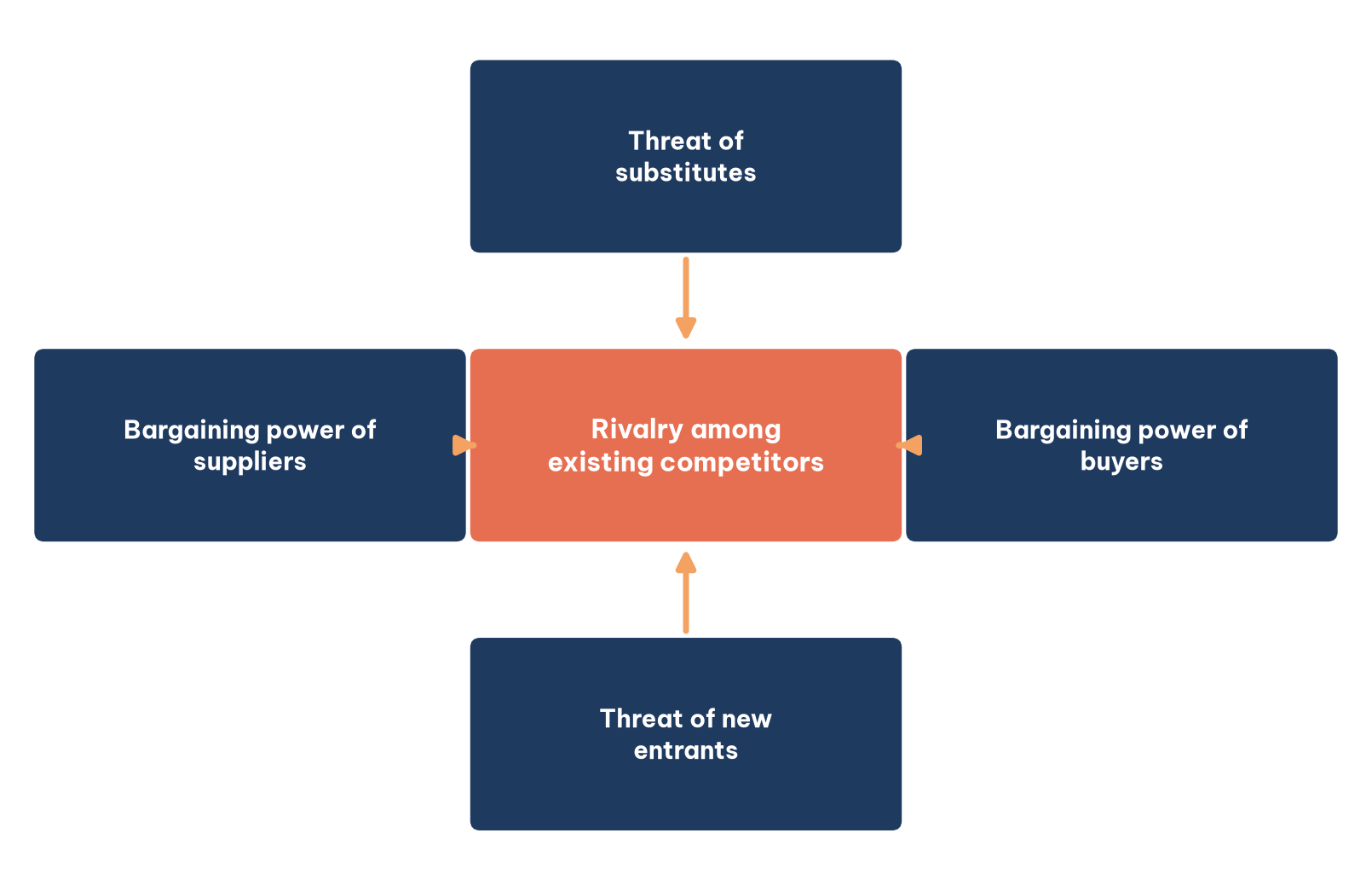
According to Porter (2008), an industry's profitability is shaped by five forces: rivalry among existing competitors, the bargaining power of buyers, the bargaining power of suppliers, the threat of new entrants and the threat of substitutes. The stronger the forces, the more industry profits are eroded. Integration is one way companies weaken the pressure from one or more directions.
This article analyses how corporations and startups use integration not just to "get bigger" but to reduce market pressures. Section 1 introduces the three directions of integration. Sections 2 to 6 go through the five forces in turn, each with international examples and, where available, an example from Vietnam, a fast-growing emerging market. Section 7, the part often overlooked, analyses the costs and risks of integration and the alternatives to full integration. Section 8 summarizes how competition law applies to integration deals.
1. Integration changes the game
An industry's value chain usually runs along a vertical axis: from raw materials and suppliers, through manufacturers, to distributors, retailers and finally consumers. From its position, a company has three main directions of expansion, as Figure 2 shows.
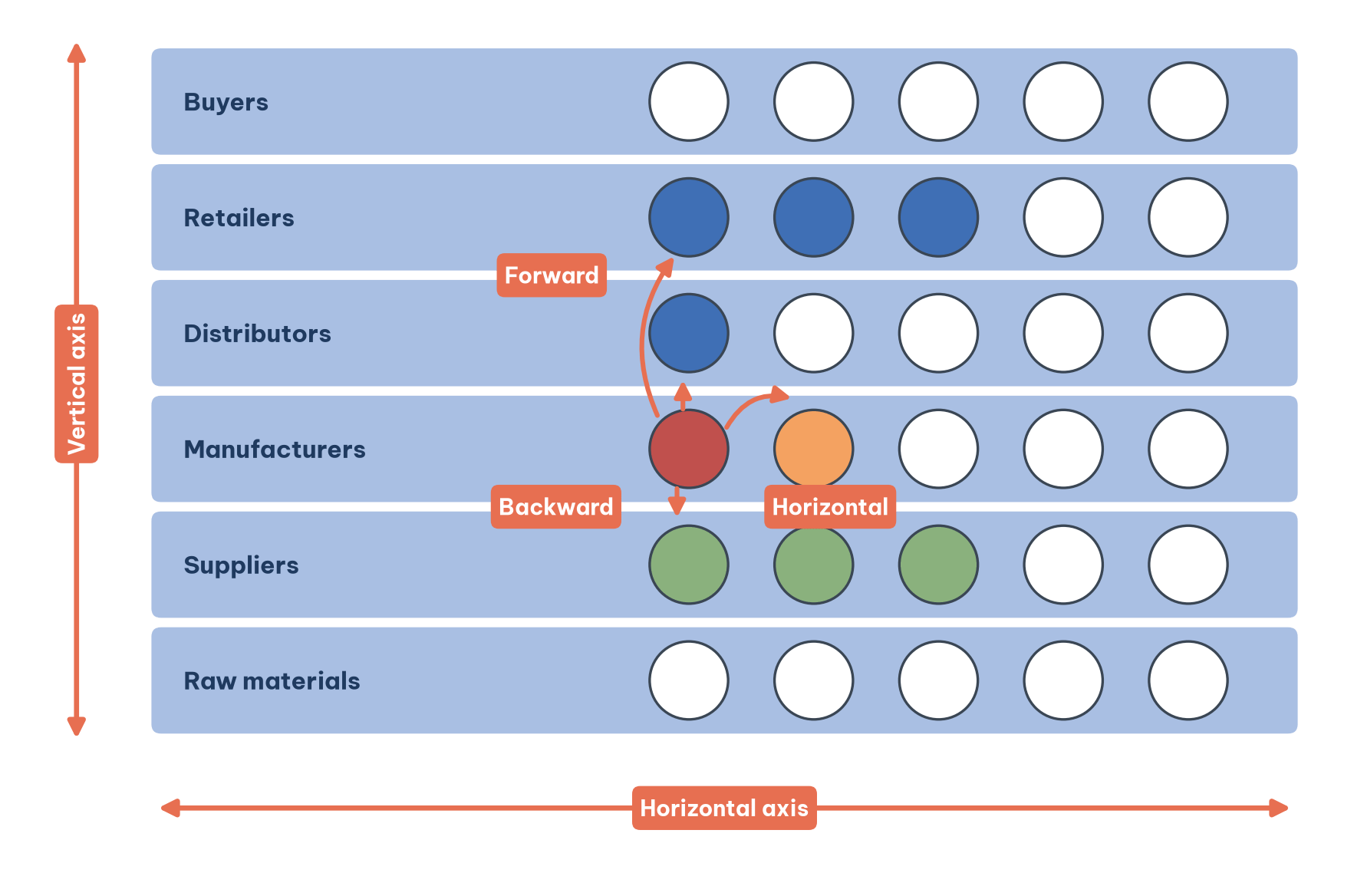
Horizontal integration: acquiring or merging with a direct competitor at the same stage of the value chain.
Backward vertical integration: moving upstream to control the capabilities of suppliers.
Forward vertical integration: moving downstream, cutting out intermediaries to reach customers directly.
Each direction is a lever for reducing one or more of Porter's forces. The following sections look at each force through real cases.
2. Buyer power and forward integration
In Porter's model, "buyers" are not only end consumers but also distributors and intermediaries. When a company depends on intermediary channels to reach the market, it loses some pricing power, some margin and, above all, data about its users. The tool for solving this is forward vertical integration.
OpenAI and ChatGPT. Before November 2022, OpenAI operated mainly as a technology supplier to businesses: it developed large language models such as GPT-3 and sold API access to software companies. In that model, the software companies were the "intermediary channel", owning the interface and the end users; OpenAI was just the "engine" behind the scenes. By launching ChatGPT, a free chat interface for the public, OpenAI integrated forward, bringing AI directly to hundreds of millions of users. What is notable is not only reduced dependence on intermediaries but the creation of a data loop: users chat, OpenAI receives feedback, the product improves and attracts more users. The move also created channel conflict: OpenAI is now both a supplier and a direct competitor of some of its API customers.
Nike, a two-way lesson. For years Nike depended heavily on sporting-goods chains such as Foot Locker and Macy's; these retailers decided which shoes got the best shelf space and kept part of the margin. In 2017 Nike announced its "Consumer Direct Offense" strategy, sharply cutting the number of retail partners and pushing its own stores, website and apps (Nike App, SNKRS). At first, direct sales rose and Nike gained more customer data. But selling direct does not mean keeping the whole margin: Nike had to bear the costs of stores, logistics and the marketing needed to attract customers. As sales slowed and other brands took its place on retailers' shelves, Nike from 2023–2024 returned to working more with Foot Locker, Macy's and DSW, and changed its CEO in 2024. The lesson: forward integration can cost a company the reach that intermediary channels used to provide.
Vietnam. At the end of 2019, Masan, a consumer-goods company, took over Vingroup's retail business (VinCommerce, now WinCommerce, with the WinMart and WinMart+ chains), moving closer to end consumers.
3. Supplier power and backward integration
If a supplier has a monopoly on core technology or raw materials, it can squeeze a company's margins at any time. To reduce this dependence, companies use backward vertical integration.
Apple and Intel. For many years Apple depended on Intel for the processors in its Mac computers. When Intel was slow to innovate or missed deadlines, Apple's product roadmap suffered. Apple acquired small chip-design companies, built its own research and development capability, and from 2020 switched the Mac to its own Apple Silicon chips (the M1 and later generations). This let Apple control its product roadmap and build machines with very high performance per watt. But Apple only designs the chips; manufacturing is still done by TSMC. Supplier power therefore did not disappear but shifted from Intel to TSMC. Backward integration at a high level is not just about cutting costs but about redefining the limits of the product, and it is rarely complete self-sufficiency.
Tesla and batteries. The battery is the most expensive component of an electric car. Tesla partnered with Panasonic to build its Nevada Gigafactory, developed its own 4680 battery cell, acquired rights to a lithium-bearing clay deposit in Nevada (2020) and built a lithium refinery in Texas. Even so, Tesla still buys batteries from Panasonic, LG Energy Solution and CATL. This is partial integration: making the parts that create differentiation and reduce supply risk, while still buying the rest.
Vietnam. Dairy producers Vinamilk and TH true MILK have invested in dairy farms to secure their own supply of fresh milk; steelmaker Hòa Phát has built a closed chain from iron ore and coking coal to finished steel.
4. Industry rivalry and horizontal integration
When a market has too many evenly matched competitors, competition easily turns into a "war of attrition": rounds of promotions and price cuts that erode the whole industry's profits. Here, horizontal integration is an effective option, but also the one regulators scrutinize most closely.
Grab buys Uber's Southeast Asian business (March 2018). After years in which both companies subsidized drivers and riders, Uber sold its Southeast Asian operations to Grab in exchange for a stake in Grab. For a ride-hailing platform, combining drivers and riders in one place improves matching efficiency, reduces subsidies and moves the business towards profit; horizontal integration here changed the economics of the whole industry. But the deal was also reviewed by competition authorities in several countries: Singapore's Competition and Consumer Commission fined Grab and Uber in 2018 and required Grab to take measures not to lock in drivers, and competition authorities in Vietnam also investigated the deal.
Facebook buys Instagram (2012) and WhatsApp (2014). In 2012 Facebook bought Instagram for about USD 1 billion, when Instagram had only 13 employees and no revenue, then bought WhatsApp in 2014. The two deals helped Facebook (now Meta) hold on to mobile and younger users while removing potential competitors. In 2020 the U.S. Federal Trade Commission (FTC) sued Meta, arguing that the deals were meant to eliminate competition; in 2025 the trial court rejected the FTC's case. Whatever the final outcome, the case shows that horizontal integration by large companies always carries legal risk.
5. The threat of entry: building barriers with infrastructure
How do you stop new challengers from eyeing your profits? One way is to use integration to push the cost of entering the market very high.
Amazon and logistics infrastructure. Amazon began as an online bookshop that depended on carriers such as UPS and FedEx. Over time it built a huge network of warehouses, a fulfilment service for sellers (FBA), a fleet of trucks and even a fleet of cargo aircraft (Amazon Air). A startup e-commerce company might build a nicer website than Amazon, but it would struggle to deliver as fast and as cheaply. By integrating vertically into infrastructure, Amazon turned logistics from a cost into a barrier to entry.
SpaceX and a closed production chain. The aerospace industry used to be led by large corporations such as Boeing and Lockheed Martin, which outsourced to thousands of component suppliers. SpaceX chose very deep backward integration: it builds most of its engines, control software and rocket bodies in its own factories, and combines this with reusable boosters. As a result, launch costs fell to levels once hard to imagine. A newcomer wanting to enter the industry now needs not only a great deal of capital but an answer to the question: how do you compete on price without a similar production chain?
6. The threat of substitutes: creating something hard to replace
Substitutes appear when customers find another solution to the same need. To counter this pressure, companies can use integration to control the value chain and create unique value that substitutes struggle to copy.
Netflix and original content. When it moved to streaming, Netflix was mainly a distribution channel, licensing films from the major studios; cable television and other streaming services were substitutes. Realizing that the studios would sooner or later withdraw their licences to launch their own services, Netflix integrated backward to become a content producer (Netflix Originals, which first stood out with House of Cards in 2013). If it only distributed films, customers could easily cancel and go elsewhere; owning intellectual property such as Stranger Things makes the product much harder to replace.
Nespresso and the limits of patents. Substitutes for an espresso at a café include instant coffee and coffee brewed at home. Nestlé created Nespresso: it sells machines and proprietary capsules (integrating backward into roasting and packaging) and opened its own upscale boutiques to sell directly (integrating forward), creating an experience quite different from instant coffee. But when the main capsule patents expired from 2012, many companies launched cheaper compatible capsules. The lesson: an advantage based on patents is temporary; what remains is brand and experience.
7. The costs and risks of integration
The previous sections show that integration can shift the balance of power. But the Nike, Nespresso, Grab and Meta examples also show that integration is not free and not always right. Table 1 summarizes five main risks.
So when should you integrate? Transaction cost theory (Williamson, 1975) suggests making something yourself when a stage needs specific assets (useful only to you), transactions are frequent and recurring, and it is hard to write complete contracts; and buying from outside when the market has many competing suppliers and the product is standardized. Between "buy" and "make entirely" lie many intermediate options, as Figure 3 shows.
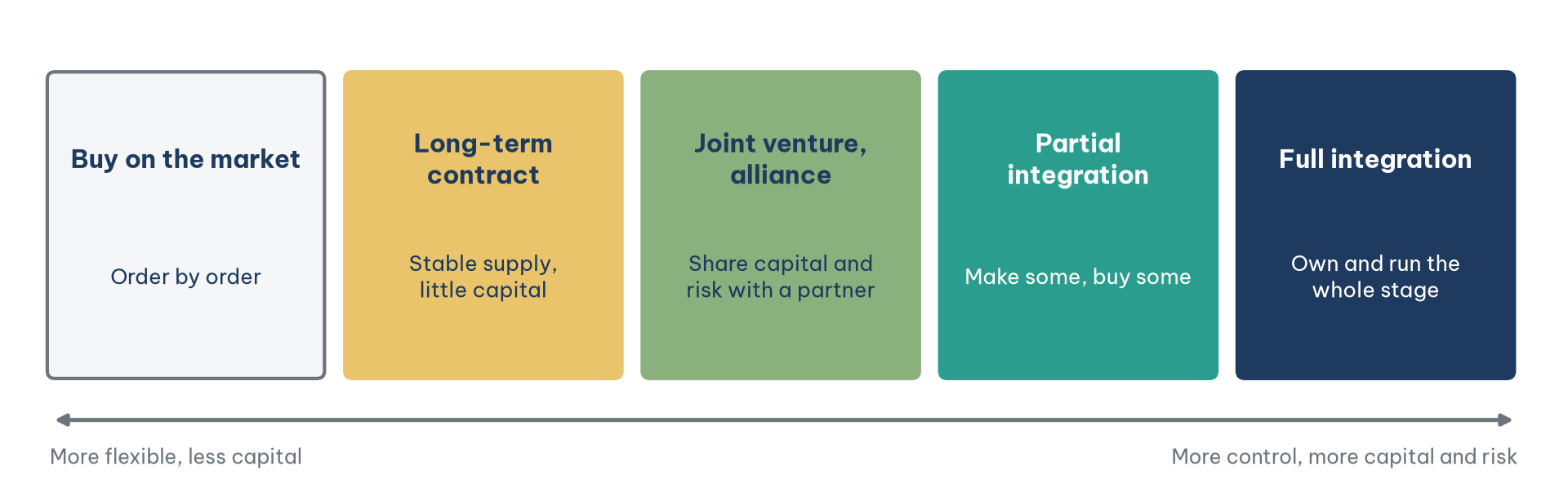
Table 2 describes when each intermediate option fits.
For startups, it is usually too early to integrate vertically: capital is better spent passing the validation stages of the startup journey. Outsourcing production is usually more sensible in the early stages.
8. Competition law and integration
Integration deals, especially horizontal ones, are not only business decisions but legal matters. Most major economies have merger-control regimes: in the United States, large deals must be notified to the antitrust agencies before closing; in the European Union, the European Commission reviews concentrations above certain turnover thresholds. Emerging markets have similar rules. Vietnam's 2018 Competition Law, for example, governs economic concentration, including mergers, consolidations, acquisitions and joint ventures; when a deal crosses thresholds for total assets, revenue, transaction value or market share, the companies must notify the National Competition Commission before completing it, and concentrations that substantially restrict competition are prohibited (National Assembly of Vietnam, 2018). Deals that take place abroad may still have to be notified if they affect the domestic market.
Conclusion: shape the battlefield instead of just fighting on it
To bring the whole picture together, Table 3 summarizes how each direction of integration acts on the five competitive forces, together with its main risks.
Looking back over the article, the expansion arrows on the value chain are not just lines on paper. Horizontal integration helps a company combine scale and reduce wars of attrition; backward integration helps it put down deep roots to reduce dependence and create differentiated products; forward integration helps it reach customers and own the data. Good leaders do not use integration to make financial statements look better at quarter's end; they use it to reshape the five competitive forces in their favour. But as Nike and Nespresso show, every advantage has a price, and it can reverse. The art of strategy lies in knowing when to make it yourself, when to partner, and when to let others do it.
References
Harrigan, K. R. (1985). Vertical integration and corporate strategy. Academy of Management Journal, 28(2), 397–425. https://doi.org/10.2307/256208
National Assembly of Vietnam. (2018). Competition Law No. 23/2018/QH14. https://chinhphu.vn/?pageid=27160&docid=206113&classid=1&typegroupid=3
Porter, M. E. (1979). How competitive forces shape strategy. Harvard Business Review, 57(2), 137–145. https://hbr.org/1979/03/how-competitive-forces-shape-strategy
Porter, M. E. (2008). The five competitive forces that shape strategy. Harvard Business Review, 86(1), 78–93. https://hbr.org/2008/01/the-five-competitive-forces-that-shape-strategy
Williamson, O. E. (1975). Markets and hierarchies: Analysis and antitrust implications. Free Press.
Discussion about this post