Hybrid Human–AI Teams in Startups: Delegate Work, Not Responsibility
AI agents can take on work like digital staff, but accountability and final judgment in a startup team must stay with people


Key takeaways
Agentic AI can be treated as a fifth source of labor for startups, alongside employees, interns, freelancers and virtual assistants: cheap at the margin, instantly scalable and always on.
A business can delegate work to AI but not responsibility. When a chatbot gives customers wrong information, the company that runs it answers for it.
The Hacker, Hustler and Hipster of a founding team are roles, not head counts. AI can boost each role, but every role still needs a person who owns the final call.
The working rule of a hybrid team is "AI executes, humans judge": anything touching money, policy, commitments, relationships or strategy passes a human approval point.
The biggest risk is not that AI makes mistakes but that people rely on it at the wrong level. Calibrate trust task by task, not tool by tool.
A two-person startup today can run like a company of ten. Generative AI tools have moved from answering one question at a time to taking on whole chains of work: writing and testing code, drafting a week of social media posts, answering customers through the night. For founders who are always short of both money and people, the appeal is obvious. The management question that follows is less obvious: is an AI agent a tool, an employee or something in between, and who answers for what it does?
Consider Theo and Mira, two cofounders of an online exam-prep platform that helps students practice for English language tests. There are only two of them, but they operate like a much larger company: one AI agent writes and tests code, another drafts and schedules social media posts and an AI assistant answers students around the clock. Everything runs smoothly until a student posts a screenshot in the platform's community group. The AI assistant had promised a full refund to any student who failed to reach their target score, a policy Theo and Mira had never offered. The student demands the refund. The two founders argue: the AI made the mistake, so why should they pay?
That question has already been answered elsewhere. In 2024, a civil resolution tribunal in British Columbia, Canada, ordered Air Canada to compensate a passenger after the airline's website chatbot gave him wrong information about its bereavement fare policy. The airline argued that the chatbot was a separate entity responsible for its own words; the tribunal rejected the argument and held that the company is responsible for all the information on its website, whether it comes from a static page or a chatbot (Moffatt v. Air Canada, 2024). A business can hand work to AI, but it cannot hand responsibility to AI.
This article has five sections. Section 1 explains why agentic AI can be seen as a new source of "digital staff". Section 2 shows the essential difference between AI staff and human staff. Section 3 analyzes the effects on the structure and skills of a startup team. Section 4 draws the line between the work AI executes and the judgment that belongs to people. Section 5 asks how far people should rely on AI.
1. Agentic AI: a fifth source of digital staff
This section places AI agents next to the familiar sources of labor a young company draws on and shows which work they can take over.
The first wave of generative AI mostly answered one prompt at a time. Agentic AI goes further: it receives a goal, makes its own plan, uses tools such as a web browser, a spreadsheet, a coding environment or business software and carries out a multi-step chain of tasks with very little supervision. That shift turns AI from something a founder consults into something a founder assigns work to, and it raises a staffing question as much as a technology question.
New ventures traditionally draw on four sources of labor: full-time employees, interns, freelancers and virtual assistants (Barringer & Ireland, 2024). Agentic AI can be seen as an emerging fifth source, something like a virtual assistant that never sleeps. Its marginal cost is low, it scales almost instantly, and it works continuously and consistently. Table 1 sets the work AI agents do well against the limits that still require a person, for each group of roles in a startup.
Table 1 reveals a pattern. AI does well at repeatable execution, while people keep the parts that involve money, commitments, relationships and strategic choices. Theo and Mira's incident falls squarely in the right-hand column: their AI assistant touched a commitment about money that should have gone through a person.
2. Delegate work, not responsibility
This section explains the one point on which AI staff differ in kind from every other source of labor, and what that means for how work is assigned.
AI staff differ from the other four sources of labor in one crucial way: an AI is not an entity that can be held accountable. An agent's output can be wrong with complete confidence, a failure usually called "hallucination". It can infringe copyright, or leak customer data and trade secrets if sensitive information is fed into a third-party AI service without controls. In every case, the legal, financial and ethical responsibility falls on the people and the business that run it, as the Air Canada case shows.
Research evidence points in the same direction. In a field experiment with 758 consultants at Boston Consulting Group, those who used GPT-4 on tasks inside the capability of AI completed about 12% more tasks, worked about 25% faster and produced work of more than 40% higher quality than those without AI. But on a task deliberately chosen to lie outside the capability of AI, consultants using AI were about 19 percentage points less likely to reach the correct answer (Dell'Acqua et al., 2023). The authors call this the "jagged technological frontier": AI is surprisingly good at one task and surprisingly poor at another that looks just as easy, and users do not always know which side of the frontier they are on.
For a startup, the consequence is very practical. Every piece of work handed to AI should be treated like work handed to a real staff member: it needs a job description, acceptance criteria and a supervisor who is accountable. Theo and Mira's AI assistant had none of the three. There was no list of what it could and could not promise, no threshold for handing a conversation to a person and nobody reading the conversations afterward.
3. Effects on team structure and skills
This section shows that AI agents do more than add a source of labor: they change how a team is organized, which skills it needs and how it hires.
3.1. Roles, not head counts
The most visible effect of agentic AI is the ultra-lean team: a few founders coordinating a set of agents that can handle a workload that once needed a whole department. This does not make the familiar model of a minimum viable founding team, the Hacker who builds, the Hustler who sells and the Hipster who designs, obsolete. On the contrary, it clarifies what the model really says: these are three roles that must be covered, not three head counts. A founder can use agents to take over part of the Hacker's or the Hipster's work, but each axis still needs a person who signs off on the final judgment. AI raises the productivity of each axis; it cannot replace the person who guards it.
3.2. Three new capabilities
Alongside traditional domain skills, a startup team in the age of AI needs three additional capabilities:
Briefing the AI: stating goals, constraints and quality criteria clearly enough for an agent to do the work correctly.
Evaluating the output: having enough expertise to spot when the AI is wrong. If you cannot check what the AI did, you should not delegate that work to it.
Designing human and machine workflows: deciding at which points in a process a person must approve before work moves on (human-in-the-loop).
The simplest way to put this into practice is to add an "AI agent" column and a "human reviewer" column to the team's skills profile, as in Figure 1. Each line of work then states who is responsible, which part the AI does and who reviews it.
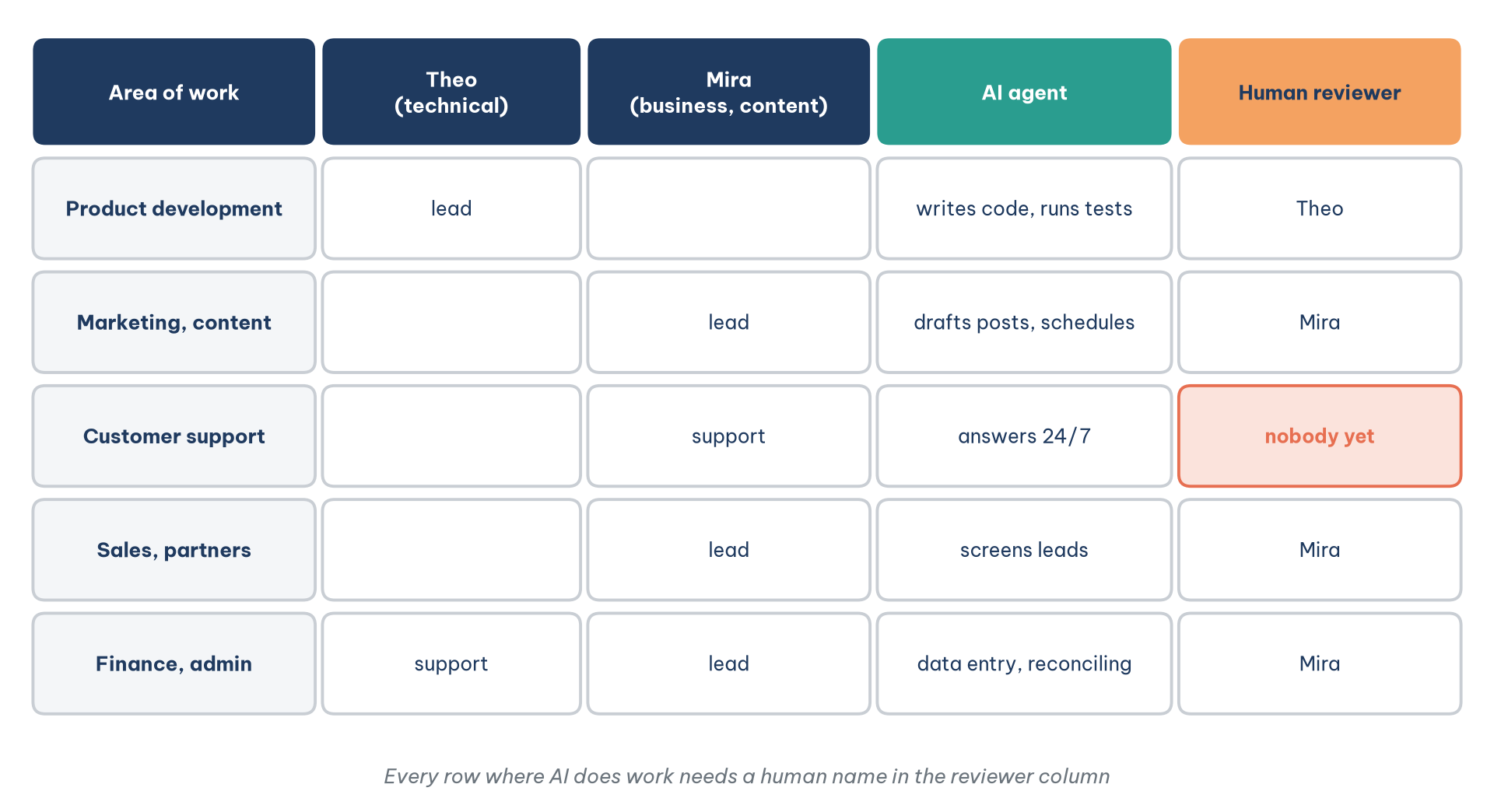
Figure 1 shows what Theo and Mira overlooked. In the customer support row, the AI agent does most of the work, but the reviewer cell is empty. Every row in which AI does work needs a human name in that column.
3.3. Hiring fewer people, to a higher standard
The third consequence concerns hiring. Once repetitive tasks are automated, every remaining human position has to create value through judgment, creativity and relationships. The principle that every person hired should add value to the venture (Barringer & Ireland, 2024) now carries a higher bar. The ability to work effectively alongside AI becomes a new selection criterion, and a company that uses AI in a disciplined way also becomes more attractive to young candidates.
4. The line between AI execution and human judgment
This section answers whether AI can replace a cofounder and sets out what must stay with people.
Can an AI replace a cofounder? The answer is no, for three reasons. First, AI has no founder-problem fit: it has not lived through the customer's pain, it has no insider understanding drawn from lived experience and it cannot commit to pursuing a problem for ten years. Second, an AI cannot be a party to a founders' agreement: it holds no equity, carries no legal liability and cannot stand accountable before investors or the law. Third, what advisers, boards and investors bring, such as legitimacy, networks and trust, rests on human reputation.
The operating principle of a hybrid human and AI team can therefore be summed up in one sentence: AI executes, humans judge. Figure 2 divides the two zones of work.
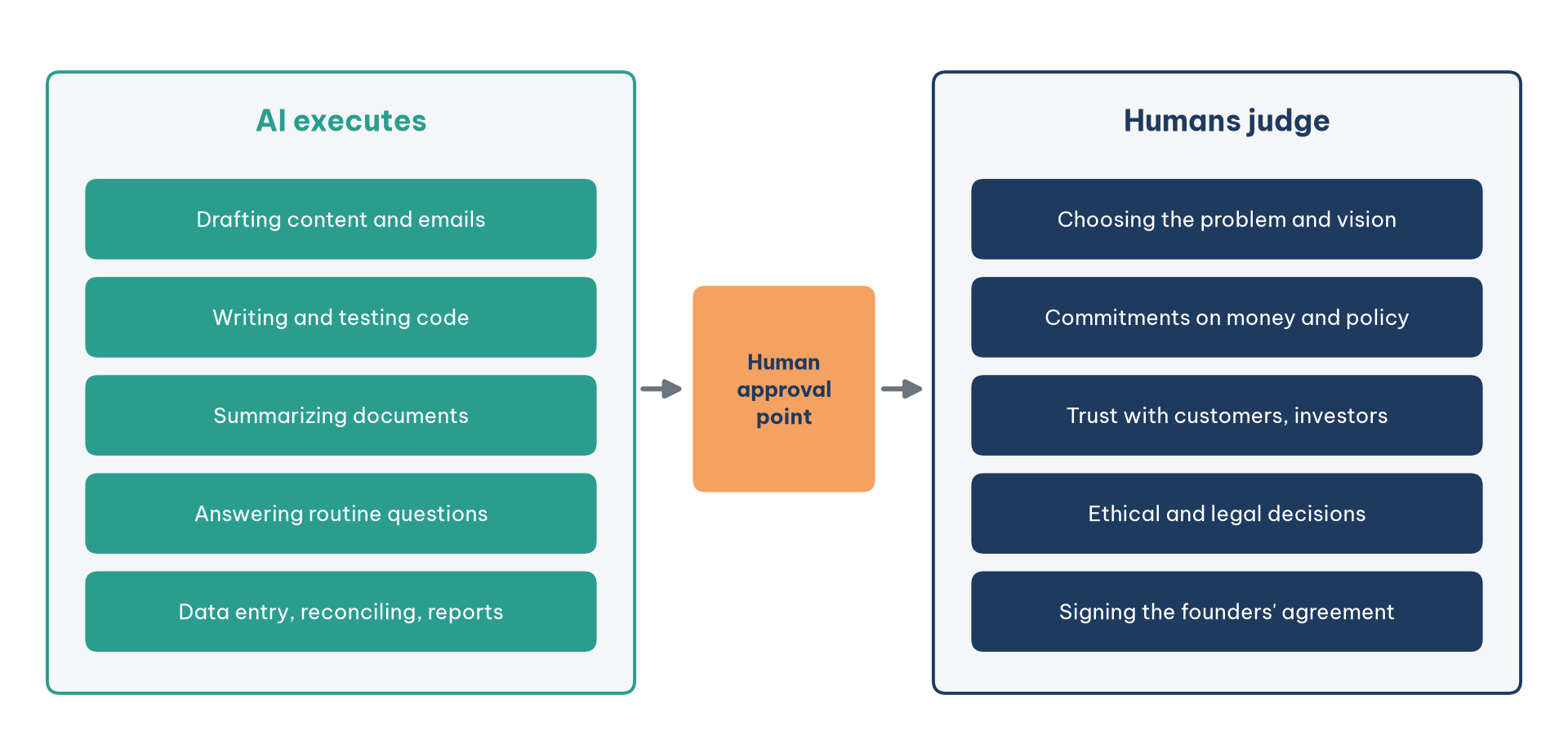
The work that should stay firmly with people includes choosing the problem and the vision; commitments and team culture; trust relationships with first customers, investors and advisers; ethical and legal decisions; and signing or amending the agreement among founders. Three management cautions go with it:
Always have a person approve important outputs, especially anything involving money, policy and commitments to customers.
Be careful with sensitive data when using third-party AI services. Pasting source code, customer lists or unannounced plans into an external tool can expose trade secrets, which usually stay protected only as long as the business takes reasonable steps to keep them confidential.
Beware the illusion that "one person plus AI is enough". Investors, and reality, still demand a balanced human team that answers for all three axes: desirability, feasibility and viability.
5. Calibrating trust between people and machines
This section deals with the second half of the problem: once work is delegated to AI and judgment is kept for people, how much should people rely on AI?
The biggest risk in a hybrid team is usually not that the AI makes mistakes, because AI will always be wrong somewhere. It is that people rely on it at the wrong level.
5.1. Two opposite tendencies
Two lines of psychological research, which at first seem to contradict each other, help explain the problem. The first is algorithm aversion: people are especially reluctant to use an algorithm that makes predictions after seeing it make a mistake, even when they have seen it predict better than a human (Dietvorst et al., 2015). We forgive human errors more easily than machine errors. The second is algorithm appreciation: across six experiments, lay people followed advice more closely when they thought it came from an algorithm than from a person, but experts relied less on the algorithm and their predictions were less accurate as a result (Logg et al., 2019).
Both results say the same thing: how much people rely on a machine often does not match how much the machine deserves to be trusted. Drawing on research into automation in cockpits and factories, Parasuraman and Riley (1997) distinguish appropriate use of automation from misuse (relying on it too much and skipping checks) and disuse (not using it even when it is reliable). Figure 3 places these ideas on two axes.
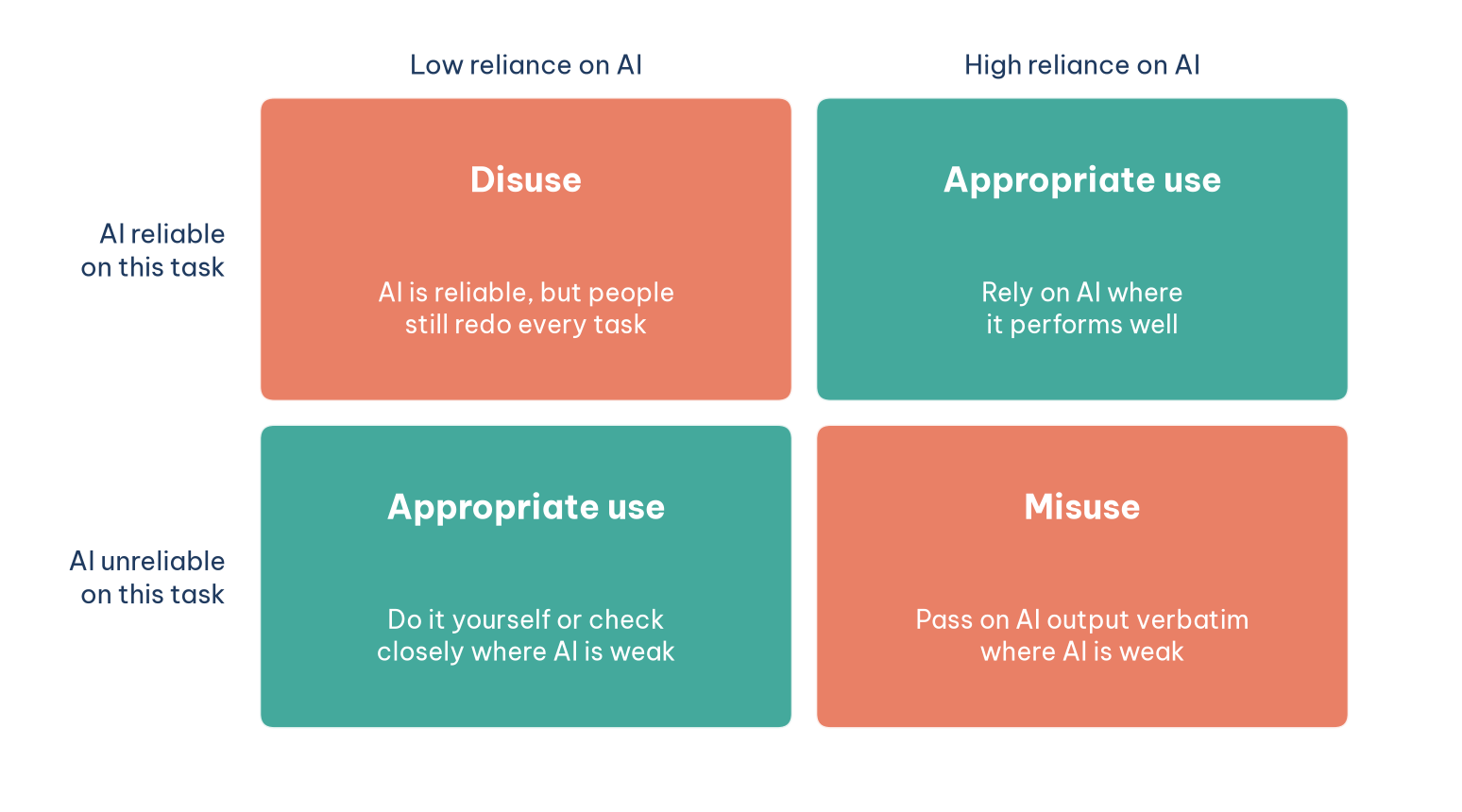
The vertical axis in Figure 3 measures how reliable the AI is on each task, not across the whole tool. The same assistant can write excellent social media posts and still get the refund policy wrong, and one person can show disuse on one task and misuse on another. The Boston Consulting Group experiment discussed in Section 2 also observed two working styles among people who used AI successfully: "centaurs" drew a clear line between what to hand to the machine and what to do themselves, while "cyborgs" interwove their work with the machine at every step (Dell'Acqua et al., 2023). Both styles actively evaluated the machine's output instead of accepting it as it was.
5.2. Three miscalibrations and how to fix them
A general warning such as "be careful with AI" cures neither misuse nor disuse, because the two miscalibrations point in opposite directions. Table 2 suggests the signs and the remedies for each type, using Theo and Mira's exam-prep startup as the example.
The last row of Table 2 is the choice Theo and Mira made in the end: they did not drop the AI assistant but wrote it a job description. Calibrating trust is ongoing work, because the capability of AI changes with every model version. A small table recording the pass rate for each type of task, updated monthly, is enough for the whole team to know how far to rely on the machine.
Conclusion
In the end, Theo and Mira refunded the student, because the promise had been made in their company's name. After the incident they kept the AI assistant but gave it a "job description": what it may answer, what it must never promise and when it must hand a conversation to a person. Mira took on the role of reviewer and reads a random sample of conversations every week. That is how a hybrid human and AI team should work: AI amplifies the team's capacity to execute, but it does not replace human judgment or human responsibility.
And because the reliability of AI differs from task to task, a hybrid team needs a habit of measurement: knowing which kinds of work the AI handles well enough to rely on and where it is weak enough to check closely, instead of trusting or doubting the whole tool at once.
References
Barringer, B. R., & Ireland, R. D. (2024). Entrepreneurship: Successfully launching new ventures (7th ed.). Pearson. https://www.pearson.com/en-us/subject-catalog/p/entrepreneurship-successfully-launching-new-ventures/P200000010335/9780138287696
Dell'Acqua, F., McFowland, E., III, Mollick, E. R., Lifshitz-Assaf, H., Kellogg, K., Rajendran, S., Krayer, L., Candelon, F., & Lakhani, K. R. (2023). Navigating the jagged technological frontier: Field experimental evidence of the effects of AI on knowledge worker productivity and quality (Working Paper No. 24-013). Harvard Business School. https://www.hbs.edu/faculty/Pages/item.aspx?num=64700
Dietvorst, B. J., Simmons, J. P., & Massey, C. (2015). Algorithm aversion: People erroneously avoid algorithms after seeing them err. Journal of Experimental Psychology: General, 144(1), 114–126. https://doi.org/10.1037/xge0000033
Logg, J. M., Minson, J. A., & Moore, D. A. (2019). Algorithm appreciation: People prefer algorithmic to human judgment. Organizational Behavior and Human Decision Processes, 151, 90–103. https://doi.org/10.1016/j.obhdp.2018.12.005
Moffatt v. Air Canada, 2024 BCCRT 149 (British Columbia Civil Resolution Tribunal, 2024). https://www.canlii.org/en/bc/bccrt/doc/2024/2024bccrt149/2024bccrt149.html
Parasuraman, R., & Riley, V. (1997). Humans and automation: Use, misuse, disuse, abuse. Human Factors, 39(2), 230–253. https://doi.org/10.1518/001872097778543886
Discussion about this post