Google's Business Model in the Age of AI
From search engine to answer engine: why Google is still standing, and why the open web is the side paying the price


Key takeaways
Google runs a multi-sided platform in which users, advertisers, content creators and businesses reinforce one another, and the click is the link that holds the loop together.
Its distribution moat, paying to be the default (about USD 26.3 billion in 2021) and owning Chrome and Android, survived the US search ruling: the court rejected a breakup, partly because generative AI was changing the market.
Answer engines and agentic browsers such as ChatGPT Atlas and Perplexity Comet attacked the core assumption that users click on links.
Google fought back with Gemini 3, AI Mode and ads inside AI answers, reached a USD 4 trillion market value and even began receiving money from Apple. The innovator's dilemma has not yet hurt revenue.
The real casualty is the open web: zero-click searches rose to about 68% in early 2026, and publishers are losing the traffic that funds the content AI depends on.
For more than two decades, Google has been far more than a search engine. Its name became a verb and part of the fabric of digital life, and behind it sits one of the most finely engineered economic machines in business history. Google's dominance in search and digital advertising was once seen as almost absolute, a fortress built on vast data and the trust of billions of users.
By 2024–2025, the prevailing media picture was of an empire under siege. From courtrooms in Washington and Brussels to AI labs in San Francisco, unprecedented challenges arrived at the same time: legal pressure from governments on one side and the wave of generative AI on the other. Many believed the model that had carried Google to the top was about to fall apart.
Yet by mid-2026 reality had turned out differently: instead of collapsing, Google had harnessed the very technology wave it once feared. To understand why, and why the real threat lies where few people are looking, we need to start from the logic that built Google's dominance, then look at the cracks and how Google patched them. For students of management, this is a rare chance to observe three important concepts at once: the multi-sided platform, distribution as an economic moat, and the innovator's dilemma.
The article has five parts. Section 1 analyses Google's business model with the Business Model Canvas and the role of distribution. Section 2 covers the legal fronts in the United States and Europe. Section 3 analyses the technology shock from generative AI. Section 4 explains how Google fought back and why the innovator's dilemma has not yet cost it revenue. Section 5 identifies the real crack: the open-web ecosystem beneath Google. Events are covered up to mid-2026.
1. Inside Google's growth engine
Google's dominance does not come from a simple two-sided model but from a multi-sided platform, in which Google connects several different customer groups and creates value from those connections. This section analyses the platform's structure, then explains how Google protects it through distribution.
1.1. Four customer segments and a self-reinforcing loop
Google's machine serves four main customer segments, each with its own value proposition. For internet users, it offers free, fast and reliable services such as Search, Gmail, Maps and YouTube; in return, users provide their most valuable asset, their attention and behavioural data. For advertisers, Google Ads offers a way to reach the right people with great precision; this is the core revenue stream, run mainly on a pay-per-click basis. For content creators and developers, there are earnings from the AdSense display network and app sales on the Play Store. For businesses, there are paid services such as Google Workspace and Google Cloud.
What makes this model hard to attack is the network effect between segments. Figure 1 illustrates the self-reinforcing loop.
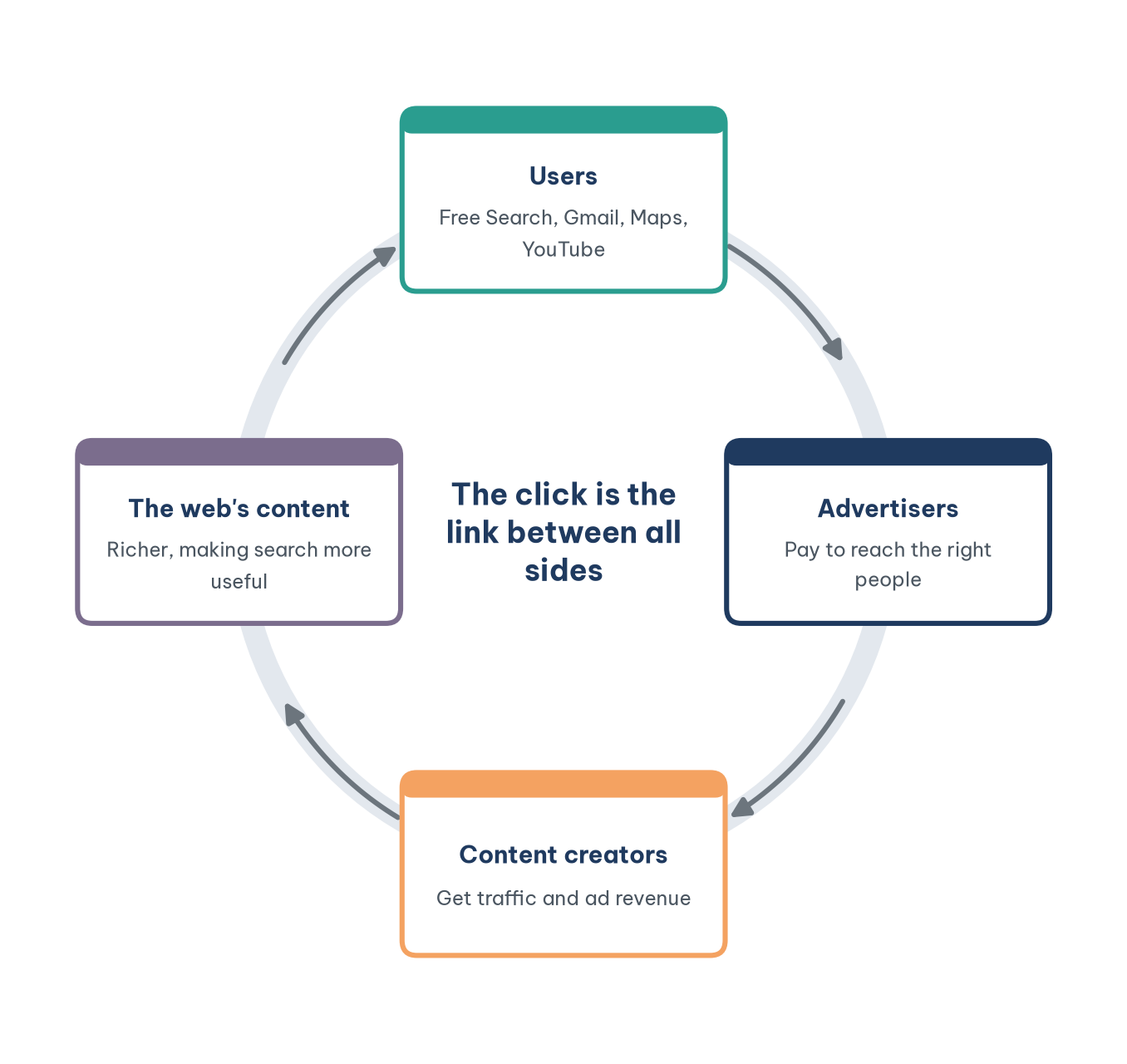
As Figure 1 shows, the more users there are, the more attractive the platform is to advertisers. The more advertisers compete, the greater the potential revenue for content creators, encouraging them to produce more. A richer pool of content makes search more useful and attracts more users. The point to remember, which becomes crucial in Section 5, is that the link connecting all sides is the click: users click on links to reach websites, and click on ads so that advertisers pay.
1.2. The business model on a Business Model Canvas
To see the whole model on one page, we can use Osterwalder and Pigneur's (2010) Business Model Canvas. Table 1 summarises eight main components of Google's model.
Table 1 shows a hallmark of multi-sided platforms: the segment that creates the most value for the platform (users) does not pay, while the paying segment (advertisers) pays to reach the other. It also shows that the "Channels" and "Cost structure" boxes are tightly linked through traffic acquisition costs, the subject of the next subsection.
1.3. Distribution as an economic moat
A good model can be copied, but a captured distribution channel is very hard to win back. Google understands this and focuses on owning distribution as an economic moat protecting its model, through two parallel routes.
The first route might be called "renting land": Google pays very large sums to partners such as Apple and Mozilla to make Google Search the default engine in their browsers and devices. The scale of these payments came out in court: in 2021 alone, Google spent about USD 26.3 billion on default agreements, of which an estimated USD 20 billion a year went to Apple to stay the default on the iPhone (DLA Piper, 2025). This is a defensive investment, showing Google is willing to pay a very high price to protect its most important channel.
The second route is "building its own territory". Chrome and Android are not just products but strategic resources. By giving Android to device makers for free, Google turns them into distribution partners and ensures that Chrome and Search come pre-installed on billions of devices. Together, the two routes make Google the default choice for most internet users, which is precisely what antitrust authorities targeted.
2. The legal front: pressure that tightened, then eased
The distribution moat became the target of the biggest antitrust cases in a generation, in both the United States and Europe. Figure 2 sets out a timeline of the main legal and technology events from 2024 to early 2026, as a frame of reference for this section and the next two.
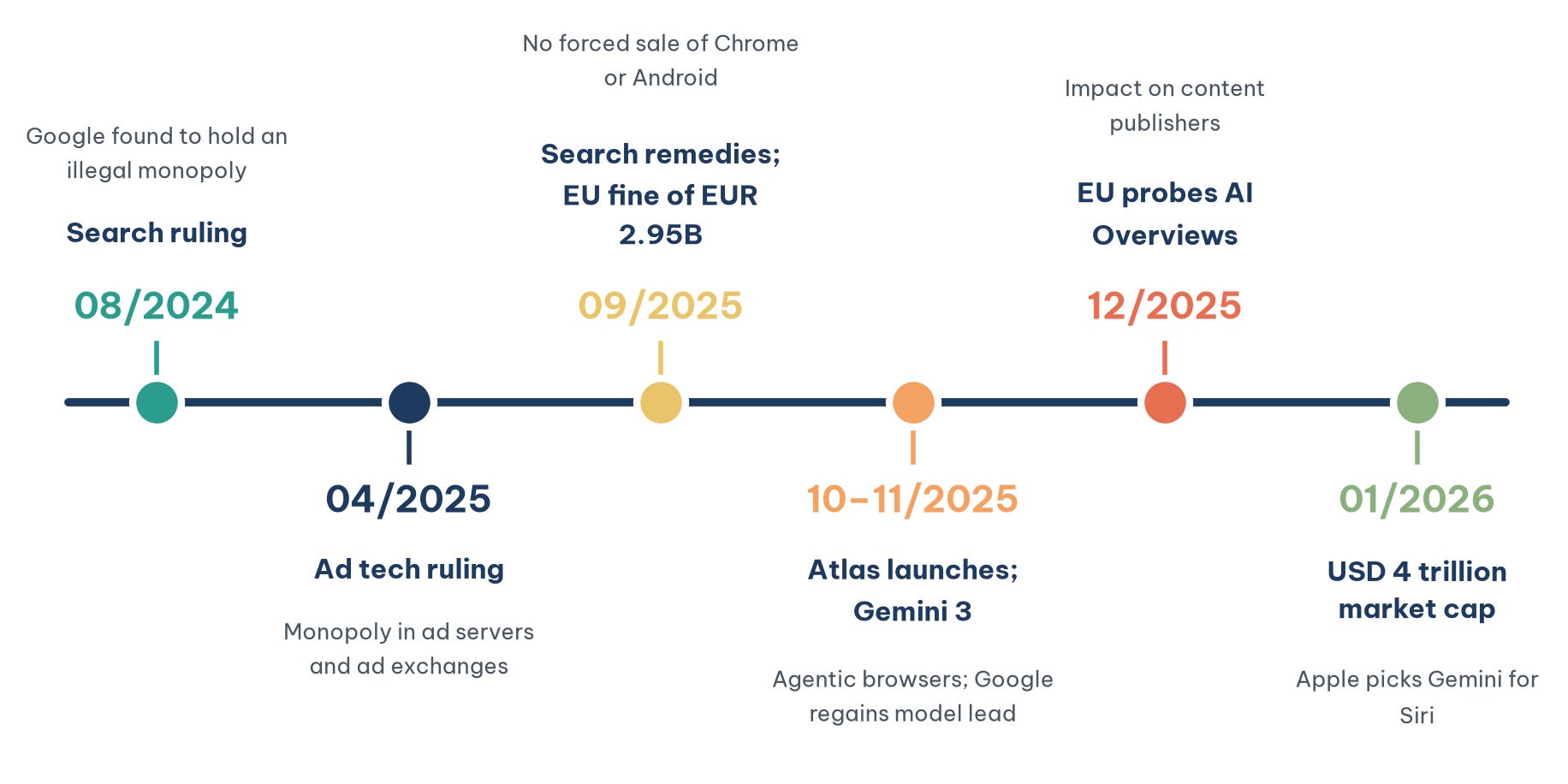
As Figure 2 shows, the legal and technology milestones are interleaved and, as we shall see, they affect each other. The three subsections below cover the three legal fronts; Table 2 at the end of the section summarises the outcomes.
2.1. The search case: losing the case but keeping the moat
In August 2024, Judge Amit Mehta of the US District Court for the District of Columbia ruled that Google had illegally maintained a monopoly in search and search advertising, in violation of Section 2 of the Sherman Act. The big question was the remedy: would Google be forced to sell Chrome, show a search-engine choice screen or stop paying Apple?
On 2 September 2025, the answer tilted clearly in Google's favour. Judge Mehta rejected the Department of Justice's request to spin off Chrome and Android, finding that such measures went beyond the scope of the violation (DLA Piper, 2025). Google may still pay to be the default, as long as the agreements are not exclusive. In return, Google is barred from exclusive contracts for Search, Chrome, Google Assistant and the Gemini app, and must share its search index and some user-interaction data with qualified competitors. The final judgment was completed in December 2025, with a technical committee overseeing compliance for six years (Courthouse News Service, 2025).
Most striking is why the court was lenient. The rise of generative AI such as ChatGPT and Perplexity was cited as evidence that the search market was being reshaped by new competitive forces, making heavy structural remedies both risky and unnecessary (DLA Piper, 2025). In other words, the very AI threat analysed in Section 3 became a legal shield for Google. Both sides appealed: Google targeted the data-sharing obligations, while the Department of Justice sought stronger measures; the appeal is expected to be heard in late 2026 or early 2027 (Tech Policy Press, 2026b).
2.2. The ad tech case: aiming at the money machine
In parallel was a second case, potentially more dangerous in the long run because it aimed straight at the revenue engine. In April 2025, Judge Leonie Brinkema of the US District Court for the Eastern District of Virginia found that Google held illegal monopolies in two ad tech markets, the publisher ad server (DFP) and the ad exchange (AdX), and had unlawfully tied the two products together (Norton Rose Fulbright, 2026).
Arguments on remedies closed in November 2025. The Department of Justice sought structural remedies: forcing Google to sell AdX and to open-source DFP's auction logic. In her questions from the bench, however, Judge Brinkema appeared sceptical that a breakup was feasible: there was no obvious buyer for AdX, and such a deal could take years and trigger new antitrust reviews (AdExchanger, 2025). She also noted that AI could transform the advertising landscape in the next few years. As of mid-2026, no final remedies ruling had been issued, and observers leaned towards the court choosing behavioural remedies over a breakup.
2.3. The Brussels front
In Europe, the pressure came thick and fast. In September 2025, the European Commission fined Google EUR 2.95 billion for abusing its position in ad tech, the fourth antitrust fine against Google in about a decade, bringing its total European fines to nearly EUR 10 billion since 2017 (Euronews, 2025). Meanwhile, an investigation under the Digital Markets Act (DMA) into Google favouring its own services in search rankings was awaiting a conclusion (Tech Policy Press, 2026a).
Most relevant to this article is the investigation opened in December 2025: the European Commission is examining whether Google used publishers' content to train AI and to generate AI Overviews summaries directly on the results page, to the detriment of those same publishers (Euronews, 2025). It is the first sign that regulators have started to treat AI search not just as a product but as a competition issue, a theme we return to in Section 5. Table 2 summarises the three legal fronts.
Table 2 shows that the legal pressure is real and prolonged, but as of mid-2026 it had not cut through the distribution moat as many feared: Google still keeps Chrome, Android and the right to pay for default placement. The bigger threat came from another direction.
3. The technology shock: from search to answers, then to action
While the legal pressure tightened, generative AI arrived and was quickly turned into a weapon by competitors. This is not just a new technology but a change in how people look for information, striking at the basic assumption of Google's model. This section analyses the two waves of that shock.
3.1. The rise of the answer engine
Microsoft, after years of losing in search, invested billions of dollars in OpenAI and built the technology into its ecosystem as Copilot. Instead of opening a browser and going to Google, users could get answers straight from the operating system or browser. It was an interception play: catch users at the starting point, before they reach Google.
Together with ChatGPT and Perplexity, this marked a shift from the search engine to the answer engine. The value proposition is no longer a list of blue links but a ready-made, synthesised answer. That shift strikes at the core of Google's revenue, which was built on clicks on links and the ads that come with them.
3.2. Agentic browsers: the new battlefield
In late 2025 and early 2026, the competition moved up a level: not just answering but acting. OpenAI launched Atlas in October 2025, a browser with ChatGPT built in and an agent mode that can carry out chains of tasks on its own. Perplexity released Comet, which by March 2026 was free on every platform; it can fill in forms, compare products, make bookings and work across multiple tabs on the user's behalf (No Hacks, 2026).
This is the interception play evolved. If answer engines threaten users' need to click on links, agents threaten users' need to browse the web themselves. And the browser, where Google built its territory with Chrome, becomes the direct battlefield. If the story stopped here, the conclusion would be an empire on shaky ground.
4. Google's counterattack
The "fallen fortress" story did not happen. Less than a year after investors sold Alphabet shares on fears that search would be AI's victim, Google staged one of the most remarkable comebacks in the tech industry (Fortune, 2026). This section analyses three elements of that comeback.
4.1. Gemini 3 and technological standing
In November 2025, Google launched Gemini 3, widely rated as one of the leading models for reasoning, multimodality and coding (Google, 2025). Just as important, Google showed strength across every layer of the AI stack: its new-generation TPU chips emerged as a serious alternative to Nvidia, attracting interest from other major AI companies (Yahoo Finance, 2026). Analysts also saw Google's ability to ground answers in its own enormous web index as something rivals that rely on third-party search would find hard to copy.
The market responded accordingly. Alphabet was the best-performing stock among the "Magnificent Seven" US tech giants in 2025, and on 12 January 2026 it reached a market value of USD 4 trillion (CNBC, 2026a). At one point Alphabet overtook Apple to become the world's second most valuable company (Yahoo Finance, 2026).
4.2. The money flow with Apple partly reverses
No symbol of this turnaround is clearer than the deal with Apple. For years, Google paid Apple about USD 20 billion a year to be the default search engine, the defensive "land rent" discussed in Section 1.3. In January 2026, the flow partly reversed: Apple signed a multi-year deal to use a customised Gemini model for its next-generation Siri, at a fee the press estimated at about USD 1 billion a year (CNBC, 2026b; TechCrunch, 2026).
The strategic significance goes beyond the fee. Google gains not only a new licensing revenue stream but also a place for Gemini inside a hardware ecosystem it does not control, with more than a billion active iPhones. The same distribution logic that once let Search dominate is now reused for AI; the difference is that this time Google is the one being paid.
4.3. The innovator's dilemma, and why it has not hurt yet
At the heart of Google's AI strategy lies a paradox. Every time AI gives a complete answer on the results page, the need to click on the links and ads below it falls. This is the innovator's dilemma that Christensen (1997) described: a market leader is forced to develop a new technology that threatens its own core revenue, and if it does not, a competitor will. Table 3 summarises three ways Google has defused the paradox.
According to Google, AI Overviews reached about 2 billion monthly users (Google, 2025), and third-party compilations suggest AI Mode is also growing very fast in users and queries. The share of AI Overviews pages carrying ads also rose sharply in 2025 (SQ Magazine, 2026). The financial results show that, at least up to mid-2026, the paradox has not turned into damage: according to compiled figures, Google's search and related revenue in Q4 2025 reached about USD 63 billion, up about 17% year on year (SQ Magazine, 2026). The money machine has not weakened; it has accelerated.
5. The real crack: the open-web ecosystem
If Google has not collapsed, where does the real threat lie? The answer is a subtle but fundamental shift: the damage falls not on Google but on the ecosystem beneath it, the open layer of content that was one of the cogs in the loop of Figure 1. This section analyses the zero-click phenomenon, its impact on publishers and the long-run paradox of AI search.
5.1. The zero-click phenomenon
The answer-engine model cuts the most important link in the loop: the click that sends users, and revenue, to websites. When the answer is already on the Google page, users have no reason to leave. Figure 3 shows the share of searches that end with no click to an external website.
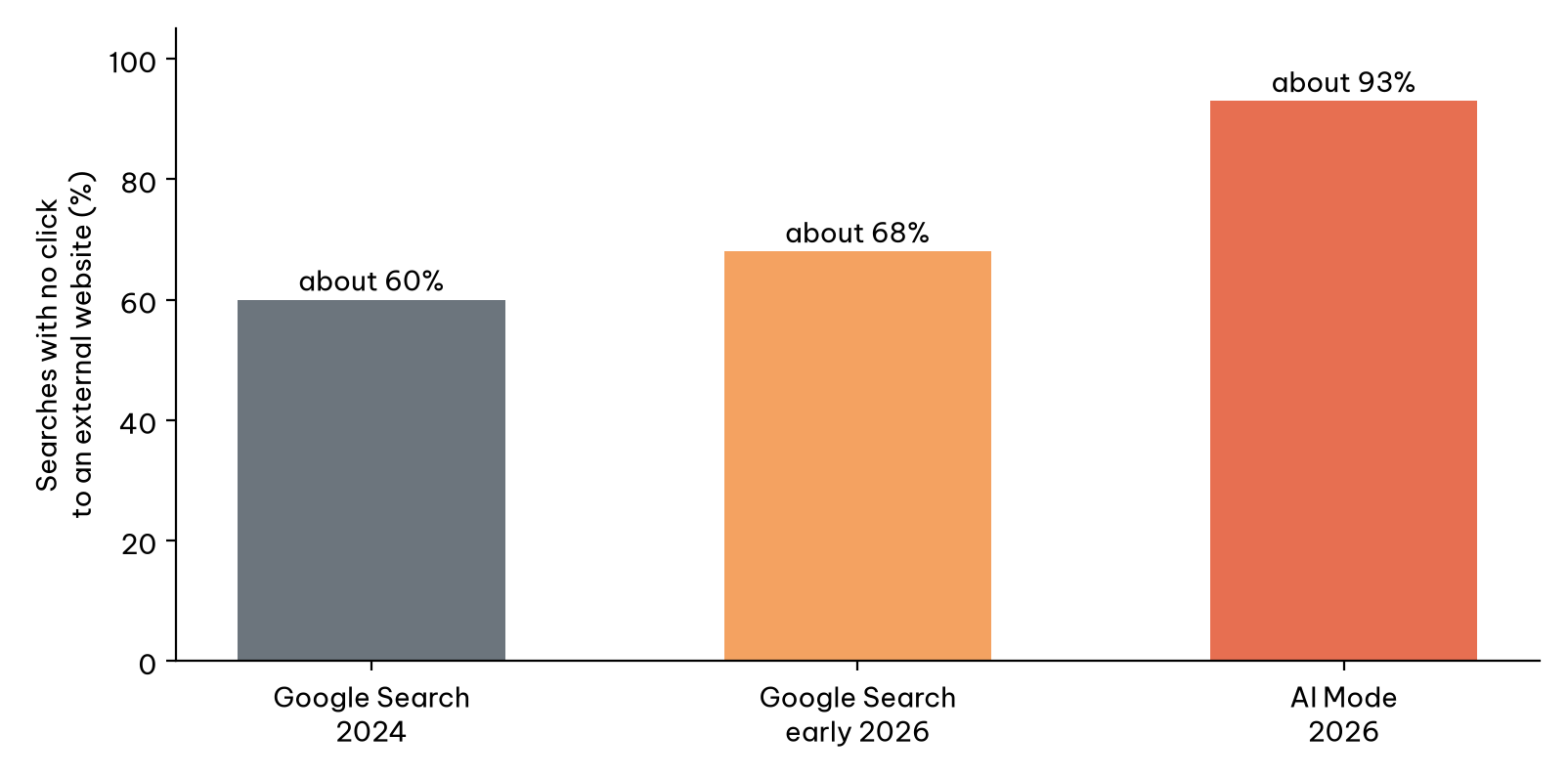
According to Figure 3, in the first four months of 2026 about 68% of Google searches ended without a single click to an external website, up from about 60% in 2024 (SparkToro, 2026). In AI Mode, compilations suggest the rate may reach about 93% (SQ Magazine, 2026). AI Overviews appear on nearly half of tracked queries, and controlled tests suggest they can cut organic clicks by up to about 38% (Search Engine Journal, 2025). Figures from different sources use different measurement methods, so they are best read as trends rather than precise values; but the trend is clear.
5.2. The impact on publishers everywhere
The consequences for content publishers are severe and structural. Organic traffic to many sites has fallen by between 40% and more than 80%; some education and publishing platforms report drops of up to 89% when their content is summarised before users have any reason to visit (Search Engine Journal, 2025). The US public broadcaster NPR described this as a potential "extinction" event for online news publishers (The Next Web, 2026). This is no longer a question of search engine optimisation; it is the erosion of the click-based economy that has funded digital publishing for two decades.
The pressure is not limited to English-language media. As AI Overviews roll out in more languages, news sites, how-to blogs and product-comparison sites in emerging markets that live on Google traffic face the same squeeze. A recipe site or a phone-review site whose revenue comes from display ads and affiliate commissions loses both when readers get their answer without visiting. For these businesses, the strategic question is no longer how to rank higher but how to build a direct relationship with readers: email newsletters, communities, paid products and content that a summary cannot replace.
5.3. The long-run paradox of AI search
This is the deepest paradox, larger even than Google's own dilemma. AI models need to be fed with new, high-quality content produced by people. But if AI models drain the traffic and revenue that keep that content being produced, then in the long run AI search is exhausting its own food supply. The European Commission's December 2025 investigation into the impact of AI Overviews on publishers is the first sign that regulators have noticed (Euronews, 2025). The real risk to Google's model, then, is not a revenue drop next quarter but the slow erosion of the ecosystem that made search valuable in the first place.
Quality and safety also deserve mention. Notable early AI Overviews blunders, such as suggesting glue on pizza, damaged trust in the brand; by the Gemini 3 generation, accuracy had improved considerably (Google, 2025). But the agentic era brings a new layer of risk: when AI not only answers but also buys, sends emails and fills in forms on its own, prompt injection and manipulation become a security front that Google and its rivals are still learning to control.
Conclusion
Google still stands at a historic crossroads, but not the one most predictions of 2024–2025 imagined. The old question was whether Google would survive the AI wave. By mid-2026 the financial and technological answer was yes. The legal front squeezed the distribution part of the model but did not cut through the moat: Google still keeps Chrome, Android and the right to pay for default placement. The technology front forced Google to restructure, but it turned that very wave into an advantage, with Gemini 3, a USD 4 trillion market value and a partly reversed money flow with Apple.
That success exposes three new, unresolved questions. The first is about monetisation during the transition: can ads inside AI answers replace pay-per-click ads over a full economic cycle? The second is about the ecosystem: if the open content layer weakens, where will AI learn from, and will the answer come from content-licensing deals, new subscription models or regulatory intervention? The third is the open legal question, with US appeals running into 2027 and investigations continuing in Europe.
So the question most worth asking is no longer whether the Google empire will fall, but what kind of internet will survive inside it. For students of management, the lesson goes beyond Google: a multi-sided platform is sustainable only while every party in the loop keeps a reason to take part. When one party is drained of value, the platform's victory may be won on increasingly barren ground.
References
AdExchanger. (2025, November 22). Closing arguments are done in the US v. Google ad tech case. https://www.adexchanger.com/antitrust/closing-arguments-are-done-in-the-us-v-google-ad-tech-case/
Christensen, C. M. (1997). The innovator's dilemma: When new technologies cause great firms to fail. Harvard Business School Press. https://store.hbr.org/product/the-innovator-s-dilemma-with-a-new-foreword-when-new-technologies-cause-great-firms-to-fail/10706
CNBC. (2026a, January 12). Alphabet hits $4 trillion market capitalization. https://www.cnbc.com/2026/01/12/alphabet-4-trillion-market-cap.html
CNBC. (2026b, January 12). Apple picks Google's Gemini to run AI-powered Siri coming this year. https://www.cnbc.com/2026/01/12/apple-google-ai-siri-gemini.html
Courthouse News Service. (2025, December 5). Federal judge largely sides with DOJ in finalizing remedy for Google search monopoly. https://www.courthousenews.com/federal-judge-largely-sides-with-doj-in-finalizing-remedy-for-google-search-monopoly/
DLA Piper. (2025, September 4). Federal court orders remedies in Google antitrust case, rejects DOJ call for breakup. https://www.dlapiper.com/en/insights/publications/2025/09/federal-court-orders-remedies-in-google-antitrust-case
Euronews. (2025, December 17). EU takes on Big Tech: Here are the top actions regulators have taken in 2025. https://www.euronews.com/next/2025/12/17/eu-takes-on-big-tech-here-are-the-top-actions-regulators-have-taken-in-2025
Fortune. (2026, May 10). AI wins have Alphabet poised to become world's biggest company. https://fortune.com/2026/05/10/ai-alphabet-stock-market-capitalization-nvidia-google-gemini/
Google. (2025, November 18). A new era of intelligence with Gemini 3. Google Blog. https://blog.google/products/gemini/gemini-3/
No Hacks. (2026, April 2). The agentic browser landscape in 2026: A complete guide. https://nohacks.co/blog/agentic-browser-landscape-2026
Norton Rose Fulbright. (2026). What you need to know from closing arguments in US v. Google: Will Google's ad tech stack be broken up? https://www.nortonrosefulbright.com/en/knowledge/publications/cb2c3ded/what-you-need-to-know-from-closing-arguments-in-us-v-google
Osterwalder, A., & Pigneur, Y. (2010). Business model generation: A handbook for visionaries, game changers, and challengers. Wiley. https://www.wiley.com/en-us/Business+Model+Generation:+A+Handbook+for+Visionaries,+Game+Changers,+and+Challengers-p-9780470876411
Search Engine Journal. (2025, October 28). Google AI Overviews impact on publishers & how to adapt into 2026. https://www.searchenginejournal.com/impact-of-ai-overviews-how-publishers-need-to-adapt/556843/
SparkToro. (2026, June 19). In 2026, less than one third of Google searches still send a click. https://sparktoro.com/blog/in-2026-less-than-one-third-of-google-searches-still-send-a-click/
SQ Magazine. (2026, May 8). AI Overviews statistics 2026: Google search impact data. https://sqmagazine.co.uk/ai-overviews-statistics/
Tech Policy Press. (2026a, January 6). Reviewing European antitrust activity in 2025 and what it all means for 2026. https://www.techpolicy.press/reviewing-european-antitrust-activity-in-2025-and-what-it-all-means-for-2026/
Tech Policy Press. (2026b, May 4). Search remedies in Google antitrust case can work even if company stays on top. https://www.techpolicy.press/search-remedies-in-google-antitrust-case-can-work-even-if-company-stays-on-top/
TechCrunch. (2026, January 12). Google's Gemini to power Apple's AI features like Siri. https://techcrunch.com/2026/01/12/googles-gemini-to-power-apples-ai-features-like-siri/
The Next Web. (2026, May 21). Google's AI search overhaul is bad news for the open web. https://thenextweb.com/news/google-search-ai-overhaul-publishers-traffic-open-web
Yahoo Finance. (2026, January 8). Alphabet overtakes Apple as world's second-most-valuable company behind Nvidia. https://finance.yahoo.com/news/alphabet-overtakes-apple-as-worlds-second-most-valuable-company-behind-nvidia-154751861.html
Discussion about this post