GEO and AEO: Being Found by AI, Not Just by Search
When shoppers ask an AI assistant instead of typing keywords, a shop needs to be cited and machine-readable, not only ranked


Key takeaways
"Being found" now has three meanings: being clicked (SEO), being used as a source in an AI answer (GEO and AEO) and being read by a machine (data for shopping agents).
When Google shows an AI summary, users click a result link in about 8% of visits, compared with about 15% without one.
The techniques with the best evidence are grounded content, direct answers at the top of a page, complete structured data and presence on other credible sites.
GEO is closer to public relations than to web engineering: a brand that talks about itself only on its own site is rarely cited.
Track a simple metric each month: the share of answers to a fixed set of questions that mention the brand, and correct any false claims at their source.
For two decades, "being found" online had a fairly clear meaning: ranking high on a search engine's results page. Sellers optimized keywords, wrote SEO-friendly articles, earned links from other sites and waited for clicks. From 2024 onward, that meaning began to shift. A shopper asks an AI assistant "where should I buy specialty coffee?", receives a ready-made summary and often clicks on no page at all.
Data from the Pew Research Center shows the shift clearly: when Google displays an AI summary at the top of the results, users click a result link in about 8% of visits, compared with about 15% when there is no summary, and they very rarely click the sources cited inside the summary (Pew Research Center, 2025). For sellers, this means that being mentioned in the answer becomes a goal of its own, alongside being clicked.
This article has five sections. Section 1 distinguishes three meanings of "being found": SEO, GEO and data for agents. Section 2 presents GEO and AEO and the techniques with evidence behind them. Section 3 explains how to prepare structured product data. Section 4 discusses two changes in how people search: conversational commerce and multimodal search. Section 5 proposes a way to measure presence in AI answers and warns against a common trap.
1. Three meanings of "being found"
Today an online shop must be found in three overlapping ways, each requiring a different kind of optimization. Figure 1 sets them side by side.
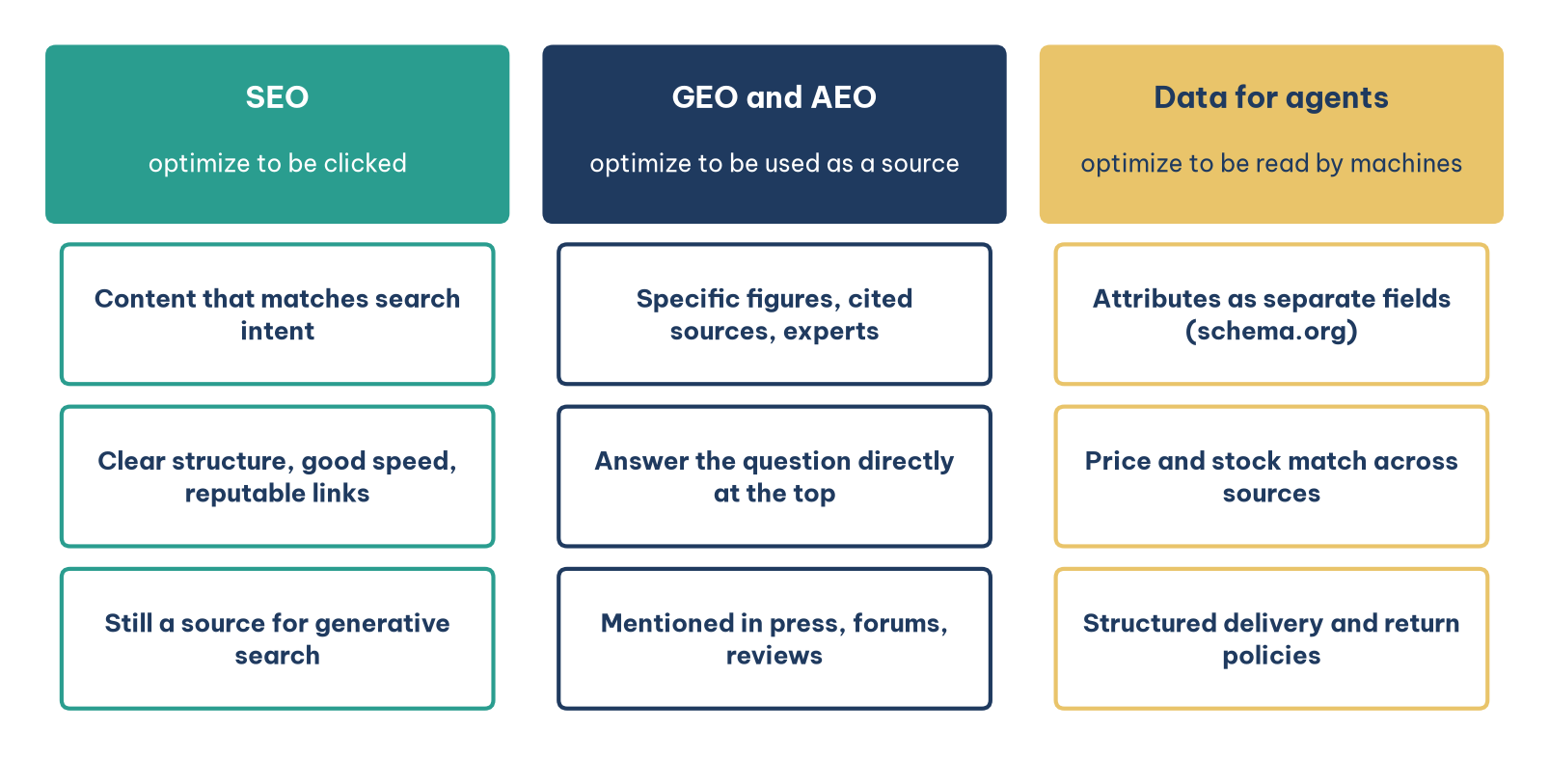
Search engine optimization (SEO) covers the techniques that make a website rank high in organic search: content that matches search intent, a clear page structure, good speed and links from reputable sites. SEO is not obsolete, because generative search systems often draw their sources from the very pages that rank well.
The other two pillars in Figure 1 are new. GEO and AEO target the answers of AI assistants; data for agents targets software that searches and orders on a customer's behalf. The three do not replace one another but complement one another: a page that ranks well, is written with evidence and carries complete structured data serves all three.
2. GEO and AEO: optimizing to be used as a source
Generative engine optimization (GEO) covers the techniques that get a business's content cited or synthesized into AI answers. Answer engine optimization (AEO) is a closely related term that emphasizes answering users' specific questions directly and concisely. The two can be treated as two names for the same approach.
2.1. The core difference from SEO
The term GEO was introduced in a 2024 study showing that techniques such as adding specific statistics, citing sources and quoting experts can increase how visible a piece of content is in generative answers (Aggarwal et al., 2024). The underlying principle differs from SEO in one respect: SEO optimizes for being clicked, GEO optimizes for being used as evidence. A page saying "the best coffee in the country" with no support will be cited less often by AI than a page stating "roasted within 7 days before delivery, grown at 1,500 m altitude, certified by [certification name]". The second sentence gives the AI a specific fact to rely on; the first is just advertising that the AI has no reason to repeat.
2.2. Four evidence-based techniques
The techniques with the best evidence so far fall into four groups. Table 1 summarizes them with examples for a coffee brand.
The last technique in Table 1 shows that GEO is closer to public relations than to web engineering. AI systems synthesize from many sources, not just the brand's own pages; according to an analysis cited by Tidio (2026), a brand's own website accounts for only about 5–10% of the sources AI search draws on when composing an answer. A brand that talks about itself only on its own site will rarely be mentioned by AI, however well that site is optimized.
2.3. The effect on traffic
Figure 2 illustrates why GEO is not only a technical matter but a revenue matter. When an AI summary appears, the share of users who click a link falls by almost half.
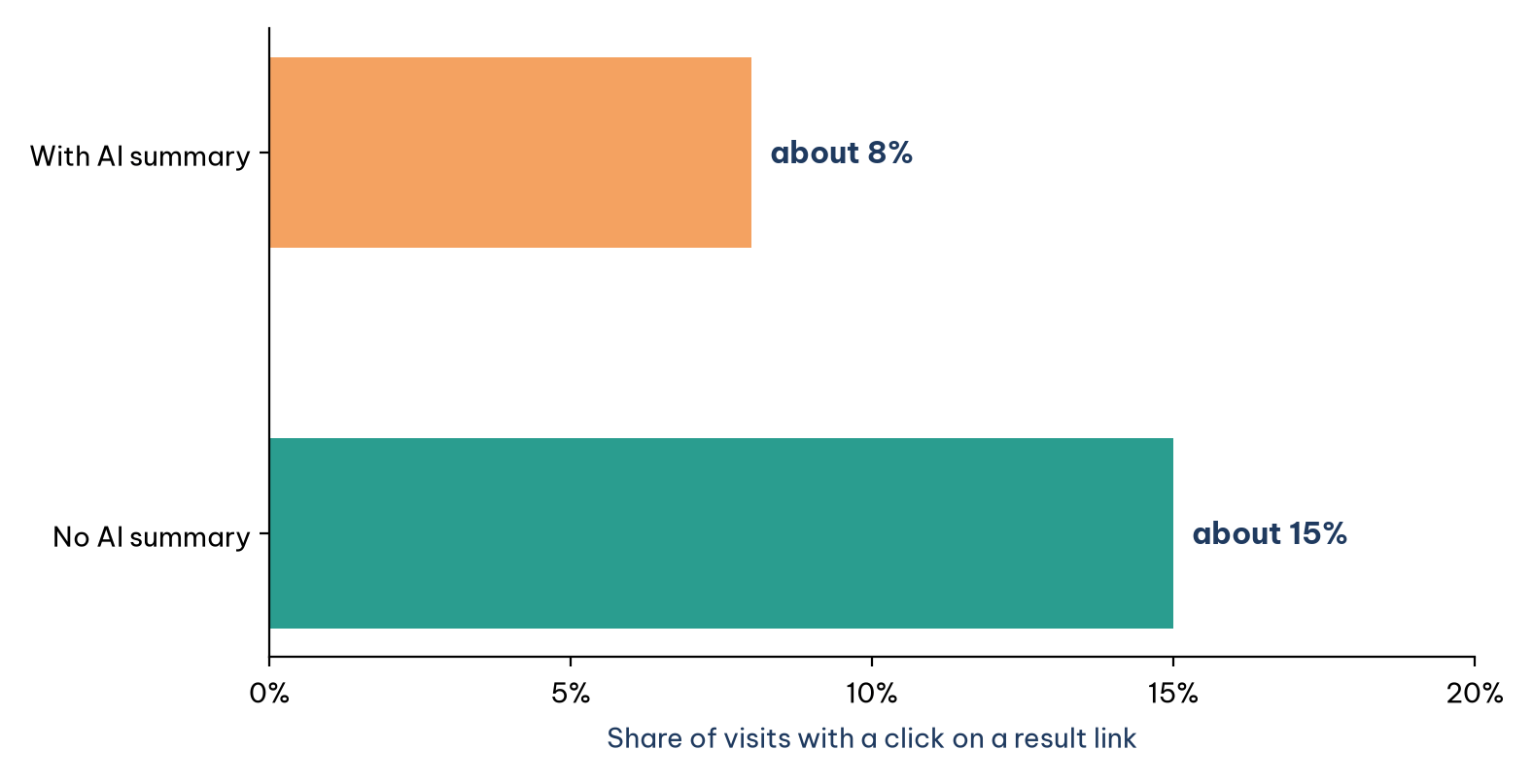
Figure 2 has two consequences for sellers. First, organic search traffic can fall even when rankings do not change, so do not rush to conclude that SEO "no longer works" when visits drop. Second, when shoppers click less, the content of the AI answer becomes the first impression of the brand. If the answer quotes the wrong price or policy, or does not mention the brand at all, the shopper may never reach the site to learn the truth.
3. Structured product data
When an AI agent searches, compares and orders on a user's behalf, it does not "read" a page as a person does. It reads structured data: name, price, stock, attributes, shipping and return policies, in a form machines understand. The most common standard is the schema.org vocabulary, with types such as Product, Offer, AggregateRating and MerchantReturnPolicy embedded in the page, together with product feeds sent to platforms such as Google Merchant Center.
The practical implications for a small business are concrete:
Each product must have its attributes as separate fields, such as weight, roast level, flavor notes and suitable brewing method, not buried in a paragraph of description.
Price and stock on the page, in the feed and on marketplaces must match, because agents detect discrepancies and may drop inconsistent sellers.
Return policies and delivery times must be declared in structured form.
A catalogue with missing attributes is invisible to agents. AI can be asked to convert free-form product descriptions into schema.org structured data, but every attribute must be checked against the real product, because AI may fill in values that sound plausible but are wrong.
4. Conversational commerce and multimodal search
Besides AI assistants, two other changes in how people search also affect how a business builds its presence. This section reviews each and its concrete consequences for sellers.
Conversational commerce is buying and selling that takes place inside a conversation, with a staff member, with the shop's own AI assistant or with a general-purpose AI assistant. It requires product information that can answer natural questions such as "which one is low in acidity but full-bodied?", not just match the keyword "strong coffee". A product page written as a list of keywords will lose to a page written as answers to customers' real questions.
Multimodal search lets people search with a photo or by voice: photographing a bag of coffee at a friend's café to find where to buy it, or asking by voice while driving. The concrete consequence is that product photos become search data. Clear photos of the real packaging, with accurate alternative text, are matched correctly to the product by image recognition systems; generic stock images are not.
5. Measuring presence in AI answers
Measuring GEO is still in its infancy, because AI assistants' answers vary with time, location and phrasing. Even so, a business can track the trend with a simple metric. This section explains how to measure it and then warns about a trap.
5.1. A three-step process
The proposed metric is answer presence rate: across a fixed set of questions, the percentage of answers that mention the brand, and whether the mention is accurate. The process has three steps:
List about 20 questions that real customers often ask, for example "where should I buy specialty coffee online" or "which medium roast suits a drip filter".
Each month, ask the same set of questions to two or three popular AI assistants, in a fresh session, without logging into an account with history.
Score each answer: is the brand mentioned, in which position, which competitors are mentioned, which claims about the brand need checking and which sources are cited.
AI can help score the answers with a prompt such as: "You are a brand analyst. Below are a consumer question and an AI assistant's answer: [question], [answer]. Brand to track: [name]; competitors: [list]. Please (1) say whether the brand is mentioned and in which position; (2) list the competitors mentioned; (3) quote every claim about the brand verbatim and mark which ones need checking; (4) list the sources cited. Base your assessment only on the answer provided." Table 2 illustrates a monthly tracking sheet.
Table 2 is meaningful only for comparing trends on the same set of questions; a single figure in a single month says very little. The last column matters most: every false claim about the brand must be corrected at its source (your own page, a review site, an article), because it cannot be corrected directly inside an AI assistant.
5.2. The trap of treating GEO as a trick to "fool" AI
Many services now promise to "put your brand in AI answers" by stuffing keywords, mass-producing fake reviews or hiding instructions in pages to influence the model. The last tactic is exactly the indirect prompt injection attack that AI security guidance warns about. Beyond the risk of platform penalties and of breaching rules on misleading advertising, these tactics rest on a misunderstanding: AI systems are designed to prefer sources that are trustworthy and consistent across many places, so fake content has a short life. The mechanism of the trap is familiarity: people who once did "black-hat" SEO bring the old mindset into a new environment.
Conclusion
When shoppers ask an AI assistant instead of typing keywords, "being found" gains two new meanings alongside SEO: being used as a source for an answer and being read correctly by machines when agents buy on a customer's behalf. The three meanings are not mutually exclusive. A page that ranks well, is written with figures and sources, answers customers' real questions directly and declares complete structured data serves readers, search engines and AI assistants alike.
The biggest difference between GEO and SEO is that GEO is closer to public relations than to web engineering. A brand that talks about itself only on its own pages will rarely be mentioned by AI; a brand that others mention consistently and with evidence has a better chance. Measuring presence every month on a fixed set of questions, and correcting false information at its source, is a practical way to manage this new channel without tricks that easily backfire.
References
Aggarwal, P., Murahari, V., Rajpurohit, T., Kalyan, A., Narasimhan, K., & Deshpande, A. (2024). GEO: Generative engine optimization. In Proceedings of the 30th ACM SIGKDD Conference on Knowledge Discovery and Data Mining (pp. 5–16). ACM. https://doi.org/10.1145/3637528.3671900
Pew Research Center. (2025, July 22). Google users are less likely to click on links when an AI summary appears in the results. https://www.pewresearch.org/short-reads/2025/07/22/google-users-are-less-likely-to-click-on-links-when-an-ai-summary-appears-in-the-results/
Tidio. (2026). AI in e-commerce in 2026: The new shopping funnel. https://www.getlyro.ai/reports/ai-in-ecommerce
Discussion about this post