Self-Fulfillment, Marketplace Warehouses or a 3PL
What order fulfillment is and how to compare three fulfillment models by cost per order, break-even volume and working capital


Key takeaways
Order fulfillment covers everything from accepting an order to the customer holding the goods, including returns. Online it is harder than in a store because expectations are higher, parcels are small and scattered and orders arrive from many channels.
Faster delivery is worth paying for only when the extra profit it brings exceeds the extra fulfillment cost. Sometimes the faster option is also the cheaper one.
The three models differ less in who packs the parcel than in who carries the fixed cost, who owns the customer data and who bears the risk when volume falls.
In the worked example, a 3PL warehouse near customers costs US$1.43 per order against US$1.68 for shipping from the roastery and delivers two days sooner, but only above a break-even volume of about 923 orders a month.
Two hidden costs sit outside the per-order comparison: working capital tied up in a second stock location and, for perishable goods, lost freshness. Always plot cost across a range of volumes before signing.
Every online seller eventually hits the same wall. The product sells and the reviews are good; then delivery becomes the weak point. Customers far from the seller's base wait days while competitors with stock in the big cities deliver tomorrow. Marketplaces reward fast shippers with badges and better placement, and logistics companies arrive with quotes that look attractive at today's volume. The choice that follows, keep shipping from your own premises, send stock into the marketplace's warehouse or hire a third-party logistics provider, is one of the largest cost decisions a growing online business makes, and it is usually made on instinct.
Consider Moc Son, a hypothetical specialty coffee brand eighteen months after opening its online store. It sells about 3,000 orders a month: 2,000 through a large marketplace and 1,000 through its own website and a messaging app. Every order is still packed at the roastery in a highland town, and parcels reach customers in the big southern city, where most of them live, in about three days and customers in the far north in four or five. Moc Son's delivery rating on the marketplace is slipping, because rival shops with stock in the city deliver in one day.
Three pieces of advice arrive at once. The marketplace invites Moc Son to send stock into its own warehouse in the city to earn a "fast delivery" badge. A logistics company offers space in its warehouse to serve both the marketplace and the website. A friend says to change nothing, because "specialty coffee sells on freshness, not speed". None of the three is entirely wrong, and none comes with numbers.
This article provides the tools to compare the three in numbers. Section 1 defines order fulfillment and explains why it is hard in e-commerce. Section 2 asks when faster delivery is worth paying for. Section 3 describes the three fulfillment models. Section 4 compares cost per order and break-even volume. Section 5 prices two hidden costs, working capital and freshness, and then discusses inventory management across several sales channels.
1. What order fulfillment is
This section defines the term, lists the steps involved and explains why online selling makes them harder.
Order fulfillment is the full set of activities a company carries out from the moment it receives an order until the goods reach the customer, including related services such as instructions for use, exchanges and returns (Turban et al., 2017). Logistics is the part of that work concerned with planning, executing and controlling the flow of goods, information and money between the point of origin and the point of consumption. The two concepts overlap but are not the same: logistics is about physical and information flows, while fulfillment is about a promise made to a particular customer.
A typical fulfillment process has nine steps: verifying payment, checking whether the item is in stock, sourcing and replenishing stock if it is short, storing it, picking and packing, shipping and tracking, delivery to the customer and finally handling returns (Turban et al., 2017). The steps depend tightly on one another. The stock check is only correct if the number in the system matches the goods on the shelf. Tracking works only if the carrier sends journey data back. Handling returns is cheap only if customers with no intention of accepting the parcel were screened out at the very first step.
Compared with store-based retail, fulfillment in e-commerce is harder in four ways (Turban et al., 2017). Customer expectations are higher: delivery times are short, and customers change their minds and cancel orders at the last minute. Accuracy matters more: sending the wrong item to an individual shopper can lose that shopper for good. Multichannel order management is messier, because each channel runs its own system. Distribution is more complex: instead of a few large truckloads to stores, there are thousands of small parcels to thousands of addresses. Amazon itself started in 1994 as a retailer without warehouses, then had to change its model and build its own warehouse network at great expense. The lesson is not that every seller must build warehouses, but that at sufficient scale fulfillment stops being a cost to be endured and becomes a competitive capability.
2. When faster delivery is worth paying for
This section turns the question "should we deliver faster?" into a comparison between extra profit and extra cost.
Delivery speed has moved from an advantage to a minimum requirement. In many product categories, next-day delivery is now taken for granted, and more than half of shoppers expect to receive their goods within two days; yet a sizable share of shoppers will choose a slower option if it is cheaper or more reliable (Knights, 2026). The management question is therefore not "does speed increase conversion?" but whether the extra profit that speed brings exceeds the extra cost of fulfilling faster (Knights, 2026).
The answer depends on basket value, margin, return rate, inventory turnover, how densely customers are clustered geographically and how efficient the fulfillment model is. Moc Son's coffee sits in the middle: a moderate basket of US$12.80, a reasonable margin and few returns for product faults, but customers scattered across the whole country and mostly far from the roastery.
A worked example makes this concrete. Suppose next-day delivery for customers in the south raised website orders from that region by 5%, from 600 to 630 a month. With a contribution margin of US$5.94 per website order (what is left of a US$12.80 order after all its variable costs), the extra profit is 30 × US$5.94 ≈ US$178 a month. If faster delivery costs more than that each month, it is not worth it. If it costs less, or if, as the next sections show, the faster option is actually cheaper at the current volume, the decision is easy.
3. Three fulfillment models
This section describes the three ways an online seller can organize fulfillment and how they differ.
The three models differ in who holds the stock, who packs the parcels and who bears the risk when volume changes.
Self-fulfillment (in-house fulfillment): the seller keeps stock in its own warehouse or workshop, packs orders itself and hands them to a carrier. Control is at its maximum, but the warehouse usually sits where the product is made rather than where customers live, and packing capacity is hard to stretch when orders spike.
Marketplace fulfillment (fulfillment by platform): the seller sends stock in batches to the marketplace's warehouse; the marketplace stores, picks, packs, delivers and handles customer service for orders placed on the marketplace. The model was popularized by Fulfillment by Amazon (Turban et al., 2017), and the large marketplaces of Southeast Asia, such as Shopee and Lazada, now offer similar programs to their sellers. The benefits are speed, a priority badge in search results and no upfront investment. The price is deeper dependence on the marketplace, stock split up across each marketplace a seller uses and, usually, no way to use that stock for orders from the seller's own channels.
Third-party logistics (3PL): the seller hires a specialist company to store, pack and ship orders from every channel. For large retailers, outsourcing can be expensive and hard to coordinate, so they often run their own warehouses (Turban et al., 2017). For small and medium sellers the logic runs the other way: a 3PL gives them a warehouse near customers without renting space, hiring staff or buying warehouse software. An extreme variant is dropshipping, in which the seller holds no stock at all but has to pay the supplier before the goods are shipped (Knights, 2026). Table 1 compares the three models.
Table 1 shows that the three models differ not in "who packs" but in who carries the fixed cost, who keeps the customer data and who bears the risk when volume rises and falls. The row on control and data matters especially for a strategy of using marketplaces to win customers and owned channels to keep them: a marketplace warehouse helps sell on the marketplace but does nothing to build the seller's own channel. The point is sharper in markets where livestream selling is common, as in much of Southeast Asia, because a single livestream session can produce a spike of orders in an hour that a small workshop cannot pack in a day.
4. Comparing the options in numbers
This section puts costs on the three options for Moc Son, then shows why the comparison changes with volume.
About 60% of Moc Son's orders, or 1,800 a month, go to customers in and around the big southern city, and 1,200 of these come from the marketplace. Table 2 compares the three options for this group of orders. All figures are hypothetical, close to typical market prices for a small seller but not a quote from any real company, and were converted at 25,000 Vietnamese dong to the US dollar.
Figure 1 redraws the cost part of Table 2 item by item.
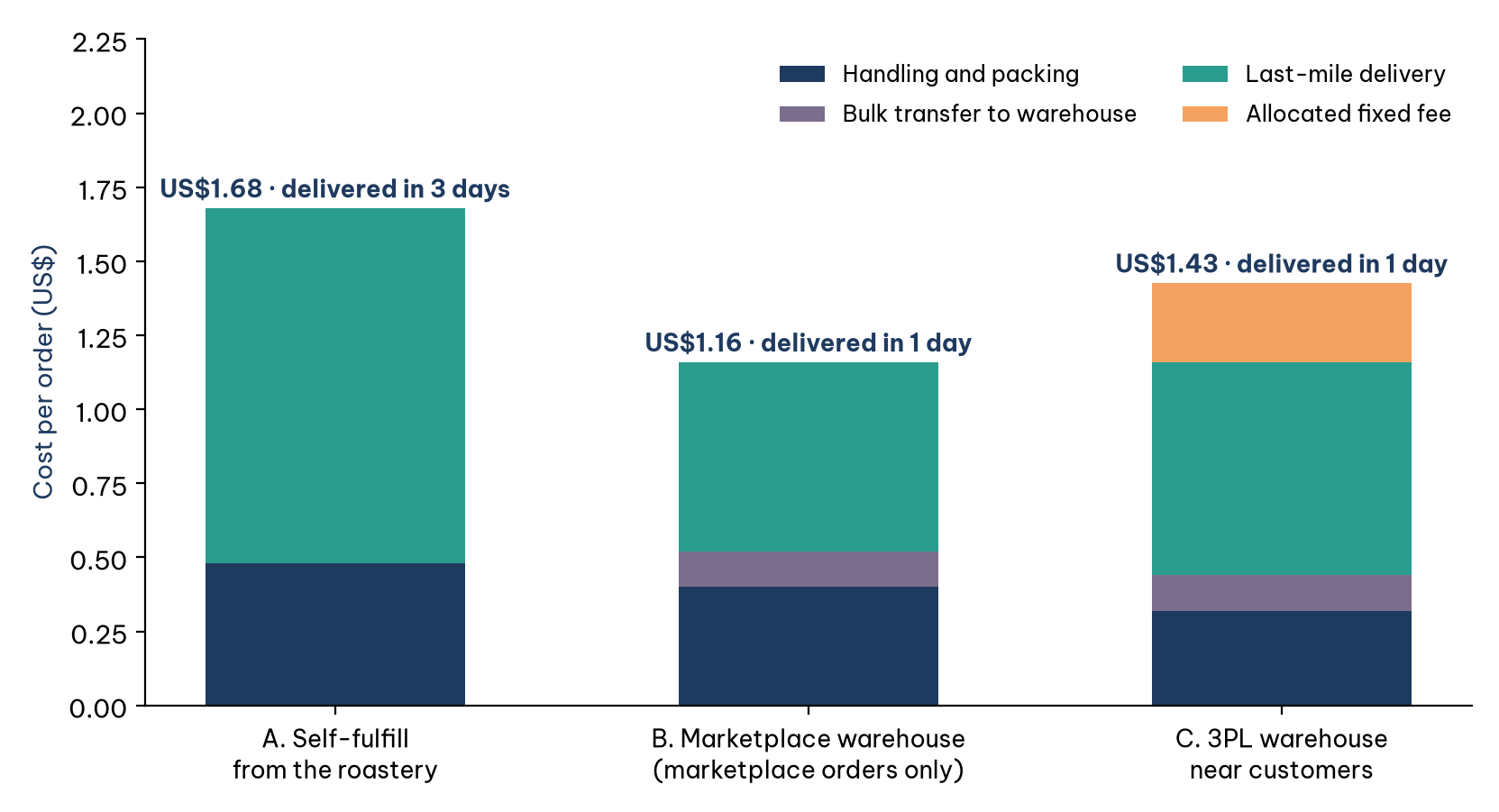
Three points follow from Table 2 and Figure 1. First, moving the 1,800 orders to option C saves (US$1.68 − US$1.427) × 1,800 ≈ US$456 a month and cuts delivery time from three days to one. This is not a trade-off between cheap and fast, because a warehouse near customers shrinks the single largest item, last-mile delivery. Second, option B is the cheapest per order but serves only the 1,200 marketplace orders. If Moc Son chooses B, it must keep running option A in parallel for website and messaging-app orders, its stock is split between two places and customers on its own channels, the group with the highest lifetime value, receive their coffee more slowly than marketplace shoppers. Third, option C contains a fixed fee of US$480 a month, so its cost per order depends on volume, as Figure 2 shows.
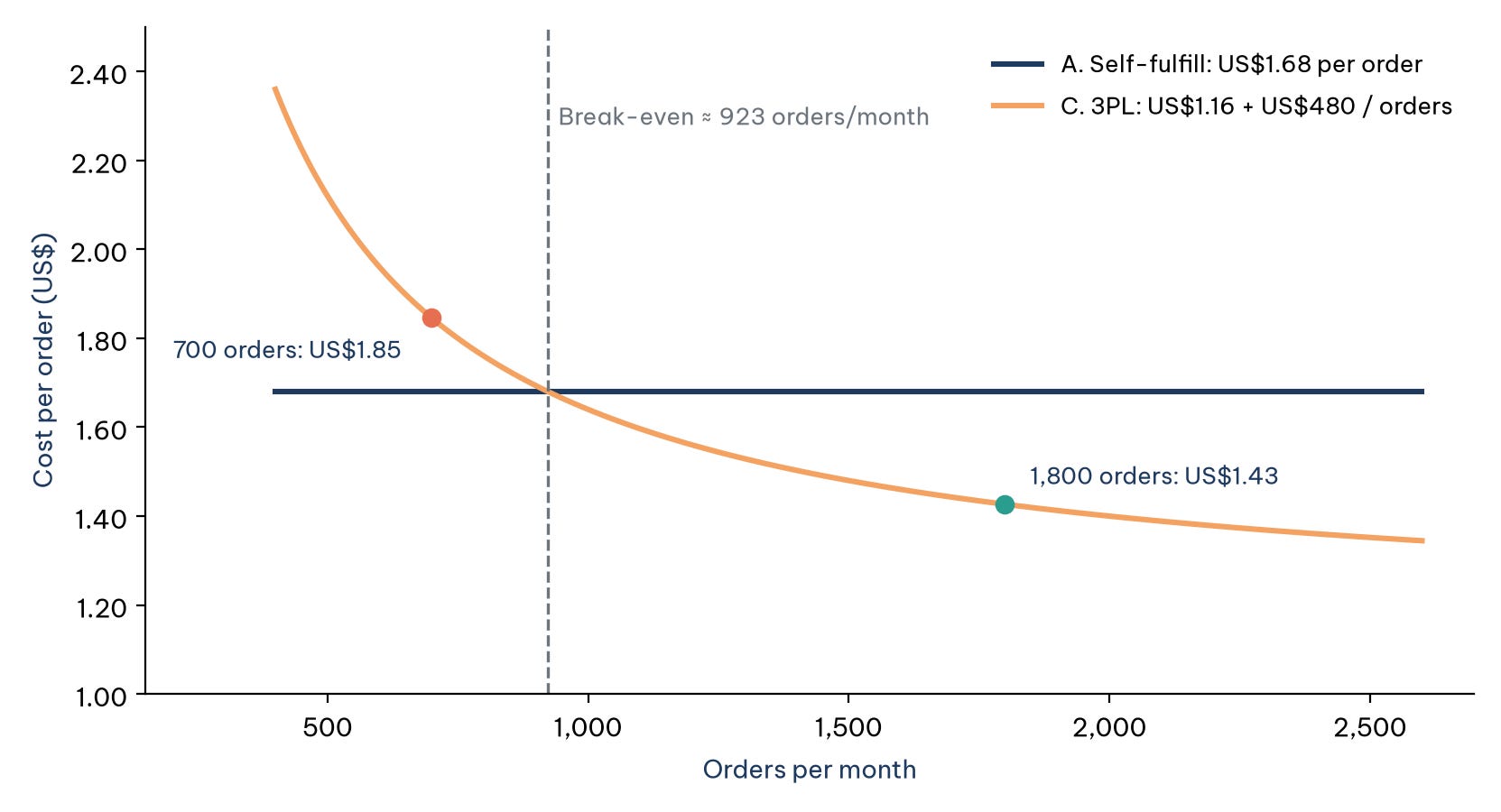
Each order moved to option C saves the difference between A's cost (US$1.68) and C's variable cost (US$1.16), or US$0.52. The fixed fee of US$480 is covered once there are enough orders for the total saving to equal it:
Break-even volume = fixed fee / (cost per order when self-fulfilling − variable cost per order with the 3PL) = 480 / 0.52 ≈ 923 orders a month.
Below this level, self-fulfillment is cheaper; above it, the 3PL is cheaper, and it gets cheaper still as volume grows. Moc Son is at 1,800 orders, almost twice the break-even point, so it has a comfortable margin of safety. A new business selling a few hundred orders a month that rushes to hire a warehouse in order to offer fast delivery will pay more than if it shipped the orders itself.
The trap in this section is comparing fulfillment models at a single volume. Logistics quotes are usually presented at the volume the seller has now or hopes to have, and at that level the warehouse option tends to look attractive. The mechanism is a fixed cost hidden inside the cost per order: when volume falls because the season ends, a channel is lost or the marketplace changes its algorithm, the fixed fee does not fall with it. At 700 orders a month, option C costs about US$1.85 per order, roughly US$0.17 more than self-fulfillment. The safeguard is to always plot cost across a range of volumes, as in Figure 2, and then ask: in a bad scenario, how long could volume stay below break-even? Where possible, negotiate a fixed fee tiered by volume, or a short contract for the first year.
5. Working capital, freshness and multichannel inventory
This section prices the last two rows of Table 2, which the cost comparison left out, and then turns to managing stock across channels.
Those two rows are the hidden costs of moving stock away from where it is made.
5.1. Working capital and freshness
A warehouse far from the roastery needs enough stock to cover the time it takes to move a batch there plus a safety buffer, assumed here to be two weeks of sales instead of one. At 1,800 orders a month, or about 415 bags a week, one extra week of stock at a cost of goods of US$5.12 a bag ties up about US$2,130 in the warehouse. At an interest rate of 12% a year, the cost of that capital is only about US$21 a month, small beside the US$456 saving. The choice of sales channel and warehouse model therefore changes not only operating cost but also working capital needs; marketplaces may also set minimum stock levels that force sellers to hold buffer inventory (Knights, 2026).
The larger cost for Moc Son is not money but its brand promise. Under option A, a bag of coffee waits on the shelf for half a week on average and then travels for three days, so it reaches the customer about six to seven days after roasting. Under option C, it waits a week on average, plus a day for the bulk transfer and a day for delivery, so it arrives about nine days after roasting. That is still within the window in which the coffee tastes best, but the buffer for delays has grown thinner. This is the kind of trade-off a cost table never reveals on its own; the manager has to place it beside the saving and decide. The friend's advice at the start of the article was therefore not wrong, only unquantified.
5.2. Inventory across several channels
When a seller sells on several channels from one or a few warehouses, inventory visibility becomes a condition for keeping promises. The main tool is a warehouse management system, which supports receiving goods, tracking stock by batch, replenishment, stock counts and assigning picking locations (Turban et al., 2017). For Moc Son, managing stock by roast batch is the most important function: first in, first out has to be applied by roast date, or a bag roasted three weeks ago may sit at the back of the shelf while fresh bags go out.
A useful operating rule is to separate physical inventory (the bags on the shelf) from available-to-sell inventory (the bags on the shelf minus those committed to unshipped orders, those awaiting inspection and those reserved for another channel). Only the second number is pushed to the sales channels. When available-to-sell stock drops below a threshold, say three days of sales, the system automatically reduces the quantity shown on the channel with the highest risk of overselling, usually the marketplace during a livestream, and alerts the roastery to roast a new batch. Shoppers and marketplaces alike now treat parcel tracking as a basic expectation, so the ability to track every order is a minimum standard when choosing a logistics partner, no longer an optional extra.
AI is used most at the demand-prediction stage, to decide how much to roast and how much to send to the distant warehouse. An AI assistant can quickly build a model like Table 2 and Figure 2 for many volume levels, but the inputs, especially the fixed fee and delivery rates by region, must come from real quotes. Demand forecasts made with AI also need to separate demand driven by promotions from baseline demand; otherwise every big sale will leave the distant warehouse holding stock past its best.
Conclusion
The three pieces of advice at the start, send stock to the marketplace warehouse, hire a 3PL or change nothing, are each sensible at some volume. Compared in numbers at 1,800 southern orders a month, the 3PL is both US$456 a month cheaper than self-fulfillment and two days faster, because a warehouse near customers cuts the largest single cost, last-mile delivery. The marketplace warehouse is the cheapest per order but serves only marketplace orders and leaves customers on the brand's own channels waiting longer.
Yet the 3PL's cost per order depends on volume: below about 923 orders a month, self-fulfillment is cheaper again. Choosing a fulfillment model is therefore a bet on future volume, with two hidden costs attached: working capital and, for a product like coffee, the promise of freshness. Always plot cost across a range of volumes, calculate the break-even point and set freshness beside the saving before signing a contract.
References
Knights, M. (2026). The future of shopping: Using digital, data and AI to win with customers. Kogan Page. https://checkout.koganpage.com/product/the-future-of-shopping-9781398627925
Turban, E., Whiteside, J., King, D., & Outland, J. (2017). Introduction to electronic commerce and social commerce (4th ed.). Springer. https://doi.org/10.1007/978-3-319-50091-1
Discussion about this post