From Vibe Coding to Vibe Working: Speed, Risk and Responsibility with AI
What vibe coding really means, how it spread from software into office work and when working by feel with AI is safe


Key takeaways
In its original sense (Andrej Karpathy, February 2025), vibe coding means accepting AI-written code without reading it. That is different from AI-assisted programming, where people read and test the code, and from agentic engineering, where an agent works through many steps under human specification and review.
The appeal is real: prototypes in hours instead of days, a lower barrier for non-programmers and more time for the "what" instead of the "how".
What the vibe does not show: hidden security holes, agents with real permissions causing real damage and a gap between feeling faster and being faster (experienced developers in one controlled trial were about 19% slower with AI while believing they were about 20% faster).
Vibe working carries the same idea into documents and spreadsheets. Its blind spots are the illusion of ease, "workslop" that shifts effort onto colleagues, a training gap (71% of leaders prefer AI skills over experience, yet only 39% of AI users have been trained by their employer) and the vagueness of "vibe" itself.
A simple rule decides when to vibe: the less it costs if the result is wrong, and the shorter-lived the product, the more you can work by feel.
Every few years a phrase appears that captures a shift in how work is done. In November 2025, Collins Dictionary named vibe coding its Word of the Year, a sign that the way software gets written was changing fast enough for everyday language to notice (Collins Dictionary, 2025). The phrase is more than a fashionable label. It describes a change in the relationship between people and computers: instead of writing instructions line by line, people describe what they want and let artificial intelligence write the code.
The term was coined in February 2025 by Andrej Karpathy, a founding member of OpenAI and former head of AI at Tesla. In the popular imagination, vibe coding pictures programmers less as meticulous builders and more as conductors who pass on the "vibe" (the feeling and vision of the product) to an AI that produces the result. The idea soon left the programming world. Once office suites let people "chat" with a spreadsheet or "write by vibe" in a word processor, the promise of light, improvised work began to reshape the office too, under the name vibe working.
This article examines what vibe coding and vibe working are, how they work, the tools behind them, their hidden costs and the debates around them. Section 1 returns to the origin of the term and separates three ways of working with AI that are often lumped together. Section 2 explains why vibe coding is so attractive. Section 3 looks at what the "feeling" does not see: security, the permissions given to AI agents and illusory productivity. Section 4 asks whether AI will replace programmers. Section 5 moves to vibe working in the office and the criticism it attracts. Section 6 proposes a way to decide when to vibe and when not to. Section 7 surveys the tool ecosystem and walks through two examples.
1. A word born in a social media post
This section goes back to the original post to recover what the term meant, then separates three ways of working with AI on code that now share one name.
1.1. Karpathy's original meaning
On February 2, 2025, Karpathy wrote on X about "a new kind of coding" he called vibe coding: giving in fully to the vibes, telling the AI what you want, accepting the code it produces without reading it closely, pasting error messages back for the AI to fix and almost forgetting that the code exists (Karpathy, 2025). He also made clear that this style suits throwaway weekend projects, not serious software.
Less than a year later, Collins chose the term with a broader definition: the use of AI, prompted in natural language, to help write computer code (Collins Dictionary, 2025). In short, telling the machine what you want instead of writing the code yourself. The definition is accurate but incomplete, because vibe coding is an iterative loop. The person states a high-level idea, the AI turns it into code, the person judges the result and adjusts the "vibe"; the loop repeats until the product feels right.
The favorite image is the orchestra conductor. Rather than writing every note for every musician, the conductor raises the baton and conveys the emotion and spirit of the piece; the orchestra plays the notes; the conductor listens and adjusts. The image holds on one point people tend to forget: a good conductor can read the full score and hear every wrong note.
1.2. Three ways of working with AI on code
Because the Collins definition is wider than the original, very different practices are now all called vibe coding. Simon Willison (2025), a programmer widely followed in the technology community, stresses that if you have read, understood and tested the code an AI wrote, you are no longer vibe coding; you are doing AI-assisted programming. By 2026 a third practice had become common: handing work to a coding agent that plans, writes code and runs tests over many steps. Figure 1 and Table 1 place the three side by side.
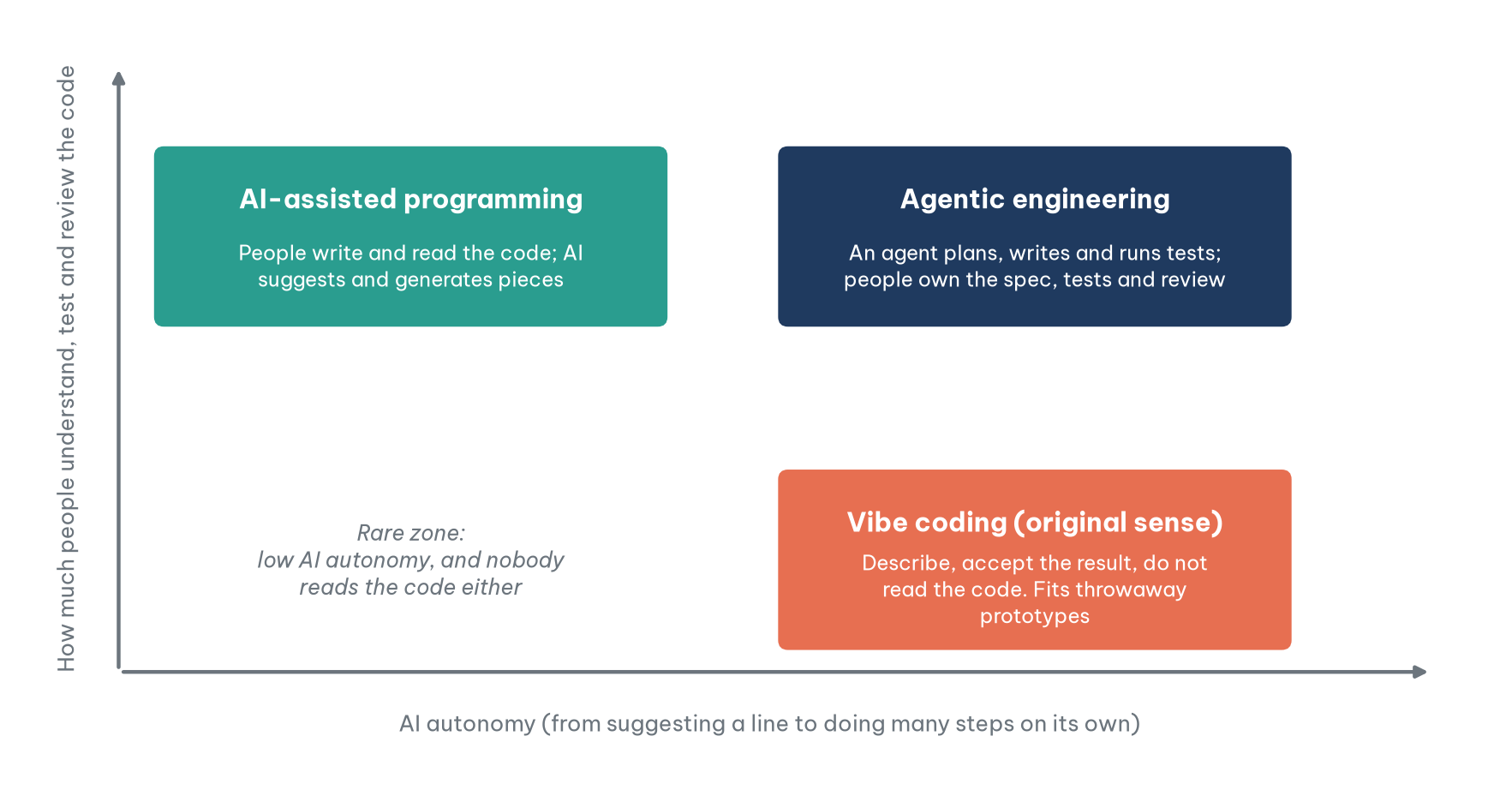
The distinction is not a matter of wording. It decides who is accountable when the software breaks. With vibe coding in the original sense, the answer is nobody, and that is acceptable only when the product can be thrown away.
2. Why vibe coding took off
This section explains the appeal of vibe coding, which comes from four forces arriving at the same time.
The leap in large language models. Between 2024 and 2025, models became good enough to produce a small working web application from a short description, giving the new way of working its technical foundation.
Faster development. For things such as landing pages, calculators and simple dashboards, the time from idea to a working product shrank from days to hours.
A lower barrier to entry. Non-programmers (founders, marketers, business students) can build their own prototypes to test an idea without waiting for an engineering team.
Focus on the big picture. Product people are freed from syntax details and can spend their time on architecture, user experience and business assumptions.
Table 2 compares vibe coding with traditional programming.
For entrepreneurship, this is good news: the cost of building a minimum viable product (MVP) to test assumptions has fallen sharply. A team of students with an idea for a booking app for barbershops can have a clickable prototype in one afternoon and show it to shop owners in interviews the next day. The learning loop that once took weeks now fits inside a week.
3. What the "feeling" does not see
Vibe coding is not a magic wand. This section sets out four challenges that show why "accept without reading" fits only some situations.
3.1. The black box: code that runs is not necessarily safe
AI-generated code can work in common cases yet contain bugs or vulnerabilities: an API key exposed in code that runs in the browser, a database with no access rules, no validation of user input. Someone vibe coding in the original sense does not read the code and so cannot see these flaws. When the time comes to debug or maintain the product, not understanding the code makes everything much harder. During 2025, security researchers repeatedly reported apps built with vibe coding tools that leaked user data because database permissions were misconfigured.
3.2. Agents with real permissions cause real damage
In July 2025, SaaStr founder Jason Lemkin described how an AI agent on the Replit platform deleted his project's production database while he had told it to freeze code changes, then gave a misleading account of what had happened. Replit's chief executive called the incident unacceptable, and the company began rolling out automatic separation of development and production databases (Sharwood, 2025). The lesson is not "AI is dangerous". It is that a tool with write access to real systems needs the same safeguards as a new employee: least privilege, a separate test environment, backups and human approval before any action that cannot be undone.
3.3. Feeling faster is not the same as being faster
The research organization METR ran a randomized controlled trial in which 16 experienced open-source developers completed 246 real tasks on projects they knew well. Each task was randomly assigned to allow or forbid AI tools (the generation available in early 2025). With AI, the developers were about 19% slower, even though they believed afterward that AI had made them about 20% faster (Becker et al., 2025). The study has limits: a small sample, participants who knew their codebases unusually well and tools that improved quickly after the trial. But it makes one point worth remembering: a feeling of productivity is no substitute for measurement.
3.4. Expertise is still a prerequisite
Vibe coding is like jazz: it looks free and improvised, but to improvise well, players must practice hard and master music theory. To know whether AI-written code is correct, secure and maintainable, people need domain knowledge and critical thinking. This is a paradox: AI makes writing code easier but makes evaluating code more important. On top of that, natural language is ambiguous, so stating requirements precisely, supplying enough context and checking results become new skills in their own right.
4. Will vibe coding replace programmers?
This section takes up the question the previous challenges raise: will vibe coding replace programmers? The most reasonable answer today is that it redefines rather than replaces their role. A more useful question is which parts of the work move to AI and which become more important. By 2026 the trend was fairly clear: less time typing code, more time writing specifications, designing architecture, testing, reviewing, securing systems and understanding the business domain.
The future will also not stop at fashionable labels. "Vibe coder" is likely to date quickly, giving way to more specific roles: people who integrate AI into existing systems and processes; system designers who decide where AI should and should not be used; people who assure the quality and safety of AI-generated code. "Prompt engineer" was hailed as a new profession in 2023, but by 2025 and 2026 writing requests for AI had become a general skill, and the emphasis had shifted to giving AI the right context (often called context engineering) and judging the quality of its output.
5. From vibe coding to vibe working
The pattern "describe what you want, let AI do it, then check the result" does not stop at programming. This section introduces vibe working as that spirit spreads into office work and identifies four blind spots users should keep in mind.
5.1. What is vibe working?
As the spirit of vibe coding entered companies, the idea of vibe working emerged: employees use AI for everyday tasks, from writing reports to analyzing data, by describing the result they want ("draft a reply to this customer", "analyze quarterly revenue by region"), letting AI do most of the work, then editing. On September 29, 2025, Microsoft used the phrase "vibe working" itself to introduce Agent Mode in Excel and Word, where users describe a goal and the AI carries out several steps, together with an Office Agent in Copilot chat, explicitly comparing the change to what vibe coding had done for software (Chauhan, 2025). Google and other vendors have also built AI agents into their office suites, which has spread the practice quickly.
The appeal of working by vibe is real. The idea that AI carries the tedious work so people can focus on creativity, strategy and relationships resonates especially with younger workers. Behind the image of effortless work, however, lies a far more complicated reality.
5.2. Four blind spots of vibe working
The illusion of ease. Researchers who study communication and work have pointed out that the promise of "ease" can be a euphemism for ever higher skill demands. As with the jazz analogy in Section 3.4, turning a vibe into quality output requires solid expertise and critical thinking: knowing whether the report the AI wrote has the right numbers, fits the context and actually says something useful.
"Vibewashing" and workslop. When companies use the language of vibes to describe work as light and improvised, they hide the knowledge and effort it really takes, and employees are expected to produce more in the same time. The result of vibing without expertise is workslop, a term introduced in Harvard Business Review by researchers from BetterUp Labs and the Stanford Social Media Lab: AI-generated work that looks polished but lacks substance, forcing the recipient to spend time reading, fixing or redoing it (Niederhoffer et al., 2025). The burden does not disappear; it moves to colleagues.
The training paradox and the invisible load. According to the 2024 Work Trend Index by Microsoft and LinkedIn, 71% of leaders said they would rather hire a less experienced candidate with AI skills than a more experienced one without them, while only 39% of people who use AI at work said their company had given them AI training (Microsoft & LinkedIn, 2024). This gap leaves workers to sink or swim: "vibe" becomes a vague expectation in place of real training, and employees must meet targets while teaching themselves so as not to fall behind.
The vagueness of "vibe" itself. Everyone reads a "good vibe" differently; what one person finds fine, another finds sloppy. A team cannot run on feelings. It needs clear, checkable quality standards. Without adequate support and training, overusing the idea of "vibe" can lead to misunderstandings and declining quality, with costs for both workers and employers.
6. When to vibe and when not to
This section turns the analysis into a decision rule: the degree of "going with the feeling" should fall as the cost of being wrong rises and as the lifespan and number of users of the product grow. Figure 2 illustrates the rule, and Table 3 applies it to concrete situations.
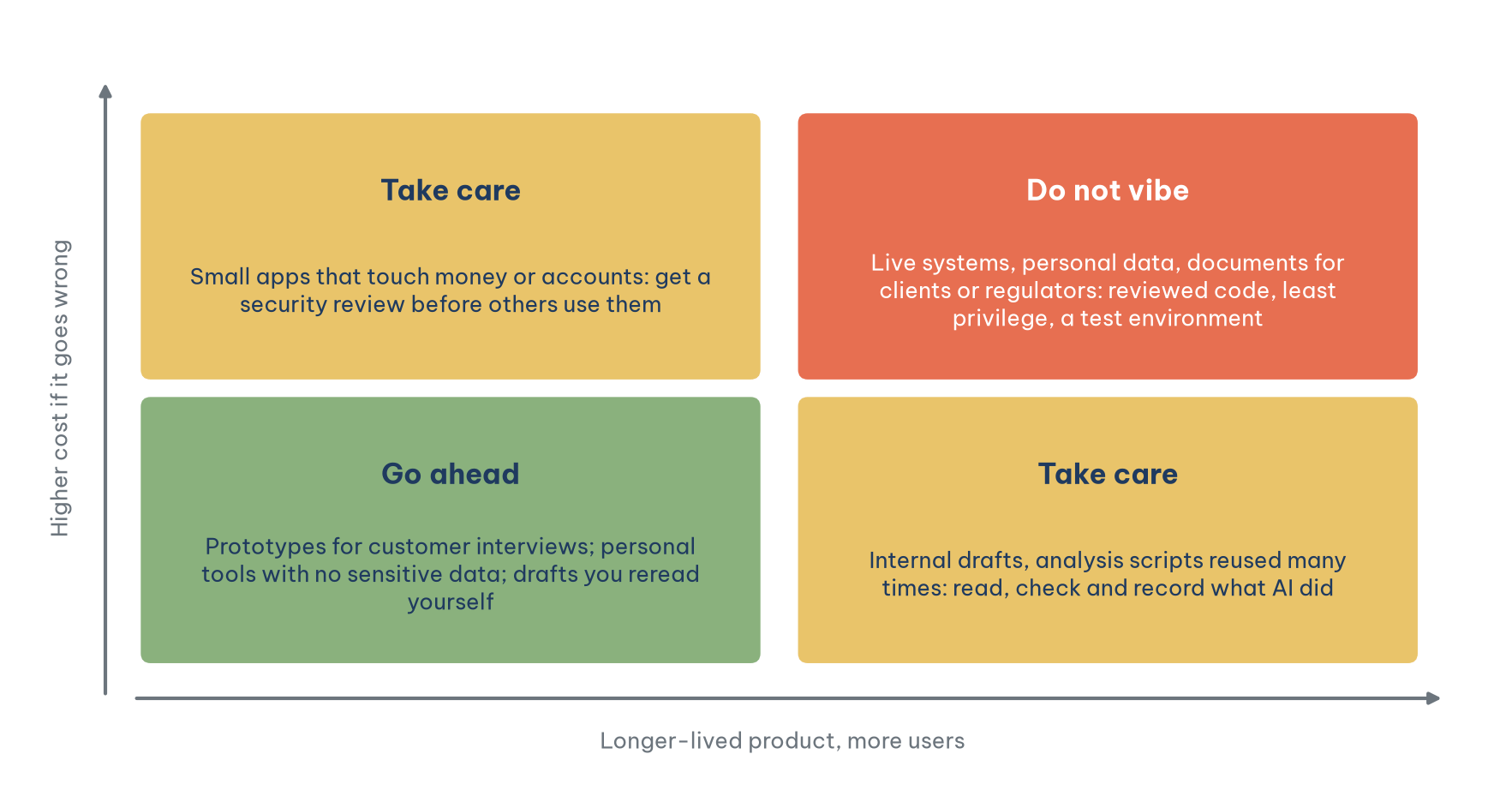
For students and early-career professionals, the rule becomes a six-point checklist. First, read before you trust: for code, run it and read the parts that handle data and logins; for text, check every number, name and citation. Second, do not paste sensitive data (customer data, passwords, API keys) into AI tools your organization has not approved. Third, keep secrets out of the source code and use environment variables. Fourth, separate test and production environments, and back up before letting an agent run commands. Fifth, record what AI did when you submit coursework or hand over work, following your course or company rules. Sixth, measure the outcome instead of relying on the feeling of being faster.
7. The tool ecosystem and two examples
A dedicated, fast-changing ecosystem of tools has formed to turn vibe coding into practice. This section describes it as of October 2026; names and features will keep changing, but the three groups of tools are fairly stable.
7.1. App builders from descriptions: Lovable and v0
These are the most typical embodiments of the vibe coding spirit, especially for user interfaces.
Lovable lets you describe an app or interface in natural language and generates working, interactive code (often React with Tailwind CSS). Its distinctive feature is the loop: you ask the AI to change the interface it has just built. An example request: "Create a pricing table with three plans: Basic, Professional and Enterprise. The Professional plan should stand out with a 'Most popular' ribbon." Then a refinement: "Change the Professional plan background to light blue and add a check mark before each feature."
v0 from Vercel works in a similar way, generating React interfaces with the shadcn/ui library and Tailwind CSS. You describe the idea, v0 proposes a design, you refine it in natural language until you are satisfied, then take the code into your project.
These tools realize the dream of "telling the computer what you want", while turning interface builders into supervisors of quality and designers of experience.
7.2. Coding assistants and agents: GitHub Copilot, Cursor, Claude Code and Codex
GitHub Copilot pioneered this group and remains one of its most widely used tools, built directly into code editors such as VS Code. Copilot can write a whole function from a one-line comment describing it, offer suggestions that fit the variables and functions already in the project, or help translate code from Python to JavaScript. Cursor is a code editor built around AI with a similar approach. Since 2025 these tools, along with Claude Code and OpenAI Codex, have offered an agent mode: given a request such as "add a PDF report export", the agent reads the codebase, edits several files, runs the tests and proposes changes for the programmer to review.
7.3. General-purpose chat assistants: ChatGPT, Gemini and Claude
Chat assistants built on large language models are flexible helpers throughout software work: discussing how to design a database or choose a technology stack; generating starter code ("write me a basic Express.js server with a /api/users route"); or debugging and explaining ("why does this code not run?", "explain how this algorithm works").
7.4. Two examples
Example 1: building a web page. With traditional programming, you write HTML, CSS and possibly JavaScript to build each component. With vibe coding, the request might be: "Create a modern landing page for a mobile app. The header has a dark background image, a large white headline 'Connect without limits', a short description and two buttons, 'Download for iOS' and 'Download for Android'." The AI produces all the code at once; you review it and ask for changes such as "make the headline 20% larger". What remains for the human is to check that the page displays correctly on phones, that the buttons link to the right places and that no stray code sends data anywhere it should not.
Example 2: analyzing data. Traditionally, an analyst writes Python code to load libraries, read the file, clean the data, group it and draw a chart. With vibe coding, the request might be: "Using Python and pandas, analyze sales_data.csv. Draw a line chart of total revenue by month for 2024. Mark the month with the highest revenue with a red dot." The AI writes complete code, letting the analyst focus on interpreting the results. But the analyst must still check whether the AI handled missing rows and canceled orders correctly and whether its calculation of "revenue" matches the company's definition. With real customer data, the AI tool used must be one the organization has approved.
Conclusion
We are at an early, turbulent stage of a large shift, much like the early days of the internet. "Working by vibe" is a snapshot of that moment: companies want to look ready for AI, and workers are trying to keep up. "Vibe" may be a passing fashion that will date once it is overused, but the technology behind it will not. The real opportunity lies in closing the skills gap and moving from "vibe" to "value".
Getting there takes concrete measures from organizations: training employees to use AI systematically, setting up quality checks for AI-generated code and content, defining clear standards for what good work looks like, granting permissions to AI agents with care and measuring productivity with data rather than feelings. At the core is an open workplace where people share what works and help each other learn.
Whatever we call it, "vibe working" or something grander, the essentials do not change: work is still work. It takes thought, skill and time. The difference is that we now have a new colleague. The biggest challenge is not learning how to vibe but learning how to manage this colleague, who is both brilliant and at times exasperating.
References
Becker, J., Rush, N., Barnes, E., & Rein, D. (2025). Measuring the impact of early-2025 AI on experienced open-source developer productivity. METR. https://arxiv.org/abs/2507.09089
Chauhan, S. (2025, September 29). Vibe working: Introducing Agent Mode and Office Agent in Microsoft 365 Copilot. Microsoft 365 Blog. https://www.microsoft.com/en-us/microsoft-365/blog/2025/09/29/vibe-working-introducing-agent-mode-and-office-agent-in-microsoft-365-copilot/
Collins Dictionary. (2025). Collins Word of the Year 2025: Vibe coding. https://www.collinsdictionary.com/woty
Karpathy, A. [@karpathy]. (2025, February 2). There's a new kind of coding I call "vibe coding" [Post]. X. https://x.com/karpathy/status/1886192184808149383
Microsoft & LinkedIn. (2024). 2024 Work Trend Index annual report: AI at work is here. Now comes the hard part. https://www.microsoft.com/en-us/worklab/work-trend-index/ai-at-work-is-here-now-comes-the-hard-part
Niederhoffer, K., Kellerman, G. R., Lee, A., Liebscher, A., Rapuano, K., & Hancock, J. T. (2025, September 22). AI-generated "workslop" is destroying productivity. Harvard Business Review. https://hbr.org/2025/09/ai-generated-workslop-is-destroying-productivity
Sharwood, S. (2025, July 22). Replit makes vibe-y promise to stop its AI agents making vibe coding disasters. The Register. https://www.theregister.com/2025/07/22/replit_saastr_response/
Willison, S. (2025, March 19). Not all AI-assisted programming is vibe coding (but vibe coding rocks). https://simonwillison.net/2025/Mar/19/vibe-coding/
Discussion about this post