From Fairy Tales to Digital Technology
From the magic mirror to a bottomless rice pot: ten technology ideas hidden in folk tales, and where each comparison breaks down


Key takeaways
Many fairy-tale wonders are early sketches of human needs that technology now meets: search and AI, authentication, APIs, on-demand manufacturing, cloud computing, GPS, alternative protein, venture capital and smart contracts.
Every comparison has a point where it stops being true, and that point reveals the real limits, risks and ethical questions of the technology.
Magic is free, absolute and side-effect-free; real technology costs money, can be wrong and raises questions of rights and ethics.
Folk tales, including Vietnamese ones such as Thanh Giong, Son Tinh and Thach Sanh, can be used to find unmet needs, provided you go on to validate who will pay.
Fairy tales, a fixture of everyone's childhood memories, are usually seen as a world of magic and impossibilities. But if we set aside the dreamy lens for a moment and look at them with the eyes of a 21st-century technologist, something interesting appears: inside many of these stories are dreams that modern technology is gradually turning into reality. A mirror that answers any question, a spell that opens a cave, a bamboo that can be joined and separated on command, a carpet that flies anywhere: all are "sketches" of human needs, told in the language of magic.
This way of looking is useful for two reasons. First, it helps newcomers to technology grasp abstract concepts such as APIs, cloud computing or smart contracts through images familiar since childhood. Second, and just as important, every comparison has a point where it stops being true. The magic mirror always tells the truth; an AI assistant can be wrong. Thach Sanh's rice pot never runs out; a food printer still needs ingredients and power. Noticing where a metaphor stops is noticing the limits, risks and ethical questions of the technology.
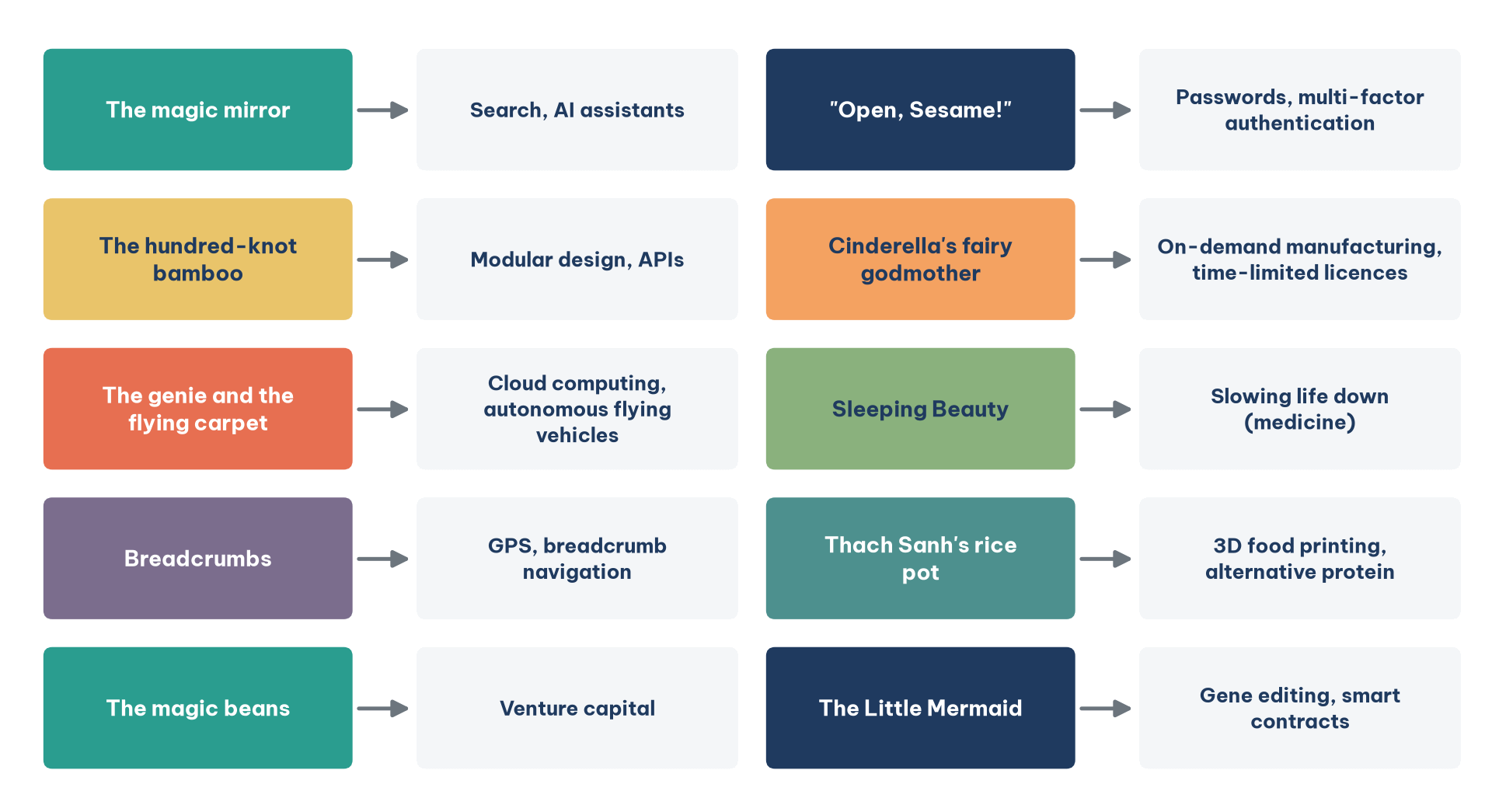
The article goes through ten familiar pieces of magic. Each section has three parts: the story, the technology decoded, and where the metaphor stops. Sections 1 to 3 cover information and software (search, AI, authentication, APIs). Sections 4 to 8 cover matter, travel, life and food. Sections 9 and 10 turn to finance and contracts. Section 11 summarizes all ten stories in one table, then suggests how to use folk tales, including stories from Vietnam that may be new to many readers, to find ideas for new products. Figure 1 maps the whole article.
1. The magic mirror (Snow White): search engines and AI assistants
The story. In Snow White and the Seven Dwarfs, the wicked queen owns a magic mirror that can answer any question, above all the classic one: "Mirror, mirror, on the wall, who is the fairest of them all?".
Figure 2 puts the magic mirror next to a phone: the question the queen once asked is now the question everyone types into a search engine or an AI assistant.
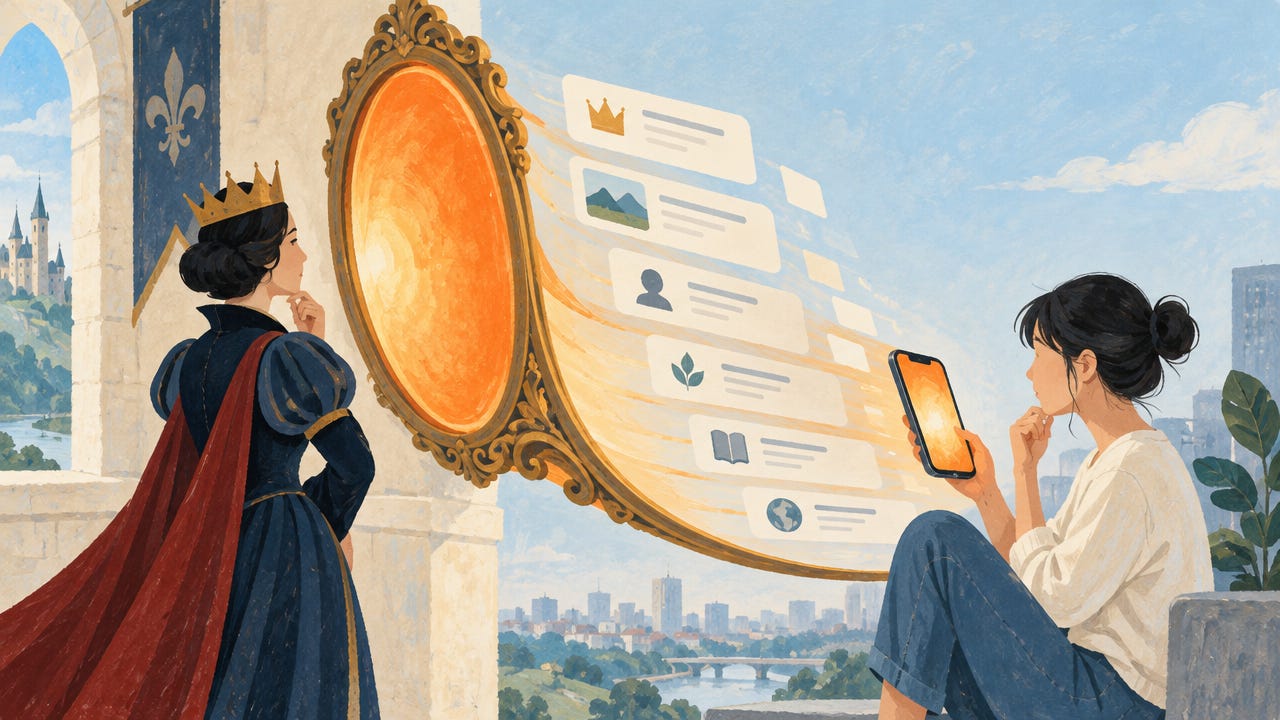
The technology decoded. The magic mirror is a neat metaphor for three pillars of modern information technology.
Search engines. To answer the queen, the mirror must access a "database" of every woman in the land, compare their attributes (here, beauty) and return a ranked result. That is the core principle of Google or Bing: crawl data from web pages, index it and rank results for a query.
Artificial intelligence and natural language processing (AI, NLP). The queen talks to the mirror in natural language. The mirror does not just "hear" but "understands" the meaning of the question to answer it. That is the essence of virtual assistants such as Siri, Google Assistant and Alexa, and more recently chatbots built on large language models such as ChatGPT, Gemini and Claude. They are "magic mirrors" in our pockets, ready to answer anything from today's weather to how to write an Excel formula.
Real-time analytics. The mirror always has the latest answer. When Snow White grows up and becomes more beautiful, the mirror changes its answer at once. This corresponds to real-time data analysis, an important capability in finance, marketing and cybersecurity today.
Where the metaphor stops. The mirror in the story is never wrong and never flatters, even when its answer enrages the queen. Today's AI assistants differ on both counts. Language models can "hallucinate", producing answers that sound convincing but are false, even inventing citations. They also tend to agree with the person asking, telling users what they want to hear. Moreover, an AI's answers reflect the data it was trained on, so they can carry that data's biases: "fairest" by whose standards? The lesson for users is to treat AI as a capable assistant that needs checking, not as a magic mirror.
The mirror answers anyone who stands before it. The next story raises the opposite problem: how do you make a door open only for the right person?
2. "Open, Sesame!" (Ali Baba): passwords and multi-factor authentication
The story. In Ali Baba and the Forty Thieves, the secret cave door opens only when someone says the right spell: "Open, Sesame!". Ali Baba hides behind a bush, overhears the thieves' spell, and the door opens for him too.
Figure 3 shows the same door in two eras: one half is a rock face that opens to a spoken spell, the other a vault door that opens to a fingerprint, a face and a code on a phone.
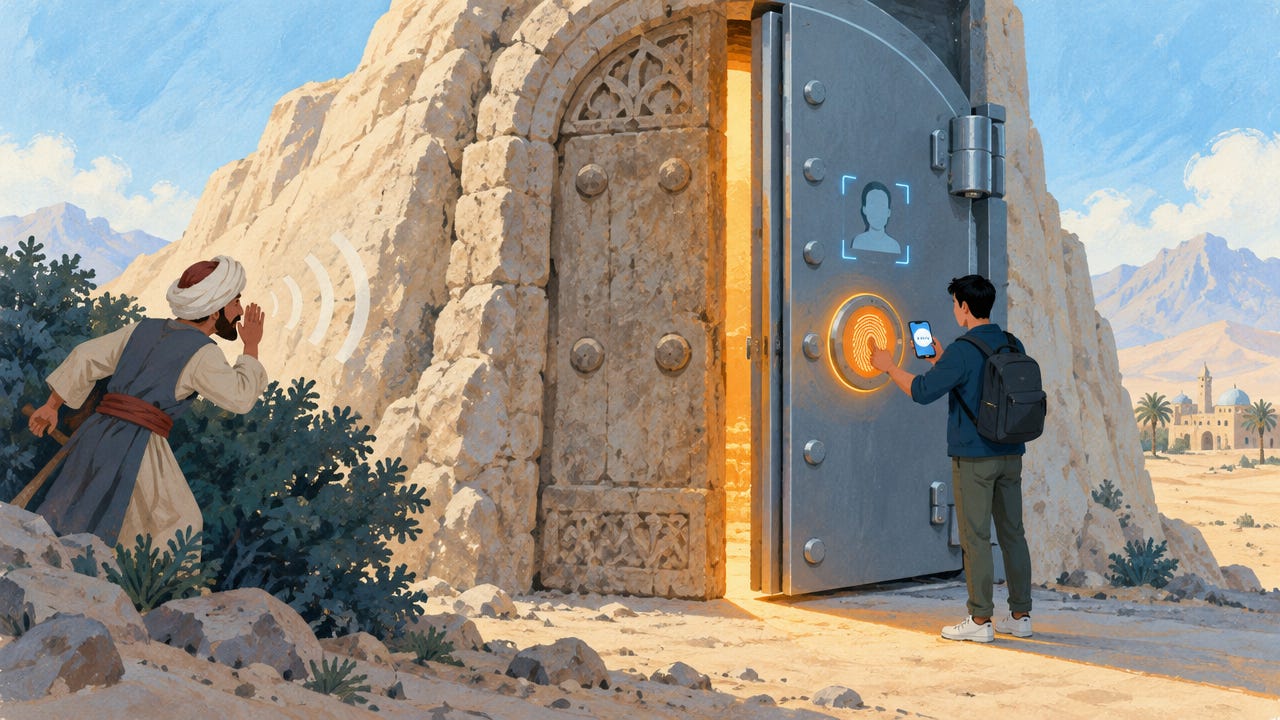
The technology decoded. The spell works like a password: the system does not need to know who is at the door, only that the person says the right secret string. Ali Baba's eavesdropping shows a password's biggest weakness at once: anyone who knows the password can get in, owner or thief. His greedy brother Cassim later gets into the cave but forgets the spell to get out, illustrating a second weakness: passwords depend on human memory.
To address this, modern information security groups authentication evidence into three categories (Grassi et al., 2017), shown in Figure 4.
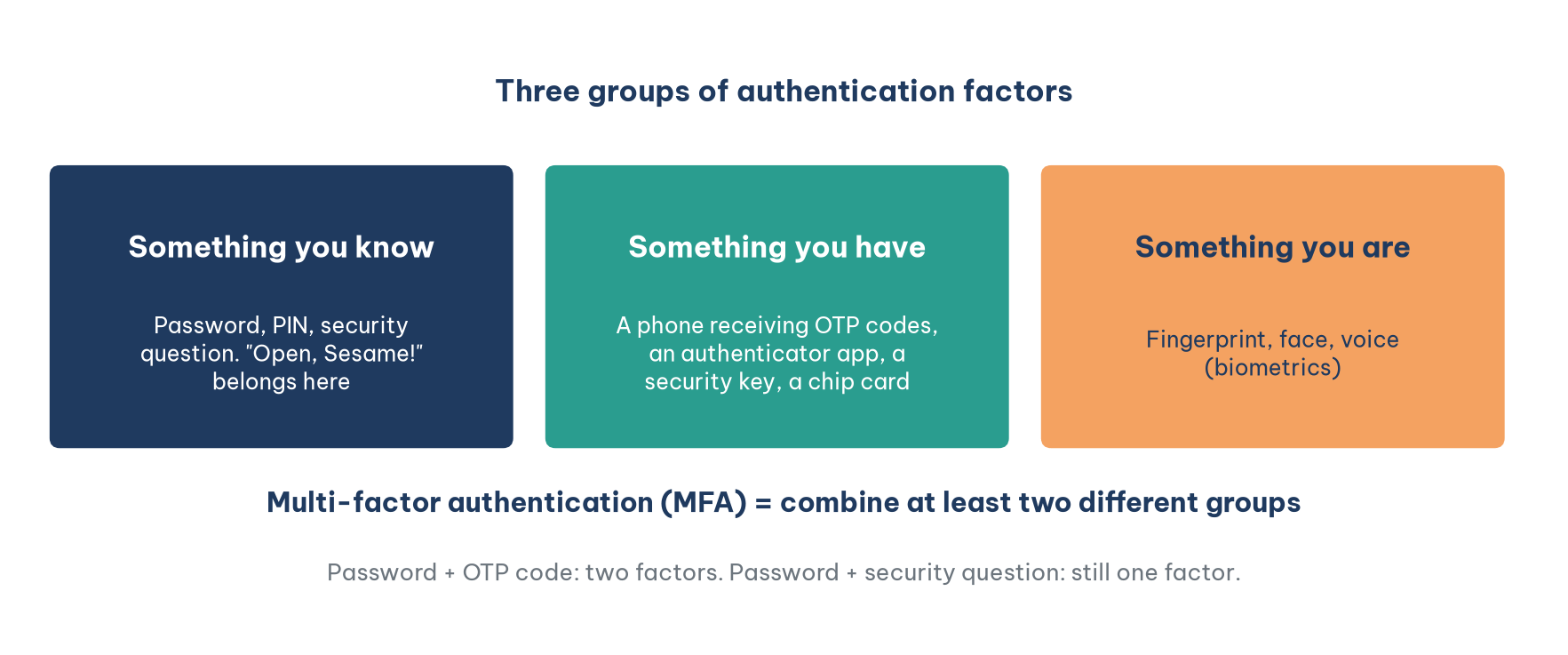
Multi-factor authentication (MFA) requires at least two different groups. When you log in to a banking app with a password and then confirm a transaction with a one-time code on your phone, you are using "something you know" plus "something you have". When a large transfer asks you to scan your face, the bank adds "something you are". If the thieves' cave had required both the spell and the leader's voice, Ali Baba could not have entered.
The idea of voice biometrics has a real basis: a more sophisticated system could recognize not only the content of what is said but the distinctive features of a voice (frequency, timbre, rhythm). Some large banks, such as HSBC, have used voice recognition to authenticate phone-banking customers instead of traditional security questions.
Where the metaphor stops. In the Thousand and One Nights, nobody could imitate the thieves' leader's voice. Today, someone can. AI tools can clone a voice from a few seconds of recording, so a voice has become an unreliable factor on its own. Scams that fake a relative's voice, or a director's voice asking for a money transfer, have appeared in many countries. The lesson: no authentication factor is absolutely safe; security comes from combining factors and from the habit of verifying through another channel when a request is unusual.
From who gets in, we move to joining parts together, with a spell familiar to every Vietnamese child.
3. The hundred-knot bamboo: modular design and application programming interfaces (APIs)
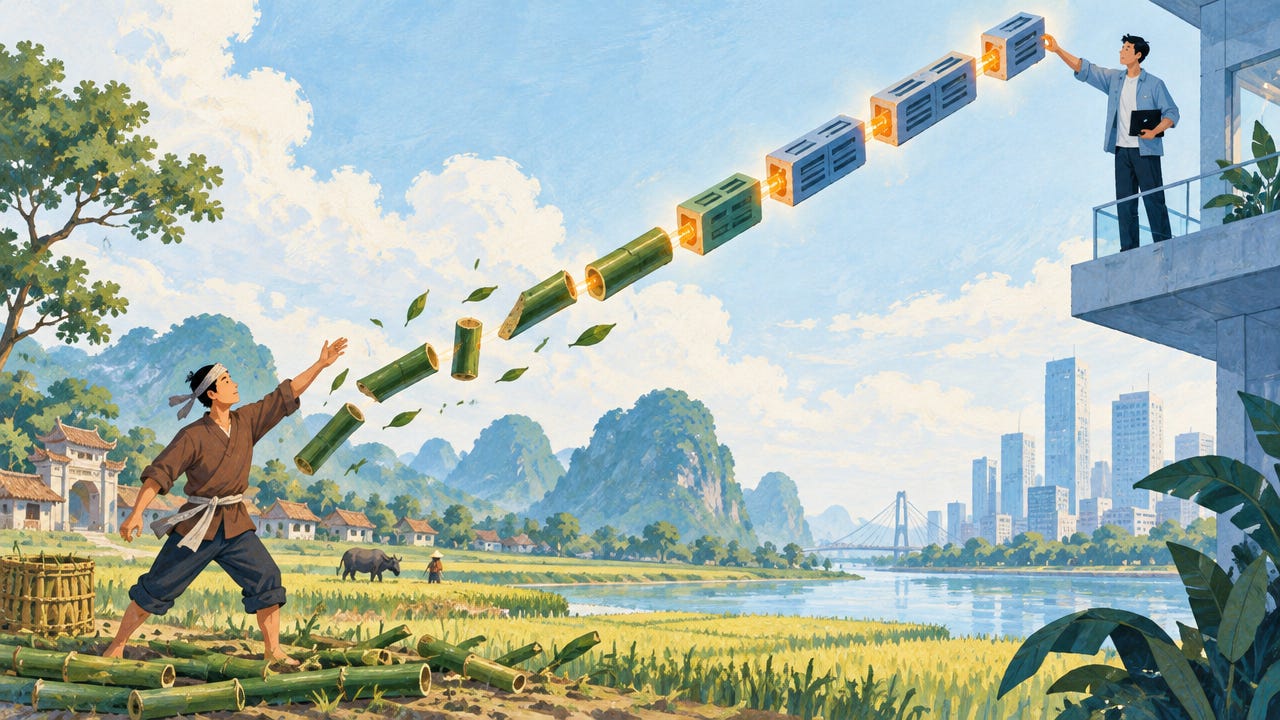
The story. In this Vietnamese folk tale, a young farmhand named Khoai is promised the hand of a rich landowner's daughter if he can find a bamboo with a hundred knots. No such bamboo exists. With help from Bụt, the kindly old sage of Vietnamese folk tales, he cuts a hundred separate bamboo segments and uses the spell "Khắc nhập! Khắc nhập!" ("Join together!") to join them into one stalk, and "Khắc xuất!" ("Come apart!") to separate them.
Figure 5 redraws that magic: the bamboo sections fly up, join together and gradually turn into modules with standard connectors in the hands of a present-day engineer.
The technology decoded. This magic illustrates two fundamental concepts in modern engineering and manufacturing.
Modular design. Instead of making a complex product as a single block, engineers divide it into independent, standardized "modules" that can be assembled together. This makes production, transport, repair and upgrades far easier. From IKEA furniture and computer components (RAM, SSDs, graphics cards) to the International Space Station, all show the power of modular design. In software, a microservices architecture splits a large application into many small services, each doing one job, connected over a network. Khoai's bamboo is a fully modularized physical system: a hundred identical segments connected to the same standard.
APIs (application programming interfaces). The spell "Join together! Come apart!" is like an API: a simple command with a clear convention that lets a user (Khoai) interact with a complex system (the bamboo segments) without knowing how it works inside. In the digital world, when you click "Sign in with Google" in another app, that app is calling Google's API. You simply say "sign in", and the API handles the whole complex authentication process behind it. When an online shop shows the delivery fee right on the checkout page, that is the result of an API call to a shipping company.
Where the metaphor stops. In the story, the spell works for anyone who says it: the landowner himself gets stuck to the bamboo. A real API must control who can call it and what they can do, using API keys, tokens and permissions. Moreover, modules fit together only when they follow the same interface standard; when the standard changes (a new API version), systems still using the old standard may "come apart segment by segment".
The first three stories concern information and software. The next moves into the physical world, with magic that has an expiry date.
4. The fairy godmother's magic (Cinderella): on-demand manufacturing and time-limited licences
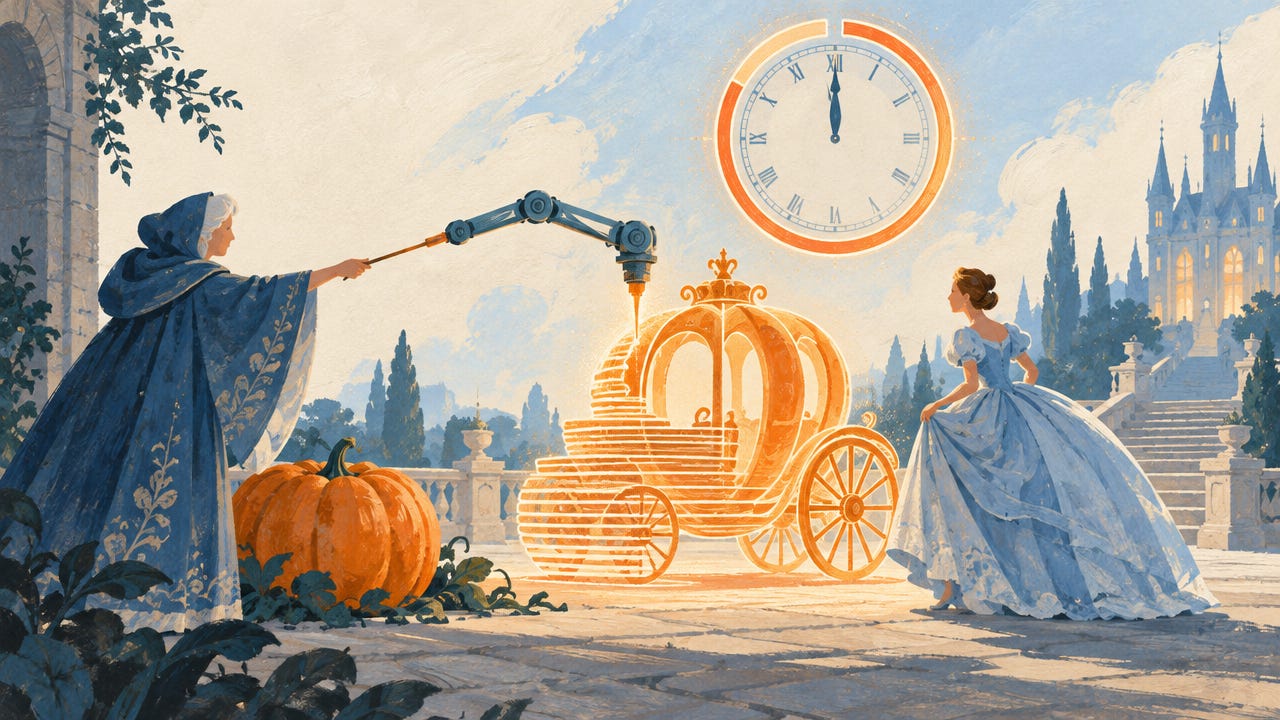
The story. The fairy godmother turns a pumpkin into a carriage, mice into horses and old clothes into a splendid ball gown, but everything "expires" at midnight.
Figure 6 reads the fairy godmother's magic through today's eyes: her wand becomes a 3D printing arm, and the stroke of midnight becomes a countdown on a licence that expires.
The technology decoded. The fairy godmother's magic does not create permanent matter but a temporary transformation, just in time.
On-demand manufacturing and 3D printing. The fairy godmother has no carriage in stock. She "manufactures" one on the spot from an available material (the pumpkin) only when Cinderella needs it. This is the spirit of 3D printing: objects are built layer by layer from raw material, as soon as an order arrives, reducing the need for warehouses and mass production. Today many workshops use 3D printing for spare parts, architectural models, product prototypes and orthopaedic braces made to each patient's measurements.
Time-limited licences and digital rights management (DRM). The midnight limit is a telling detail. It is like a pre-programmed "temporary licence". In the digital world this model is familiar: you rent a film on a streaming app and can only watch it for 48 hours, borrow an e-book from a library and it "returns" itself after 14 days, or subscribe to software and lose access when you stop paying. On the materials side, researchers are developing smart materials and 4D printing: printed objects that change shape or properties when exposed to heat, water or light. Imagine packaging that decomposes itself after its expiry date: a real, more modest version of the pumpkin carriage.
Where the metaphor stops. Technology cannot "turn" a pumpkin into a carriage: 3D printing still needs the right plastic, metal or powder, takes hours to print, and for many products cannot yet match mass production in quality. As for time-limited licences, the question is users' rights: when the provider decides when "midnight" strikes, what does the buyer really own?
If the fairy godmother creates objects on demand, the genie can do even more: grant almost any wish.
5. The genie and the flying carpet (Aladdin): cloud computing and autonomous flying vehicles
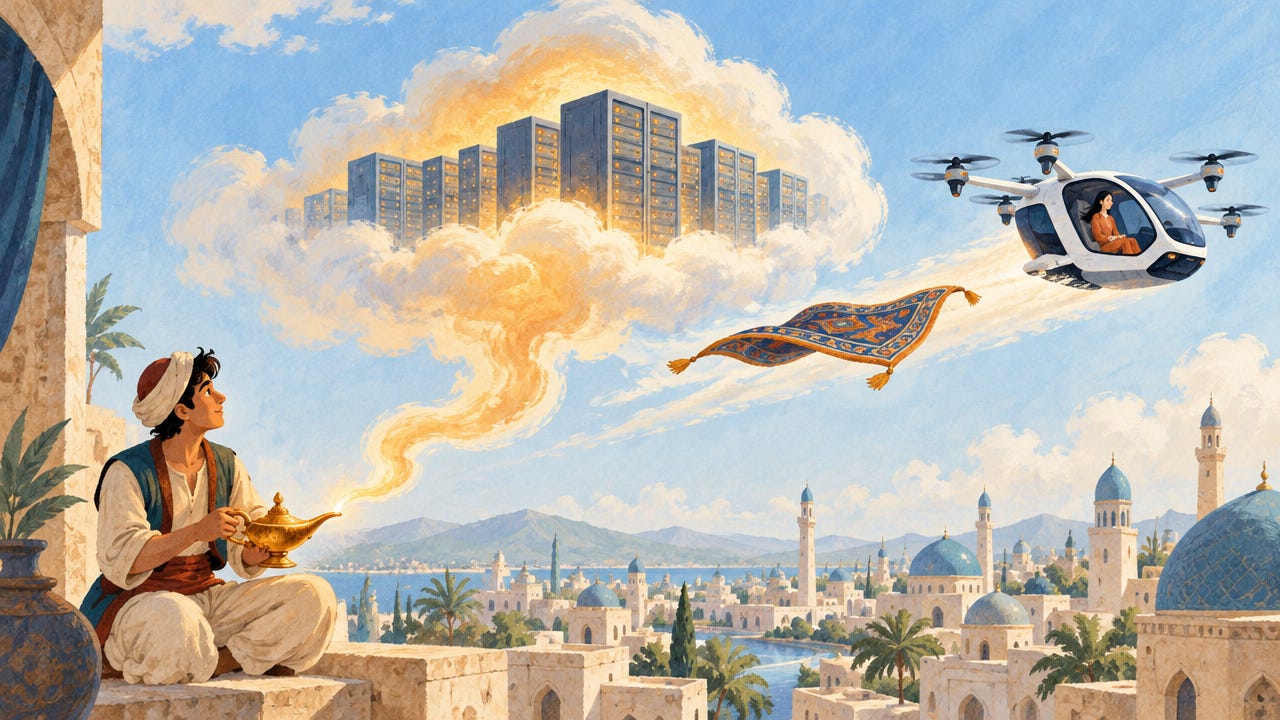
The story. Aladdin can summon a genie from an old lamp and owns a flying carpet that can take him anywhere.
Figure 7 links Aladdin's two pieces of magic to two technologies: the smoke from the lamp rises into a cloud full of servers, and the flying carpet shares the sky with a driverless air taxi.
The technology decoded.
The genie and cloud computing. The genie is not just a servant. He can fulfil almost any request, from building a magnificent palace overnight (the equivalent of deploying a whole server infrastructure in minutes) to bringing wealth. "Summoning" the genie from a small lamp is like how we access the enormous computing power of cloud services such as AWS, Microsoft Azure or Google Cloud from a small laptop, to run AI models or store huge amounts of data. We make a request, and "the cloud" carries it out.
The flying carpet and autonomous flying vehicles. The flying carpet is humanity's age-old dream of personal travel, unconstrained by roads, flying automatically to its destination. Today many companies are developing electric vertical take-off and landing aircraft (eVTOL) and air taxis. EHang's pilotless passenger aircraft EH216 (formerly EHang 184) is one example: the EH216-S version received a type certificate from China's civil aviation authority in October 2023, opening the way for commercial sightseeing flights.
Where the metaphor stops. The genie grants only three wishes and charges nothing. The cloud grants countless "wishes" but charges for each one: every server hour, every gigabyte stored, every AI model call. Many companies receive surprisingly high cloud bills because they forgot to switch resources off. Moreover, when a whole system runs on one provider's cloud, the company depends on that provider, just as Aladdin loses everything when the lamp falls into someone else's hands. For the flying carpet, the biggest barrier today is not flight technology but safety regulation, landing infrastructure, noise and social acceptance.
The first five stories concern information, software and objects. The sixth touches a bigger dream: extending and pausing life itself.
6. The hundred-year sleep (Sleeping Beauty): slowing life down
The story. The princess does not die and does not age. Her body is "preserved" in an unchanging state for a hundred years, waiting for an outside agent (the prince's kiss) to "reactivate" it.
Figure 8 places two beds side by side: the princess asleep in a tower overgrown with rose thorns, and a patient being cooled in an emergency room where the doctor counts every minute.
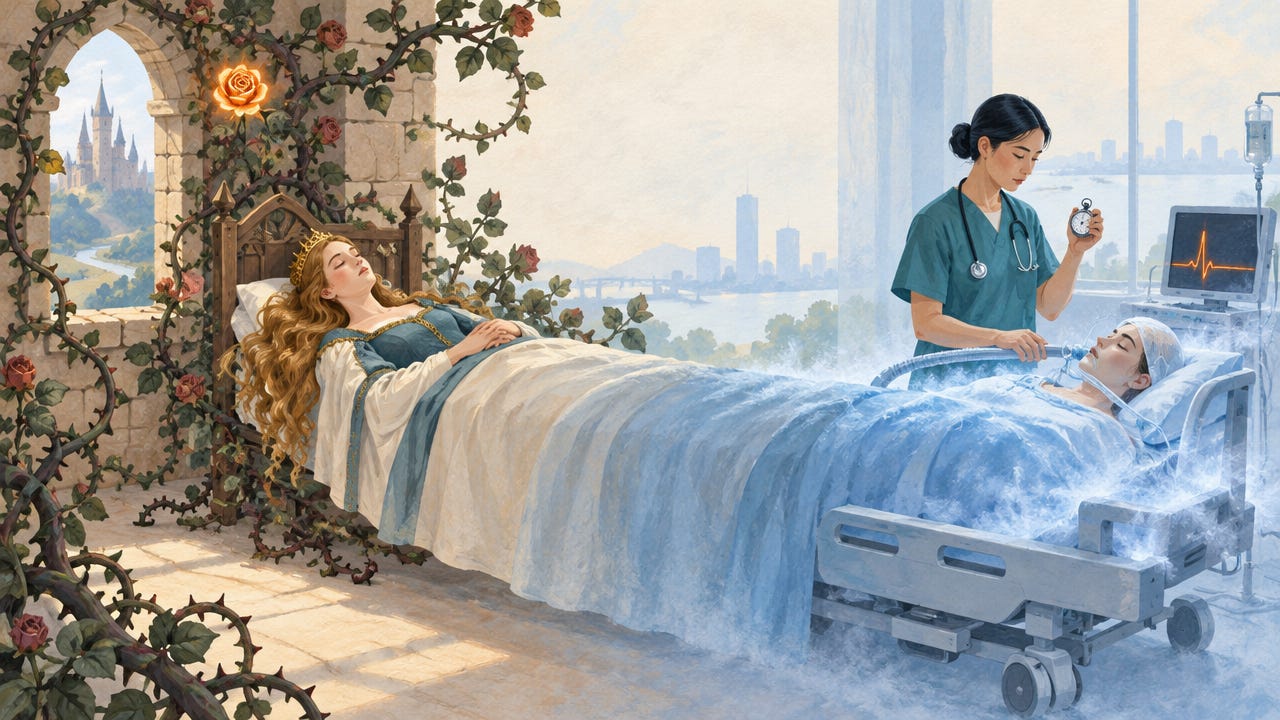
The technology decoded. People often lump this together as "hibernation technology". In fact there are two very different directions, differing both in who they apply to and in their scientific standing, as Table 1 shows.
The first direction is serious medicine: doctors use cold solutions to rapidly lower the body temperature of trauma patients in cardiac arrest, "buying time" for surgery to stop the bleeding, then rewarm and resuscitate them (Tisherman et al., 2017). It is a real-world version of "waiting for an outside agent to reactivate", only with a far shorter wait. The second direction, cryonics, is a commercial service in some countries, but there is no evidence that freezing and thawing can preserve the brain intact for revival. The idea of astronauts "hibernating" through interstellar voyages lasting decades remains at the level of conceptual research.
Where the metaphor stops. In the story, the princess wakes intact after a hundred years. In reality, every hour of suspended animation risks brain and organ damage. The story also raises an ethical question: when a company sells "waiting for revival", are buyers paying for science or for hope?
From preserving life, we return to a far more everyday problem: finding the way home.
7. Breadcrumbs (Hansel and Gretel): GPS and breadcrumb navigation
The story. Abandoned in the forest, Hansel scatters breadcrumbs to mark the way home. But the birds eat the crumbs, and the two children get lost.
Figure 9 follows the trail from the forest to the map: the breadcrumbs the birds eat turn into location points linked to a satellite, guiding a hiker who follows the route on her phone.
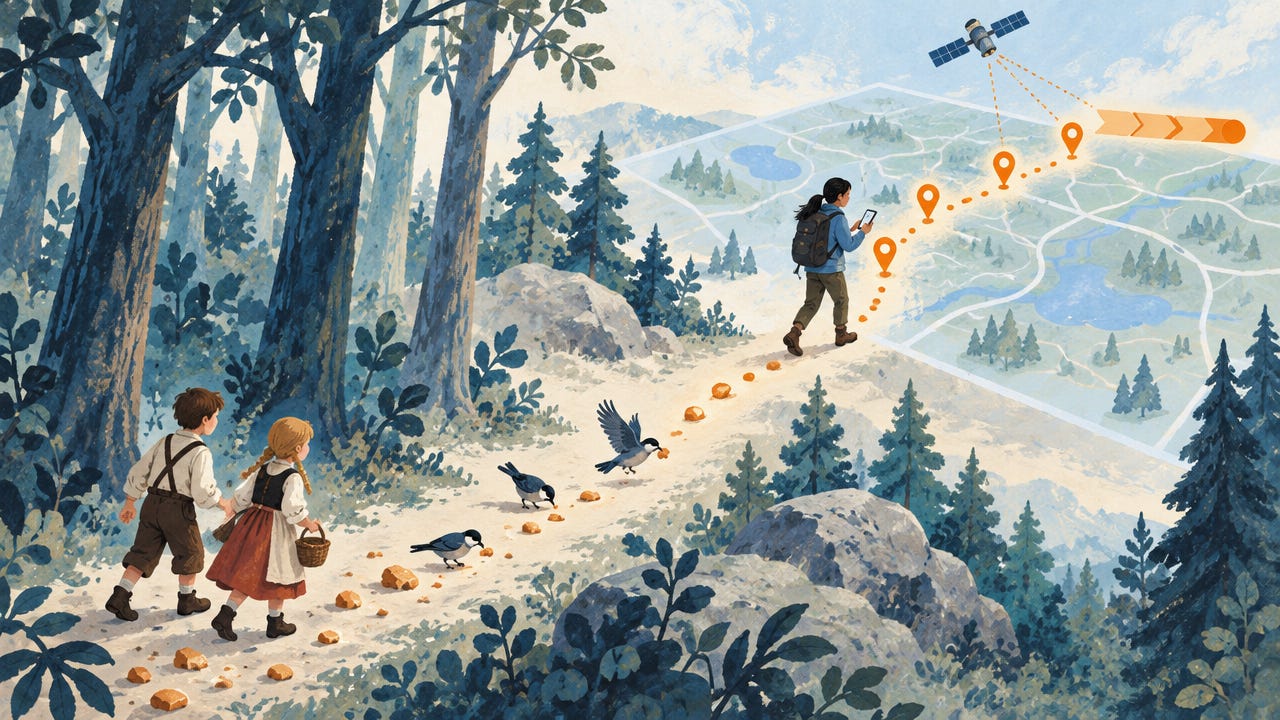
The technology decoded. Hansel's act is a primitive attempt to create a system for recording a route and giving directions.
The Global Positioning System (GPS). Hansel creates a chain of "data points" (breadcrumbs) to record his path. Our phones also record routes as a chain of coordinates, each calculated from signals from several satellites. The system's failure in the story (the birds eat the bread) is a lesson about making systems robust to their environment, something satellite signals do much better than breadcrumbs, although they can still weaken in tunnels, between tall buildings, or under jamming.
Breadcrumb navigation. More interestingly, the idea went straight into web and software interface design. When browsing a multi-level website, you often see a line at the top of the page showing where you are, for example: Home > Products > Electronics > Phones. This navigation bar is literally called a breadcrumb, inspired by this story. The user-experience research firm Nielsen Norman Group recommends breadcrumbs for sites with multi-level structures, because they help users know where they are and go back up a level with one click (Nielsen, 2007).
Where the metaphor stops. Hansel scattered his breadcrumbs himself and only he used them. Our "breadcrumbs" today (location history, browsing history, searches) are recorded automatically and can be read by many others: app providers, advertisers, sometimes criminals. The birds in the story only ate the trail; in the digital world, the trail can be collected and sold. That is why personal-data protection laws in many jurisdictions, from the EU's General Data Protection Regulation (European Parliament & Council of the European Union, 2016) to Vietnam's 2025 Personal Data Protection Law (National Assembly of Vietnam, 2025), treat location data as information requiring protection.
Hansel and Gretel get lost in the forest because their family is poor and hungry. The next story, from Vietnam, answers exactly that fear with a pot that never empties.
8. Thach Sanh's rice pot: 3D food printing and alternative protein
The story. In this Vietnamese folk tale, the hero Thach Sanh owns a tiny rice pot that can feed the armies of eighteen kingdoms without ever running out. The soldiers eat and eat, and the pot fills up again.
Figure 10 shows the tiny rice pot feeding a whole army next to a 3D food printer and a cultivated-protein tank in a modern kitchen.
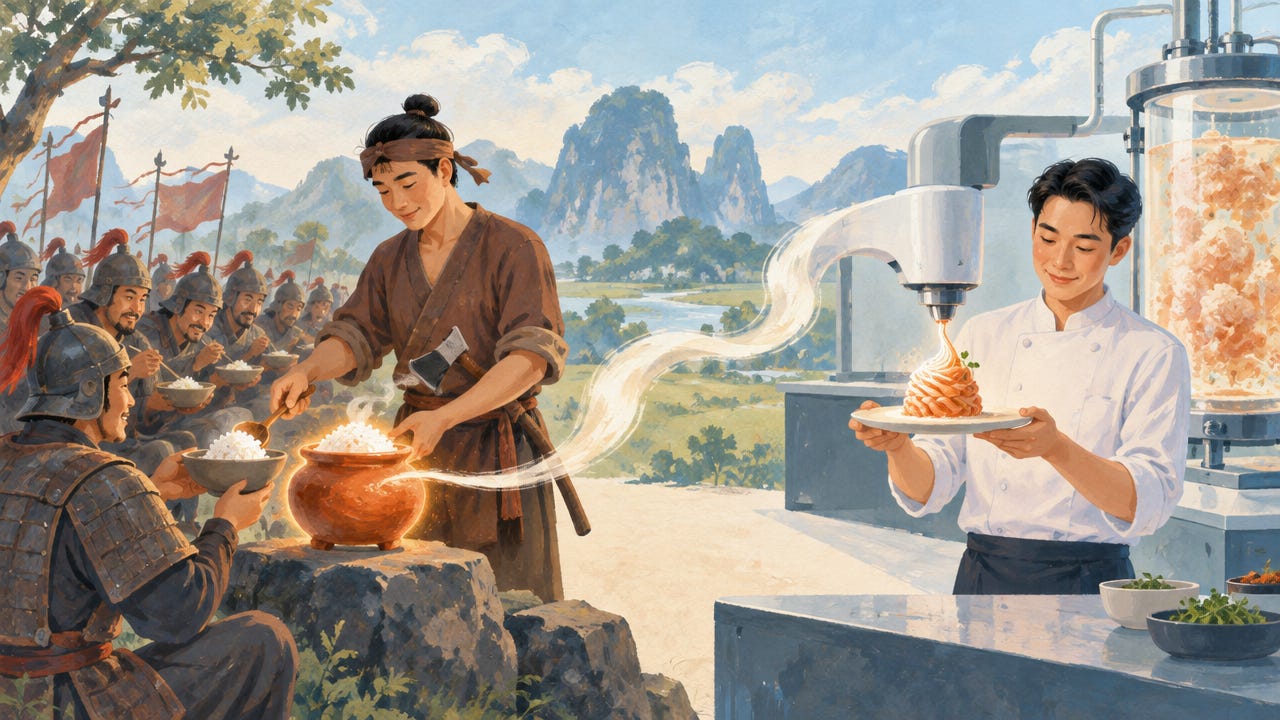
The technology decoded. This is the dream of an abundant food supply that ends hunger. Modern technology is approaching it in several ways.
3D food printers. Imagine a printer that not only shapes food but combines nutrients (protein, starch, vitamins) from raw ingredients such as algae flour or plant protein to create dishes tailored to each person, for instance soft, easy-to-swallow meals for older people. Food printers are already used in some restaurants and hospital kitchens, though still at small scale.
Alternative protein. Instead of raising a whole chicken for meat, companies grow animal cells in bioreactors (cultivated meat), or use microbial fermentation to produce protein. Singapore was the first place to allow the sale of cultivated chicken, in 2020. This is the closest thing to "a small pot feeding a whole army": producing protein on far less land than livestock farming.
Science-fiction replicators. In Star Trek, the "replicator" can rearrange matter to create any dish. Thach Sanh's rice pot can be seen as a food-only replicator. Unlike the two directions above, this remains pure fiction.
Where the metaphor stops. The rice pot needs no rice, firewood or water. All real food technologies need ingredients and energy: cultivated meat needs growth media, electricity and sterile bioreactors, and it still costs more than farmed meat. Moreover, hunger today is usually caused not by a global shortage of food but by distribution, prices, conflict and poverty. A magic pot in one place does not solve the problem of food not reaching the places that need it.
From the rice pot we move to a small seed that can grow up to the sky, and a story about money.
9. The magic beans (Jack and the Beanstalk): venture capital
The story. Jack trades the family cow for a few magic beans. His mother angrily throws them out of the window. Overnight, they grow into a giant beanstalk reaching the sky, where a giant's castle holds a hen that lays golden eggs.
Figure 11 retells the story in an investor's language: a whole row of seeds is planted and watered, most barely sprout, and only one stalk climbs into the clouds to the golden egg.
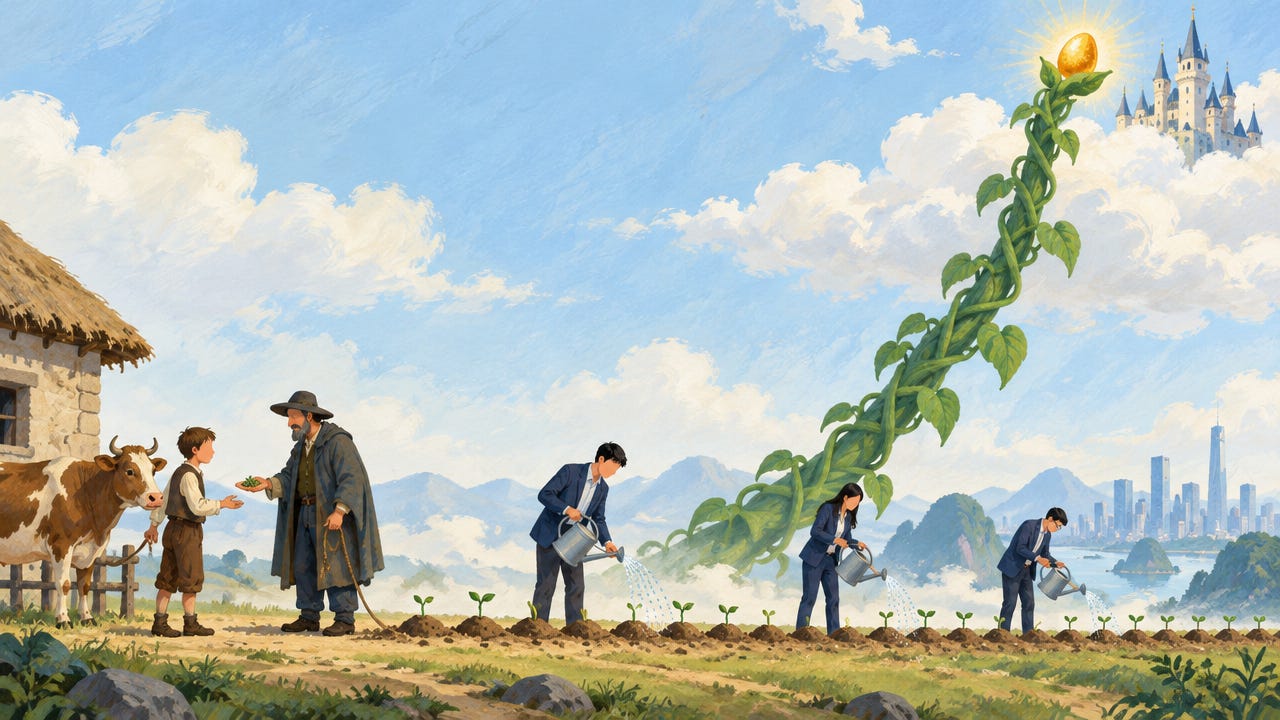
The technology decoded.
Venture capital. Trading the cow (a safe asset producing a steady supply of milk) for a few beans (a risky asset with an unknown outcome) is exactly the logic of seed funding: a small investment with very high risk but the potential for returns many times over. The beanstalk growing overnight is an image of the meteoric growth that venture investors look for in a startup.
"The cloud". The giant's castle sits literally in the clouds. By climbing up, Jack gains access to a whole new world of resources (a golden-egg hen, a self-playing harp). Similarly, companies today "move to the cloud" to access computing power, storage and AI services they could not build themselves (see Section 5).
Where the metaphor stops. In the story, Jack's mother throws the beans away and they still grow. In venture capital, most beans never sprout: most early-stage startup investments do not return their capital, and a fund's returns usually come from a few very large successes. That is why venture investors spread their money across many startups, and why founders should not trade the family's only "cow" for a single bean. One more detail is worth pondering: Jack gets his wealth by stealing from the giant's castle. Fast growth does not justify violating other people's rights, a lesson some technology startups have paid dearly to learn.
The last story is also a transaction, but one with terms that enforce themselves automatically.
10. The Little Mermaid's legs: gene editing and smart contracts
The story. In Disney's animated film, the mermaid Ariel trades her singing voice for a pair of legs in a deal with the sea witch Ursula. The deal has a harsh clause: if Ariel does not receive true love's kiss within three days, she will belong to Ursula. The clause is enforced automatically; no one can intervene.
Figure 12 combines the story's two technologies in one scene: a spiral of bubbles like a DNA molecule around the mermaid, and the scroll of the deal stretching into a locked chain of blocks that ends in a self-triggering clock.
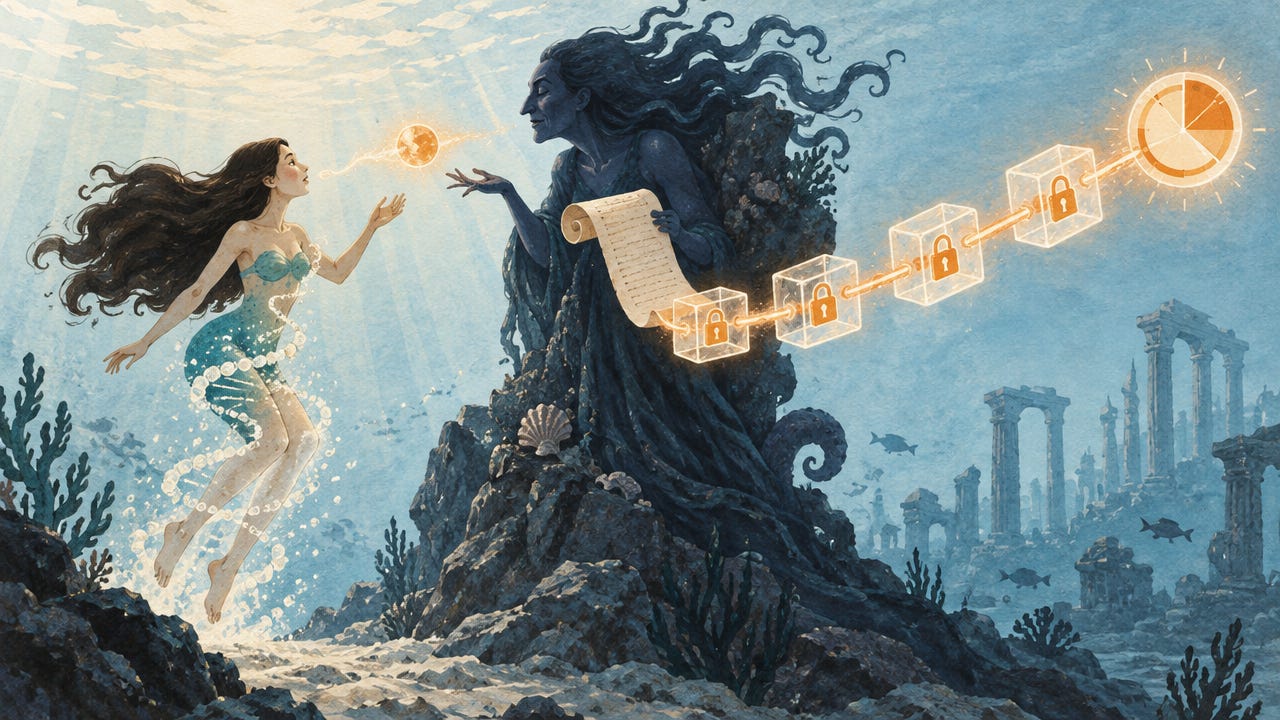
The technology decoded.
Biological intervention and genetic engineering. Transforming part of the body is an extreme form of biological intervention. It evokes both the potential and the ethical questions of gene-editing technologies such as CRISPR. In late 2023, the first CRISPR-based therapy (Casgevy, for sickle cell disease and beta-thalassaemia) was approved by regulators in the United Kingdom and the United States. By contrast, in 2018 a Chinese scientist announced that he had edited the genes of human embryos, leading to the birth of two girls, provoking strong opposition from the scientific community and a criminal conviction. The two events show that, with the same technology, the line between curing disease and "trading away" human nature lies in purpose and consent.
Smart contracts. The deal between Ariel and Ursula is a contract with clear terms and consequences triggered automatically when conditions are not met. That is the core principle of smart contracts on blockchain platforms such as Ethereum: terms are written as code and executed automatically when conditions occur, without an intermediary. For example, a flight-delay insurance contract can automatically pay passengers when flight data show the plane is more than two hours late.
Where the metaphor stops. Ursula's contract has a vague clause, "true love", but magic can still judge it. Smart contracts can only enforce what data can measure: amounts of money, times, flight statuses. They cannot judge "love", "good faith" or "goods as described". Moreover, buggy code is executed just like correct code: in 2016, a vulnerability in the smart contract of The DAO project on Ethereum was exploited to drain a large amount of cryptocurrency. When "code is law", programming errors become law too.
11. A summary table, and using fairy tales to find ideas
After ten stories, it is time to look at them together. This section summarizes the magic, the corresponding technology and the limit of each comparison in one table, then suggests how to use fairy tales themselves as a tool for finding product ideas.
11.1. Ten stories in one table
Across the ten stories, each piece of magic is a need, each technology is a way of meeting that need, and each comparison has its own limit. Table 2 sets these three elements side by side for review.
Reading down the last column reveals a pattern: magic in stories is usually free, absolute and without side effects, while real technology costs money, can be wrong and raises questions of rights and ethics. Kevin Kelly (2016) describes technology as a continual process of "becoming" that is never complete. The gap between magic and technology, then, is not only a gap in time but the work technologists must take on: making it safe, fair and trustworthy.
11.2. Using fairy tales to find ideas
There is a more interesting way to use folk tales than just explaining existing technology: use them to find unmet needs. Folk tales contain dreams; dreams contain needs; and needs are the starting point of every product. Figure 13 suggests a four-step process.
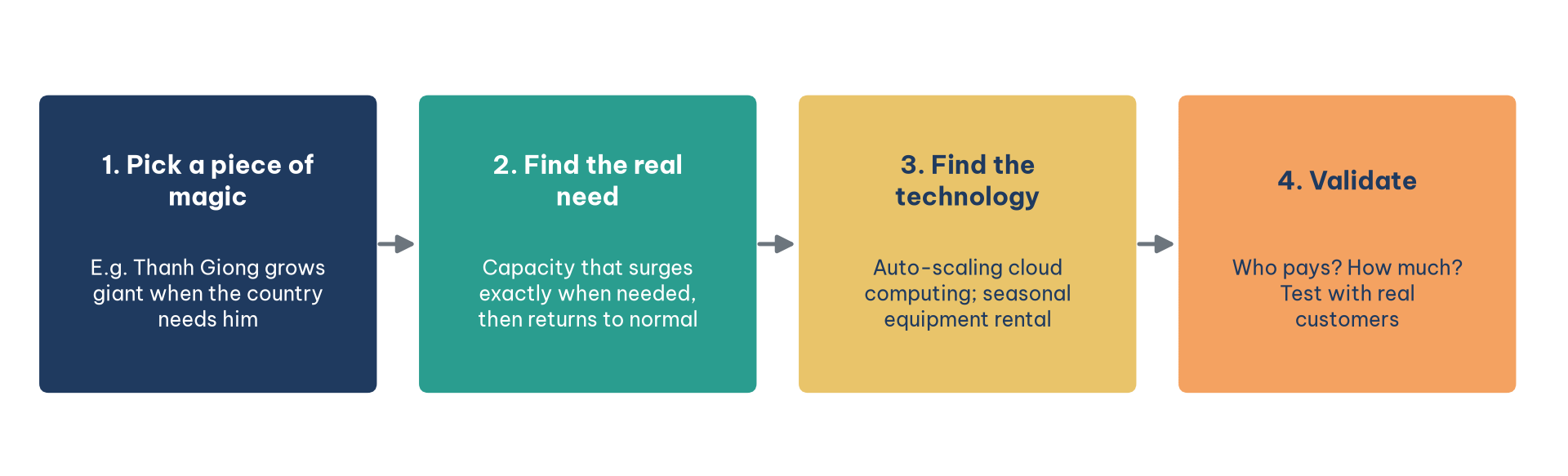
Step 1 picks a piece of magic. Step 2 asks: who needs that today, and in what situation? Step 3 looks for technology that can meet part of that need. Step 4, the most important, validates: who will pay, how much, and how could you test it with real customers within a few weeks? Table 3 applies the process to three Vietnamese folk tales that will be new to many international readers.
The next three figures redraw the three rows of Table 3. Each keeps the magic on one side and puts the person with today's need on the other, in the spirit of step 2. Figure 14 starts with Thanh Giong: the iron horse that grows in an instant becomes a stack of servers that expands just as a small shop is flooded with orders on a sale day.
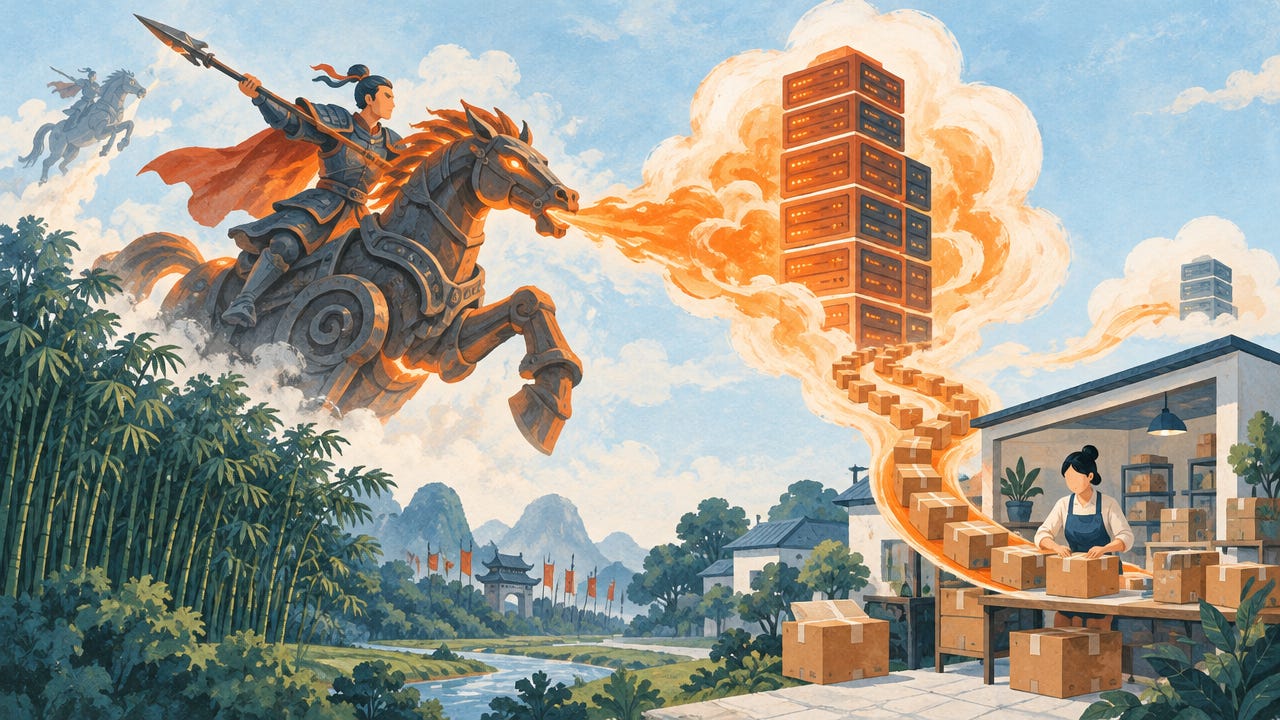
Figure 15 moves to Son Tinh and Thuy Tinh. The race between mountain and water is replaced by a water-level sensor by the river, which sends an early warning so the farmer can move his motorbike and sacks of rice to higher ground.
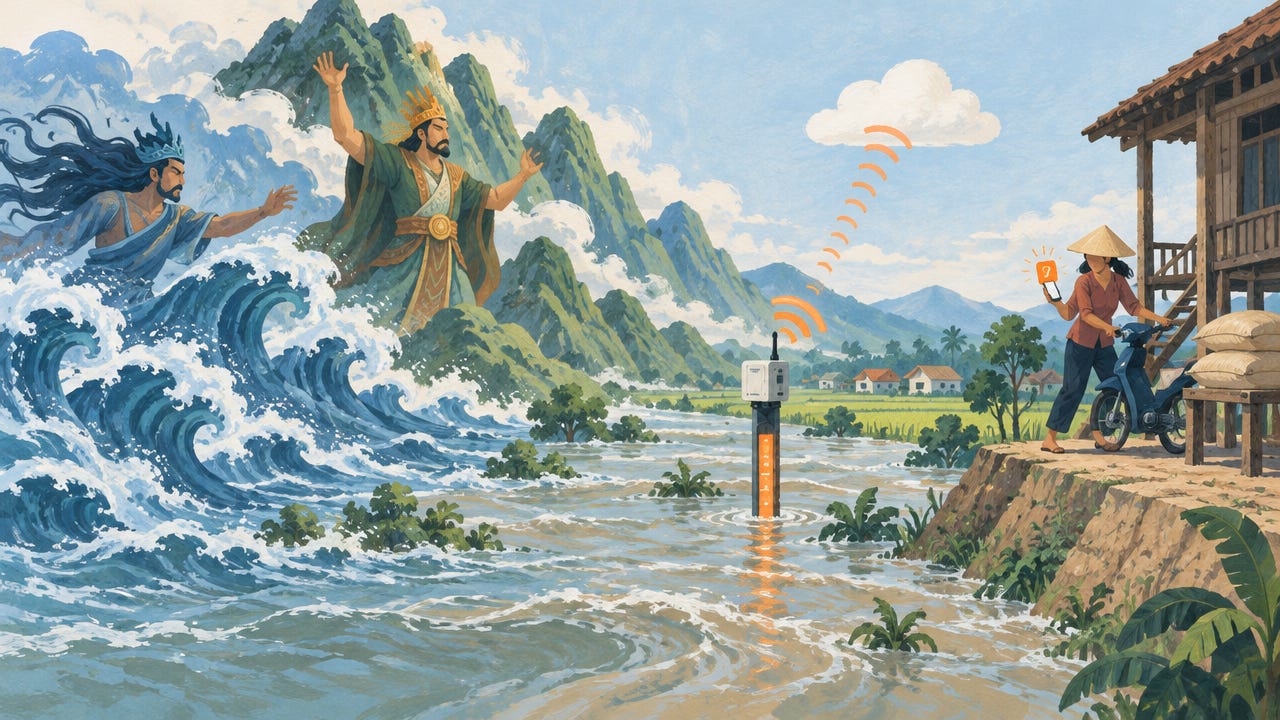
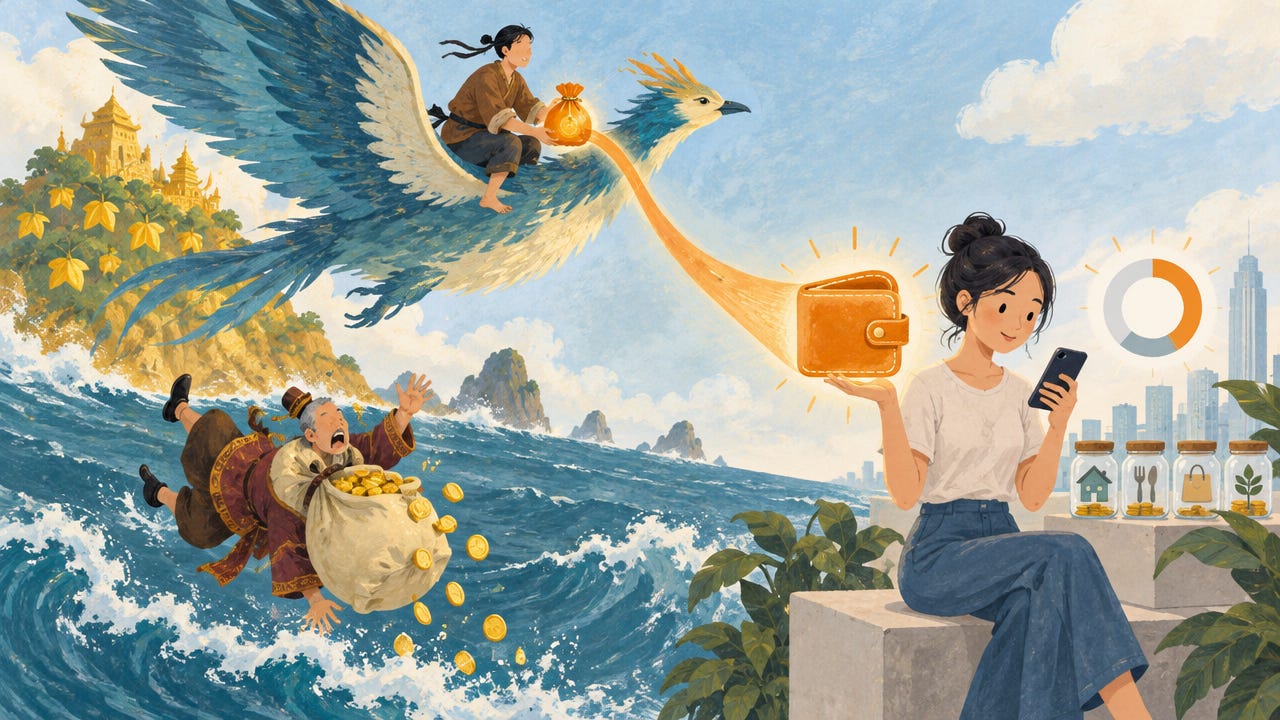
Figure 16 closes with The Star Fruit Tree. The younger brother's three-span bag becomes a wallet with a limit, while the elder brother, clutching more gold than he can carry, falls into the sea.
The key point is that the magic is only a starting point. Most of the value lies in steps 2 and 4: understanding correctly who has the problem, and proving they are willing to pay for a solution. An idea for "a flying taxi like a magic carpet" sounds very appealing, but an idea for "maintenance reminders for ride-hailing drivers' motorbikes" may be far more practical and useful.
Conclusion: technology is magic with conditions
Fairy tales are not only products of the imagination. They crystallize humanity's deepest dreams, aspirations and needs: to know, to be protected, to have enough, to travel far, to live longer. Technology, in essence, is humanity's tireless journey to turn that "magic" into reality. Today's engineers, programmers and scientists are, in a sense, the fairy godmothers of the modern age.
But unlike fairy godmothers, they have no free magic. Every technology in this article has a price: money, energy, personal data, dependence, or ethical questions not yet answered. Reading folk tales through a technology lens should therefore come with two questions: what need does this magic meet, and where does the comparison stop?
Next time you reread a folk tale, try to find the technology ideas hidden inside, and try to carry on to the validation step. You will find that the line between magic and technology is a matter of time, creativity and human responsibility.
References
European Parliament & Council of the European Union. (2016). Regulation (EU) 2016/679 (General Data Protection Regulation). https://eur-lex.europa.eu/eli/reg/2016/679/oj
Grassi, P. A., Garcia, M. E., & Fenton, J. L. (2017). Digital identity guidelines (NIST Special Publication 800-63-3). National Institute of Standards and Technology. https://doi.org/10.6028/NIST.SP.800-63-3
Kelly, K. (2016). The inevitable: Understanding the 12 technological forces that will shape our future. Viking.
National Assembly of Vietnam. (2025). Law on Personal Data Protection No. 91/2025/QH15. https://chinhphu.vn/?pageid=27160&docid=214590&classid=1&typegroupid=3
Nielsen, J. (2007). Breadcrumb navigation increasingly useful. Nielsen Norman Group. https://www.nngroup.com/articles/breadcrumb-navigation-useful/
Tisherman, S. A., Alam, H. B., Rhee, P. M., Scalea, T. M., Drabek, T., Forsythe, R. M., & Kochanek, P. M. (2017). Development of the emergency preservation and resuscitation for cardiac arrest from trauma clinical trial. Journal of Trauma and Acute Care Surgery, 83(5), 803–809. https://doi.org/10.1097/ta.0000000000001585
Discussion about this post