Finding Trustworthy Research Sources in Business
Where to find reliable articles, theses, and data, how to verify each source, and which traps every student should avoid

Key takeaways
Ask three questions of every source: has it been peer reviewed, who stands behind it, and do you have the right to read it?
Search portals find documents; they do not guarantee quality. Judge the journal, then judge the article itself.
Preprint servers, academic social networks, and consulting reports are usable with an extra step. Pirate libraries, predatory journals, hijacked journals, retracted papers, and AI-invented references are not.
Even curated databases have been breached: 67 documented cases of hijacked journals have entered Scopus since 2013.
Open every reference yourself. One 2026 audit estimates that 146,932 citations in 2025 papers point to works that do not exist.
When students start a term paper or a thesis, the first question is nearly always the same: "Where do I find sources?" Type a few keywords and thousands of results appear. The hard part is not a shortage of documents. It is telling apart reliable research, drafts that nobody has reviewed, and sources that could cost you marks or even raise questions about academic integrity.
That task is getting harder. A single results page can hold a paper from a top journal, an unreviewed draft, an article from a journal whose website was cloned by fraudsters, a paper that has been retracted but still downloads perfectly, and, since generative AI became common, references that never existed. The legitimate sources change too: one preprint server has stopped taking new submissions, a national thesis service vanished for almost three years and came back, and journal lists are revised every few years. The facts in this article were checked in November 2026.
This article is for students of business and management. It answers three questions: where to look, how to use what you find, and what to avoid. Section 1 sets out three questions to ask of any source. Section 2 walks through the legitimate sources, from search portals and databases to open repositories, theses, statistics, and journal ranking tools. Section 3 examines seven groups of sources that call for caution. Section 4 gives a five-step routine for verifying a source, and Section 5 condenses everything into one table.
1. Three questions to ask before using any source
A common filter comes before any list of websites: three questions to ask each time you meet a new document.
Has it been peer reviewed? An article in a peer-reviewed journal is a different thing from a preprint, a blog post, or a consulting report. Peer review does not prove that a paper is right, but it does mean that independent experts read and challenged it before publication.
Who stands behind it? Is it a university, an international organization, a reputable publisher, or a website with no clear owner? This matters more than how the site looks because, as Section 3 shows, fraudsters can copy a real journal's name, ISSN, and design.
Do I have the right to access it? Being able to read something for free does not mean you are allowed to. Pirated copies can create trouble for you and your university, while most reading needs can be met legally once you know where to look.
The first question is about process, the second about accountability, and the third about rights. A document can pass one and fail another: an excellent article downloaded from a pirate library, for example, or a perfectly legal draft that no one has reviewed. Figure 1 places the groups of sources discussed here on a scale from use to avoid.
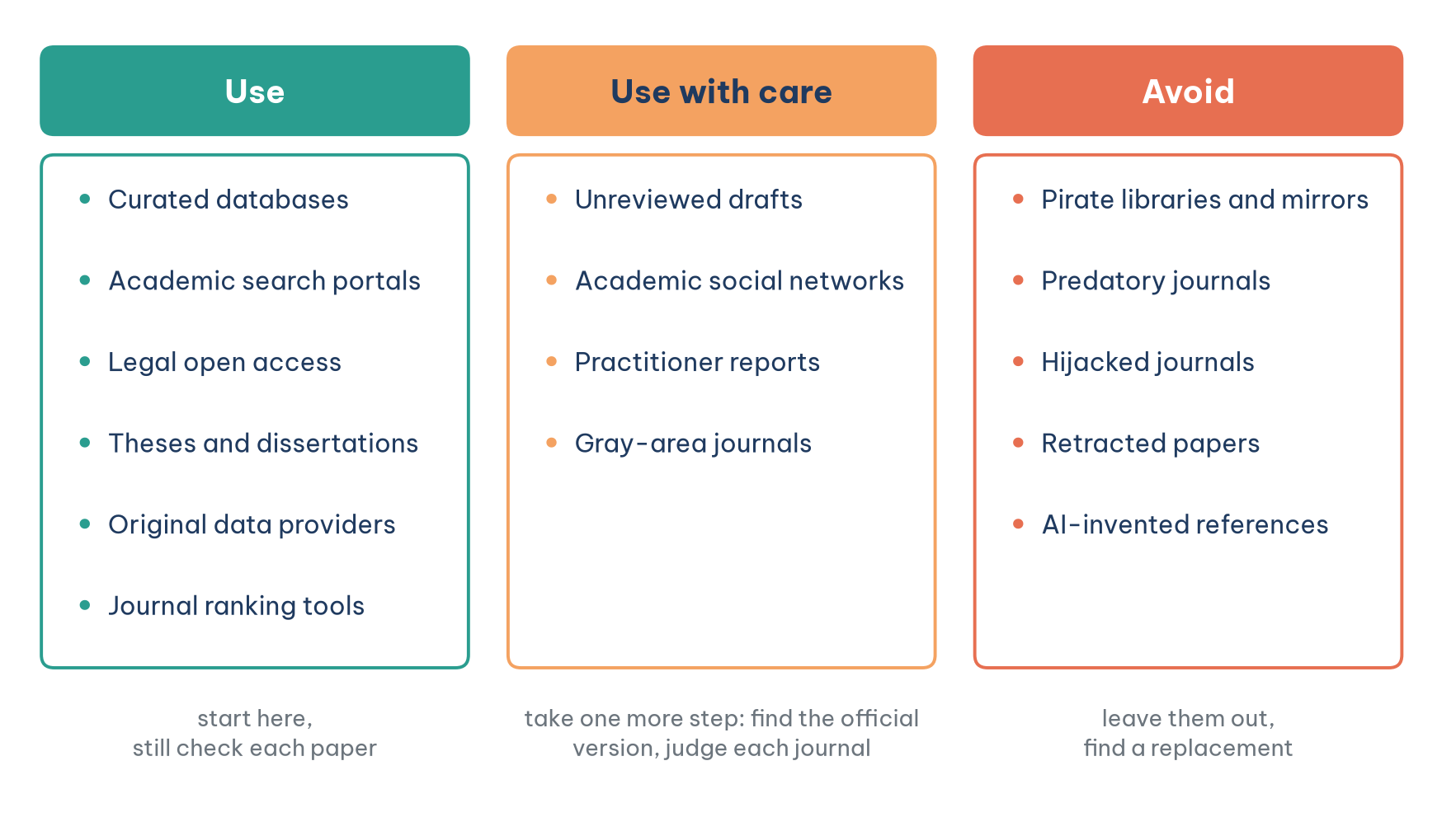
The middle column of Figure 1 is not "bad." It simply asks for one more step before you cite. Keep the three questions in mind and you will filter out most poor sources on your own.
2. Legitimate sources worth using
No single website is enough for a research paper, because each type of source does a different job. This section takes the types one by one: portals help you discover, databases help you select, open repositories help you read, theses show you how others worked, and statistical agencies supply numbers.
2.1. Search portals to start with
A portal is where you type keywords and find papers. It helps you find; it does not vouch for what it returns. Table 1 compares four free portals.
A productive way to use Table 1 is to start wide and then narrow. Find one recent review article in Google Scholar, read its reference list to go back to the foundations, and then use "Cited by" to move forward to the papers that build on them. AI research assistants such as Consensus or Elicit belong to this same layer: they help you discover, and they do not replace checking.
2.2. Curated databases
This is the safest zone for business students, because every journal in these databases has been screened. Most require an institutional account, so your first move should be to ask your library which databases it subscribes to.
Scopus and Web of Science are the two largest citation indexes, and many universities and national systems use them to assess research output. They tell you who cites a paper and how its journal stands, but they usually do not hold the full text. Full text sits on publisher platforms: ScienceDirect (Elsevier), Emerald Insight, SAGE Journals, Wiley Online Library, and Taylor & Francis Online carry a large share of journals in management, marketing, finance, and human resources. EBSCO Business Source and ProQuest are strong on business periodicals, industry reports, and dissertations, while JSTOR is good for classic articles, economic history, and foundational management theory.
Curation has limits. Scopus re-evaluates journals it already covers; when a title is flagged, new content is paused until its selection board decides to keep or drop it (Elsevier, n.d.). A journal that was in Scopus last year may not be there now. Section 3.4 describes a further weakness: content from fake journals has slipped into the database.
2.3. Working papers and preprints in economics and business
Economists and finance scholars have long circulated drafts before journal publication. Drafts are the best way to see the newest research, but most have not been peer reviewed. Label them as working papers when you cite them, and prefer the journal version if one exists.
SSRN is a large repository for economics, finance, law, and management. RePEc/IDEAS is a free bibliography of economics that lists more than 5.6 million items, over 5 million of them downloadable in full text; it covers both working papers and published articles, so check which kind you have (IDEAS/RePEc, n.d.). NBER Working Papers come from the network of economists at the U.S. National Bureau of Economic Research; the authors are often distinguished, but the papers have not been through journal review.
For behavioral psychology and organizational behavior, many older guides recommend OSF Preprints. That advice needs updating. On August 25, 2025, the Center for Open Science stopped accepting submissions to the generalist server on OSF Preprints, and in October 2025 it made the suspension indefinite, citing moderation and research-integrity concerns. Existing preprints can still be read and cited, and 14 community-run servers, including PsyArXiv and SocArXiv, remain active (Center for Open Science, 2025).
2.4. Legal open access
A great many papers have free versions that are entirely legal, if you know where to look. Piwowar et al. (2018) estimated that at least 28% of the scholarly literature was open access, and that 47% of the articles users of Unpaywall actually viewed were.
Unpaywall is a browser extension that looks up the article you are viewing and shows a green tab when a legal free copy exists. Its data now run on the same database as OpenAlex, and the extension is still supported (OpenAlex, n.d.). Install it today. DOAJ, the Directory of Open Access Journals, lists open access journals that have been vetted; on November 23, 2026, it listed 23,774 (DOAJ, 2026). It is a good check on an open access journal, although absence from the list does not by itself prove that a journal is bad.
Zenodo, operated by CERN, stores papers, datasets, and code. Anyone can deposit there and receive a DOI, so a DOI does not mean that something was reviewed. Finally, institutional repositories are where many authors post the accepted manuscript: the text after peer review but before typesetting. Use OpenDOAR to find which universities have one.
2.5. Theses and dissertations
Theses cannot replace journal articles in your theory section, but they are excellent for seeing how methods are written up, finding adapted scales, and tracing original sources.
OATD (Open Access Theses and Dissertations) indexes freely available graduate theses from around the world, and ProQuest Dissertations & Theses offers deep coverage through a library account. For doctoral theses from the United Kingdom, EThOS is back. After the 2023 cyberattack on the British Library, it was offline for almost three years and returned in July 2026 with records for more than 650,000 theses. EThOS no longer hosts full text; each record points to a university repository, where over 400,000 theses can be downloaded freely, and EThOS itself needs no login (British Library, 2026).
Many countries have a national thesis portal or a deposit collection in the national library, and many universities run their own. Local theses are valuable when you need to see how a scale worked in your own setting. Trace every scale and every hypothesis to its origin rather than copying it from the thesis.
2.6. Statistical data
Business students often need macroeconomic and industry figures. Take them from the organization that produced them, not from a news story, because news stories tend to drop the definition, the unit, and the base year.
For international data, use World Bank Open Data, IMF Data, and the OECD Data Explorer. For a single country, go to its national statistical office for yearbooks, enterprise surveys, and labor data; the domain names and parent ministries of these offices do change, so confirm that you are on the current official site. For listed companies, use the annual reports and financial statements filed with the securities regulator or the stock exchange. Record the indicator name, year, dataset, and access date, since series are often revised backward.
2.7. Tools for judging journals
Knowing which journal an article appeared in is not enough; you also need to know how that journal is regarded. For business students this is the most important group of tools. Table 2 compares five of them.
The AJG in Table 2 is widely used in business schools; its 2024 edition grew to 1,822 journals from nearly 1,700 in 2021 (Chartered Association of Business Schools, 2024). The ABDC list comes from the Australian Business Deans Council. Counting the published file gives 2,651 journals in the 2025 edition: 219 rated A*, 630 rated A, 861 rated B, and 941 rated C. Compared with the previous list, the review added 120 titles, removed 149, upgraded 111, and downgraded 27 (Australian Business Deans Council, 2026). Ratings move, so always state the year of the list you used.
Many countries also maintain their own lists, for academic promotion, research funding, or project evaluation. A list built for one purpose is not a substitute for a list built for another, so find out what yours is for before relying on it.
2.8. Practitioner sources, used selectively
Harvard Business Review, MIT Sloan Management Review, and reports from McKinsey, BCG, Deloitte, or PwC are excellent for context, trends, and topic ideas. But consulting reports are gray literature, and magazines such as HBR, though carefully edited, are not peer-reviewed evidence.
When you read a consulting report, look at the method before the conclusion: how many people were surveyed, where, who answered, and whether the firm sells a solution to the problem it describes. Use these sources to frame the problem, and build your theory and research model on journal articles.
3. Sources that call for caution
Poor sources do not always look poor. This section moves from the easy cases, such as pirate libraries, to the subtle ones: hijacked journals, retracted papers, and references invented by AI.
3.1. Sci-Hub, LibGen, and other pirate libraries
Sci-Hub is famous for giving away tens of millions of paywalled papers. To be plain, sites of this kind distribute papers in breach of copyright. On August 19, 2025, the Delhi High Court ordered Sci-Hub and its sister site Sci-Net blocked in India, in a case brought by Elsevier, Wiley, and the American Chemical Society. The court held, prima facie, that they were "rogue" websites and that their founder had broken an undertaking given in 2020 (SCC Times, 2025). By December 2025 the order had been extended to mirror sites and associated domains (LiveLaw, 2025). In May 2026, a U.S. federal court entered a $19.5 million default judgment, with a sweeping domain takedown order, against another large shadow library that mirrors LibGen and Sci-Hub (Van der Sar, 2026).
For students, the risk is not only legal. Mirror sites keep changing address, can be full of malicious advertising, and can be imitated to spread malware. The City of London Police's intellectual property crime unit warned universities that using Sci-Hub could expose students' usernames and passwords; Nordin (2021) reported the warning on the site of a publisher that is itself suing Sci-Hub, so read it with that in mind. Using pirated copies is also an integrity issue that many universities now address in their rules.
There is a serious debate about whether scientific knowledge should be open to everyone, and many scholars sympathize with the reasons Sci-Hub exists. But legal routes lead to the same place. First, install Unpaywall. Next, look for the accepted manuscript in the repository of the author's university. If that fails, email the author; many researchers are glad that someone wants to read their work and will send a PDF. Finally, ask your library for an interlibrary loan. Be wary of extensions that promise "papers in one click": find out where the file comes from, because if it comes from a pirate library it carries the same risks.
3.2. ResearchGate and Academia.edu are social networks, not journals
Both platforms are useful for following authors, asking questions, and sometimes downloading a readable copy. But they are academic social networks run by private companies. Anyone can upload, and a paper's presence there does not mean it has been peer reviewed.
Many files there were posted by authors who had already transferred copyright. In 2013, Elsevier sent roughly 2,800 takedown notices to Academia.edu (Diaz, 2013). In 2017, a publishers' coalition said its first batch of notices to ResearchGate would cover about 100,000 articles and that up to 7 million papers could be affected (Van Noorden, 2017). In September 2023, Elsevier and the American Chemical Society settled with ResearchGate, which now checks rights information when their articles are uploaded (Jack, 2023).
The rule is simple: use ResearchGate to find and to contact, but cite the official journal version, with its DOI.
3.3. Predatory journals
Predatory journals charge publication fees without serious peer review. The consensus definition by Grudniewicz et al. (2019) says that they put self-interest ahead of scholarship and points to false or misleading information, departures from good editorial practice, lack of transparency, and aggressive solicitation.
In practice you will meet four signs: mass emails full of flattery that promise publication "in two weeks"; an implausibly broad scope, such as one journal covering management, medicine, and mechanical engineering; no clear statement of the review process, fees, or editorial board; and an "impact factor" from a rating agency that does not exist. One sign alone proves little, since not every new or open access journal is bad. Several together mean stay away.
3.4. Hijacked journals, the subtler trap
In a hijacked journal, fraudsters build a fake website that copies a real journal's name, ISSN, and design, and then collect fees. Authors believe they have published in the real journal, and readers believe they are citing it.
The alarming part is that such content has entered Scopus. Abalkina (2024) cataloged 67 cases since 2013. In 23 of them the Scopus profile linked to the cloned site, in 33 unreviewed content from the clone sat inside the real journal's profile, and in 11 both happened. In December 2023, Scopus removed all homepage links from its journal profiles, yet fake content continued to get in. The Hijacked Journal Checker from Retraction Watch began in May 2022 with just over 100 entries and passed 400 in December 2025, or about 70 to 80 new hijacked journals a year; a study cited in the same article found plagiarism in 66% of sampled papers from such journals (Retraction Watch, 2025).
To protect yourself, never enter a journal through a link in an email. Because Scopus no longer links to homepages, look up the title and ISSN in the ISSN Portal, the Web of Science Master Journal List, or DOAJ, compare the web addresses, and then check the Hijacked Journal Checker. If two sites carry the same title, look for a notice from the publisher or learned society that owns the journal.
3.5. Paper mills and retracted papers
Paper mills write and sell papers and sometimes manipulate peer review itself. The best-known case is Hindawi, once a very popular open access publisher, which Wiley acquired in 2021.
Hindawi's journals were overrun by paper mills. Retraction Watch knew of more than 7,100 retractions in 2023 alone; Clarivate dropped 19 Hindawi titles from Web of Science in March 2023; and in December 2023, Wiley said it would retire the Hindawi name and fold about 200 journals into its own portfolio (Kincaid, 2023). By May 2024, Wiley confirmed more than 11,300 retractions over two years and the closure of 19 journals (Claburn, 2024).
The lesson: before citing a paper, check whether it has been retracted. Retracted papers often remain downloadable from many places, especially saved copies and academic social networks. The reference manager Zotero compares your library with the Retraction Watch database and warns you when you cite a retracted paper, even if the retraction came after you cited it; the check works only for items with a DOI or PMID (Stillman, 2019). Since September 2023 that database has belonged to Crossref and has been open to all (Crossref, 2023).
3.6. The gray area, where each journal must be judged
Some large publishers that grew fast on publication fees are the subject of debate about quality. Finland's Publication Forum (JUFO) shows what that debate looks like.
In December 2024, JUFO announced that 271 journals, 193 from MDPI and 78 from Frontiers, would drop from level 1 to level 0 in 2025; 16 MDPI and 22 Frontiers journals stayed at level 1. MDPI said that downgrading 271 journals at once looked like a generalized process rather than a fair assessment of each title, and Frontiers called the move "unfair and arbitrary" (Kincaid, 2024). In June 2025, JUFO reported that some MDPI and Frontiers journals had been restored to level 1 after panel evaluation, based on suggestions from Finnish researchers (Publication Forum, 2025).
These are not predatory journals, and they publish plenty of good work. But do not trust or dismiss an article because of its publisher's name. Judge each journal: is it in the AJG or ABDC list, which SCImago quartile is it in, and is it on your national list? Then judge the article itself: are the question, sample, measures, and analysis convincing?
3.7. References invented by AI
This is the newest risk and it is growing fast. Generative AI tools can produce references that look entirely real, with genuine author names, a genuine journal, and a plausible year, for a paper that does not exist.
The scale is considerable. Zhao et al. (2026) audited 111 million references in 2.5 million papers on arXiv, bioRxiv, SSRN, and PubMed Central and conservatively estimated 146,932 hallucinated citations in 2025 alone. Business students should note that SSRN had the highest rate of the four: by August 2025, an estimated 1.91% of references there were hallucinated, against 0.39% on arXiv, 0.27% in PubMed Central, and 0.21% on bioRxiv. The study is itself a preprint.
Peer-reviewed papers are not immune. Another audit, published in The Lancet, found 4,046 fabricated references in 2,810 biomedical papers, out of nearly 2.5 million papers and 97.1 million references checked (Topaz et al., 2026). Figure 2 shows the pace of the increase.
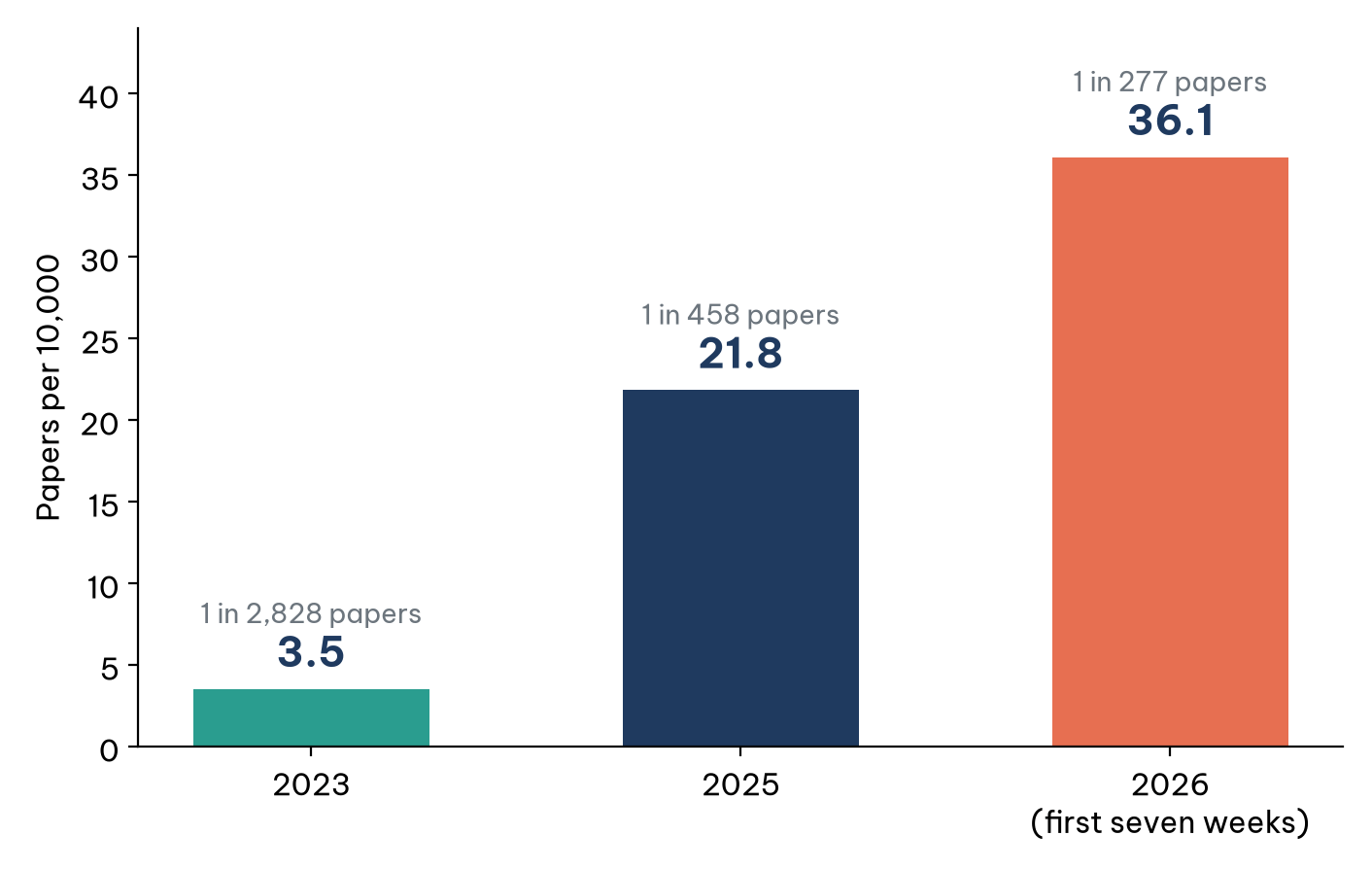
In Figure 2 the rate rises more than tenfold: from 1 in 2,828 papers in 2023 to 1 in 458 in 2025 and 1 in 277 in the first seven weeks of 2026 (Orrall, 2026). Even leading AI conferences have not caught everything. The company GPTZero reported hallucinated citations in at least 53 papers accepted at NeurIPS 2025, although the organizers noted that a wrong reference does not necessarily invalidate a paper's content (Goldman, 2026).
One rule follows: open every reference in your paper yourself and read at least the abstract. Look up the DOI at doi.org or search for the title in Google Scholar. Do not copy a citation from another paper without checking it, because that paper may already carry an invented one. AI can help with ideas and keywords, but it should never be the final source of your reference list.
4. A five-step routine for verifying a source
Knowing the traps is one thing; having a routine that keeps you out of them is another. Each time you plan to cite something, go through the five steps in Figure 3. After a few rounds it becomes a reflex.
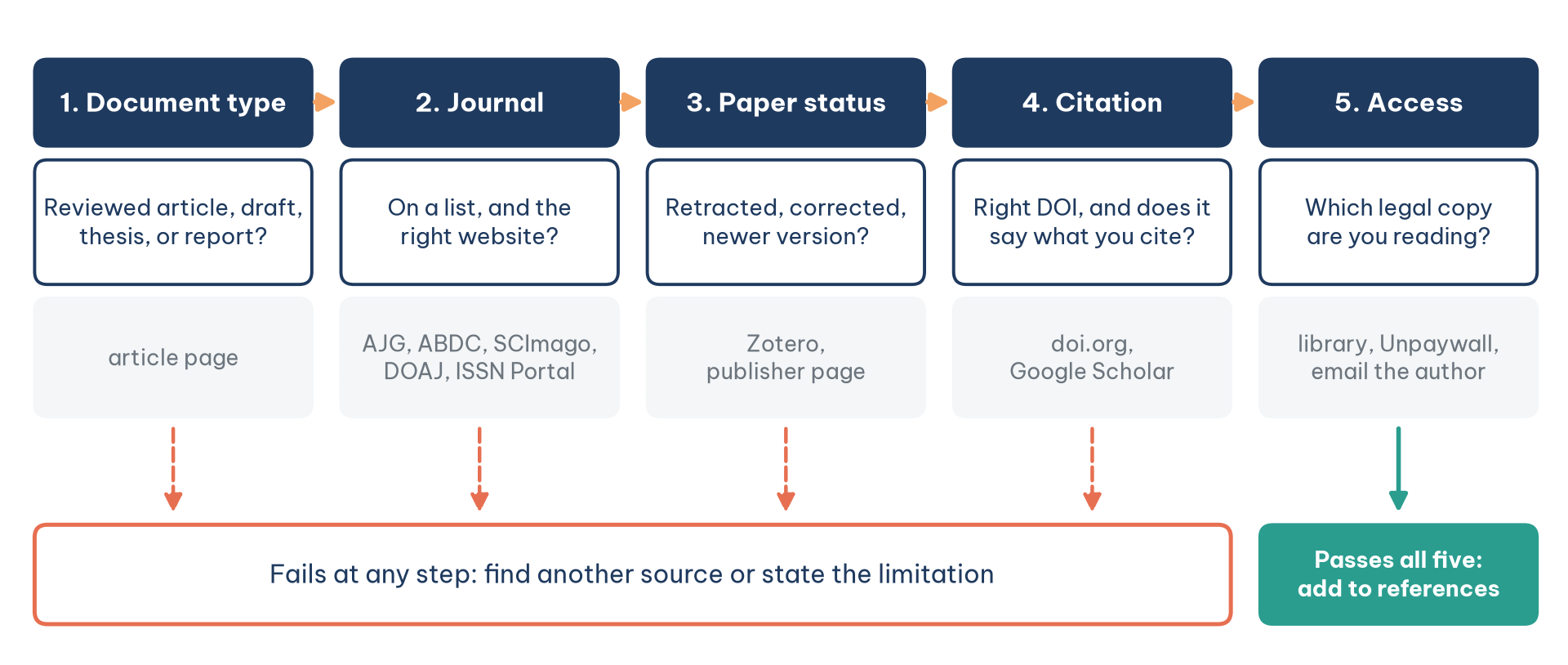
Step 1, identify the document type. Is it a peer-reviewed article, working paper, preprint, thesis, industry report, or news item? The answer decides where you can use it and how you list it.
Step 2, check the journal. Is it in Scopus, Web of Science, AJG, ABDC, DOAJ, or your national list? Does its web address match the ISSN Portal or DOAJ?
Step 3, check the paper's status. Has it been retracted or corrected? If it is a preprint, has a journal version appeared, and did the conclusions change?
Step 4, verify the citation. Does the DOI lead to the right paper? Do the authors, year, and journal match? Above all, does the paper say what you are citing it for?
Step 5, confirm legal access. Are you reading through your library, an open access copy, or a copy sent by the author?
Take a hypothetical case. A student writing about repurchase intention receives a polished reference from an AI tool: a well-known marketing journal, 2023, with a DOI. At Step 1 it looks like a journal article. At Step 2 the journal is in the AJG. But at Step 4 the DOI leads to a different paper in the same journal, and the title does not appear in Google Scholar. A student who stopped at Step 2 would have put an invented reference in the thesis. The right response is to drop it, find a real paper on repurchase intention, and start again from Step 1.
5. A quick-reference table
Everything above reduces to three levels: use, use with care, and avoid. This section gives Table 3 as a lookup while you write.
Compared with Figure 1, Table 3 adds notes on what to do. Sources in the "use" rows come with conditions as well: use means start there, not skip the check.
Conclusion
The skill of finding sources is not knowing a great many websites. It is knowing how to judge what you find. Sources will keep changing: lists are updated, servers change policy, and dozens of journals are hijacked every year. The three questions about review, accountability, and rights, and the five-step routine, will still work. A paper with 15 carefully chosen references from respected journals is more convincing than one with 50 from everywhere.
You can take the first step today. Visit your library or its website, ask which databases you can use, and install Unpaywall. Those two actions will meet most of your needs, legally and reliably.
References
Abalkina, A. (2024, June 18). Journal hijackers still infiltrate Scopus despite its efforts. Retraction Watch. https://retractionwatch.com/2024/06/18/journal-hijackers-still-infiltrate-scopus-despite-its-efforts/
Australian Business Deans Council. (2026, March 26). 2025 ABDC Journal Quality List released. https://abdc.edu.au/2025-abdc-journal-quality-list-released/
British Library. (2026, July 8). E-Theses Online Service (EThOS). https://bl.uk/collection/ethos
Center for Open Science. (2025, October 16). Update on future of OSF Preprints. https://www.cos.io/blog/update-on-future-of-osf-preprints
Chartered Association of Business Schools. (2024). Academic Journal Guide 2024 available now. https://charteredabs.org/insights/news/academic-journal-guide-2024-available-now
Claburn, T. (2024, May 16). Wiley shuts 19 scholarly journals amid AI paper mill problems. The Register. https://www.theregister.com/2024/05/16/wiley_journals_ai/
Crossref. (2023, September 12). Crossref acquires Retraction Watch data and opens it for the scientific community. https://www.crossref.org/blog/news-crossref-and-retraction-watch/
Diaz, C. (2013, December 9). Elsevier issues take down notices to Academia.edu for breach of copyright. University of Iowa Libraries. https://blog.lib.uiowa.edu/combo/?p=2212
DOAJ. (2026). Directory of Open Access Journals [Database]. Retrieved November 23, 2026, from https://doaj.org
Elsevier. (n.d.). Scopus content policy and selection. https://www.elsevier.com/products/scopus/content/content-policy-and-selection
Goldman, S. (2026, January 21). NeurIPS papers contained 100+ AI-hallucinated citations, new report claims. Fortune. https://fortune.com/2026/01/21/neurips-ai-conferences-research-papers-hallucinations/
Grudniewicz, A., Moher, D., Cobey, K. D., Bryson, G. L., Cukier, S., Allen, K., Ardern, C., Balcom, L., Barros, T., Berger, M., Ciro, J. B., Cugusi, L., Donaldson, M. R., Egger, M., Graham, I. D., Hodgkinson, M., Khan, K. M., Mabizela, M., Manca, A., … Lalu, M. M. (2019). Predatory journals: No definition, no defence. Nature, 576(7786), 210–212. https://doi.org/10.1038/d41586-019-03759-y
IDEAS/RePEc. (n.d.). IDEAS: Economics and finance research. https://ideas.repec.org
Jack, P. (2023, September 15). Publishers settle copyright legal battle with ResearchGate. Times Higher Education. https://www.timeshighereducation.com/news/publishers-settle-copyright-legal-battle-researchgate
Kincaid, E. (2023, December 6). Wiley to stop using "Hindawi" name amid $18 million revenue decline. Retraction Watch. https://retractionwatch.com/2023/12/06/wiley-to-stop-using-hindawi-name-amid-18-million-revenue-decline/
Kincaid, E. (2024, December 24). Finland Publication Forum will downgrade hundreds of Frontiers and MDPI journals. Retraction Watch. https://retractionwatch.com/2024/12/24/finland-publication-forum-will-downgrade-hundreds-of-frontiers-and-mdpi-journals/
LiveLaw. (2025, December 13). Delhi High Court orders blocking of additional Sci-Hub mirror websites in India in publishers' copyright infringement suit. https://www.livelaw.in/high-court/delhi-high-court/delhi-high-court-orders-blocking-of-additional-sci-hub-mirror-websites-in-india-in-publishers-copyright-infringement-suit-513192
Nordin, B. (2021, April 9). Universities and students warned of Sci-Hub security risks. ACS Axial. https://axial.acs.org/publishing/student-dangers-sci-hub
OpenAlex. (n.d.). Unpaywall. OpenAlex Help. https://help.openalex.org/access/unpaywall
Orrall, A. (2026, May 7). One in 277 PubMed-indexed papers in 2026 shows fabricated references, says analysis. Retraction Watch. https://retractionwatch.com/2026/05/07/one-in-277-pubmed-indexed-papers-in-2026-shows-fabricated-references-says-analysis/
Piwowar, H., Priem, J., Larivière, V., Alperin, J. P., Matthias, L., Norlander, B., Farley, A., West, J., & Haustein, S. (2018). The state of OA: A large-scale analysis of the prevalence and impact of open access articles. PeerJ, 6, e4375. https://doi.org/10.7717/peerj.4375
Publication Forum. (2025, June 10). Grey area journals to level 0 [Update]. Federation of Finnish Learned Societies. https://julkaisufoorumi.fi/en/news/grey-area-journals-level-0
Retraction Watch. (2025, December 26). The Retraction Watch Hijacked Journal Checker now has 400 entries. https://retractionwatch.com/2025/12/26/retraction-watch-hijacked-journal-checker-now-has-400-entries/
SCC Times. (2025, August 27). Delhi HC directs DoT and MeitY to block Sci-Hub, Sci-Net and affiliate websites in copyright infringement suit; holds founder guilty of contempt for violating 2020 undertaking. https://www.scconline.com/blog/?p=358016
Stillman, D. (2019, June 14). Retracted item notifications with Retraction Watch integration. Zotero. https://www.zotero.org/blog/retracted-item-notifications/
Topaz, M., Roguin, N., Gupta, P., Zhang, Z., & Peltonen, L.-M. (2026). Fabricated citations: An audit across 2·5 million biomedical papers. The Lancet, 407(10541), 1779–1781. https://doi.org/10.1016/S0140-6736(26)00603-300603-3)
Van der Sar, E. (2026, May 20). Anna's Archive hit with $19.5m default judgment and global domain takedown order. TorrentFreak. https://torrentfreak.com/annas-archive-hit-with-19-5m-default-judgment-and-global-domain-takedown-order/
Van Noorden, R. (2017). Publishers threaten to remove millions of papers from ResearchGate. Nature. https://doi.org/10.1038/nature.2017.22793
Zhao, Z., Wang, Y., Stuart, T., De Vaan, M., Ginsparg, P., & Yin, Y. (2026). LLM hallucinations in the wild: Large-scale evidence from non-existent citations (Version 1). arXiv. https://doi.org/10.48550/arXiv.2605.07723
Discussion about this post