Finding Startup Problems Worth Solving: Four Founder Tools
How to spot opportunities with the Rumsfeld matrix, check founder-problem fit, define the problem with a seven-box canvas and score the idea before building anything


Key takeaways
Good startup ideas are noticed rather than invented. The Rumsfeld matrix shows four places to look: known knowns, known unknowns, unknown knowns and unknown unknowns, each with its own risks and evidence to seek.
Before product–market fit comes founder–problem fit: does the team understand the problem, have the right capabilities and care enough to stay with it for years? MILES, the three circles and the Hacker–Hustler–Hipster team help answer that.
The Problem Statement Canvas forces a team to describe the problem in seven boxes, separating symptoms from root causes and finding the gap left by current alternatives.
The idea matrix scores the problem (PASI: Pain, Active, Scale, Inevitable) and the solution (10x better, Frictionless, Scalable, Defensible) on evidence, not belief, and places the idea in one of four zones.
All four tools only produce "product–market fit on paper". The real proof is real customers using a real product and paying real money.
A familiar start-up story: a talented founding team works behind closed doors for six months to build a product they believe is perfect. On launch day, the market is silent. An analysis of failed start-ups by CB Insights (2021) found that one of the most common reasons was no market need: they built something nobody needed enough to pay for.
Bill Aulet (2013) puts it bluntly: the single necessary and sufficient condition for a business is a paying customer. Customers pay for the solution to their problem, not for the seller's product. So before writing the first line of code, founders need to switch from a "builder" mindset, in love with the solution, to a "detective" mindset, in love with the problem. That raises four practical questions, each answered by one tool in this article:
Where should we look for ideas? The Rumsfeld matrix maps four kinds of opportunity.
Are we the right people to solve this problem? Founder–problem fit checks the team.
What exactly is the problem? The Problem Statement Canvas describes it in a structured, testable way.
Is this idea good enough to pursue? The idea matrix scores the problem and the solution on evidence.
Sections 1 to 4 cover the four tools in that order, each with worked examples. Section 5 discusses the limits of these tools and how to use AI as a tough critic. The examples are drawn from around the world, with a few from Vietnam.
1. Where to look: the Rumsfeld matrix
Start-up ideas rarely come from a random "Aha!" moment. Most of the opportunities behind great companies can be found by thinking systematically: looking at what we know, what we know we don't know, and even what we have without realising it. Paul Graham (2012) advises founders not to try to think up ideas but to notice them; the difficulty is knowing where to look. The Rumsfeld matrix is a simple map for that.
1.1. Origins and structure
The matrix has a surprising origin: a defence press briefing rather than the business world. In 2002, US Secretary of Defense Donald Rumsfeld distinguished three kinds of knowledge: things we know we know, things we know we don't know, and things we don't know we don't know (Rumsfeld, 2002). The remark was mocked at first for sounding convoluted, but was later recognised as a useful way to classify decisions under uncertainty.
The fourth box, things we don't know we know, was not in the original remark. The philosopher Slavoj Žižek (2004) added it when analysing Rumsfeld's words. For founders, this extra box is especially valuable, because it points to assets already in their hands that they have not yet recognised.
Applied to entrepreneurship, one axis asks whether we know the solution or asset, and the other asks whether we are aware of the opportunity. Figure 1 shows the four boxes with their strategies and typical examples.
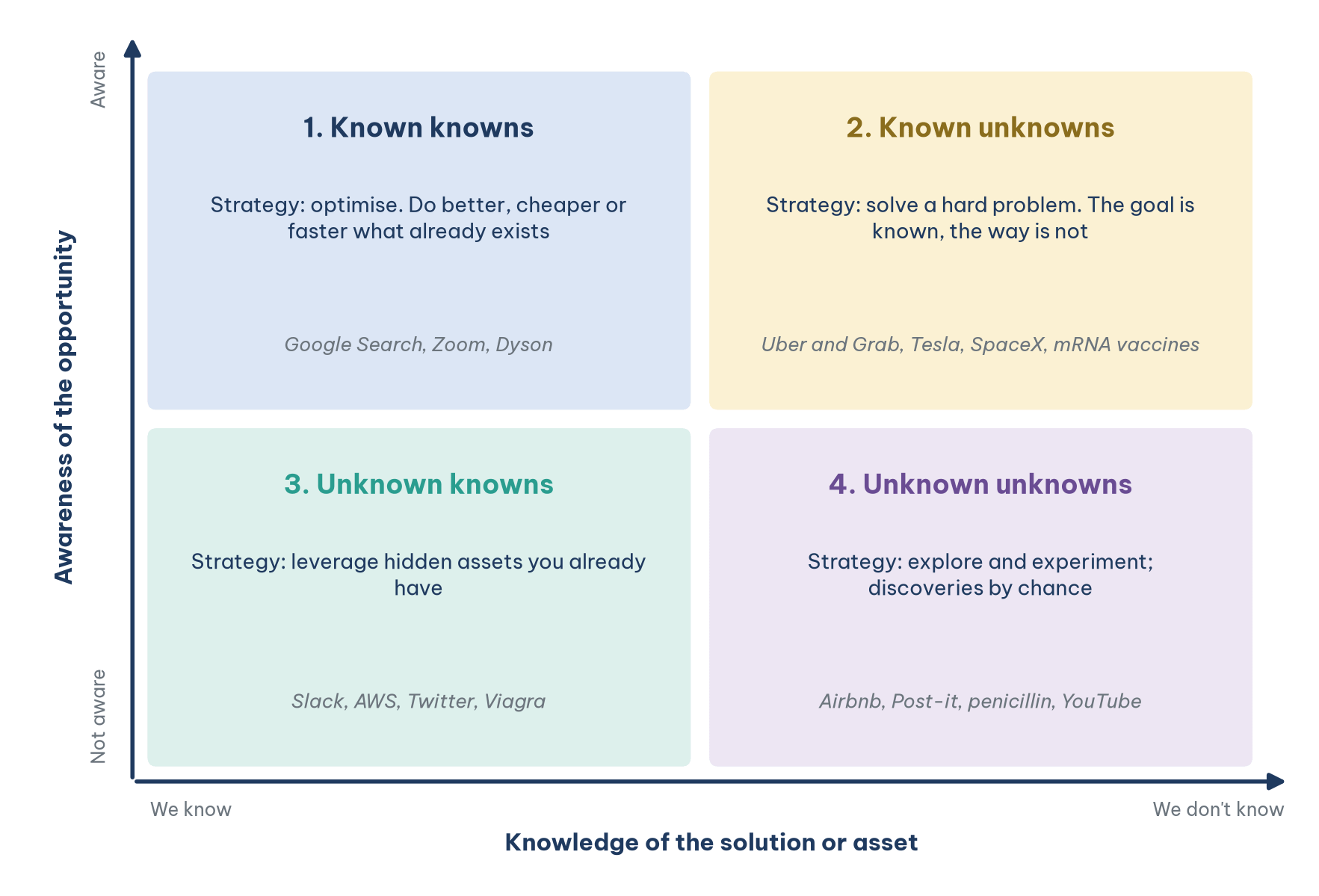
One caution when reading Figure 1: placing a company in a box is a way of reading it in order to learn, not an absolute classification. The same company can be viewed from several boxes, and a business often moves through several boxes over its life. The value of the matrix lies in the different questions it prompts, not in the labels.
1.2. The four boxes
Known knowns: do better what everyone knows. This is the territory of existing markets and clear needs. Founders do not need to redefine the world; they need to do far better, faster, cheaper or more easily what incumbents are doing badly. Google did not invent search; Yahoo and AltaVista were already serving that need. Google won because PageRank gave far more relevant results. Zoom arrived when Skype and Webex already existed and focused on specific annoyances such as dropped connections and complicated set-up. Dyson tackled the bag that clogs and weakens suction in vacuum cleaners. McDonald's did not invent the burger but invented the Speedee Service System in 1948, turning the kitchen into an assembly line for fast, consistent service. The market needs no educating, but the main risk is head-on competition and easy copying, so the improvement has to be large enough to make customers switch.
Known unknowns: solve a named hard problem. Here we know the problem and the destination, but how to get there is still unknown. This is the playground of deep-tech start-ups and new business models. The shortcomings of traditional taxis were obvious for decades; the question "how do we connect idle cars with people who need a ride now, without a call centre?" could only be answered once smartphones and GPS were widespread, and Uber and Grab followed. Electric cars were not a new idea; the unknown was a battery with enough range at an acceptable price, plus a charging network. Tesla was founded by Martin Eberhard and Marc Tarpenning in 2003; Elon Musk joined in the first funding round and later led the company. SpaceX targeted the high cost of launches caused by single-use rockets, with booster reuse as the unknown. The clearest example is the mRNA vaccine. The idea of using mRNA to trigger immunity was decades old, but injected mRNA caused inflammation and broke down quickly. The two key breakthroughs were modified nucleosides, the work of Katalin Karikó and Drew Weissman, who received the 2023 Nobel Prize in Physiology or Medicine (The Nobel Assembly at Karolinska Institutet, 2023), and lipid nanoparticles to carry mRNA into cells. The main risk is the time and money needed for R&D; the evidence to seek first is a proof of concept showing the problem can be solved.
Unknown knowns: assets you have but have not noticed. This box holds capabilities, data and tools that founders or organisations already have but whose commercial value they have not seen. Many famous pivots sit here. The team behind the online game Glitch built an internal chat tool to work together; the game failed and the chat tool became Slack. Amazon built server infrastructure to run its own store, then realised it could sell that capacity to other businesses, and AWS was born. Twitter began as an internal project at Odeo, a struggling podcast company, as a service for sharing status updates by SMS. Sildenafil was being tested as a treatment for angina; trial participants reported a side effect, and Pfizer redirected development towards Viagra. The most valuable asset began as a by-product of another goal. The main risk is overestimating the value of your own assets, so the evidence to seek is outsiders actually paying, not just praising.
Unknown unknowns: discoveries through experiments and chance. This is the realm of findings nobody foresaw. Ordinary market research is impossible here because the market does not yet exist. Airbnb's founders rented out air mattresses in their living room to pay the rent; nobody, including them, imagined the start of a new lodging industry. Spencer Silver's weak glue at 3M was considered a failure until his colleague Art Fry used it years later to mark pages in a hymn book, leading to the Post-it. Alexander Fleming found mould killing bacteria in a culture dish after a holiday in 1928, the start of penicillin. According to its founders, YouTube was first conceived as a video dating site. You cannot plan for luck, but you can raise the odds of meeting it by running many small experiments and watching for "strange" user behaviour, when people use a product for something it was not designed for.
1.3. A question bank and a worked example
The four boxes can be used not only to analyse successful companies but also to find your own ideas. Table 1 summarises the questions, main risks and evidence to seek for each box.
The last column of Table 1 matters most. Each box demands a different kind of evidence before serious investment, and knowing what evidence you are looking for keeps a team from wasting time on activities that cannot answer the key question.
Consider a hypothetical team of four students whose families grow pomelos in the Mekong Delta in Vietnam. Each member wrote three ideas per box, and the team merged duplicates and kept the most promising idea in each box, as in Table 2.
Not every box suits every team. For students with little capital, known knowns and unknown knowns are usually the most feasible: the market already exists, or the asset is already in hand, so ideas can be tested quickly and cheaply. Known unknowns carry the greatest risk in money and time and are worth pursuing only with a real technical edge or laboratory support. Unknown unknowns cannot be chosen deliberately, but teams that run many small experiments and watch users closely meet them more often.
2. Are you the right team? Founder–problem fit
Students of entrepreneurship are usually taught that the main goal of the early stage is product–market fit: a product that matches the needs of a large enough market. But many start-ups stop before they get there, not because the idea was poor but because the team did not understand the problem well enough, lacked the ability to solve it or lacked the stamina to stay with it through months without revenue. The question that comes before product–market fit is therefore a question about people.
That question is founder–problem fit (FPF): why are you, and your team, the right people to solve this problem? If product–market fit asks "does the market need this product?", FPF asks "do we understand it well enough, are we good enough and will we last long enough to stay with this problem for years?". It is also the first question early-stage investors ask, because when there is no product yet, the only thing they can assess is the people.
2.1. Definition and place in the validation journey
FPF is widely used in venture capital and incubator circles, though it is not tied to a single academic theory. It has three components: deep understanding of the problem, often from direct experience; the capabilities and resources the solution needs; and motivation strong enough to stay with the problem for years. A team with good FPF is not necessarily better than others at everything, but it is better at exactly what this problem demands. Sam Altman, while running Y Combinator, wrote that it is best if the founders are the target users themselves; if not, they must understand the target users extremely well (Altman, 2015). The shorter the distance between those who build a product and those who use it, the less the team has to guess.
FPF comes first in the sequence of start-up validation milestones: is the team right for the problem, is the problem real for customers, does the solution solve it, and only then does the product fit the market? Every later step is carried out by the team itself: a team that understands the problem superficially will interview customers superficially, design superficial solutions and give up early when results disappoint.
2.2. Three lenses on founder–problem fit
FPF is hard to measure directly, so it is usually viewed through complementary lenses.
Commitment and understanding. Early-stage funds usually look for four signs: long-term commitment, a willingness to stay with a hard problem for five to ten years; deep understanding, gained from direct experience rather than reading; expertise that outsiders lack; and resilience through failure and rejection. Long-term commitment usually comes from deep understanding, because someone who has lived with a problem sees it as more worth solving than someone who has only read about it.
An inventory of advantages with MILES. Ali and Kubba (2020) propose the MILES framework for identifying a founder's "unfair advantage", in five groups. Table 3 sets them out with questions tied to the problem the team has chosen.
The key phrase in Table 3 is "tied to your chosen problem". A founder with plenty of money and a wide network in banking has no advantage when building an app for durian farmers. A useful rule of thumb is that a team with good FPF has at least two of the five advantages directly relevant to the problem.
A quick 4P check. A set of four short questions often used in incubator screening sessions lets a team check itself in minutes. Passion: how "obsessed" are you with this problem; do you think about it even when you're not working? Pain: are you a "patient" who has suffered from it, or a "doctor" observing from outside? Proficiency: do your skills match the solution? People: whom do you know in this industry, and who will pick up when you call? The pain question usually separates founders most clearly. "Patients" have a big advantage in understanding but are prone to assuming everyone hurts the way they do; "doctors" must make up for it with more hours of observation and customer interviews.
2.3. Why founder–problem fit matters
Many young founders see FPF as an "emotional" matter, less important than product and market. There are three reasons it has real effects.
Stamina through hard times. Start-ups have months of running out of cash, buggy products and repeated rejection by customers and investors. A team that chose a problem only because it was trendy soon runs out of excitement. Someone who treats the problem as their own has a reason to stay when other reasons have gone. Stamina is also economic: a start-up usually needs several rounds of trying and fixing before finding the right model, each taking months. A team that quits after the second attempt will never see the result of the fourth.
Insider secrets. Many good ideas look boring or too small to outsiders. Only people who have worked in an industry know which step wastes the most time, who really makes the buying decision and which regulation is about to change. These "earned secrets" are hard for competitors to copy because they take years to accumulate. Still, insider intuition needs testing: insiders also have biases, assuming that their old employer's way is the whole industry's way, or that their pain is everyone's.
Attracting capital and talent. At the early stage, investors mostly bet on the jockey rather than the horse. A survey of almost 900 venture capitalists by Gompers et al. (2020) found that the team was the factor mentioned most often in investment decisions, and the most important factor for about 47% of respondents, ahead of product, market or business model. Talent chooses the same way: a strong engineer leaves a well-paid job for a start-up because they believe in the problem and in the person leading it.
2.4. From individual to team
Assessing FPF on one person, usually the CEO, is not enough. A good team has pieces that complement each other.
The three circles. Jim Collins (2001), studying companies that went from good to great, proposed the "hedgehog concept": the intersection of what an organisation is deeply passionate about, what it can be the best at and what drives its economic engine. Applied to a founding team, the three circles become three questions about passion, capability and whether someone will pay, as in Figure 2.
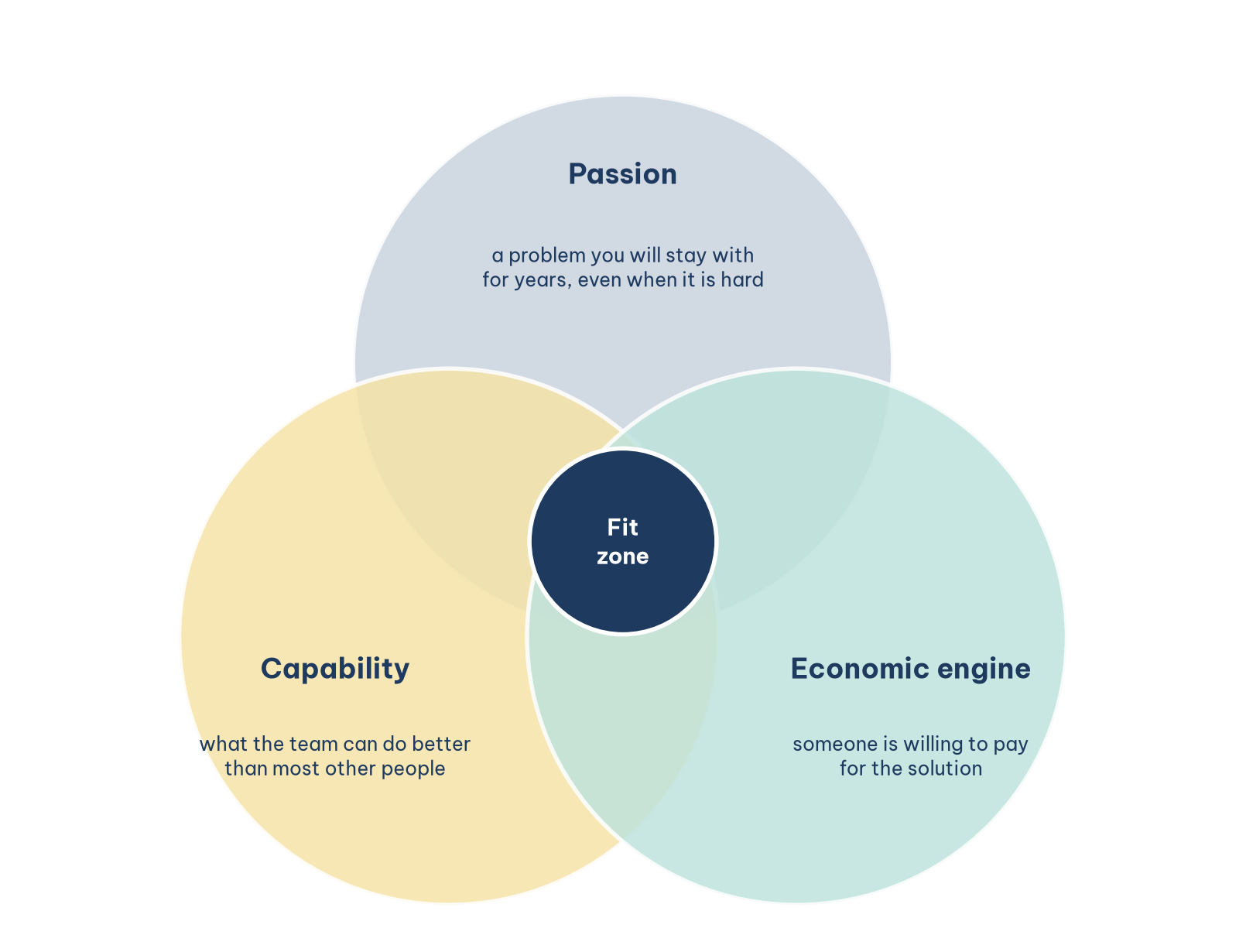
The fit zone is only the small overlap in the middle. The four-circle Ikigai diagram, in the popular version drawn by Marc Winn (2014), tells the same story but splits "what the world needs" and "what you can be paid for" into separate circles. Combining the two views shows what happens when a team lacks one element, as in Table 4.
The minimum viable team. If a minimum viable product (MVP) is the smallest version of a product that lets you learn from the market, a minimum viable team is the smallest group with enough capability to bring the MVP to market. The model popularised by Rei Inamoto (2012) at the agency AKQA divides it into three roles, as in Figure 3.
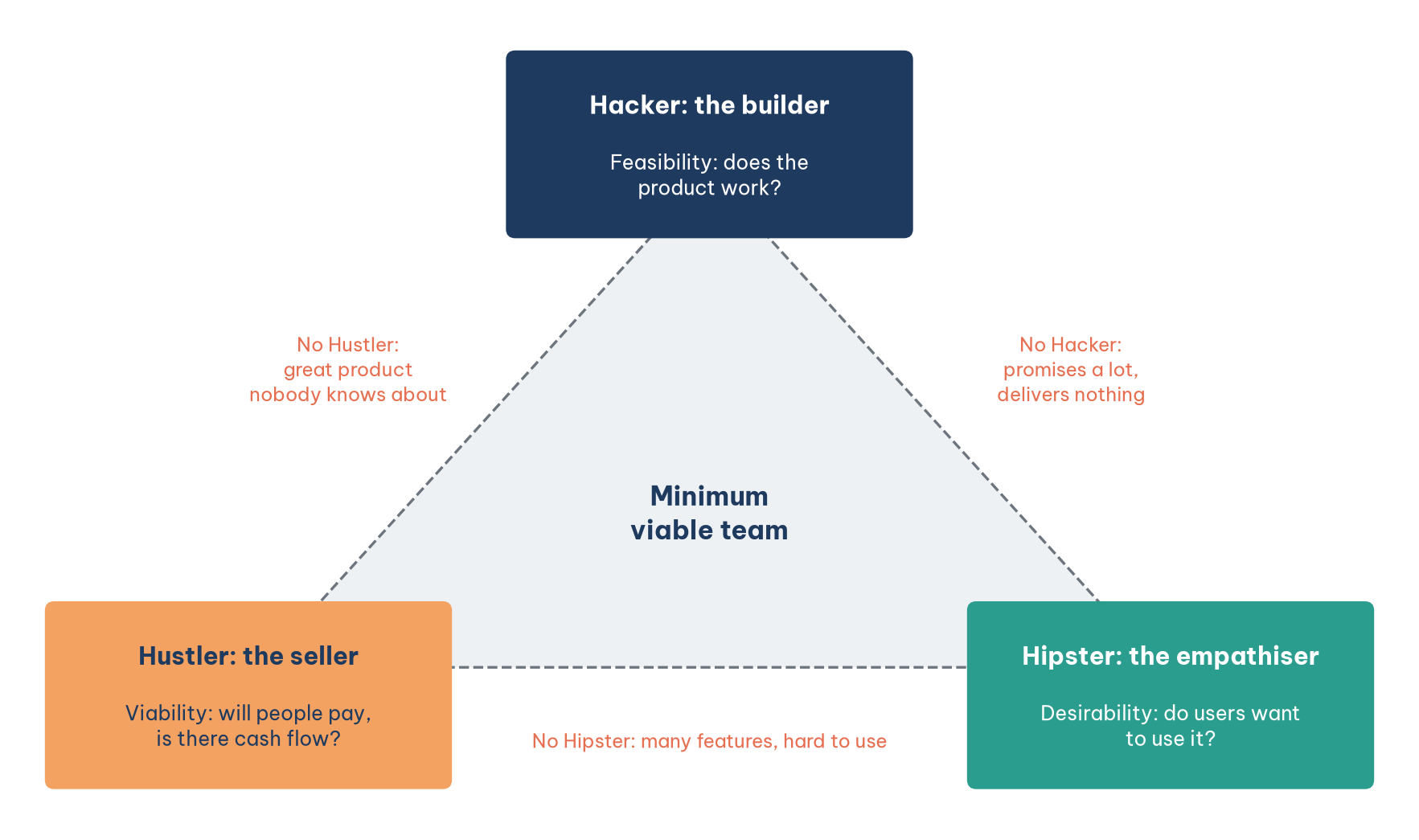
The Hacker (often the CTO) answers for feasibility and brings the E of MILES; without one, the product breaks. The Hustler (often the CEO or head of growth) answers for viability and brings S and often M; without one, a good product goes unnoticed and the money runs out. The Hipster (product, design or user experience) answers for desirability and brings I; without one, the product has many features but is hard to use. The three roles need not be three people; at the very early stage one person can cover two, as long as the team knows where it is weak. The most common mistake is a team made up entirely of one role, typically three engineers who all code well but none of whom wants to meet customers.
A team SWOT. SWOT is usually applied to a business in its market, but it is very useful applied to the team itself, in a frank conversation before anyone signs an agreement or invests money. Strengths: what does our combination give us that no individual has? Three engineers are not three times the strength but a weakness: nobody sells. Weaknesses: where is the whole team blind, for example law, tax or finance? Opportunities: whose network or assets will carry us through the first six months? Threats: what is the worst people scenario? One person holds all the source code; one needs a stable income after six months; egos clash. A simple indicator is the "bus factor": how many people would have to leave suddenly for the project to stop? If the answer is one, the team has a bigger risk than any market risk.
2.5. Patient zero versus the tourist
Famous start-up stories show FPF at work. Many large companies began with a founder's personal irritation, as Table 5 shows.
None of these founders needed market research to know the problem was real. But they still had to test its scale: Houston had to know enough people forgot their USB drives, and Perkins had to know that people beyond her students struggled with design software.
"Tourists" are founders who come to an industry because it is hot and money is easy to raise, without real attachment to the problem. Many projects in the 2021–2022 crypto boom were set up only to follow the money and were abandoned when the market turned. Quibi, launched in 2020 and led by Jeffrey Katzenberg, former chairman of Walt Disney Studios and co-founder of DreamWorks, and Meg Whitman, former CEO of eBay and HP, raised about USD 1.75 billion for premium short videos on phones. Its leaders were not target users and misjudged young people used to free, shareable content; Quibi shut down about six months after launch. Juicero made a USD 400 internet-connected juicer; users then discovered they could squeeze the juice packs by hand. It raised about USD 120 million but closed in 2017. Both had huge M and S in MILES, but lacked the I: insight into users.
2.6. Finding co-founders and keeping the team together
Knowing which role is missing is half the problem; the other half is finding the right person and keeping them. Generic networking events rarely produce co-founders. It is more effective to go where each role naturally gathers and to watch how people work: engineering-school incubators, developer communities and hackathons for Hackers; marketing communities, business alumni networks and pitch competitions for Hustlers; design portfolios and UX communities for Hipsters; and programmes that cover all three, such as company builders like Antler or Y Combinator's co-founder matching platform. The most reliable way to know whether someone fits is to work together on a small project with a deadline for a few weeks; a start-up competition or a hackathon is a good opportunity.
FPF means nothing if the team breaks up midway. Most conflicts between founders come not from who is right but from things never said while everything was still fun. A co-founder agreement should be written from the start, covering at least four points: vesting, typically over four years with a one-year cliff, so someone who leaves after six months does not take a large share; roles and decision rights over technology, sales and user experience; a deadlock mechanism for 50–50 disagreements, such as a casting vote or an independent adviser; and departure terms: the buy-back price of shares and who owns intellectual property such as code and designs. Not every jurisdiction supports US-style vesting directly; in Vietnam, for example, company law has no such mechanism, and teams use shareholder agreements, conditional transfer commitments or an offshore holding company. Take legal advice before signing, because an unenforceable clause can be more dangerous than none.
2.7. A 12-question self-assessment
The lenses and tools above can be gathered into a short self-assessment for the team to repeat regularly. Each member scores each statement from 1 (not at all true) to 5 (completely true); the team averages each statement and adds them up. Table 6 lists the twelve statements in three groups.
A total of 48–60 suggests strong FPF; 36–47 is fair, and the team should shore up any statement scoring under 3; below 36, the team should reconsider the problem or add members. The total is only a signal; more important is which statements score low and whether the team agrees on them. Imagine three final-year students building inventory and expiry-date software for independent pharmacies: one studies pharmacy and has worked two years in a family pharmacy, one studies IT and one studies marketing. They might score 39/60: strong on understanding, with all three roles present, but weak on financial runway (statement 7), regulatory knowledge (statement 8) and a written agreement (statement 12). That points to three concrete actions: find an adviser who knows pharmacy regulation, keep part-time jobs for the first six months with clear validation milestones, and write the co-founder agreement now, before the first paying customer makes splitting the pie harder to discuss.
2.8. Measuring yourself first
The 12-question self-assessment scores the team. Before that, each founder should ask questions about themselves, because every team starts with individuals. Aulet (2024) offers a commitment checklist of things founders need to admit honestly: starting a company will be very hard and they still want to do it; it is a long journey with many failures that they must learn from rather than take personally; they cannot do it alone; there is no "algorithm" that guarantees success, only an iterative process that raises the odds; and they are doing it for something bigger than money. Not yet answering "yes" to most of these is not the end of the road, but it may mean the timing is not right.
Aulet also stresses that a purely financial motive is not enough to get through the ups and downs, nor to attract and keep good people. Profit is needed for the organization to survive, but it serves the mission rather than being the mission (Aulet, 2024).
Beyond self-questioning, standardised questionnaires can give a quantitative picture instead of a gut feeling. Table 7 suggests four groups of tools.
In Holland's (1997) RIASEC model, the enterprising type, who enjoys leading, persuading and "selling" ideas, is closest to the stereotype of a founder. But as the Hacker, Hustler and Hipster model in section 2.4 shows, a strong team needs a mix of types, such as an investigative type for the Hacker role or an artistic type for the Hipster role. A test result is not a verdict; its value is to give each person and the whole team an honest picture of where they start, as input to the 12-question self-assessment in section 2.7.
3. What exactly is the problem? The Problem Statement Canvas
With a candidate idea and a team that fits it, the next step is to describe the problem precisely. The Problem Statement Canvas, developed by d-eship, an entrepreneurship and innovation training organisation, is a tool dedicated to this step (d-eship, n.d.). It forces a team to describe the problem in a structured way, specific enough to test.
3.1. The seven boxes
The canvas has seven boxes, arranged so that the person filling it moves from people, through context and problem, to consequences and existing ways of coping. Figure 4 shows the layout with the guiding question for each box.
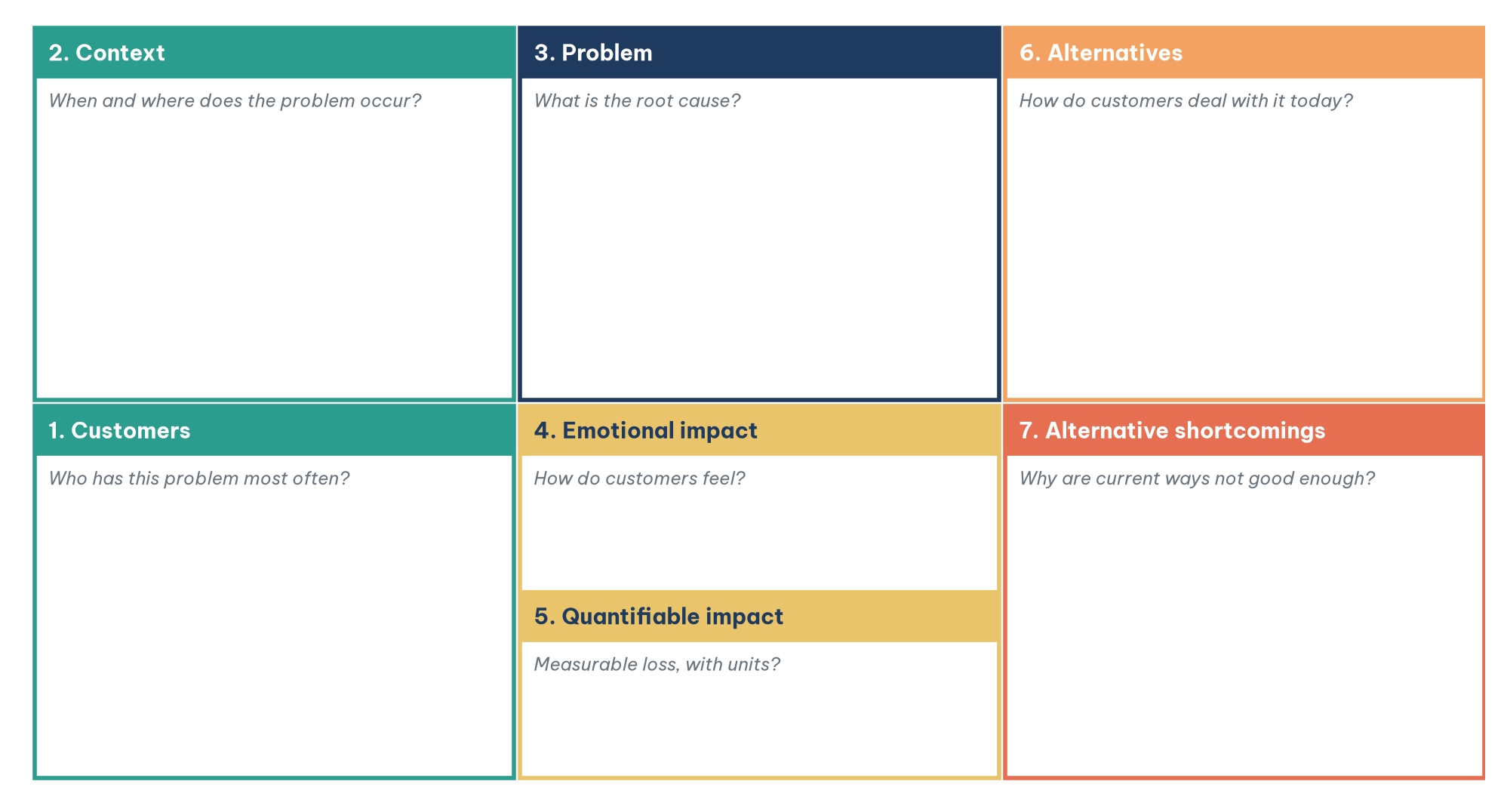
The middle column is the "core": the problem and its two kinds of impact. The right-hand column is the "market": how customers cope today and why that is not good enough. The numbers indicate the suggested order of filling, not the reading order. Table 8 summarises what each box asks and how specific it needs to be.
Boxes 4 and 5 are often filled in carelessly but matter later for sales. Emotional impact explains why customers want to change; quantifiable impact explains how much they are willing to pay to change.
3.2. Filling it in: data, not imagination
A team's first canvas is usually filled in during a meeting, from what the team already knows. That version is useful as a list of hypotheses, but it is not yet a description of the problem. Each box should be updated with data from customer interviews, on-site observation and secondary statistics, with the source noted next to each entry, for example "12 of 20 interviewees". The most important interviewing rule is to ask about specific past events, not opinions about the future.
Box 3 is the hardest. People tend to write the symptom, what everyone can see, instead of the problem, the cause. "Revenue is falling" is a symptom; "staff forget to record orders at peak hours, so the numbers never reconcile and nobody knows which items sell" is a problem. Solutions aimed at symptoms usually treat only the surface. A simple technique is to ask "why?" several times until you reach a cause that, if solved, would make the symptom disappear. Stop when the answers go beyond what a product could influence, such as "because the economy is weak".
Once all seven boxes are filled, the team combines them into one paragraph using this template:
[Context], [customers] are [problem]. This makes them feel [emotional impact] and costs them [quantifiable impact]. Today they [alternatives], but this [shortcomings].
The paragraph is a diagnostic tool. If it sounds unconvincing when read aloud, a box is still weak, usually box 3 (still a symptom) or box 5 (no numbers yet). A useful test is to read it to someone in the target customer group and ask, "Is this true for you? Where is it wrong?" If they nod and add details, the canvas is on the right track.
3.3. Three worked examples
Car-sharing in São Paulo. A team's first idea was very general: traffic is a problem, so build a ride-sharing app. But Uber and many others already existed. The canvas helped the team find a neglected niche. Customers: men aged 25–35 on lower-middle incomes living in the suburbs and working in office jobs downtown. Context: every working day, morning and evening, two to three hours on the road. Problem: time lost in traffic instead of doing something more valuable. Emotional impact: frustration. Quantifiable impact: about 40 hours a month. Alternatives: signing up as an Uber driver and taking only rides along their route. Shortcomings: waiting to "catch" a passenger going their way; uncertain timing.
A fitness app for new mothers. Many founders would jump straight into a "home workout app", a crowded market. The canvas narrowed it to a group with specific needs: mothers aged 28–35 with a baby under one, who want to regain their fitness but cannot leave the baby. They exercise late at night or in short breaks; they lack time and energy for 45–60-minute workouts and are unsure which exercises are safe after childbirth; they feel self-conscious, guilty for neglecting themselves and lonely; they are 5–10 kg above their pre-pregnancy weight and paying for gym memberships they don't use; they rely on random YouTube videos and fad diets, which offer no programme, no safety guidance and no company. One important caveat: a postnatal health product must be built with medical professionals, advise users to consult a doctor before exercising and point to support for signs of postnatal depression. That professional trust is also a hard-to-copy advantage.
Software for small cafés. The point-of-sale software market looks saturated, but perhaps not if you look closely at the pain of small, owner-run cafés. Figure 5 shows a completed canvas for this case; the figures are illustrative assumptions.
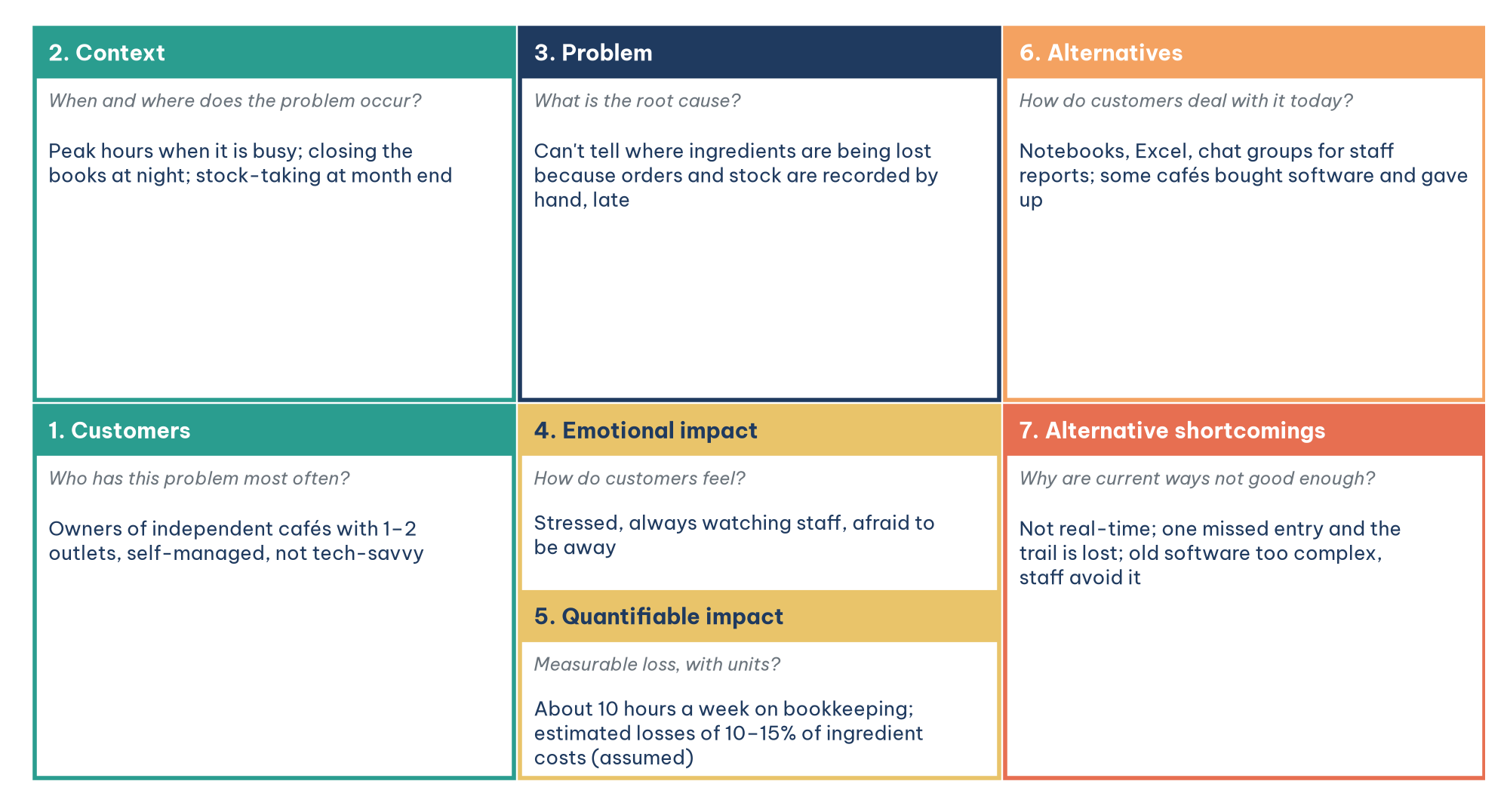
The problem box in Figure 5 is written at the level of cause, "can't tell where ingredients are being lost because orders and stock are recorded by hand, late", rather than the symptom "low profit". The alternatives box also records a crucial detail: some cafés bought software and gave up, so the market lacks not products but suitable products.
3.4. From canvas to solution direction, and six common mistakes
A good solution need not beat competitors on everything; it must be far better at exactly the point where customers are losing the most. Box 7 is the map of those points. For the São Paulo case, the main shortcoming is uncertainty and waiting, suggesting monthly subscriptions between neighbours who live and work in the same areas, on fixed schedules: steady income for drivers, rides as cheap as a bus and as convenient as a taxi for passengers. For new mothers, it is loneliness and the lack of a programme, suggesting a "15 minutes a day" plan by recovery stage plus community challenges, selling connection and understanding rather than just workouts. For cafés, it is delay and fragmentation, suggesting tablet-based sales that deduct stock automatically by recipe and alert the owner when physical stock drifts, selling peace of mind: knowing how the café runs even when you are away. In each case, what is sold is not the feature but something that links back to the emotional-impact box.
Across many classes and incubator programmes, the same mistakes recur, most of them because the team is still thinking about its solution while filling in a canvas about the problem. Table 9 lists the six most common.
The first mistake is the most dangerous because it turns the whole canvas into disguised advertising for a solution already in the team's head. The tell-tale sign is a problem box containing phrases like "there is no", "lacks an app" or "needs a platform". When you see them, rewrite the problem box as if your product would never exist. Leaving the alternatives box blank is also a warning: if customers really do nothing about the problem, either it is not painful enough to act on or the team has not looked closely enough.
4. Is the idea good enough? The idea matrix
Ideas on their own are cheap. What is valuable is a real problem and a solution good enough to make customers abandon old habits. Many founders love their solution and forget to ask whether the market needs it; others find a big problem but build a clumsy or easily copied solution. Peter Thiel (2014) summed this up in his well-known remark that competition is for losers: if a solution cannot be defended, the business is dragged into price wars and its profits erode.
The idea matrix assesses an idea on two axes at once: problem quality, how badly the market needs it, and solution quality, how well the team solves it. To score them, this article uses two sets of criteria compiled by the author from several sources: PASI for the problem and 10x-FSD for the solution. What sets this matrix apart from an ordinary scoring sheet is that every score must rest on evidence from customers, not on the team's feelings.
4.1. Problem quality: PASI
Michael Seibel of Y Combinator calls the best problems "hair on fire" problems: when your hair is on fire, you don't care whether the bucket is pretty or how much it costs; you just need the fire out. Such problems differ from a "mild itch" in four ways, set out in Table 10.
Of the four, A is the most reliable signal of a real problem, because it measures behaviour while the other three rely more or less on what people say. A customer may complain a lot about a problem, but if they do nothing about it, no spreadsheet, no hired help, no payment for even a poor service, it is not important enough to them. Conversely, a customer already spending money on a patchy solution is double evidence: the problem is real and a budget already exists. The question then becomes not "will customers pay?" but "is our solution far better than what they already pay for?", which is the job of the second axis.
4.2. Solution quality: 10x-FSD
Finding people whose hair is on fire is necessary. What is sufficient is a "bucket" far better than anything they have used. Table 11 sets out the four criteria.
Thiel and Masters (2014) argue that proprietary technology needs to be roughly ten times better than its closest substitute in some important dimension to create a real advantage. Ten is not a law, but it reflects a truth about behaviour: people resist change. A product only 10–20% better rarely persuades customers to abandon familiar tools, learn something new and risk it not living up to expectations. Frictionlessness complements this from the other side: a solution ten times better in results but requiring two weeks of training loses its advantage to friction. The best solutions show their value the very first time they are used.
4.3. Four zones
Combining the two axes places every idea in one of four zones, as in Figure 6.
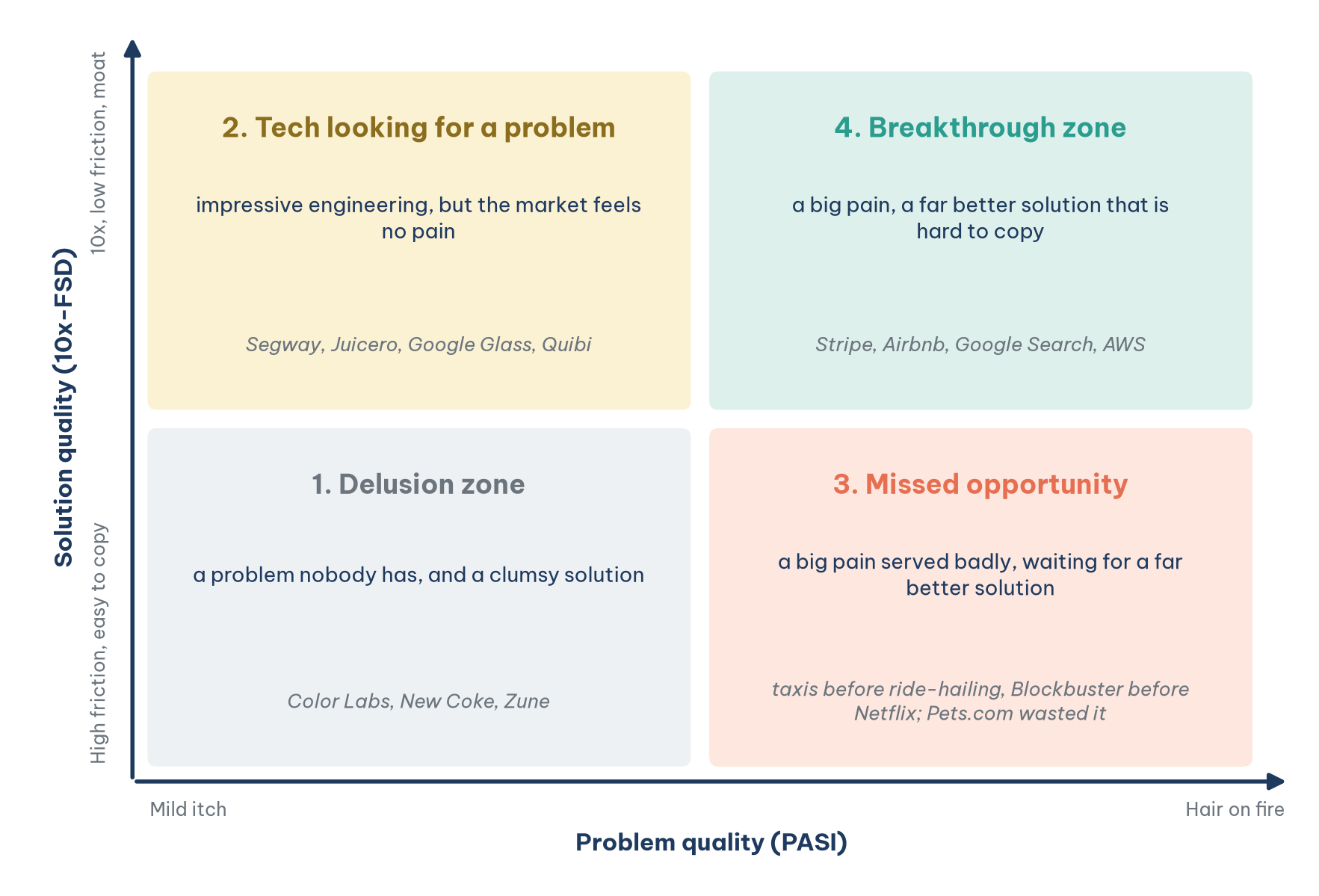
Zones 3 and 4 both sit on the right, meaning both have good problems. This matters: an idea in zone 3 is much closer to zone 4 than an idea in zone 2, because redesigning a solution is much easier than finding a real problem for an existing technology.
Zone 1, delusion: the product relieves no meaningful pain and is clumsy or expensive besides. Color Labs raised USD 41 million in 2011 for an app to share photos with strangers nearby; users had no such need, and the app only worked if many people installed and opened it at the same time. New Coke in 1985 changed the formula to be sweeter, like Pepsi, when customers had no "problem" with the old taste; the backlash forced a return. Microsoft's Zune arrived late with features merely equal to the iPod's, giving customers no reason to switch.
Zone 2, technology looking for a problem: the trap of brilliant engineers, a technical masterpiece the market ignores because it feels no pain. The Segway's self-balancing technology was impressive, but it was only "a bit better than walking" at about USD 5,000, heavy and legally awkward on roads. Juicero, Google Glass in 2013 (ordinary users did not need email on their glasses, which also raised privacy concerns) and Quibi belong here. Placing them in zone 2 refers to the mass markets they targeted; some later found niches, such as Segways for patrols and tours or smart glasses in industry. That is exactly the right move for zone 2: keep the technology, change the customer.
Zone 3, missed opportunity: the market is putting up with bad service for lack of anything better. This is the most fertile zone for newcomers who can build a far better solution. Traditional taxis before Uber and Grab made customers call a dispatcher, wait, guess the price and pay cash; ride-hailing removed those frictions. Blockbuster before Netflix made customers visit a store and pay late fees; according to its former CEO John Antioco (2011), late fees in 2000 reached about USD 800 million, roughly 16% of revenue. Pay-per-message SMS gave way to free, multimedia messaging apps such as WhatsApp. Pets.com in 2000 is the counter-example in the same zone: the need for convenient pet food was real, but shipping heavy bags with delivery costs above the margin meant that every sale lost money. Zone 3 is an opportunity, not a guarantee.
Zone 4, breakthrough: a team solves a big pain in a way competitors want to copy but cannot. Stripe replaced weeks of bureaucratic, technically complex bank integration with a clean API and self-service sign-up, defended by documentation and a developer community that create switching costs. Airbnb offered travellers better prices and local experiences while solving hosts' fear of strangers with two-way reviews and host insurance, protected by two-sided network effects. Google Search's PageRank gave far more relevant results at near-zero marginal cost, with behavioural data improving results over time. AWS turned servers from capital spending into pay-as-you-go operating costs, available in minutes and elastic with demand. What the four share is D: a moat that deepens over time. A ten-times-better solution without D will soon be copied and dragged back into price competition.
4.4. Scoring on evidence
To place an idea on the matrix, the team scores eight criteria on a common scale from 1 to 5. The score reflects not how confident the team feels but the kind of evidence it has, as in Table 12.
This has an important consequence: a team that has interviewed nobody cannot score more than 2 on any criterion, however certain it feels. That forces teams to meet customers before judging their idea. The problem score is the average of P, A, S and I; the solution score is the average of 10x, F, S and D. An average of 3.5 or more counts as high. Two override rules apply: if A is 2 or lower, the problem counts as low regardless of the average, and if 10x is 2 or lower, the solution counts as low regardless of the average.
Returning to the café software, suppose the team interviewed 25 owners and let ten cafés trial a first version (illustrative figures). On the problem side: P = 4 (owners spend about an hour closing the books each night and lose ingredients for unknown reasons), A = 4 (18 of 25 use notebooks and Excel; 5 bought software and gave up), S = 3 (many small cafés in the area, but no market sizing yet) and I = 5 (it happens every day), averaging 4.0. On the solution side: 10x = 3 (the trial cut closing time to about ten minutes), F = 2 (staff needed two sessions to get used to it), S = 4 (software, no extra staff per café) and D = 2 (no distinctive advantage yet), averaging 2.75. The idea sits in zone 3: a good problem, a solution not yet good enough. The detail "5 cafés bought software and gave up" both strengthens A and warns about F. Next steps: redesign so staff can use it after ten minutes, and look for a moat, for example a dataset of ingredient quantities for popular local drink recipes that foreign competitors lack.
4.5. A four-step process into the breakthrough zone
The matrix shows where an idea stands; a four-step process shows how to gather evidence and move between zones, as in Figure 7.
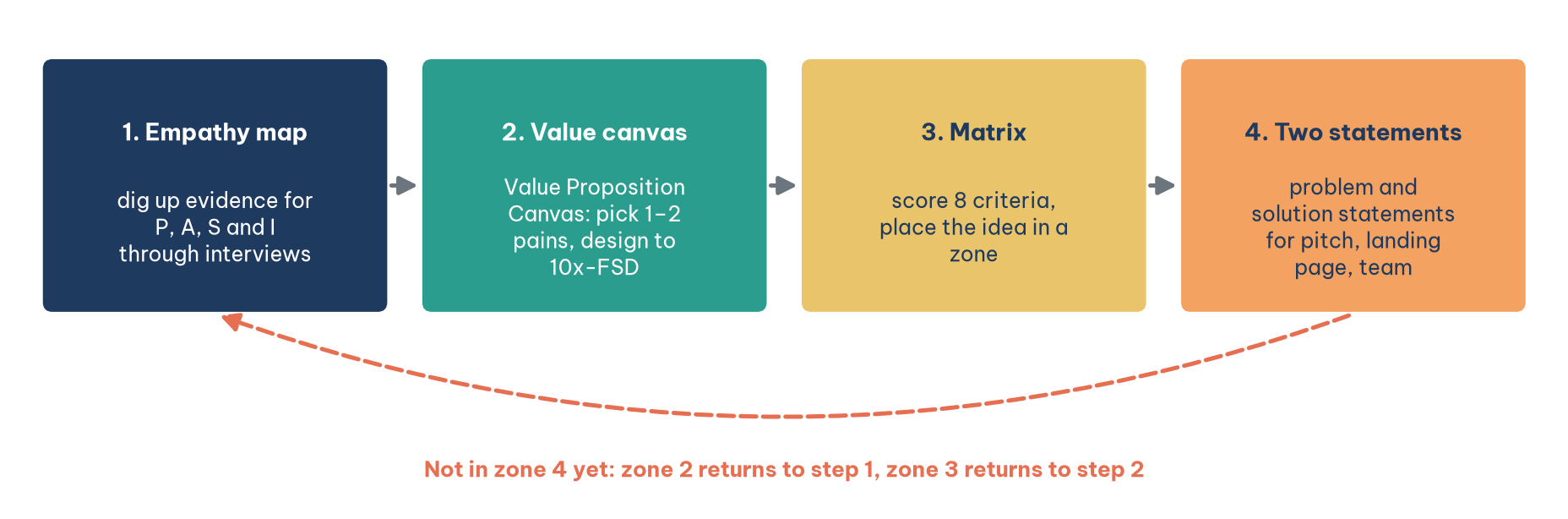
Step 1: an empathy map to gather evidence for PASI. The empathy map, developed by Dave Gray and introduced in Gamestorming (Gray et al., 2010), is often used as a pretty customer-portrait exercise. Here it is an evidence-gathering tool. The team interviews 10–20 potential customers about specific past events and, for each point, records a verbatim quote, the coping behaviour, frequency and consequence. "Thinks and feels" plus consequences feeds P; "says and does" feeds A; repetition across interviews feeds S; frequency of action feeds I. The condition for moving on is a repeated pattern of pain and coping, with customers actively dealing with it. If not, change the customer group or the problem.
Step 2: a value proposition canvas to design to 10x-FSD. If the empathy map answers "is their hair really on fire?", the Value Proposition Canvas (Osterwalder et al., 2014) answers "is our bucket good enough to make them abandon old habits?". On the customer-profile side, the team lists jobs, pains and gains, keeping only the one or two pains that met the PASI bar. On the value-map side, it designs products, pain relievers and gain creators, then checks each against 10x-FSD. The output is a hypothesis: we solve [pain X] with [mechanism Y], [Z times] better than today on [metric].
Step 3: place the idea on the matrix. Score the eight criteria and act according to the zone: stop or pivot completely in zone 1; keep the technology but find another customer with a real problem in zone 2 (back to step 1); keep the problem but redesign the solution in zone 3 (back to step 2); move to step 4 and start prototyping in zone 4.
Step 4: two statements. The last step condenses all the evidence into a problem statement and a solution statement, for landing pages, pitches and a shared team language. Each part of the templates below is tied to a criterion, so the writer can see at once which criterion lacks evidence.
For [specific customers] in [context, scale] (S), whenever [trigger event], the problem occurs [frequency] and must be dealt with (I). Their core difficulty is [root cause], which makes them feel [emotion] and costs them [specific figure] (P). Today they cope with [current solution], but it fails because [shortcoming] (A).
[Name] is a [type of product] that helps [customers] achieve [main job]. Unlike [old solution], we use [mechanism, technology, insight] to move [metric] from [current level] to [target level] (10x). Customers get value after [minutes, steps] without [barrier] (F). The model scales through [factor] (S) and is protected by [moat] (D).
Applied to Stripe in its early days (the timings are illustrative): developers and online businesses spent weeks integrating payments for each product launch, even with bank gateways or first-generation payment services, because traditional systems were bureaucratic and not designed for developers. Stripe helped developers integrate payments with a few lines of code and get paid almost immediately instead of after weeks of paperwork, protected by a developer ecosystem that makes switching providers costly. The two sentences contain every element: specific customers, a measurable loss, the old solution and its weakness, the degree of improvement, the barrier removed and the moat. A statement missing any of these usually signals missing evidence on the matching criterion.
5. The map is not the territory
Completing all four tools does not mean the idea has succeeded. The result is only "product–market fit on paper": early evidence that the problem is real and that the solution could in theory solve it. The team still has to prove much more: that the market is large enough, that the promise of being ten times better survives successive versions of the product, and that the business can reach customers at a reasonable cost and make money sustainably.
AI can act as a demanding critic to stress-test the two statements before they are presented. A sample prompt:
You are a tough venture capitalist. Score my problem statement on PASI (Pain, Active, Scale, Inevitable) out of 10 and my solution statement on 10x-FSD (10x Better, Frictionless, Scalable, Defensible) out of 10. Point out the biggest red flag in the problem, the weakest point in the solution, the three hardest questions you would ask if I pitched you, and suggest a sharper one-line summary. No polite praise.
If the AI awards 9 or 10 on the first pass, be suspicious and ask it to play a sceptical investor looking for every reason to reject the project. AI is good at finding holes in arguments, but it does not know the team's real customers; every objection it raises must be answered with evidence from customers, not with new arguments.
Conclusion
The four tools in this article answer four questions in sequence. The Rumsfeld matrix shows where to look: do better what already exists, solve a named hard problem, leverage assets you have not noticed, or explore through experiments. Founder–problem fit asks whether the team understands the problem deeply, has the right capabilities and will last, and moves the assessment from the individual to the team through MILES, the three circles, the Hacker–Hustler–Hipster triangle and a written co-founder agreement. The Problem Statement Canvas turns a vague problem into seven testable boxes, separates symptoms from causes and finds the gap left by current alternatives. The idea matrix scores the problem and the solution on evidence, with two override rules: customers must already be actively coping, and the solution must be far better than the old way.
What ties the four tools together is a shift from belief to evidence. Every box, score and statement should be traceable to something customers actually said or did. A good problem statement remains true even if the team's product never exists; a good idea is noticed rather than invented; and an idea is proven only when real customers use a real product and pay real money.
References
Ali, A., & Kubba, H. (2020). The unfair advantage: How you already have what it takes to succeed. Profile Books. https://profilebooks.com/work/the-unfair-advantage/
Altman, S. (2015). Startup playbook. https://playbook.samaltman.com/
Antioco, J. (2011). How I did it: Blockbuster's former CEO on sparring with an activist shareholder. Harvard Business Review, 89(4), 39–44. https://hbr.org/2011/04/how-i-did-it-blockbusters-former-ceo-on-sparring-with-an-activist-shareholder
Aulet, B. (2013). Disciplined entrepreneurship: 24 steps to a successful startup. Wiley. https://www.wiley.com/en-gb/Disciplined+Entrepreneurship%3A+24+Steps+to+a+Successful+Startup-p-9781118720813
Aulet, B. (2024). Disciplined entrepreneurship: 24 steps to a successful startup (Expanded & updated ed.). Wiley. https://www.wiley.com/en-us/Disciplined+Entrepreneurship:+24+Steps+to+a+Successful+Startup,+Expanded+&+Updated,+2nd+Edition-p-9781394222513
CB Insights. (2021). The top 12 reasons startups fail. https://www.cbinsights.com/research/report/startup-failure-reasons-top/
Cohen, S., Kamarck, T., & Mermelstein, R. (1983). A global measure of perceived stress. Journal of Health and Social Behavior, 24(4), 385–396. https://doi.org/10.2307/2136404
Collins, J. (2001). Good to great: Why some companies make the leap… and others don't. HarperBusiness. https://www.amazon.com/s?k=Good+to+great+Collins&i=stripbooks
d-eship. (n.d.). The Problem Statement Canvas: A deep dive in problem definition for startups and innovation teams. https://www.d-eship.com/articles/the-problem-statement-canvas-a-deep-dive-in-problem-definition-for-startups-and-innovation-teams/
Gompers, P. A., Gornall, W., Kaplan, S. N., & Strebulaev, I. A. (2020). How do venture capitalists make decisions? Journal of Financial Economics, 135(1), 169–190. https://doi.org/10.1016/j.jfineco.2019.06.011
Graham, P. (2012). How to get startup ideas. http://paulgraham.com/startupideas.html
Gray, D., Brown, S., & Macanufo, J. (2010). Gamestorming: A playbook for innovators, rulebreakers, and changemakers. O'Reilly Media. https://www.oreilly.com/pub/pr/2610
Holland, J. L. (1997). Making vocational choices: A theory of vocational personalities and work environments (3rd ed.). Psychological Assessment Resources. https://www.amazon.com/s?k=Making+vocational+choices+Holland&i=stripbooks
Inamoto, R. (2012). The new creative team: Hacker, hipster, hustler. AKQA. https://www.google.com/search?q=Rei+Inamoto+hacker+hipster+hustler
Osterwalder, A., Pigneur, Y., Bernarda, G., & Smith, A. (2014). Value proposition design. Wiley. https://www.wiley.com/en-us/shop/general-introductory-business-management/value-proposition-design-how-to-create-products-and-services-customers-want-p-9781118968062
Rumsfeld, D. (2002, February 12). DoD news briefing – Secretary Rumsfeld and Gen. Myers. U.S. Department of Defense. https://archive.defense.gov/Transcripts/Transcript.aspx?TranscriptID=2636
The Nobel Assembly at Karolinska Institutet. (2023). The Nobel Prize in Physiology or Medicine 2023: Katalin Karikó and Drew Weissman. https://www.nobelprize.org/prizes/medicine/2023/summary/
Thiel, P. (2014, September 12). Competition is for losers. The Wall Street Journal. https://www.wsj.com/articles/peter-thiel-competition-is-for-losers-1410535536
Thiel, P., & Masters, B. (2014). Zero to one: Notes on startups, or how to build the future. Crown Business. https://www.penguinrandomhouse.com/books/234730/zero-to-one-by-peter-thiel-with-blake-masters/
Winn, M. (2014, May 14). What is your ikigai? The View Inside Me. http://theviewinside.me/what-is-your-ikigai/
Žižek, S. (2004, May 21). What Rumsfeld doesn't know that he knows about Abu Ghraib. In These Times. https://inthesetimes.com/article/what-rumsfeld-doesn-know-that-he-knows-about-abu-ghraib
Discussion about this post