Effectuation: Sarasvathy's Five Principles for Starting with What You Have
Expert entrepreneurs start not from a big goal but from the means they already hold and the loss they can afford


Key takeaways
Sarasvathy describes two logics of venture creation: causation starts from a given goal and picks the best means; effectuation starts from given means and asks what can be made from them.
In think-aloud studies, expert entrepreneurs used effectual reasoning far more than MBA students working on the same problems, who mostly predicted and planned as they had been taught.
Effectuation begins with three questions about the founder (Who am I? What do I know? Whom do I know?) and runs on five principles: bird in hand, affordable loss, crazy quilt, lemonade and pilot in the plane.
Each new partner commitment expands the founder's means and narrows the goal at the same time, which is why many successful ventures end up far from the original idea.
Effectuation fits new, uncertain markets; once there are paying customers and real cost and revenue data, founders should shift step by step toward prediction and planning.
Ask almost any business school, accelerator or bank how to start a company and the answer follows the same script: research the market, pick the most attractive segment, write a business plan, raise money and only then begin. The script works well when the market already exists and the numbers can be estimated. It breaks down exactly where most new ventures live, in markets that are new, customers who do not yet know what they want and data that does not exist.
Consider Lan, a young pharmacy graduate who wants to start an herbal tea business. The advice she hears most often is to study the national herbal tea market, find the best segment, write a plan and raise capital before doing anything. She tries and gets stuck at the first step: there are no reliable market figures, she cannot tell what customers will like and no investor will fund a plan built on guessed numbers.
A friend suggests the opposite. Start from what you already have: you understand medicinal plants, your mother's family grows artichokes in the highlands, a few friends run pharmacies and a café and you have about $600 in savings that you could lose without hurting your life. Given those things, what could you do this week? The second way of thinking has a name in entrepreneurship research: effectuation.
This article has five sections. Section 1 contrasts the two logics of starting a venture. Section 2 describes the founder's own means, where effectuation begins. Section 3 explains the five principles of effectuation. Section 4 shows how the effectual process runs as a cycle. Section 5 discusses when to use effectuation and when to plan, along with the limits of the approach.
1. Two logics of starting a venture
This section introduces the research behind effectuation and the contrast between causal and effectual reasoning.
Saras Sarasvathy set out to study how expert entrepreneurs actually make decisions, and found that they do not behave the way management textbooks describe. She gave 27 founders who had built substantial companies the same hypothetical start-up problem and asked them to think aloud while solving it. Most of them did not begin by predicting the market and choosing an optimal goal; they began with who they were, what they knew and whom they knew (Sarasvathy, 2008).
Sarasvathy (2001) calls the two logics causation and effectuation. Causation takes a goal as given and selects the best means to reach it. Effectuation takes a set of means as given and asks which effects can be created with them. Her image is two cooks. The first picks a dish, buys exactly the ingredients the recipe calls for and cooks it. The second opens the refrigerator, looks at what is there and invents a dish that can be made from it. Both can cook well; they differ only in where they start. Table 1 compares the two logics.
A follow-up study compared 27 expert entrepreneurs with 37 MBA students solving the same venture problems aloud. The experts used effectual logic far more often, while the students tended to rely on prediction and planning, as they had been taught (Dew et al., 2009). This does not mean that planning is wrong. It suggests that experience of building ventures teaches people a different way of working when the future is too blurry to forecast.
2. The founder's means
This section turns to the starting point of effectuation: an honest inventory of what the founder already brings.
Effectuation begins with three questions about the founder's own means: Who am I? (identity, values, tastes and abilities), What do I know? (knowledge, experience and expertise) and Whom do I know? (social and professional networks) (Sarasvathy, 2001). Aulet (2024) offers a more detailed set of self-assessment questions that works well as an inventory of these means:
Knowledge: what fields have your studies and work focused on?
Skills: what are you best at doing?
Connections: whom do you know with expertise in other fields, and which entrepreneurs do you know?
Financial resources: how much money can you access, or do you only have modest savings?
Reputation: what fields or skills are you or your co-founders known for?
Work experience: in the places you have worked, what "pain" or inefficiency did you see clearly?
Passion: which markets do you truly care about, such as health, education, energy or agriculture?
Commitment: how much time and effort can you give to this?
For Lan, the inventory produces a concrete list: knowledge of medicinal herbs, a family farm in an artichoke-growing region, two friends who own pharmacies, a cousin who runs a café, about $600 in savings and roughly twenty hours a week outside her day job. That is her refrigerator. Nothing on the list is remarkable, and that is the point: an ordinary inventory is enough to begin.
3. The five principles of effectuation
This section sets out the five principles that summarize effectual reasoning and applies each one to Lan's tea project.
Drawing on the studies of expert entrepreneurs, Sarasvathy (2008) and her colleagues condensed effectual reasoning into five principles, each usually known by a memorable image (Read et al., 2017). Table 2 presents the five principles and how Lan might apply them.
Of the five, affordable loss usually changes students' thinking the most. When the future cannot be predicted, every figure for expected profit is a guess. The amount you can afford to lose, by contrast, is known today. Asking "if this fails, what do I lose, and can I live with that?" lets a founder act early instead of waiting for a perfect plan that never arrives. It also caps risk: several small attempts, each with a small loss, are safer than one large bet with a large loss. Lan's limit of $600 and three months is not a budget derived from a revenue forecast; it is a ceiling she set from her own circumstances, and it tells her exactly when to stop or rethink.
The crazy quilt principle deserves attention because it reverses the usual view of competitors and partners. Instead of studying competitors closely and trying to outrun them, expert entrepreneurs look for people willing to contribute resources, however small, in exchange for a share in the outcome. Each such commitment adds means and also shapes the goal. Lan's artichoke cooperative is not just a supplier; by accepting deferred payment in return for a steady buyer, it is helping her decide what the product will become.
4. The effectual process as a cycle
This section puts the five principles together into the dynamic process that Sarasvathy describes.
Placed side by side, the five principles form an iterative process, shown in Figure 1 (Sarasvathy, 2008). The entrepreneur starts from the three kinds of means, imagines what could be done with them, talks to people she knows and obtains commitments from some of them. Each commitment moves the cycle in two directions at once: means expand (more resources, more people) and goals converge (more constraints, a clearer direction). At some point the goal is clear enough to become a product, a market or a firm.
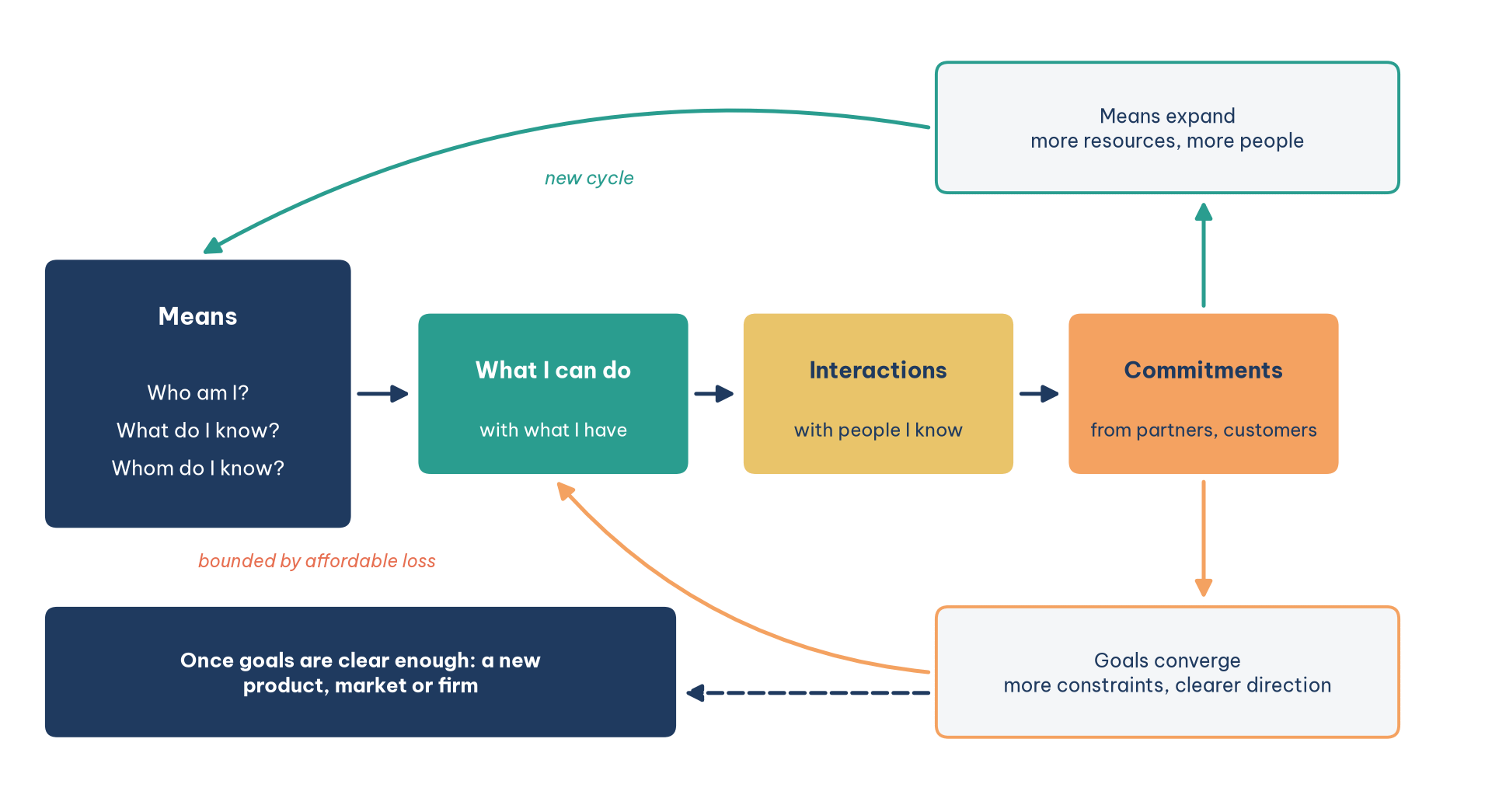
Figure 1 explains why so many successful companies end up "nothing like the original idea". That outcome is not a failure of planning; it is the natural result of letting partners and customers help define the goal. Six months in, Lan's main product may no longer be retail tea bags but ready-brewed artichoke tea for a group of cafés, a market she had not imagined at the start. Note too that affordable loss sits at the entrance of the cycle: each new round begins only with stakes the founder has decided she can bear.
Effectuation has much in common with the lean startup: both value early action, small experiments and learning from feedback. The difference lies in emphasis. The lean startup concentrates on testing hypotheses about customers, while effectuation stresses the role of existing means and of committed partners in creating the opportunity itself. The two views complement each other; a founder can run lean experiments inside an effectual cycle, using partners' commitments both as resources and as evidence.
5. When to effectuate and when to plan
This section places effectuation alongside other strategies and sets out its limits.
Effectuation does not replace planning. Wiltbank et al. (2006) propose viewing strategy along two axes: how much a firm emphasizes predicting the future, and how much it emphasizes controlling it, that is, creating the future itself. The two axes produce four approaches, shown in Figure 2.
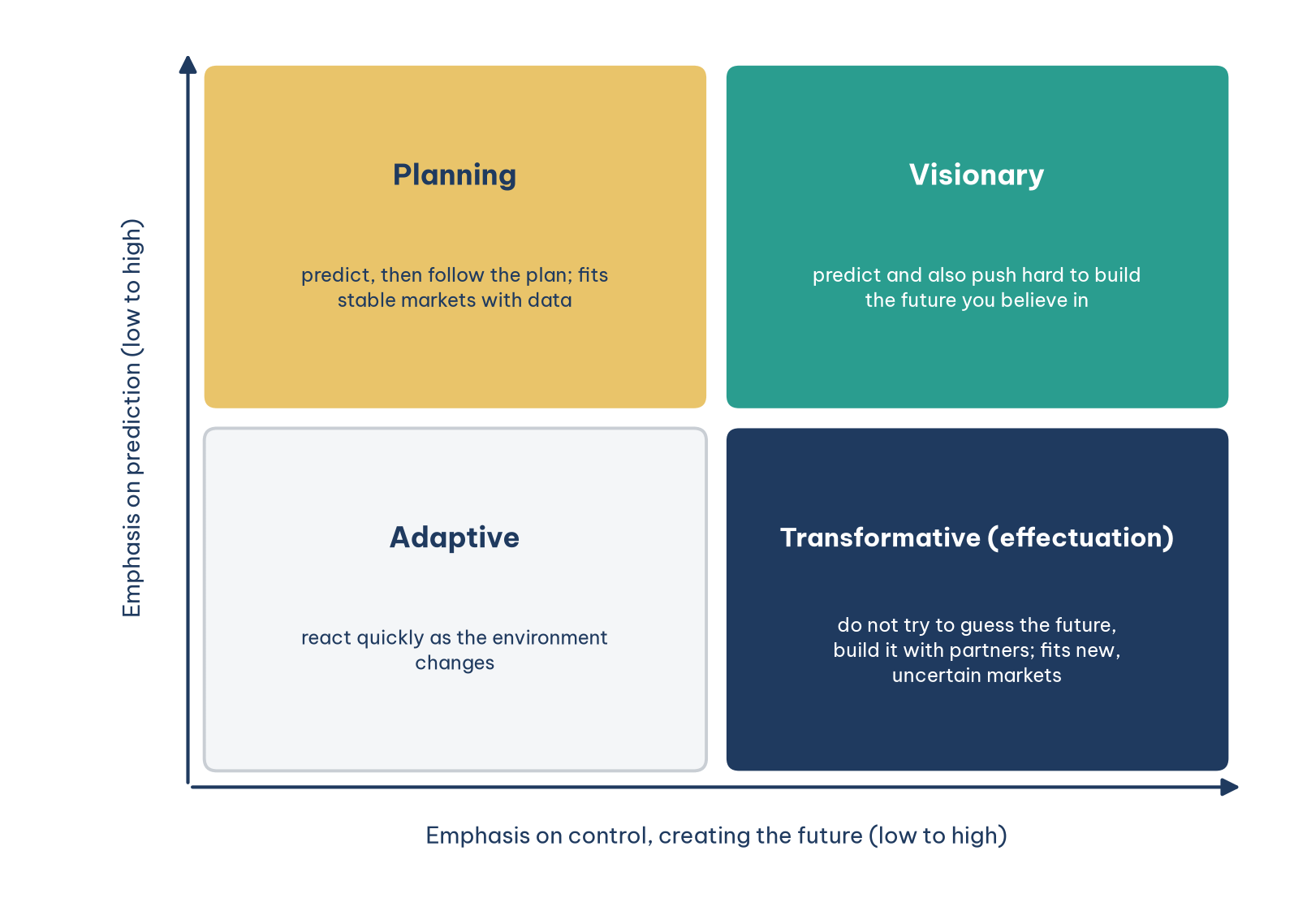
The planning quadrant (high prediction, low control) suits stable markets with good data, such as opening another branch of a chain whose stores already run well. The adaptive quadrant (low on both) means responding quickly to changes in the environment. The visionary quadrant (high on both) describes a firm that both predicts and commits heavily to creating the future it believes in. The transformative quadrant (low prediction, high control) is where effectuation sits: rather than trying to guess the future, the firm builds it with its partners.
For a start-up, the practical rule is fairly simple. When the market is new, customers are unclear and data hardly exists, think effectually: start from what you have, cap the loss and look for committed partners. Once there are paying customers and real figures on costs and revenue, shift gradually toward planning: forecast, analyze feasibility and write a business plan to raise money and scale. Many good founders use both logics; what changes from stage to stage is the dose.
Effectuation also has limits worth knowing. Starting from what you have can keep a team circling inside familiar territory, missing a larger opportunity that lies outside its own network. And affordable loss differs greatly from person to person: a student with no family obligations can bear a different risk from a parent supporting young children. For that reason the affordable loss should be set honestly, written down and respected, not stretched a little after every setback.
Conclusion
Lan does not need to wait for perfect market data. She starts with three things already in her refrigerator: knowledge of medicinal herbs, a family farm in artichoke country and a few friends in business. She sets a limit of $600 and three months, finds a pharmacy willing to sell a trial batch and a cooperative willing to supply on credit, then turns the complaint "a bit bitter" into a product line for cafés. That is effectuation in practice: not guessing the future, but building it step by step with other people. When the numbers become good enough to predict from, that is the moment for Lan to write a business plan, this time based on real data rather than guesswork.
References
Aulet, B. (2024). Disciplined entrepreneurship: 24 steps to a successful startup (Expanded & updated ed.). Wiley. https://www.wiley.com/en-us/Disciplined+Entrepreneurship:+24+Steps+to+a+Successful+Startup,+Expanded+&+Updated,+2nd+Edition-p-9781394222513
Dew, N., Read, S., Sarasvathy, S. D., & Wiltbank, R. (2009). Effectual versus predictive logics in entrepreneurial decision-making: Differences between experts and novices. Journal of Business Venturing, 24(4), 287–309. https://doi.org/10.1016/j.jbusvent.2008.02.002
Read, S., Sarasvathy, S., Dew, N., & Wiltbank, R. (2017). Effectual entrepreneurship (2nd ed.). Routledge. https://doi.org/10.4324/9781315684826
Sarasvathy, S. D. (2001). Causation and effectuation: Toward a theoretical shift from economic inevitability to entrepreneurial contingency. Academy of Management Review, 26(2), 243–263. https://doi.org/10.5465/amr.2001.4378020
Sarasvathy, S. D. (2008). Effectuation: Elements of entrepreneurial expertise. Edward Elgar. https://doi.org/10.4337/9781848440197
Wiltbank, R., Dew, N., Read, S., & Sarasvathy, S. D. (2006). What to do next? The case for non-predictive strategy. Strategic Management Journal, 27(10), 981–998. https://doi.org/10.1002/smj.555
Discussion about this post