Design Thinking, Lean Startup and Agile Together
Which question each method answers, when to use it, and the four outputs that mark progress: proof of concept, prototype, MVP and MVBP

Key takeaways
Design Thinking finds the right problem, Lean Startup tests whether the solution has a market, and Agile delivers it steadily. They are three lenses on one process, not rivals.
Four outputs are often confused. A POC tests technical feasibility, a prototype tests usability, an MVP tests whether users come back, and an MVBP tests whether someone pays.
The form of each output depends on the product: software, hardware, two-sided platforms and services all validate differently.
Common mistakes include treating "minimum" as "crap", skipping discovery, stopping at a free MVP, and practising Agile as ritual.
AI tools now compress the path from idea to prototype to hours, but they do not replace understanding the customer.
A figure often repeated in startup circles is that about nine out of ten startups fail (an estimate that varies with how "failure" is defined and which source you use). What matters more is why they fail. According to the post-mortem analyses compiled by CB Insights (2021), no market need is always among the top two reasons (35% in the 2021 edition, second only to running out of cash at 38%, and running out of cash is usually a consequence of nobody wanting to buy). Many teams painstakingly build something nobody really wants to buy.
This is the founder's great paradox. We love our idea so much that we forget to ask whether customers love it. We spend six months, a year, even three years perfecting a product behind closed doors, only to open the doors to the market and be met with a deafening silence.
Over the past two decades, the startup world has developed a trio of methodologies that, combined, can sharply reduce this risk: Design Thinking, Lean Startup and Agile. Each solves a different problem at a different stage of product development, and their real strength appears when the three are woven into one continuous process.
Figure 1 sketches the trio and where each sits in the product-development journey.

This article looks at how to combine the three. Section 1 clarifies which question each method answers and why all three are needed. Section 2 distinguishes four outputs that are often confused, the POC, prototype, MVP and MVBP, and Section 3 shows how these outputs take different forms for software, hardware, two-sided platforms and services. Section 4 assembles everything into an integrated product-development process, Section 5 reviews common mistakes, Section 6 introduces the AI tools that are shortening execution time at each stage, and Section 7 proposes a 12-month roadmap for an early-stage startup.
1. Understanding the three methodologies
Before combining them, we need to understand each method properly: what problem it was born to solve, what steps it involves, and at which stage of product development it works best. The first three subsections introduce Design Thinking, Lean Startup and Agile in turn, each with real examples; the last places all three in one picture.
1.1. Design Thinking: from a fuzzy problem to possible solutions
Design Thinking, popularized by IDEO and the Stanford d.school (Brown, 2008), helps product teams discover and define the right problem before thinking about solutions. It is the "top of the funnel" of product development, where everything is still fuzzy and the team needs to immerse itself in the customer's world.
The classic Design Thinking process has five steps:
Empathize: observe and interview users to understand their behaviour, motivations and pain deeply.
Define: synthesize the observations into a clear problem statement.
Ideate: generate as many possible solutions as you can.
Prototype: make the ideas tangible as models people can interact with.
Test: put the prototypes in front of real users and collect feedback.
The point is not to follow this order mechanically but to adopt its spirit: understand users deeply before assuming anything.
A classic example is Airbnb. In 2009 the company was on the brink of bankruptcy, with revenue stuck at USD 200 a week. Brian Chesky and Joe Gebbia decided to fly to New York to meet hosts in person. They discovered that the photos of the rooms were poor, blurry and unappealing. Instead of writing more code or tuning algorithms, they rented a professional camera and photographed the rooms themselves. Revenue in New York doubled within a week.
Another memorable example is Bank of America and its "Keep the Change" product. In the early 2000s the bank wanted more people to open savings accounts and hired IDEO to apply Design Thinking. The IDEO team observed dozens of middle-aged women in their daily lives, not in bank meeting rooms. They found two things: many people rounded up amounts when balancing their chequebooks to make the arithmetic easier, and many women found it hard to start saving even though they knew they should. "Keep the Change" was born: it rounded up every debit-card purchase and moved the difference into a savings account. The product attracted more than 12 million customers in its first few years.
A third example from healthcare is GE Healthcare's redesign of MRI scanning for children. Doug Dietz, a lead engineer at GE, watched a little girl cry in terror as she was about to enter an MRI scanner he had designed. He learned that up to 80% of children had to be sedated before an MRI because they were frightened. After Design Thinking training at Stanford, he observed children playing at a children's museum and spoke with child psychologists and parents. He redesigned the MRI experience into the "Adventure Series", turning scan rooms into a pirate ship, a spaceship or a campsite, with a story told by the technician. The share of children needing sedation fell sharply (sources give different figures), and patient and parent satisfaction rose markedly.
1.2. Lean Startup: learn fast, fail fast, fix fast
If Design Thinking helps a team find the right problem, Lean Startup, introduced by Eric Ries (2011) in the book of the same name, helps it test the solution as cost-effectively as possible. The heart of Lean Startup is the Build–Measure–Learn loop, which aims to shorten the time between making an assumption and confirming or refuting it.
Lean Startup introduces two key concepts:
Minimum viable product (MVP): the version of a product that lets a team collect the maximum amount of validated learning with the least effort.
Pivot or persevere: after each round of measurement, the team must seriously ask whether it is on the right track. If its core assumptions are not confirmed by the market, it must have the courage to pivot rather than keep investing in the wrong direction.
The textbook pivot story is Instagram. The app started as Burbn, a feature-packed Foursquare-style social network for checking in, making plans, sharing photos and more. After analysing the data, founders Kevin Systrom and Mike Krieger realized that users only really cared about photo sharing. They pivoted by stripping out every other feature and focusing on mobile photography. The rest is history.
Another memorable pivot is Slack. Stewart Butterfield originally founded a game company, Tiny Speck, to build an online role-playing game called Glitch. The game failed commercially after a few years. But the team had built an internal communication tool to coordinate work among members in several cities. When they shut Glitch down, they realized that the tool was especially valuable, and pivoted to Slack, which Salesforce later acquired for USD 27.7 billion.
YouTube is another pivot. Few people know that YouTube was first designed as a dating site called "Tune In, Hook Up", where users posted introduction videos to find a partner. The model failed completely. But founders Chad Hurley, Steve Chen and Jawed Karim noticed users uploading all kinds of videos unrelated to dating, and pivoted to a general video-sharing platform.
1.3. Agile: deliver steadily, adapt continuously
Once there is an MVP and it must become a mature product serving more users, Agile becomes the main methodology (Beck et al., 2001). Agile, whose most popular frameworks are Scrum and Kanban, organizes work into short cycles (sprints, usually one to four weeks) and continuously produces shippable increments, versions that can be put in customers' hands.
The Scrum cycle has these main components (Schwaber & Sutherland, 2020):
Product backlog: a prioritized list of features and work, maintained and updated continuously.
Sprint planning: at the start of each sprint, the team chooses items from the backlog to commit to.
Sprint execution: the work itself, with a short daily stand-up to synchronize progress.
Sprint review: at the end of the sprint, the team demonstrates the product to stakeholders and gathers feedback.
Retrospective: the team reviews how it worked in order to improve the next sprint.
Spotify is a classic example of Agile at scale. It developed the "squads, tribes, chapters and guilds" model, in which each squad is a small autonomous Agile team working on a specific product area. The model let Spotify stay nimble even as a global company with thousands of engineers.
1.4. The big picture: why combine all three?
A common belief is that Design Thinking, Lean Startup and Agile are three different, even opposing, methods and that founders must pick one. The opposite is true. They are three lenses on the same process: turning a fuzzy idea into a product with real users and real revenue.
Figure 2 shows a widely shared diagram, based on a model Gartner presented in 2016, that illustrates the combination. It draws a curve through three zones, explained below.
The customer PROBLEM zone (Design Thinking): the team goes through Empathize, Define and Ideate, moving from the "concrete" (field observation) to the "abstract" (insights and solution ideas).
The overlap zone (Lean Startup): the team tests assumptions with small experiments, learns, measures and decides whether to pivot or persevere. The Build–Measure–Learn loop runs here, with the MVP at its centre.
The customer SOLUTION zone (Agile): once the direction is confirmed, the team switches to steady delivery through Scrum sprints, continuously producing shippable increments.
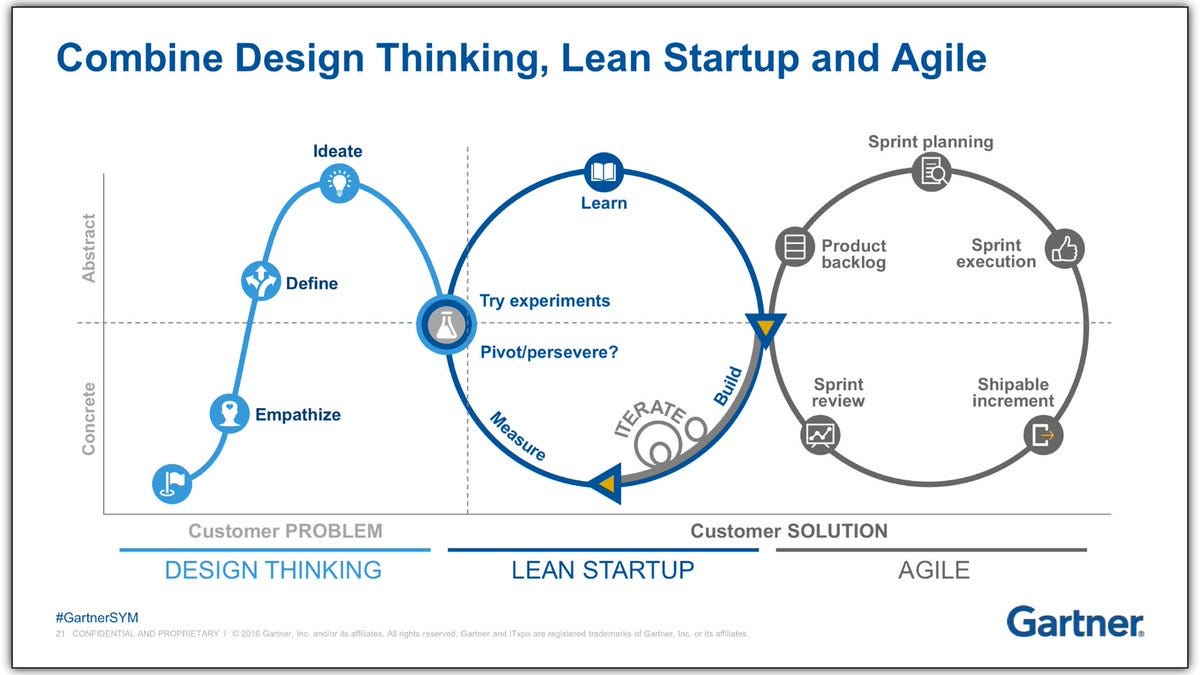
What Figure 2 shows is that the three zones are not separate but overlapping and interleaved. A mature startup keeps returning to Design Thinking when it expands into a new customer segment, uses Lean Startup when it tests new features, and Agile when it executes and scales. It is an upward spiral, not a straight line.
2. POC, prototype, MVP and MVBP: four key outputs
Before turning to the detailed process, we need to clarify four concepts that are often confused. They are the four core outputs of product development, each answering a different question and serving a different purpose.
2.1. Proof of concept (POC): evidence of feasibility
A POC answers the question: "Is this idea technically feasible?". It is a small, internal experiment, with no polished user interface and no intention of being sold. A POC matters most for products with high technical risk, such as deep tech, hardware, AI or blockchain.
Some examples of POCs:
An AI startup wants to check whether its language model is accurate enough in the medical domain. It builds a POC by running the model on a sample of 100 cases and measuring accuracy against doctors' diagnoses.
An IoT startup wants to check whether its sensor can measure heart rate accurately at the wrist. It solders a circuit on a breadboard, straps the sensor to volunteers' wrists and measures the error against a standard medical device.
An electric-vehicle battery startup tests a new electrode formula. It makes a small battery cell in the lab and measures capacity and durability over thousands of charge cycles.
2.2. Prototype: showing form and experience
A prototype answers the question: "How will the product look and work?". It is a "looks-real" version of the product, with a full interface and interaction flows, but no working system behind it. Its purpose is to test the design and gather feedback from users and stakeholders on the experience before investing in a full build.
There are two common kinds of prototype:
Low-fidelity prototypes: hand drawings on paper, whiteboard sketches or simple wireframes. The goal is to be fast, cheap and easy to change.
High-fidelity prototypes: clickable models in Figma or Adobe XD, with colours, typography and animation close to the real product. Users can click through the screens and feel the flow.
2.3. Minimum viable product (MVP): the minimum version for learning
The MVP, as Eric Ries defines it in The Lean Startup, is the version of a product that lets a team collect the maximum amount of validated learning about customers with the least effort. It answers the question: "Does the market want this product?".
Unlike a POC or a prototype, an MVP is a real, working product put in the hands of real users. But it focuses only on core features, enough for users to experience the product's value and for the team to measure their response.
2.4. Minimum viable business product (MVBP): the minimum version that proves the business model
The MVBP is an important but often overlooked concept introduced by Professor Bill Aulet in Disciplined Entrepreneurship: 24 Steps to a Successful Startup (Aulet, 2013), based on his teaching at MIT. It is step 22 of Aulet's 24 steps.
The difference between the MVP and the MVBP lies in the word "business". Whereas Lean Startup's MVP mainly tests whether users find the product useful, Aulet's MVBP sets a much higher bar: it tests whether someone is willing to pay for it. According to Aulet, an MVBP must meet three criteria at once:
The customer gets real value from using the product, confirming the value proposition defined in earlier steps.
The economic buyer pays for the product. Aulet stresses that actions speak louder than words: taking out a wallet is far stronger validation than a customer saying "I would buy it".
The product starts a real feedback loop with customers, helping the team keep improving the product, the value proposition and the go-to-market strategy.
Aulet puts it sharply: the MVBP is the first "full systems test" of your business. Before the MVBP, the team tests individual assumptions one at a time. The MVBP integrates the most important assumptions into a product that can be sold, to test the overarching assumption: will customers actually pay for this?
The distinction is crucial for B2B startups and for products that must convince both end users and purchase decision-makers. An MVP can have thousands of free users and still prove no business model. An MVBP, even with only a few dozen paying customers, is much stronger evidence that the startup is on the right track.
Figure 3 sets the four outputs side by side to compare quickly the question each answers, its audience and the investment it requires.
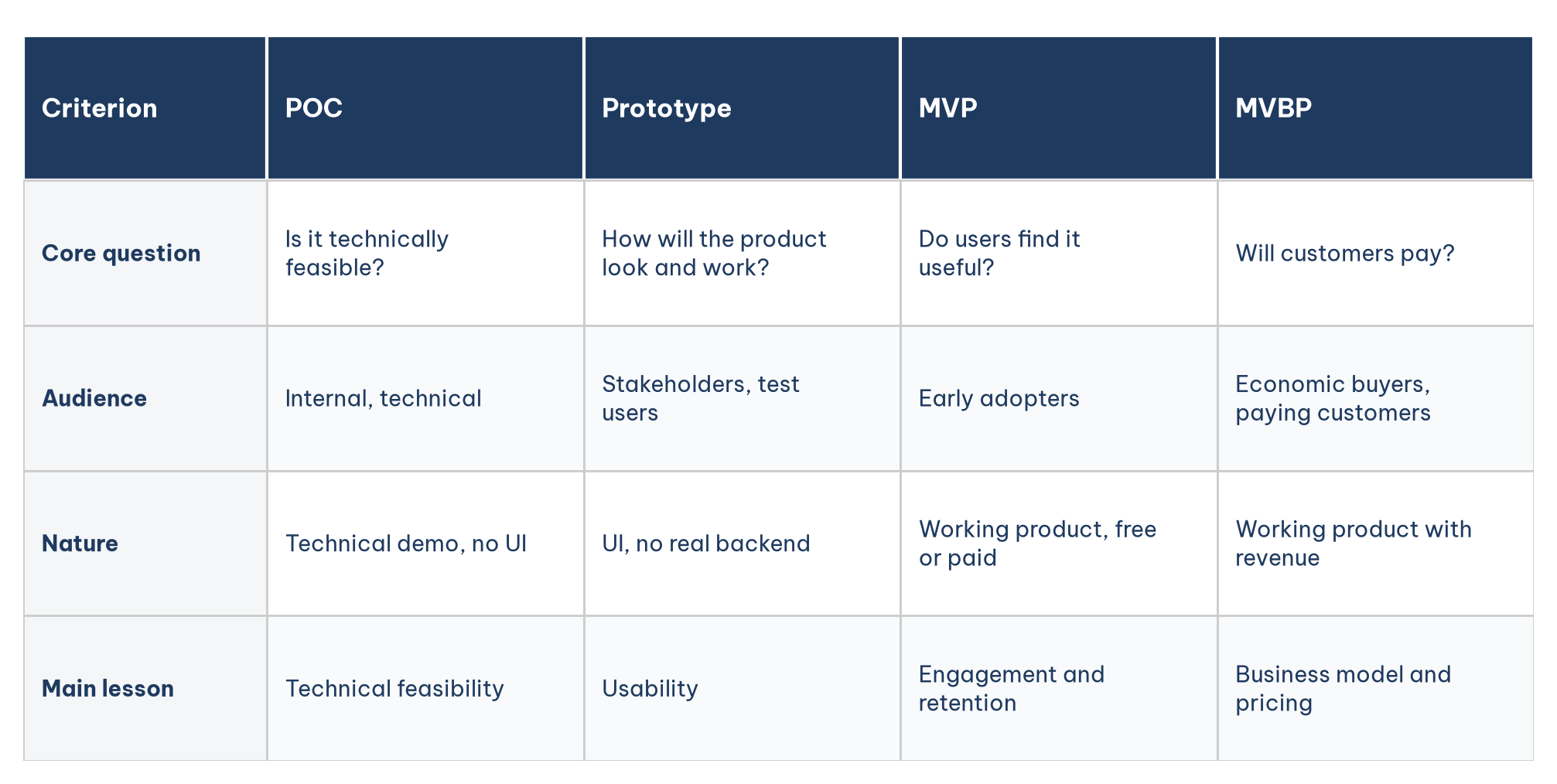
Reading Figure 3 from left to right, each output demands stronger evidence than the one before: from "technically possible", to "users understand and can use it", to "users actually come back", and finally to "someone pays".
3. What the outputs look like for different products
A point many articles miss is that the form of a POC, prototype, MVP and MVBP varies considerably with the kind of product. An MVP for a SaaS app is very different from an MVP for a wearable device, and both differ from an MVP for a two-sided marketplace. This section covers four common kinds of product, each with real examples.
3.1. Digital products: software, web and mobile apps
This category has the most mature and flexible process. A typical SaaS startup produces these outputs:
POC: a Python script in a Jupyter notebook proving the algorithm works, or a small backend testing a connection to a third-party API. For example, an AI startup that wants to check how accurately a GPT model can summarize legal contracts builds a POC as a notebook that runs the model on 50 sample contracts and compares the output with summaries written by lawyers.
Prototype: a set of clickable screens in Figma or, increasingly, an interface generated by AI tools such as Google Stitch or Claude Design. Users can click through the screens and feel the flow, but if they submit a form nothing happens behind it.
MVP: a real web or mobile app, with user sign-up, a database and possibly payments. A common stack for web MVPs today is Next.js with Supabase and Stripe, or no-code platforms such as Bubble, Webflow, Adalo or FlutterFlow.
MVBP: the same structure as the MVP but with real paying customers (subscription, one-off payment or pay-per-use). More importantly, an MVBP needs a sales and go-to-market process that has been tested.
The story of Buffer illustrates this progression clearly. Joel Gascoigne built a two-step landing page (a smoke-test MVP) before writing a line of code. Once interest was confirmed, he built an MVP with only a simple tweet-scheduling function. When the first customer paid USD 5 a month, that was Buffer's MVBP. The whole journey from idea to first paying customer took just seven weeks.
3.2. Physical products: hardware, IoT, consumer devices
The process here is much more complex and expensive, because changes after mass production are extremely costly. A small flaw in a plastic mould can cost tens or hundreds of thousands of dollars to fix.
POC: an electronic circuit on a breadboard, or a mathematical model and simulation proving the operating principle.
Prototype: a 3D-printed model (resin or FDM) combined with custom electronics ordered from small manufacturers in Shenzhen. In the industry this is called an engineering prototype; later rounds go through design validation testing (DVT). Apple typically goes through several prototype rounds, named P1, P2, EVT (engineering validation test), DVT and PVT (production validation test), before mass production.
An MVP for hardware usually needs a special strategy, because you cannot "release a beta" of a physical device. Pebble Watch is the classic example. In 2012 the Pebble team ran a Kickstarter campaign with a demo video and a concept design, aiming to raise USD 100,000. They raised USD 10.3 million from nearly 69,000 backers. This form of MVP suits hardware especially well and can be called a "pre-order MVP" or "crowdfunding MVP".
An MVBP for hardware: here Aulet's concept fits especially well. The Pebble Kickstarter was an MVBP because customers actually paid (even though the product had not yet shipped). The first Tesla Roadster was also a strategic MVBP. Elon Musk knew Tesla could not compete with Toyota on price at first, so he built an expensive sports car for wealthy buyers to prove that electric cars could be fast, beautiful and powerful, while generating profit to invest in mass-market models later.
Another notable example is Dyson. James Dyson built 5,127 prototypes of his first bagless vacuum cleaner before he had a product he could sell. Each prototype was a lesson, a small refinement. It shows that with hardware the line between prototype and MVP can be very blurry, and iteration needs enormous patience.
3.3. Two-sided platforms
This is the hardest kind of product, because it faces the "chicken-and-egg problem": you need buyers to attract sellers, and sellers to attract buyers. A platform MVP must test several assumptions on both sides of the market at once.
The smart approach is usually to focus on one side first, or on a narrow niche. Some examples:
Airbnb did not try to build a global marketplace from the start. It ran "AirBed & Breakfast" for attendees of a design conference in San Francisco in October 2007, when all the hotels were full. This "single-event MVP" was very narrow and very specific, but enough to test the assumption that people would sleep on an air mattress in a stranger's home.
Uber started as UberCab in San Francisco, serving only black cars, in only one city, with only a few dozen drivers. It did not try to become "global Uber" in its first week.
Etsy initially served only a very narrow niche: crafters frustrated by eBay's high fees. The four founders built a simple website where makers could list their products, then expanded step by step.
Facebook first served only Harvard students, then expanded to other Ivy League universities, then to all universities, and only then to the public. Mark Zuckerberg chose a very astute "small island" (beachhead market) strategy, close to Bill Aulet's method in Disciplined Entrepreneurship.
3.4. Service products
For service startups, the MVP often takes the form of a "fully manual concierge": the team sells the service first and builds the automation later. Some examples:
Groupon started as a simple WordPress blog called "The Daily Groupon". When someone signed up for a deal, Andrew Mason's team created a PDF voucher by hand and sent it through Apple Mail. There was no automation at first. Only once the model was proven did they invest in a technology platform.
Food on the Table, a startup offering recipes tailored to customers' tastes, began with CEO Manuel Rosso personally visiting each of the first customers, asking what they wanted to eat that week, planning menus and printing shopping lists by hand. It was a true concierge MVP.
Zappos is the classic Wizard of Oz MVP. In 1999 Nick Swinmurn built a simple website with photos of shoes from stores in a local mall. When an order came in, he went to the store, bought the shoes at retail price and shipped them to the customer. The goal was not profit but to test the core assumption: would people buy shoes online? The answer was yes, and Amazon later acquired Zappos for USD 1.2 billion in 2009.
4. An integrated product-development process: from idea to growth
With the methodologies and outputs understood, picture a realistic process for a very early-stage startup. It has seven stages, integrating Design Thinking in the early stages, Lean Startup in the middle and Agile later.
4.1. Stage 1: discovering the problem
This is Design Thinking's time. The team is not yet allowed to write a line of code. Instead, it focuses on these activities:
Customer interviews following Rob Fitzpatrick's (2013) The Mom Test. The method advises asking about customers' lives and specific behaviour rather than whether they like your idea. A good question is "When was the last time you ran into problem X? How did you deal with it?". A bad one is "Do you think an app that solves X would be useful?".
Insight-visualization tools such as the empathy map, the customer journey map and the Jobs-To-Be-Done framework. These help the team synthesize scattered observations into clear problem statements.
Identifying the riskiest assumption: the one that, if wrong, brings the whole idea down. For Dropbox it was "do users really want a cloud file-sync service?". For Zappos it was "will people buy shoes online without trying them on?". For Airbnb it was "will people sleep in a stranger's home instead of a hotel?".
The output of this stage is usually a problem statement, together with specific personas and a list of assumptions to test.
4.2. Stage 2: ideating and rough prototyping
Once the problem is understood, the team moves to ideation. Some popular techniques:
Crazy 8s: each member sketches eight different ideas in eight minutes. The goal is quantity, not quality.
How Might We: turn the problem statement into open questions starting with "How might we...". For example: "How might we help users save money without it feeling painful?".
Design studio: each member presents their ideas; the others critique and build on them.
The team then makes low-fidelity prototypes, which may be no more than paper drawings or whiteboard sketches. The goal is not beauty but something good enough to test with users and get quick feedback.
4.3. Stage 3: testing core assumptions with a POC (if needed)
Before building anything sellable, some startups need to test technical feasibility first. That is the POC's role.
A POC matters most for products with high technical risk. For a startup building a simple to-do list app, a POC is almost unnecessary and the team can jump straight to prototyping. But for a startup building an AI, IoT or deep-tech product, a POC is essential to avoid a large investment in a technically impossible idea.
4.4. Stage 4: high-fidelity prototypes and user testing
Once technical feasibility is confirmed, the team moves to high-fidelity prototypes: realistic versions of the product, with full interfaces and interaction flows but no working backend.
In software, tools such as Figma, Adobe XD and Sketch dominate this stage. But a new wave of AI tools is shrinking the process from days to minutes, as Section 6 discusses.
The output is usually a set of clickable mockups. The team takes them to user interviews and runs usability tests. Tests at this stage uncover many flow and behaviour problems the team would never see by imagining alone.
4.5. Stage 5: building and launching the MVP
This is the moment a startup moves from "ideating" to "going to market". The MVP must satisfy two seemingly contradictory conditions at once:
Minimum: as minimal as it can possibly be. If a feature can be dropped while still conveying the core value, drop it.
Viable: good enough for customers to actually use. Users may forgive missing features, but not broken ones.
There are many kinds of MVP, depending on the level of risk and the type of product. The most common are:
Concierge MVP: the team delivers the service entirely by hand, as the people behind the curtain. Suitable when you want to understand the first customers deeply before automating.
Wizard of Oz MVP: users think they are interacting with an automated system, but people are doing the work manually behind it. Zappos is the classic example.
Video MVP: when a product needs complex infrastructure, a demo video may be enough to test demand. Dropbox is the classic example: Drew Houston made a three-minute screen-recorded video demonstrating the main features, aimed at early adopters on Hacker News. The beta waiting list jumped from 5,000 to 75,000 people overnight.
Landing-page MVP / smoke test: the team builds a landing page promoting a product that does not yet exist and measures the sign-up rate to test demand. Buffer started exactly this way.
Single-feature MVP: a real product, but with only one core feature. Twitter originally only let you post 140-character statuses. Foursquare originally had only check-ins and badges.
Piecemeal MVP: stitching together existing tools (Google Forms, Zapier, Stripe, Airtable) into a working product without code. This is a very popular choice for non-technical founders.
Crowdfunding MVP: especially suited to hardware; the team creates a Kickstarter or Indiegogo page with a demo video and concept design so customers can pre-order. Pebble and Oculus Rift are typical examples.
4.6. Stage 6: evolving from MVP to MVBP
This is the step many startups miss. They have an MVP with thousands of free users but never prove that anyone will pay. According to Bill Aulet, this is when the team must move from MVP to MVBP, testing at the same time:
The value proposition: do customers really see the product's value?
The pricing model: what price is reasonable? How much value do customers perceive relative to what they pay?
The sales process: who makes the purchase decision? How long does selling take? What is the customer acquisition cost (CAC)?
Distribution channels: through which channels do customers reach the product, and what does each cost?
Aulet calls this stage "show that the dogs will eat the dog food": proving that the dogs (target customers) will eat the dog food (the product) when it is put in front of them.
The MVP in the age of AI. When AI can build a product that looks finished in a few days, an MVP is no longer automatically evidence of learning. Steve Blank (2026) proposes calling such products IUPs (initial untested products) and shifting the focus to snippets, the Minimal Tested Canvas and design partners. The MVBP criterion that "someone pays" therefore matters even more.
4.7. Stage 7: measure, learn and iterate with Agile
Once the MVBP has launched and has revenue, the Build–Measure–Learn loop runs at full speed, and Agile becomes the main methodology. The team divides work into sprints, with a product backlog continuously updated from real user and customer feedback.
Eric Ries calls measurement at this stage "innovation accounting". Important metrics include:
Activation rate: how many people who sign up actually use the product.
Retention curve: how many still come back after a week, a month, three months.
Net Promoter Score (NPS): whether customers are willing to recommend the product.
Customer acquisition cost (CAC) and lifetime value (LTV): an LTV/CAC ratio of 3 or more is usually considered healthy.
Free-to-paid conversion rate: especially important for freemium models.
5. Common mistakes in practice
The process in Section 4 sounds sensible on paper, but in practice founders repeatedly stumble into five mistakes. Recognizing them in advance can save months of going the wrong way.
The first mistake is confusing "minimum" with "crap". Many people misread the MVP as "a bad version of the product". It is not. An MVP must be good at what it does, just narrower in scope. An MVP of a messaging app may lack many features, but basic messaging must work smoothly and reliably, without losing messages.
The second mistake is skipping discovery. Technical founders tend to jump straight into code: "I have an idea, I can code, I'll build it now". Six months after launch nobody uses it, because the initial assumption about the customer's problem was wrong from the start. A simple rule is to spend at least two to four weeks interviewing 20–30 potential customers before writing any code.
The third mistake is stopping at the MVP without moving to the MVBP. This trap is especially dangerous for freemium and B2C products. The team sees thousands of free users and convinces itself it has product–market fit. In reality, as Bill Aulet argues, until someone pays, the business model is unproven.
The fourth mistake is pivoting too early or too late. Pivoting is an art, not a science. Pivoting too early means giving up before the idea has had a real chance; pivoting too late means trying to save a sinking ship. A practical rule is to set clear pivot criteria from the start, for example: "If after three months we do not reach 20% week-4 retention, we pivot". Hard decisions are easier when the criteria are set in advance.
The fifth mistake is practising Agile without understanding it. Many teams hold daily stand-ups, sprint planning and retrospectives faithfully but are still slow and fail to deliver. That is "ritual Agile". The real spirit of Agile, according to the Agile Manifesto, values individuals and interactions over processes and tools, working software over comprehensive documentation, customer collaboration over contract negotiation, and responding to change over following a plan.
6. A modern AI toolkit for each stage
A major change in 2024–2026 has been the arrival of generative AI tools built specifically for product design and development. They are compressing the time from idea to prototype and MVP from weeks to hours, even minutes. A solo founder today can launch a SaaS MVP within a week, something that five years ago needed a whole engineering team. This section introduces groups of tools for four stages: discovery and ideation, prototyping, building the MVP, and measuring and learning. The list is current as of October 2026; names, features and prices change very quickly, so treat these as examples of tool types rather than specific recommendations.
6.1. Tools for discovery and ideation
This stage focuses on synthesizing insights, building personas and brainstorming solution directions.
Claude, ChatGPT, Gemini, Perplexity: general AI assistants can help teams turn customer-interview transcripts into salient patterns, build data-based personas and brainstorm different solution directions. Anthropic's Claude is particularly strong at analysing long texts and summarizing many interviews at once.
Otter.ai and Fireflies.ai: automatically record customer interviews and transcribe them, so the team does not miss important details.
Notion AI: built into the workspace the team already uses, it helps synthesize notes, write problem statements and create persona comparison tables.
Dovetail: a dedicated user-research platform that uses AI to code interviews and automatically detect salient themes.
6.2. Tools for prototyping
This is where AI tools are changing things most. Previously, a clickable prototype of a five-screen app took a designer one to two days in Figma. Today, AI tools can do it in minutes.
Google Stitch launched at Google I/O 2025 and was upgraded to Stitch 2.0 in March 2026. It is an interface-design tool built on Gemini, developed from Galileo AI after Google acquired the company in May 2025. Stitch lets users describe an app in natural language and receive a complete interface design. Stitch 2.0's highlights include generating up to five connected screens at once from a description of the app flow, an AI-native infinite canvas for exploring several design directions in parallel, importing an organization's design system so every screen follows its brand identity, and exporting directly to Figma or Firebase Studio. At the time of writing, Google Stitch is free at stitch.withgoogle.com, with daily credit limits.
Claude Design from Anthropic: unlike Stitch, which focuses on visual design, Claude Design generates real, deployable code as HTML, React or SVG. Users can describe a landing page, a dashboard mockup or an interactive slide deck, and Claude Design builds a first working version. Users then refine it through natural conversation, commenting directly on elements, editing text inline, or using AI-generated sliders to adjust spacing and layout in real time. A particular strength is that during onboarding it can read an organization's existing codebase and design files, build a design system automatically and apply it to every new project. When the prototype is finished, Claude Design creates a "handoff bundle" that can go straight to Claude Code to be built into a full product. Claude Design is available to Claude Pro, Max, Team and Enterprise users.
v0.dev from Vercel pioneered this wave, launching in late 2023. Users enter a description, such as "an analytics dashboard with monthly revenue charts and a top-products table", and v0 generates a React component using Tailwind CSS and shadcn/ui. Its strength is that the output can be deployed to Vercel in one click, and the generated code is clean and readable.
Lovable (formerly GPT Engineer) goes a step further. It is a "vibe coding" tool that lets users describe a whole app and generates a full-stack product, including backend, database and authentication. Users refine it through chat, and every change is committed as a new version.
Bolt.new from StackBlitz is similar to Lovable but runs entirely in the browser with nothing to install. It is especially fast for simple MVPs.
Figma AI is Figma's response to the new wave of AI design tools. Figma has built AI features into its familiar platform, including Make Design (generating designs from prompts), AI-assisted prototyping and auto-generated content.
6.3. Tools for building the MVP
When the team moves from prototype to building a real MVP with backend, database and authentication, many AI tools can help.
Cursor and Windsurf are new-generation IDEs built from the ground up around AI. Cursor, especially popular among engineers, lets users write a whole application through conversation with an AI model that can read and edit many files at once. Windsurf (originally from Codeium, which changed hands in 2025) has an agent, Cascade, that carries out complex chains of actions on its own.
Claude Code from Anthropic is a command-line tool that lets engineers delegate coding tasks to Claude from the terminal. With its ability to understand large codebases and make consistent multi-file changes, it is especially effective for refactoring and extending an existing MVP.
GitHub Copilot's coding agent (which replaced the Copilot Workspace experiment, discontinued in 2025) integrates deeply with GitHub repositories: the team assigns an issue to the AI, and the AI opens a pull request for review.
Replit Agent combines a cloud development environment with an AI agent, especially suited to beginners and non-technical founders who want to build their own MVP. Users describe the app, and Replit Agent both codes and deploys it on Replit's infrastructure.
Bubble, Webflow, Adalo and FlutterFlow are no-code platforms with deep AI integration. They let founders build web or mobile apps without writing code, which suits non-technical founders particularly well.
6.4. Tools for measuring and learning
Once the MVP or MVBP has launched, the team needs tools to measure and analyse.
Mixpanel, Amplitude and PostHog are leading product-analytics platforms. PostHog is especially popular with startups because of its generous free tier and open-source code.
Hotjar and Microsoft Clarity record user sessions and create heatmaps, showing exactly how users interact with the product. Microsoft Clarity is completely free.
Pendo and UserGuiding combine analytics with in-app messaging and onboarding tours, especially useful for SaaS products that want to improve activation.
6.5. Tools do not replace thinking
These AI tools are very powerful, but one truth is worth remembering: they are catalysts, not substitutes for strategic thinking. They handle layout, colour and responsive design well, but they do not yet grasp the deeper aspects of Design Thinking, such as visual hierarchy, user-journey mapping or emotional resonance, which require creative judgment and strategic intent that AI cannot yet fully reproduce.
In other words, AI helps a team move quickly from idea to interface, but if the original idea is wrong, the team is only failing faster. Design Thinking to understand the problem, Lean Startup to test assumptions and Agile to deliver steadily remain the foundational framework. AI tools only make executing each stage cheaper and faster.
7. A sample 12-month roadmap for an early-stage startup
To close the analysis, everything discussed can be summarized as a reference roadmap for a very early-stage startup. Table 1 presents it by period, with the main method, key activities and required outputs.
The roadmap in Table 1 is not a rigid template: stages can overlap, and a startup with high technical risk should insert a POC in months 2–3. What matters is that each stage ends with a concrete output that grounds the next decision.
Conclusion: product development is a combined martial art
A common belief is that Design Thinking, Lean Startup and Agile are three different, opposing methods and that founders must choose one. In reality they are three lenses on the same process: turning a fuzzy idea into a product with real users, real revenue and staying power.
Each method answers a different question. Design Thinking asks "what is the real problem?". Lean Startup asks "is this solution feasible and does it have a market?". Agile asks "how do we deliver steadily and adapt quickly?".
Likewise, the outputs of product development do not overlap; they complement each other. The POC answers technical feasibility. The prototype answers usability. The MVP answers user engagement. And the MVBP, in Bill Aulet's insightful sense, answers the most important question for a startup: will customers take out their wallets and buy?
A smart founder is not loyal to any one methodology or output. They draw from each method the tools that fit each stage of the journey: empathy maps early on, a Wizard of Oz MVP when testing demand, Aulet's MVBP to prove the business model, and Scrum sprints when scaling the team.
New AI tools such as Google Stitch, Claude Design, v0.dev, Lovable and Cursor are transforming the speed of execution at every stage. But they do not change the nature of the thinking, which is still to get out of the office, understand customers, test assumptions, learn quickly and keep improving.
The winner in a startup is not the person with the best idea. The winner is the one who learns fastest and proves earliest that someone is willing to pay. That is the real spirit of Design Thinking, Lean Startup and Agile when they are combined, and when they are supported by the right outputs at each stage.
References
Aulet, B. (2013). Disciplined entrepreneurship: 24 steps to a successful startup. Wiley.
Beck, K., Beedle, M., van Bennekum, A., Cockburn, A., Cunningham, W., Fowler, M., Grenning, J., Highsmith, J., Hunt, A., Jeffries, R., Kern, J., Marick, B., Martin, R. C., Mellor, S., Schwaber, K., Sutherland, J., & Thomas, D. (2001). Manifesto for agile software development. https://agilemanifesto.org/
Blank, S. (2026, September 25). AI killed the MVP – Long live the IUP. Steve Blank. https://steveblank.com/2026/09/25/ai-killed-the-mvp-long-live-the-iup/
Brown, T. (2008). Design thinking. Harvard Business Review, 86(6), 84–92. https://hbr.org/2008/06/design-thinking
CB Insights. (2021). The top 12 reasons startups fail. https://www.cbinsights.com/research/report/startup-failure-reasons-top/
Fitzpatrick, R. (2013). The Mom Test. CreateSpace.
Ries, E. (2011). The lean startup. Crown Business.
Schwaber, K., & Sutherland, J. (2020). The Scrum guide. https://scrumguides.org/
Discussion about this post