Dark Patterns in E-Commerce
Interface tricks that push shoppers to buy what they did not intend, why they work and the price sellers pay later


Key takeaways
Dark patterns are interface design choices that lead users to decisions against their own interest, through hidden or false information or through unequal effort between options.
A simple test separates persuasion from manipulation: with full information and equal effort for every option, would the customer choose the same way?
A crawl of about 11,000 shopping websites found dark patterns on about 11% of them; an EU sweep found them on 148 of 399 online shops.
In a controlled experiment, mild dark patterns more than doubled acceptance of a paid plan without provoking any backlash, which makes them more dangerous for consumers and more tempting for sellers.
The gains show up immediately in conversion; the costs arrive later as complaints, returns, lost repeat customers and legal risk.
A shopper visits a coffee website and sees red text saying "only 3 bags left" beside a countdown timer at 09:59. They hurry to order. At checkout, a box for "breakage insurance, US$0.20" is already ticked. A week later, they receive an email inviting them to renew a monthly coffee delivery plan they do not remember signing up for; to cancel, they must phone a hotline during office hours. No step in this chain is a blatant lie. But each step is designed so that the customer does something they would probably not do with more time and information.
Tricks like these are called dark patterns, now also called deceptive patterns: interface design choices that lead users to decisions that work against them (Laudon & Traver, 2023). The term was coined by the designer Harry Brignull in 2010 and has since entered European Union legislation. For online sellers, this is not only an ethical matter: dark patterns raise conversion today but can raise returns, complaints and legal risk tomorrow.
The article proceeds as follows. Section 1 distinguishes dark patterns from legitimate persuasion. Section 2 presents seven common categories and how prevalent they are. Section 3 explains why they work, based on a controlled experiment. Section 4 calculates the later cost to sellers. Section 5 summarizes the legal framework, and Section 6 offers a way to audit a sales page.
1. Persuasion or manipulation
Every sales interface wants customers to buy. This section draws a line between interfaces that persuade and interfaces that manipulate.
A prominent orange "Buy now" button, a line saying "free shipping on orders over US$12" and a genuine review from a past customer are all persuasion: they provide information or make the choice the customer already wants easier. Dark patterns differ in two ways. First, they rely on false or hidden information: invented stock levels, costs revealed only at the last step. Second, they create unequal effort: signing up takes one tap, cancelling takes a phone call; accepting tracking is a large button, declining is a faint line of text.
A simple test: if the customer had full information and the same effort for every option, would they choose this way? If yes, the interface is persuading. If no, it is manipulating, even if no sentence on the page is false. The test is close to the Golden Rule in business ethics: treat customers as you would want to be treated as a customer (Laudon & Traver, 2023).
2. Seven categories of dark patterns
This section introduces the most widely used classification and shows how common these patterns are.
Mathur et al. (2019) built an automated tool that crawled about 53,000 product pages on about 11,000 shopping websites and found 1,818 instances of dark patterns, of 15 types grouped into seven categories, on 1,254 websites, or about 11% of the sites studied. Of these, 183 websites used patterns that were clearly deceptive, such as fake countdown timers or invented purchase notifications. The more popular a website, the more likely it was to use dark patterns. Table 1 presents the seven categories with examples from online retail.
The seven categories in Table 1 often appear together, and their effects add up. A countdown timer plus "only 3 bags left" plus "Anna just bought" creates pressure that no single element could.
Prevalence has also been measured in Europe. In January 2023, the European Commission and consumer protection authorities from 23 member states, Norway and Iceland published the results of a sweep of 399 online shops: 148 shops, or about 37%, used at least one of the three types of dark pattern examined; 42 used fake countdown timers and 54 steered users toward certain choices through presentation (European Commission, 2023). The two studies used different methods, so their rates cannot be compared directly, but both show that this is a widespread phenomenon, not the work of a few fraudulent websites.
3. Why they work
If dark patterns did not work, sellers would not use them. This section measures how well they work using a controlled experiment.
Luguri and Strahilevitz (2021) had a representative sample of U.S. adults take part in a survey and then told them they had been enrolled in a paid identity-theft protection plan. Three groups saw three different interfaces for accepting or declining. The control group saw a neutral choice. The "mild" group saw a few dark patterns, such as a pre-selected accept option and steering wording. The "aggressive" group saw more, such as having to go through several screens to decline. Figure 1 shows the share of people who kept the plan in each group.
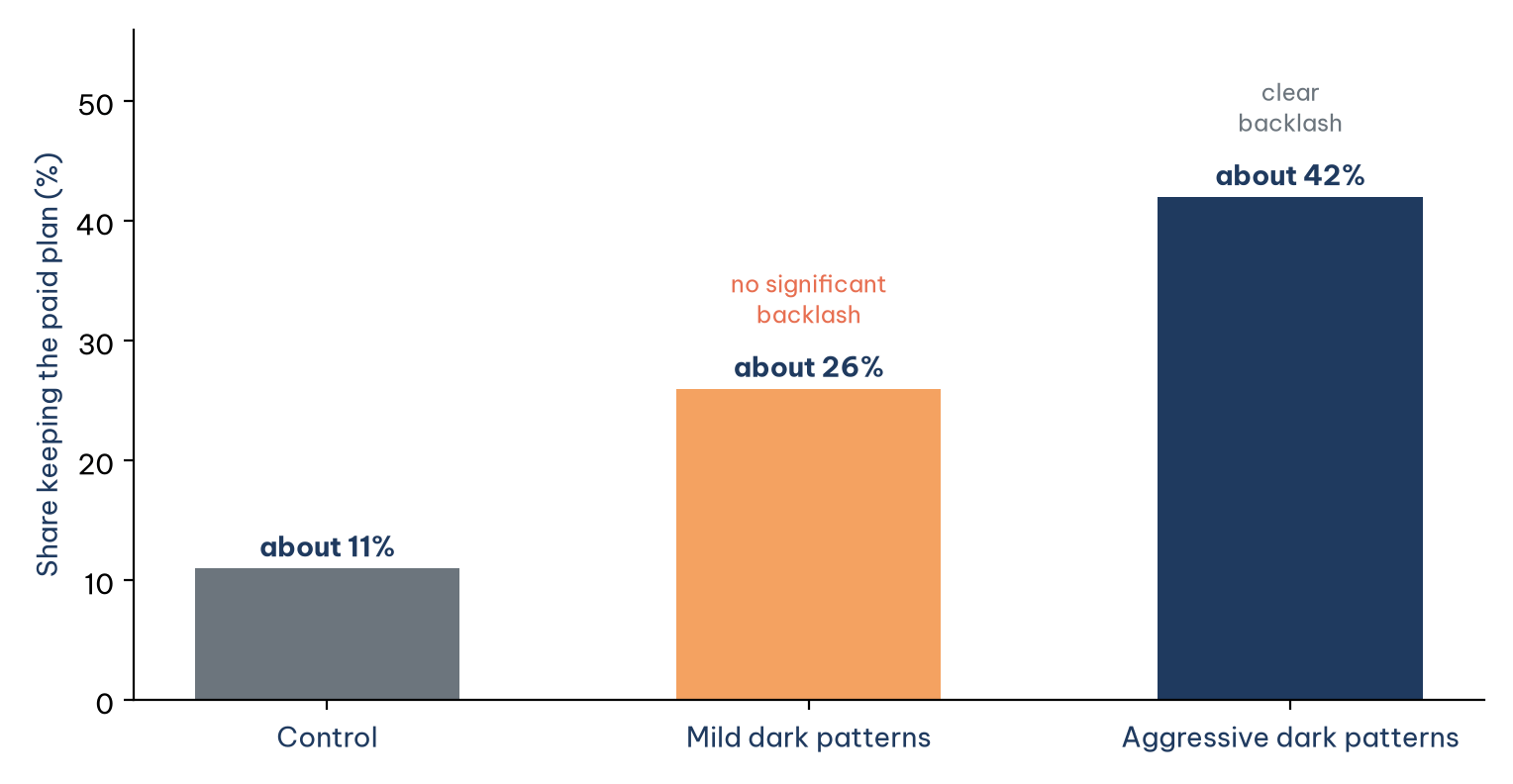
Figure 1 shows that just a few mild tricks more than doubled the acceptance rate, from about 11% to about 26%, and the aggressive version nearly quadrupled it, to about 42%. Two accompanying findings matter even more. First, aggressive patterns caused clear backlash: participants were annoyed and rated the company offering the plan lower. Mild patterns caused almost no reaction; users did not notice they were being steered. That is exactly why mild patterns are more dangerous for consumers and more tempting for sellers. Second, people with less education were significantly more susceptible to mild patterns, so the harm does not fall evenly on all customers.
As for the mechanism, these patterns exploit familiar shortcuts in human decision-making: the tendency to stick with the default, fear of missing out when something seems scarce, following the crowd and avoiding effort. None of these shortcuts is the customer's fault; they are how the brain saves energy across hundreds of small decisions every day.
4. The later cost to sellers
The experiment in Section 3 measured immediate conversion. This section asks a question sellers rarely calculate: what happens afterward?
Consider a hypothetical example with Moc Son, a coffee brand selling online. A "breakage insurance, US$0.20" box is pre-ticked at checkout. Without the pre-tick, about 10% of customers choose it themselves; with the pre-tick, about 60% of orders carry insurance because most customers do not notice. At 1,000 orders a month, the additional revenue from the 500-order difference is US$100. Suppose one-fifth of the customers who were charged without knowing discover it when reviewing their receipt: 100 customers a month. If one-fifth of those, 20 customers, call to complain and each call costs US$0.80 in staff time, handling costs US$16. If 10 customers never come back, and each loyal customer leaves about US$24 of contribution margin over their lifetime, the loss is US$240. A trick that brings in US$100 a month can lose more than twice that, only the loss arrives later and does not appear on this month's dashboard.
The figures in the example are assumptions; what is worth keeping is the structure of the calculation. The benefit of a dark pattern is measured immediately and lands on this month's conversion metric. The costs arrive later and land on other metrics: return rate, complaint count, repeat rate, customer lifetime value. A growth team judged on monthly conversion will always find dark patterns profitable. The proper way to measure the effect of an interface change is a controlled A/B test whose outcome metrics include those later costs, not conversion alone.
For e-commerce, there is a cost that is harder to quantify: trust is an asset that accumulates slowly and is lost quickly. One screenshot of a countdown timer restarting from the top, shared on social media, can damage a brand faster than any advertising campaign can build it.
5. The legal framework
Dark patterns are moving from an ethical gray zone into regulated territory. This section summarizes the main rules sellers should know; it is no substitute for reading the full texts and consulting a lawyer in each market.
In the European Union, the Digital Services Act prohibits online platforms from designing, organizing or operating their interfaces in a way that deceives or manipulates users or materially distorts or impairs their ability to make free and informed decisions (European Parliament & Council of the European Union, 2022, Article 25). Europe's existing consumer protection laws also apply to patterns such as fake countdown timers.
Data protection law adds another constraint. Under the EU's General Data Protection Regulation, consent must be a clear affirmative act; silence, pre-ticked boxes or inactivity do not constitute consent (European Parliament & Council of the European Union, 2016, Recital 32). A pre-ticked box agreeing to marketing or data sharing is therefore unlikely to count as valid consent, and many national data protection laws outside Europe take the same position. More generally, consumer protection laws in most markets prohibit misleading consumers, including through incomplete or false information about goods and services. Fake countdown timers, invented stock levels and reviews exchanged for incentives are the patterns most likely to be treated as misleading information.
6. Auditing a sales page
The best defense is an audit before a feature or campaign goes live. This section offers a list of questions for each step of the purchase journey.
Table 2 groups the audit questions by the four touchpoints where dark patterns appear most often.
Beyond the specific questions, three general tests handle cases Table 2 does not anticipate (Laudon & Traver, 2023). The Golden Rule test: would I want to meet this interface as a customer? The newspaper test: if this screenshot appeared in the press, what would customers think of the brand? The universality test: if every seller did this, would signals such as stock levels, reviews and countdowns still be trustworthy? The answer to the last test is almost always no, which is why consumers increasingly ignore these signals, even when they are true.
How the audit is built into the process matters as much as its content. The list in Table 2 should be a mandatory step in approving every new campaign and feature, like a legal review, rather than a one-off check. And the metrics used to judge a growth team should include complaint rates, cancellation rates and repeat rates, not conversion alone.
Conclusion
Dark patterns work because they exploit shortcuts everyone uses in decision-making, and mild patterns work best because customers do not notice them. A controlled experiment shows that a few small tricks are enough to more than double acceptance of a paid plan; crawls of thousands of websites show that they are common, not rare. But that effectiveness is measured at the wrong moment: the gains arrive immediately, while the costs arrive later, as complaints, returns, customers who never return and, increasingly, legal risk.
For sellers, the line between persuasion and manipulation can be checked with one question: if the customer had full information and every option were equally easy, would they choose this way? A sales page that answers "yes" at every step may convert a little less this month, but it is building what e-commerce needs most and can least easily buy back: customers' trust.
References
European Commission. (2023, January 30). Consumer protection: Manipulative online practices found on 148 out of 399 online shops screened [Press release]. https://ec.europa.eu/commission/presscorner/detail/en/ip_23_418
European Parliament & Council of the European Union. (2016). Regulation (EU) 2016/679 on the protection of natural persons with regard to the processing of personal data and on the free movement of such data (General Data Protection Regulation). https://eur-lex.europa.eu/eli/reg/2016/679/oj
European Parliament & Council of the European Union. (2022). Regulation (EU) 2022/2065 on a single market for digital services (Digital Services Act). Official Journal of the European Union. https://eur-lex.europa.eu/eli/reg/2022/2065/oj
Laudon, K. C., & Traver, C. G. (2023). E-commerce 2023–2024: Business, technology, society (18th ed., Global ed.). Pearson. https://www.pearson.com/en-gb/subject-catalog/p/e-commerce-2023-2024-business-technology-society-global-edition/P200000010016/9781292449722
Luguri, J., & Strahilevitz, L. J. (2021). Shining a light on dark patterns. Journal of Legal Analysis, 13(1), 43–109. https://doi.org/10.1093/jla/laaa006
Mathur, A., Acar, G., Friedman, M. J., Lucherini, E., Mayer, J., Chetty, M., & Narayanan, A. (2019). Dark patterns at scale: Findings from a crawl of 11K shopping websites. Proceedings of the ACM on Human-Computer Interaction, 3(CSCW), Article 81. https://doi.org/10.1145/3359183
Discussion about this post