Core vs. Moat: Three Ways to Think About Advantage
Five strategy terms founders often confuse, from core values to competitive advantage, explained through the metaphor of a kingdom


Key takeaways
Core values, capabilities, the Core, the moat and competitive advantage are five different things. Confusing them leads to misallocated resources.
In Bill Aulet's sense, the Core is the one thing a startup does better than anyone else to deliver what customers value most. It is offensive.
A moat is defensive: it slows competitors down and buys time to strengthen the Core. Patents, first-mover status and exclusive supplier deals are usually moats, not Cores.
Three frameworks use similar words: Prahalad and Hamel's core competence, Aulet's Core and Buffett's economic moat. Say which one you are using.
Competitive advantage is the whole picture: a sharp Core plus a deep moat.
In the world of startups and management, we keep running into terms that sound important: "core competence", "competitive advantage", "core values" and, more recently, "moat". Confusing them is not just a matter of semantics; it often leads to mistakes in how a company allocates resources. A familiar example is a startup that pours money into patents because it thinks they are its "core competence", while what actually helps it win is its engineering team and its data.
Bill Aulet, managing director of the Martin Trust Center for MIT Entrepreneurship and author of Disciplined Entrepreneurship, devotes a whole step of his method to defining a startup's Core (Aulet, 2013, 2024). From this perspective, failing to distinguish the Core from the moat is one reason many startups build castles on sand.
To see the full picture, imagine your company as a kingdom, as in Figure 1: core values are the foundation, capabilities are the body of the castle, the Core is the most precious treasure, the moat is the water around the walls, and competitive advantage is the combined strength of the whole kingdom.
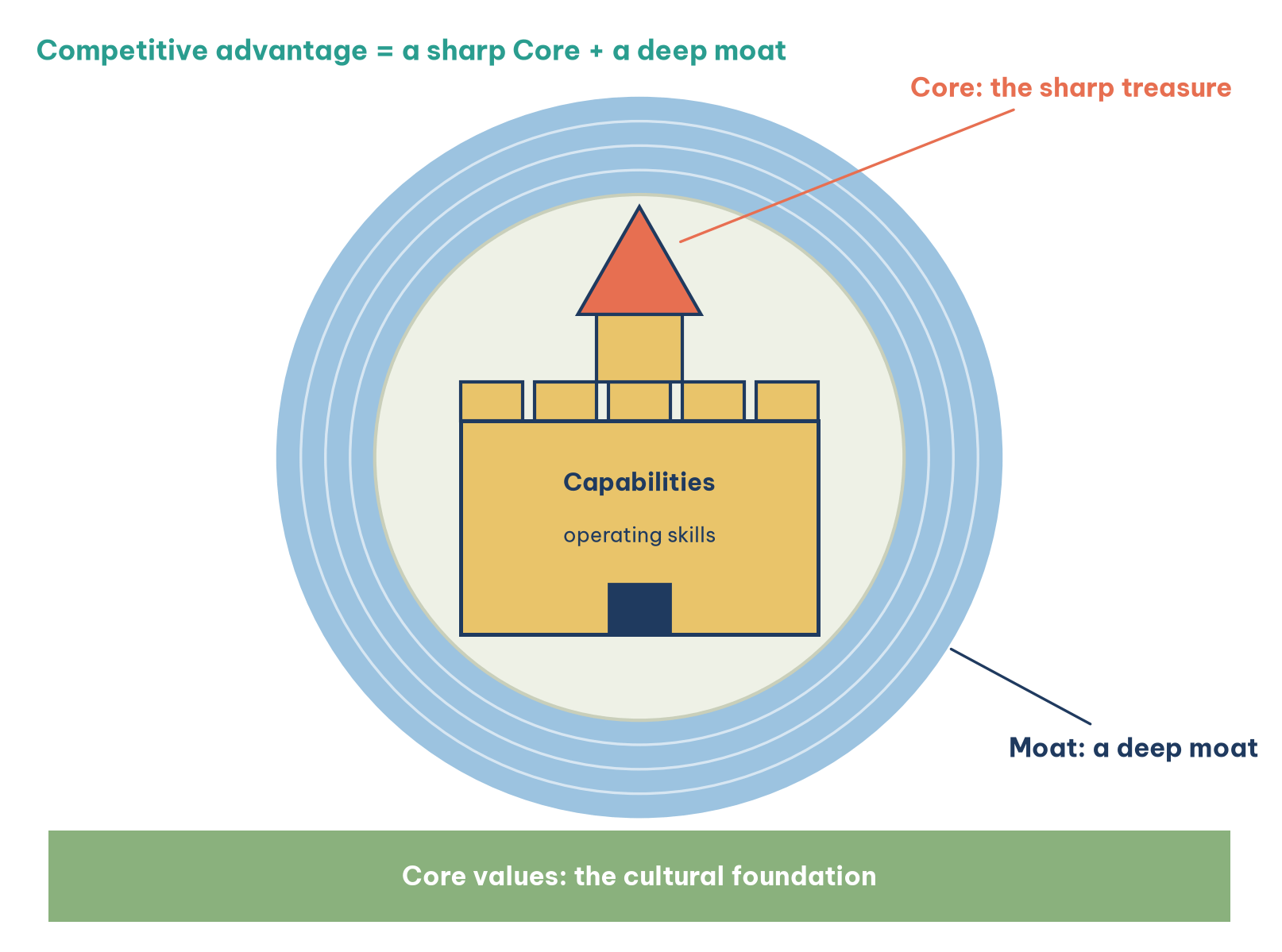
This article unpacks each concept through the metaphor, so you can tell what needs attacking and what needs defending. Section 1 covers the foundation: core values and capabilities. Section 2 explains the Core in Aulet's sense. Section 3 sets the Core beside two classic frameworks readers will meet elsewhere: Prahalad and Hamel's core competence and Buffett's economic moat. Section 4 discusses the moat and three common misconceptions. Section 5 analyses the case of SensAble Technologies. Section 6 puts everything together as competitive advantage, and Section 7 applies the ideas to some well-known companies in Vietnam, a fast-growing emerging market.
1. The castle's foundation: core values and capabilities
Before building weapons or digging a moat, a kingdom needs a foundation and basic survival skills.
Core values are the kingdom's cultural foundation. They are the system of beliefs and ethical principles that guides how everyone in the organization behaves, answering the question: "Who are we and how do we behave?". Google's code of conduct was once famous for "Don't be evil", and one of Zappos's core values is "Create fun and a little weirdness". Core values do not defeat competitors directly, but if this foundation rots, the company collapses from within.
Capabilities are basic survival skills: coding, hiring, accounting processes, delivery. Every business needs capabilities to survive, just as the people of a kingdom must know how to farm and forge iron. But capabilities alone are not enough to win: without them you die, but having them does not guarantee victory.
2. The kingdom's treasure: what the Core really is
Think of the Core as the royal treasure: keep it and the kingdom survives; lose it and power collapses. According to Aulet (2013), the Core is the one thing a startup does better than any competitor, used to deliver the benefit customers value most. It is the main "engine" of value creation, hard to copy, and the decisive reason customers choose you over a competitor. It is proactive and offensive, and it belongs to the company rather than to a particular product: products become obsolete, but the Core lets you create new ones. Three forms of Core are common.
Network effects: the more users, the more valuable the platform, as with Facebook, LinkedIn or the Southeast Asian marketplace Shopee. Once a tipping point is reached, it is very hard for a rival to persuade users to move to an emptier platform.
Deep technical capability: Honda has the capability to build durable, high-performance engines. That lets it compete in markets from motorcycles and cars to lawnmowers and marine engines, the classic example of Prahalad and Hamel (1990).
Proprietary data: Aulet observes that if the Core lay mostly in hardware in the 1980s–1990s and in software in the 2000s–2010s, today, as AI makes software easier to write, data is increasingly an important source of Core. For Spotify, what is hard to copy is not the music app but the data on listening habits, which produces personalized playlists that new rivals cannot quickly imitate.
An important caveat: the Core is not the value proposition. Customers buy value, such as low prices or fast delivery, while the Core is the hidden machine that lets you create that value. Customers go to Walmart for low prices, but Walmart's Core is a supply-chain system and purchasing capability honed over decades.
3. Three meanings of "core" and "moat": do not mix them up when reading
Readers will meet three frameworks that look alike but are not the same, and they are easy to mix up in a business plan or a class project. Table 1 sets them side by side.
Table 1 answers a frequent question: are network effects a Core or a moat? They can be both, depending on the question you ask. If you ask "why do we create more value?", for Facebook or Shopee the answer is network effects, a Core in Aulet's sense. If you ask "why is it hard for rivals to win our customers?", the answer is also network effects, a moat in the investor's sense. When you write a plan, say clearly which framework you are using.
4. The water around the castle: moats and misconceptions
If the Core is the treasure, the moat (economic moat, protective barrier) is the water around the castle. A moat is passive and defensive. It does not help you defeat the enemy, but it slows the enemy down, buying you time to strengthen your Core. According to Dorsey (2008), economic moats have five main sources, summarized in Table 2.
Many founders confuse the moat with the Core. Three misconceptions are the most common.
4.1. Misconception one: a patent is the Core
Many startups believe a patent is their core competence. But to obtain one you must disclose the technical details, unintentionally handing competitors a "blueprint" for finding a different way to do the same thing. Patents also expire (usually after 20 years) and are expensive to defend. In pharmaceuticals, patents matter enormously; in most other industries they are only a temporary moat.
4.2. Misconception two: being first is the advantage
First-mover advantage is real under some conditions, such as when the first mover secures scarce resources or creates switching costs or network effects; but first movers also bear the cost of educating the market and the technological risk (Lieberman & Montgomery, 1988). A well-known study found that many "pioneers" failed or were overtaken, and that long-term market leaders often entered later (Golder & Tellis, 1993). Google was not the first search engine, Facebook was not the first social network, and Apple rarely creates the first product in a category. Being first is valuable only if you use that time to build a real Core, such as accumulating data or creating network effects.
4.3. Misconception three: locking in suppliers is the Core
Signing exclusive deals with key component suppliers, as Apple often does, is a good tactic. But it is still a moat: if the market is attractive enough, competitors will find or build new sources of supply.
5. A real lesson: do not pick the wrong treasure
To see the difference between Core and moat clearly, consider SensAble Technologies, a maker of haptic devices based on MIT technology, where Bill Aulet served as chairman and CEO. As Aulet tells it, SensAble owned a breakthrough robotic haptic device (the PHANToM) and a foundational patent. Many advised the company to make the hardware or the patent its Core.
The team, however, realized that the hardware was capital-intensive and hard to scale quickly, while the patent could be worked around and would take time to litigate. They decided to treat hardware and patent as moats only. Instead, they defined the Core as the software that simulates the physics of three-dimensional touch, the hidden "operating system" inside the device. To protect this treasure, they relied not only on patents but on recruiting the best engineers in the field. As a result, even if competitors could build similar hardware, the core software remained hard to copy.
The lesson: the Core usually lies in what is hardest to see and hardest to transfer (accumulated know-how, data, processes, people), not in what is most visible.
6. Competitive advantage: the big picture
When you combine a sharp offensive weapon (the Core) with a strong defensive system (the moat), you create competitive advantage, the company's overall position in the market. It can be temporary, as when Shopee spent heavily on promotions to win market share, or durable, like Apple's closed ecosystem. The ultimate goal of every company is a sustainable competitive advantage, and that is possible only with a truly strong Core. Figure 2 shows how the layers relate.
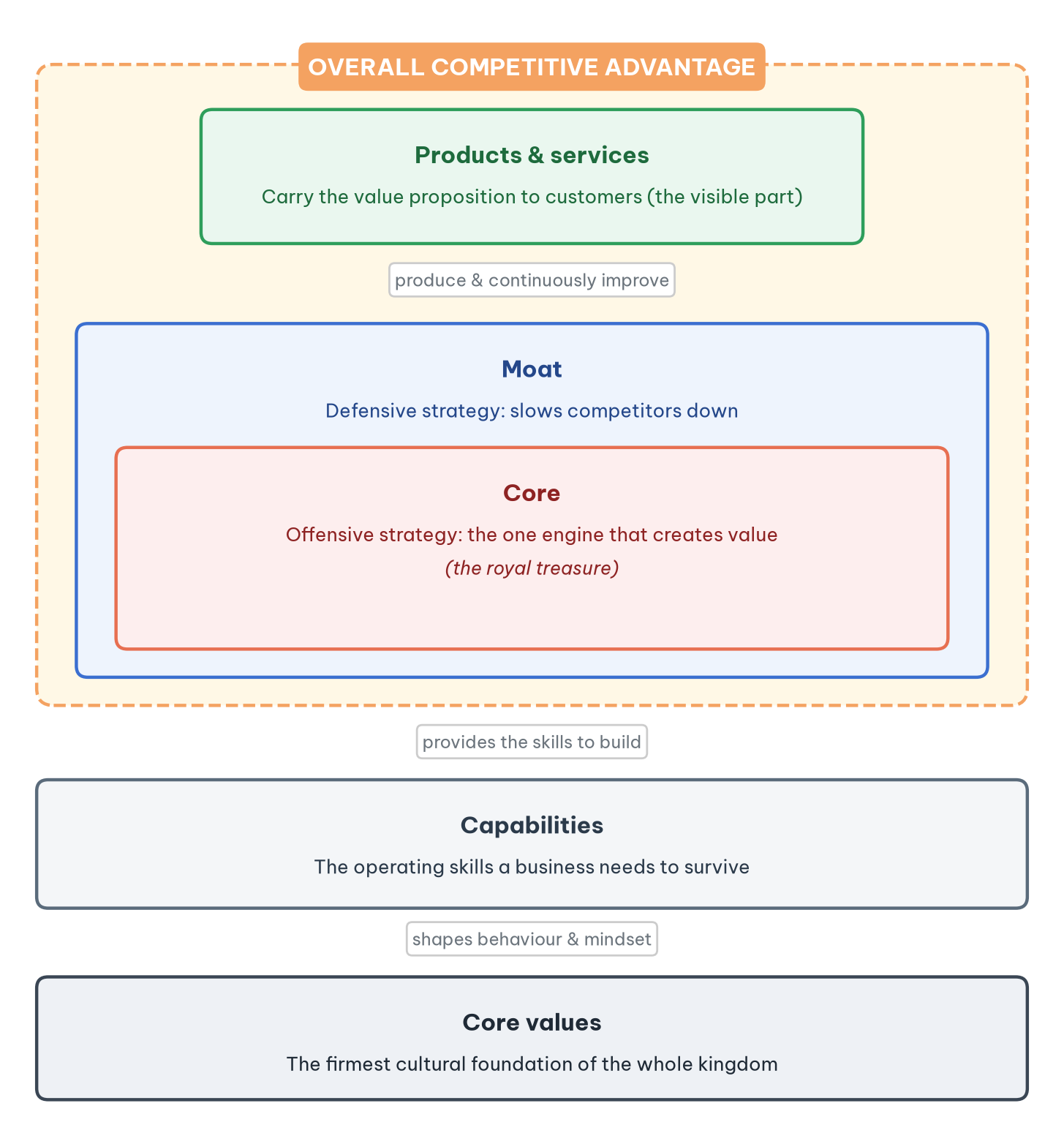
Read Figure 2 from the bottom up: core values shape behaviour, capabilities provide the skills to build, the Core is the value-creating engine protected by the moat, and products and services are the visible part that carries the value proposition to customers. Together they form the overall competitive advantage.
7. Examples from an emerging market: Vietnam
Applying these concepts to some well-known Vietnamese companies shows how to tell Core from moat in practice. Table 3 offers analytical judgements for discussion, not statements by the companies themselves.
What stands out in Table 3 is that the same factor, such as scale or a network, can be both a result of the Core and a moat. That is exactly why you need to say which framework you are using in your analysis.
Conclusion: build your own castle
To avoid confusion in strategic planning, Table 4 summarizes the whole "corporate kingdom".
Defining your Core is hard; it takes deep reflection and sometimes experimentation. But once you have found your treasure, Aulet's advice is to keep it like a trade secret. Broadcast your value proposition to the world, but build your Core quietly inside. Competitors can see your product; they should not see how you make it.
References
Aulet, B. (2013). Disciplined entrepreneurship: 24 steps to a successful startup. Wiley.
Aulet, B. (2024). Disciplined entrepreneurship: 24 steps to a successful startup (Expanded & updated ed.). Wiley.
Dorsey, P. (2008). The little book that builds wealth: The knockout formula for finding great investments. Wiley.
Golder, P. N., & Tellis, G. J. (1993). Pioneer advantage: Marketing logic or marketing legend? Journal of Marketing Research, 30(2), 158–170. https://doi.org/10.1177/002224379303000203
Lieberman, M. B., & Montgomery, D. B. (1988). First-mover advantages. Strategic Management Journal, 9(S1), 41–58. https://doi.org/10.1002/smj.4250090706
Prahalad, C. K., & Hamel, G. (1990). The core competence of the corporation. Harvard Business Review, 68(3), 79–91. https://hbr.org/1990/05/the-core-competence-of-the-corporation
Discussion about this post