Conversational Analytics: Talking with Customers and with Data
How AI turns what customers say into data and turns a manager’s plain-language questions into analysis that can be checked and trusted


Key takeaways
"Conversational analytics" has two meanings: analyzing the conversations customers have with a business, and analyzing data by holding a conversation with it. The two are now converging.
Quality teams in contact centers have traditionally reviewed only 1% to 5% of interactions. Falling costs of speech recognition and language models make it possible to analyze all of them, which is where the real value lies.
Published cases from banks, payment firms, telecoms and B2B sales show gains in quality, retention, sales and compliance, but most numbers come from vendors and should be read as signs of potential.
When managers ask questions of data in plain language, accuracy depends more on a well-governed semantic layer than on the language model: on realistic business questions, raw models answer correctly only about half the time.
The main risks are confident wrong answers, privacy, emotion monitoring of employees and Goodhart's law. Start from a business question, calibrate with humans and close the loop to action.
Picture the contact center of a mid-sized retail bank. About 20,000 calls come in every day: questions about interest rates, disputed fees, lost cards, an app that crashed at 11 p.m. The quality assurance (QA) team has six people, who can listen again to a few hundred calls a week, roughly 1% to 2% of the total. The other 98% go into the archive and are almost never opened again.
This is not an exaggeration. Before adopting speech analytics, Halkbank in Turkey could manually evaluate only 1% to 2% of its calls (Sestek, n.d.), and one vendor of automated QA describes the manual approach as randomly sampling about 5% of conversations (VnExpress, n.d.). Yet the ignored calls hold the most valuable signals: why customers leave, process failures that repeat every day, compliance risks and the best phrases of the best salespeople. Conversational analytics exists to solve this paradox: companies own a huge volume of customer data, yet they are deaf to most of what customers say.
Over the past few years the same phrase has acquired a second meaning: using natural-language conversation to query and analyze data instead of writing SQL or dragging fields onto a dashboard. Google gave exactly the name "Conversational Analytics" to the feature for chatting with data in Looker and BigQuery (Google Cloud, 2026). This article covers both meanings, shows why they are converging, illustrates them with published cases and turns to the legal and ethical risks managers need to weigh.
Section 1 separates the two meanings. Section 2 explains why the field is booming now. Section 3 dissects the six layers of a conversation analytics system, and Section 4 collects cases with published numbers. Section 5 moves to managers talking with data and explains why the semantic layer decides accuracy. Section 6 shows how the two streams meet, Section 7 discusses risks, Section 8 proposes an eight-step roadmap and Section 9 sketches the near future.
1. Two meanings of conversational analytics
This section untangles a phrase that two professional communities use in two different ways: customer experience (CX) people use it for analyzing conversations, while business intelligence (BI) people use it for analyzing through conversation.
1.1. The first meaning: analytics of conversations
In the CX industry, conversational analytics (also called conversation intelligence) is the extraction of data from text and voice conversations between customers and agents or chatbots (CX Today, 2022). Text analytics covers chat, email, messages and social media comments; speech analytics transcribes calls with automatic speech recognition and then applies similar techniques; the narrower voice analytics looks at how someone speaks (tone, speed, pauses), for instance to notice a customer whose voice turns faster and sharper with frustration (CX Today, 2022).
The core difference from surveys and traditional operational reports lies in the question "why". Metrics such as average handle time (AHT), first contact resolution (FCR) or waiting time tell what happened, not why it happened (Huffnagle, 2026). Conversational analytics fills that gap. More important, it works on all interactions rather than on a small sample (Mychal, 2025).
1.2. The second meaning: analytics through conversation
The second meaning belongs to BI and is often called conversational BI. Here the conversation is not the object of analysis but the interface for analysis. A user types or says a question such as "How much did September revenue in our Central region stores fall compared with last year?", and the system translates it into a query, runs it against the data warehouse and returns a number, a chart and an explanation.
Google describes Conversational Analytics in Looker as chatting with data in everyday language, anchored in a semantic model defined in LookML so that terms such as "revenue" or "churn" are always interpreted consistently (Google Cloud, 2026). The idea is old: in 2019 Gartner forecast that by 2020 half of all analytical queries would be generated through search, natural language processing or voice, or generated automatically (Wright, 2019). The forecast arrived late, but large language models (LLMs) have made it real.
1.3. What the two share
Placed side by side, the two meanings differ in inputs, technology and users but share a spirit. Table 1 compares them on five criteria.
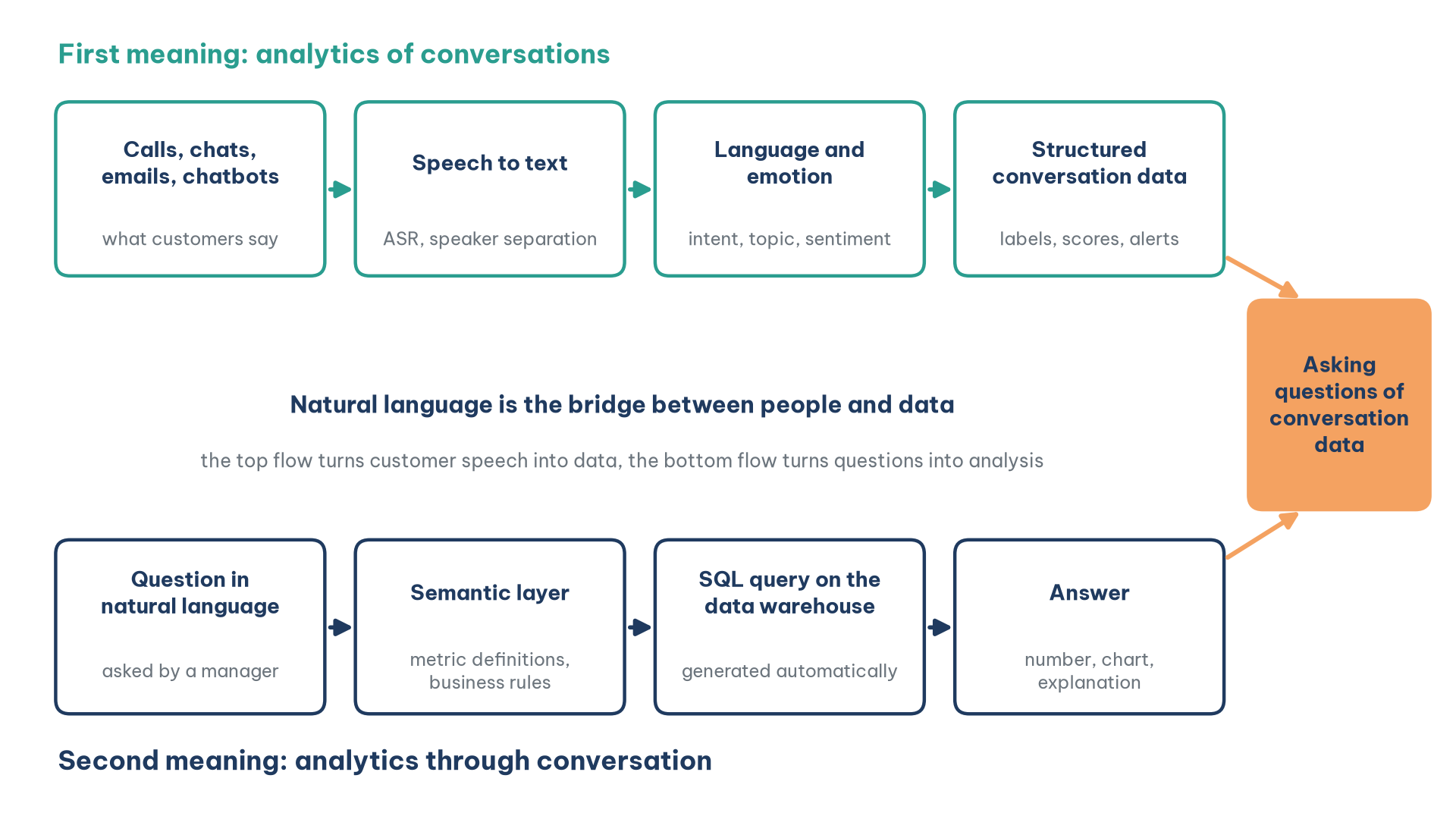
Despite their different objects, both rest on one idea: natural language is the bridge between people and data. The first meaning turns customers' words into data; the second turns managers' questions into analysis. Figure 1 draws the two as parallel pipelines flowing toward a single point that Section 6 examines: asking questions of conversation data itself.
2. Why conversational analytics is booming now
This section explains what changed. Conversation data has existed as long as call centers, and the idea of asking data questions in words is old; what is new is that four factors matured at once: cost, market demand, the decline of surveys and the capability of generative AI.
2.1. Analyzing everything became affordable
For years, conversation data was too expensive to analyze in full: speech recognition was inaccurate, topic labeling relied on hand-built keyword lists and computing was costly. Reviewing a small fraction of calls was a constraint rather than a choice (Mychal, 2025). As recognition and language processing became cheap, analyzing every conversation became economically feasible for the first time.
2.2. Double-digit market growth
According to Fortune Business Insights (n.d.), the global speech analytics market was worth about US$4.94 billion in 2025 and is forecast to reach US$15.31 billion by 2034, a compound annual growth rate (CAGR) of about 13.15%. MarketsandMarkets (2025) puts the broader conversational AI market at US$17.05 billion in 2025, possibly reaching US$49.80 billion by 2031 (CAGR 19.6%). Research firms define their scope differently, so the figures are not strictly comparable, but the direction is consistent.
2.3. Surveys are losing ground
Survey response rates keep falling, and respondents cluster at the extremes. In 2022 Gartner forecast that by 2025, 60% of organizations with voice of the customer (VoC) programs would supplement surveys by analyzing voice and text interactions (as cited in CRM Magazine, 2022). Fifth Third Bank, in Section 4, went further and dropped its surveys entirely.
2.4. Generative AI raised the ceiling
Earlier systems relied on keywords and rules: if a customer said "cancel", flag "churn risk". LLMs understand context, summarize, classify topics nobody defined in advance and answer open questions. VNPT iSense, used by the Vietnamese mobile carrier VinaPhone, applies generative AI in exactly these ways to call data at large scale (Mỹ Lệ, 2026).
3. Anatomy of a conversation analytics system
This section opens the pipeline to show what conversation analytics can and cannot do. A typical system has six layers, from data capture to action, and the quality of each layer caps the quality of every layer after it.
3.1. Layer 1: multichannel data capture
Data comes from calls, interactive voice response (IVR), voicebots, web and app chat, messaging apps such as WhatsApp or Messenger, email and social media (Huffnagle, 2026). The first challenge is linking identity and journey: a customer who chats in the morning, calls in the afternoon and emails a complaint in the evening must not be counted as three separate problems.
3.2. Layer 2: speech to text and speaker separation
Automatic speech recognition (ASR) turns audio into text, while speaker diarization works out which sentences belong to the agent and which to the customer. VNPT iSense combines exactly these components: speech recognition, speaker separation, emotion detection from acoustic features and generative AI for more complex tasks (Mỹ Lệ, 2026). This layer decides everything downstream: one misrecognized word can turn "not satisfied" into "satisfied".
3.3. Layer 3: understanding language
Here natural language processing and understanding (NLP, NLU) answer four questions: the intent (why did the customer call: to check a balance, to complain, to cancel?), the topic (fees, the app, delivery, returns?), the entities (which product, branch or order number?) and the outcome (was the problem solved, was a callback promised?). These labels turn a free-form conversation into a structured record that can be counted and compared.
3.4. Layer 4: emotion and nonverbal signals
Sentiment analysis combines content (negative or positive words) with acoustics (a rising voice, interruptions, long silences). Common nonverbal metrics include silence share, overtalk, hold time and the talk-to-listen ratio.
3.5. Layer 5: scoring, detection and alerts
From these signals the system scores each interaction against a checklist (greeting, identity verification, required disclosures, offering a solution) and detects anomalies. Near-real-time threshold alerts can trigger workflows for operations, product or risk teams when, for instance, mentions of "payment failed" suddenly jump (Huffnagle, 2026).
3.6. Layer 6: insight and action
The last and most neglected layer gets insight to the people who act on it: coaches receive calls that need coaching, product teams receive bug reports, legal receives compliance alerts. Mychal (2025) notes that when these functions sit on separate platforms, insight gets stuck in silos and rarely becomes action.
Illustrative example (hypothetical): An electronics chain sees mentions of "installation" in calls rise 40% in the two weeks after an air conditioner promotion. The system shows that 70% of those calls come from one state, where the installation partner had just changed. The report goes automatically to the regional operations director, who fixes the problem before it becomes a wave of one-star reviews.
4. Applications through numbers that speak
This section gathers published case studies. One caveat matters: most of the figures below were published by solution vendors, who may select positive results. Readers should treat them as indicators of potential, not as promises.
4.1. Quality control and agent coaching
Halkbank (Turkey). After moving from manual review of 1% to 2% of calls to monitoring all calls with a Sestek solution, Halkbank reported 10% less silence, 5% less hold time and a 75% improvement in the rate of angry customers (Sestek, n.d.). All three are behaviors that can be coached: long silences usually mean an agent is struggling to look something up, and anger often comes from being asked for the same information again.
Banco BMG (Brazil). This retail bank uses conversation analytics to track customer effort from signals in the interactions themselves, and to automate quality evaluation. According to NICE, the number of automated evaluations per agent rose thirteenfold and quality scores improved by 7.4% (NICE, 2024).
Fifth Third Bank (United States). This may be the most convincing case of replacing surveys. The bank, with about US$211 billion in assets, used to rely on small-sample surveys. Its expanded speech analytics analyzed 15.7 million calls and automatically characterized 77% of them; after a six-month ramp-up the bank ended its survey program, redeployed six full-time staff and coached agents on behaviors such as taking ownership and active listening (NICE Systems, n.d.).
4.2. Retention through churn signals
Elavon (United States and Europe). This payments company, part of U.S. Bancorp, already recorded every call at its Knoxville center (about 300 agents, about 10,000 calls a day) but had no manual way to find merchants about to leave. With speech analytics, four specialists work through about 2,000 flagged calls a day, prioritized by revenue. In the first three months Elavon saved nearly 600 accounts (about US$1.7 million in revenue), reached full payback after seven weeks and raised its save rate from about 90% to more than 96% (Verint Systems, n.d.-a). The recordings existed before; the value came from timely detection and the right priorities.
4.3. More revenue by learning from the best sellers
A credit card and lending bank (a Transcom client). Traditional monitoring scored a small sample of calls, and feedback reached agents days later. After deploying speech analytics with machine learning and predictive analytics, lending sales rose 20% in four months while average handle time fell 10% (Transcom, n.d.).
Gong and the talk-to-listen ratio in B2B sales. One of the best-known findings in conversation intelligence comes from Gong. In early analyses of 2016 sales call data, Gong Labs found that the most effective calls had an "ideal" talk-to-listen ratio of about 43:57, meaning the seller talked only 43% of the time (Orlob, 2017).
Almost a decade later, Gong revisited the question with about 326,000 sales calls. The average is still about 60% talking, and talking more than 65% of the time is associated with lower conversion and win rates. Top sellers keep their talk time almost the same whether they win or lose, while weaker sellers talk 54% of the time on won deals and 64% on lost ones (Morgese, 2025). Consistency matters as much as the number itself, and the real value of measurement is letting sellers see habits they usually misjudge.
4.4. Voice of the customer and process improvement
A Fortune 500 financial services firm. The firm built a Customer Sentiment Index and a Customer Effort Impact measure from call data, found that problem calls lasted at least 60% longer than normal, traced root causes and fixed agent scripts and complex forms. Unusually long calls and repeat calls fell substantially (Verint Systems, n.d.-c).
Florius (Netherlands). This mortgage lender, part of ABN AMRO, found that customers were most frustrated by having to explain their situation again on every call. Speech analytics plus a "coaching bot" that feeds agents real-time information raised its Net Promoter Score (NPS) by 5 points and first contact resolution by 5% (Verint Systems, n.d.-b).
These two cases illustrate an important principle: insight from conversations usually points to a broken process, not a broken person. A confusing form will generate thousands of follow-up calls, however good the agents are.
4.5. Compliance and risk management
In banking, debt collection and insurance, agents must read certain disclosures and avoid certain phrases, and manual checks on a small sample almost never catch systematic violations. Conversation analytics compares every call against configured compliance rules (CX Today, 2022). In a U.S. financial services case published by Alvaria (successor to Aspect), reported results include 54% fewer violations of the Fair Debt Collection Practices Act (FDCPA), 28% fewer calls in which the customer hung up, 40% less time preparing coaching and a 9.6% higher collection rate (Alvaria, n.d.).
4.6. Analyzing the chatbot's own conversations: the Klarna lesson
When companies let AI answer customers, conversation analytics becomes a tool for monitoring the AI itself. The story of Klarna, the Swedish buy-now-pay-later company, is the most cited example.
In February 2024 Klarna announced that its AI assistant, built with OpenAI technology, had handled 2.3 million conversations in its first month, two-thirds of all customer service chats, doing the work of 700 full-time agents in 23 markets and more than 35 languages, with satisfaction on par with human agents, 25% fewer repeat inquiries and an estimated US$40 million profit improvement in 2024 (Klarna, 2024).
By 2025, however, Klarna acknowledged quality problems with its AI-first approach, hired people again and moved to a hybrid model, promising that customers could always reach a real person (Pedoeem, 2025). The lesson is not that "AI failed" but that attractive efficiency metrics do not fully capture the quality of the experience. Companies need to analyze bot conversations in depth (do customers abandon them, ask again through another channel, express frustration?) to tell whether the AI is solving problems or just closing tickets quickly.
4.7. A view from a tonal-language market
Deployments in Vietnam offer an angle rarely discussed in English-language coverage: what conversation analytics looks like at scale in a tonal language with strong regional accents, served mainly by domestic vendors rather than global platforms.
VNPT iSense at VinaPhone. The mobile carrier's contact center uses VNPT iSense to monitor service quality across all calls. In 2025 iSense analyzed more than 30 million calls, helping cut manual monitoring work by about 70% and outsourced QA staff costs by about 21%; it also suggests context-based information so agents spend less time looking things up. VNPT stressed that the biggest change was not replacing people but extending quality monitoring to a scale manual methods could never reach (Mỹ Lệ, 2026).
FPT AI Enhance and AI-made calls. FPT Smart Cloud's automated QA product analyzes messaging and voice interactions so that every conversation is scored, not a random 5% (VnExpress, n.d.). In the opposite direction, FPT reports that its voicebot helps the consumer lender Home Credit Vietnam make more than 12 million calls a month, saving 50% of operating costs and raising agent productivity by 40% (VnExpress, n.d.). At that volume, conversation analytics becomes a precondition for controlling the bot itself, as the Klarna story shows.
4.8. The cases at a glance
The cases above range from QA and retention to sales, compliance and automation. Table 2 brings the headline results together for comparison; as a reminder, most figures were published by vendors or by the companies themselves.
5. Analytics through conversation: when managers talk with data
This section turns to the second meaning, where the question is no longer "what are customers saying" but "what is our own data saying". It moves from the limits of static dashboards to the inside of a conversational BI system, then to the accuracy problem and the design principles that follow.
5.1. From static dashboards to open questions
Traditional dashboards answer well the questions someone anticipated. Real business questions, however, come in chains nobody predicted: "Revenue is down? In which region? Which product group? How does it compare with the competitor's promotion?" Each new question often means a request to the data team and a few days of waiting.
Conversational BI shortens that loop. Google's Conversational Analytics API combines its AI agent tools with Looker's semantic layer and BigQuery's data context so that asking questions of data can be embedded in everyday applications (Kuzma, 2025). By July 2026, BigQuery Conversational Analytics and the API were generally available, with previews for AlloyDB, Cloud SQL and Spanner, and data agents could be published to Gemini Enterprise so employees query several systems from one interface (Mitchell, 2026).
5.2. Inside a conversational BI system
According to Google, the core is an NL2Query engine that translates a question into a correct query for the data source, handles ambiguity and infers intent, supported by a Python interpreter and a context retrieval tool that, for BigQuery, pulls schemas and table and column descriptions from Dataplex (Krishnan & Berk, 2025). Figure 2 generalizes the flow: the question passes through intent understanding, the semantic layer maps it onto the company's own metric definitions and only then does it become a query against the warehouse.
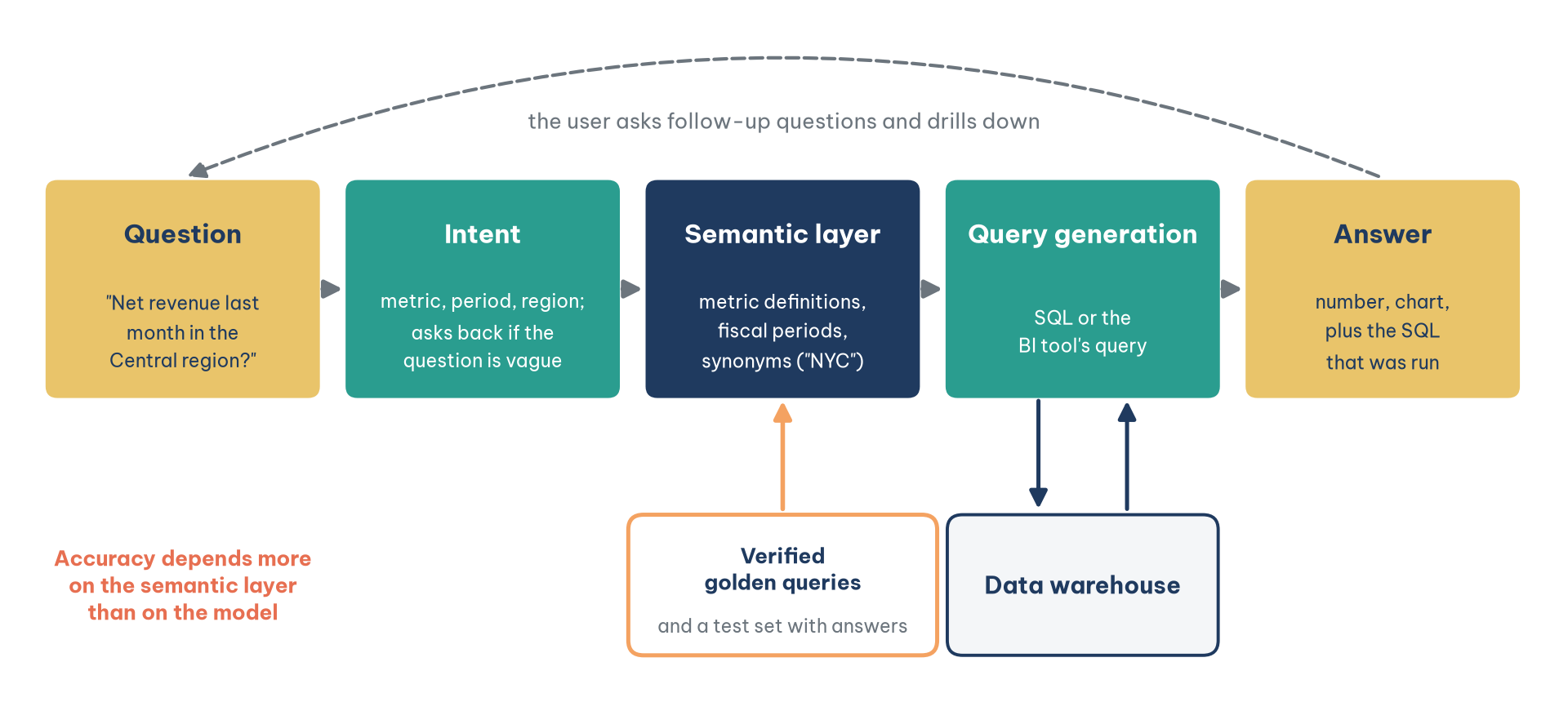
Looker adds several features (Google Cloud, 2026): data agents, specialized "virtual analysts" connected to up to five Explores and shareable across the organization; golden queries, verified question and query pairs that anchor common business patterns; Advanced Analytics, which turns a question into Python code for analysis beyond SQL; and metric alerts set in natural language, still in preview.
5.3. The accuracy problem and why the semantic layer is the key
When conversational BI answers wrongly, the consequences are far worse than a slow dashboard: a manager may make a decision based on a wrong number without knowing it. Academic research shows the challenge is real. The BIRD benchmark, with 12,751 question and SQL pairs over 95 real databases totaling 33.4 GB across 37 professional domains, found that GPT-4 reached only 54.89% execution accuracy, against 92.96% for humans (Li et al., 2023).
Industry results are similar. Snowflake reports that GPT-4o reached only 51% accuracy on an internal test set modeled on real BI scenarios, while its Cortex Analyst, which combines agents with a semantic model, exceeded 90% (Snowflake, 2024b). In Snowflake's image, an LLM is a brilliant analyst on their first day who does not yet know the nuances of the company's data, and the semantic model supplies that knowledge (Snowflake, 2024a). Google likewise reports that Looker's semantic layer cuts data errors in natural-language queries by up to two-thirds (Kuzma, 2025).
Gartner put it more bluntly in an October 2026 note: natural-language query will be inaccurate without well-governed semantics (Gartner, 2026). The expectation that "AI alone is enough" therefore tends to produce inconsistent answers.
Illustrative example (hypothetical): A pharmacy chain's sales director asks, "Which product had the best revenue last month?" Does "best" mean revenue, profit or units? Is "last month" a calendar month or a fiscal period? Is revenue net of returns? If the semantic layer defines "net revenue = revenue − returns − discounts" and fixes the fiscal month, the answer matches the financial statements; if not, each asking may return a different number. Snowflake uses the same kind of example and argues that the system should suggest a clearer question rather than guess (Snowflake, 2024a).
5.4. Five principles for trustworthy conversational BI
The evidence above yields five design principles. The first is query transparency: always let users see the SQL that was generated. Conversational Analytics in Data Studio has a Code tab under "How was this calculated?" that shows the SQL query run to produce the result (Google Cloud, n.d.).
The second is verified queries: build a library of golden queries for the most common questions. The third is handling real-world values: users say "the Northeast", "NYC" or "the Big Apple" while the data says "New York City". Snowflake describes a semantic search mechanism to match such values (Snowflake, 2024a), and Google gives the example of matching "NYC" to "New York City" (Kuzma, 2025).
The fourth is cost control: set query size limits and monitor usage, features Google has added to BigQuery and Looker (Mitchell, 2026). The fifth is continuous evaluation: maintain a standard set of questions with known answers and rerun it whenever the model or the data changes. This is exactly how the BIRD team and Snowflake measured accuracy in Section 5.3, except that a company builds its test set around its own business.
6. When the two streams meet: asking questions of conversation data
This section shows what happens when the two meanings meet, which is where the field becomes most interesting. Imagine the customer experience director of a mobile carrier asking a data assistant:
"This week, which reason for calling the contact center rose most in the Central region compared with last week? Summarize three typical complaints for me."
To answer, the system needs call data already classified by topic and tagged by region (the first meaning), the ability to turn the question into a week-on-week regional comparison (the second meaning) and generative AI to retrieve and summarize the original transcripts.
Data platforms are preparing for this. Google says BigQuery supports multimodal analysis through object tables, with AI functions for classification, scoring, forecasting and anomaly detection (Mitchell, 2026), so call transcripts can be analyzed inside the warehouse and queried in natural language instead of passing through a separate system first.
The organizational consequences are large. Insight from the voice of the customer stops being "the customer service department's report" and becomes shared data that product managers, marketing heads and branch managers can explore for themselves.
7. Challenges, risks and limits
This section balances the benefits with five groups of challenges that companies need to take seriously.
7.1. Language and acoustics
Contact center audio is rarely the clean, standard speech that recognition benchmarks are built on. VNPT, describing deployments in Vietnamese, names fast speech, broken phrases, overlapping talk, regional dialects and constantly shifting emotion as the hardest features of real calls (Mỹ Lệ, 2026). Add code-switching (local-language sentences with English words such as "check the bill" dropped in), poor phone audio, noise and polite, indirect complaints. A customer who says "yes, yes, I understand" in a tired voice may be very dissatisfied, yet a system that reads only the transcript will score it as positive. The same holds for any language with strong accents or little training data.
7.2. Hallucination and bias
In conversation analytics, the risk is a summary that invents details or topics that are systematically misclassified; in conversational BI, it is a wrong number presented with confidence. The BIRD and Snowflake results show how wide the gap between demo and trustworthy product remains without a semantic layer and verification (Li et al., 2023; Snowflake, 2024b). The practical rule: every important insight must trace back to the original transcript or query.
7.3. Personal data and privacy
Recording and analyzing calls is processing of personal data. The EU's General Data Protection Regulation (GDPR) is the most common reference point: processing needs a lawful basis, people must be told what is done with their data, and processing likely to pose a high risk requires a data protection impact assessment before it starts (Regulation (EU) 2016/679, 2016). Many newer national laws follow similar logic.
Three questions matter for any contact center. Does the notice "this call may be recorded for quality purposes" really cover AI analysis, and can the company prove what each customer agreed to and when? Do calls contain sensitive data, such as card details, transaction history, health information (a customer explaining a late payment) or family circumstances? And where is the data processed, since sending transcripts to a cloud in another country can trigger cross-border transfer rules? This section is for information only; companies should consult a lawyer about their own situation.
7.4. Emotion recognition of employees: a red line in Europe
For companies operating in Europe or serving European customers, the EU AI Act matters. Since 2 February 2025, Article 5(1)(f) has prohibited AI systems that infer emotions in the workplace; the European Commission's draft guidelines cite webcams and voice recognition used to track emotions such as anger in call center staff (de Fonseka & McFadden, 2025). Tracking the emotions of customers is not covered by the ban, as long as the system does not also track employees' emotions (CMS, 2025).
The distinction is worth reflecting on even for companies outside the reach of EU law: scoring an employee's "stress level" or "attitude" from their voice is a form of surveillance that can erode trust inside the organization.
7.5. The illusion of efficiency and Goodhart's law
When a measure becomes a target, it ceases to be a good measure. Agents judged on "reading the full standard greeting" will read like machines; a bot rewarded for "sessions closed quickly" may push customers away. As the Klarna story shows, efficiency and experience quality do not always move together (Pedoeem, 2025). Conversation analytics should be used to understand and coach, not only to score and discipline.
8. An eight-step implementation roadmap
This section turns the lessons above into an eight-step roadmap for companies that want to start, moving from a business question to an expansion into conversational BI.
Step 1: start from a business question, not from technology. Pick one or two problems with measurable value: reducing churn (as Elavon did), raising sales (as the Transcom client did) or cutting compliance violations. Huffnagle (2026) observes that the largest returns come from applying conversation analytics to specific, high-impact processes rather than using it as a general reporting layer.
Step 2: inventory the data and the legal basis. Which channels are already recorded? Is the recording notice sufficient as a basis for AI analysis? Where is the data stored, and for how long?
Step 3: pilot with a comparison group. Choose a team or a product line and measure baseline metrics before deployment. Without a baseline, effectiveness cannot be shown; where possible, design the pilot as an A/B test with a control group.
Step 4: build your own taxonomy. The list of contact reasons, the QA scoring criteria and the list of compliance risks must reflect the company's own business. VNPT stresses that iSense was designed to be customized for each line of business, customer group and set of criteria rather than applying one fixed standard (Mỹ Lệ, 2026).
Step 5: calibrate against humans. Have QA specialists score the same sample of calls in parallel with the machine, measure agreement and tune. This is the step that builds trust.
Step 6: close the action loop. Every type of insight needs an owner and a handling process: who receives the alert, how quickly they must respond and where the outcome is recorded.
Step 7: measure the return. Track the metrics in Table 3 before and after deployment. The table groups them into six families, each answering its own management question.
Step 8: expand into conversational BI. Once conversation data is structured and backed by a semantic layer, let managers across departments ask their own questions. The metrics in Table 3 can then go onto a KPI dashboard that can still be queried in plain language.
9. The near future of conversational analytics
This section looks a few years ahead at five trends, each raising a new management question.
From post-call analysis to real-time intervention. Instead of discovering problems at the end of the month, systems prompt agents during the call, as Florius and VinaPhone already do (Verint Systems, n.d.-b; Mỹ Lệ, 2026).
From answering questions to acting automatically. Data agents will not only answer but also set alerts, schedule reports and trigger workflows based on metrics (Google Cloud, 2026; Mitchell, 2026). The management question becomes: what may an AI agent do on its own, and when must it ask a human?
The semantic layer as a strategic asset. When a question-and-answer interface becomes the default, the quality of metric definitions and data governance will decide the quality of business decisions. Gartner (2026) has named this precondition clearly.
Models tuned for local languages. Vendors such as VNPT and FPT invest in recognition tuned for Vietnamese and local operational data (Mỹ Lệ, 2026; VnExpress, n.d.). Outside the largest languages, local language quality may become an advantage over global platforms, one that also fits tightening rules on where data may be processed.
Responsible governance as a vendor selection criterion. With the EU AI Act and a growing body of data protection law, the ability to explain results, switch off employee emotion recognition, keep data in a chosen jurisdiction and audit queries is likely to become a standard requirement in requests for proposals.
Conclusion
Conversational analytics, in both meanings, revolves around one idea: human language is the richest source of data and the most natural interface for working with data. The cases from Halkbank, Fifth Third, Elavon, Gong and Klarna to VinaPhone show that the value lies not in speech recognition or language models as such but in organizational capability: asking the right question, building shared definitions, closing the loop to action and measuring honestly.
For most companies the moment is both favorable and demanding: favorable because recognition technology has matured and analyzing every conversation is within reach; demanding because data protection rules keep tightening and the trust of customers and employees is easily lost when analytics turns into surveillance.
The question for managers is no longer whether to listen to customers at scale, but what to do with what they hear and how to do it responsibly.
References
Alvaria. (n.d.). Speech analytics solutions for banking & finance [Case study]. CaseStudies.com. https://www.casestudies.com/company/alvaria/case-study/speech-analytics-solutions-for-banking-finance
CMS. (2025). EU Commission issues guidelines on prohibited AI practices, Part II. https://cms.law/en/gbr/legal-updates/eu-commission-issues-guidelines-on-prohibited-ai-practices-part-ii
CRM Magazine. (2022, March 9). Gartner urges supplementing surveys with analytics. destinationCRM.com. https://www.destinationcrm.com/Articles/CRM-Insights/Insight/Gartner-Urges-Supplementing-Surveys-with-Analytics-151826.aspx
CX Today. (2022, April 5). What is conversational analytics? https://www.cxtoday.com/data-analytics/what-is-conversational-analytics/
de Fonseka, J., & McFadden, P. (2025, February 17). Understanding the EU AI Act's prohibited practices: Key workplace and advertising insights from the new draft guidelines. Lewis Silkin. https://www.lewissilkin.com/en/insights/2025/02/17/understanding-the-eu-ai-acts-prohibited-practices-key-workplace-and-advertising-102k011
Fortune Business Insights. (n.d.). Speech analytics market size, share & industry analysis. https://www.fortunebusinessinsights.com/speech-analytics-market-108836
Gartner. (2026, October 2). Natural language query will be inaccurate without well-governed semantics. https://www.gartner.com/en/documents/8464345
Google Cloud. (n.d.). Conversational Analytics in Data Studio [Documentation]. https://docs.cloud.google.com/looker/docs/studio/conversational-analytics-looker-studio
Google Cloud. (2026). Conversational Analytics overview [Looker documentation]. https://docs.cloud.google.com/looker/docs/2610/conversational-analytics-overview
Huffnagle, J. (2026, October 16). What is conversational analytics? The missing layer between your contact center data and CX decisions. Parloa. https://www.parloa.com/knowledge-hub/what-is-conversational-analytics/
Klarna. (2024, February 27). Klarna AI assistant handles two-thirds of customer service chats in its first month [Press release]. PR Newswire. https://www.prnewswire.com/news-releases/klarna-ai-assistant-handles-two-thirds-of-customer-service-chats-in-its-first-month-302072740.html
Krishnan, V., & Berk, E. (2025, July 10). How to tap into natural language AI services using the Conversational Analytics API. Google Cloud Blog. https://cloud.google.com/blog/products/business-intelligence/use-conversational-analytics-api-for-natural-language-ai
Kuzma, R. (2025, August 26). Chat with your data from anywhere: Announcing Google's Conversational Analytics API. Google Cloud Blog. https://cloud.google.com/blog/products/data-analytics/understanding-lookers-conversational-analytics-api
Li, J., Hui, B., Qu, G., Yang, J., Li, B., Li, B., Wang, B., Qin, B., Cao, R., Geng, R., Huo, N., Zhou, X., Ma, C., Li, G., Chang, K. C. C., Huang, F., Cheng, R., & Li, Y. (2023). Can LLM already serve as a database interface? A BIg bench for large-scale database grounded text-to-SQLs. Advances in Neural Information Processing Systems, 36, 42330–42357. https://doi.org/10.52202/075280-1835
MarketsandMarkets. (2025). The rapid rise of conversational AI: Market size, share and future opportunities. https://www.marketsandmarkets.com/ResearchInsight/conversational-ai-market-size-share.asp
Mitchell, S. (2026, July 29). Google Cloud widens conversational analytics tools. IT Brief Australia. https://itbrief.com.au/story/google-cloud-widens-conversational-analytics-tools
Morgese, D. (2025, August 21). Mastering the talk-to-listen ratio in sales calls. Gong. https://www.gong.io/resources/labs/talk-to-listen-conversion-ratio/
Mychal, D. (2025, December 12). Conversation intelligence: The complete guide to conversational analytics for 2026. Cresta. https://cresta.com/guides/conversation-analytics
Mỹ Lệ. (2026, May 19). Tổng đài của nhà mạng giảm 70% việc giám sát thủ công nhờ AI tạo sinh [A carrier's contact center cuts manual monitoring by 70% with generative AI]. VnReview. https://vnreview.vn/threads/tong-dai-cua-nha-mang-giam-70-viec-giam-sat-thu-cong-nho-ai-tao-sinh.83099/
NICE. (2024). Customer case studies flip book: Customer engagement analytics. https://resources.nice.com/wp-content/uploads/2024/03/customer-case-studies-flip-book-customer-engagement-analytics.pdf
NICE Systems. (n.d.). Fifth Third Bank transforms voice of the customer through NICE Enlighten AI and Nexidia Analytics [Case study]. CaseStudies.com. https://www.casestudies.com/company/nice-Systems/case-study/fifth-third-bank-transforms-voice-of-the-customer-through-nice-enlighten-ai-and-nexidia-analytics
Orlob, C. (2017, February 6). Taking the guesswork out of sales call effectiveness. Gong Labs. https://www.gong.io/blog/taking-the-guesswork-out-of-sales-call-effectiveness
Pedoeem, J. (2025, September 10). Klarna customer service: From AI-first to human-hybrid balance. PromptLayer. https://blog.promptlayer.com/klarna-customer-service-from-ai-first-to-human-hybrid-balance/
Regulation (EU) 2016/679. (2016). Regulation (EU) 2016/679 of the European Parliament and of the Council of 27 April 2016 on the protection of natural persons with regard to the processing of personal data and on the free movement of such data (General Data Protection Regulation). Official Journal of the European Union, L 119, 1–88. https://eur-lex.europa.eu/eli/reg/2016/679/oj
Sestek. (n.d.). Halkbank improves customer experience with speech analytics [Case study]. https://www.sestek.com/success-stories/halkbank
Snowflake. (2024a, August 14). Snowflake Cortex Analyst: Behind the scenes. https://www.snowflake.com/en/blog/engineering/snowflake-cortex-analyst-behind-the-scenes/
Snowflake. (2024b, August 29). Snowflake Cortex Analyst: Evaluating text-to-SQL accuracy for real-world business intelligence scenarios. https://snowflake.com/en/engineering-blog/cortex-analyst-text-to-sql-accuracy-bi
Transcom. (n.d.). Increasing sales by 20% in 4 months for a brilliant bank [Case study]. https://transcom.com/case-studies/increasing-sales-by-20-in-4-months-for-a-brilliant-bank
Verint Systems. (n.d.-a). Elavon customer case study [Case study]. CaseStudies.com. https://www.casestudies.com/company/verint-systems/case-study/elavon-customer-case-study
Verint Systems. (n.d.-b). Florius improves NPS by 5 points with Verint Systems [Case study]. CaseStudies.com. https://www.casestudies.com/company/verint-systems/case-study/florius-improves-nps-by-5-points-with-verint-systems
Verint Systems. (n.d.-c). A Fortune 500 financial services firm reduces repeat calls and average handle time with Verint Speech Analytics [Case study]. CaseStudies.com. https://www.casestudies.com/company/verint-systems/case-study/a-fortune-500-financial-services-firm-reduces-repeat-calls-and-average-handle-time-with-verint-speech-analytics
VnExpress. (n.d.). Công ty FPT Smart Cloud [FPT Smart Cloud company] [AI4VN 2025 entry profile]. https://vnexpress.net/cong-ty-fpt-smart-cloud-4915084.html
Wright, H. (2019, February 20). BI buyers seeking more magic says Gartner. iStart. https://istart.com.au/news-items/bi-buyers-seeking-augmented-analytics-says-gartner/
Discussion about this post