Using Consensus as an AI Research Assistant: A Workflow
An AI assistant for literature reviews across five stages of business research, with 55 sample prompts, the biases to guard against and the work you should never hand to AI


Key takeaways
Consensus is an AI-powered academic search engine: it searches published papers by meaning, extracts findings and always cites its sources. Its summaries are still written by a language model, so the original papers must be checked.
The Consensus Meter counts papers for and against a yes/no question; it does not weigh quality or sample size.
Consensus can help at all five stages of a research project, from finding topics and gaps to choosing theories, validated scales, analysis techniques and evidence for the discussion. This article offers 55 tested prompts across marketing, HR, finance, operations and information systems.
Four biases come with it: algorithmic, confirmation, publication bias and the loss of skills through dependence. Six principles, above all actively searching for contrary evidence, reduce the risks.
AI cannot be an author, its use must be disclosed, and the researcher remains fully responsible for every reference and claim.
In academia and business alike, evidence-based decisions matter more and more, and quick, accurate access to research findings has become an advantage. For people doing business and management research, from students writing theses to faculty writing journal articles, the most time-consuming part is often the literature review: finding, reading, screening and synthesising dozens or hundreds of papers. Consensus is one of several AI-powered academic search tools designed to shorten that work.
What sets Consensus apart from general-purpose chatbots is that it searches a database of published scientific papers and always cites its sources. Even so, it uses language models to summarise and synthesise, so its summaries can misinterpret, oversimplify or merge the findings of different papers. It is not a black box that answers on the researcher's behalf, but an assistant that speeds up searching so the researcher can spend more time on analysis, interpretation and creating new knowledge.
The article has eleven parts. Section 1 explains how Consensus works. Section 2 introduces the five stages of a research project and how to read the prompt tables. Sections 3 to 7 show how to use Consensus at each stage, with prompts for five fields: marketing, human resources, finance, production and operations, and information systems. Section 8 analyses biases and ethical risks. Section 9 places Consensus alongside other tools. Section 10 applies the whole workflow to a thesis topic, and Section 11 discusses disclosing the use of AI.
1. What is Consensus and how does it work?
To use a tool well, you need to know what it does and does not do.
1.1. How it differs from general-purpose chatbots
General-purpose chatbots such as ChatGPT, when not connected to a data source, can produce plausible-looking information that is not true, a phenomenon often called "hallucination", including citations that do not exist. Consensus is designed the other way round: every claim comes from a specific paper and is accompanied by a link to the original.
Consensus also complements traditional academic search engines such as Google Scholar, which rely mainly on keywords. Thanks to language models, Consensus tries to understand the meaning of a question and find semantically related findings even when papers do not contain the exact keywords the user typed.
1.2. How it works
The Consensus process can be summarised in five steps, the last of which belongs to the user, as Figure 1 shows.
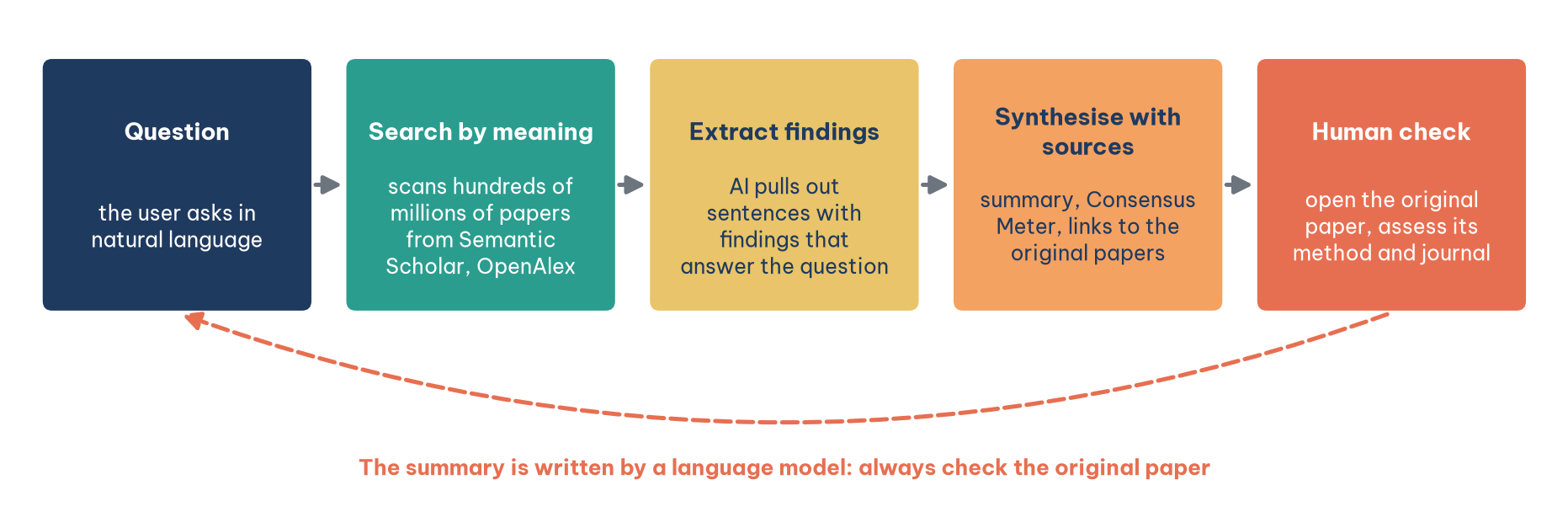
Consensus searches a database of hundreds of millions of papers drawn from sources such as Semantic Scholar, OpenAlex and PubMed (Consensus, n.d.). Coverage is very broad, but not every paper has been peer reviewed, and journal quality varies widely. When a user asks a question, the AI analyses the intent, scans relevant papers and extracts the sentences or passages containing results or conclusions that answer it. Findings are presented with full citations and direct links to the original papers so users can verify them at once.
1.3. The Consensus Meter and its limits
The Consensus Meter quickly summarises how far the papers found agree: how many support, how many oppose and how many are neutral. It is only meaningful for yes/no questions, such as "Does remote work increase productivity?"
More importantly, the Consensus Meter counts papers; it does not weigh quality or sample size. Ten small, methodologically weak studies can "outvote" one large, rigorous study. Its result should therefore be read as a hint about the direction of the literature, not a verdict on the evidence; assessing the evidence requires reading each paper's method.
2. The five stages of a research project
A typical business and management research project passes through five stages, and Consensus can help at each in a different way.
2.1. Five stages
Business research methods textbooks usually describe the research process as a sequence from formulating the problem to reporting (Bryman & Bell, 2022). Figure 2 shows the five stages and how Consensus can help at each.
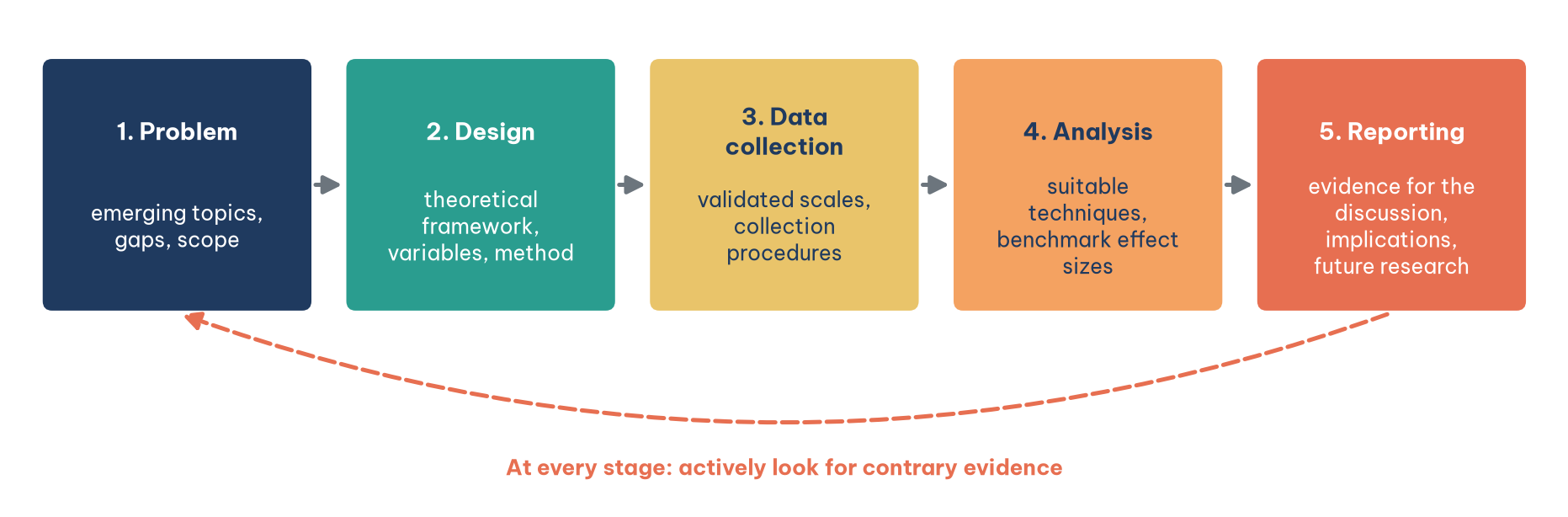
Consensus is most useful where you need to know "what previous studies have done": choosing a topic, finding a theoretical framework, finding scales, choosing analysis techniques, benchmarking results. It does not collect or analyse the researcher's own data; those tasks remain entirely human.
2.2. How to read the prompt tables
Each stage in Sections 3 to 7 has two or three tables of sample prompts, each with five prompts for five fields of business management. Each prompt links to a pre-run search on Consensus; links may require signing in, and results may change over time as the database is updated.
Use the prompts as templates: keep the sentence structure and replace the topic with your own. A good Consensus prompt usually states the subject, the variables or context, and the kind of answer wanted, such as "which mediating variables" or "which validated scales".
3. Stage 1: formulating the research problem
This foundational stage sets the direction of the whole project. It starts from a broad area of interest and ends with a specific, clear, answerable research question. A good research problem needs novelty, relevance to management practice and a clear research gap.
3.1. Finding ideas and emerging topics
Before settling on a topic, a researcher can use Consensus to scan the landscape, grasp trends, key debates and emerging areas. Broad questions quickly reveal promising directions you may never have considered. Table 1 suggests five prompts.
3.2. Identifying research gaps
With a broad topic, say "remote work and productivity", the next step is to find an unexplored angle. Asking Consensus for unanswered questions or for limitations that earlier papers acknowledge helps identify a direction for genuinely new work. Table 2 suggests five prompts.
Consensus's answers about "gaps" are only suggestions. A real gap must be verified by reading the field's most recent reviews and searching other databases, because it may already have been filled by papers Consensus has not yet indexed.
3.3. Assessing scope and feasibility
Before committing to a topic, a researcher needs to know whether it is too broad, too narrow or too complex. Consensus can produce a rough outline that quickly shows the subtopics, relevant theories and depth of the field, helping to judge feasibility within a time frame. Table 3 suggests five prompts.
4. Stage 2: research design
This stage builds the research "blueprint": choosing a qualitative, quantitative or mixed methodology, a theoretical framework and variables, and planning data sources and sampling. A rigorous design determines the validity and reliability of the results.
4.1. Identifying theoretical frameworks, models and variables
Consensus quickly finds theoretical models, such as the technology acceptance model (TAM), the theory of planned behaviour (TPB) or SERVQUAL, and the independent, dependent, mediating and moderating variables widely used to study a phenomenon. This builds a solid theoretical foundation and ensures the study is in dialogue with earlier work. Table 4 suggests five prompts.
4.2. Evaluating and choosing a methodology
Asking about the strengths and limitations of different research methods in a specific context helps a researcher choose a suitable method and justify it persuasively in the methods chapter. Table 5 suggests five prompts.
5. Stage 3: data collection
This stage gathers primary data through surveys or interviews, or uses existing secondary data. Data quality directly affects the quality of results. Consensus does not collect data, but it is useful for preparation.
5.1. Finding validated scales and instruments
In quantitative research, using scales or questionnaires that earlier studies have developed and validated is essential. Consensus helps find them, saving the time of designing from scratch and increasing reliability. Table 6 suggests five prompts.
When using a scale developed elsewhere, for example applying a US-validated scale to consumers in Vietnam or another non-English-speaking market, researchers need forward and back translation, a pilot test and re-validation of reliability on their own sample. A scale validated in one culture does not necessarily keep its structure in another.
5.2. Learning from data-collection procedures
Knowing how to collect data matters as much as knowing what to ask. Consensus helps you learn the procedures earlier studies used: whom they approached (executives, employees, consumers), which modes they used (online surveys, phone interviews, on-site observation) and which challenges they met (low response rates, difficulty reaching senior leaders). Table 7 suggests five prompts.
6. Stage 4: data analysis
Once collected, raw data must be cleaned, processed and analysed. Depending on the design, this may involve statistical techniques such as regression, structural equation modelling (SEM) or ANOVA, or qualitative methods such as thematic or discourse analysis.
6.1. Choosing suitable analysis techniques
Consensus can help researchers, especially newcomers, identify which analysis techniques are standard or suitable for a type of question and data, by looking at how similar published studies did it. Table 8 suggests five prompts.
6.2. Interpreting and benchmarking results
Analysis does not stop at a number. The next important step is to interpret it by benchmarking against findings in the field. If your analysis shows an advertising campaign raised sales by 3%, is that high or low? Finding effect sizes or average results from similar studies places your result in a wider context and deepens the discussion. Table 9 suggests five prompts.
7. Stage 5: reporting and presenting results
At this stage findings are interpreted, discussed and communicated to the academic community and to practitioners. A good report not only presents results but places them in theoretical context, discusses implications and suggests further research.
7.1. Finding evidence for the discussion
The discussion deepens when researchers compare their results with earlier work. Consensus quickly finds studies with similar or opposing results. Table 10 suggests five prompts.
Several prompts in Table 10 look for evidence supporting a claim. To avoid confirmation bias, discussed in Section 8, run the opposite prompt for every important claim as well, looking for studies with contrary results.
7.2. Managerial implications and future research
Valuable research offers practical guidance to managers. Consensus can find implications proposed in similar papers, helping develop this section more persuasively, and can synthesise suggestions for future research from many papers. Table 11 suggests five prompts.
8. Biases and ethical risks
Bringing AI tools into the research process has clear benefits but also carries cognitive and ethical risks. This section analyses four main biases and proposes six principles for using Consensus responsibly.
8.1. Four biases
Some biases come from the algorithm, some from the scientific publishing system and some from users themselves. Table 12 summarises them and their effects in business research.
The first two biases can be reduced by changing how you search; the last two require changing how you work. Publication bias cannot be eliminated by tools, but researchers can reduce it by also searching theses, conference papers and preprints, where "non-significant" results are filtered less.
8.2. Six principles for responsible use
First, treat AI as an assistant, not an oracle. Consensus is an efficient starting point for mapping a field and identifying candidate literature, but it does not replace reading and analysing the original papers. Second, practise critical thinking actively: for each result, ask who wrote it, whether the journal is reputable, who funded it, whether the sample size and the data collection and analysis are strong enough, and whether the conclusions are convincingly supported by the data.
Third, fight confirmation bias deliberately, making the search for counter-evidence mandatory. After finding evidence for your hypothesis, run the opposite searches, for example:
Provide the existing opposing viewpoints that do not support the statement that…
What are the main criticisms of [a theory, e.g. Hofstede's cultural dimensions theory]?
Summarize the limitations of studies on [topic].
Fourth, diversify and cross-check sources, combining Consensus with Scopus, Web of Science, EBSCO, ProQuest and Google Scholar, as discussed in Section 9. Fifth, keep academic integrity: copying a Consensus summary into your work without citation is plagiarism; every idea or result from another source must be paraphrased in your own words and cited correctly. Sixth, use the time saved to build the core skills AI cannot replace: deep reading, reflection, connecting ideas across fields and developing your own arguments.
9. Consensus and other tools
Consensus is one of many AI research tools, and each is strong at something different.
9.1. Comparing tools
Combining several tools usually works better than relying on one. Table 13 compares strengths and caveats.
9.2. Research on non-Western markets
For research on markets outside the major English-speaking economies, researchers should also search in local languages and local sources. In Vietnam, for example, that means universities' scientific journals, Vietnam Journals Online (VJOL) and university digital libraries. Many studies relevant to a local context are absent from international databases, a concrete expression of the algorithmic bias in Section 8.
9.3. Why not use a general chatbot to find references?
General-purpose large language models, when not connected to a database of papers, can invent citations that look entirely real. Walters and Wilder (2023) checked citations generated by ChatGPT for short literature reviews and found that about 55% of GPT-3.5's citations and 18% of GPT-4's did not exist. Models have improved a great deal since, but the rule stands: every reference must be opened and checked before it goes into your work.
10. Worked example: a thesis topic
To see how the five stages connect, this section walks through a hypothetical thesis from start to finish, showing what Consensus does and what the student must do at each stage. A business student wants to study young consumers' purchase intention in livestream shopping. Table 14 summarises how the student uses Consensus at each stage and what is never handed to AI.
At every stage, Consensus only answers "what have earlier studies done?"; every decision, from narrowing the topic and choosing a theory to interpreting results, is the student's. The stage 5 prompt is written to look for counter-evidence, applying the third principle in Section 8.2 directly. Survey respondents' data is never uploaded to an AI tool without permission, because it is personal data.
11. Disclosing the use of AI
Many journals, publishers and universities have issued rules on using AI in research. According to the position statement of the Committee on Publication Ethics (2023) and the policies of most major publishers, four common principles apply. AI cannot be listed as an author, because it cannot take responsibility for content. Authors must disclose their use of AI, which tools and for what, in the methods section or acknowledgements as the venue requires. Authors are fully responsible for the accuracy of the content, including any parts AI helped with. And sensitive research data, such as survey data with personal information or unpublished material, must not be uploaded to AI tools without permission.
Students should read their university's and each course's rules carefully before using AI for assignments or theses, because what is allowed varies widely. When in doubt, the safe course is to state clearly which tool was used for what, for example: "Consensus was used for the initial literature search; every cited source was read and checked directly." That transparency protects the writer.
Conclusion
Consensus is an AI academic search engine: it finds papers by the meaning of a question, extracts conclusions and always cites sources, but its summaries are still written by a language model and must be checked against the original papers, and the Consensus Meter counts papers rather than weighing quality. It can support all five stages of research: finding topics and gaps, choosing theoretical frameworks and methods, finding validated scales, choosing analysis techniques and benchmarking results, and finding evidence for the discussion and implications.
With the benefits come four biases: algorithmic, confirmation, publication bias and dependence that erodes skills. Six principles, from treating AI as an assistant to actively seeking counter-evidence, cross-checking sources and keeping academic integrity, reduce those risks. In the end, the value and depth of research still depend on the researcher's critical thinking, methodological rigour and ethical commitment: every reference must be opened and checked, and the use of AI disclosed as the venue requires.
References
Bryman, A., & Bell, E. (2022). Business research methods (6th ed.). Oxford University Press. https://global.oup.com/academic/product/business-research-methods-9780198869443
Committee on Publication Ethics. (2023). Authorship and AI tools: COPE position statement. https://publicationethics.org/cope-position-statements/ai-author
Consensus. (n.d.). How Consensus works. https://consensus.app/home/blog/
Rosenthal, R. (1979). The file drawer problem and tolerance for null results. Psychological Bulletin, 86(3), 638–641. https://doi.org/10.1037/0033-2909.86.3.638
Walters, W. H., & Wilder, E. I. (2023). Fabrication and errors in the bibliographic citations generated by ChatGPT. Scientific Reports, 13, 14045. https://doi.org/10.1038/s41598-023-41032-5
Discussion about this post