A Critical Reading of Kiyosaki's Cashflow Quadrant
What the E–S–B–I model gets right, where it breaks, how multi-level marketing twists it, and the frameworks that supply its missing manual


Key takeaways
Robert Kiyosaki's Cashflow Quadrant sorts income into four groups (Employee, Self-employed, Business owner, Investor). Its core insight, active versus passive income, is genuinely useful.
The model oversimplifies, carries a moral hierarchy against employees, ignores survivorship bias and offers inspiration without method. Its author's own track record also deserves scrutiny.
Multi-level marketing (MLM) groups exploit exactly those gaps. Independent data from the FTC, the AARP Foundation and others show that most participants earn little or lose money.
Two academic frameworks supply the missing manual: Bill Aulet's SME versus IDE explains whether a business can scale, and Barringer and Ireland's three firm types ask whether you want it to.
Between those poles lie five practical vehicles from S to B, a four-stage roadmap and one unifying test. For young people, the most protective question is: "Where does my money really come from?"
There is a kind of room that many young people around the world have walked into. It is cramped and hot, packed with students still clutching their school bags, chanting slogans about "financial freedom" and "taking control of your life". On the board, a young speaker draws four familiar boxes and says this is the secret the rich keep to themselves: just "jump" from the left side of this map to the right and you can escape a lifetime of working for someone else. In Vietnam, journalists who went undercover in such rooms found that within weeks some of the students had handed over their tuition money, around 15 million dong (roughly USD 600), lied to their parents to ask for more and begun thinking about dropping out (Trần Duy Khánh, 2023).
Those four boxes are the Cashflow Quadrant, a genuinely clever financial model by Robert Kiyosaki and the sequel to the publishing phenomenon Rich Dad Poor Dad. Yet here is a paradox worth pondering: precisely because it is clever and easy to grasp, the Cashflow Quadrant has been twisted by multi-level marketing (MLM) organisations and fraudulent Ponzi-style investment schemes into a kind of "bible" for manipulating young people.
At the same time, many people who read the books in good faith end up stuck at one specific point: the border between S (self-employed) and B (business owner). They start a company, hire staff, work sixteen hours a day, and the harder they work the more they feel that they are the job rather than owning it. They have more money but no more freedom. The reason is that the quadrant is a map without a user manual: it shows the destination, "build a system", but never defines what a system is, which kinds of business can become one or, most importantly, whether you really want to build one.
This article does three things. It presents the model fairly, takes it apart with critical thinking, and then supplies the manual it lacks. Section 1 introduces the quadrant and Section 2 sets out its real value. Section 3 shows the cracks that critical reading reveals. Section 4 analyses four tactics MLM organisations use to twist the model, with data on what participants actually earn. Sections 5 and 6 bring in two academic lenses, Bill Aulet's and Barringer and Ireland's, to explain why S gets stuck and what it means to choose. Section 7 widens the picture to five vehicles from S to B, and Section 8 assembles everything into a four-stage roadmap and a single test. Section 9 offers a mental filter to avoid being led by the nose.
1. What the Cashflow Quadrant actually says
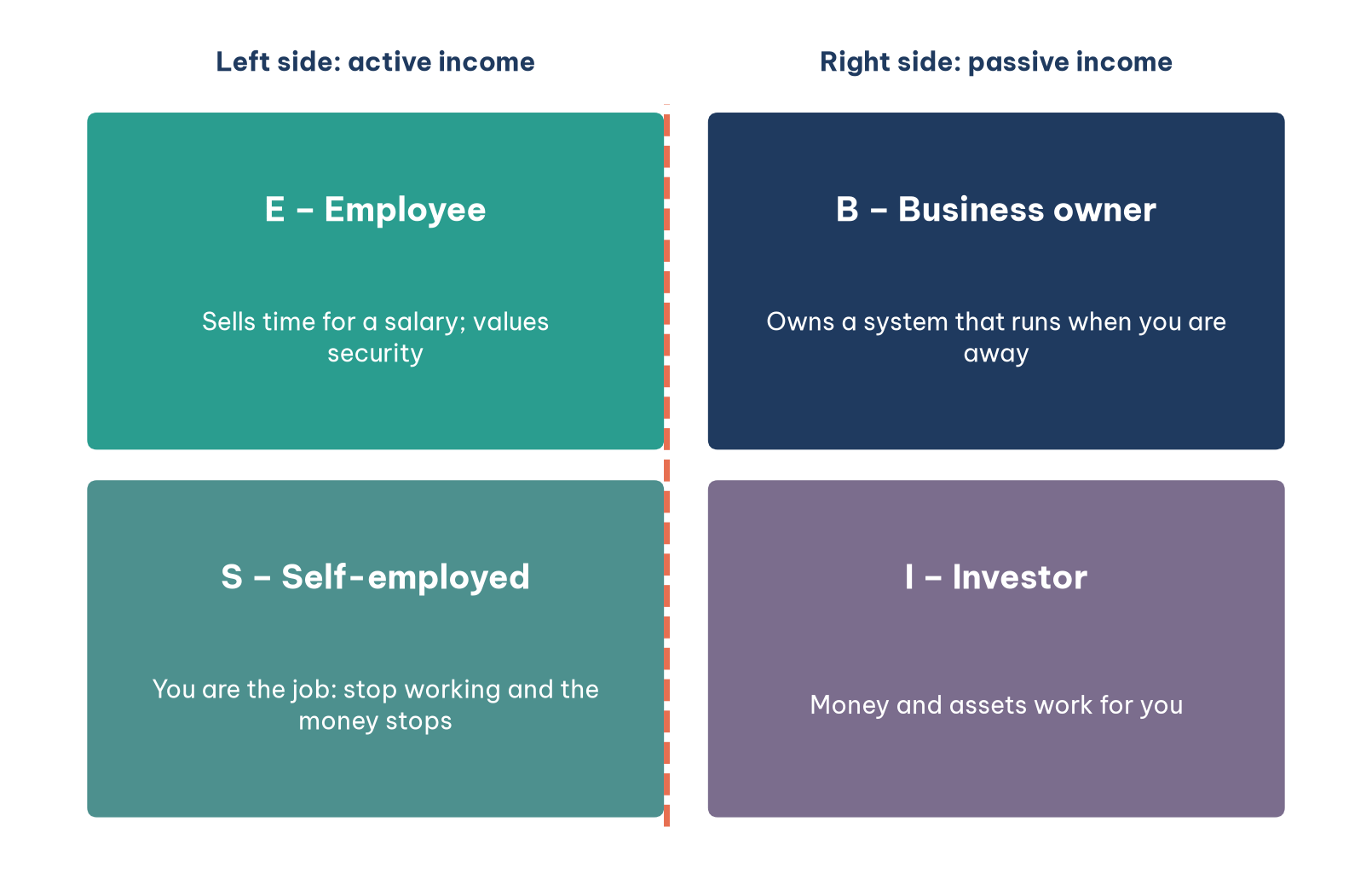
The Cashflow Quadrant divides every way of earning money into four groups, labelled with the letters E–S–B–I (Kiyosaki, 2000). Table 1 summarises them.
More concretely: an employee (E) has a job and earns a salary. A self-employed person (S) might be a doctor with a private practice, a freelance designer or a shop owner who serves behind the counter; they earn more than E, but when they stop working the money stops. A business owner (B) is someone who has built, say, a restaurant chain that runs without them being there every day. An investor (I) invests in shares, property and businesses and lives on the cash flow those assets produce.
The most important dividing line is not rich versus poor but the left side (E, S) versus the right side (B, I), as in Figure 1. The left side earns active income: time and labour traded directly for money. The right side earns passive income: building or owning assets that generate cash flow on their own. Kiyosaki's whole argument comes down to one piece of advice: move from left to right, because that is where "financial freedom" lives, the state in which passive income is large enough that you no longer have to work.
Alongside it comes a foundational idea from Rich Dad Poor Dad: the distinction between assets (things that put money in your pocket) and liabilities (things that take money out of it). Kiyosaki argues that the middle class grows poorer by buying liabilities they mistake for assets, while the rich grow richer by patiently accumulating cash-generating assets (Kiyosaki, 1997).
2. Why the model has real value
Before criticising, it is only fair to admit that the Cashflow Quadrant did not become popular by luck. It touches three true points.
First, it simplifies a confusing subject into a diagram anyone can redraw after five minutes. In societies where schools teach almost nothing about personal finance, having a frame to locate yourself ("Which box am I in? Where do I want to go?") is a valuable start.
Second, the distinction between active and passive income is an important truth that is often overlooked: a person on a high salary can still fall into crisis within months of losing their job, because all their income depends on continuing to work.
Third, the model changes how people think about ownership: it encourages them to ask, "How can I own a piece of the system rather than just selling my labour to it?", the question behind every serious investment or start-up decision.
In other words, if it stayed a thought-provoking frame, the Cashflow Quadrant would be a healthy contribution. The trouble is that it is rarely left there.
3. The cracks under critical reading
The quadrant's communicative strength is also its intellectual weakness. Four cracks stand out.
3.1. Simplification slides into distortion
Real finances are not as tidy as four boxes: one person can be in several at once, for example employed at a hospital (E), running an evening clinic (S), co-investing in a chain (B) and owning a flat to rent out (I). More dangerous is the moral hierarchy hidden in the model: the left side is portrayed as the home of the fearful and complacent, "stuck in the rat race", while the right side belongs to the brave, the free and the clever. This framing belittles a simple fact: most of society's wealth and welfare is created by hundreds of millions of dedicated employees and self-employed people.
3.2. Survivorship bias
The model sells readers the glamour of the B and I boxes but says almost nothing about the odds of failure. In reality, most new businesses fail within their first few years, and most amateur investors underperform the market. Showing only those who succeeded while ignoring the countless people who tried and failed is a textbook case of survivorship bias: if you only ever see lottery winners celebrating, it is easy to conclude, wrongly, that buying tickets is a smart strategy.
3.3. Inspiring but short on method
One of the most persistent criticisms is that Kiyosaki's books are rich in motivation but poor in concrete guidance. The real-estate writer John T. Reed, after dissecting Rich Dad Poor Dad, concluded that it contains a great deal of wrong, bad and even dangerous advice and almost no good advice, and pointed out that Kiyosaki published no evidence of investment success before becoming famous for selling books (Reed, n.d.). This is no small matter: a model that tells you to "move to B and I" without saying how, with how much capital, at what risk and over what time leaves a gap, and there is always someone waiting to fill that gap with an "opportunity".
3.4. The author's own credibility
Critical thinking also means looking at the source. In 2012, Kiyosaki's company Rich Global LLC filed for bankruptcy after a court ordered it to pay about USD 24 million to the partner who had helped make him famous; ironically, a man who teaches the world how to run strong businesses let his own company go bankrupt (Olen, 2016). According to journalist Helaine Olen's investigation in Slate, the "Rich Dad" seminars reportedly brought in about USD 45 million in royalties between 2007 and 2010, while the company declared only USD 1.8 million in assets when it went bankrupt; many "free" seminars were in fact designed to upsell courses costing thousands of dollars (Olen, 2016). Even the "rich dad" himself, the heart of the brand, is considered fictional by many critics, and Kiyosaki later added a note on the copyright page of another book that some events had been fictionalised for educational purposes (Reed, n.d.).
To be fair, an argument is not automatically wrong because the person making it has flaws, and many readers say the book woke them up to money. But when a message is presented as the truth handed down by "someone who is really rich", gaps in credibility and evidence should lower our confidence and push us to check for ourselves.
4. How the Cashflow Quadrant gets twisted
This is the part young people most need to read carefully, because it is where a thinking tool becomes a tool of manipulation. The bridge between the Cashflow Quadrant and multi-level marketing was not invented by its victims; Kiyosaki built it himself. In The Business of the 21st Century, he openly champions network marketing as the ideal route for moving from E and S to B with little capital (Kiyosaki et al., 2010). Critics like to point out an irony: in that very book praising MLM, Kiyosaki admits he has never personally built a network-marketing business. Someone who confidently recommends a road they have never travelled is a reason for caution, not trust.
From there, the twisted versions deploy four familiar tactics.
4.1. Tactic one: swap the concept, turning "employee" into "slave"
They sow fear and contempt towards employees: "You go to university only to work for someone else to get rich," "Being an employee is selling cheap labour," "Do you really want to commute to the same desk for the rest of your life?" The aim is to make students feel that studying and building a professional career is pointless, so that they long to escape group E immediately, even without experience, capital or skills.
4.2. Tactic two: the illusion of leaping from nothing to B and I
Naturally, people need to build up capital and knowledge in E and S before they can move to B and I. MLM paints a shortcut: "Just join our system and you'll leap to Business owner and Investor without big capital or experience." The harsh truth: you do not become a business owner. In MLM you are in effect a salesperson without a base salary, exactly like group S (you eat what you kill, and stop working means going hungry), but you are filled with the illusion that you are an entrepreneur.
4.3. Tactic three: deify "passive income"
They borrow the quadrant's lofty destination as bait: "Money comes in while you sleep," "Build the system once, enjoy it for life." This goes straight for greed and the wish for a shortcut: young people often do not yet want to work hard but long for the results of someone who has worked for twenty years. Data from three independent sources demolish this promise, as Table 2 shows.
Three numbers from three different methods all point the same way. Ironically, if you apply the quadrant's real spirit, you should stay away from MLM: for most members it is not a cash-generating asset but a liability dressed up as an opportunity.
4.4. Tactic four: isolate the mind, "only poor people think like that"
When you push back or your family objects, they use the quadrant itself to silence you: "Your parents are employees, so they have a poor mindset; they can't understand the billionaire mindset of investors." The aim is to cut you off from sober advice and lock you in the organisation's echo chamber. This is the clearest sign of manipulation. In the Vietnamese investigation cited above, students were bombarded with messages and calls and made to memorise one instruction: don't tell your family, friends or teachers what you are doing here (Trần Duy Khánh, 2023). A legitimate organisation never needs you to hide things from the people who love you.
5. Aulet's engine: why S gets stuck and B is set free
Tactics like these thrive in the gap the model leaves. Filling that gap requires better tools, and the first comes from MIT. Kiyosaki defines S as someone who "owns a job", but his border with B is blurry. Is someone who runs three noodle shops a B? Kiyosaki would say "possibly". Bill Aulet would say not really: that is an SME (small and medium enterprise), and the economics of SMEs pull the owner firmly back into S (Aulet, 2013; Aulet & Murray, 2013).
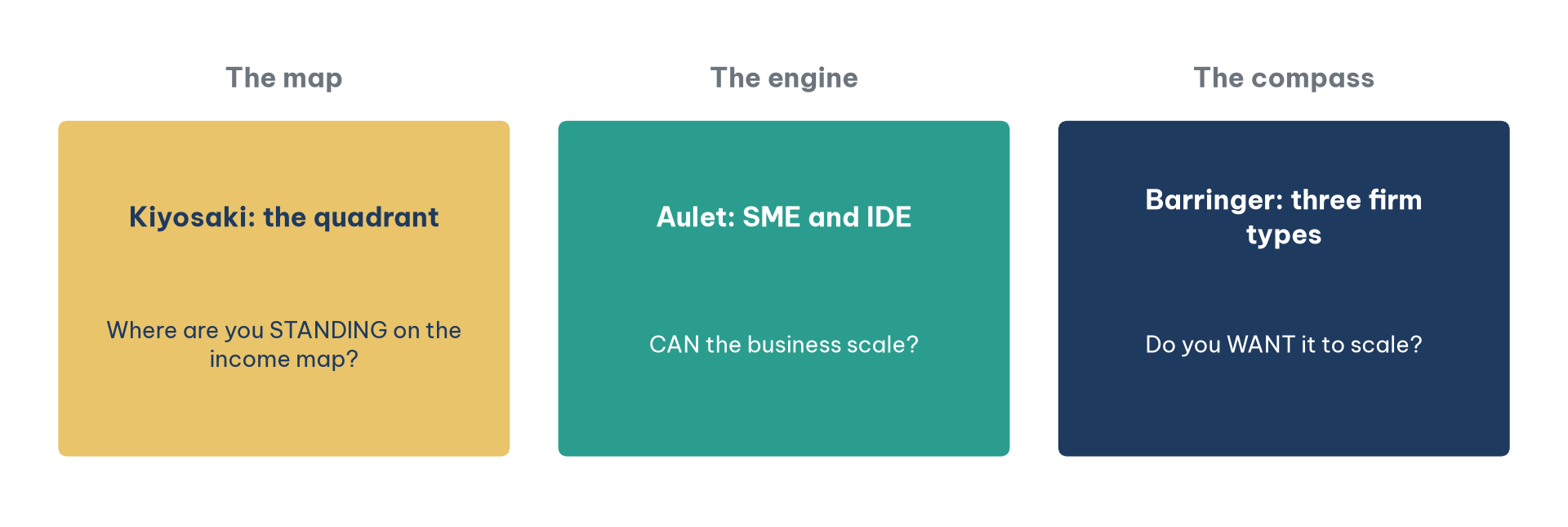
Figure 2 shows how the three frameworks used in the rest of this article fit together. The Cashflow Quadrant tells you where you stand on the income map. Disciplined Entrepreneurship by Bill Aulet, with its pair of concepts SME and IDE, tells you whether a business can scale: the engine. Barringer and Ireland's three firm types tell you whether you want it to scale: the intent.
The reason S gets stuck lies in the shape of growth. An SME serves a local market, and to double revenue the owner has to open more shops, hire twice the staff and invest twice the capital. Because costs rise almost in proportion to revenue, this is linear growth, and margins rarely break through. More importantly, the system runs on people rather than on technology or self-running processes, so the owner becomes the bottleneck: to manage three noodle shops, you have to be there. A classic example is the dental-practice trap: a dentist opens a clinic, hires two nurses and a receptionist, and thinks he has become a B. But patients come for his skill; he cannot treat ten thousand patients because of the physical limits of his own body. He stays in S forever: money, but no time. Put simply, an SME is often a business-shaped shell around an S mindset.
By contrast, an IDE (innovation-driven enterprise) is a machine designed to escape that pull. Its core feature is an innovation advantage, in technology, process or business model, that makes the marginal cost of serving one more customer approach zero (Aulet, 2013). Figure 3 illustrates the difference in cost shape between the two kinds of business.
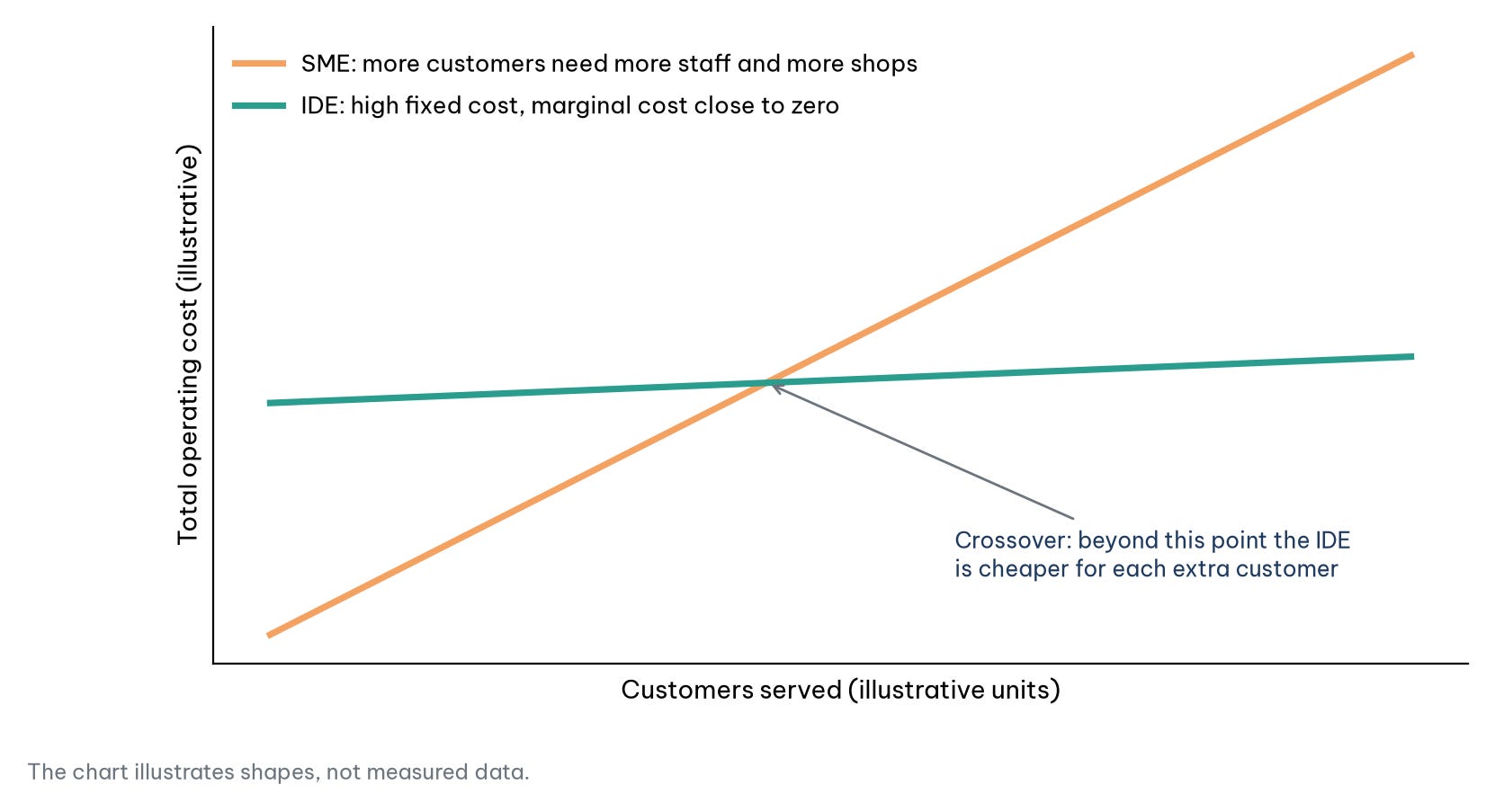
Once software like Zoom or Slack has been written, adding one more user or a million more does not require working a million times harder. This decoupling of revenue from labour is the precise definition of group B, and it is exactly the "system" Kiyosaki talks about but never defines. A system, in Aulet's language, is an innovation advantage that lets revenue multiply while the owner's labour does not have to. Only a model like that lets a founder leave the business for a year and still see revenue grow, because technology or a platform is doing the work. The difference is clearest when a traditional taxi company is set beside a ride-hailing platform, as in Table 3.
This is Aulet's great contribution: he supplies the engine where the map only draws the destination.
6. Barringer's compass: intent, not size
Stopping at Aulet risks a cold conclusion: only IDEs matter and everything else is failure. This is where Barringer and Ireland's framework becomes sharp, because it moves the axis of classification from size to intent. In their textbook Entrepreneurship: Successfully Launching New Ventures, they divide new firms into three types according to the founder's purpose, summarised in Table 4 (Barringer & Ireland, 2019).
Laid over the quadrant, the picture becomes clear: the first two types sit mostly in S, while the entrepreneurial firm is the route towards B. But Barringer's real value is that the framework removes the prejudice Kiyosaki built in. Kiyosaki treats staying in S as a shameful failure. Barringer shows it is often a deliberate choice. A lifestyle firm its owner loves is not "a failed B"; it is a successful lifestyle firm, optimised for autonomy, meaning and time rather than size. Salary-substitute firms are the backbone of every economy and the overwhelming majority of businesses. Entrepreneurial firms create most new jobs and innovation, but choosing one is a choice of intent, not a measure of human worth.
Combining the two academic frameworks gives a powerful principle. Aulet asks: can this business scale? (a question of economics and mechanism). Barringer asks: do you want it to scale? (a question of intent and purpose). The biggest mistake, and the psychological trap that Kiyosaki and then the MLM world exploit, is to measure a lifestyle firm with an entrepreneurial firm's ruler and then shame people for a perfectly reasonable choice. Before asking "how do I scale?", a young person should be allowed to ask, "do I really want to scale?" Skipping the question of intent to rush into the question of mechanism is the fastest way to build the wrong business for your own life.
7. Beyond either–or: a spectrum of vehicles and leverage
Aulet's split into SME and IDE is a good tool for macro-level strategy for students and policymakers; as an MIT professor, he needs that clarity. In practice, though, the road from S to B has more than two kinds of "vehicle". If the quadrant is the map and SME and IDE are two cars, there are other vehicles for crossing the "desert" from S to B.
What helps see through this variety is a question about mechanism: the essence of moving from S to B is decoupling income from personal presence, and every legitimate vehicle is a way of stacking leverage. Naval Ravikant names four kinds of business leverage: labour, capital, code and media, of which code and media are "permissionless leverage", because you can write software or publish content without anyone's permission, and they replicate almost for free (Jorgenson, 2020). The five most common border-crossing routes, arranged from low to high leverage in Figure 4, are in effect five different combinations of that toolkit.
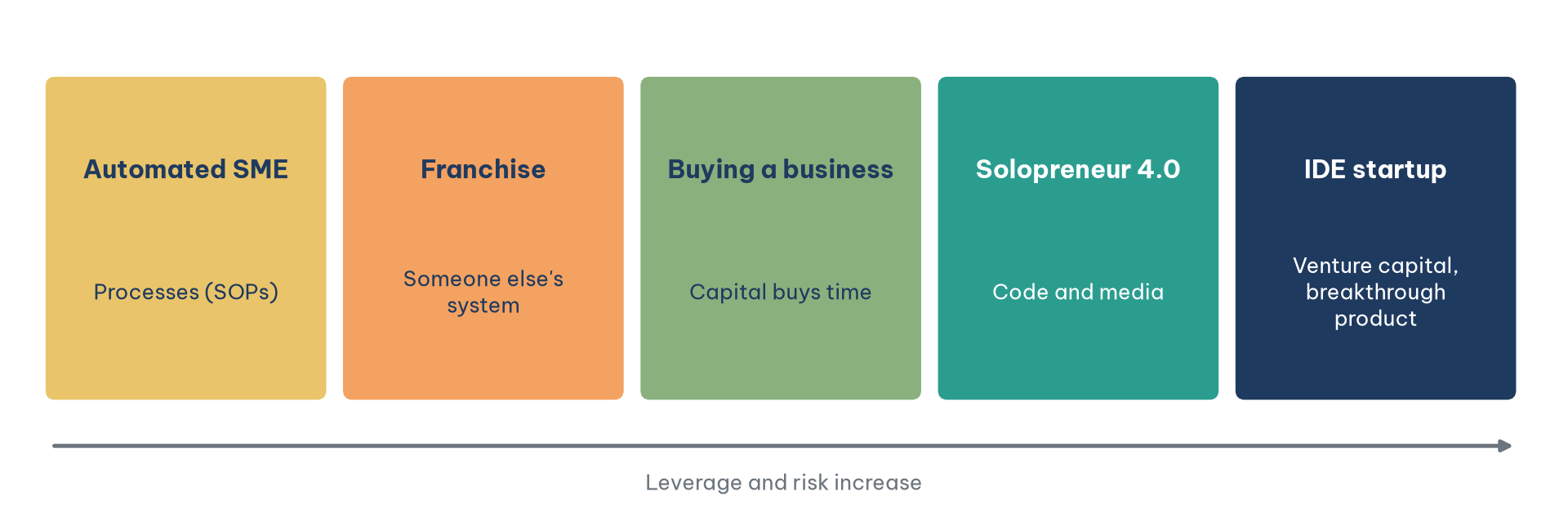
First, the automated SME. You still open a café, but instead of standing at the counter you spend the first two years writing detailed standard operating procedures (SOPs) for each role, installing remote-management software and hiring a trustworthy store manager. The main lever is process replacing your presence. Full automation is hard, but a "semi-automated" state is the most common stepping stone from S to B.
Second, franchising. Instead of building a brand and processes from scratch, which is risky and easily leaves you stuck in S, you buy a proven system. The main lever is someone else's system. Kiyosaki calls this "a B business for people who can't build their own system"; you can enter B, provided you hire someone to run it rather than serving customers yourself.
Third, acquisition entrepreneurship (also known as the search fund). This is a growing interest at business schools such as Harvard and Stanford, quite different from starting from zero. Instead of taking on start-up risk, you use capital (your own, raised or borrowed) to buy a business that is already running well, with stable cash flow and staff, then take the executive chair to optimise it. The main lever is capital buying time: you skip the hard S stage and land straight in the B seat.
Fourth, the "solopreneur 4.0". This model upends the traditional definition of B. A developer builds a software-as-a-service (SaaS) product, uses AI to write marketing content and bots to handle customer service. The main levers are code and media, exactly the permissionless kind. The paradox: in headcount they look like S (just one person), but in cash flow and freedom they are close to B and I.
Fifth, the IDE start-up. As discussed, this is the route of the tech start-up that raises capital to win market share and grow exponentially. The main levers are venture capital and a breakthrough product, aiming for a listing or a large exit.
Table 5 compares the five vehicles on leverage, risk and freedom.
The lesson of Table 5 is that SME and IDE are just the names at the two ends of a spectrum. In between is a whole fleet to choose from according to your strengths: capital, expertise or management skill.
8. A four-stage roadmap and one unifying test
Putting the frameworks together gives a complete roadmap for anyone considering starting a business, as in Figure 5.
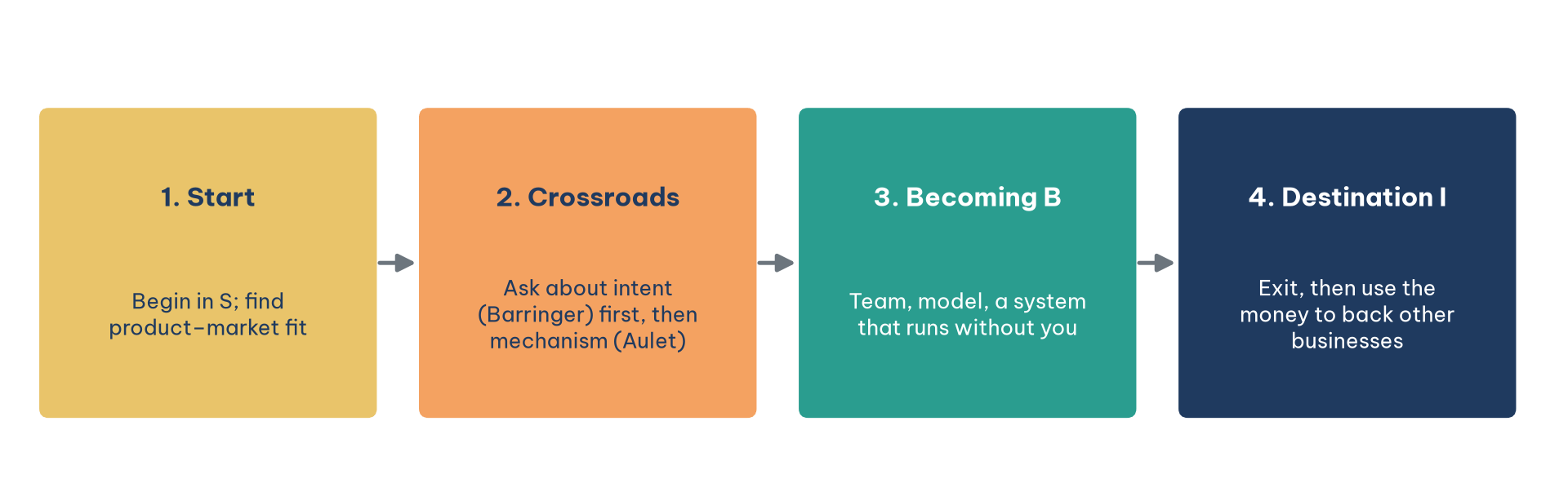
Stage one: start. Almost everyone begins in S; even the founder of a big tech start-up writes the first lines of code. The job here is to find product–market fit. The trap: if you unknowingly choose a salary-substitute model, for instance opening a bakery just to replace a salary, you will stay here for good, with income but without freedom.
Stage two: the crossroads. This is the decisive point, and where Barringer must come before Aulet. The first question is about intent: which kind of business do you want, a lifestyle firm to live well, a salary-substitute firm for income independence, or an entrepreneurial firm to create value and scale? Only if you choose the entrepreneurial route does Aulet's question become urgent: does this business have a mechanism to scale, an innovation advantage that keeps marginal cost low, or does it run on labour alone?
Stage three: becoming B. If you have chosen to scale, you start using "other people's money" and "other people's time". This is where Aulet's steps on building a team and designing a business model help you build what Kiyosaki calls a "system". When the system runs smoothly without you intervening in every detail, you have set foot in B.
Stage four: destination I. An entrepreneurial firm of the IDE kind is highly liquid: it can be sold or listed, because its value lies in the system rather than the owner. When the founder exits, they receive a large sum and move into I, using that money to back other businesses. By contrast, salary-substitute firms and many lifestyle firms are hard to sell, or sell cheaply, because they depend on the owner; and for a lifestyle firm whose owner never meant to sell, that is perfectly fine.
The whole theory can be compressed into one question, asked right at the S–B border of the map:
"If I disappeared tomorrow, would this system, whether a noodle shop, a piece of software or a company I just bought, keep pumping money into my account?"
If the answer is yes, you have moved to B, whatever vehicle you took. And if the answer is no because you deliberately chose a lifestyle firm to gain time and autonomy, that is not failure either; you are simply playing a different game, on purpose. Maturity means knowing which game you are playing.
This leads to an important change of destination, especially when learning and teaching innovation-driven entrepreneurship. The quadrant makes "passive income" and "financial freedom" the ultimate goal. But if we adopt Barringer and Ireland's (2019) view that the essence of entrepreneurship is creating value and spreading it, the destination should be rewritten as new value, plus scalability, plus impact. B and I then become a possible consequence of building a successful innovative business, not the motive.
This is more than a change of words; it patches the hole that MLM exploits. The two pieces that get-rich-quick and twisted MLM schemes use are precisely the two defects of the original map: the gap in method and the contempt for S. They fill the gap with a fake shortcut ("join our system and you're in B straight away"), and they use the contempt to shame students out of employment or out of small but healthy choices. The two academic frameworks are the vaccine. Seen through Aulet, joining an MLM does not give members an innovation advantage with low marginal cost; it is not an IDE, and for most participants it does not even decouple income from personal effort. Seen through Barringer, it is not a healthy salary-substitute or lifestyle firm either, when revenue comes mainly from recruiting new members rather than from value sold to end consumers.
9. A mental filter so you are not led by the nose
Critical thinking is not doubting everything; it is asking the right question at the right moment. Here are six "antibodies".
9.1. Understand the real value of being an employee
Don't be ashamed of working for someone else: it is the best place to learn with other people's money. A job pays you to learn skills and processes and to build relationships. More importantly, without stable cash flow from E, how will you support yourself, and where will the capital come from to move into I one day? The right mindset is: "I work to build capital and knowledge for the future," not "Employees are slaves."
9.2. Tell a real "system" from a fake one
A real business owner owns the processes, the product and the brand, and has the authority to hire and let staff go. In an MLM posing as group B, you do not own the parent company's brand, you do not set product prices, and your distributor ID can be cut at any time. You are the weakest link in the chain, not the boss.
9.3. Ask the key questions
The most important question can be summed up in Figure 6: where does your money really come from?
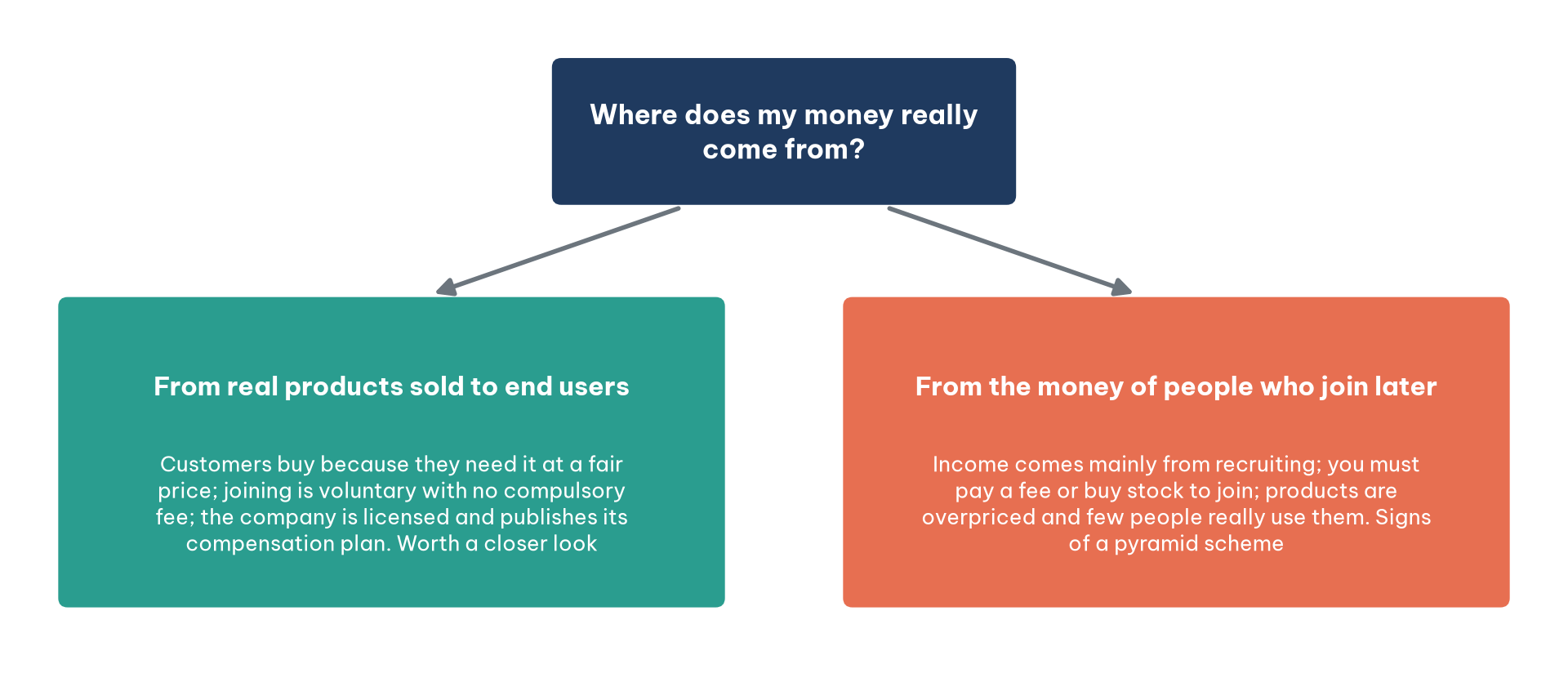
When someone pitches a "super-profitable" project, calmly ask three questions:
"Where does the cash flow actually come from?" Is the money paid to me earned by selling products of real value to end consumers, or taken from later recruits to pay earlier ones? If products are overpriced and almost no one buys them to use, that is a sign of fraud.
"Show me the company's licence to operate as a direct-selling or multi-level business and its financial statements." In most countries such firms must register with a regulator; in Vietnam, for example, the licence is issued by the Ministry of Industry and Trade (Government of Vietnam, 2018). If the answer is "we don't have one" or evasive, walk away.
"If this opportunity is so good, why are you inviting me, a stranger, instead of your own family?" If there really were 30% profit a month, people would mortgage their homes to do it themselves; it would never reach a student.
9.4. Remember: there is no free lunch
To truly be in group I you need one of two things: very deep knowledge or very large capital. Students usually have neither yet. So anyone inviting a student to "invest" to get rich fast deserves the highest level of suspicion. Remember a simple rule: people often invite students to work (sell their labour), but rarely to invest (sell their capital), because students have no capital to sell.
9.5. Separate legal direct selling from twisted MLM
To be fair, two things that are often lumped together need to be separated, as in Table 6.
In other words, the problem is not the words "multi-level" but this: does your money come from real value sold to customers, or from the pockets of people recruited after you? Even with legal MLM, the data in Table 2 show that most participants make no profit.
9.6. Slow down and widen your sources
Every financial scam needs you to decide quickly and in isolation. So your strongest weapon is very simple: wait 48 hours and tell at least one trusted outsider. Be especially suspicious of any "opportunity" that asks you not to do exactly that.
Conclusion: a map for a lifetime, not for one summer
The Cashflow Quadrant is not wrong. It is a thought-provoking map of income sources and of the value of owning assets. But it is a map for a journey of twenty or thirty years, not for one summer holiday. The distance between "understanding the E–S–B–I diagram" and "actually building a business or an investment portfolio" is filled with expertise, discipline, capital, time and a good deal of luck, not with a weekend course or a "silver investment package".
The three lenses have separate, complementary roles. The Cashflow Quadrant is an intuitive entry point for thinking about income and ownership. Aulet is the engine, explaining how scaling works and what a real "system" is. Barringer is the compass of intent, so young people need not be ashamed of legitimate paths or swept along by a single definition of success. And Naval's leverage toolkit shows that there are many vehicles for crossing the desert. In one sentence: the quadrant draws the destination of B's freedom, Aulet supplies an engine strong enough to escape the pull of S, and Barringer reminds us, before we hit the accelerator, to ask where we really want to go.
At student age, your greatest assets are not money but time and intellect. The wisest investment now is in your own mind, learning real skills that will stay with you for life, such as languages, technology, marketing and sales, rather than pouring money (and your education) into dreams painted by someone else. Young people need not fear money or entrepreneurship; what they need is an attitude that is both open and clear-headed: ready to learn, but always demanding evidence and always keeping the right to say "no" to anyone who wants them to decide in a hurry and in the dark.
If you remember only one line from this article, let it be the question that has saved many people: "Where does my money really come from?" A genuine opportunity always has a clear answer. A trap does not.
Note: this article is a piece of financial education and analysis, not personal investment or legal advice. Before any important financial decision, do your own due diligence and consult a qualified professional.
References
AARP Foundation. (2018, October 9). New survey reveals 73 percent of people who participate in network marketing opportunities lose money or make no money. PR Newswire. https://www.prnewswire.com/news-releases/new-survey-reveals-73-percent-of-people-who-participate-in-network-marketing-opportunities-lose-money-or-make-no-money-300727716.html
Aulet, B. (2013). Disciplined entrepreneurship: 24 steps to a successful startup. Wiley. https://www.wiley.com/en-gb/Disciplined+Entrepreneurship%3A+24+Steps+to+a+Successful+Startup-p-9781118720813
Aulet, B., & Murray, F. (2013). A tale of two entrepreneurs: Understanding differences in the types of entrepreneurship in the economy. Ewing Marion Kauffman Foundation. https://www.kauffman.org/entrepreneurship/reports/a-tale-of-two-entrepreneurs/
Barringer, B. R., & Ireland, R. D. (2019). Entrepreneurship: Successfully launching new ventures (6th ed.). Pearson. https://www.pearson.com/en-us/subject-catalog/p/Barringer-Entrepreneurship-Successfully-Launching-New-Ventures-6th-Edition/P200000005825/9780136878681
Federal Trade Commission. (2024, September 18). FTC staff report analyzes 70 MLM income disclosure statements. https://www.ftc.gov/business-guidance/blog/2024/09/ftc-staff-report-analyzes-70-mlm-income-disclosure-statements
Government of Vietnam. (2018). Nghị định số 40/2018/NĐ-CP về quản lý hoạt động kinh doanh theo phương thức đa cấp [Decree No. 40/2018/ND-CP on the management of multi-level business activities]. https://moit.gov.vn/van-ban-phap-luat/van-ban-phap-quy/-nghi-dinh-ve-quan-ly-hoat-dong-kinh-doanh-theo-phuong-thuc-.html
Jorgenson, E. (2020). The almanack of Naval Ravikant: A guide to wealth and happiness. Magrathea Publishing. https://www.amazon.com/s?k=The+almanack+of+Naval+Ravikant+Jorgenson&i=stripbooks
Kiyosaki, R. T. (1997). Rich dad poor dad: What the rich teach their kids about money that the poor and middle class do not! Warner Books. https://www.amazon.com/s?k=Rich+dad+poor+dad+Kiyosaki&i=stripbooks
Kiyosaki, R. T. (2000). Rich dad's cashflow quadrant: Rich dad's guide to financial freedom. Warner Books. https://www.amazon.com/s?k=Rich+dad%27s+cashflow+quadrant+Kiyosaki&i=stripbooks
Kiyosaki, R. T., Kiyosaki, K., & Fleming, J. (2010). The business of the 21st century. Plata Publishing. https://www.amazon.com/s?k=The+business+of+the+21st+century+Kiyosaki&i=stripbooks
Olen, H. (2016, February 11). This legal dispute says everything about the shadiness of personal finance gurus. Slate. https://slate.com/business/2016/02/robert-kiyosaki-s-ongoing-legal-dispute-says-everything-about-the-shadiness-of-personal-finance-gurus.html
Reed, J. T. (n.d.). John T. Reed's analysis of Robert T. Kiyosaki's book Rich dad, poor dad. https://johntreed.com/blogs/john-t-reed-s-real-estate-investment-blog/61651011-john-t-reeds-analysis-of-robert-t-kiyosakis-book-rich-dad-poor-dad-part-1
Taylor, J. M. (2011). The case (for and) against multi-level marketing. Federal Trade Commission. https://www.ftc.gov/sites/default/files/documents/public_comments/trade-regulation-rule-disclosure-requirements-and-prohibitions-concerning-business-opportunities-ftc.r511993-00008%C2%A0/00008-57281.pdf
Trần Duy Khánh. (2023, May 8). Đa cấp "giăng bẫy" sinh viên [Multi-level marketing "sets traps" for students]. Thanh Niên. https://thanhnien.vn/da-cap-giang-bay-sinh-vien-185230508003950798.htm
Discussion about this post