Business Models in the AI Era: How AI Amplifies Every Pattern
AI amplifies every existing business model pattern rather than adding a new pillar, so advantage shifts to how firms combine them


Key takeaways
When every firm can call the same AI models through the same interfaces, "using AI" stops being a difference. It becomes a baseline, much as having a website did twenty years ago.
AI does not add a new building block to the business model. It amplifies all four parts at once: the value, experience, operating and profit models.
The "new" ways of charging in the AI era (pay per token, outcome-based pricing, digital-worker subscriptions, data licensing) are descendants of old patterns, recombined.
When the buyer is an AI agent, products must be readable by machines, and emotional marketing loses part of its power, while trust moves up a level to the choice of agent.
Advantage moves to what AI cannot flatten: proprietary data tied to a learning loop, direct customer relationships, a keystone you own and the human skill of arranging patterns into a system that is hard to copy.
Across the world, the same conversation is taking place in boardrooms and founders' chats: "What is our AI strategy?" The question sounds urgent, but it is slowly losing its meaning. The most capable AI models are now available to almost anyone through the same application programming interfaces (APIs), at prices that keep falling. A two-person startup and a global corporation can call the same model on the same afternoon. Asking whether a business "uses AI" is becoming like asking, twenty years ago, whether it had a website: necessary, but not a source of difference.
Three forces are reshaping business models at the same time. The first is artificial intelligence. The second is the deepening platform economy, where network effects pull value into ecosystems. The third is sustainability, which is turning from a slogan into a design constraint. Each force touches all four parts of a business model as this article uses the term: the value model (what is promised, and to whom), the experience model (how customers meet and feel the business), the operating model (the machine behind the promise) and the profit model (how value comes back as money).
The argument of this article is simple. The more powerful and the more widely available a tool becomes, the less advantage lies in owning the tool and the more it lies in how a company arranges business model patterns into a combination that is hard to copy. AI is not a new pillar to add to the model. It is an amplifier that makes every existing pattern cheaper, faster, more personal and more automated.
Section 1 shows how AI amplifies the four models. Section 2 reads the new ways of charging that AI has produced as descendants of older patterns. Section 3 asks what happens when the customer is an AI agent. Section 4 discusses the platform economy and sustainability. Section 5 introduces six zones that AI opens for business model innovation. Section 6 names three traps for the coming decade and asks what remains for people to do.
1. AI as an amplifier
This section replaces a common but misleading view of AI with a more useful one.
The misleading view treats AI as a new pattern to be added to the catalog, one more box on the business model canvas. The more useful view treats AI as an amplifier that turns up the volume of all four models at once. Figure 1 summarizes how AI amplifies each of them.
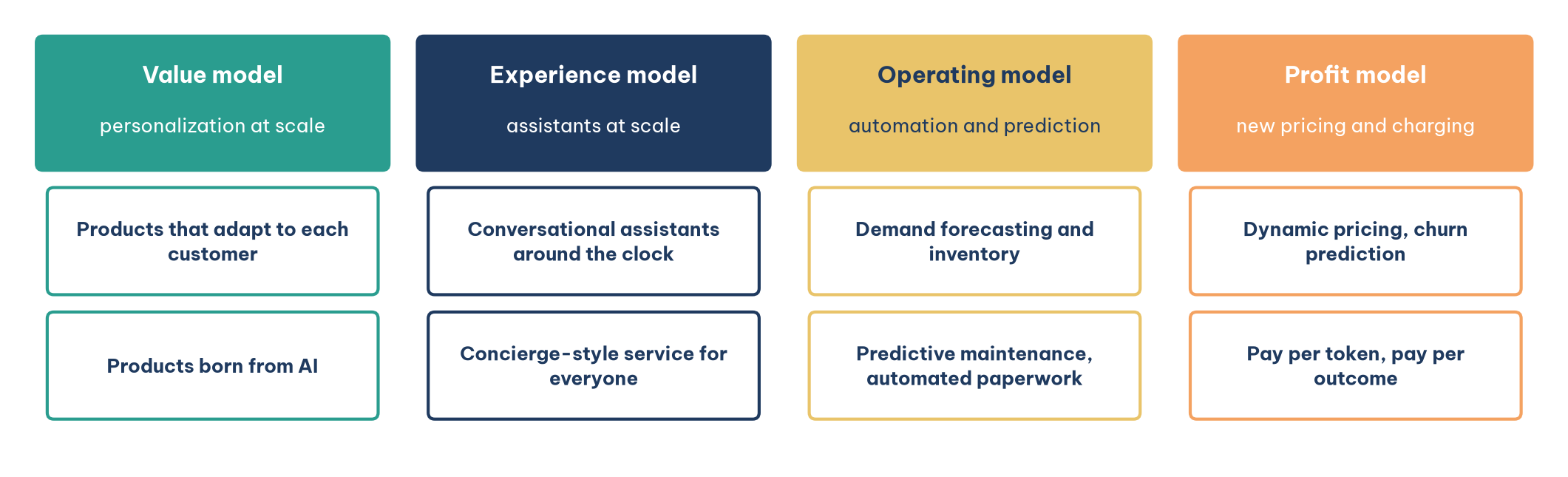
In the value model of Figure 1, AI removes an old trade-off between "tailored for one person" and "mass-produced for a million". Products and content can now adjust to each customer at almost no extra cost. For the same subscription fee, every person who opens a music or video streaming app sees a different service, cut to measure from data. A new layer of value has also appeared: products in which intelligence itself is what is sold, such as conversational assistants, creative tools and software that adapts to its user.
In the experience model, AI makes "attentive service for everyone" possible without a huge staff. A conversational assistant can serve each customer day and night in the customer's own language, and a spoken request can replace a confusing menu. Concierge-style service, once reserved for important clients, can reach the mass market.
In the operating model, AI is the leading edge of automation and prediction. Inventory adjusts itself to demand forecasts, machines are repaired before they break down and paperwork is processed from end to end without a human touching it. Capabilities that once belonged only to large corporations are becoming affordable for small and medium-sized firms.
In the profit model, AI brings dynamic pricing into real time, predicts which customers are about to cancel and gives rise to new ways of charging that Section 2 examines. AI is both a gift and a blade here. The same capacity to personalize can serve customers better or manipulate them more subtly, so it demands limits grounded in ethics, privacy and fairness.
2. Ways of charging born from AI
This section shows that even the newest revenue models of the AI era are recombinations of old patterns.
Gassmann et al. (2020) argue that most business model innovation does not invent something from nothing. It borrows patterns that already work in other industries, such as subscription, freemium, pay per use or licensing, and recombines them in a new setting. The ways of charging that AI has produced fit this view closely. Table 1 traces four of them back to their parent patterns.
Table 1 leads to a practical lesson. Even models that look "brand new in the AI era" are recombinations. A manager who knows the catalog of old patterns well will read a new model faster than one who only follows the news. The real question is the next one: once these patterns become standard practice for everyone, where does advantage remain?
The last row of Table 1 deserves a closer look, because it poses a strategic choice for every company that holds data of its own. The company can rent the data out, keep it as a moat or use it to train its own advantage. Renting brings cash now but may feed a competitor. Keeping it as a moat makes sense only when the data are truly exclusive and tied to a loop that improves the product. The second half of this choice returns in Section 6 as a trap.
3. When the customer is an AI agent
This section examines a deeper shift: AI agents that buy and transact on behalf of people.
When an AI assistant compares prices, places orders and renews services for its user, the question "who controls the door to the customer?" is rewritten. That door may no longer be a person scrolling on a phone. It may be an algorithm choosing according to its own criteria. Table 2 traces the impact on the four models.
Table 2 shows that many familiar patterns are turned upside down. Emotional marketing and eye-catching packaging matter less to an agent that only reads data, while the ability to be read and chosen by machines becomes a new front of competition. Brands are not dead, however. They may move up one level: people choose which agent to trust and instruct that agent to favor the brands they already trust. The fight for attention shifts from the shelf to the instructions a person gives an agent.
4. Deeper platforms and sustainability as a constraint
The two remaining forces are not new, but both are growing stronger. This section discusses each and how it interacts with AI.
4.1. The platform economy
Network effects and "winner takes most" dynamics keep pulling value toward ecosystems. They push almost every business into one of two roles: become a platform, or become a smart player on someone else's platform (Parker et al., 2016). What is new in the coming decade is that a second kind of network effect now sits beside the classic one, in which more users make a service more valuable to each user. This second kind is the data network effect. Every use makes a platform's AI a little smarter, the better product attracts more users and more data, and the result is a learning flywheel that latecomers find very hard to catch.
For most small and medium-sized firms, the realistic path is not to build a giant platform but to ride existing platforms strategically. They sell on marketplaces, serve customers through super apps and appear on live-commerce channels, but they avoid losing their direct relationship with customers and their customer data. The platform supplies reach; the firm must still own something the platform cannot take away.
4.2. Sustainability
Pressure from regulators, investors and consumers is turning emissions and waste into real costs, and it is turning "green" into a part of the value proposition that some customers are willing to pay more for. Researchers call this direction sustainable business model innovation: redesigning how value is created, delivered and captured around environmental and social constraints, rather than putting a green label on an old model (Geissdoerfer et al., 2018). Bocken et al. (2014) collected the recurring solutions into archetypes, from maximizing material and energy efficiency to delivering functionality rather than ownership. Figure 2 arranges these ideas into three levels of increasing depth.
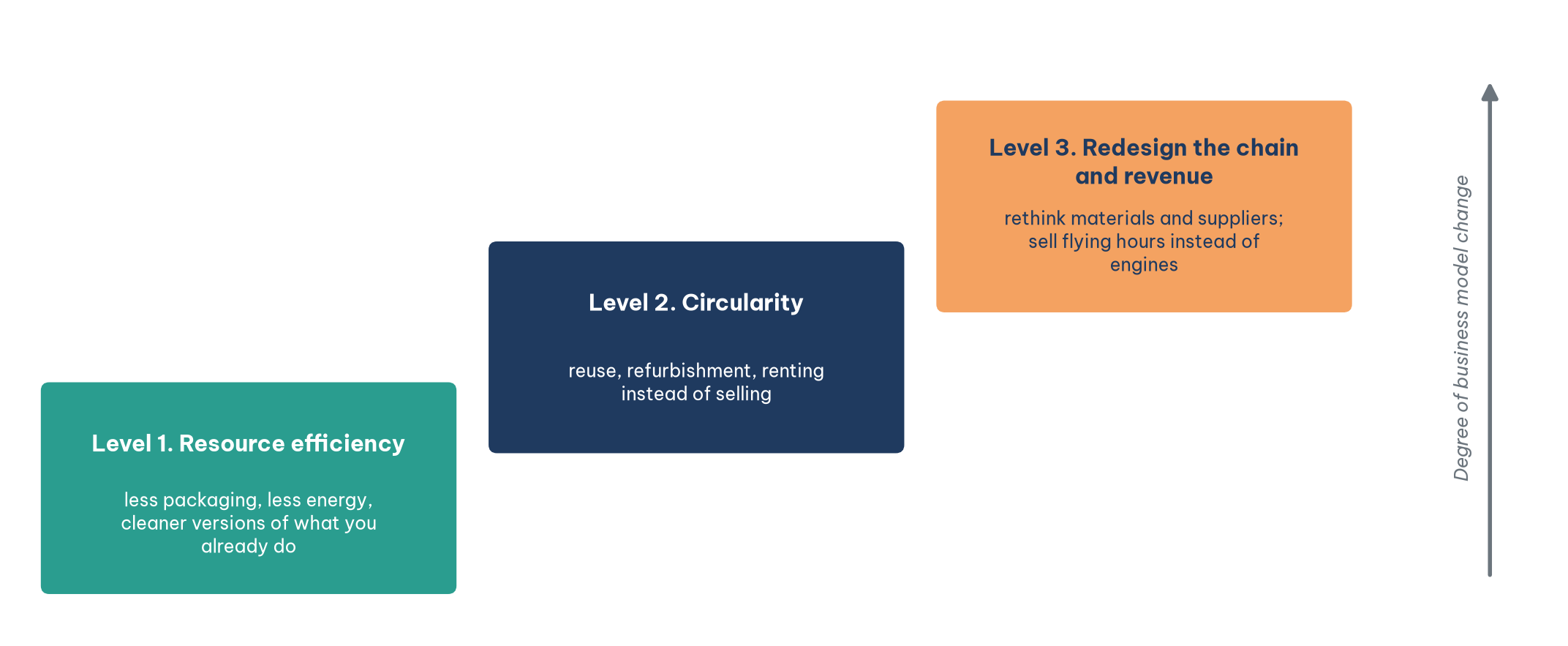
The lowest level in Figure 2 is resource efficiency: less packaging, less energy, cleaner versions of what the firm already does. The middle level is circularity: reuse, refurbishment and renting instead of selling outright. Patagonia, for example, takes back its own used clothing to repair and resell it. The highest level redesigns the whole value chain and the revenue architecture. When Rolls-Royce sells engine "flying hours" instead of engines, it gains a natural economic reason to make engines last longer and fail less: the right revenue architecture can itself act as an environmental policy. Read correctly, a constraint becomes an advantage. Early movers turn what is a compliance cost for others into part of their own value proposition.
AI touches all three levels. It cuts waste through better forecasting at the first level, tracks the condition and location of products at the second and makes usage-based contracts measurable at the third. In this sense, AI and sustainability are less two separate forces than one force multiplying the other.
5. Six zones that AI opens
This section steps back and asks a broader question: which zones does AI open for business model innovation?
Dawson (2024) proposes a map of the ways AI reshapes business models and value creation. Six of its zones are useful as a lens. They do not replace the four models used in this article; they cut across them, like six spotlights shining on the same building from six sides. Table 3 presents the six zones and the building blocks each one mostly touches.
The six zones in Table 3 are worth using as a checklist. When reviewing an innovation opportunity, a team can walk through each zone and ask what AI opens for the business in that zone. Most firms see only the first zone, efficiency, and ignore the other five, where more durable advantage usually lies. Even within the efficiency zone, the gain is often misunderstood. One employee using AI can do the work of several people not because AI replaces the others, but because it removes the tedious part of the work so that person can concentrate on what only a human can do.
6. Three traps and what remains for people
Every wave has its undertow. This section names three traps of the coming decade, each with a question for self-assessment, and ends with the work that stays human.
The third trap in Table 4 is the AI-era version of an old lesson. A music streaming service whose key resource, the catalog, is licensed from record labels has learned that when the keystone belongs to a supplier, the supplier largely decides the margins. The same risk is sharper for firms built on AI services whose prices could rise once providers stop subsidizing them to win market share. Riding a platform to grow fast is reasonable, but in parallel a firm needs to build what is its own: direct relationships, proprietary data, a brand and at least one keystone that no one can pull out.
So what remains for people? AI can play the notes: write content, optimize prices, automate processes and personalize experiences. But writing the score, that is, choosing which pattern fits with which, deciding which keystone is worth protecting and judging whether a combination suits this market at this moment, is still human work. Three capabilities will grow more valuable as machines grow more capable. The first is judgment: choosing the right problem and reading the context correctly. The second is taste and trustworthiness, the qualities that make customers love a product rather than merely use it. The third is the ability to combine patterns into a system.
Conclusion
AI, the platform economy and sustainability are reshaping all four models of the business model at once. AI is not a new pillar but an amplifier: personalization at scale in the value model; assistants at scale in the experience model; automation and prediction in the operating model; dynamic pricing and new ways of charging in the profit model. Those "new" ways of charging are descendants of old patterns, and when the customer is an AI agent, the product must be readable by machines.
As tools become more powerful and more equally available, advantage shifts to what AI cannot flatten: proprietary data tied to a learning loop, direct relationships with customers, a keystone the firm owns and the ability to arrange patterns into a combination that is hard to copy. Every business model eventually grows old. The capacity to keep diagnosing, recombining and experimenting is what is most worth building.
References
Bocken, N. M. P., Short, S. W., Rana, P., & Evans, S. (2014). A literature and practice review to develop sustainable business model archetypes. Journal of Cleaner Production, 65, 42–56. https://doi.org/10.1016/j.jclepro.2013.11.039
Dawson, R. (2024). AI impact on business models and value creation [Slide presentation]. Advanced Human Technologies. https://rossdawson.com/wp-content/uploads/2024/09/AI_Impact_Business_Models.pdf
Gassmann, O., Frankenberger, K., & Choudury, M. (2020). The business model navigator: The strategies behind the most successful companies (2nd ed.). FT Publishing International. https://pearson.com/en-gb/subject-catalog/p/business-model-navigator-the-the-strategies-behind-the-most-successful-companies/P200000004274/9781292327143
Geissdoerfer, M., Vladimirova, D., & Evans, S. (2018). Sustainable business model innovation: A review. Journal of Cleaner Production, 198, 401–416. https://doi.org/10.1016/j.jclepro.2018.06.240
Parker, G. G., Van Alstyne, M. W., & Choudary, S. P. (2016). Platform revolution: How networked markets are transforming the economy and how to make them work for you. W. W. Norton. https://wwnorton.com/books/9780393249132
Discussion about this post