Business Model Patterns in Vietnam: Lessons From a Fast-Growing Emerging Market
Business model patterns travel across borders, but the conditions that keep them alive are local: import the logic, never the hidden assumptions


Key takeaways
A business model pattern is universal; the assumptions underneath it (how people pay, where they shop, what labor costs, whom they trust, what the law allows) are local.
Vietnam, a digital economy of about $36 billion in 2024, shows five gates every imported pattern must pass: payments, a three-layer channel structure, labor cost, trust and institutional rules.
Winning patterns in Vietnam revolve around price sensitivity and the smartphone. Three local champions (Mobile World, MoMo and Vietjet) each built their keystone on a local peculiarity rather than in spite of it.
Patterns such as auto-renewing subscriptions or direct-to-consumer sales do not fail outright; they need their underlying assumption swapped while the core logic stays.
Five screening questions sort any imported pattern into "use now", "adapt first" or "unlikely to survive"; the answers change year by year as markets mature.
In the early years of e-commerce in many emerging markets, companies arrived with a global playbook: build a marketplace, add a shopping cart and ask customers to pay upfront by card. The playbook was right where it was born, yet it carried one assumption that did not hold in places such as Vietnam: that buyers are willing to pay a stranger before the goods arrive. The market only took off when the winners changed the model. They offered cash on delivery (COD) to bridge the trust gap, then moved customers toward e-wallets and QR codes as trust grew. The marketplace pattern was correct. The assumption bundled with it, prepaid card payment, was the part that failed.
That is the central idea of this article. Researchers who catalog business models, such as Gassmann et al. (2020) in The Business Model Navigator, show that most successful models recombine a limited set of recurring patterns (add-on, freemium, subscription, direct selling and dozens more). The catalog is global. The conditions under which each pattern survives are not. Every pattern quietly assumes something about payment habits, distribution, labor, trust and regulation. An entrepreneur who copies the pattern also copies those assumptions unless they check them.
Vietnam is a useful laboratory for this question. Its digital economy reached an estimated $36 billion in gross merchandise value in 2024 and is among the fastest growing in Southeast Asia (Google et al., 2024). It combines a young, mobile-first population with deeply rooted traditional retail and a large informal sector, the mix found in many emerging markets from Indonesia to Nigeria. Lessons drawn here apply to any founder, investor or multinational manager who wants to take a proven model into a market whose underlying conditions differ from the one where the model was invented.
The article answers four questions. Section 1 describes five features of the Vietnamese market that act as five gates for any imported pattern. Section 2 reviews the patterns that thrive there and dissects three domestic companies. Section 3 covers patterns that need adjustment before use. Section 4 points to open opportunity spaces. Section 5 offers five questions for screening an imported pattern.
1. Five features of an emerging market
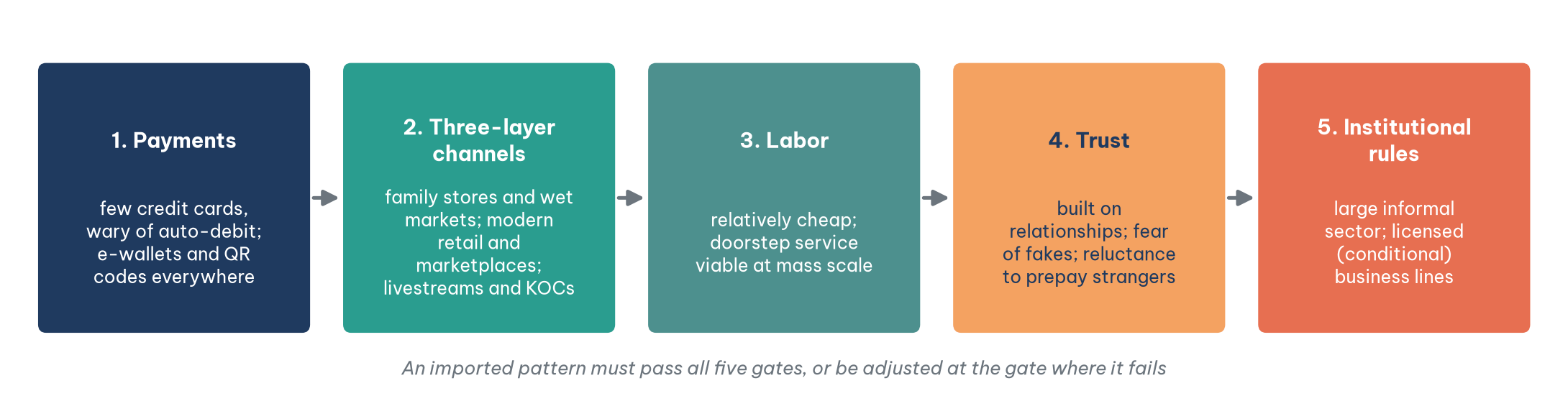
This section sets out the five market features that decide whether an imported pattern takes root or withers. Figure 1 arranges them as five gates that a pattern must pass in sequence.
1.1. Payments and channels
The first gate in Figure 1 is payment behavior. Vietnam was once almost entirely cash-based and is moving to digital payment very quickly. E-wallets and QR codes now reach from shopping malls to street vendors, and across Southeast Asia more than 60% of transaction value is already digital (Google et al., 2025). Yet credit cards remain uncommon, and people are still cautious about letting a system debit their account automatically each month; many prefer to confirm every payment themselves. Any pattern that assumes a card on file for recurring charges, such as an auto-renewing subscription, stumbles at this gate. In the other direction, QR codes and wallets open small, instant payment paths that many Western markets lack.
The second gate is channel structure. Although modern and online channels are booming, millions of tạp hóa (family-run corner stores), wet markets and household shops still hold the bulk of sales in many essential categories. They are not a relic about to disappear. They form a network embedded in every alley: close to home, willing to sell on credit and on first-name terms with their customers. At the same time, video and livestream commerce accounted for about a fifth of e-commerce value in Southeast Asia in 2024, up from less than 5% in 2022 (Google et al., 2024). The channel map is therefore three layers that coexist: corner stores and markets; modern retail and online marketplaces; and livestreams driven by KOLs (key opinion leaders, celebrities and influencers) and KOCs (key opinion consumers, ordinary users whose reviews carry weight because they look like the buyer).
1.2. Labor and trust
The third gate is labor cost. Relatively cheap labor reverses many calculations that are taken for granted in high-wage countries. Where wages are high, automating to replace people is the obvious move. In Vietnam a fleet of motorbike couriers or a layer of hands-on doorstep service is sometimes cheaper and more flexible than an expensive automated system. Food delivered in thirty minutes, same-day home installation and returns collected from the customer's door are services that work at mass scale. The tactic of "cutting service levels to cut cost" therefore does not always win; sometimes attentive service is both affordable and a competitive weapon.
The fourth gate is trust and relationships. Personal connections, community ties and the voice of acquaintances (today, of KOLs and KOCs) carry unusual weight. Consumers are skeptical of unfamiliar brands, afraid of counterfeits and reluctant to prepay someone they do not know. That very distrust created cash on delivery, and it created the habit of watching a real person use a real product before buying, the fertile ground on which livestream selling grew. Any pattern that asks customers to place both trust and money in an unknown name needs a trust bridge: payment on delivery, marketplace escrow, easy returns or a face the customer already believes.
1.3. Institutional rules
The fifth gate is invisible to anyone who reads only consumer data. The first element is the size of the informal sector. Millions of household businesses are at once a distribution channel, a competitor and a supplier. They are also the reason many platform patterns are hard to standardize. A modern retail chain competing with the corner store at the end of the alley is not competing on price; it is trying to replace a relationship that may be ten years old. That network is usually easier to borrow than to beat.
The second element is licensing. Vietnam's Law on Investment keeps a list of "conditional" business lines, such as banking and finance, education, health care and transport, in which a firm must meet specific conditions or obtain a license before it can operate (National Assembly of Vietnam, 2025). Most countries regulate these sectors, but the principle bites harder in an emerging market where licenses are scarce and slow to obtain. In these industries the license, not the model, decides who gets to play; a brilliant model without a license is only an elegant slide deck. This reverses the usual order of the innovation process: legal due diligence must come before cheap experiments. A strategic alliance is often the viable route, borrowing the license of a firm that has one in exchange for the channel and data of the firm that needs it. Much of the wave of embedded finance in Vietnam runs on exactly this principle.
The third element concerns business-to-business markets. When enforcing contracts through the courts is slow and expensive, personal relationships take over the roles of contracts, credit insurance and due diligence. "Guarantee by relationship" is powerful, but it has a weakness: the risk concentrates in one person, and that person can leave at any time. Table 1 summarizes the five features.
Table 1 shows that each feature is both a gate and a raw material. The "difficulties" of the market are also a moat for whoever understands them deeply enough.
2. Patterns that thrive and three domestic champions
This section looks at the patterns that take root quickly when they meet the right conditions, usually because they fit a market that is price-sensitive, mobile-first and community-minded. Table 2 lists them.
Table 2 has a common thread: almost every winning pattern revolves around price sensitivity and the smartphone. A list of patterns, however, is only the notes; to hear how they are arranged, it helps to read three domestic companies through two lenses. The first is the keystone, the single element of a business model that the other elements lean on, so that removing it brings the arch down. The second is the flywheel, the self-reinforcing loop in which each component pushes the next and momentum builds over time (Collins, 2019). The three figures below draw each flywheel as a causal loop diagram. Every box is a variable that can rise or fall. A plus sign means the two variables move in the same direction, a minus sign means they move in opposite directions, and R marks a reinforcing loop, which amplifies change upward or downward. A dashed box is a variable outside the loop that acts on it.
2.1. Three domestic flywheels
Mobile World (Thế Giới Di Động, the Mobile World Investment Corporation) placed its keystone in standardized service delivered through a dense network of stores, a direct answer to the trust gate. In a market full of worries about counterfeit goods, gray imports and vague warranties, what it sells is peace of mind. Figure 2 draws its flywheel.
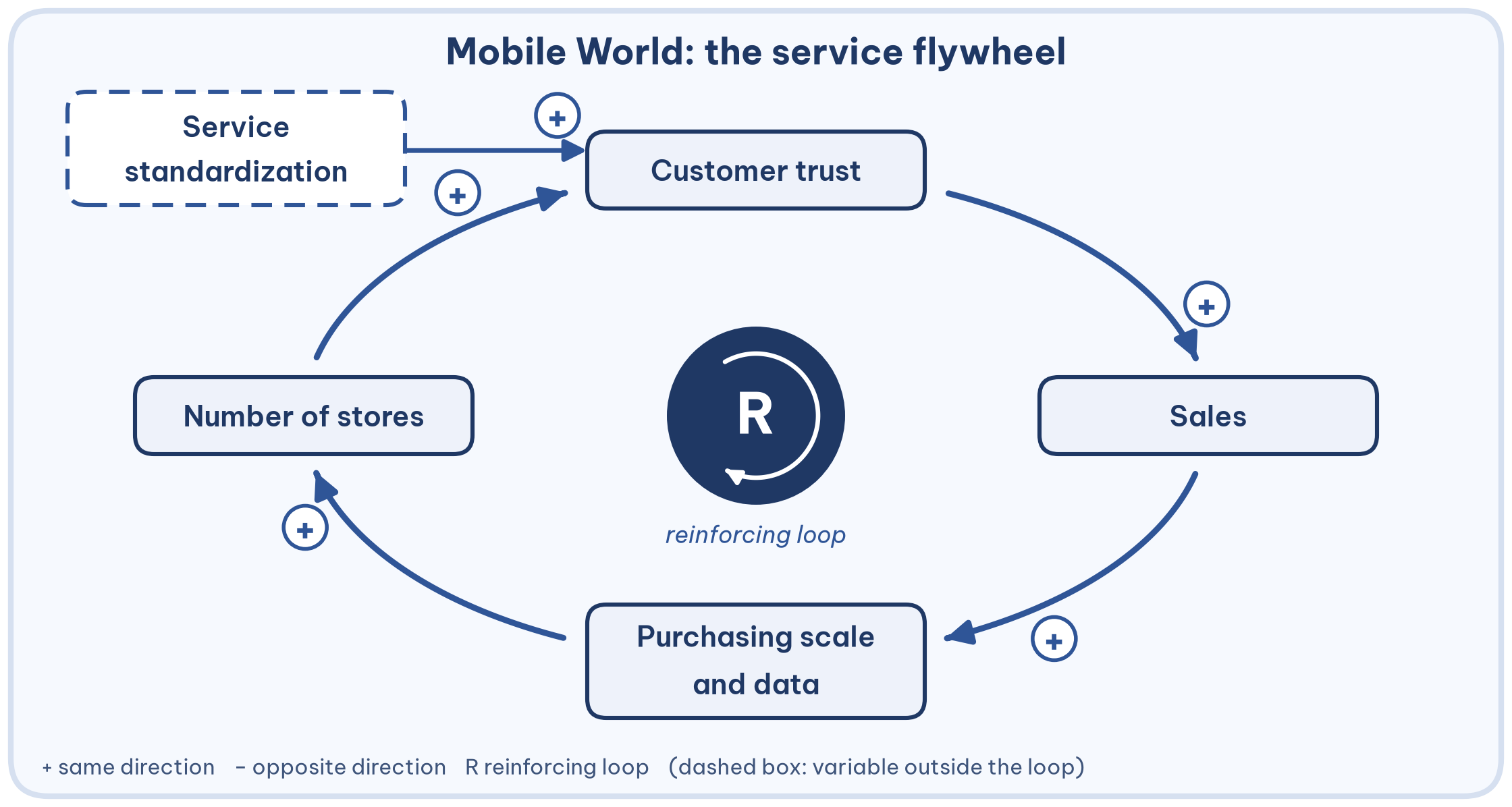
In Figure 2, customer trust lifts sales, sales build purchasing scale and operating data, scale funds more stores, and a network that reaches small provincial towns deepens trust. Service standardization, with clear returns and genuine warranties, pushes the loop from outside. The distinctively local element is the use of standardized people, not only technology, as the weapon of customer experience, something a chain in a high-wage country would struggle to copy at the same cost.
MoMo, one of Vietnam's largest e-wallets, placed its keystone in a free wallet that acts as a gateway to financial life. Figure 3 draws the funnel as a loop.
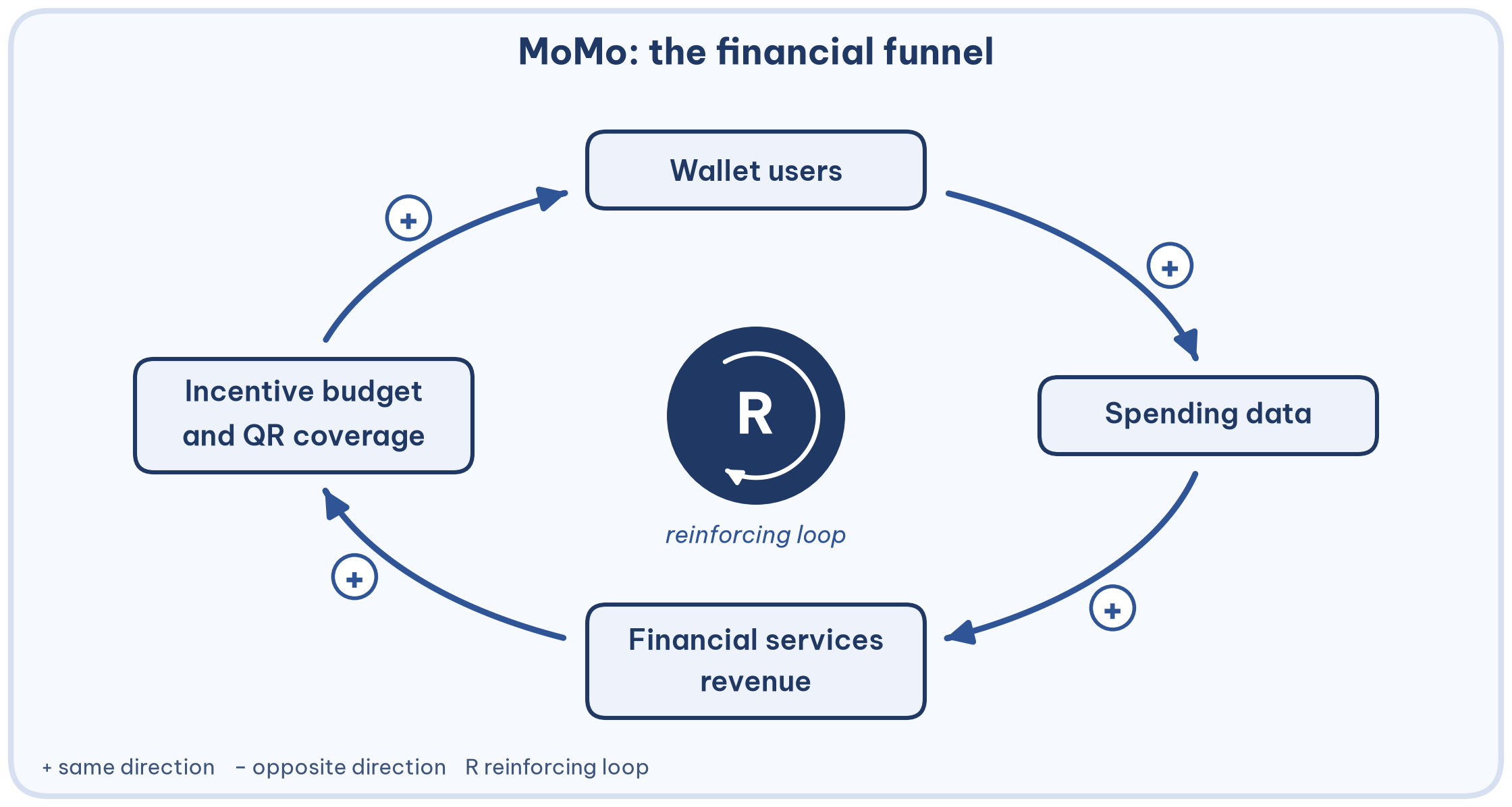
In Figure 3, more wallet users produce richer spending data, the data help sell financial services to the right person at the right moment, the revenue funds incentives and QR coverage, and wider coverage brings in more users. This is freemium leading to financial services, localized. The free tier is not a piece of software but everyday payment infrastructure, and the paid tier is embedded finance for people who do not yet have a full relationship with a bank. The weakness of the model is that the free tier burns real money for years before the financial tier grows large enough; an imitator without patient capital and without financial licenses will collapse in the middle.
Vietjet, a low-cost airline, placed its keystone in low-cost discipline as a platform for ancillary revenue: a young fleet built mainly around the Airbus A320 family, fast turnarounds and cheap base fares, with income from baggage, seat selection, meals and insurance. This is the add-on pattern in its purest form (Gassmann et al., 2020). Figure 4 draws the engine.
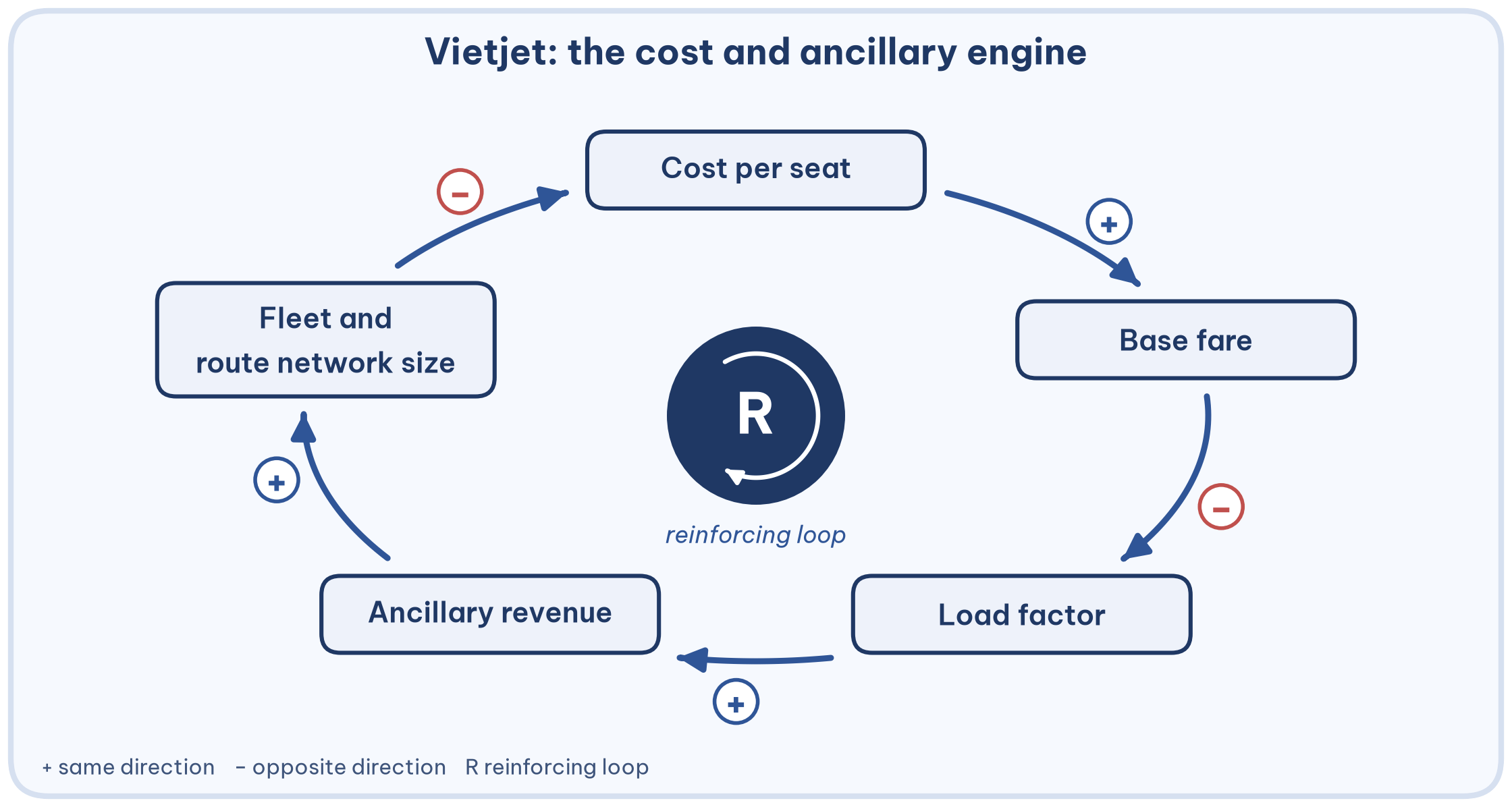
Figure 4 contains two minus signs, so the loop is still reinforcing: a lower cost per seat allows a lower base fare, cheaper fares fill more seats, fuller flights earn more ancillary revenue, that revenue funds aircraft and routes, and a larger network lowers the cost per seat again. The local mark lies in the fact that the airline did not only take customers from other carriers but expanded the market itself, turning long-distance bus journeys into many travelers' first flight. Table 3 places the three companies side by side.
Table 3 shows three different arrangements with one thing in common: each company turned its keystone around a local feature. Context was not their obstacle but the raw material of their advantage, which is precisely why a foreign latecomer finds them hard to copy.
3. Patterns that need adjustment
This section turns to a second group of patterns: they are not wrong, but imported unchanged they stumble. Table 4 presents four examples and how to adjust them.
The four cases in Table 4 share one feature: the core logic of the pattern stays, while the underlying assumption is replaced to fit the market. A subscription is still recurring revenue, only collected through a wallet instead of a card. Direct selling still means owning the relationship with the end user, only without cutting off the traditional channel. When in Rome, do as the Romans do; when importing a pattern, adapt it to local conditions.
4. Opportunity spaces
This section shows how the same features that trouble imported patterns open gaps for those who understand the context. Four directions stand out.
Digitizing traditional channels. Millions of corner stores still order goods, manage inventory and handle working capital by hand. A platform that connects manufacturers with these stores, covering ordering, logistics and small loans, applies the brokerage pattern plus financial services to the ground layer that consumer e-commerce missed. The winner here does not replace the corner store but makes it stronger, and is therefore welcomed by the network instead of resisted.
Provincial and rural markets. Much of future growth lies outside the big cities, where infrastructure and behavior differ sharply. This is a geographic "long tail" that needs models built to serve it: smaller points of sale, tiered pricing, consolidated delivery routes and content in the local voice.
Embedded finance for the underbanked. Many individuals and small household businesses lack full access to banking services. Building credit, insurance and payment into platforms they already use, with behavioral data standing in for a credit history, is a large opportunity, provided it is done together with a licensed partner and in compliance with personal data rules.
Underdeveloped verticals. Agricultural supply chains, digital health and digital education are areas where platform, subscription and data patterns still have plenty of open ground. A company that understands both the industry and the context can set its keystone in place before large players take notice.
5. Five questions for screening an imported pattern
This section turns the five gates into a practical screening tool. Before bringing in an attractive pattern from abroad, run it through the five questions in Table 5, one for each gate in Section 1.
The questions in Table 5 place a pattern in one of three boxes: usable now, needs adjustment or unlikely to survive. A fifteen-minute exercise makes the tool concrete. Choose a foreign model you would like to apply, write down its underlying assumptions about payment, channels, labor and trust, pass it through the five gates and, for every gate where an assumption fails, propose one adjustment. AI tools can help list the hidden assumptions of a foreign model from public descriptions, but knowledge of payment habits, channels and trust in your own market still has to come from local observation and experiments.
The trap in this section is to swing from "import unchanged" to the opposite extreme: believing the market is so special that no pattern from elsewhere can work. The features in Section 1 change every year. Digital payments grow quickly, and a new generation is growing up with smartphones. The right question is not "does this pattern fit Vietnam?" but "which of its underlying assumptions do not hold here yet, and how long until they do?"
Conclusion
A sound pattern in the wrong context still fails; an ordinary pattern in the right context can win big. In Vietnam, five features decide the fate of an imported pattern: payment behavior, a three-layer channel structure, labor cost, relationship-based trust and institutional rules. The winning patterns tend to revolve around price sensitivity and the smartphone, and three domestic companies show that a keystone can be cast from the very peculiarities of the local market.
For anyone doing business in an emerging market, this is both a warning and good news. The warning: do not carry a foreign model over unchanged without asking the five gate questions. The good news: the difficulties of the market are a moat for those who understand them well enough to get through. Import the core logic of a pattern; do not import its underlying assumptions along with it.
References
Collins, J. (2019). Turning the flywheel: A monograph to accompany Good to Great. Harper Business. https://www.jimcollins.com/books/turning-the-flywheel.html
Gassmann, O., Frankenberger, K., & Choudury, M. (2020). The business model navigator: The strategies behind the most successful companies (2nd ed.). FT Publishing International. https://www.pearson.com/en-gb/subject-catalog/p/business-model-navigator-the-the-strategies-behind-the-most-successful-companies/P200000004274/9781292327143
Google, Temasek, & Bain & Company. (2024). e-Conomy SEA 2024: Profits on the rise, harnessing SEA's advantage. https://services.google.com/fh/files/misc/e_conomy_sea_2024_report.pdf
Google, Temasek, & Bain & Company. (2025). e-Conomy SEA 2025: From digital decade to AI reality. https://services.google.com/fh/files/misc/e_conomy_sea_2025_report_combined.pdf
National Assembly of Vietnam. (2025). Luật Đầu tư số 143/2025/QH15 [Law on Investment No. 143/2025/QH15]. https://vanban.chinhphu.vn/?pageid=27160&docid=216524
Discussion about this post