Building a Business Case for AI Before You Invest
State the problem, rank opportunities by value and feasibility, test the numbers for sensitivity and pilot with decision gates


Key takeaways
Three of the five root causes of AI project failure occur before a line of code is written: a misunderstood problem, chasing the latest technology and choosing a problem too hard for current AI.
Begin every proposal with a problem statement in business language that names no technology and includes at least one non-AI alternative.
A value-feasibility matrix sorts opportunities into strategic bets, quick wins, foundations first and set aside; its main value is making judgments visible for debate.
Separate potential benefits from realized benefits. Time saved is not money saved unless the organization actually changes staffing or workload.
A positive net present value can be fragile. The assumptions that decide it are exactly what a controlled pilot, with pre-set criteria, guardrail metrics and a real option to stop, must measure.
In 2024, the research organization RAND interviewed 65 experienced data scientists and engineers to understand why AI projects fail. The report cites estimates that more than 80% of AI projects fail, twice the rate of information technology projects without AI (Ryseff et al., 2024). The 80% figure is only an estimate and should be read with care. More interesting are the five root causes the practitioners identified.
The leading cause is not weak algorithms or slow computers but stakeholders misunderstanding or miscommunicating the problem that AI is meant to solve. Next come a lack of suitable data, a focus on the latest technology rather than on the problem, a lack of infrastructure to manage data and deploy models, and finally applying AI to problems too difficult for current technology (Ryseff et al., 2024). Three of the five causes occur before a single line of code is written. They are failures of the stage at which a problem is chosen and its value measured, the stage this article is about.
This article has five sections. Section 1 shows how to state a problem so that errors are stopped at the outset. Section 2 introduces a value-feasibility matrix for ranking several opportunities. Section 3 builds a business case in money, with net present value and sensitivity analysis. Section 4 designs a pilot with decision gates. Section 5 suggests ways to stress-test a business case with a spreadsheet and with AI.
1. Start from the problem, not the technology
Before scoring or calculating anything, it helps to know where each cause of failure can be stopped. Table 1 lists RAND's five causes alongside their usual symptoms and the stage that can stop them.
Two of the five rows in Table 1 share the same stopping point: the problem statement. This section shows how to write one and the trap that awaits those who skip it.
1.1. The problem statement
The simplest way to stop the first and third causes is to require every AI proposal to open with a problem statement written in business language that does not mention technology. A good statement answers five questions: who has the problem; how it shows up in numbers; how much it costs; which decision would change if it were solved; and how we will know it has been solved.
Consider Nha Vui Home, a hypothetical furniture retailer with stores in several provinces and an online channel. One way to open a proposal is: "Deploy a generative AI chatbot for customer service." Another is: "The contact center receives about 30,000 chat requests a month, most of them asking about order status; customers wait 8 minutes on average at peak times; each request costs about US$1 in staff time. Goal: cut waiting time to under 1 minute for lookup questions without lowering satisfaction scores." The second version invites challenge, can be measured and can be compared with options that need no AI, such as sending proactive order-status messages so that customers do not have to ask.
1.2. The trap of a solution looking for a problem
When a technology is in the spotlight, the question in the meeting room easily becomes "where can we use generative AI?". The mechanism of the error is salience combined with fear of falling behind: the new technology captures attention, becomes the starting point of thinking, and every problem is seen through its lens. A simple rule helps avoid the trap: any proposal that names a technology in its first sentence goes back to be rewritten as a problem statement, and every proposal lists at least one option that does not use AI for comparison.
2. Ranking with a value-feasibility matrix
A business rarely has only one AI opportunity. Starting from an opportunity map, Nha Vui Home identified six concrete opportunities and needs to choose which to pursue first.
2.1. Scoring six opportunities
Each opportunity is scored from 1 to 5 on five criteria in two groups. The value group comprises financial impact (weight 30%) and strategic fit (20%). The feasibility group comprises data readiness (20%), technical ease (15%) and low legal and reputational risk (15%). The value score and the feasibility score are the weighted averages within each group. Table 2 shows the scores of the six opportunities.
Table 2 shows that the two highest-value opportunities (B and D) are not the easiest to do. Placing the value score and the feasibility score on two axes shows more clearly how the opportunities group.
2.2. Four groups, four treatments
Figure 1 places the six opportunities on a matrix with a value threshold of 3.5 and a feasibility threshold of 3.0. The matrix divides the plane into four corners, each leading to a different treatment.
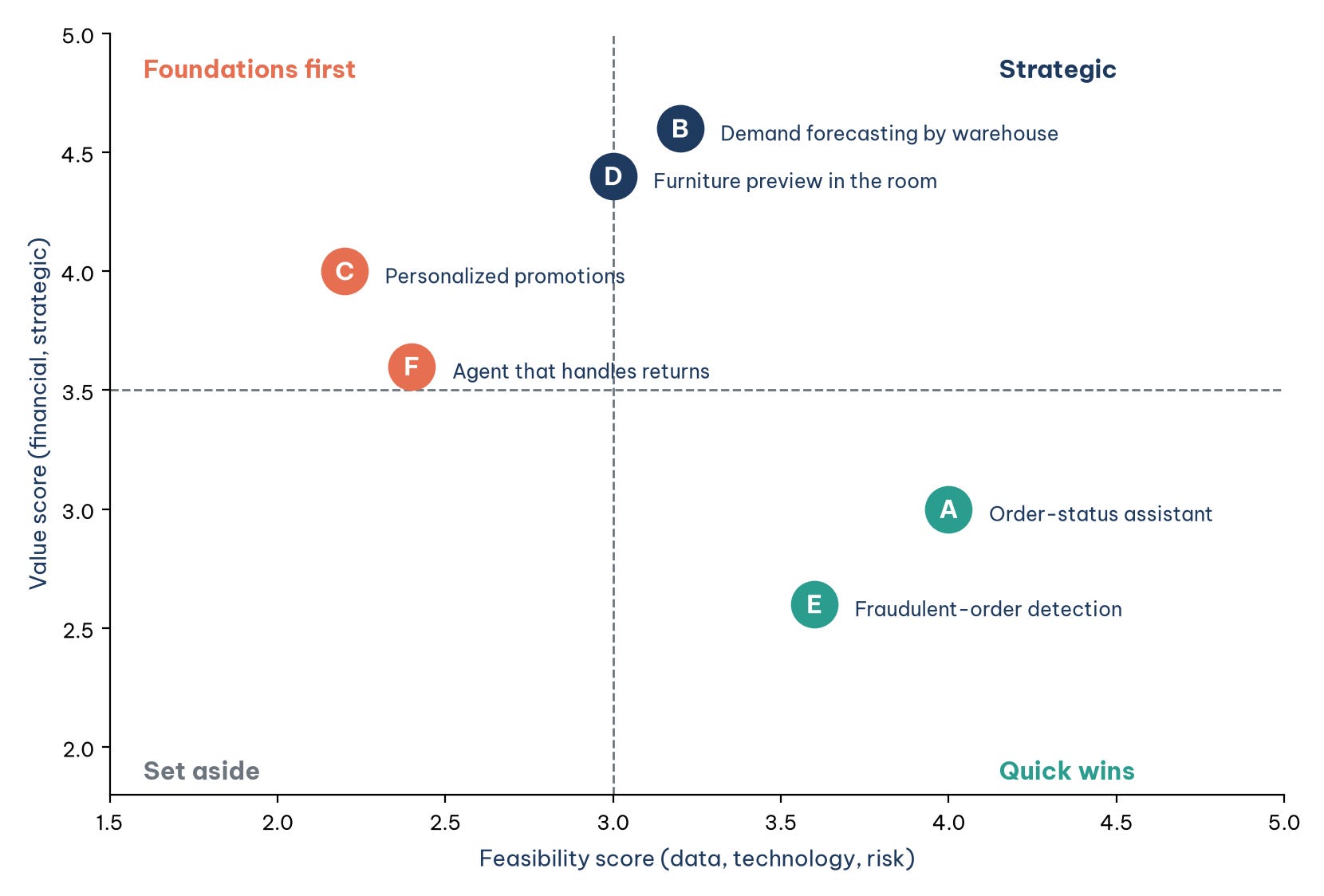
Strategic bets (high value, sufficiently feasible): invest seriously and accept a long horizon. Quick wins (moderate value, easy): do them early to build trust and learn how. Bernard Marr advises that a priority list should combine one to three big strategic opportunities with one to three quick wins, because quick wins build confidence in AI while the larger projects are still under way (Marr, 2025). Foundations first (high value, not yet feasible): do not drop them, but do not start yet; invest in what is missing. Personalization (C) is blocked by fragmented customer data; the returns agent (F) is blocked by the risk of wrong actions when a machine is allowed to issue refunds. Set aside: low value and hard to do.
The matrix is not a decision calculator. The scores are human judgments written down for transparency, and the matrix's greatest value is forcing those judgments into the open for debate. If the sales director scores personalization 5 on financial impact and the finance director scores it 2, the argument about why is the valuable part. Opportunity D, sitting exactly on the feasibility threshold, is also a reminder that the boundaries between groups are conventions: change the weights slightly and it moves group.
3. The business case: measuring value in money
The matrix says what to do first; the business case says whether it is worth doing at all. This section uses opportunity A, the order-status assistant, as its example, because its benefits are easy to express in money and because this kind of project needs especially careful calculation. The Klarna case shows that a customer service assistant can hit every cost metric and still reduce service quality (Entrepreneur, 2025).
3.1. Potential benefits, realized benefits and full lifecycle cost
Potential benefits. With 30,000 requests a month, if AI fully resolves 40% of them and each request handled by a person costs US$1, the potential saving is 30,000 × 12 × 40% × US$1 = US$144,000 a year.
Realized benefits. This is the step most business cases skip. Staff time freed up turns into money only if the business actually reduces shifts, does not replace people who leave, or moves people to work that creates measurable value. Otherwise, staff are simply less busy. Assuming 60% of the saving is realized, the steady-state benefit is US$86,400 a year. The first year reaches only half that level because implementation and tuning take time.
Full lifecycle cost. The upfront cost is US$48,000, covering system integration, building the knowledge base the assistant searches and testing. Running costs of US$44,000 a year include platform fees, model usage fees, one quality-monitoring staff member and update costs. A business case without a running-cost line is a wrong business case.
One trap deserves special mention: treating time saved as money saved. Experiments show AI shortens working time considerably; in Noy and Zhang's experiment, for example, writing time fell by 40% (Noy & Zhang, 2023). Multiplying that percentage directly by the payroll to get a saving silently assumes that every freed hour will vanish from the payroll. The remedy is always to separate "potential benefit" from "realized benefit", with a concrete plan for the freed time: fewer new hires, redeployment or higher service volume.
3.2. Net present value
Benefits and costs stretch over several years, and a dollar next year is worth less than a dollar today. Net present value (NPV) brings every cash flow back to today and adds them up:
NPV = CF₀ + CF₁ / (1 + r) + CF₂ / (1 + r)² + … + CF_T / (1 + r)^T
where CFt is the net cash flow in year t (realized benefit minus cost), r is the discount rate reflecting the cost of capital and risk, T is the number of years evaluated, and t = 0 is the time of the initial investment. A positive NPV means the project creates more value than the minimum return the capital demands; a negative NPV means the money would do better elsewhere. Table 3 calculates the assistant's three-year NPV at a 12% discount rate.
Adding the last row of Table 3, the three-year NPV is about US$15,300, positive but thin compared with the US$48,000 investment. The undiscounted three-year return on investment (ROI) is 20%: total benefits of US$216,000 against total costs of US$180,000. The project pays back only in its third year.
3.3. Sensitivity analysis
A single NPV figure hides the most important thing: which assumptions the result depends on. Sensitivity analysis changes one assumption at a time to see how the result moves. Figure 2 varies the two most uncertain assumptions together: the share of requests AI resolves fully and the share of the saving that is realized.
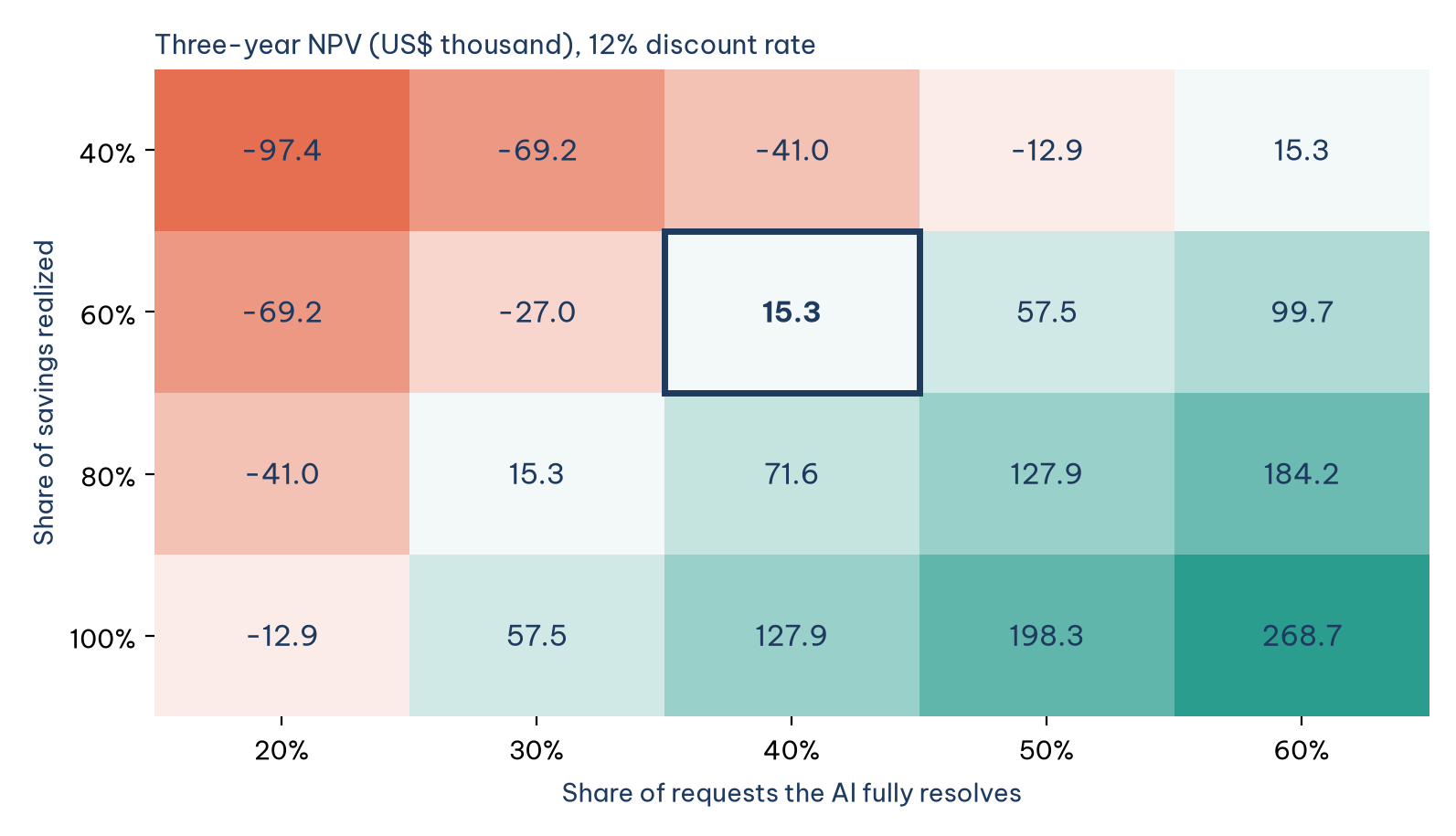
Figure 2 shows two things. First, if the resolution rate is 30% instead of 40%, an easy miss, NPV is already negative by about US$27,000. Second, if the full saving is realized, NPV rises to about US$128,000. The project's value therefore lies as much in organizational capability (reorganizing staff) as in the AI's capability. These two assumptions also point exactly to what the pilot needs to measure.
A business case also has a built-in gap: the cost of quality. No spreadsheet line records the loss when customers are annoyed by an assistant that talks in circles. The practical remedy is to set a quality metric as a guardrail: the project counts as a success only if satisfaction does not fall, however high the NPV.
4. Pilots and decision gates
A business case is a chain of assumptions, and a pilot is the cheapest way to turn assumptions into data. But a badly designed pilot produces a confidently wrong conclusion, which is worse than no pilot at all. This section presents three elements of a trustworthy pilot and how to avoid being "stuck in pilot".
4.1. Three elements of a trustworthy pilot
A control group. Comparing before and after AI is easily confounded by seasonality, promotions or anything else that changes at the same time. The most reliable approach is a randomized controlled experiment: randomly split customers or shifts into a group with AI and a group without, the standard method technology companies use to evaluate product changes (Kohavi et al., 2020).
Criteria set in advance. Write down before starting which metrics will be measured, what level justifies scaling up and what level means stopping. If the criteria are set after seeing the results, someone will always find a metric that looks good.
Measuring the business case's assumptions. For Nha Vui Home's assistant, the pilot must measure the share of requests fully resolved by AI (not just the share "answered"), how much staffing can actually be adjusted, and customer satisfaction, the three figures that sensitivity analysis showed decide success or failure. Table 4 arranges these metrics by role.
The guardrail metrics in Table 4 are what separate a careful pilot from one that just hunts for pretty numbers. They prevent in advance the kind of lopsided optimization that Klarna ran into.
4.2. Decision gates
A common phenomenon is being "stuck in pilot": the trial runs on and on, neither scaling up nor stopping, because nobody wants to declare failure. The remedy is to design decision gates between stages in advance, as in Figure 3, each with three exits: continue, adjust or stop.
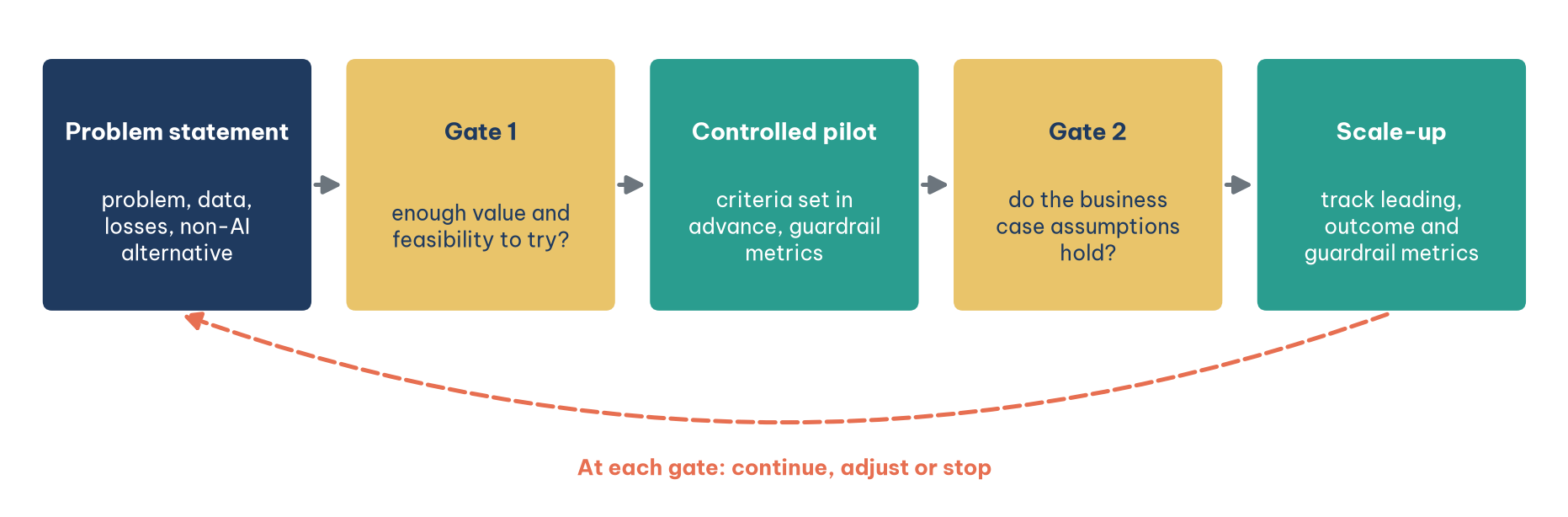
Gates work only when stopping is not treated as personal failure. If the person who proposed a project is judged poorly when it stops, they have every incentive to prolong the pilot or choose easy metrics. Stopping a project at the right time is a success of the process, not a failure of the people. This is where the lesson about sunk costs becomes very practical: money already spent on a pilot is not a reason to continue.
5. Stress-testing the business case
A good business case is not the one with the highest NPV but the one that has been tested to destruction before it is submitted. There are three simple spreadsheet tests:
Find the break-even point. Use Goal Seek in Excel (Data › What-If Analysis › Goal Seek) to set the NPV cell to zero by changing the number of requests per month. The result is the minimum scale at which the project does not lose money.
Read the safety margin. On a sensitivity table like Figure 2, find the negative cell closest to the base cell. The distance between them is the project's safety margin.
Add a bad scenario. Raise running costs by 30%, a common level of overrun, and record the new NPV.
AI can be asked to play the critic. A sample prompt: "You are a skeptical chief financial officer reviewing the business case for the following AI project at [business]: [project description]. Assumptions: [paste assumptions table]. Results: [NPV, ROI]. Please (1) identify the three assumptions most likely to be wrong and the usual direction of error; (2) list costs that may have been missed, especially running, monitoring and quality costs; (3) propose a pilot metric for each assumption in (1); (4) do not recalculate the NPV yourself, only raise questions." Request (4) is deliberate: language models easily make arithmetic mistakes, so every calculation belongs in the spreadsheet. And do not paste confidential financial data into public AI tools.
Conclusion
Most AI projects fail because of mistakes made before any code is written: misunderstanding the problem, chasing technology, choosing a problem that is too hard. The three tools in this article stop those mistakes in order. A problem statement in business language, with numbers and a non-AI alternative for comparison. A value-feasibility matrix that turns stakeholders' judgments into scores for debate and sorts opportunities into four groups with four treatments. A business case that expresses value in money, separates potential from realized benefits and counts running costs in full.
The Nha Vui Home assistant shows how fragile a positive NPV can be: shift one assumption slightly and the project loses money. That is why the most important number in a business case is not the NPV but the list of assumptions that decide it, and those are exactly what the pilot must measure. A pilot with a control group, criteria set in advance, guardrail metrics and decision gates with a real "stop" exit is the cheapest way to find out whether an AI project is worth doing.
References
Entrepreneur. (2025, May 9). Klarna CEO reverses course by hiring more humans, not AI. https://www.entrepreneur.com/business-news/klarna-ceo-reverses-course-by-hiring-more-humans-not-ai/491396
Kohavi, R., Tang, D., & Xu, Y. (2020). Trustworthy online controlled experiments: A practical guide to A/B testing. Cambridge University Press. https://doi.org/10.1017/9781108653985
Marr, B. (2025). AI strategy: Unleash the power of artificial intelligence in your business. Kogan Page. https://www.koganpage.com/business-strategy/ai-strategy-9781398619562
Noy, S., & Zhang, W. (2023). Experimental evidence on the productivity effects of generative artificial intelligence. Science, 381(6654), 187–192. https://doi.org/10.1126/science.adh2586
Ryseff, J., De Bruhl, B. F., & Newberry, S. J. (2024). The root causes of failure for artificial intelligence projects and how they can succeed: Avoiding the anti-patterns of AI (RR-A2680-1). RAND Corporation. https://www.rand.org/pubs/research_reports/RRA2680-1.html
Discussion about this post