Bring Your Own Everything: BYOD, BYOK and BYOAI
How “bring your own” models shift choice and responsibility to users, from devices and apps to identities, encryption keys and AI tools


Key takeaways
"Bring your own" (BYO) began with letting staff use personal phones for work and has grown into a family of models that transfer ownership of an asset, and responsibility for it, to the user.
Four models change how employees work: BYOD (devices), BYOA (applications, or "shadow IT"), BYOAI (personal AI tools, used by 78% of AI users at work) and BYOW (workspace).
Four models change how customers use digital services: BYOI (identity), BYOL (software licences), BYOK/HYOK (encryption keys) and BYOK in its second sense, bringing your own AI API key.
"BYOK" means two different things, and encryption has three levels: only holding your own key (HYOK) truly stops the cloud provider from decrypting your data.
Successful BYO is a governance problem, not a technology problem: clear policies on data, privacy, tools, incidents, costs and training.
In the flow of digital transformation, a deceptively simple operating philosophy is driving deep change: "Bring Your Own" (BYO). It began with policies allowing employees to bring personal laptops and phones to work, and has grown into a whole family of models that reshape the relationship between organisations, employees and customers on the one hand and technology on the other.
What every BYO model has in common is a transfer of ownership and responsibility for an "asset": a physical device, an application, a workspace, an identity, a software licence, an encryption key and, most recently, an AI tool. The transfer brings autonomy, flexibility and savings, but raises hard questions about governance, security and accountability: when a personal phone holding customer data is lost, who is responsible?
The article has five parts. Section 1 maps the BYO models and divides them into two groups. Section 2 covers the models that affect employees: BYOD, BYOA, BYOAI and BYOW. Section 3 covers the models that affect customers of digital services: BYOI, BYOL, the levels of encryption-key management (BYOK and HYOK) and BYOK in the sense of "bring your own API key". Section 4 pulls them together with a "journey" metaphor and a table of transferred responsibilities, and Section 5 offers a checklist for building a BYO policy.
1. A map of BYO models
BYO models fall into two groups according to one question: who hands which asset to whom? Figure 1 shows the map.
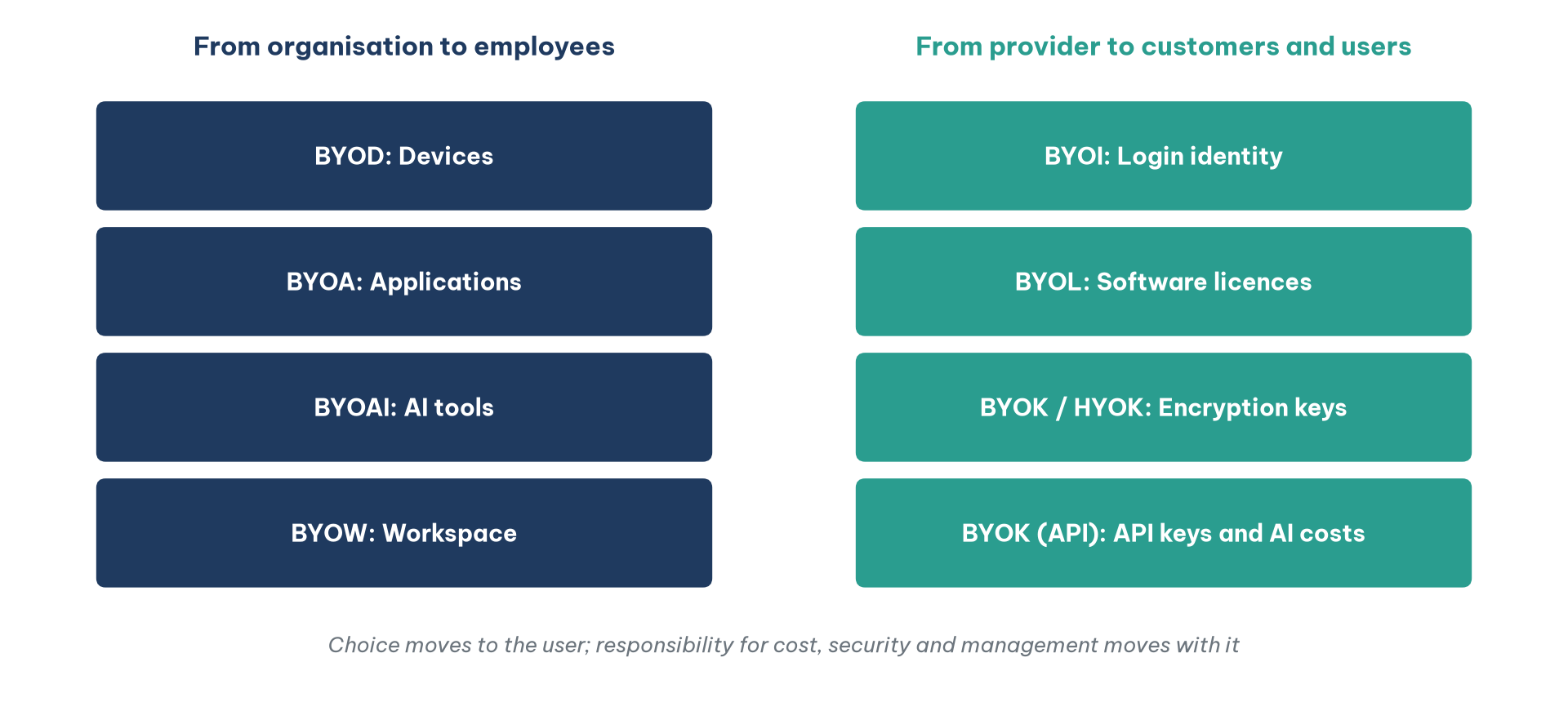
The first group operates inside the organisation: employees bring their own devices, applications, AI tools and spaces into their work. The second operates between digital service providers and their customers: customers bring their own identity, licences, encryption keys or API keys into someone else's service. The two groups carry different risks and need different governance tools, so they are presented separately.
2. Models that affect employees
The first group of BYO models changes how employees work inside the organisation. Each model below is presented in the same order: definition, benefits and risks, then strategic meaning and implementation.
2.1. BYOD: the foundation
Definition. BYOD (Bring Your Own Device) lets employees use personal devices (laptops, phones, tablets) to access company resources and do their work. It is the oldest and most widespread form of BYO.
Benefits and risks. For the organisation, BYOD cuts hardware purchasing and maintenance costs and usually raises employee satisfaction. But the security risk is high if a personal device is infected or lost, and technical support becomes more complicated with countless device types. For employees, BYOD means working comfortably on a familiar device and carrying one device for both personal and work life. In return, they may worry about privacy when the company installs management software on their personal device, and they bear repair and upgrade costs themselves.
Strategic meaning and implementation. BYOD is the first step towards a flexible workplace. To succeed, organisations need mobile device management (MDM) or mobile application management (MAM), "containers" that separate company data from personal data on the device, and a clear, transparent usage policy: what the company can see, and what it can wipe when an employee leaves or loses the device. When customers' personal data sits on an employee's device, the organisation remains responsible for protecting it under data-protection law.
2.2. BYOA: choosing your own software
Definition. BYOA (Bring Your Own Application), known as "shadow IT" when uncontrolled, is the tendency of employees to use third-party applications, usually SaaS services such as Trello, Notion, Dropbox or chat groups on WhatsApp or Telegram, instead of the tools the company prescribes.
Benefits and risks. For the organisation, BYOA drives innovation and agility as employees find the best tools for their work. But the organisation loses control of data stored on unapproved platforms, creating security holes and data silos. For employees, BYOA raises productivity and initiative, but they may unintentionally breach security policy and leak data.
Strategic meaning and implementation. Rather than banning it, the wise strategy is to manage BYOA. Companies can use a cloud access security broker (CASB) to monitor and control cloud-app use, and maintain a list of approved, supported applications that guides rather than merely blocks.
2.3. BYOAI: bring your own AI
Definition. BYOAI (Bring Your Own AI) is employees using personal chatbots and AI assistants (ChatGPT, Claude, Gemini and others) for work, often without company approval. It is the newest and fastest-spreading form of BYOA. Microsoft and LinkedIn's 2024 Work Trend Index found that 78% of AI users at work bring their own AI tools (Microsoft & LinkedIn, 2024).
Benefits and risks. For the organisation, productivity rises quickly with no upfront investment. But the risk of data leakage is very high: in 2023, the international press reported that some Samsung employees had pasted internal source code into ChatGPT, after which the company restricted public chatbots. Wrong AI output can go straight into documents sent to customers without anyone checking, and customers' personal data can end up in external services in breach of data-protection rules. For employees, BYOAI speeds up work, but they may be held personally responsible when something goes wrong.
Strategic meaning and implementation. Organisations should provide approved AI tools (enterprise versions that commit not to use customer data for model training), specify which kinds of data must never be entered into AI tools, train employees to check outputs, and ask them to state where AI has helped.
2.4. BYOW: beyond the office walls
Definition. Strongly accelerated by the COVID-19 pandemic, BYOW (Bring Your Own Workspace) lets employees work from a space they choose and set up themselves, usually their home, instead of a central office.
Benefits and risks. For the organisation, BYOW cuts office rental and running costs and widens the hiring pool beyond geography. But it is harder to sustain company culture and engagement, and home or café Wi-Fi creates cybersecurity risks. For employees, BYOW offers flexibility in time and place and better work–life balance, but can be isolating, reduces interaction, and makes them pay for setting up their own workspace (furniture, internet).
Strategic meaning and implementation. BYOW redefines "the office". To make it sustainable, companies need secure remote access (a VPN or, better, a zero trust architecture that trusts no device or network by default, even inside the company) (National Institute of Standards and Technology [NIST], 2020a), effective online collaboration tools, and performance management based on results rather than hours of presence.
These four models all operate inside the organisation. The next group operates at the boundary between a business and its customers.
3. Models that affect customers of digital services
The second group faces outwards: customers of a digital service bring their own identity, software licences or keys. The subsections follow the same order as Section 2 for easy comparison.
3.1. BYOI: a unified digital identity
Definition. BYOI (Bring Your Own Identity) means users log in to third-party services with a digital identity already verified by a trusted provider such as Google, Apple or Microsoft: the familiar "Sign in with Google" button. Government digital identities used to access public services, such as the EU's planned digital identity wallet or Vietnam's VNeID, are a similar idea.
Benefits and risks. For service providers, BYOI reduces the burden of managing user databases and passwords and raises sign-up rates thanks to a simpler process. But the system's security depends on the identity provider. For users, BYOI is very convenient: no more dozens of passwords. But the line between personal and work identity blurs, and if the main account is hijacked, every linked service is at risk.
Strategic meaning and implementation. Organisations should adopt BYOI through federated identity and single sign-on (SSO), and always require multi-factor authentication (MFA).
3.2. BYOL: making the most of software investments
Definition. BYOL (Bring Your Own License) lets customers use software licences they already own in another provider's environment, most commonly in the cloud: for example, bringing existing Windows Server or SQL Server licences to virtual machines on AWS or Azure.
Benefits and risks. For customers, BYOL saves a great deal by reusing licence investments instead of buying again from the cloud provider. But management and compliance are very complex: the rules on licence mobility differ between vendors, and breaches can bring heavy penalties during licence audits. For cloud providers, BYOL attracts customers by lowering the cost barrier of software.
Strategic meaning and implementation. BYOL is an important financial lever when moving to the cloud. Companies need software asset management (SAM) tools, a careful reading of licence-mobility agreements and advice from licensing specialists.
3.3. Managing encryption keys: from BYOK to HYOK
This model is sometimes called BYOE (Bring Your Own Encryption) and described as making the cloud provider "completely unable to decrypt" the data. In reality there are three levels, and only the highest matches that description. Figure 2 shows the spectrum.
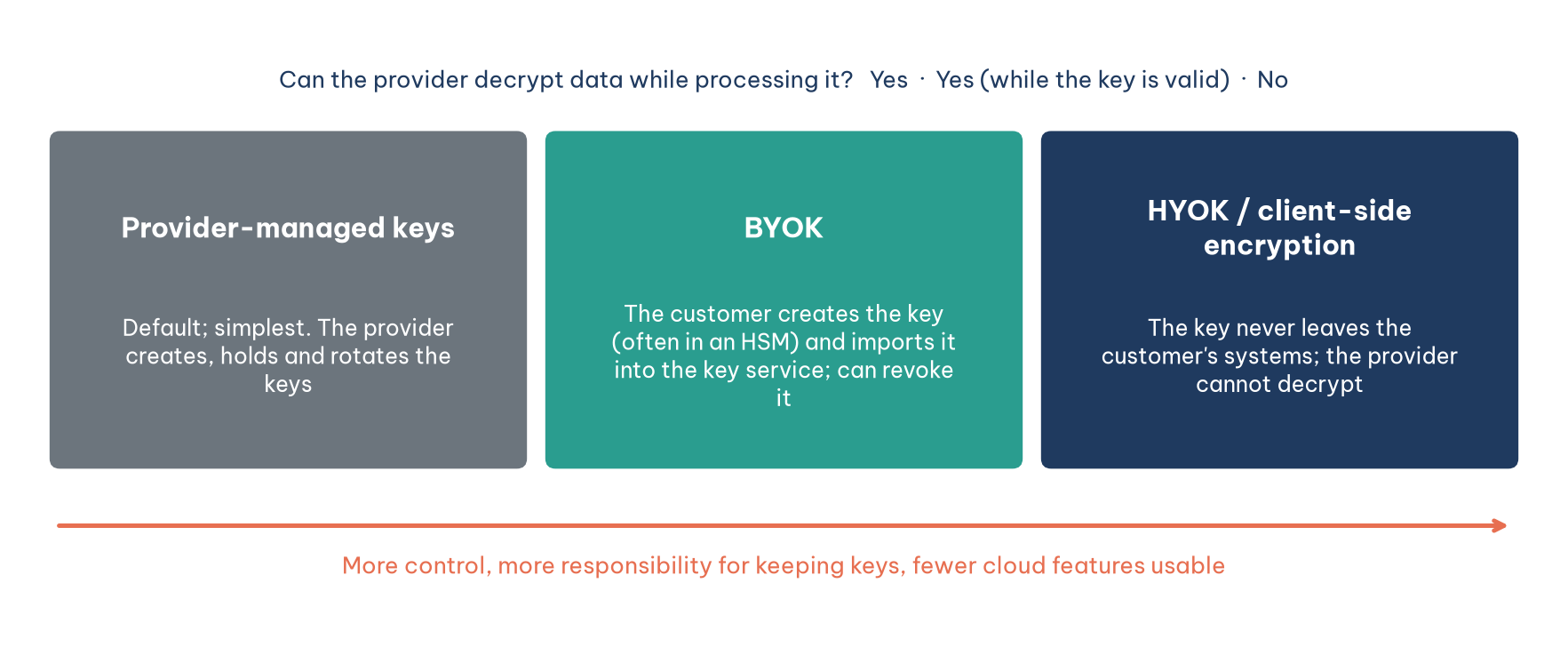
Table 1 compares the three levels in more detail.
The right level depends on how sensitive the data is and how capable the organisation is. A hospital storing medical records or a bank may need BYOK or HYOK to meet compliance requirements; a small business is usually safer with provider-managed keys, because holding your own keys and managing them badly is riskier still. Key management is also part of the wider debate on data sovereignty: some countries require certain data to be stored locally. In Vietnam, for instance, providers of online services may have to store data domestically under the 2018 Cybersecurity Law (National Assembly of Vietnam, 2018) and Decree 53/2022 (Government of Vietnam, 2022).
3.4. BYOK in its second sense: bring your own API key
In the AI-app developer community, BYOK has another, increasingly common meaning: the application provides only the interface and features, while users enter their own API key from a model provider (OpenAI, Anthropic, Google and others) and pay for their own usage. When reading documentation, check the context to know whether BYOK refers to encryption keys or API keys.
Benefits and risks. For app developers, running costs fall close to zero, the financial risk of paying for millions of users' API calls disappears, and they can focus on features. In return, they lose some control over the experience (if the underlying API fails) and need another revenue model, such as a one-off purchase instead of a subscription. For end users, upfront costs are low or nil and they control their spending. But creating and managing API keys is complicated for non-technical people; a leaked key can be used by others and billed to your account; and costs vary and are hard to predict.
Strategic meaning and implementation. This model lets small developers compete with large companies in building AI applications. To succeed, developers need very clear documentation, secure storage of API keys (not sending them to their own servers unless necessary) and cost-estimation tools for users.
4. The business "journey" in the BYO era
The BYO ecosystem is essentially a restructuring of ownership and responsibility. To picture it, imagine work as a journey and yourself, as employee or user, as the driver. Table 2 retells the BYO models through this metaphor.
The whole BYO philosophy rests on a basic trade-off: organisations gain flexibility, leanness and savings; users gain choice, but also take on more responsibility for cost, security and management. Table 3 summarises that transfer.
5. Building a BYO policy: a checklist
Adopting BYO successfully is not only a technology problem but a governance and cultural one. Table 4 suggests the questions an organisation should answer when writing a BYO policy, drawing on the solutions in Sections 2 and 3.
Conclusion
"Bring your own" models began with a simple question: may employees read company email on their own phones? Two decades later, that question has spread to applications, workspaces, identities, licences, encryption keys and now AI tools. The common thread is that choice moves to the user, and responsibility follows that choice.
The article also carries a lesson about terminology: the same acronym, BYOK, can mean two completely different things, and an imprecise description of encryption can lead an organisation to believe its data is safer than it is. In security, the difference between "the provider cannot decrypt" and "the provider can decrypt while the key is valid" is a very large one.
Organisations that build a clear policy framework, deploy security solutions suited to their scale and cultivate a culture of trust matched by responsibility will capture the benefits of BYO without paying for them with a data breach.
References
Government of Vietnam. (2022). Nghị định số 53/2022/NĐ-CP quy định chi tiết một số điều của Luật An ninh mạng [Decree No. 53/2022/ND-CP detailing the Law on Cybersecurity]. https://caselaw.vn/van-ban-phap-luat/411600-nghi-dinh-so-53-2022-nd-cp-ngay-15-08-2022-cua-chinh-phu-huong-dan-luat-an-ninh-mang
Government of Vietnam. (2025). Nghị định số 356/2025/NĐ-CP quy định chi tiết một số điều và biện pháp thi hành Luật Bảo vệ dữ liệu cá nhân [Decree No. 356/2025/ND-CP detailing the Law on Personal Data Protection]. https://chinhphu.vn/?pageid=27160&docid=216387
Microsoft & LinkedIn. (2024). 2024 Work Trend Index annual report: AI at work is here. Now comes the hard part. https://www.microsoft.com/en-us/worklab/work-trend-index/ai-at-work-is-here-now-comes-the-hard-part
National Assembly of Vietnam. (2018). Luật An ninh mạng số 24/2018/QH14 [Law on Cybersecurity No. 24/2018/QH14]. https://chinhphu.vn/?pageid=27160&docid=206114&classid=1&typegroupid=3
National Assembly of Vietnam. (2025). Luật Bảo vệ dữ liệu cá nhân số 91/2025/QH15 [Law on Personal Data Protection No. 91/2025/QH15]. https://chinhphu.vn/?pageid=27160&docid=214590&classid=1&typegroupid=3
National Institute of Standards and Technology. (2020a). Zero trust architecture (NIST Special Publication 800-207). https://doi.org/10.6028/NIST.SP.800-207
National Institute of Standards and Technology. (2020b). Recommendation for key management: Part 1 – General (NIST Special Publication 800-57 Part 1 Rev. 5). https://doi.org/10.6028/NIST.SP.800-57pt1r5
Discussion about this post