Who Is the Customer? Personas, DMUs and the Beachhead Market
How disciplined entrepreneurship picks a first market, sizes it by counting real customers, and maps who uses, who pays and who can say no


Key takeaways
Selling to everyone means selling to no one. Bill Aulet's disciplined entrepreneurship starts by choosing one beachhead market: narrow, homogeneous, poorly served and a springboard to adjacent segments.
TAM, SAM and SOM are three nested measures of the same market, counted in customers and annual revenue. For the beachhead, only TAM is needed, ideally sized bottom-up by counting real customers.
The end-user profile describes a group in six factors; the persona turns it into one real person the team has interviewed; the decision-making unit (DMU) covers everyone involved in the purchase, including the often-forgotten veto holder.
Multi-sided platforms need a profile for each side, and products for babies, pets or dependants must separate the user experience from the message to the payer.
After winning the beachhead, expand by selling new products to existing customers or existing products to adjacent markets, never new products to new markets.
The most common mistake in a start-up is believing the product is so good that everyone needs it. The reality is the opposite: try to sell to everyone and you will sell to no one. A small team's thin resources cannot be spread across every customer group, and a message written for "everyone" rarely touches anyone. A close cousin of this mistake is telling investors that the market is worth billions of dollars and the company only needs 1% of it. That line signals not ambition but a lack of homework.
The Disciplined Entrepreneurship method of Bill Aulet (2013, 2024) offers another path: find a small "beach", concentrate on winning it, then use it as a springboard. Along the way, the founding team has to answer a set of linked questions: Which market do we start with? How big is it? Who exactly will use the product? Who will pay, and who can block the deal? Where do we go next? In every case, the key question is not "how big is the market?" but "how well do we understand our customers?".
This article follows that sequence. Section 1 covers segmentation and choosing a beachhead market. Section 2 builds the end-user profile. Section 3 sizes the market with TAM, SAM and SOM. Section 4 turns the profile into a persona, and Section 5 maps the decision-making unit. Section 6 handles two special cases, Section 7 applies all the tools to two worked examples, and Section 8 plans the follow-on markets.
1. Segmentation and the beachhead market
Before measuring a market, the team has to know which market it is measuring.
1.1. Segmenting the market
In innovation-driven entrepreneurship, segmentation is not just dividing customers by age, gender or income. It is finding groups that share a pain and a way of buying. A good segment is narrow enough to describe the customer clearly, yet large enough to generate revenue. Take a team building AI-powered timekeeping and payroll software. Targeting "all businesses" means going head to head with established enterprise systems and accounting software. Instead, it could split the market into food-and-beverage chains with 5–20 outlets and complex shift patterns, advertising agencies with 50–100 staff, and small contract workshops. Each group has a different payroll process and a different pain, so each needs a different product, message and sales approach.
The initial list of segments is usually long. Aulet suggests six criteria to narrow it down to a few worth deep research, as in Table 1.
The last criterion is often overlooked but matters as much as the economic ones. A segment that looks attractive on paper but that the team neither understands nor wants to stay with will not sustain the team through the first hard months.
1.2. Niche market or beachhead market?
With a shortlist in hand, the next step is to choose one and only one segment to start with. People often confuse a beachhead market with a niche market, but the two serve different purposes, as Table 2 shows.
The term "beachhead" comes from the Normandy landings of 1944: the Allies did not spread troops along the whole European coast but concentrated on taking a few beaches as a springboard inland. For a start-up, that means accepting that many attractive prospects will be ignored in order to win decisively in one place.
Beyond the six criteria in Table 1, a good beachhead usually has features that help a start-up win fast with little money: customers already willing to spend but badly served or ignored by large rivals; low-cost marketing channels that target them precisely; openness to giving feedback that helps refine the product; and strong word of mouth, so each satisfied customer brings others. Two more features concern operations and expansion: geographic proximity, which matters for start-ups with physical operations, and sales skills and scripts that carry over to adjacent segments. A beachhead with no path to other segments easily becomes a niche, even if that was never the plan.
2. The end-user profile: six factors
"Customer" is often used as if it meant one person, but in practice it covers several roles. Everything starts with the end user: if nobody uses the product, there is no value; without value, nobody pays; without payment, the business collapses. Finding customers therefore always starts with understanding end users.
Aulet uses "end user" rather than "consumer" for a reason. "Consumer" usually means someone buying for personal use in a business-to-consumer (B2C) market. "End user" is broader: the person who uses the product directly to create value, whether an employee using company software in a business-to-business (B2B) market or a baby wearing nappies that a parent bought.
2.1. Three linked tools
This article uses three tools from Aulet's 24 steps to answer "who is the customer?", each building on the one before, as Figure 1 shows.
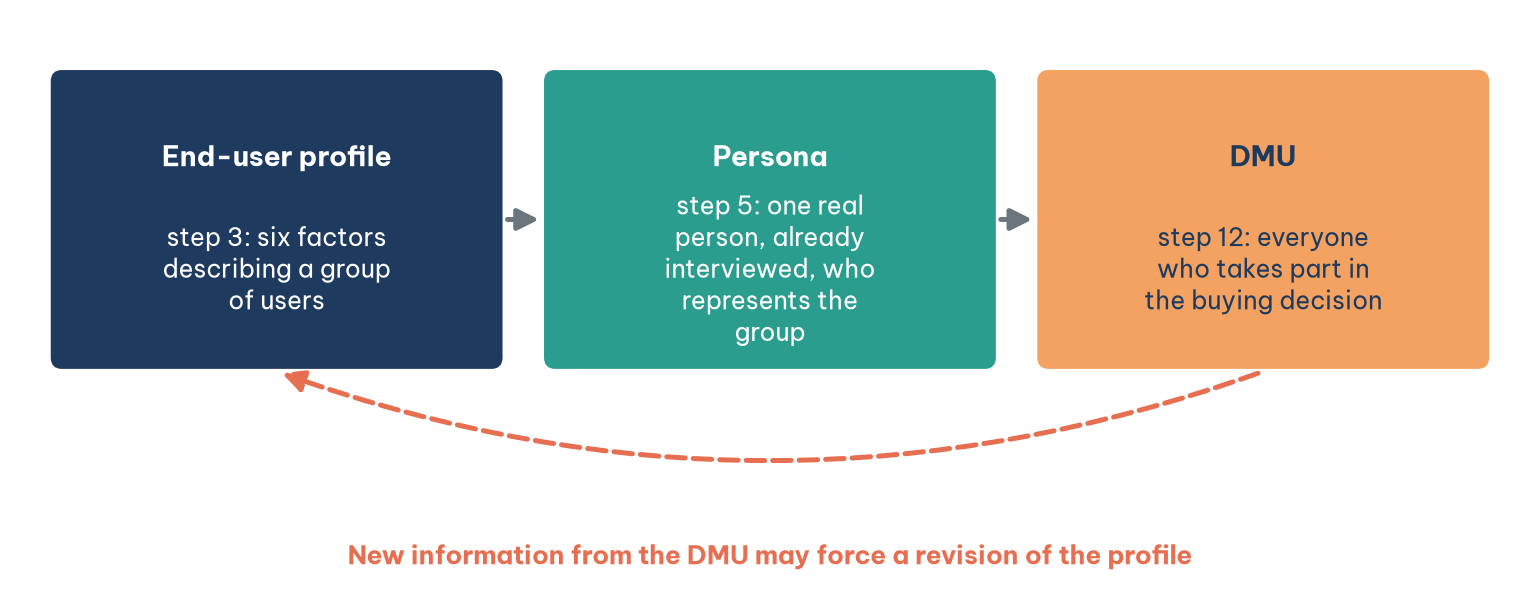
The process is not one-way. When analysing the DMU, a team may discover that the end user has no say in the purchase, or that the veto holder cares about things the profile missed, and must go back and revise the profile.
2.2. The six factors
An end-user profile is not a line like "male, 25, lives in the capital". To pin down the beachhead market, founders need a multi-dimensional profile. Its six factors run from what is easy to see, such as age and income, to what can only be learned through interviews and observation, such as fears and motivations, as Table 3 shows.
The first two factors can be partly found in statistics, but the other four come almost only from direct contact. Interviews should ask about specific past occasions; observation should happen where users actually work or live. The 100-point technique for factor 6 is especially useful. Instead of asking "Do you care about price?", to which everyone says yes, the team presents eight to ten criteria and asks interviewees to split 100 points among them. The five criteria with the highest totals across many interviews become the compass for product design and sales messaging.
3. How big is the beachhead? TAM, SAM and SOM
Once the beach is chosen, the next question is how big it is and whether it is worth the effort.
3.1. Three measures of the same market
TAM, SAM and SOM are not three separate markets but three measures applied to the same specific market, nested as in Figure 2.
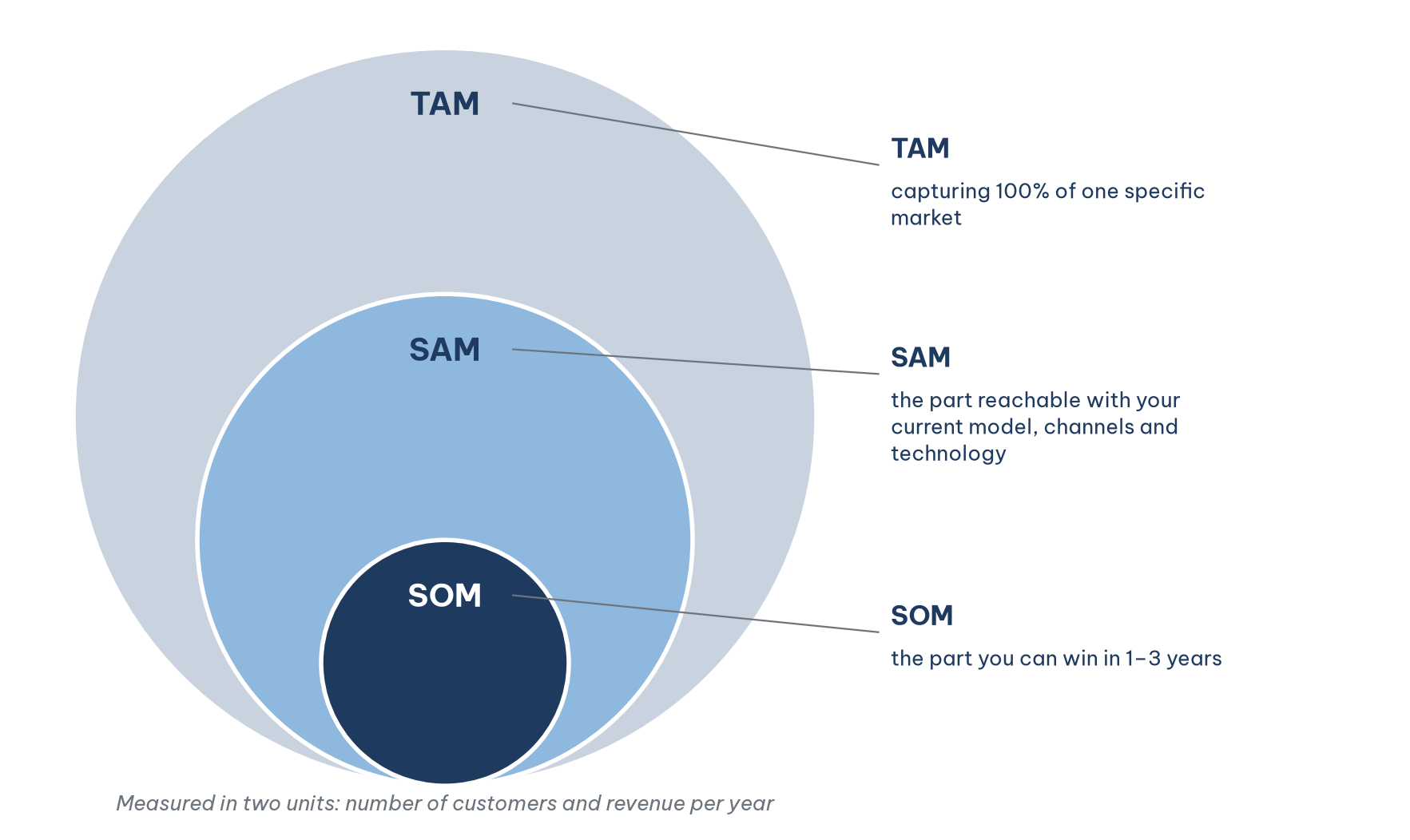
Size should be measured in two units in parallel: the number of customers (people, households or businesses) and revenue per year. A billion-dollar market made of five corporations needs a completely different sales strategy from a billion-dollar market made of ten million individuals. Table 4 defines each measure and what it tells investors.
Consider an AI app for conversational English priced at about USD 40 a year (illustrative figures). TAM: people in a country who need to learn English, say 20 million, or USD 800 million a year. SAM: the app runs only on iOS and needs a good connection, so the reachable users are iPhone owners in large cities, say 2 million, or USD 80 million. SOM: with the current budget and a five-person team, a first-year target of 1% of SAM, or 20,000 users and USD 0.8 million. The TAM is impressive but says almost nothing about the odds of success; SOM is what the team must actually achieve. Notice that SAM here is limited by the team's own technology choice, not by the market.
3.2. Why Aulet asks only for the beachhead's TAM
In step 4 of the method, Aulet asks only for the TAM of the beachhead market, not SAM or SOM. The reason is that the beachhead has already been narrowed and filtered by what the team can serve. If it still has to be cut into SAM and SOM, the "beach" is too wide and not homogeneous enough. In a beachhead, the team must be able to serve all of it, so TAM is roughly SAM, and the goal is not a timid 1% but a dominant share. The three measures remain useful for painting the industry picture for investors, but they do not replace a very narrow definition of the first market.
How big is big enough? Aulet's rule of thumb is a beachhead TAM of about USD 5–100 million a year. Too small, and there is not enough cash flow to survive and invest in later stages; too large, and big companies probably already dominate it, making a dominant share hard to win. The upper bound reflects the US market. For a very early start-up serving a smaller domestic market, such as Vietnam's, a beachhead TAM of about USD 1–5 million is often a more realistic starting point: small enough for large corporations to ignore, but enough to support a team of 10–20. For start-ups going international from day one, such as global software or AI products, Aulet's range still applies.
3.3. Four factors that adjust the TAM
A single TAM figure is a simplification that gives a quick sense of scale. Two markets with the same TAM of USD 3 million can be very differently attractive. Before drawing a conclusion, Aulet (2024) suggests weighing four factors, as in Table 5.
Once the number is in, a quick check of the beachhead takes four questions: is the market big enough; is it small enough for word of mouth to work; can the company reach positive cash flow in about three years; and does the whole team genuinely see it as a good place to start? Any "no" calls for careful thought before going further. The TAM should also be read against the industry picture: an emerging, fragmented or declining industry offers very different kinds of opportunity.
3.4. Three ways to estimate size
Estimating market size is not a hunt for the biggest number; it is a way to show how well the team understands its customers.
Top-down starts from macro reports by research firms such as Gartner, Nielsen, McKinsey or Statista and narrows them with ratios: "The EdTech market is worth X billion dollars and we will take 1%." It is optimistic, stacks assumptions and includes segments the start-up will never touch. It is fine for sketching TAM as context to show a growing industry; used to calculate SOM, it will not convince investors.
Bottom-up, counting customers one by one, is mandatory for the beachhead and for SOM. Market size equals the number of realistic potential customers times average revenue per user per year (ARPU). First, define a specific customer profile: not "millennials" or "SMEs" but something like "B2B companies with revenue of USD 2–20 million that spend about USD 5,000 a month on marketing but cannot afford an agency". Second, count them using several sources, as in Table 6. Third, multiply by the start-up's own price, not by what customers currently spend with competitors.
Aulet's own example of the third step: 1,600 university laboratories times USD 5,000 a year for the start-up's materials equals USD 8 million. That is far smaller than "the global materials market", but every component can be checked.
Hybrid estimation uses top-down to show a growing industry and bottom-up to show achievable revenue. Imagine a healthy-lunch delivery service for office workers in one central business district at about USD 40 a month (illustrative figures). TAM, top-down: from commercial-property data, about 300,000 office workers times USD 480 a year, or USD 144 million. SAM, bottom-up: checking search volume for "healthy lunch" in the district and running test ads suggests about 10% are genuinely interested and willing to pay, or 30,000 people and USD 14.4 million. SOM, by capacity: the kitchen and three delivery staff can serve at most 500 customers a day, or USD 240,000 a year. That last number is the realistic first-year revenue target, and it is limited by operations, not demand: to grow revenue, the team must invest in the kitchen and delivery before advertising.
3.5. A full bottom-up example
To see the whole chain, consider sales and inventory software for independent cafés with 1–3 outlets in one large city, on a subscription of about USD 16 a month. Table 7 shows each step and the source of each assumption (illustrative figures).
The result is below the USD 1–5 million suggested for smaller domestic markets, so this beachhead may be a little small. The team has two options: widen the definition to include bubble-tea shops with similar processes, or raise revenue per customer with add-on services. The most influential assumption is the 25%; that is the number to verify with more interviews before relying on the result.
3.6. Presenting market size to investors
If the team is bootstrapping, it should be realistic, even cautious, because it needs to know exactly how much cash it will burn before turning cash-flow positive. If it is raising venture capital, investors look for scenarios of very large success. Then the team should be rigorous and logical about TAM and SAM; for a three-year SOM, it can present a conditional optimistic scenario that states its assumptions about funding and go-to-market. What it should never do is mix measures, for example using the whole industry's TAM as the denominator for projected revenue to get a "safe", tiny market share. Experienced investors spot this immediately.
A simple sanity check is to compare projected year-five revenue in the financial plan with the target market size. The ratio should be meaningful, roughly 10–25%. A mere 2% usually means the market is defined too broadly; 80–90% is too optimistic, or the market is defined too narrowly for the growth plan.
4. The persona: turning data into a real person
If the end-user profile is a set of criteria describing a group, the persona is a specific individual who represents that group.
4.1. Why it must be a real person
According to Aulet (2013), the persona must be a real end user the team has met and interviewed, not a composite character like "Office Worker Olivia". This is an important difference from many design guides, where personas are fictional characters assembled from many people. A real person keeps the whole team honest. When everyone shares a concrete picture, instead of debating "Do customers in general like this feature?", the team asks "Would Mr A like this feature?" and can phone him to find out. A fictional character is easily "adjusted" to like exactly what the team wants to build.
Choosing a persona takes three steps. Select: go through the list of interviewees and pick the one who best matches the end-user profile. Fill the gaps: go back and interview them again about whatever is missing, rather than guessing. Make it visible: create a one-page sheet and put it where the team works. Every debate about features or messaging comes back to one question: "Would this person like this?" When moving from profile to persona, the team fills in the six factors with the chosen person's exact details: a specific age rather than a range, the phone brand they use, the café where they usually sit, their own order of priorities. Table 8 suggests the sections of a one-page persona.
4.2. Ethics and privacy
Because the persona is a real person, the team must ask that person's permission before using them as a persona. In documents shared outside the team, such as assignments or pitch decks, use a different name and no real photo unless consent has been given. If the persona is a child, the team should work only through the parents and store no identifying information about the child. Data-protection laws in many jurisdictions require parental consent for processing children's personal data; in Vietnam, for example, this is set out in the 2025 Personal Data Protection Law (National Assembly of Vietnam, 2025) and its implementing decree (Government of Vietnam, 2025). Interview notes containing personal information should be stored securely and deleted when no longer needed.
5. The decision-making unit: who holds the wallet?
Once the team knows who uses the product and understands them through the persona, the next question is how to get paid.
5.1. Six roles
The decision-making unit (DMU) is everyone who influences whether a purchase happens. Figure 3 shows six common roles.
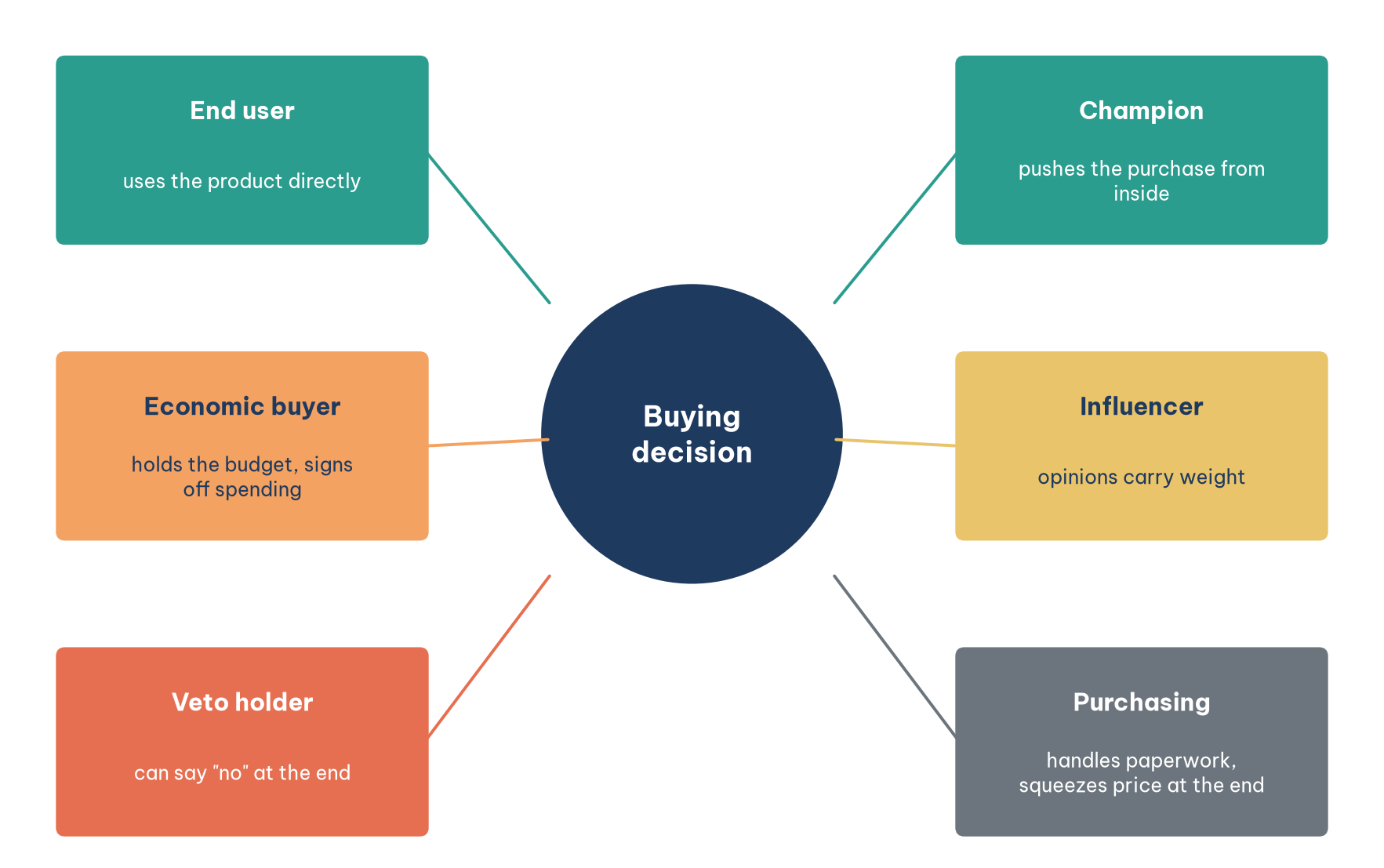
One person can hold several roles, and one role can involve several people. Table 9 gives examples of each role in B2B and B2C markets.
5.2. The DMU determines the cost of selling
The DMU determines the time and money needed to win a customer: the more people involved, the longer the sales cycle and the higher the cost of customer acquisition (CoCA, in Aulet's terms). Software sold to individuals may close after one free trial; the same software sold to a company may take three months and five meetings. That is why the team must map the DMU before estimating acquisition cost. The veto holder deserves special attention: they rarely attend product demos, but one question from them about data security or system integration can stop the whole deal at the final step.
6. Two special cases
Most products can use these tools as described. Two cases need adjustment.
Multi-sided platforms. If the start-up connects two groups, such as drivers and passengers or sellers and buyers, the team must build a profile, a persona and a DMU for each side. The two sides' motivations often pull in opposite directions. In a tutoring marketplace, parents want trustworthy teachers, progress for their child and a fair price, and fear no-shows, lack of progress and their child's safety; their veto holder may be the other parent or the child. Student tutors want good pay, flexible hours and short commutes, and fear late payment and last-minute cancellations; their veto holder is their own class timetable. The right message for parents is "verified tutors, rated by other parents"; for tutors, "paid on time, choose sessions around your timetable". Sometimes one side's benefit is the other side's cost. Please one side and neglect the other, and the platform collapses.
Users who do not decide. Products for pets, babies or elderly people with cognitive decline share one feature: the user cannot say what they want and has no money. The solution is to separate two jobs. The product experience is optimised for the user: nappies that don't cause rashes, pet food that tastes good. The marketing message speaks to the carer and payer, selling peace of mind and convenience. Dog food is the clearest example: the dog needs it to taste good, but the owner cares about "a glossy coat", "easy to clean up" and "clear ingredients". The packaging speaks to the owner; the flavour wins over the dog. Do only one and the product either doesn't sell or sells once and is dropped.
7. Two worked examples
The people and businesses in these examples are hypothetical, for illustration.
7.1. A B2C example: an English app for children
The end user is a primary-school child in a large city, but most information comes from parents, so the profile combines parent interviews with observing children during trials. The team's profile: children aged 6–10 in big cities with comfortably-off parents; they like games, dislike studying and want instant rewards; they use YouTube Kids, building games and construction toys; they gather at apartment playgrounds, extra classes and children's YouTube channels; their day is school, TV, being told to do homework, bed; they fear boredom and are motivated by play.
The chosen persona is Bin, 8, in Hanoi, son of Mai, an accountant. He is restless and cannot sit still for more than 15 minutes; he dislikes writing but memorises game characters' names very quickly; he plays building games on his father's tablet and collects trading cards; he is at the ground-floor playground after 5 p.m.; at 5 p.m. he asks for the tablet, at 7:30 he sits at his desk but keeps asking to get up, and at 9 he gets 20 minutes of screen time if homework is done. The app must feel like a game or he will demand it be deleted, and he wants badges to show his mother.
The DMU follows. The end user is Bin: if he is bored, the app is deleted, however happy his mother is. The economic buyer and champion is Mai, who wants him to be good at English and pays the monthly fee. Influencers are his English teacher and other mothers in a parents' group on social media. The veto holder is Bin's father, who worries about eye strain and allows only 30 minutes of tablet time a day. That detail leads directly to two features: a usage time limit and progress reports for parents. The DMU does not only help sell; it shapes the product.
7.2. A B2B example: inventory software for small manufacturers
Here the end user has no budget and is usually not consulted when the company buys software. The end users are warehouse keepers, who handle goods every day but rarely use computers. The team's profile: men aged 35–50 with vocational training and long warehouse experience; afraid of getting numbers wrong, wary of new technology, valuing stability; using mid-range Android phones, motorbikes and notebooks; gathering at cafés near the industrial park and during lunch breaks in the warehouse; receiving goods, counting by hand and entering data into Excel at the end of the day; afraid of losing their job over stock losses and wanting to leave on time.
The persona is Hung, 42, warehouse team leader at a plastics manufacturer in an industrial zone near Ho Chi Minh City. He is careful but conservative, trusts notebooks more than computers and fears being seen as old-fashioned by his younger boss. He uses a phone with large fonts and always keeps a pen in his shirt pocket. He drinks coffee at the café opposite the factory and is in the warehouse team's chat group on Zalo, Vietnam's dominant messaging app. He opens the warehouse at 7:30, is stressed at 10 when lorries arrive in waves, and at 4:30 strains his eyes adding up the book, often asking a younger colleague to enter the data. For him, the software must never lose data and must have big text and big buttons.
In the DMU, Hung is the end user but not the decision-maker. The champion is the operations director, who wants to streamline processes and cut losses. The economic buyer is the finance director, who compares the software's price with annual stock losses. The veto holder is the head of IT: if the software does not connect with the existing accounting system, they will reject it. Notably, Hung has an implicit veto: if he refuses to use it, the software will be abandoned within months and the company will not renew. The team therefore needs two parallel strategies: convince the finance director with savings figures, and design a product simple enough that Hung sees it as helping him leave on time rather than threatening his job.
8. After the beachhead: follow-on markets
Venture investors look for companies that can become very large, so the rest of the story lies in the follow-on markets.
8.1. The bowling-pin strategy
Follow-on markets are the segments a start-up expands into after winning its beachhead. Geoffrey Moore (2014) calls this the "bowling pin" strategy: the first pin knocks over the next, because each segment won becomes evidence and a referral channel for the one beside it. According to Aulet (2013), the beachhead plus about 5–10 follow-on markets should add up to something large, ideally over a billion dollars, to attract talent and venture capital.
8.2. Two sensible directions and one trap
When expanding, a start-up can change the product, the market or both. Figure 4 shows the four combinations.
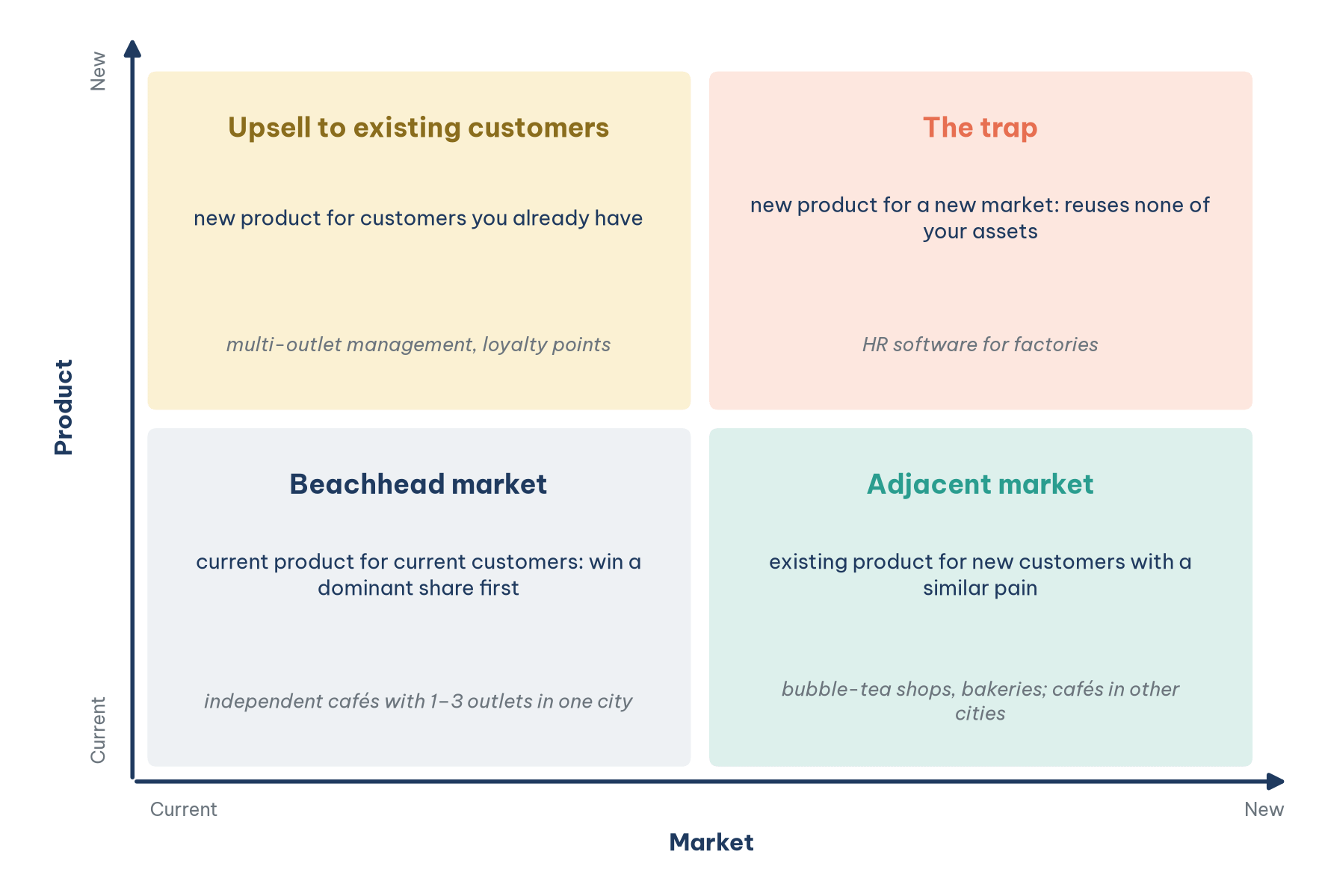
The two sensible directions each keep one of the assets already built: customer relationships, or a proven product. Selling new products to existing customers (upselling premium packages or add-ons) reuses existing channels and relationships, costs very little to acquire and raises lifetime value, but requires new product development. Selling the existing product to an adjacent market, new customers with a similar pain, saves development cost because usually only the interface, packaging and message need adjusting, but customer relationships must be built from scratch. A new product for a new market is the trap: it reuses none of the assets built in the beachhead.
8.3. From hunters to farmers
Expansion also requires organisational change. Once the beachhead is stable, the "hunters", who like exploration and accept risk, should move on to attack adjacent markets, and be replaced by "farmers", who are good at caring for customers and optimising processes. This lets the start-up hold its core market while expanding. The product plan, step 24 in Aulet's method, must also balance new features for the next market against quality for existing customers. Keep adding features while neglecting bug fixes, and the product collapses under its own weight.
The journey of MoMo, Vietnam's leading e-wallet, can be read through this frame, as an illustration rather than an official company account. Its beachhead was people who needed to top up phone credit and send small amounts quickly: a simple product used often. The adjacent market was bringing QR-code payments to small traders, shops and retail chains, an existing product for a new market. Once many users were used to opening the app daily, MoMo upsold bill payments, cinema tickets and then higher-margin financial services.
The picture of follow-on markets inspires the team and persuades investors, but it must not distract the team from the current beachhead. As the saying attributed to Dwight D. Eisenhower goes, plans are worthless, but planning is everything.
Conclusion
The question "who is the customer?" has several layers of answer. It starts with a beachhead market: narrow, homogeneous, poorly served, with word of mouth and a path to adjacent segments. Unlike a niche, which is a place to stay, a beachhead is a springboard, with a dominant share as the goal. TAM, SAM and SOM are three measures of the same market, counted in both customers and revenue; for the beachhead, Aulet asks only for TAM, because the team must be able to serve all of it, and bottom-up counting is mandatory.
Within that market, the end-user profile describes a group in six factors, from demographics to the biggest fears and motivations. The persona turns the profile into a real person the whole team can consult, with their consent and respect for their privacy. The DMU widens the view to everyone involved in the purchase, among whom the veto holder is the easiest to overlook. The two examples show that these tools shape the product as well as the sale: a father's worry led to a time-limit feature, and a warehouse keeper's fear led to large text and data that is never lost. After winning the first beach, the start-up expands by selling new products to existing customers or existing products to new customers, and avoids new products for new markets. The most valuable market-size figure is not the biggest one, but the one whose every component can be checked.
References
Aulet, B. (2013). Disciplined entrepreneurship: 24 steps to a successful startup. Wiley. https://www.wiley.com/en-gb/Disciplined+Entrepreneurship%3A+24+Steps+to+a+Successful+Startup-p-9781118720813
Aulet, B. (2017). Disciplined entrepreneurship workbook. Wiley. https://www.wiley.com/en-us/disciplined-entrepreneurship-workbook-p-9781119365792
Aulet, B. (2024). Disciplined entrepreneurship: 24 steps to a successful startup (Expanded & updated ed.). Wiley. https://www.wiley.com/en-us/Disciplined+Entrepreneurship:+24+Steps+to+a+Successful+Startup,+Expanded+&+Updated,+2nd+Edition-p-9781394222513
Government of Vietnam. (2025). Nghị định số 356/2025/NĐ-CP quy định chi tiết một số điều và biện pháp thi hành Luật Bảo vệ dữ liệu cá nhân [Decree No. 356/2025/ND-CP detailing the Law on Personal Data Protection]. https://chinhphu.vn/?pageid=27160&docid=216387
Moore, G. A. (2014). Crossing the chasm: Marketing and selling disruptive products to mainstream customers (3rd ed.). HarperBusiness. https://www.amazon.com/s?k=Crossing+the+chasm+Moore&i=stripbooks
National Assembly of Vietnam. (2025). Luật Bảo vệ dữ liệu cá nhân số 91/2025/QH15 [Law on Personal Data Protection No. 91/2025/QH15]. https://chinhphu.vn/?pageid=27160&docid=214590&classid=1&typegroupid=3
Discussion about this post