Anatomy of a Winning Pitch Deck
The twelve slides you need, how to tell your story to investors, examples from real decks, and how to get through the Q&A


Key takeaways
A pitch deck is the trailer, not the novel. Its job is to win a second meeting by telling the TRIM story: team, resources, idea and market.
Never pitch for more than 20 minutes of an hour-long meeting; the rest belongs to questions.
A standard deck runs 10 to 12 slides: cover, purpose, problem, solution, why now and market size, business model, go-to-market, competition, traction, financials, team, and the ask.
Real decks from Airbnb, Uber, YouTube, LinkedIn, Tinder, Coinbase, Front and others show what each slide should do.
The founders, not the slides, tell the story: research the investors, split the presentation between co-founders and keep slides minimal.
Prepare backup slides, anticipate five families of questions plus personal ones, and rehearse with AI acting as a tough investor.
In the startup world, a great idea is only the starting point. Turning it into a real business takes resources, partners and above all capital. Along the way, founders typically use three tools, each with a completely different role and moment of use.
The first is the business model, which describes how a company creates, delivers and captures value. To bring that model to life, you need a business plan: a document that explains the business opportunity in detail, identifies the market to be served and sets out concrete ways for the business to pursue its goals. Finally, when you go out to seek resources from investors, you need a pitch deck: a short presentation that summarizes your business plan as quickly and clearly as possible (Barringer & Ireland, 2019).
If the business plan is a detailed novel, the pitch deck is a sharp film trailer. In the first meetings, the pitch deck does not replace or overshadow the business plan; it goes first. It condenses the four elements investors scrutinize most, captured in the acronym TRIM (Team, Resources, Idea, Market), into a compelling story. Its aim is to persuade the audience that your project has enough potential for them to want a follow-up meeting to dig deeper, and that is when the business plan really comes into play.
This article brings together practical perspectives from startup experts and venture capital funds, and analyses examples from companies that raised money successfully (these decks were published by the companies or their investors and archived on SlideShare; sources are listed at the end). It also shows how to use modern AI tools to help build a pitch deck, with an important caveat: AI is a powerful assistant for saving time, but judgment, strategic thinking and the soul of the story still require a human lens. Figure 1 shows the general layout of a pitch deck for a software startup, the skeleton that the following sections fill in.
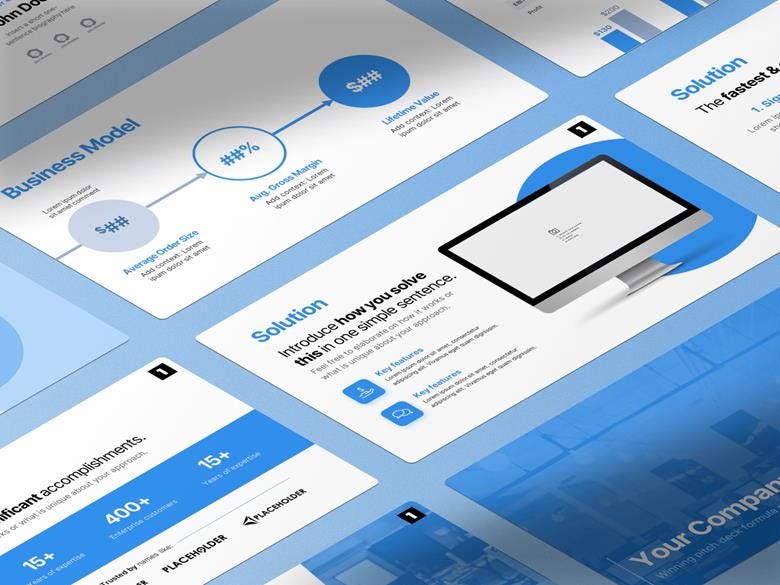
The article has five parts. Section 1 sets out the rules to master before designing. Section 2 walks through the 12-slide structure, each slide illustrated with real decks from Airbnb, Uber, YouTube, LinkedIn, Coinbase and others. Section 3 introduces tools and ways to use AI to draft content. Section 4 moves from the deck to the presenter: preparation, who speaks, and connecting with the audience. Section 5 covers the most decisive part of a fundraising meeting: the Q&A.
1. Golden rules before you design a deck
Before going into each slide, you need to know the rules of the game. An on-stage investor pitch is completely different from an elevator pitch, which usually lasts under two minutes and focuses on "what" rather than "how".
1.1. Manage time tightly
A first meeting with an investor usually lasts about an hour. The survival rule is: never present for more than 20 minutes. The remaining 40 minutes are for questions and answers. If you spend all the time talking, you deprive yourself of invaluable feedback from investors. Always have versions of your deck ready that run 1, 3, 10 and 20 minutes, so you can adapt to any situation.
1.2. Design on the principle of "less but better"
Investors have no time to read long paragraphs on screen. The five design principles below help each slide get its message across in seconds.
Colour: use at most three main colours throughout the presentation.
Font size: Guy Kawasaki (2005) recommends a font no smaller than 30 points (his 10/20/30 rule: 10 slides, 20 minutes, 30-point text); at the very least, use 24 or above. Imagine people sitting in the farthest corner of the room; they still need to read your message.
Language: use plain, everyday language. Avoid heavy technical jargon. You are selling a business model, not defending a PhD thesis in technology.
Identity: put your company logo and name in a small, consistent corner of every slide so they stick in the audience's mind.
Text density: the 6/6/6 rule suggests no more than six words per bullet, no more than six bullets per slide, and no more than six text slides in a row before an image slide changes the pace.
1.3. Flexibility in structure
There is no "absolutely correct" number of slides. Guy Kawasaki (2004) is famous for his 10-slide rule; Sequoia Capital's (n.d.) template has about 10–11 sections; other funds such as 500 Startups or NextView Ventures offer longer templates of up to 15 slides. Figure 2 compares the number of slides in recommended structures: there is no single common denominator, but they all share the same core elements.
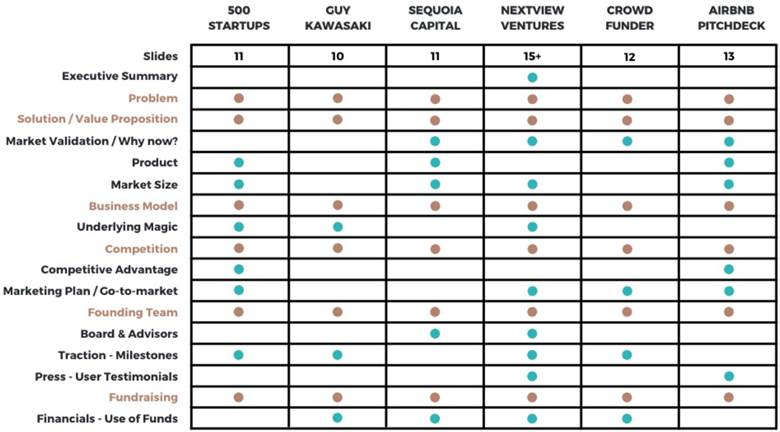
That said, the safest and most effective structure usually runs 10 to 12 slides. Above all, the order of slides can change according to your strengths. If your team consists of serial entrepreneurs, put the Team slide first. If you already have impressive revenue, open with Traction.
2. The 12-slide structure, with examples from real decks
Drawing on leading investment funds, here is the most standard 12-slide formula, illustrated with the decks of companies that went on to great success.
Note: how does a deck's focus change across funding rounds?
In the examples you will see terms such as pre-seed, seed, Series A and Series B. At each stage investors expect different things, so the "soul" of the deck must change too:
Pre-seed / seed: sell the vision and the team. The product may be only a draft (an MVP) with no revenue yet. The deck must persuade investors that the problem is acute, your solution is a breakthrough, and your team is good enough to build it. (Example: Airbnb's 2008 pre-seed deck.)
Series A: sell the evidence (product–market fit). You have a product and a certain number of users. The deck must focus on traction (growth numbers) to prove that the product really has users and the business model can make money. (Example: YouTube's 2005 Series A deck.)
Series B, C and beyond: sell scaling. The model runs smoothly and revenue is stable. The deck no longer talks much about the idea; it is full of financial metrics (customer acquisition cost, CAC, and lifetime value, LTV) to prove that if investors pour in more fuel (money), your machine will take off and dominate the market. (Example: LinkedIn's 2004 Series B deck.)
2.1. Slide 1: Cover (one-liner)
This is the first slide and usually stays on screen longest while people settle in. Keep it simple but striking.
Basic content: company name, logo, presenter's name, contact details.
Highlight: a very short definition (3–7 words) so the audience immediately knows what field you work in or what your product's core action is. Prefer a one-liner or a directly descriptive tagline. Avoid lofty, empty marketing slogans that leave investors still not knowing what you sell. You can use a comparison with a well-known brand as your one-liner so people "get it" in the first second (for example, "We are Shopify for restaurants" or "Uber for pets").
Note: do not confuse a one-liner with a tagline or a slogan.
One-liner: explains what you do in practical, direct terms so investors understand immediately (e.g. "A platform connecting drivers with people who need a ride").
Tagline (brand positioning): more emotional and broader, used long term to shape the brand (e.g. "Next-Generation Car Service").
Slogan (campaign line): usually for short-term marketing or a specific customer-facing campaign (e.g. "Ride safely this season").
Real examples:
Airbnb (pre-seed, 2008)
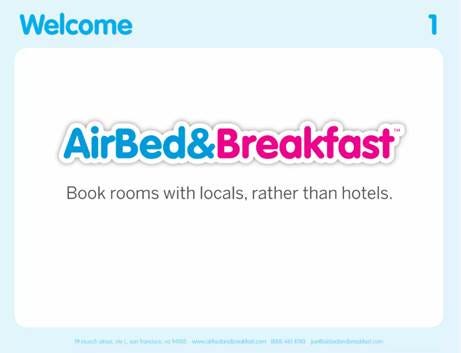
Its first slide had only the logo and a very direct line: "Book rooms with locals, rather than hotels" (Figure 3).
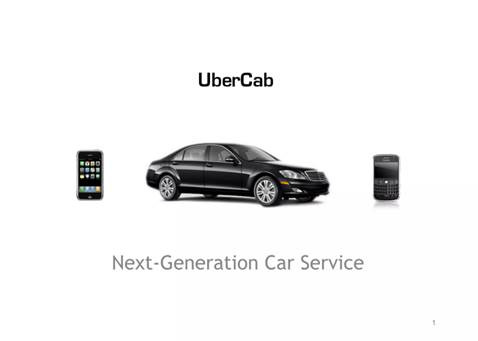
Uber (early stage, 2008): "Next-Generation Car Service". Short, immediately defining the industry and sparking curiosity (Figure 4).
YouTube (Series A, 2005): "Broadcast Yourself". Right on the cover, just two words that capture everything users will do on the platform (Figure 5).

2.2. Slide 2: Company purpose
If slide 1 uses a short "keyword" to spark curiosity, slide 2 is where you formally fix in the investor's mind the clearest definition of your business model and your reason for existing.
Describe the company's purpose in a single declarative sentence. A useful exercise is to fill in the formula: [Company] is [what] for [whom] to [solve which job].
On this slide you can combine vision (what you want to become) and mission (how you will do it) in one sentence. If your vision is enormous (say, completely changing how humanity consumes energy), do not rush to put it on slide 2, or it may seem unrealistic. Weave it in skilfully on slide 5 (opportunity and market size) or slide 12 (call to action and use of funds), so investors see the huge future picture after you have proven the model's feasibility on earlier slides.
Real examples:
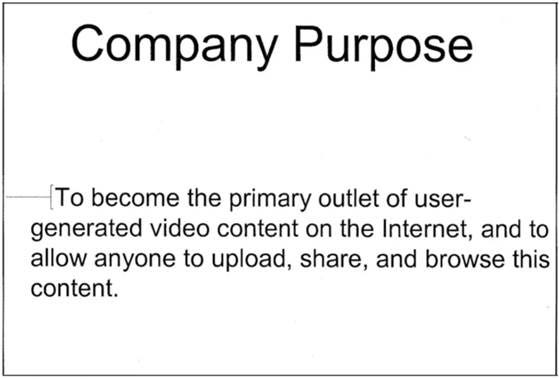
YouTube (Series A, 2005): YouTube defined its purpose in a very clear, unpretentious declarative sentence: "To become the primary outlet of user-generated video content on the Internet, and to allow anyone to upload, share, and browse this content". The sentence combines vision (become the primary outlet...) and mission (allow anyone to...) perfectly (Figure 6).
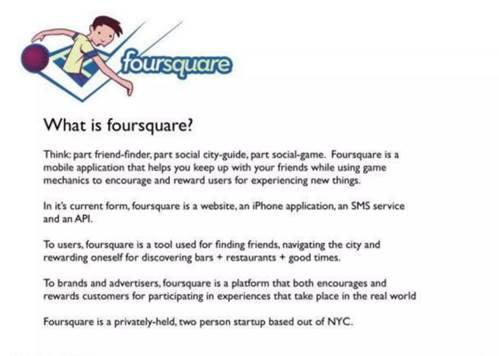
Foursquare (Series A, 2009): Foursquare defined its model through a vivid hybrid: "part friend-finder, part social city guide, part nightlife game". It then pinned down its purpose by separating the core value clearly: for users, a tool for finding friends and earning rewards for exploring places; for brands, a platform for drawing customers into real-world experiences. This explanation let investors grasp the whole product ecosystem in a few short lines (Figure 7).
2.3. Slide 3: The problem
Venture capitalist Skylar Fernandes once said: "You have to solve the customer's number one problem, not their number ten!".
List 3–5 specific problems that are mutually exclusive and collectively exhaustive (the MECE principle).
Prove it is a big "pain" with concrete data (how much money is lost, how many customers suffer).
Show why existing solutions on the market fall short.
Use storytelling to make investors empathize with the market's pain immediately.
Real examples:
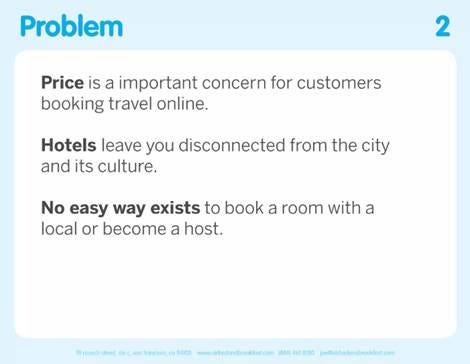
Airbnb (pre-seed, 2008): three sharp bullet points: (1) price is a top concern for travellers; (2) hotels leave travellers disconnected from local culture; (3) there is no easy way to book a room with a local (Figure 8).
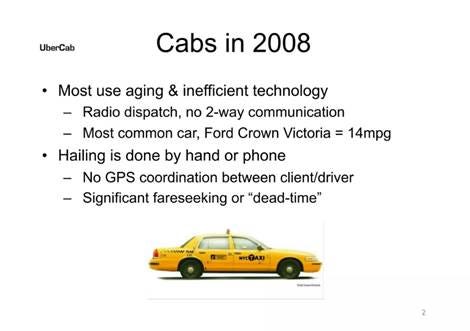
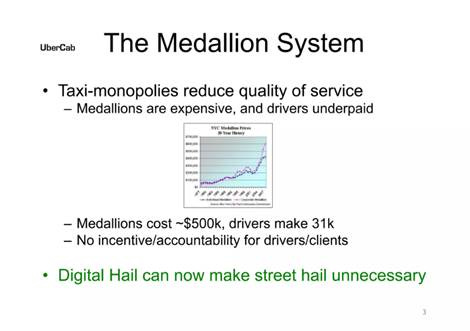
Uber (early stage, 2008): Uber did not just complain vaguely that cabs were hard to get. It used two slides to expose the root of the taxi industry's pain at the time: (1) outdated technology ("Cabs in 2008"): one-way radio dispatch with no GPS to connect customers and drivers, so hailing by hand wasted a lot of dead time; (2) a monopolistic system ("The Medallion System"): taxi licences had been bid up to USD 500,000, yet drivers earned only USD 31,000 a year. This monopoly and exploitation led inevitably to poor service and no accountability to customers. By showing the weaknesses of both the technology and the old operating model, Uber set up the perfect springboard for its "digital hail" solution (Figures 9 and 10).
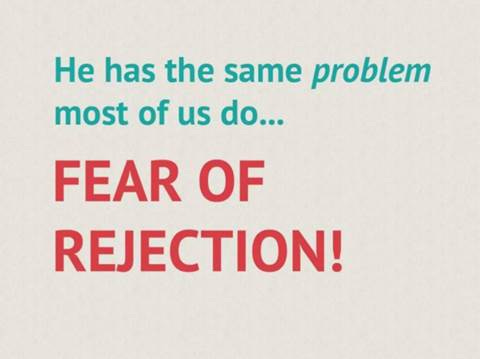
Tinder (the MatchBox version, 2012): Tinder's deck did not use macro statistics. It told the story of a young man named Matt: Matt sees a girl he really likes at a party, BUT he doesn't dare go over and say hello because of the "fear of rejection". With a very ordinary story, it touched the deepest psychological pain of millions of single people (Figures 11 and 12).

2.4. Slide 4: Solution and value proposition
Unlike the big-picture vision on slide 2, the value proposition on slide 4 is 100% practical. It must respond directly to each pain listed on slide 3.
Show how much better the customer's world becomes with your product.
Use visuals: a product demo, a prototype or a short video under 10 seconds.
Use use cases: illustrate step by step how customers interact with the product.
Real examples:
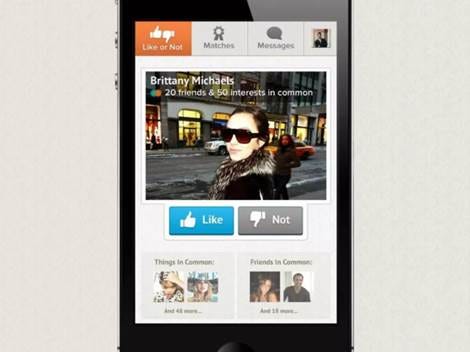
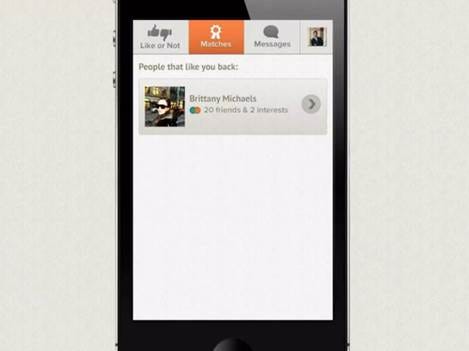
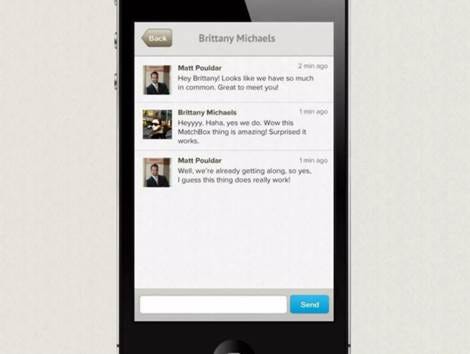
Tinder (the MatchBox version, 2012): Tinder's solution slides used few words. They simply showed three phone screens for the three core feature tabs: "Like or Not", "Matches" and "Messages". The "double opt-in" mechanism (messaging only when both people like each other) came across perfectly through these three screens, removing the "fear of rejection" raised in the problem section (Figures 13, 14 and 15).
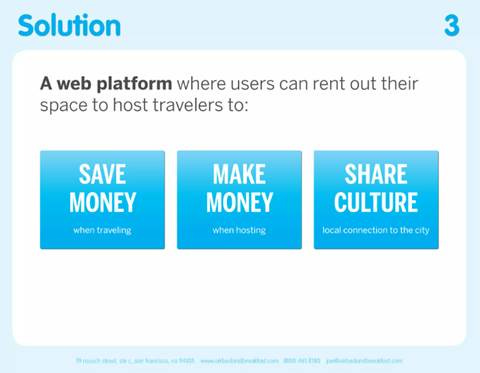
Airbnb (pre-seed, 2008): its solution matched the problem slide one to one: Save money when travelling. Make money when hosting. Share culture (Figure 16).
2.5. Slide 5: Why now and market size
Your solution may be excellent, but investors need to know two things: why do it now, and how big is the pie? Separate these two elements clearly on one slide (or two adjacent slides):
Why now: every business opportunity has a window of time. Why did this idea not appear five years ago, and why would waiting five more years be too late? Point to macro trends, shifts in consumer behaviour or changes in regulation.
Market size: analyse the market through three lenses:
TAM (total available market): total theoretical demand.
SAM (serviceable available market): the part of the market your product targets.
SOM (serviceable obtainable market): the part you can realistically win in the next few years. Investors scrutinize this number most because it reflects your ability to execute (Aulet, 2013).
Real examples:
Coinbase (seed, 2012, illustrating "why now"): to explain "why now?", Coinbase showed a chart of Bitcoin's explosive growth, creating an unprecedented window of opportunity (Figure 17).

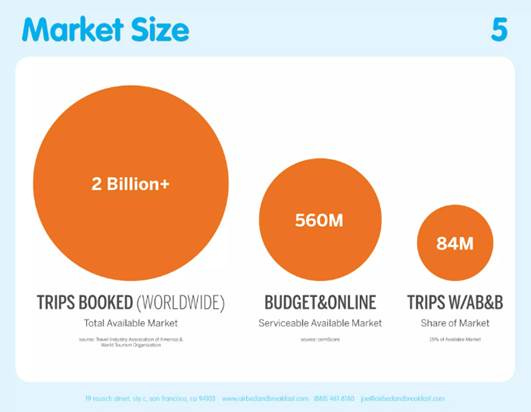
Airbnb (pre-seed, 2008, illustrating market size): a classic lesson in sizing a market. TAM: 2 billion trips booked worldwide. SAM: 560 million budget trips booked online. SOM: 84 million trips with Airbnb (about 15% of SAM, its target) (Figure 18).
2.6. Slide 6: Business model
An important note: in the context of a pitch deck, "business model" really means your answer to the question "How do you make money?" (the revenue model). Keep it simple and easy to understand.
Real examples:
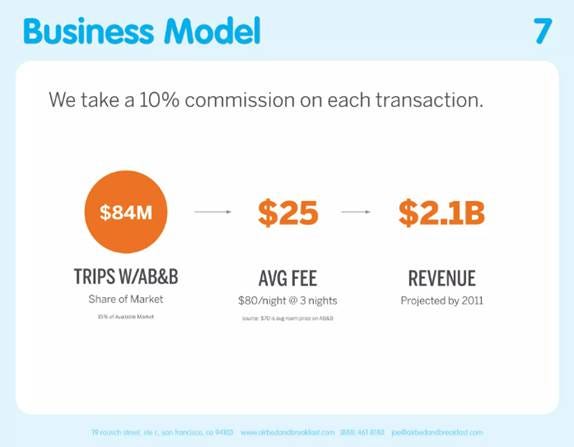
Airbnb (pre-seed, 2008): the slide had just three big numbers: 84 million trips × USD 25 average fee = USD 2.1 billion in revenue. It explained simply: "We take a 10% commission on each transaction". Short and uncomplicated (Figure 19).
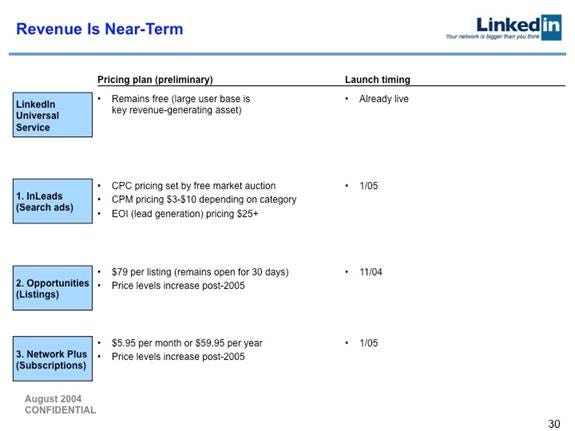
LinkedIn (Series B, 2004): LinkedIn's deck set out three clear revenue streams: listings (recruitment), advertising and premium subscriptions (Figure 20).
2.7. Slide 7: Go-to-market strategy
Knowing where customers are is one thing; bringing them to your business is another. Investors want to see a smart, feasible plan for attracting customers (marketing and sales), not just "pour money into ads".
Which channels will you use? Specify your focus channels (social media, B2B partnerships, paid advertising, SEO or offline events).
What does it cost to acquire one customer (CAC, customer acquisition cost), and how does that compare with customer lifetime value? The lower and more realistically calculated this number is, the more investors will believe in your ability to scale.
Real examples:
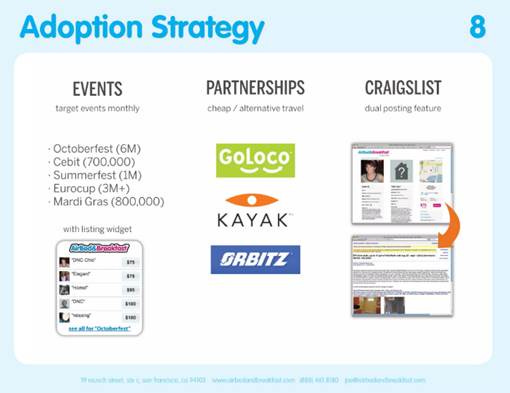
Airbnb (pre-seed, 2008): Airbnb had an outstanding, low-cost go-to-market slide. Instead of expensive ad campaigns, it focused on three core strategies: (1) events: targeting festivals and big events directly, where traditional hotels regularly sell out; (2) partnerships: tying up with budget travel sites; (3) cross-posting to Craigslist: Airbnb's legendary growth hack. It built a feature that let hosts list a room on Airbnb and automatically post it to Craigslist, the giant classifieds site of the time, to pull Craigslist's huge user base back to Airbnb at a CAC close to zero (Figure 21).
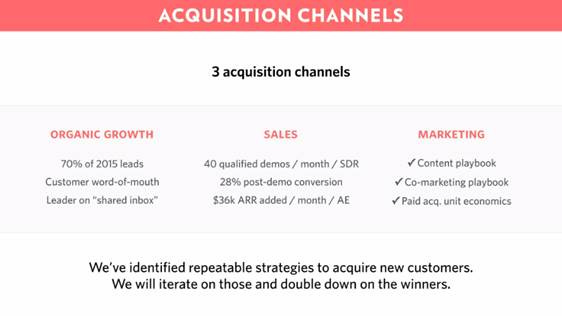
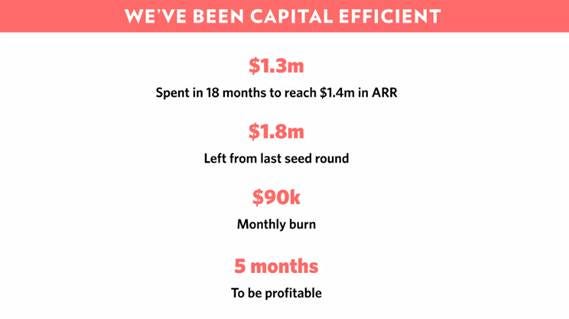
Front (Series A, 2016): Front won investors over by proving its go-to-market strategy in two very practical slides. First, it set out three proven acquisition channels: organic growth (70% of leads in 2015, thanks to word of mouth), sales (a 28% conversion rate after demos) and marketing. It then showed a striking capital-efficiency figure: only USD 1.3 million spent over 18 months to reach USD 1.4 million in annual recurring revenue (ARR), with just five months left to break-even. The message was powerful: it had found repeatable strategies for acquiring customers and now only needed money to double down on that success (Figures 22 and 23).
2.8. Slide 8: Competitive analysis
Never say "we have no competitors". You always do (even before iTunes, its competitors were the shops selling CDs).
Build a competitive profile matrix (CPM) or a competitive positioning chart.
List the criteria your target customers value most (from highest to lowest).
Show clearly where you beat competitors (price, quality, experience, core technology), and why that advantage is hard to copy.
Real examples:
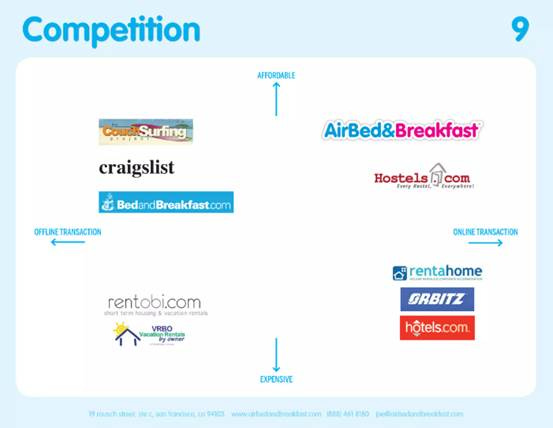
Airbnb (pre-seed, 2008): a competitive positioning chart with two axes: price (affordable to expensive) and transaction method (offline to online). It placed competitors such as CouchSurfing in the "affordable/offline" corner and Hotels.com in the "expensive/online" corner. Airbnb put itself in the emptiest quadrant: "affordable and online", a visual and convincing demonstration of its unique advantage in both price and convenience (Figure 24).
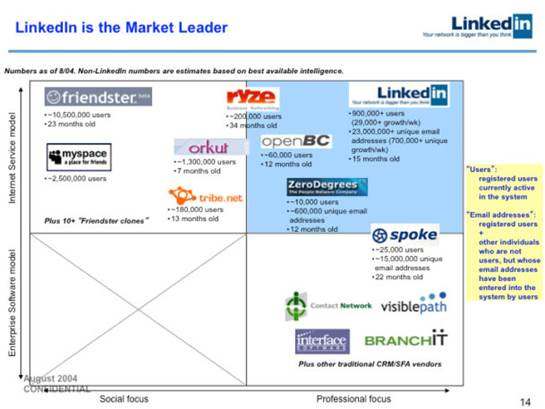
LinkedIn (Series B, 2004): similarly, LinkedIn used a positioning chart with two axes: purpose (social to business) and model (software to internet service). It placed the giants of the time, such as MySpace and Friendster, in the "social" group, and put itself in a unique quadrant: "business and internet service". The masterstroke was showing its dominant growth figure (more than 900,000 users) right next to its logo to claim the position of market leader in this niche (Figure 25).
2.9. Slide 9: Traction and milestones
This is where you prove you deliver on what you say. Traction is the clearest evidence that the market really wants and accepts your product.
Show numbers that speak: waitlist sign-ups, early revenue, pilot results, signed partners or a successful crowdfunding campaign.
Draw a timeline showing what you have achieved and the big milestones you aim to reach in the next few years.
Real examples:
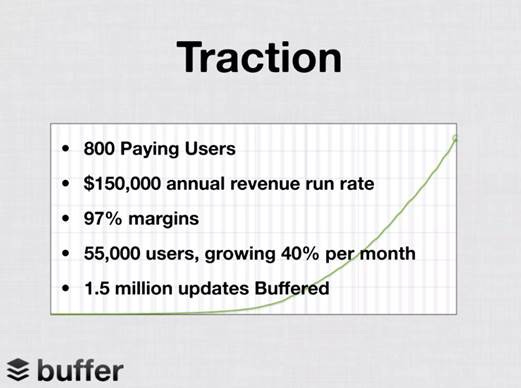
Buffer (seed, 2011): the social media management app raised about half a million dollars in seed funding with a transparent and impressive traction slide: 800 paying users, USD 150,000 in annual revenue run rate (ARR), 97% profit margin. These figures dispelled most investor doubts about its ability to make money (Figure 26).
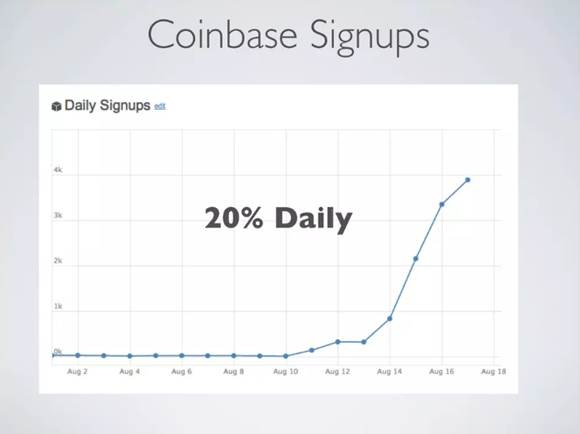
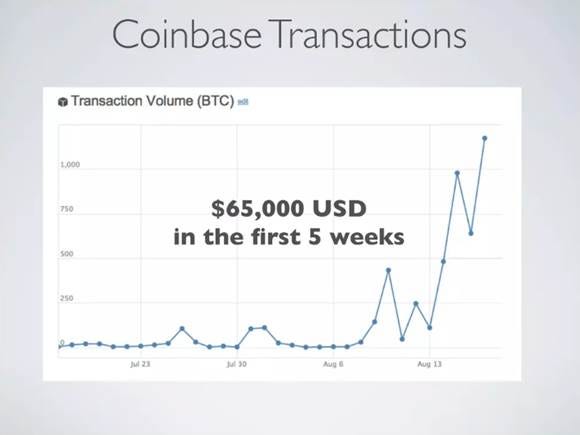
Coinbase (seed, 2012): Coinbase's deck had two traction slides. Although the product had been live for only five weeks, it showed real figures: "3,000+ users and more than USD 65,000 in transaction volume". It is a perfect demonstration that even after a very short time, you can prove the market really needs your product (Figures 27 and 28).
2.10. Slide 10: Financials
You do not need (and should not) paste a full balance sheet or cash-flow statement full of numbers on screen. Keep them in backup slides or the full business plan to send by email later.
On this slide, present high-level revenue and cost projections for the next three to five years in clear charts.
Do not use traditional financial metrics (such as NPV or IRR) for an early-stage startup. Focus instead on the language venture capitalists want to hear: recurring revenue (ARR/MRR), burn rate, runway and headcount.
You can present scenarios (best, most likely, worst) to show you are a realistic founder who understands market risk, not just someone who draws a line going straight up.
Real examples:
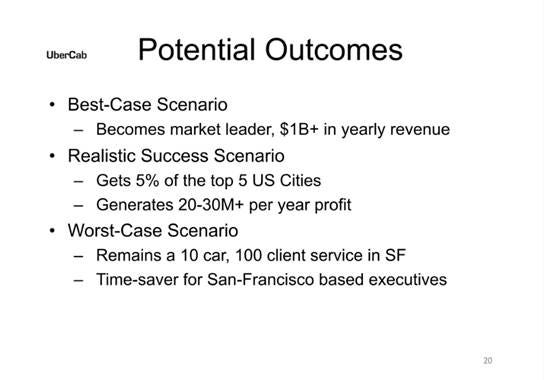
Uber (early stage, 2008): Uber's deck had a very realistic slide called "Potential Outcomes". Instead of empty promises, it laid out three clear scenarios: (1) worst case: a small car service with 10 cars serving 100 customers in San Francisco; (2) realistic success: 5% market share in five major U.S. cities, with USD 20–30 million in annual revenue; (3) best case: global market leader with USD 1 billion+ in revenue. This approach let investors see both the "floor of risk" and the "ceiling of potential" (Figure 29).
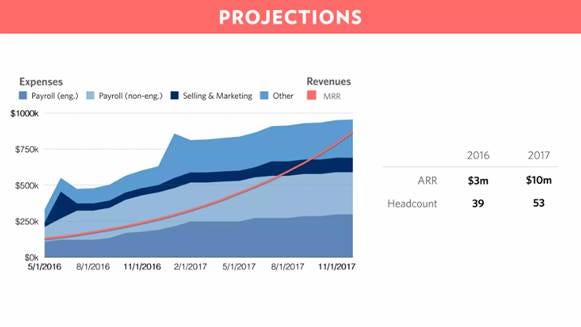
Front (Series A, 2016): instead of a messy spreadsheet, Front used an easy-to-read area chart called "Projections". It showed clearly how costs (engineering salaries, non-tech salaries, sales costs and so on) related to monthly recurring revenue (the red MRR line rising through the cost layers, signalling break-even). It also summarized its growth projection in a very short table: ARR would jump from USD 3 million (2016) to USD 10 million (2017), while headcount would rise only slightly from 39 to 53. This showed investors that the model scales very well: revenue triples without bloating the organization (Figure 30).
2.11. Slide 11: Team
Many investors would rather back an excellent team with a B-grade idea than an A-grade idea with a weak team. An excellent team knows how to pivot when the market shifts.
Highlight each member's "superpower", experience and education, and why this team is the best fit to realize the vision.
Do not forget advisors or the board. Talent attracts talent, and a respected advisory board is a great endorsement of your project.
Real examples:
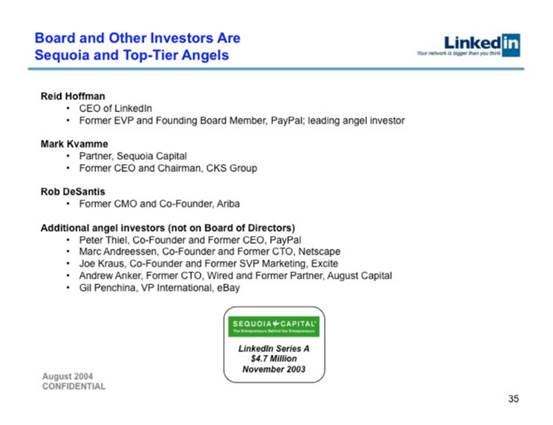
LinkedIn (Series B, 2004): its team slide was heavy artillery. Reid Hoffman listed founding members who came from the "PayPal Mafia" or leading technology companies. Looking at this team, investors knew they were dealing with people who had already created success (Figure 31).
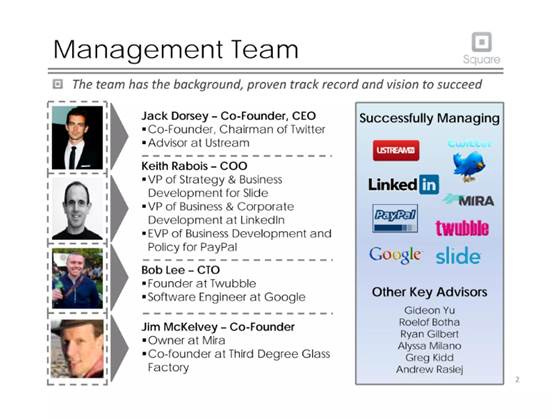
Square (Series D, 2012): its team slide showed not only the founders but also the logos of the companies (Google, PayPal) where its core engineers had worked, a strong endorsement of its technical capability (Figure 32).
2.12. Slide 12: Call to action and use of funds
The last slide is also the one most often forgotten. You must make the ask: how much money are you seeking? In exchange for what percentage of equity? And most importantly: which specific milestone will the money achieve? (Do not just say "for marketing".)
A legal note: issuing equity to investors depends on your company's legal form and jurisdiction; in many countries a limited-liability company must restructure or admit new members first, and many startups in emerging markets incorporate a holding company in Singapore or the United States when raising international capital. This is only general guidance; consult a lawyer before signing a term sheet.
Real examples:
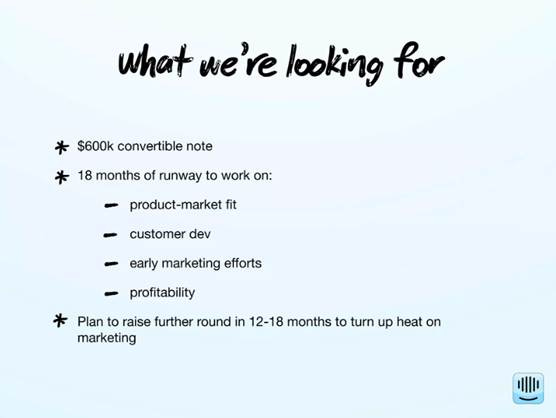
Intercom (seed, 2012): in its USD 600,000 deck, Intercom stated clearly that the money would give it 18 months of runway, enough to finish building the product and reach the revenue milestone needed for a Series A (Figure 33).
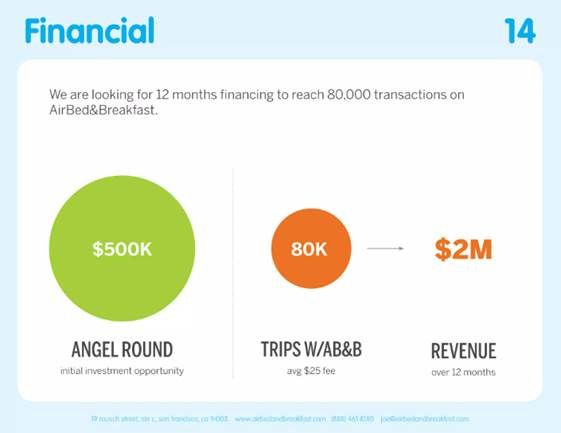
Airbnb (pre-seed, 2008): its closing slide was crisp: "Looking for USD 500,000 in angel investment in exchange for a percentage of equity. This money will help us reach 80,000 trips and USD 2 million in revenue over the next 12 months." A clear, measurable promise (Figure 34).
3. Tools and AI for designing a pitch deck
Once you have the "soul" of a deck through the 12-slide structure, the next question is how to bring it to life professionally, attractively and quickly. Here are resources and tools to consider.
3.1. Dedicated platforms and design software
List current as of October 2026; features and prices change quickly.
Pitch.com: often described as "Figma for presentations". Pitch.com offers hundreds of templates designed by experts and investment funds, a very modern interface and real-time collaboration.
Slidebean: built for startups. Slidebean offers not only templates but also integrated tools for financial modelling and AI-driven automatic layout.
Gamma.app: if you want speed, Gamma is the top choice. Enter a line describing your project and Gamma's AI produces a draft deck, from content to illustrations, in about a minute (though you will still need to refine it).
Canva / Visme / PowerPoint / Keynote: these traditional tools remain very powerful if you already think like a designer. Canva now also offers many high-quality "startup pitch deck" templates.
3.2. Template and example libraries
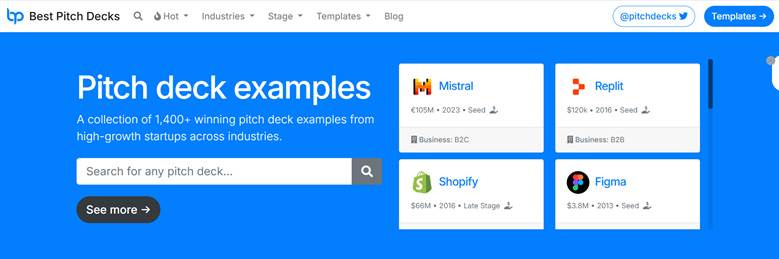
To learn from the best, you do not have to guess. BestPitchDeck.com is an invaluable archive with hundreds of original decks from startups that raised money successfully (from Uber, Airbnb and Coinbase to startups in every field, such as SaaS, fintech and edtech). Dissecting these real decks helps you understand how top founders think and present numbers (Figure 35).
3.3. An AI prompt for drafting deck content
If you are stuck for ideas or unsure how to phrase things sharply, use ChatGPT, Claude or Gemini with a prompt built around the 12-slide formula below. Copy it and fill in your details in the square brackets [...].
Prompt:
Act as a top venture capital consultant in Silicon Valley with 15 years of experience helping startups raise seed and Series A rounds.
I am preparing a pitch deck for my startup. Here is the basic information:
Project name: [your startup's name]
Industry: [e.g. edtech, fintech, SaaS...]
Customer problems: [briefly describe 2–3 problems]
Our solution: [what your product does to solve them]
Revenue model: [how you make money, e.g. subscriptions, commissions...]
Target customers: [who will pay you?]
Unique competitive advantage: [core technology, network, or biggest differentiator]
Amount to raise: [e.g. USD 500,000]
Based on this information, write detailed content for a pitch deck of exactly 12 slides in this standard structure:
Cover (one-liner)
Company purpose
The problem
Solution and value proposition
Why now and market size
Business model
Go-to-market
Competitive analysis
Traction and milestones
Financials
Team
Call to action and use of funds
Requirements: write in professional, concise business language using bullet points. For each slide, suggest which image or chart would illustrate it most clearly.
With this prompt, AI will give you a sharp content skeleton; your job is to check its feasibility, move it onto a design platform and refine it to suit your style.
Important: AI only helps suggest a skeleton and phrasing. You must verify the numbers, set a realistic strategy and breathe life into your own story.
4. Presenting to investors
A well-designed deck is only half the job; the other half is how the founders deliver it. While listening, investors judge not only the idea but the people presenting it: their composure, how well they work together and how they handle the unexpected are all signals of their ability to run a company. This section covers three things before and during the presentation: preparation, who presents, and connecting with the audience.
4.1. Preparing for the meeting
The first and most important piece of preparation is learning about the people you will pitch to. A fund's portfolio and its partners' backgrounds are usually published on its website. This pays off in two ways. First, if you can link your project to the areas the fund cares about, the audience will see more value in it; conversely, if the fund has just backed a direct competitor, you want to know in advance and prepare your answer. Second, a personal connection, such as a shared university or interest, helps break the ice, as long as it is genuine.
The rest of the preparation is practical: know the time allowed and stick to it absolutely; rehearse many times to check timing and get feedback; watch others pitch and learn from them; and check the venue in advance, for example increasing font size for a large hall, or testing the projector connection and keeping a PDF backup on hand.
4.2. Who presents, and what the slides are for
When a startup has several founders, consider having more than one of them present, for example the business lead covering the market and traction while the technical lead demonstrates the product. Taking turns shows that the team works well together and that nobody dominates, and it helps investors get to know each member. The condition is clear roles and smooth handovers; one clumsy handover does more harm than good.
A common mistake is letting the slides tell the story instead of the presenter. The founder is the storyteller; the slides only provide context and highlight key points. Duarte (2012) offers a memorable test: if the story can be told entirely by the slides without the presenter, it is not a good pitch. It also helps to distinguish the deck you present from the deck you email before the meeting: the emailed version must stand on its own and can carry more text, while the presented version should stay minimal, following the rules in section 1.2.
4.3. Connecting with the audience
The biggest challenge in front of investors is not passing on information but creating a connection. There are many ways to do it: telling the story of a real customer, using humour with restraint, showing passion through voice and gesture, or demonstrating the product live. Mehrabian's (1971) classic research on emotional communication is often cited to claim that most of a message is carried by tone of voice and body language. It should be read carefully: those percentages apply only to conveying feelings and attitudes, not to every kind of communication, and in a fundraising meeting the substance still decides the outcome. The lesson that remains is sound: how you speak raises or lowers the credibility of what you say. Table 1 summarizes six principles commonly recommended to founders.
When the presentation ends, the next challenge begins: the Q&A.
5. Mastering the Q&A
If the 20-minute presentation is the warm-up to capture attention, the Q&A is the real battle that decides whether you get a nod from investors. Throughout this time, keep your cover slide (or contact slide) on screen.
Investors often seem demanding and keep looking for holes. Do not be discouraged. Michael Rovner, a partner at AV Labs, once said: "We ask a lot of tangential questions. Sometimes we don't need an exact answer; we just want to evaluate the entrepreneur's thought process." An investor who points out a weakness in your project is actually doing you a favour, helping you rethink and improve your model.
To master the Q&A, preparation is the key. The four subsections below present four ways to prepare: backup slides, anticipating the families of questions, facing questions that test you as a person, and rehearsing with AI.
5.1. Backup slides
One of founders' biggest mistakes is cramming everything into the 12 main slides. Instead, always prepare a detailed set of backup slides after the "Thank you" slide.
When investors ask in depth about financial assumptions, unit economics or the complex technical architecture of the product, confidently switching to a carefully prepared backup slide earns full marks for professionalism. What's more, after every pitch, successful or not, note any new questions that came up and keep adding to your store of backup slides.
5.2. Anticipate five key families of questions
However smoothly you present, be ready to defend your reasoning against five classic families of questions that come up in every fundraising meeting. Investors do not just want answers; they want to test your logic and preparation:
Team questions: investors want to know whether you are truly cohesive and capable of executing.
Why is the current team capable of executing what you have just proposed?
How do you divide responsibilities among members?
What is the equity split among members?
When you disagree, how are decisions made? Who is really the boss (the final decision-maker)?
Who came up with the original idea?
Whom (which positions) do you need to add to the team in the short term?
What obstacles have you faced, and how did you overcome them together?
Are you willing to change the idea (pivot) if the market does not respond?
Product and customer questions:
What really makes customers want to try your product or service?
What is the core technology behind your product?
How exactly does your product work?
What are the biggest risks of this technology or product?
What is the next step in the product's evolution?
Where do most of your customers come from today? How many customers do you have?
Who will be your first paying customer?
How are you understanding customer needs? How do you know for sure that people really want this product?
Competition questions:
Which competitor do you fear most?
Are the barriers to entry high or low? In other words, can other competitors easily enter the same market?
How much money have your competitors made?
Why do you think you are unique and different from competitors?
If the big players wanted to do what you are doing, what would stop them?
Why has no one done such a good idea before?
Financial questions:
How did you calculate your market size?
What assumptions lie behind your revenue projections?
Are your financial figures similar to those of your competitors?
What happens if you do not reach your projected revenue?
If I invest, exactly what will you do with the money, and what specific impact will it have on the business?
What is the typical cycle from first contact with a customer to closing a sale?
What does it cost to acquire one customer (CAC)?
Growth and vision questions:
If your startup succeeds, which adjacent areas could you expand into?
Are there other applications for your product, service or technology?
How do you define success? How big do you want this company to grow?
What is the most likely exit strategy for this business?
What are your growth projections based on?
5.3. Facing questions that test you as a person
However well you prepare, some questions will stop you in your tracks. Caroline Cummings, a technology entrepreneur who raised USD 1 million, compiled a list of the ten most unexpected questions she received from VCs.
These questions are not meant to assess the project but to assess you as a person: your honesty, self-awareness and trustworthiness:
Who believes in you, and how can I contact them?
Which entrepreneur do you admire most, and why?
How do you keep track of trends in your market?
Can you tell me a real story about a customer using your product?
How do you know you need exactly this amount of money? Could you scale with less?
How can I connect with five customers who have used your product?
What will your market look like in five years thanks to your product?
What mistakes have you made in this project so far, and what did you learn from them?
The toughest question: if in three to five years we found you were no longer the right person to run this company (as CEO), how would you handle it?
Have you ever been fired from a job? Tell us about it.
5.4. Using AI as a sparring partner
Just as with slide design, AI is an excellent tool for simulating the pressure of a real meeting room. Instead of only imagining questions yourself, you can turn ChatGPT, Claude or Gemini into seasoned venture capitalists for live practice.
Give the AI your deck content and use this prompt to challenge yourself:
Prompt:
Act as an extremely demanding and sharp venture capitalist. I have just presented my pitch deck for [your project's name – a one-sentence description].
Now ask me the 10 toughest questions to probe the revenue model, scalability, market risk, barriers to entry and the founding team's ability to execute.
Requirements: stay fully in character. Do not ask all 10 questions at once; ask one at a time so I can answer. After each answer, give blunt feedback on how convincing it was, point out any holes in my reasoning, and only then move on to the next question.
Sparring with AI in scenarios like this not only helps you fill gaps in your reasoning and prepare data for backup slides, but also builds the composure and confidence to face any real investor.
Conclusion
In short, building and presenting a pitch deck is not just reporting a business plan; it is a subtle blend of storytelling, data analysis, technology and a deep understanding of investor psychology.
The ultimate key to owning this stage is preparation. By designing coherent slides in a logical structure, making full use of modern tools, presenting with passion, knowing every number inside out and anticipating the toughest questions in the Q&A, you will create a highly persuasive presentation.
Always remember one vital principle, though: the goal of a pitch is rarely to receive a cheque on the spot. Its real job is to engage the audience and make investors curious and confident enough to schedule a second meeting, where real commitments and funding are decided.
Master this sharp tool and you are not just selling an idea; you are seizing the chance to find true companions on a startup journey that is full of obstacles but also immensely rewarding. Good luck with your fundraising!
References
Airbnb. (2008). Airbnb pitch deck from 2008 [Slide deck]. SlideShare. https://www.slideshare.net/slideshow/airbnb-pitch-deck-from-2008/65585661
Aulet, B. (2013). Disciplined entrepreneurship: 24 steps to a successful startup. Wiley.
Barringer, B. R., & Ireland, R. D. (2019). Entrepreneurship: Successfully launching new ventures (6th ed.). Pearson.
Buffer. (2011). Buffer seed round deck [Slide deck]. SlideShare. https://www.slideshare.net/slideshow/buffer-seedrounddeck/20684215
Coinbase. (2012). Coinbase seed round pitch deck [Slide deck]. SlideShare. https://www.slideshare.net/slideshow/coinbase-seed-round-pitch-deck/78867044
Duarte, N. (2012). HBR guide to persuasive presentations. Harvard Business Review Press. https://store.hbr.org/product/hbr-guide-to-persuasive-presentations/11150
Foursquare. (2009). Foursquare first pitch deck [Slide deck]. SlideShare. https://www.slideshare.net/slideshow/foursquare-1stpitch2009/10620782
Front. (2016). Front Series A deck [Slide deck]. SlideShare. https://www.slideshare.net/slideshow/front-series-a-deck-64596550/64596550
Intercom. (2012). Intercom's first pitch deck [Slide deck]. SlideShare. https://www.slideshare.net/slideshow/intercoms-first-pitch-deck/60630417
Kawasaki, G. (2004). The art of the start. Portfolio.
Kawasaki, G. (2005, December 30). The 10/20/30 rule of PowerPoint. How to Change the World. https://guykawasaki.com/the_102030_rule/
LinkedIn. (2004). LinkedIn Series B pitch deck [Slide deck]. SlideShare. https://www.slideshare.net/slideshow/linkedin-deck-27367069/27367069
Mehrabian, A. (1971). Silent messages. Wadsworth. https://www.amazon.com/s?k=Silent+messages+Mehrabian&i=stripbooks
Sequoia Capital. (n.d.). Writing a business plan. https://www.sequoiacap.com/article/writing-a-business-plan/
Square. (2012). Square pitch deck [Slide deck]. SlideShare. https://www.slideshare.net/slideshow/square-pitch-deck/13971387
Tinder. (2012). Tinder (MatchBox) pitch deck [Slide deck]. SlideShare. https://www.slideshare.net/slideshow/tinder-pitch-deck/69837113
Uber. (2008). Uber pitch deck [Slide deck]. SlideShare. https://www.slideshare.net/slideshow/uber-pitch-deck/79089661
YouTube. (2005). YouTube Series A pitch deck [Slide deck]. SlideShare. https://www.slideshare.net/slideshow/youtube-pitch-deck-87211646/87211646
Discussion about this post