AI Risk Governance: Inventory, Risk Register and Three Lines
A business cannot hand responsibility to a chatbot, so it needs a system that shows when its AI cannot be trusted


Key takeaways
Responsibility cannot be delegated to a machine. A company answers for what its AI says and does, just as it answers for its staff.
Every governance framework starts with the same task: an inventory of the AI systems the business actually uses, including AI built into purchased software and tools staff adopt on their own.
A risk register scores likelihood and impact before and after controls, and gives every risk a named owner, a monitoring metric and a review date.
Controls mostly reduce likelihood; few reduce the impact of an incident that has already happened. Residual risk must be accepted consciously by leadership.
The three lines model puts risk ownership with whoever captures the value, while the EU AI Act turns much of this good practice into legal obligation by 2027–2028.
In 2022, a customer asked Air Canada's chatbot about bereavement fares. The chatbot replied that he could buy a full-price ticket and claim the difference back later, which contradicted the airline's policy. He bought the ticket on the strength of that answer and was refused a refund. When he sued, Air Canada argued that the chatbot was a separate entity responsible for its own statements. British Columbia's Civil Resolution Tribunal rejected the argument: the airline is responsible for all the information on its website, whether it comes from a static page or from a chatbot (Moffatt v. Air Canada, 2024).
The case involved only a few hundred Canadian dollars, but it states a principle of wide value: responsibility cannot be handed to a machine. Whatever a business uses AI to do, it remains responsible for that work just as if people had done it. The governance question is therefore not "can AI be trusted?" but "what system does the business have to know when it cannot?"
This article presents such a system in four sections. Section 1 introduces the NIST AI Risk Management Framework, the ISO/IEC 42001 standard and the first task of all: building an inventory of AI systems. Section 2 shows how to build a risk register. Section 3 assigns responsibility using the three lines model. Section 4 outlines the EU AI Act and data protection law, then suggests clauses to include in contracts with AI vendors.
1. Frameworks for AI governance
A business does not need to invent AI governance from scratch. Widely used frameworks already exist; they are voluntary and apply to organizations of any size. This section introduces the two most common and the task that every framework starts with.
1.1. The NIST AI Risk Management Framework
In 2023, the U.S. National Institute of Standards and Technology (NIST) published the AI Risk Management Framework (AI RMF). It is not specific to any industry and organizes risk management into four functions (National Institute of Standards and Technology, 2023), as shown in Figure 1.
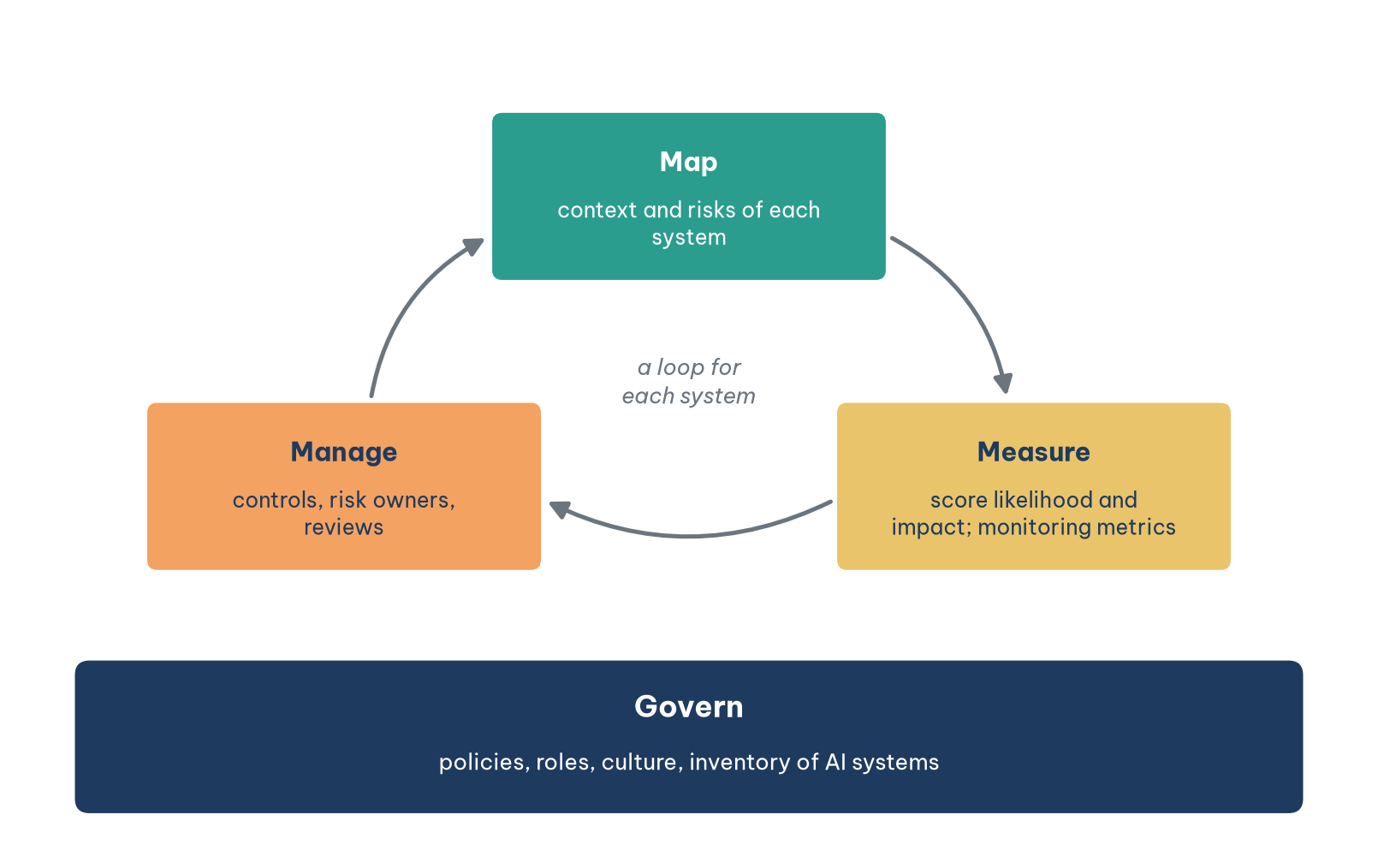
Govern sets policies, roles and culture; it is the shared foundation without which nobody starts the loop. Map establishes the context and risks of each system. Measure assesses risks through measurement. Manage prioritizes and acts. In 2024, NIST added a dedicated profile for generative AI, listing specific risks such as confabulated content, data leakage, information security and intellectual property infringement (National Institute of Standards and Technology, 2024).
1.2. ISO/IEC 42001
If NIST says what to do, ISO/IEC 42001, published at the end of 2023, says how to organize that work into a management system that a third party can audit and certify, much like ISO 9001 for quality or ISO/IEC 27001 for information security (International Organization for Standardization, 2023). For a mid-sized business, certification is not yet necessary, but using the standard's structure as a frame helps ensure nothing is missed. Certification can become an advantage when selling to business customers or working with international partners.
1.3. The inventory of AI systems
Every governance framework starts with the same task: knowing which AI systems the business uses. It sounds simple but is often the hardest step, because AI hides in purchased software, in new features vendors switch on, and in tools staff adopt without the technology team knowing. An AI system inventory records for each system its purpose, the decisions it affects, the data it uses, the vendor, the business owner and the risk level. Without an inventory, there is no way to know what must be governed, and no answer to a regulator's first question.
2. The AI risk register
The inventory says which systems the business has; the risk register says how each one could cause harm. This section explains how to score risks, applies the method to a hypothetical business and warns about a common mistake.
2.1. Scoring
The risk register is the central tool of the map and manage functions. Each risk is scored for likelihood and for impact if it occurs, on a 1–5 scale; the risk score is the product of the two. Each risk is scored twice: inherent risk with no controls in place, and residual risk after controls are applied. The gap between the two scores shows the value of the controls. Residual risk is something leadership must accept consciously, not something that simply happens.
2.2. Nha Vui Home's risk register
Consider Nha Vui Home, a hypothetical furniture retailer that uses or plans to use six AI systems: a customer service assistant, demand forecasting, personalized promotions, fraudulent-order detection, an agent that handles returns, and AI tools that staff use on their own. Table 1 records eight of its risks with the main controls.
Every row of Table 1 has a named risk owner, not a vague "technology department". That is the condition for the register to be genuinely updated. Figure 2 places the eight risks on a heat map before and after controls.
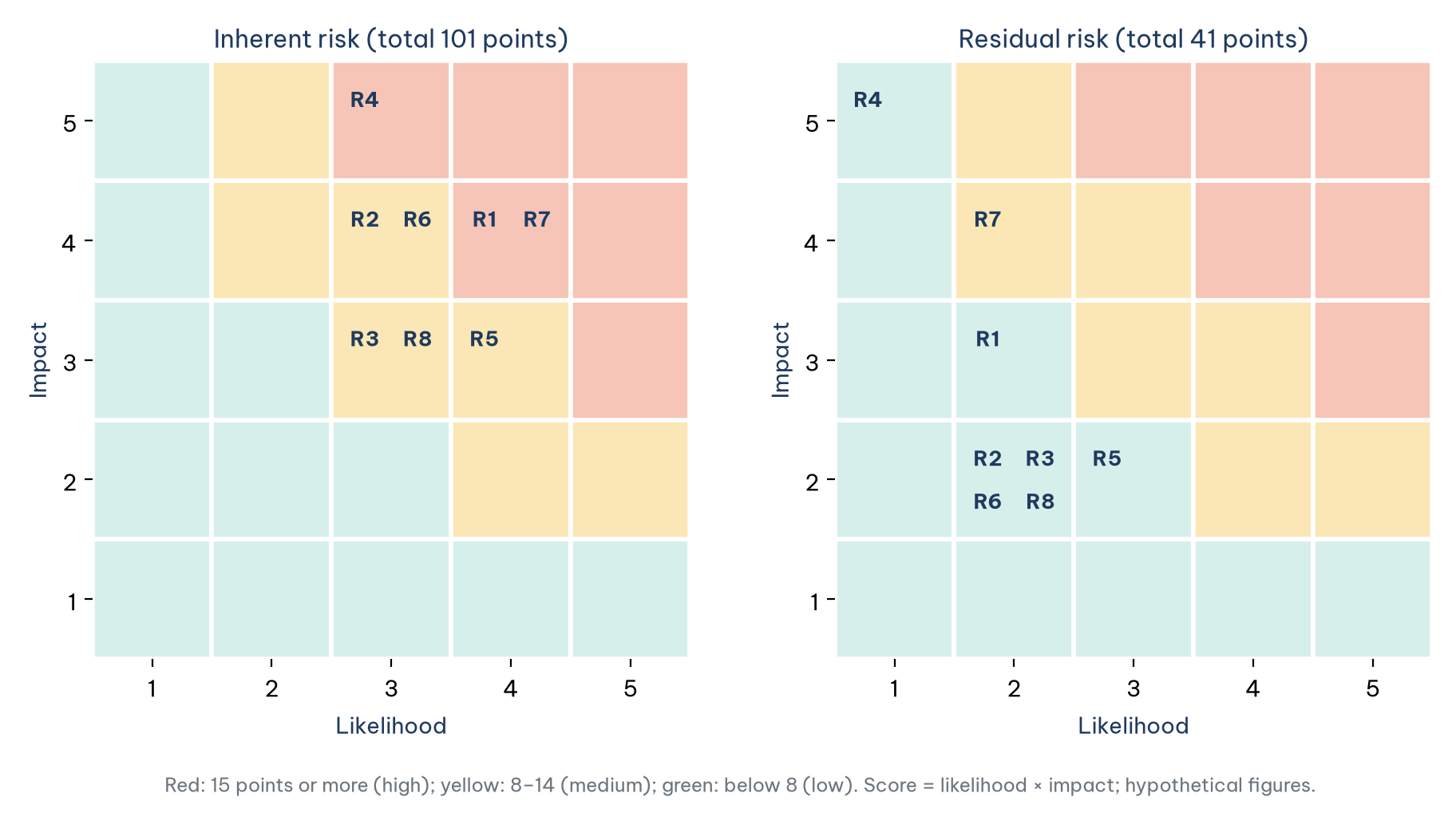
Figure 2 shows the total score of the eight risks falling from 101 to 41 and the number of high risks falling from three to zero. Two points stand out. First, the controls mostly reduce likelihood; very few reduce the impact of an incident that has already happened. For R4, impact remains 5, because a personal data breach is always serious. Second, R7 (shadow AI) remains at a medium level: no control completely removes the chance that an employee pastes data where it should not go. That is residual risk the board must know about and accept.
Risk R5 deserves explanation. A fraud model can catch fraud equally well across customer groups, yet because fraud rates are higher in some provinces, honest customers there are still wrongly held more often than city customers. The control here does not fix the model but fixes how its output is used: replace "hold the order for three days" with "call to verify within two hours".
2.3. The trap of a one-off register
Many risk registers are carefully built for a project approval and then left untouched. The mechanism of the error is treating risk as a fixed property of a system, when AI risk changes with the data, with the version of the foundation model and with how real users interact, all of which surface only after deployment. The remedy is to tie each risk to a monitoring metric (rate of wrong policy answers, false alarms by customer group and so on), a named owner and a regular review schedule, and to update the register after every incident and every vendor model upgrade.
3. Who is responsible: the three lines model
A risk register needs a structure of responsibility to go with it. The Institute of Internal Auditors' three lines model, updated in 2020 from the "three lines of defense", is a framework many businesses use; the new version stresses that first- and second-line roles may be combined or separated depending on the organization (The Institute of Internal Auditors, 2020). Table 2 applies the model to AI.
The core principle of Table 2 is that whoever creates the value also owns the risk. The head of customer service, who benefits when the AI assistant lightens the contact center's load, is also responsible when the assistant answers wrongly. The second line sets standards and oversees; the third line provides independence.
The third line needs a method. Raji and colleagues propose a framework for internal algorithmic auditing across the development lifecycle, in which each stage produces a set of documents that together form an audit report based on the organization's own values and principles (Raji et al., 2020). Documents such as data sheets, model cards, pre-deployment assessment forms, risk registers and agent action logs are the audit evidence. A business that produces them as part of its everyday work will not have to reconstruct them when an auditor or regulator asks.
4. The regulatory map
The period 2025–2028 is crowded with regulatory milestones for AI. Figure 3 places the main milestones of voluntary frameworks and of the EU AI Act side by side; this section then presents the AI Act, the role of data protection law and the contract clauses that help a business meet its responsibilities.
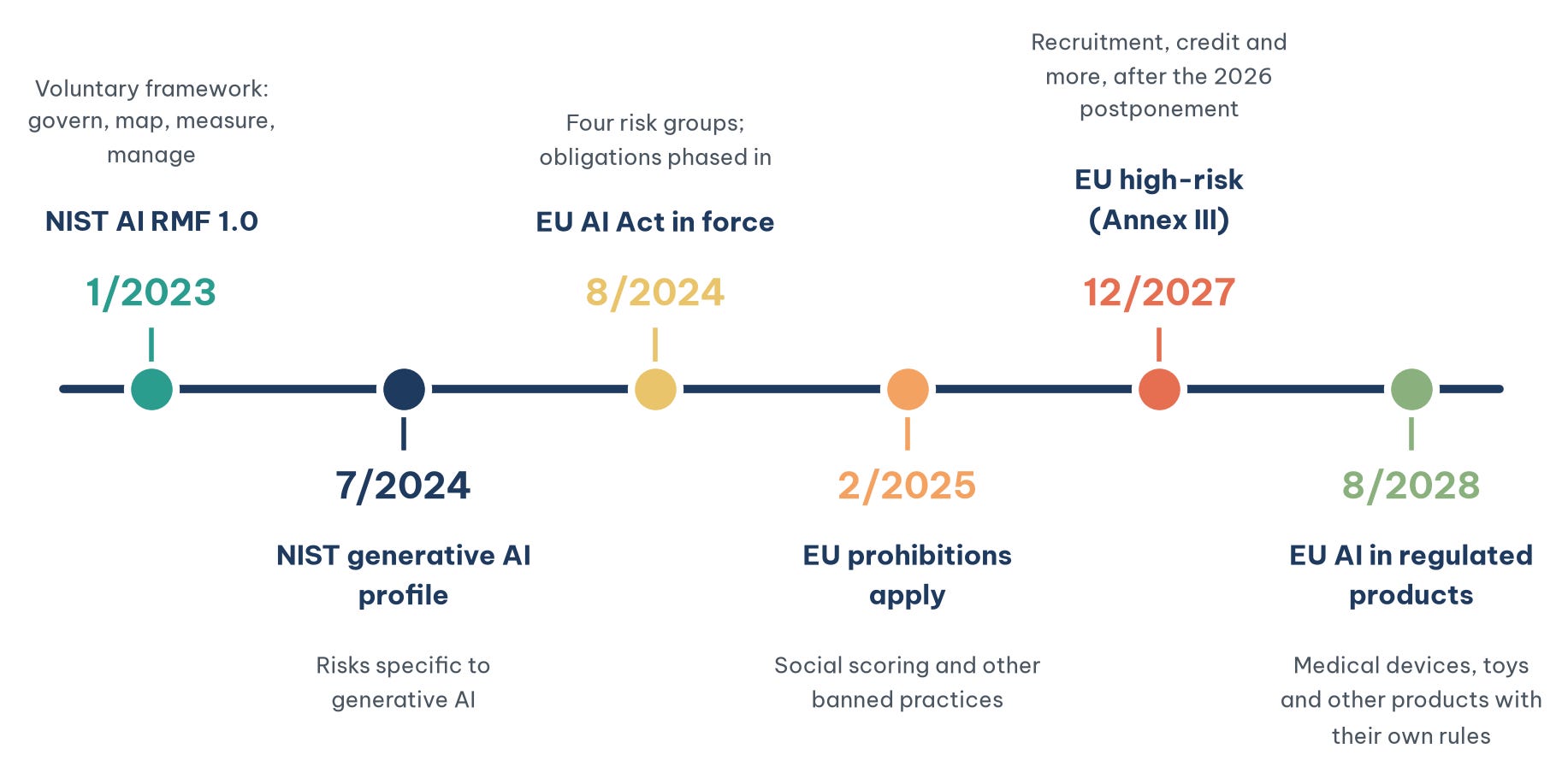
Figure 3 shows that businesses do not have much time. Those that start building their AI inventory now are the ones that will finish before the transition periods end.
4.1. The EU AI Act and its 2026 amendment
The EU AI Act is the world's first comprehensive legal framework for AI. It divides AI systems into four groups: prohibited (such as social scoring), high-risk (such as AI in recruitment and credit scoring), transparency obligations (such as chatbots and AI-generated content) and minimal risk. The prohibitions have applied since 2 February 2025; violations can be fined up to €35 million or 7% of the previous year's worldwide turnover, whichever is higher (European Parliament & Council of the European Union, 2024). In 2026, the EU adopted the "Digital Omnibus" amendment package, postponing obligations for high-risk systems to 2 December 2027 for areas such as recruitment and credit, and to 2 August 2028 for AI embedded in products that already have their own safety rules; the prohibitions were not postponed (European Parliament & Council of the European Union, 2026). Table 3 summarizes the four groups.
The Act also reaches organizations outside the EU when an AI system is placed on the EU market or its output is used in the EU. A software company outside Europe selling a CV-screening tool to European clients, or a furniture exporter using a chatbot to serve buyers in Germany, falls within its scope. Businesses operating in several markets should design one governance system that meets the strictest applicable standard, rather than maintaining parallel sets of procedures.
4.2. Data protection law
AI law does not stand alone. Data protection laws, such as the EU's General Data Protection Regulation and the national data protection laws now in force in many countries, govern every processing of personal data, including data used to train and run AI. At Nha Vui Home, risk R4 (personalization beyond the scope of consent) is a legal risk under data protection law even if the personalization model is not classified as high-risk under any AI law. In practice, the risk register is where AI law and data protection law meet: each risk row should note which laws make it a legal, not just a business, risk.
4.3. Contracts with AI vendors
The principle of the Air Canada case has a practical consequence: when buying or renting AI, a business remains responsible to its customers, so it must use contracts to obtain the tools it needs to meet that responsibility. Six groups of clauses are worth including:
Data: whether the vendor may use the business's data to train models; where the data is stored.
Model changes: whether the vendor gives advance notice before upgrading the foundation model (risk R8).
Transparency: whether model cards and evaluation results are provided.
Incidents: the deadline for notifying errors or leaks.
Audit: whether the business or a third party may inspect.
Termination: how data and conversation history can be exported, to avoid lock-in to a single vendor.
The second and sixth clauses matter even more now that the price of AI services can rise sharply as providers move away from subsidized pricing.
Conclusion
The Air Canada case shows that a business cannot shift responsibility to a chatbot. The governance question therefore moves from "can AI be trusted?" to "what system does the business have to know when it cannot?". That system has four layers that follow one another: an inventory showing which AI the business uses; a risk register that scores likelihood and impact before and after controls, with an owner and a review schedule; a three lines structure in which whoever captures the value also owns the risk; and contract clauses that give the business the tools it needs when AI comes from outside.
The regulatory framework is closing in quickly. The EU AI Act's prohibitions already apply, and its obligations for high-risk systems take effect from late 2027, alongside data protection laws that already cover AI's use of personal data. Businesses that get internal governance right now will find that compliance becomes a matter of reorganizing documents they already have, rather than a last-minute race.
References
European Parliament & Council of the European Union. (2024). Regulation (EU) 2024/1689 laying down harmonised rules on artificial intelligence (Artificial Intelligence Act). https://eur-lex.europa.eu/eli/reg/2024/1689/oj
European Parliament & Council of the European Union. (2026). Regulation (EU) 2026/1744 amending Regulation (EU) 2024/1689 as regards the simplification of the implementation of harmonised rules on artificial intelligence (Digital Omnibus on AI). https://eur-lex.europa.eu/eli/reg/2026/1744/oj
International Organization for Standardization. (2023). Information technology. Artificial intelligence. Management system (ISO/IEC Standard No. 42001:2023). https://www.iso.org/standard/81230.html
Moffatt v. Air Canada, 2024 BCCRT 149. https://decisions.civilresolutionbc.ca/crt/crtd/en/525448/1/document.do
National Institute of Standards and Technology. (2023). Artificial intelligence risk management framework (AI RMF 1.0) (NIST AI 100-1). U.S. Department of Commerce. https://doi.org/10.6028/NIST.AI.100-1
National Institute of Standards and Technology. (2024). Artificial intelligence risk management framework: Generative artificial intelligence profile (NIST AI 600-1). U.S. Department of Commerce. https://doi.org/10.6028/NIST.AI.600-1
Raji, I. D., Smart, A., White, R. N., Mitchell, M., Gebru, T., Hutchinson, B., Smith-Loud, J., Theron, D., & Barnes, P. (2020). Closing the AI accountability gap: Defining an end-to-end framework for internal algorithmic auditing. In Proceedings of the 2020 Conference on Fairness, Accountability, and Transparency (pp. 33–44). Association for Computing Machinery. https://doi.org/10.1145/3351095.3372873
The Institute of Internal Auditors. (2020). The IIA's three lines model: An update of the three lines of defense. https://www.theiia.org/en/content/position-papers/2020/the-iias-three-lines-model-an-update-of-the-three-lines-of-defense/
Discussion about this post