AI Killed the MVP: Rebuilding the Startup Classroom
When AI makes building a product almost free, how Steve Blank is redesigning the Lean LaunchPad method, and what educators everywhere can take from it


Key takeaways
In spring 2026, every team in Steve Blank's Stanford class arrived on day one with a finished, AI-built product. The teams that looked most advanced learned the least.
Blank names three problems: evidence theater, a hallucination that lives in the founders rather than the machine, and learning debt.
The MVP no longer proves technical skill or customer discovery. Blank renames day-one products Initial Untested Products (IUPs) and tests them only in small snippets.
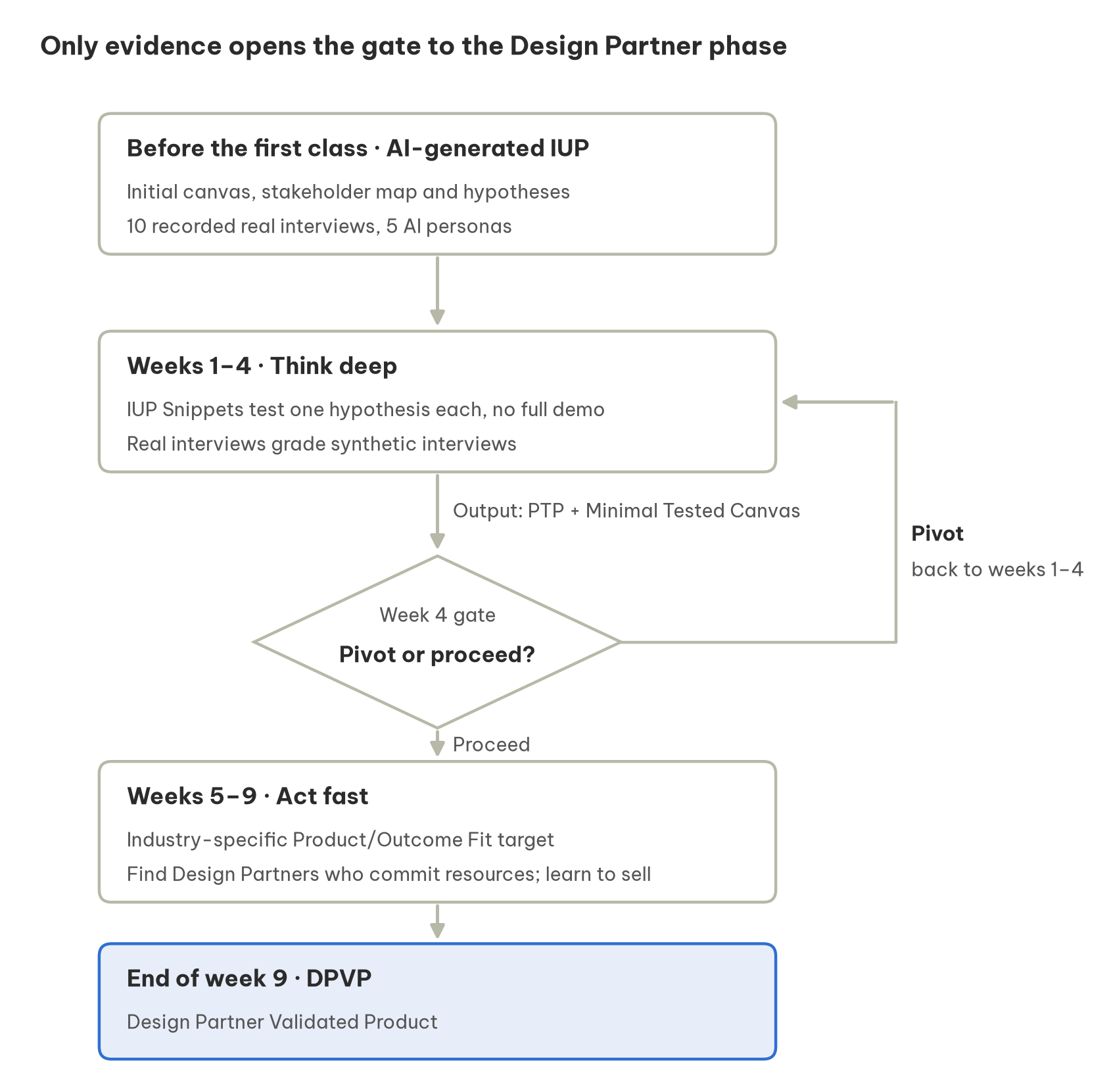
The new course thinks deep in weeks 1–4, passes an explicit evidence gate in week 4, then acts fast to win Design Partners who commit scarce resources.
AI makes building cheap; it does not make understanding cheap. "Get out of the building" matters more than ever.
When anyone can build a product that looks finished over a single weekend, the hardest question in entrepreneurship is no longer "how do we build it?" but "what should we build, for whom, and what evidence shows they really need it?". This article summarizes and analyses the four-part series Steve Blank published in September 2026 on how AI "broke" the Lean LaunchPad class at Stanford, and how he redesigned it for the AI era. Examples marked "hypothetical" are illustrations written for this article, not cases from Blank's posts.
Steve Blank is the name behind Customer Development and one of the founders of the Lean Startup movement. In 2011 he created the Lean LaunchPad class at Stanford; fifteen years later, by his own account, the class had been taught at hundreds of universities and helped launch thousands of startups (Blank, 2026a).
Yet in four posts published between 23 and 30 September 2026 (which had appeared earlier in Poets & Quants), Blank admits that spring 2026 was the last year the class ran at its familiar rhythm. That summer, he even wondered whether AI had "killed" Lean LaunchPad, and with it Lean Startup and Customer Development (Blank, 2026a).
The value of the series is not the conclusion that "AI changes everything"; everyone says that. Its value is that Blank does exactly what he teaches his students: observe, form hypotheses, misdiagnose, go back, and find the root cause. The four posts follow that arc:
Post 1, "The Year AI Came For Us": what happened in the class and in the After-Action Review that followed.
Post 2, "AI Killed the MVP – Long Live the IUP": a return to first pedagogical principles, and the realization that the MVP has lost its role as evidence.
Post 3, "The World Outside the Classroom Changed, The Class Didn't": how the outside world changed between 2011 and 2026.
Post 4, "Lean LaunchPad – The Next Generation": the design of the new class, with a draft syllabus.
This article walks through each stage, adds real-world examples, and asks what these changes mean for founders, investors and entrepreneurship educators outside Silicon Valley. Sections 1 and 2 recount what happened in the class and the phenomenon of "illusory progress". Section 3 returns to the ten elements that kept Lean LaunchPad alive for 15 years. Section 4 explains why the MVP lost its role as evidence and how the IUP was born. Section 5 shows how the world outside the classroom changed, Section 6 presents the next-generation class design, and Section 7 lists questions that did not exist in 2011. Section 8 reviews the risks and critical voices, and Section 9 draws lessons for emerging startup ecosystems, using Vietnam as an example.
1. Day one: eight teams, eight "finished" products
For 15 years, the rhythm of the Lean LaunchPad class barely changed. Teams arrived with hypotheses about their product and target customers. Each week they "got out of the building" to talk to 10–15 stakeholders, then presented the following week in a fixed format: what we thought, what we did, what we learned, and what we will do next. After 10 weeks, each team had interviewed more than 100 people and used that feedback to confirm, modify or reject their hypotheses, while gradually refining a Minimum Viable Product (MVP) on the way to product/market fit (Blank, 2026a).
According to Blank, the method worked regardless of the technology fashion of the moment: social media, mobile apps, energy, life sciences or defence. The first week was always the most exciting: teams usually brought a PowerPoint deck or a wireframe sketching their idea.
But at the first session of spring 2026, the first team had no slides and no wireframe. It demoed a finished product. So did the second team. By the time the third, the fourth and finally the eighth team had shown fully featured products, from a solution for paediatric sleep apnoea, freight logistics and 3D-printed GPU cooling to music rights attribution, the teaching team was stunned (Blank, 2026a).
All of them had used AI to build apps, digital twins or simulations of clinical endpoints, things the instructors used to hope to see only by week 10. Blank recalls that the teaching team was thrilled at first, sure the teams were on a wonderful trajectory. Then he passes a short verdict on himself: they were wrong, completely wrong.
1.1. Context: not just a Stanford phenomenon
What Blank's class witnessed reflects a trend that had spread since 2025. "Vibe coding", describing what you want in natural language so that an AI model writes the code, became popular after Andrej Karpathy coined the term in February 2025. Just a month later, Y Combinator CEO Garry Tan said that about a quarter of the startups in the Winter 2025 batch had 95% of their code written by AI (CNBC, 2025).
In other words, "having a product from day one" is no longer the mark of an outstanding team; it has become the baseline. And that is exactly what creates the problem.
2. Illusory progress: when AI stages "evidence theater"
The following weeks showed that the most promising-looking teams were learning less. Blank describes a series of symptoms that anyone who has mentored startups will recognize (Blank, 2026a):
AI replaced customers. Students asked AI for insights and to validate hypotheses, and because the answers came from AI, they assumed they were right.
The MVP became a sales pitch. Instead of an experiment, the product became a tool of persuasion; teams collected compliments instead of disconfirming evidence.
Interviewees reacted to the product, not the problem. Put a polished app in front of someone and they comment on colours, buttons and features, rather than describing their real pain and needs.
Customers could build it themselves. Many prospective customers were already using the same AI tools to build alternatives just as fast.
Nobody dared to pivot. Pivoting is now technically cheap but psychologically more expensive than ever. The original idea froze even when customer evidence said otherwise. Instructors had to intervene to pry the product out of students' hands.
2.1. Three key concepts from the After-Action Review
A few days after the course ended, the teaching team and Stanford faculty held an After-Action Review. They acknowledged AI's many benefits: students used Claude Skills, Gemini Gems and ChatGPT for market research, Replit to build websites, Granola and Twinmind for notes, Listen Labs and Viewpoints AI to create "synthetic users", NotebookLM (now Gemini Notebook) or Notion to synthesize, and Perplexity for their weekly presentations. AI also helped teams put the right questions to the right people faster (Blank, 2026a).
But the negative effect on learning was much larger. Blank distils it into three memorable concepts.
First, evidence theater. AI-built products look like evidence, but they are produced with almost no customer contact. They look like progress, yet they amplify confirmation bias and slow down pivots. In Blank's words, AI helped teams make bad ideas "run faster".
Second, the hallucination is in the people, not the machine. Blank stresses that the problem was not AI making things up, but the teams "hallucinating" that a polished product meant product/market fit. Before AI, teams typically pivoted three or four times; this year, if they pivoted at all, they pivoted late. One team even fell into the opposite trap: creating a new product every week but never letting evidence accumulate.
Third, learning debt. Like technical debt in software, learning debt builds up when a team skips the struggle that produces customer insight. The code runs, the slides look good, the analysis is coherent; but because AI summarized the interviews, the teams missed the insight itself, so they could not defend their assumptions or explain the edge cases.
2.2. An illustration: two ways to start the same idea
A hypothetical case, not from Blank's posts. Suppose two teams both want to build order-management software for independent pharmacies in a large Southeast Asian city.
Team A uses AI to build a complete app in two days, then demos it to 20 pharmacists. Most praise the interface and say they "would probably use it". Team A takes that as validation and adds more features.
Team B has a similar build but puts it away. They visit 20 pharmacies, observe a working day, and ask who decides to buy software, what they use now, what they have tried and why they gave it up. They discover that the decision-maker is usually the chain owner, not the pharmacist at the counter, and that the biggest pain is reconciling near-expiry stock with distributors, a feature Team A does not even have.
Team A has the better product on day 2; Team B has the better understanding on day 30. That gap is what Blank calls learning debt.
Connections to familiar frameworks. Team B is following the spirit of Rob Fitzpatrick's The Mom Test (Fitzpatrick, 2013; ask about past behaviour, not opinions about your product) and of the decision-making unit (users, deciders and payers are different people). In a staged validation roadmap, Team A has jumped to problem–solution fit before establishing customer–problem fit.
2.3. Six conclusions from the After-Action Review
At the end of the review, the teaching team agreed on six points (Blank, 2026a):
The MVP, as a product that reflects learning about the value proposition, is dead.
The startup bottleneck has shifted from the time and cost of building to judgment: what to build and for whom.
When everyone can build fast, choosing what to build and for whom becomes the whole game.
The competitive landscape matters far more: the cost of building used to be a moat in itself; that moat is gone.
Customers are more sophisticated because they also use AI to build their own solutions, so discovery must find both the moat and the path to scale.
Barriers to copying are very low; the moat must be treated as a discovery problem, not a slide in the pitch deck.
Blank left the meeting believing that a few small syllabus changes would do. But he admits that, just like his students, the teaching team had mistaken a symptom (the MVP is dead) for the real problem, which was much bigger.
3. Back to first principles: ten elements that kept Lean LaunchPad alive for 15 years
In the second post, Blank explains that the more he thought about it, the more he sensed that something deeper had broken that he could not yet name. He decided to return to the foundational questions: who the class was designed for, how it was designed, why it scaled and lasted nearly two decades, and what he wanted students to learn then compared with now. He separates three layers: pedagogy (why and how we teach), course design (what is taught, when and in what order), and syllabus (the document students receive) (Blank, 2026b).
3.1. From writing a business plan to searching for a business model
In 2011, entrepreneurship education centred on writing a business plan, on the assumption that founders only needed to describe the future on paper, raise money and execute. Lean LaunchPad started from the opposite premise: on day one, almost every important fact is only a hypothesis. Blank (2013) offered what is now a classic definition: existing companies execute a business model, whereas startups search for one; a startup is a temporary organization designed to search for a repeatable and scalable business model (Blank, 2026b; see also Blank, 2013).
3.2. The ten original design elements
Blank lists ten elements that made the class, which he summarizes as a combination of a common framework, industry-specific field evidence, a high-accountability cadence and permission to change direction (Blank, 2026b). Table 1 lists the ten elements and the role each played in the class.
The tenth element explains why the class travels so easily: the same cadence works, but in the life sciences the canvas emphasizes clinical research organizations, FDA regulation and insurance reimbursement, while in B2B the focus is product/market fit.
3.3. A track record that proves the model's durability
Blank's figures show its real-world reach: the class was adopted by the U.S. National Science Foundation (NSF), the National Institutes of Health (NIH) and ARPA-E as I-Corps, runs at more than 100 universities, has trained about 10,000 scientists in some 3,500 teams, and has produced more than 1,400 startups. Five years later, the Hacking for Defense version, using the same syllabus, was running at more than 60 universities in the United States and 17 in the United Kingdom (Blank, 2026b).
The I-Corps story is also a textbook case of turning a teaching method into policy. At a 2017 hearing before the U.S. House of Representatives, NSF confirmed that I-Corps grew out of Blank's Lean LaunchPad class at Stanford, to train NSF-funded scientists and engineers in Lean Startup (Tilbury, 2017). NSF's reason for betting on the method was simple: testing hypotheses outside the lab is just an extension of the scientific method researchers already practise every day (Blank, 2011).
4. "AI killed the MVP – long live the IUP"
With the ten design elements on the table, Blank saw clearly that AI had knocked down a pillar: two of the ten elements, numbers 5 and 6, both centred on the MVP, were obsolete (Blank, 2026b).
4.1. Why the MVP no longer proves anything
The MVP used to be built laboriously, accumulating week after week from what teams learned from stakeholders. It therefore carried two layers of meaning: (1) evidence that the team was technically capable, and (2) a trace of the customer discovery process. When a team can "vibe code" a product on day one, both layers disappear. Blank writes that the MVP is no longer evidence of customer discovery, critical thinking, hypothesis testing, product/market fit or customer validation; it does not even prove commitment (Blank, 2026a, 2026b).
4.2. The IUP: naming it correctly to change behaviour
To make clear how these day-one products should be viewed, the teaching team gave them a new name: Initial Untested Product (IUP). The renaming is deliberately pedagogical. The word "Viable" in MVP implies that the product already has value; the word "Untested" in IUP reminds everyone that it is only a nicely packaged hypothesis.
Notably, Blank does not want to ban AI from the classroom. On the contrary, he wants students to use AI as fully as they would in real life. The problem is that AI has changed the whole world founders are entering, so the class must change far more than swapping MVP for IUP (Blank, 2026b).
4.3. The MVP in historical perspective
To see the full significance of this change, recall what the MVP was invented for. In The Lean Startup, Eric Ries (2011) defines the MVP as the version of a product that lets a team collect the maximum amount of validated learning with the least effort. The classic example is Dropbox: before building its complex sync system, founder Drew Houston made a short demo video to test whether people really wanted the product, and the beta waiting list jumped overnight (Ries, 2011).
The key point is that Dropbox's MVP was valuable because it was much cheaper than the real product, which forced the team to ask "what is the minimum we need to learn this?". When AI makes the real product as cheap as a demo video, the incentive to stay minimal disappears, and with it the habit of asking the learning question before building.
4.4. Pushback from the community
Not everyone fully agrees. Under the posts, some readers asked whether renaming MVP to IUP is just "relabelling" to remind founders not to skip customer discovery, while the mechanism of hypothesis testing stays the same. Another reader argued that the MVP is not dead: the real signal was never the build, but how many times you got someone to pay, and that is the one signal AI cannot fake (Blank, 2026a; Blank, 2026b; comments).
These objections are reasonable, but they actually reinforce Blank's point: if the MVP was always meant to be a learning tool, the fact that the community gradually turned it into "version one of the product" shows that the language had drifted. Renaming pulls behaviour back to its purpose. And as the next sections show, Blank does not stop at renaming.
5. The world outside changed; the class did not
The third post widens the lens beyond the classroom. Lean LaunchPad had adapted to 15 years of technological and market change, but it was designed to simulate the pace and rhythm of a 2011 startup. Blank identifies four external factors that determine whether a startup succeeds (Blank, 2026c):
Venture capital: how much a startup can raise, when and from whom.
How products are built: the core technology platform and development tools.
The cost of building: time to market, team size, capital needs.
Customer adoption: how customers evaluate, buy, deploy and use products; how fast those steps happen; and their build-versus-buy criteria.
Comparing 2011 and 2026 startups on these criteria, Blank draws four conclusions: bottlenecks in adoption and scaling still exist but have moved; product/market fit needs market-specific targets; customers are willing to be design partners; and finding a defensible moat has become critical (Blank, 2026c).
5.1. A real example: how build-versus-buy has changed
The fourth factor, build-versus-buy, is perhaps the most uncomfortable change for startups. Klarna is a telling example. In 2024, the Swedish fintech drew attention when CEO Sebastian Siemiatkowski announced that it had stopped using Salesforce and would soon stop using Workday, as part of a strategy combining AI, standardization and simplification (The Backlog, 2024). Klarna later clarified to CX Today that it had not replaced them entirely with AI, but with a combination of other third-party SaaS applications and in-house solutions (CX Today, 2024).
Whatever the details, the lesson for startups is clear: enterprise customers now have a very real option to build with AI themselves, and the moat "we spent two years building this product" no longer convinces. This is exactly what Blank's students found when prospective customers built solutions as fast as they could.
5.2. Product/market fit needs industry-specific targets
According to Blank, for 15 years "product/market fit" was used as a one-size-fits-all phrase covering end users, influencers, specification writers, regulators and more, in every field. Now the concept is splitting apart (Blank, 2026c). Table 2 summarizes the "fit" targets Blank proposes for each type of startup.
One reader, Michael Frank Martin, offered an interesting reading of the table through the lens of transaction costs: every buyer faces a measurement problem (how to verify value before committing), and each new kind of "fit" is the cheapest form of verification that the relevant gatekeeper trusts. Enterprises measure outcomes, the FDA measures clinical endpoints, schools measure test scores. He also noted a weakness: some criteria measure efficacy rather than demand; a drug can improve a clinical endpoint and still not be reimbursed by insurers (Blank, 2026c, comments).
5.3. Design Partners: the new evidence of customer validation
Because AI shortens time to market, Blank argues that the class must teach students to think deep in the first half and act fast in the second. In the second half, each team must win one or more Design Partners as evidence of customer validation.
A Design Partner is a co-developer: they provide feedback, data, access to workflows and a real test environment, in return for early access, favourable terms or a voice in product direction. What matters is that they commit scarce resources: staff time, data, integration effort, authority, test environments and even changes to how they work (Blank, 2026c).
The reasoning is practical: a compliment costs nothing, and neither does a video call. But when a hospital lets a startup access anonymized data and assigns a head nurse to spend two hours a week testing, that is a signal that is hard to fake.
6. The next-generation Lean LaunchPad: think deep first, act fast later
The fourth post opens with a statement that condenses the whole series: AI accelerates product development and customer discovery, but it does not accelerate understanding, evidence or insight. Teams still have to find out who has the problem, how painful it is, who controls the budget and the data, what counts as success, what failure is acceptable, how the product fits into the workflow, and why customers would choose a startup over dozens of fast followers or an in-house build (Blank, 2026d).
6.1. What stays and what changes
The new class keeps: team-based, experiential learning; the Business Model Canvas and Value Proposition Canvas; Customer Development; hypothesis testing; field interviews; weekly evidence reviews; validating the problem before the solution; permission to pivot; and time pressure.
What changes, according to Blank, comes down to eight points: more rigour in the first half of the course (understanding stakeholders, problems, hypotheses and how they connect); making full use of AI for rapid development and deployment; replacing the MVP with "snippets" to test the value proposition; replacing the MVP with a "Minimal Tested Canvas" to test the rest of the canvas; setting industry-specific product/market fit targets; speeding up the class cadence; using Design Partners as evidence of customer validation; and changing the vocabulary to express the new concepts (Blank, 2026d).
6.2. A new vocabulary
Blank stresses that renaming is not a semantic trick: language shapes behaviour, and in the uncertain search for a business model, precision helps students know whether they are really making progress (Blank, 2026d). Table 3 summarizes the new terms, their meaning and when they are used in the course.
6.3. The two halves of the course
Weeks 1–4: think deep. Teams get out of the building and use IUP snippets to map stakeholders, problems, hypotheses and the links between them. The goal is to understand quickly current behaviour, the workarounds customers use, budgets, the cost of failure and the decision process. Notably, students are graded on the quality of their approach, not on proving their snippets right (Blank, 2026d).
Weeks 5–9: act fast. Once teams understand who buys and why, their goal shifts to signing one or more Design Partners (or a validated go-to-market strategy) before the course ends.
6.4. Snippets instead of full-product demos
This is perhaps the subtlest change. Instead of putting the whole app in front of customers, which makes them comment on the interface rather than talk about the problem, teams may only use small pieces of the IUP to test one hypothesis at a time. There is no "whole product" demo until discovery is complete. Where the old class iterated from a low-fidelity MVP to a high-fidelity one, the new class iterates from a low-fidelity value proposition and stakeholder map to a high-fidelity one. The tools are the Stakeholder Map, the Value Proposition Canvas and Lean Experiment Cards, which Blank used when teaching "wicked problems" at Imperial College London (Blank, 2023; Blank, 2026d).
One reader put the rationale well: the ultimate bottleneck is human cognitive bandwidth; putting a finished website in front of someone who has never seen it is not a good way to ask whether a particular button is useful to them (Blank, 2026d, comments).
A hypothetical illustration: for an AI assistant that reads purchase invoices for small-business accountants, instead of demoing the whole app, the team gives an accountant a sample spreadsheet that AI extracted from ten of her own real invoices, and asks: "Which column would you check before trusting these numbers?". The answer reveals the trust threshold, the reconciliation process and the risks that a full demo would never surface.
6.5. Synthetic interviews, with real people as the referee
The new class encourages AI personas for weekly synthetic interviews, but always checks them against live interviews. Real feedback is fed back into the language model to make the personas more accurate. Blank insists on the direction of authority: real interviews grade synthetic interviews, never the reverse (Blank, 2026d). In the syllabus, each team must state on its title slide every week how many in-person, remote and synthetic interviews it ran; Stanford students do not count as interviewees, and at least 50% of interviews must be face to face.
6.6. The Minimal Tested Canvas and the "pivot or proceed" gate
AI can produce products faster than teams can test the other eight boxes of the canvas. The Minimal Tested Canvas brings the course back to a weekly discovery rhythm for every component beyond the value proposition: regulatory processes, specifications, demand creation and the sales model, funding, decision processes inside the customer organization, and so on.
Because AI has erased the "natural rhythm" that building an MVP used to impose, the class now sets explicit go/no-go criteria so that a polished product cannot substitute for evidence. In week 4, each team must answer five questions, each with a "show me the evidence" requirement (Blank, 2026d):
Stakeholders: who are they, and what are their problems or goals?
Value proposition: do they care about how you intend to create value?
Differentiation and moat: why would they choose you, and is that advantage defensible?
Willingness to pay and unit economics: will they pay enough, and do the economics work?
Customer acquisition and retention: how will you get and keep customers?
Each team then meets the instructors individually to tailor a Product/Outcome Fit target for its technology and market, which becomes the milestone for the next five weeks.
Figure 1 summarizes the nine-week journey of the next-generation Lean LaunchPad.
6.7. The Design Partner as the team's goal
Blank explains why a Design Partner is an honest signal: in 2026 anyone will take a video call, and pilot projects can be spun up in days; only a partner willing to "bet" its scarce resources is credible evidence (Blank, 2026d). For the same reason, selling becomes a formal part of the curriculum for the first time, a major departure from the original Lean LaunchPad, which warned students not to rush into selling before the solution was validated.
7. Questions that did not exist in 2011
Beyond replacing the MVP, Blank adds a set of topics specific to the AI era (Blank, 2026d). They can be grouped into seven sets of questions every AI founder should answer.
1. The learning-debt check. Any team member must be able to explain the customer, the workflow, the evidence, the economics and the key tensions without opening a laptop. Technical team members must hear the customer's language first-hand. Every AI-generated or AI-edited artifact must state its provenance, and the team must distinguish what the model produced from what the team has verified.
2. The user interface. It sounds contrary to the spirit of minimalism, but IUPs now need a level of polish that MVPs did not. The reason: customers compare every interface with the chatbots they use daily, so UI design matters more than before.
3. LLM costs and unit economics. Three questions that did not exist in 2011 are now part of the canvas: how much does it cost to run the language model, what are the unit economics, and how much does it cost the customer to operate it? A startup can show healthy gross margins on a slide, but if every customer task calls the model many times, inference costs can eat all the profit. The new syllabus devotes week 5 to token spend and inference costs.
4. Autonomy permissions. Which actions will customers allow AI agents to take, at what level of confidence and reversibility? Human intervention remains especially important in early deployment and for sensitive, irreversible or high-risk actions. For example: a bank may let an AI agent draft email replies to customers on its own, but require staff to approve every refund.
5. Model portability is a strategic issue. Startups should assume that their preferred model, its price, latency, terms or relative quality will change. Dependence on one model is therefore a business-model risk, not just a technical choice.
6. Evidence of trust can be a moat. In many markets, the evidence needed for safe deployment is not an extra cost after product/market fit; it is part of product/market fit. Blank cites two specific reference frameworks:
NIST AI 600-1, the Generative AI Profile from the U.S. National Institute of Standards and Technology, published in July 2024 as a companion to the AI Risk Management Framework. It identifies 12 risks unique to or exacerbated by generative AI and maps suggested actions to the four functions Govern, Map, Measure and Manage (National Institute of Standards and Technology, 2024).
The FDA's guidance on Predetermined Change Control Plans (PCCPs) for AI-enabled medical device software, finalized in December 2024. According to legal analyses, a PCCP lets manufacturers plan changes in advance, together with methods for developing, validating, implementing and assessing their impact, so they need not file a new submission for every significant update (Akin Gump Strauss Hauer & Feld LLP, 2024).
For startups, the implication is clear: an AI medical-imaging team that builds a validation dossier, documentation and a clear PCCP early has an advantage that a competitor "vibe coding" over a weekend cannot copy.
7. Defensibility, opportunity size, team and capital. The moat must be part of discovery, whether it lies in data, models, team or hardware. The week-3 syllabus suggests many forms of moat: accumulated data, distribution channels, brand, existing licences, accumulated evidence, yield experience, data from deployed devices, a qualified supply chain, an installed customer base (Blank, 2026d). Teams must also decide whether they are building an incremental improvement or something that changes, or even creates, an industry.
A small but telling detail: Blank warns students that they will buy fewer textbooks but will have to pay for AI tokens and design tools, the "textbooks" of the new era.
8. Risks, limits and critical voices
What makes the series credible is that Blank does not present the new design as settled truth. He calls the new syllabus itself a hypothesis to be tested in Lean LaunchPad classes at Stanford, and promises to publish an analysis of "what we learned" (Blank, 2026d). He also names four risks plainly:
A heavier load for instructors. The old class was already far more complex than teaching business-plan writing; the new one raises the bar again for students and instructors alike.
Grade inflation. Students already tend to "pad" their interview counts. Blank repeats his familiar comparison: cheating in an entrepreneurship class is like cheating in a parachute-packing class. The Design Partner target opens another loophole, so the class will favour partners that help validate the business and lead to growth, not demo sessions.
Local maxima. Using Design Partners as the measure may lead teams to stop on a small "hilltop" instead of searching for the highest peak, which happens in most early-stage startups anyway. The class will provide rules of thumb for when to pivot to a bigger opportunity.
Teaching students to sell. Go-to-market used to be just part of the customer-relationships box on the canvas, and the class discouraged selling before the solution was validated. Now Blank believes AI will speed up discovery in the first half enough for selling to become formal content, a major difference from the original Lean LaunchPad.
8.1. Thoughtful pushback from readers
The comments under the posts also offer useful perspectives:
"Week 9 is too late." One reader, the author of Start With One, argues that when AI makes building instantaneous, the demand for commitment (time, money or reputation) should come from the very first conversation, not wait for Design Partners in week 9 (Blank, 2026d, comments).
"Startups are not only high tech." Someone asked how these frameworks can help every kind of startup in the world, not only high-tech companies chasing billion-dollar markets (Blank, 2026b, comments).
"Don't forget real materials." A mentor and former pressure-pipe welder observed that the MBA and engineering students he mentors almost only use AI to build AI products, with no experience of metal, fibre or chemicals. The first question he now asks students is: besides AI, what are you building? (Blank, 2026a, comments).
An investor's view. A stock trader said he applies IUP thinking to listed companies: he treats loudly announced AI applications as "untested" until they turn into real customer cash flow with named buyers (Blank, 2026b, comments).
These objections do not refute Blank's design; they show that IUP thinking can be applied far more widely than a single classroom.
9. Lessons for emerging startup ecosystems
Blank's series is written for Stanford, but the problems he describes are already present in emerging ecosystems such as Vietnam's: students use AI for startup coursework, startup competitions score heavily on demo products, and angel investors receive more and more decks that look good but are thin on evidence. What follows is the author's own analysis and proposals, applying Blank's framework beyond Silicon Valley.
9.1. For founders
Founders building a startup can take six concrete actions from Blank's series.
Treat the AI-built product as a hypothesis, not an achievement. Call it an IUP in your own head. Whenever you want to demo the whole thing, ask: which hypothesis am I testing, and what is the smallest piece that can test it?
Measure progress in evidence, not features. A simple tracker in Blank's format (hypothesis, experiment, expected result, actual result, next step) says more than any demo.
Meet real people, and meet all the stakeholders. In many B2B markets, the user, the decision-maker and the budget holder are three different people; in the public sector or healthcare there is also a regulator. Blank's stakeholder map is especially useful here.
Find Design Partners early. A company that gives you data access, assigns staff to work with you and changes its workflow to run a trial is stronger evidence than any generic memorandum of understanding.
Calculate AI unit economics from the start. Token costs are usually priced in U.S. dollars while revenue is earned in local currency; for low-priced mass-market products in emerging markets, inference costs can decide survival.
Treat the moat as a discovery problem. If a competitor, or the customer itself, can rebuild your product in a week, where does the real advantage lie: proprietary data, distribution relationships, licences, or proven trust?
9.2. For educators and entrepreneurship programmes
Entrepreneurship courses and competitions can learn directly from Blank's new design:
Grade the process, not the product. Blank grades students on the quality of their customer approach, not on proving themselves right. Competition judges can ask for interview logs with recordings (with interviewees' consent) and a hypothesis-and-results table.
Add a "no-laptop test". Ask any team member about the customer, the workflow and the key tensions; if only the presenter can answer, the team is carrying learning debt.
Require provenance for AI-generated work. Separate what AI produced from what the team verified, especially synthetic versus real interviews.
Set an explicit "pivot or proceed" gate mid-course, with five "show me the evidence" questions.
9.3. For investors and incubators
IUP thinking is also a useful investment filter. When every startup has a working product, the due-diligence question shifts from "is there a product yet?" to "what evidence shows customers need it, will pay for it, and why won't they build it themselves?". As Blank himself puts it, when everyone can build fast, deciding what to build and for whom becomes the whole game (Blank, 2026a).
Conclusion: change the tactics, keep the core beliefs
If Steve Blank's series had to be summed up in one sentence, it would be: AI makes building cheap, but it does not make understanding cheap. The MVP used to be the tool that forced founders to learn before building; when building is almost free, that tool loses its force, and the classroom must rebuild the guardrails that the cost of building used to provide naturally: snippets instead of demos, the Minimal Tested Canvas, the "pivot or proceed" gate, real interviews as referees of synthetic ones, and Design Partners as the measure of validation.
Perhaps the most valuable lesson is how Blank approached the problem. He admits he was dazzled by illusory progress, misdiagnosed it the first time, then went back to first principles to find the real cause. That is Customer Development applied to course design. And as Blank writes, while the tactics change, the core beliefs remain: products succeed when they solve real customer problems, or create something entirely new that improves the lives of people, communities and businesses (Blank, 2026d).
Blank closes the series with excitement: he has watched 50 years of breakthrough technologies (semiconductors, computers, the internet, smartphones), and none of the people present at the start imagined how they would change the world. He says he cannot wait to see what his students will do with AI.
For founders everywhere, the message may be simpler still: use AI to build fast, but do not let it build your understanding for you. Blank's old slogan, "get out of the building", has never been more true.
Steve Blank's four posts first appeared in Poets & Quants before being republished on his blog.
References
Akin Gump Strauss Hauer & Feld LLP. (2024, December 6). FDA finalizes PCCP guidance for AI-enabled medical devices. Mondaq. https://mondaq.com/unitedstates/life-sciences-biotechnology-nanotechnology/1554406/fda-finalizes-pccp-guidance-for-ai-enabled-medical-devices
Blank, S. (2011). Commentary: Science rediscovers entrepreneurship. CNBC. https://www.cnbc.com/id/45754560
Blank, S. (2013). Why the lean start-up changes everything. Harvard Business Review, 91(5), 63–72. https://hbr.org/2013/05/why-the-lean-start-up-changes-everything
Blank, S. (2023, July 25). Lean meets wicked problems. Steve Blank. https://steveblank.com/2023/07/25/lean-meets-wicked-problems/
Blank, S. (2026a, September 23). The year AI came for us: Teaching entrepreneurship will never be the same. Steve Blank. https://steveblank.com/2026/09/23/the-year-ai-came-for-us-teaching-entrepreneurship-will-never-be-the-same/
Blank, S. (2026b, September 25). AI killed the MVP – Long live the IUP. Steve Blank. https://steveblank.com/2026/09/25/ai-killed-the-mvp-long-live-the-iup/
Blank, S. (2026c, September 28). The world outside the classroom changed, the class didn't. Steve Blank. https://steveblank.com/2026/09/28/the-world-outside-the-classroom-changed-the-class-didnt/
Blank, S. (2026d, September 30). Lean LaunchPad – The next generation. Steve Blank. https://steveblank.com/2026/09/30/lean-launchpad-the-next-generation/
CNBC. (2025). Y Combinator startups are fastest growing, most profitable in fund history because of AI. NBC New York. https://www.nbcnewyork.com/news/business/money-report/y-combinator-startups-are-fastest-growing-most-profitable-in-fund-history-because-of-ai/6188199/
CX Today. (2024). Klarna didn't replace Salesforce & Workday with AI; it replaced them with alternative SaaS apps. https://www.cxtoday.com/?p=65960
Fitzpatrick, R. (2013). The Mom Test: How to talk to customers and learn if your business is a good idea when everyone is lying to you. CreateSpace. https://www.momtestbook.com/
National Institute of Standards and Technology. (2024). Artificial intelligence risk management framework: Generative artificial intelligence profile (NIST AI 600-1). U.S. Department of Commerce. https://doi.org/10.6028/NIST.AI.600-1
Ries, E. (2011). The lean startup: How today's entrepreneurs use continuous innovation to create radically successful businesses. Crown Business. https://theleanstartup.com/book
The Backlog. (2024). The beginning of the end for SaaS products? https://thebacklog.beehiiv.com/p/the-beginning-of-the-end-for-saas-products
Tilbury, D. (2017, December 6). Testimony at the hearing "From lab to market: A review of NSF Innovation Corps" [Testimony]. U.S. House Committee on Science, Space, and Technology. https://science.house.gov/sites/republicans.science.house.gov/files/documents/HHRG-115-SY15-WState-DTilbury-20171206.pdf
Discussion about this post