AI in Product Development and the Decisions That Stay Human
AI widens the options at every stage of making a product, while people still frame, select, and answer for them


Key takeaways
AI is now used across the product life cycle, from synthetic customers to generative design, drug molecules, and virtual factories. The common effect is more options, sooner.
The bottleneck moves from creating options to choosing among them. In a field experiment with 791 professionals at P&G, AI mainly improved the ideas generated, while human judgment kept its value in selection.
Famous cases shrink under checking. A material announced as new turned out to be in the model's training data, Klarna returned to hiring people, and Mattel's first OpenAI product was delayed.
Productivity evidence ranges from 55.8% faster to 19% slower. Task, date, and person matter, and people's own sense of speed is unreliable.
A sound rollout starts from a bottleneck, sorts tasks by how easily errors are caught, builds data before models, and measures outcomes against a control group.
Every product starts from scarcity. A design team can sketch a few dozen options, a laboratory can try a few hundred formulas, an engineer can simulate a handful of configurations in a week. Management systems for new products were built around that scarcity. Stage-Gate divides the journey into stages separated by go-or-kill "gates" (Cooper, 1990), and design thinking loops through empathy, definition, ideation, prototyping, and testing. Both assume that human time and attention limit how many possibilities can be explored.
AI changes that limit, and not only for software. The phrase "AI in product development" usually brings to mind programmers with coding assistants, or an app with a chat box added. But product development is the whole journey of bringing something new to a customer: understanding needs, forming ideas, designing, choosing materials or formulas, building prototypes, testing, preparing production, and launching. It happens in car plants, food laboratories, shoe studios, pharmaceutical institutes, banks, and airlines. An aircraft partition, a seat bracket, a soft drink "from the future", and a drug candidate for lung fibrosis have all been shaped by AI.
The promises are large. McKinsey estimates that generative AI could unlock $60 billion in productivity in product research and design alone and reports that, used properly across the life cycle, it sometimes cuts development cycle times by upward of 70% (Booth et al., 2024). The word "sometimes" matters. The figure comes from the firm's own project experience, not from a controlled study.
This article checks the best-known cases against their sources and asks what they support. Section 1 separates four families of AI. Sections 2 to 6 follow the life cycle: understanding customers, generating ideas, engineering design, formulas and materials, and testing and production. Section 7 reads the conflicting evidence from software and services. Section 8 draws out five shifts, Section 9 proposes a six-step framework, and Section 10 covers risk and governance.
1. Four families of AI in the product life cycle
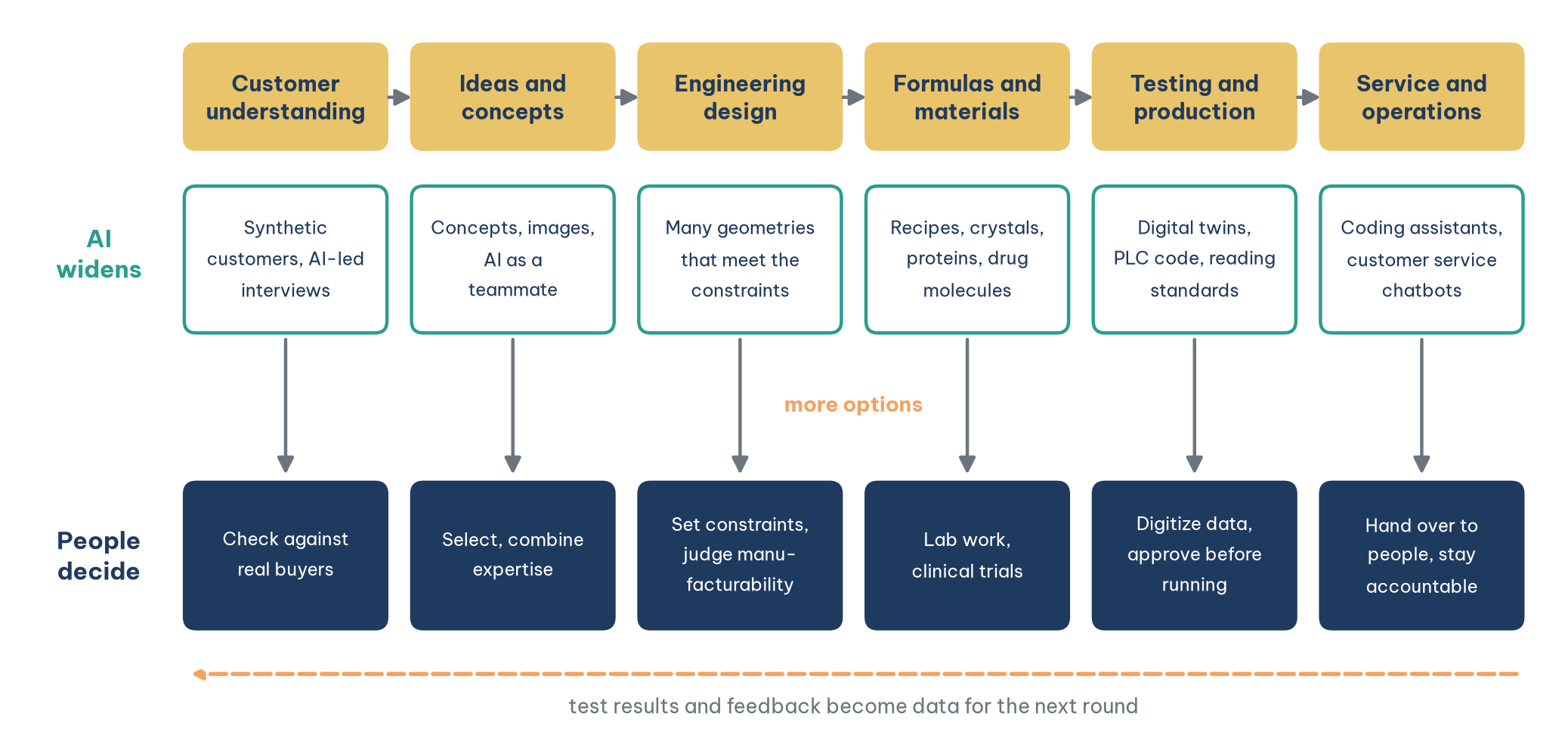
This section separates tools that share a label but solve different problems. The first family is analytical and predictive AI, or traditional machine learning, used to forecast demand, classify customer feedback, or detect defects on a line. The second is generative AI: large language models (LLMs) and models that produce images and video. They summarize market research, propose ideas, draw concepts, and draft technical documents.
The third family is generative design and topology optimization. The computer explores geometries that satisfy constraints an engineer has set. Despite the similar name, it predates the ChatGPT wave by years and relies on optimization algorithms, not language models. The fourth is simulation and digital twins, together with specialized scientific models for proteins, materials, and molecules. They let teams try things in the machine before trying them in the world. A digital twin is not necessarily AI, but it is where many algorithms are trained and tested.
Figure 1 places these families along the life cycle. The middle row shows where AI widens the space of choices. The bottom row shows what people keep.
2. Understanding customers with and without real people
This section looks at two very different uses of AI in market research: playing the customer, and helping researchers talk to more real customers.
2.1. When AI plays the consumer
Traditional market research is slow, expensive, and biased in familiar ways. Respondents say they would pay more than they actually do and choose things in surveys that they never choose in shops. Researchers at Harvard Business School and Microsoft tried something bold. They asked an LLM to answer surveys as if it were a shopper in a product category, and repeated the questions hundreds of times to create a synthetic sample.
The first results were striking. Answers responded to price and shifted with the shopper's assumed income, as economic theory would predict. In a study of real consumers, people would pay an extra $3.27 for fluoride in toothpaste; one GPT estimate was $3.40. Yet there were early signs of trouble. Told to act as a diner who had already drunk several glasses of wine, GPT would pay the same for the next glass, contrary to diminishing marginal utility (Senz, 2023).
The current version of the paper is far more cautious. Willingness-to-pay estimates from LLMs are sometimes comparable with human studies but often inaccurate, and in some cases have the wrong sign. Fine-tuning on earlier human survey data improves alignment, including for new features, as long as the category and the population stay the same. For new product categories, or for differences between customer segments, the authors find no similar improvement (Brand et al., 2026).
The lesson is practical. Synthetic customers are useful for screening dozens of ideas cheaply, for finding ambiguous survey questions, and for preparing hypotheses. They supplement data from real buyers but do not replace it, least of all when a firm enters a new category or compares segments, which is exactly when customer research is most valuable.
2.2. AI asks the questions, people interpret the answers
A more practical route is to let AI run research with real people at scale. Nestlé brands such as Coffee mate, Stouffer's, and Vital Pursuit have used the Outset platform, where an AI agent presents product concepts, asks multiple-choice questions, and then probes in open conversation. According to Outset (n.d.), qualitative studies usually involve 20 or 30 people, while most of these projects include more than ten times as many; the tool has covered more than 100 concepts, seven brands, and five countries. These are the vendor's figures, so they illustrate a method more than they prove its effect.
McKinsey describes a consumer goods company that used generative AI to study consumer sentiment and the reach of its brand into growth markets, and then broadened its ethnographic interviews (Booth et al., 2024). AI did not replace qualitative research here. It helped researchers ask better questions, a pattern that recurs throughout this article.
3. Ideas and concepts: from a few to a few hundred
This section covers the stage where generative AI is most visible, moving from a company tool to a randomized field experiment and then to three creative projects.
3.1. Nestlé: six months to six weeks
Nestlé USA uses a proprietary generative AI tool embedded in its innovation process. It produces tailored product concepts in a little over a minute, drawing on more than 20 brands and real-time market trends (Presley, 2024). In early efforts, ideation fell from six months to six weeks, and about 100 people in the company's innovation community were trained to develop starter concepts from a few simple prompts (Shah, 2024).
Nestlé does not let the tool decide which products exist. Its concepts are starting points that teams explore, test, and refine (Shah, 2024). And six weeks is the length of ideation, not the time it takes to reach a shelf.
3.2. Procter & Gamble and the cybernetic teammate
The strongest evidence on ideation comes from a preregistered field experiment at Procter & Gamble. Researchers recreated the company's product development process in one-day workshops, where 791 professionals worked on real challenges from their own business units, including baby care, feminine care, grooming, and oral care (Dell'Acqua et al., 2026a; Nover, 2025). An early 2025 draft reported 776 participants, a number that still circulates.
Participants were randomly assigned to work alone or in pairs, with or without AI. Four findings stand out. First, one person with AI matched a two-person team without it. Second, AI bridged functional silos. Without AI, research and development staff leaned toward technical solutions and commercial staff toward commercial ones; with AI, both produced more balanced proposals. Third, teams with AI were the most likely to produce solutions in the top 10%, three times as likely as individuals without AI (Nover, 2025), although their average quality did not differ significantly from that of individuals with AI (Mollick, 2025). Working time fell by about 16% for individuals and 13% for teams (Nover, 2025).
The fourth finding receives less attention. When the authors broke innovation into steps, AI mainly improved the ideas generated, while human judgment retained value in evaluating and selecting them (Dell'Acqua et al., 2026a). Employees less familiar with product development also reached the level of experienced colleagues when they had AI. One author's summary is that AI can make an individual as effective as a team, but anyone aiming for the top 10% still wants a full human team with AI (Nover, 2025).
3.3. Mattel, Coca-Cola, and Nike
Mattel was an early experimenter. In 2022, Hot Wheels designers used the image model DALL·E 2 to generate dozens of images, turning a car into a convertible or trying it in other colors (Roach, 2022). In June 2025 the company announced a collaboration with OpenAI that included using ChatGPT Enterprise for product development and creative ideation (OpenAI, 2025). A Mattel executive said the company was not licensing its intellectual property and kept control over the products made (Bellan, 2025). What followed is just as instructive. The first joint product, expected in 2025, did not appear that year, amid greater scrutiny of toys that include generative AI (Fried, 2025). A tool in the studio can be used right away. A product in a customer's hands has to pass a different gate.
Coca-Cola took AI into flavor. In September 2023 it launched the limited-edition Y3000 Zero Sugar, described as co-created by human and artificial intelligence. Fans' views of the future, expressed through emotions, aspirations, colors, and flavors, were combined with insights from AI, and the packaging design was also co-created (The Coca-Cola Company, 2023). A company representative described two steps: collecting flavor preferences and trends, and then using AI to help develop flavor profiles and pairings (Vega, 2023). Reactions split. In one street test, one taster liked it better than the original, another said it "tastes like medicine", and a third poured the rest into a planter (Raasch, 2023). AI makes difference faster to produce. It does not guarantee that the market wants the difference.
Nike presented its A.I.R. (Athlete Imagined Revolution) prototypes in Paris in April 2024: one-of-a-kind, AI-explored, 3D-printed shoes for 13 athletes (Nike, 2024). They were shown again during the Olympics and covered track, soccer, basketball, and tennis. Athletes' ideas came first, AI opened up variations, and designers refined them. These were concepts, not merchandise, but they show AI being used to expand creative possibilities and not only to replace labor (Fried, 2024).
4. Engineering design: the machine proposes, the engineer chooses
This section turns to generative design. Instead of drawing a geometry and then simulating it, engineers set goals and constraints, such as materials, manufacturing methods, and budget, and the software explores the solutions that satisfy them (Autodesk, n.d.). The number of alternatives can run from hundreds to thousands (Autodesk, 2015).
4.1. Airbus: the bionic partition
The classic case is the bionic partition that Airbus developed with Autodesk, The Living, and APWorks for the A320. It separates the cabin from the galley and holds a jump seat, so requirements on strength, cutouts, and weight are strict. Algorithms that mimic cellular structure and bone growth, combined with metal 3D printing, produced a design 45% (30 kg) lighter than the current one. At the time, it was the world's largest 3D-printed cabin component (Autodesk, 2015).
The story did not end there. Metal printing ran into material and market constraints, so Airbus used generative design to create a 3D-printed plastic mold and cast the part in an alloy already qualified for flight. "Bionic partition 2.0" kept the strength and lightness and could be made at scale more affordably (Autodesk, 2019). The research project page describes 16G crash testing on the way to certification (Autodesk Research, n.d.), so this is best read as a long development program and not as a part installed across a fleet. Generative design delivers performance. Manufacturability, certification, and cost decide whether a design leaves the laboratory.
4.2. General Motors: eight parts become one
In 2018 General Motors described itself as the first large North American carmaker to adopt Autodesk's generative design software. In a proof of concept, engineers redesigned a seat bracket. The software offered more than 150 alternatives. The one chosen merged eight components into a single 3D-printed stainless steel part, 40% lighter and 20% stronger than its predecessor (Autodesk, n.d.). The team weighed aesthetics, manufacturability, and simulation results as well as weight (Modern Machine Shop, 2018). GM itself said it had no plan to print all 30,000 parts of a car, only those with business value.
Consolidating parts is easy to undervalue. Fewer parts mean fewer suppliers, fewer assembly steps, and a shorter supply chain, which matters especially for electric vehicles, where lower weight extends range.
4.3. Toyota: putting constraints into image generation
Popular image generators offer inspiration but ignore aerodynamics and chassis dimensions. In June 2023 the Toyota Research Institute announced a technique that lets designers add sketches and engineering constraints to the generation process, cutting the iterations needed to reconcile design with engineering. Constraints such as drag, ride height, and cabin dimensions can be built in implicitly while designers keep their text prompts about style (Toyota Research Institute, 2023). The accompanying paper concentrated on drag alone, so this is a research result and not a production workflow. Still, it points in the right direction: the value of AI in design lies in narrowing the gap between what is attractive and what is feasible.
4.4. Twenty-five variations in two hours
McKinsey describes designers at a carmaker who created initial concepts for 25 variations of a next-generation dashboard in about two hours; images of similar detail would otherwise have taken at least a week. The concepts were then refined in image-editing software. In another example, a designer used iterative prompts to reduce the titanium in a bicycle pedal while improving its strength. The same article warns that raw outputs are often flawed — one example is a drone that could not fly — and that substantial postproduction should be expected (Booth et al., 2024).
5. Formulas, materials, and molecules
This section covers products that are not shapes but formulas: a recipe, a crystal structure, a protein sequence, a drug molecule. The search space is too large for people to scan, which makes this the home of the most remarkable advances and of the claims that most need checking.
5.1. NotCo and Kraft Heinz
NotCo, a food technology company from Chile, built its products around an AI platform called Giuseppe. It analyzes animal-based foods at the molecular level and proposes plant combinations that reproduce flavor, texture, and properties such as foaming, gelling, and emulsification. NotMilk contains pineapple and cabbage, an unlikely pair that Giuseppe identified as a source of lactones, aroma compounds found in dairy (Watson, 2022). The company began with mayonnaise in 2017 in Chile, one of the world's top mayonnaise consumers (Poinski, 2023).
In February 2022 Kraft Heinz formed The Kraft Heinz Not Company with NotCo, under Kraft Heinz's control, joining NotCo's formulation technology to its own brands and scale (Watson, 2022). The venture launched NotCheese slices in October 2022 and NotMayo, made with chickpea flour, in March 2023 (Poinski, 2023). The strategy is worth noting. A large firm need not build AI capability from nothing. It can partner with a specialist and contribute what it does best: brands, distribution, and production. These sources verify the speed of launches but say nothing about long-term commercial success.
5.2. MatterGen: materials to order, with a caveat
Traditional materials discovery screens lists of known candidates. MatterGen, a diffusion model from Microsoft Research published in Nature in January 2025, generates inorganic crystal structures to match desired properties. As a proof of concept, the team synthesized one structure and measured a property within 20% of the target (Zeni et al., 2025).
The developers state the model's limits openly. It supports at most 20 atoms in the unit cell, and performance may degrade for extreme property values that are rare in the training data (Microsoft, n.d.). Every research team should expect this kind of disclosure from a vendor.
Another limit surfaced only when someone else looked. A 2026 paper in Materials Horizons argued that the synthesized structure matched a compound first described in the early 1970s and present in MatterGen's own training data. Because the model does not handle crystallographic disorder, it classified a known material as new (Juelsholt, 2026). The property measurement stands, but the claim of novelty does not stand so easily. Checking novelty, in the literature and in patents, remains human work.
5.3. AlphaFold and a 50-year-old problem
Half of the 2024 Nobel Prize in Chemistry went to David Baker for computational protein design, and the other half to Demis Hassabis and John Jumper of Google DeepMind for protein structure prediction. AlphaFold2 has helped predict the structure of virtually all of the 200 million proteins researchers have identified (The Royal Swedish Academy of Sciences, 2024). For product developers, the importance is that proteins can now be designed. Baker's group has created proteins that can serve as pharmaceuticals, vaccines, nanomaterials, and tiny sensors.
5.4. Insilico Medicine: a target and a drug from AI
Pharmaceuticals have one of the longest and costliest development cycles. In June 2025 Nature Medicine published phase 2a results for rentosertib, a TNIK inhibitor for idiopathic pulmonary fibrosis developed by Insilico Medicine. Both the biological target and the molecule came from AI. The double-blind, placebo-controlled trial enrolled 71 patients in China and met its primary safety endpoint. At the highest dose, 60 mg a day, forced vital capacity rose by an average of 98.4 mL after 12 weeks (95% confidence interval, 10.9 to 185.9), while the placebo group declined by 20.3 mL (−116.1 to 75.6) (Xu et al., 2025).
Those numbers call for restraint. Each arm had fewer than 20 patients, and the intervals are wide and overlap. Sixteen patients (22.5%) stopped treatment early, seven of them because of liver injury or dysfunction (Xu et al., 2025). The authors themselves noted that phase 2 failure rates of AI-discovered drugs have resembled those of other drugs, and that none had yet come through phase 3 (Kaltwasser, 2025). In July 2026 Insilico announced a phase 3 trial with 320 patients at 47 centers in China (Insilico Medicine, 2026); results are years away. AI shortens the preclinical stage considerably, but human biology is the final judge.
6. Testing, simulation, and preparing production
This section covers the stage where a design must prove it can be made. Digital twins let teams try in the machine first, and generative AI helps engineers with control code and technical standards.
6.1. BMW: a virtual factory ahead of the real one
A new car needs a whole production system. BMW Group used NVIDIA Omniverse to build a digital twin of its plant in Debrecen, Hungary, home of the Neue Klasse electric models. Virtual production of the roughly 1.4 km² production area began more than two years before series production, with several sites working on the same twin in real time, and BMW calls the approach a blueprint for its future factory planning (BMW Group, 2023). By July 2026 the plant had built its 50,000th iX3, the fastest ramp-up of any new BMW plant. The announcement mentions digital tools and shared data but does not attribute the result to the twin (BMW Group, 2026).
The benefit of a twin is finding conflicts, such as a robot that does not fit or a flow of parts that jams, while corrections are cheap. Changing the layout of a working plant is costly and stops production (NVIDIA, 2023).
6.2. Siemens and Schaeffler: code for industrial machines
In November 2023 Siemens and Schaeffler demonstrated the Siemens Industrial Copilot, a generative AI assistant connected to the TIA Portal engineering framework. Schaeffler's automation engineers use natural language to generate code for programmable logic controllers (PLCs) faster. According to the companies, it automates repetitive tasks, frees engineers for higher-value work, and helps less experienced shop-floor employees move into engineering roles (Siemens, 2023b). That last point echoes the P&G experiment: on tasks within its reach, AI tends to narrow the gap between newcomers and experts.
6.3. Rang Dong: a mid-sized manufacturer's path
Most published cases come from global giants, so a Vietnamese maker of lamps and vacuum flasks offers a rare view. According to deputy general director Nguyễn Hoàng Kiên, Rang Dong began using AI in early 2025 in research and product development, technical documents, sales support, and operations. One use is turning the requirements of international standards into plain instructions for each department, relieving a chronic shortage of experts. The company has also developed a circuit breaker that detects electric arcs and image-processing algorithms for cameras (VCCI, 2026).
It reports that some engineering problems that once took three to six months now yield a sample for the customer in about one month. It also reports growth above 25% and nearly doubled export orders in the first four months of 2026, plus first exports of high-standard electronics to the United States (VCCI, 2026). The company credits AI. But many other factors affect growth, and the figures are self-reported, so they are better read as correlation than as cause.
Its path is the most transferable part, from simple to complex. It began with off-the-shelf tools, connected them through APIs into automated workflows, then added the company's own knowledge, and only later aimed at models of its own. The executive's other point was that data comes first: without digital data, advanced models have nothing to learn from.
7. Software and services: conflicting evidence
This section turns to the field with the most experiments, where the results disagree in instructive ways.
7.1. 55.8% faster or 19% slower?
In a 2023 controlled experiment, developers with GitHub Copilot completed a JavaScript HTTP server 55.8% faster than a control group (Peng et al., 2023). In 2025 a randomized trial by METR with 16 experienced open-source developers and 246 real tasks, in mature projects they knew well, found the opposite: with AI tools, tasks took 19% longer. Even afterward, the developers believed AI had made them about 20% faster (Becker et al., 2025).
Articles that quote the 19% often leave out what came next. In August 2025 METR began a new experiment with newer tools. Returning developers were about 18% faster with AI (interval from 38% faster to 9% slower), and newly recruited ones about 4% faster (from 15% faster to 9% slower). METR does not consider these reliable estimates either. A growing number of developers declined to take part, or held back tasks they did not want to do without AI, so the true gain is probably higher (METR, 2026). It now labels its early 2025 results as out of date. Figure 2 sets the estimates side by side with two other studies discussed in this article.
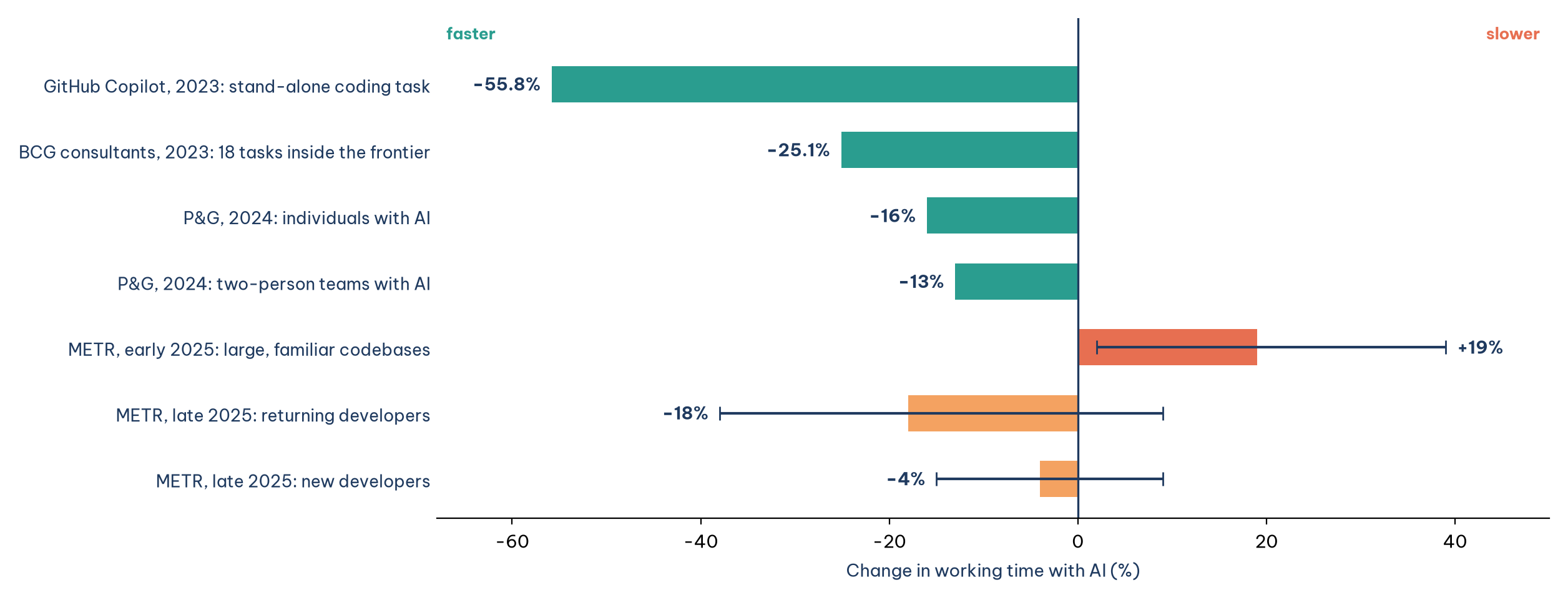
These results can all be true. The first task was self-contained and well defined, METR's tasks required deep context, and the tools change every few months. The lesson for any product is that the effect of AI depends on the task, the date, and the person, and that a feeling of speed is not a measure of speed.
7.2. The jagged frontier
The same message comes from an experiment with 758 consultants at Boston Consulting Group. On tasks inside AI's abilities, people using GPT-4 completed 12.2% more tasks, worked 25.1% faster, and delivered significantly better quality (Dell'Acqua et al., 2026b); the 2023 draft put the quality gain at more than 40%. On a task deliberately chosen to lie outside those abilities, people with AI were 19 percentage points less likely to reach the correct answer (Dell'Acqua et al., 2023). The authors call this a jagged technological frontier. Two tasks look equally hard, yet AI does one brilliantly and the other badly, and users find it difficult to tell which in advance. For product teams this may be the most useful idea of all: knowing when not to trust AI is a core skill.
7.3. Klarna and Air Canada
In February 2024 the fintech company Klarna announced that in one month its AI assistant had handled 2.3 million conversations, two-thirds of its customer service chats, doing the work of 700 full-time agents (Klarna, 2024). In 2025 its chief executive acknowledged that the cheaper chatbots had produced lower quality and that the strategy had not been the right path. Klarna began hiring people again so that customers could always reach a human (Shibu, 2025).
Also in 2024, a tribunal in British Columbia held Air Canada responsible for wrong information its website chatbot gave a passenger about bereavement fares. The airline argued that the chatbot was "a separate legal entity" responsible for its own actions. The tribunal disagreed: the chatbot was part of the airline's website, and the company answers for what appears there. The award was only about 650 Canadian dollars plus interest and fees (Lifshitz & Hung, 2024), but the cost in reputation and precedent was greater.
Both stories point to one principle. When AI becomes part of what the customer touches, responsibility cannot be outsourced to the algorithm.
8. What changes in the life cycle
This section gathers the cases into one picture. Table 1 lists the main uses, examples, and cautions by stage.
Five shifts follow.
From scarce options to abundant ones. The bottleneck used to be producing enough alternatives. Now it is choosing among them. McKinsey warns that too many choices can overwhelm stakeholders and consumers, so experts must curate (Booth et al., 2024), and the P&G evidence points the same way (Dell'Acqua et al., 2026a). The ability to evaluate, grounded in knowledge of customers and engineering, gains value.
From "design, then check" to "constrain, then explore". At Airbus, GM, and Toyota, the engineer moves from drafting to defining the problem and judging the answers.
From functional silos to hybrid ability. At P&G, AI helped technical people think commercially and commercial people think technically. Siemens and Schaeffler expect something similar on the shop floor.
From physical trials to virtual trials first. Digital twins and materials models allow cheap failure in the computer before expensive failure in the world.
From supporting tool to product component. When AI sits inside the product, as with Air Canada's chatbot or the experiences Mattel has in development, safety, privacy, and liability become design requirements.
9. A six-step framework
This section turns the lessons into a sequence that suits companies of any size, including small and medium-sized ones. Figure 3 shows the steps as a loop: the measures from step 5 and the skills from step 6 reveal the next bottleneck.
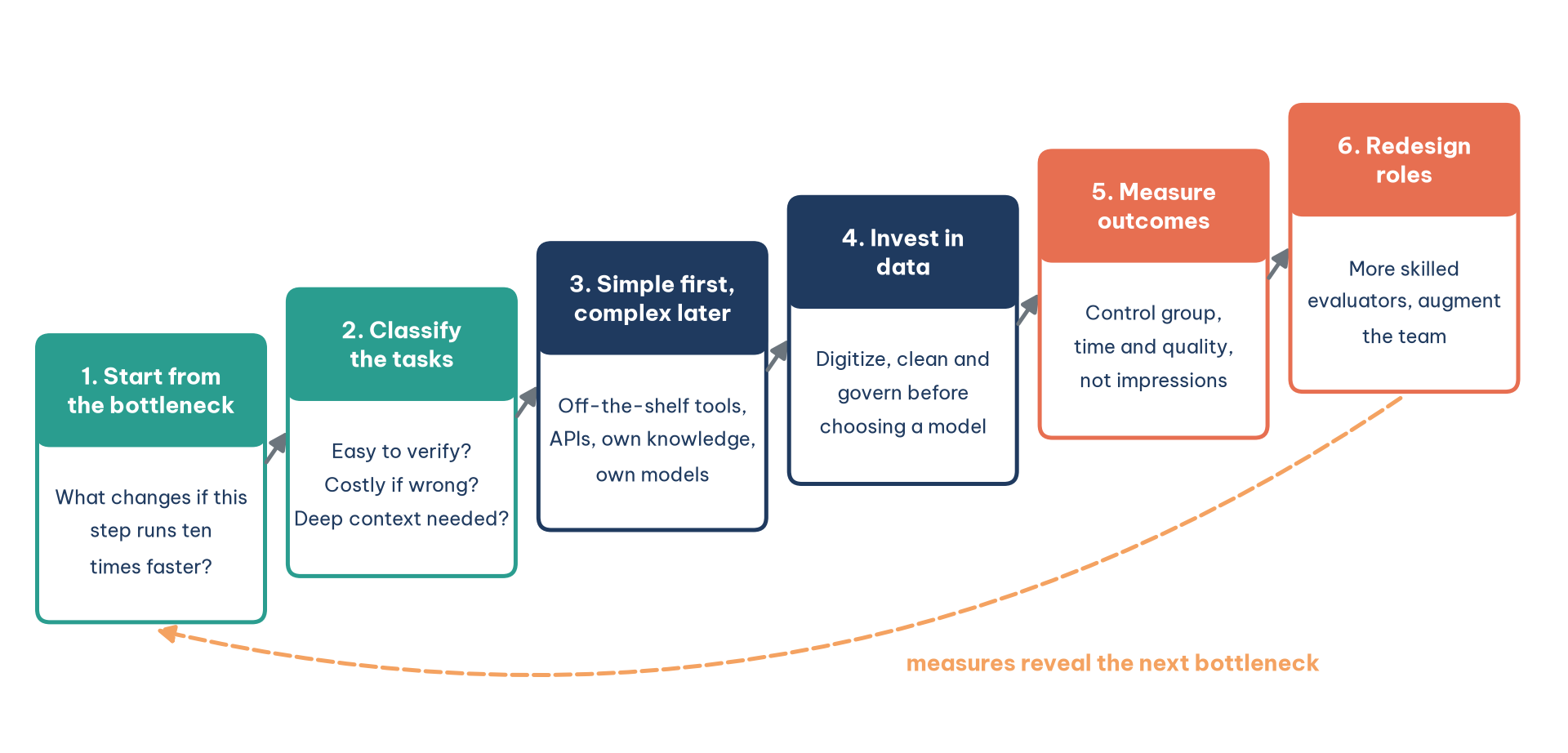
Step 1. Start from the bottleneck, not the tool. Map the current process and mark where time is lost, where people wait for a rare expert, and where quality wavers. Rang Dong worked on understanding standards, where experts were scarce. Nestlé worked on ideation, which took months. A useful test: if this step ran ten times faster, what would change in business results? If the answer is "not much", start elsewhere.
Step 2. Classify tasks along the jagged frontier. Is the output easy to verify? Is an error costly? How much context does the task need? Tasks that are easy to check, cheap to get wrong, and light on context, such as concept sketches, packaging drafts, or document summaries, are good places to begin. Tasks that are hard to check, costly, and rich in context, such as a final formula or policy advice to customers, need close human review.
Step 3. Go from simple to complex. Use off-the-shelf tools, then connect them by API, then add the company's own knowledge, and only then consider a model of your own. For specialized problems such as food formulas, a partnership like that of Kraft Heinz and NotCo may be faster and cheaper than building.
Step 4. Invest in data before models. Synthetic customers need real survey data, and a digital twin needs current plant data. MatterGen's developers recommend at least several thousand labeled structures to fine-tune for a new property (Microsoft, n.d.). Old test results, complaints, inspection records, and customer feedback are assets to be digitized, cleaned, and governed.
Step 5. Measure outcomes, not impressions. Developers felt 20% faster while being 19% slower, and later measurement was distorted when people chose which tasks to submit. Run internal trials with a control group. Track time from idea to prototype, design iterations, the share of concepts that pass consumer tests, and cost per prototype. As Klarna learned, cost must not be the only number on the dashboard.
Step 6. Redesign roles and skills. More options call for more people who are good at evaluating them. If newcomers can perform like veterans, training and career paths need rethinking. At P&G, teams with AI produced the most exceptional work, so the goal should be to augment teams and not to replace them.
10. Risk and governance
This section reviews five groups of risk that product teams need to manage.
Hallucination and stale information. Models can give wrong information, and consumer trends often move faster than training data, so primary research is still needed (Booth et al., 2024). In engineering, one wrong parameter from a standard can mean a product that fails certification.
Bias and sameness. Because models "average" their inputs, they can perpetuate historical bias and miss the nuances of behavior that seed innovation (Booth et al., 2024). If every company brainstorms with the same few models, products may converge. In one experiment, writers given AI ideas produced stories rated more creative individually, yet the stories resembled one another more (Doshi & Hauser, 2024).
Intellectual property and data. Who owns a design that AI proposed? Will research data entered into a tool train a competitor's model? Mattel's insistence on control (Bellan, 2025) and the pledge by Siemens and Microsoft that customers control their data, which is not used to train underlying models (Siemens, 2023a), are terms worth negotiating.
Inflated expectations. Highly realistic renderings can make stakeholders overoptimistic, so regular updates on real progress help (Booth et al., 2024). An attractive concept is not yet a product that can be made at an acceptable cost.
Liability and compliance. Air Canada shows that a company answers for what its AI tells customers. Comprehensive AI laws are also arriving. The European Union's AI Act sets obligations according to risk (European Union, 2024), and other jurisdictions are passing their own. Products for children, health, or finance need compliance built in at the design stage.
Conclusion
A partition 45% lighter, eight parts merged into one, a concept in a little over a minute, a drug candidate with an AI-found target, an engineering sample in one month where it once took three to six: AI is becoming an important capability in product development far beyond software.
The cases also agree on something else. Where projects went far, people framed the problem, set the constraints, chose among the options, and took final responsibility. Airbus had to rework how its partition was made. GM chose on looks and manufacturability as well as weight. Nestlé treated AI concepts as a beginning. It took another scientist to notice that a "new" material was an old one. Where projects stumbled, as at Klarna and Air Canada, weak technology was only part of the trouble; people had handed over work that lay beyond the jagged frontier without adequate supervision.
Perhaps the best image of AI in product development is not an invention machine but a new teammate: tireless, widely read, quick to propose, and at times wrong with great confidence. Companies that learn which work to give that teammate, how to check it, and where to keep the decision will bring better products to market sooner.
References
Autodesk. (2015, December 16). Autodesk and Airbus show the future of aerospace design and manufacturing in pioneering generatively designed 3D printed partition [Press release]. Airframer. https://www.airframer.com/news/release/32217
Autodesk. (2019, November 19). Autodesk and Airbus demonstrate the impact of generative design on making and building. https://adsknews.autodesk.com/news/autodesk-airbus-generative-design-aerospace-factory
Autodesk. (n.d.). Driving a lighter, more efficient future of automotive part design: General Motors. Retrieved November 23, 2026, from https://www.autodesk.com/customer-stories/general-motors-generative-design
Autodesk Research. (n.d.). Bionic partition: The world's largest 3D-printed airplane component. Retrieved November 23, 2026, from https://www.research.autodesk.com/projects/bionic-partition/
Becker, J., Rush, N., Barnes, E., & Rein, D. (2025). Measuring the impact of early-2025 AI on experienced open-source developer productivity (arXiv:2507.09089). arXiv. https://doi.org/10.48550/arXiv.2507.09089
Bellan, R. (2025, June 12). OpenAI and Barbie-maker Mattel team up to bring generative AI to toymaking and content creation. TechCrunch. https://techcrunch.com/2025/06/12/openai-and-barbie-maker-mattel-team-up-to-bring-generative-ai-to-toy-making-and-content-creation/
BMW Group. (2023, March 21). BMW Group at NVIDIA GTC: Virtual production under way in future plant Debrecen [Press release]. https://newsroom.bmwgroup.com/global/bmw-group-at-nvidia-gtc-virtual-production-under-way-in-future-plant-debrecen
BMW Group. (2026, July 28). Ramp-up in record time: BMW Group Plant Debrecen produces 50,000th BMW iX3 [Press release]. https://newsroom.bmwgroup.com/global/ramp-up-in-record-time-bmw-group-plant-debrecen-produces-50000th-bmw-ix3
Booth, B., Donohew, J., Wlezien, C., & Wu, W. (2024, March 5). Generative AI fuels creative physical product design but is no magic wand. McKinsey & Company. https://www.mckinsey.com/capabilities/tech-and-ai/our-insights/generative-ai-fuels-creative-physical-product-design-but-is-no-magic-wand
Brand, J., Israeli, A., & Ngwe, D. (2026). Using LLMs for market research (Harvard Business School Marketing Unit Working Paper No. 23-062, rev. April 2026). SSRN. https://doi.org/10.2139/ssrn.4395751
Cooper, R. G. (1990). Stage-gate systems: A new tool for managing new products. Business Horizons, 33(3), 44–54. https://doi.org/10.1016/0007-6813(90)90040-I90040-I)
Dell'Acqua, F., McFowland, E., III, Mollick, E. R., Lifshitz-Assaf, H., Kellogg, K., Rajendran, S., Krayer, L., Candelon, F., & Lakhani, K. R. (2023). Navigating the jagged technological frontier: Field experimental evidence of the effects of AI on knowledge worker productivity and quality (Harvard Business School Working Paper No. 24-013). SSRN. https://doi.org/10.2139/ssrn.4573321
Dell'Acqua, F., Ayoubi, C., Lifshitz, H., Sadun, R., Mollick, E., Mollick, L., Han, Y., Goldman, J., Nair, H., Taub, S., & Lakhani, K. R. (2026a). The cybernetic teammate: A field experiment on generative AI and teamwork. Organization Science, 37(4), 1217–1242. https://doi.org/10.1287/orsc.2025.20702
Dell'Acqua, F., McFowland, E., III, Mollick, E., Lifshitz, H., Kellogg, K. C., Rajendran, S., Krayer, L., Candelon, F., & Lakhani, K. R. (2026b). Navigating the jagged technological frontier: Field experimental evidence of the effects of artificial intelligence on knowledge worker productivity and quality. Organization Science, 37(2), 403–423. https://doi.org/10.1287/orsc.2025.21838
Doshi, A. R., & Hauser, O. P. (2024). Generative AI enhances individual creativity but reduces the collective diversity of novel content. Science Advances, 10(28), Article eadn5290. https://doi.org/10.1126/sciadv.adn5290
European Union. (2024). Regulation (EU) 2024/1689 laying down harmonised rules on artificial intelligence (Artificial Intelligence Act). Official Journal of the European Union. https://eur-lex.europa.eu/eli/reg/2024/1689/oj
Fried, I. (2024, July 25). Nike is using AI to turn athletes' dreams into shoes. Axios. https://www.axios.com/2024/07/25/nike-olympics-paris-ai-technology-design-air-sneakers
Fried, I. (2025, December 15). Scoop: Mattel's collaboration with OpenAI won't emerge this year. Axios. https://www.axios.com/2025/12/15/mattel-openai-toys-kids
Insilico Medicine. (2026, July 7). Insilico initiates Phase III clinical trial for rentosertib [Press release]. https://insilico.com/news/xmjsn4l091-insilico-initiates-phase-iii-clinical-tr
Juelsholt, M. (2026). Continued challenges in high-throughput materials predictions: MatterGen predicts compounds from the training dataset. Materials Horizons, 13(11), 5672–5679. https://doi.org/10.1039/D6MH00268D
Kaltwasser, J. (2025, June 14). AI-derived therapy for IPF shows potential in phase 2a trial. The American Journal of Managed Care. https://www.ajmc.com/view/ai-derived-therapy-for-ipf-shows-potential-in-phase-2a-trial
Klarna. (2024, February 27). Klarna AI assistant handles two-thirds of customer service chats in its first month [Press release]. https://www.klarna.com/international/press/klarna-ai-assistant-handles-two-thirds-of-customer-service-chats-in-its-first-month/
Lifshitz, L. R., & Hung, R. (2024, February 29). BC tribunal confirms companies remain liable for information provided by AI chatbot. Business Law Today. https://businesslawtoday.org/2024/02/bc-tribunal-confirms-companies-remain-liable-for-information-provided-by-ai-chatbot/
METR. (2026, February 24). We are changing our developer productivity experiment design. https://metr.org/blog/2026-02-24-uplift-update/
Microsoft. (n.d.). MatterGen [Model card]. Hugging Face. Retrieved November 23, 2026, from https://huggingface.co/microsoft/mattergen
Modern Machine Shop. (2018). What this seat bracket says about the future of automotive manufacturing. https://www.mmsonline.com/blog/post/what-this-seat-bracket-says-about-the-future-of-automotive-manufacturing
Mollick, E. (2025, March 22). The cybernetic teammate. One Useful Thing. https://www.oneusefulthing.org/p/the-cybernetic-teammate
Nike. (2024, April 11). Creating the unreal: How Nike made its wildest Air footwear yet. https://about.nike.com/en/magazine/nike-design-athlete-imagined-revolution
Nover, S. (2025, October 17). When AI joins the team, better ideas surface. Harvard Business School Working Knowledge. https://www.library.hbs.edu/working-knowledge/when-ai-joins-the-team-better-ideas-surface
NVIDIA. (2023, March 21). BMW Group starts global rollout of NVIDIA Omniverse. NVIDIA Blog. https://blogs.nvidia.com/blog/bmw-group-nvidia-omniverse/
OpenAI. (2025, June 12). Bringing the magic of AI to Mattel's iconic brands. https://openai.com/index/mattels-iconic-brands/
Outset. (n.d.). How Nestlé uses AI to accelerate product innovation with Outset. Retrieved November 23, 2026, from https://outset.ai/blog-post/nestle-case-study
Peng, S., Kalliamvakou, E., Cihon, P., & Demirer, M. (2023). The impact of AI on developer productivity: Evidence from GitHub Copilot (arXiv:2302.06590). arXiv. https://doi.org/10.48550/arXiv.2302.06590
Poinski, M. (2023, March 10). Kraft Heinz and NotCo launch plant-based NotMayo. Food Dive. https://www.fooddive.com/news/kraft-heinz-notco-notmayo-plant-based/644686/
Presley, S. (2024, December). A year of innovation and meeting the moments that matter. Nestlé USA. https://www.nestleusa.com/stories/innovation-moments-that-matter
Raasch, J. M. (2023, October 6). Coca-Cola's new AI-created flavor has some saying it's better than the original. Fox News. https://www.foxnews.com/us/taste-tasters-deliver-verdict-coca-colas-new-ai-generated-recipe
Roach, J. (2022, October 12). From Hot Wheels to handling content: How brands are using Microsoft AI to be more productive and imaginative. Microsoft Source. https://news.microsoft.com/source/features/innovation/from-hot-wheels-to-handling-content-how-brands-are-using-microsoft-ai-to-be-more-productive-and-imaginative/
Senz, K. (2023, May 30). Can AI predict whether shoppers would pick Crest or Colgate? Harvard Business School Working Knowledge. https://www.library.hbs.edu/working-knowledge/can-ai-predict-whether-shoppers-would-pick-crest-over-colgate
Shah, V. (2024, June). Unlocking new opportunities with gen AI. Nestlé USA. https://www.nestleusa.com/stories/unlocking-new-opportunities-gen-ai
Shibu, S. (2025, May 9). Klarna is hiring customer service agents after AI couldn't cut it on calls, according to the company's CEO. Entrepreneur. https://www.entrepreneur.com/business-news/klarna-ceo-reverses-course-by-hiring-more-humans-not-ai/491396
Siemens. (2023a, October 31). Siemens and Microsoft partner to drive cross-industry AI adoption [Press release]. https://press.siemens.com/global/en/node/6800
Siemens. (2023b, November 14). AI for industry: Schaeffler and Siemens bring Industrial Copilot to shopfloor [Press release]. https://press.siemens.com/global/en/pressrelease/ai-industry-schaeffler-and-siemens-bring-industrial-copilot-shopfloor
The Coca-Cola Company. (2023, September 11). Coca-Cola Creations imagines year 3000 with new futuristic flavor and AI-powered experience [Press release]. https://www.coca-colacompany.com/media-center/coca-cola-creations-imagines-year-3000-futuristic-flavor-ai-powered-experience
The Royal Swedish Academy of Sciences. (2024, October 9). The Nobel Prize in Chemistry 2024 [Press release]. NobelPrize.org. https://www.nobelprize.org/prizes/chemistry/2024/press-release/
Toyota Research Institute. (2023, June 20). Toyota Research Institute unveils new generative AI technique for vehicle design. https://www.tri.global/news/toyota-research-institute-unveils-new-generative-ai-technique-vehicle-design
VCCI. (2026, May 20). Ứng dụng AI giúp xuất khẩu bứt phá mạnh tại Rạng Đông [AI helps Rang Dong achieve an export breakthrough]. Vietnam Chamber of Commerce and Industry. https://www.vcci.com.vn/tin-tuc/ung-dung-ai-giup-xuat-khau-but-pha-manh-tai-rang-dong
Vega, N. (2023, September 12). Coca-Cola used AI to create its newest flavor: The Y3000 soda "from the future." CNBC. https://www.cnbc.com/2023/09/12/ai-created-coca-colas-newest-flavor-the-y300-soda-from-the-future.html
Watson, E. (2022, February 22). Kraft Heinz creates joint venture with AI-powered foodtech startup NotCo. FoodNavigator-USA. https://www.foodnavigator-usa.com/Article/2022/02/22/Kraft-Heinz-creates-joint-venture-with-AI-powered-foodtech-startup-NotCo
Xu, Z., Ren, F., Wang, P., Cao, J., Tan, C., Ma, D., Zhao, L., Dai, J., Ding, Y., Fang, H., Li, H., Liu, H., Luo, F., Meng, Y., Pan, P., Xiang, P., Xiao, Z., Rao, S., Satler, C., … Zhavoronkov, A. (2025). A generative AI-discovered TNIK inhibitor for idiopathic pulmonary fibrosis: A randomized phase 2a trial. Nature Medicine, 31(8), 2602–2610. https://doi.org/10.1038/s41591-025-03743-2
Zeni, C., Pinsler, R., Zügner, D., Fowler, A., Horton, M., Fu, X., Wang, Z., Shysheya, A., Crabbé, J., Ueda, S., Sordillo, R., Sun, L., Smith, J., Nguyen, B., Schulz, H., Lewis, S., Huang, C.-W., Lu, Z., Zhou, Y., … Xie, T. (2025). A generative model for inorganic materials design. Nature, 639(8055), 624–632. https://doi.org/10.1038/s41586-025-08628-5
Discussion about this post