Mapping the AI Ecosystem: Five Layers and Where Startups Win
From chips to applications: where start-ups have room to build, the risk of being swallowed by the layer below, and three sources of a durable moat


Key takeaways
The AI ecosystem can be mapped as five layers: infrastructure, models, data, tooling and applications. The lower the layer, the more capital it takes to enter.
Most start-ups belong in the upper layers, especially vertical applications and specialised data, where deep industry knowledge is an advantage that global model providers find hard to match.
BloombergGPT shows how fast a specialised model can be caught by the next general model; Scale AI shows that neutrality is part of a data supplier's value.
The biggest risk is lower layers expanding upwards and swallowing the products built on them. A "thin wrapper" around someone else's API has no moat.
Durable moats come from proprietary data that improves with use, deep integration into customers' workflows, and network effects.
The strategic question for founders today is no longer whether to use artificial intelligence (AI), but where and how to build so as not to be replaced. In just a few years, thousands of start-ups have been born around large language models, and many have vanished almost overnight when a model provider built in exactly the feature the start-up was selling.
The reason is usually position. A "thin wrapper", a polished interface calling an existing model's API, is easy to copy, or to be replicated by the model provider itself. To choose a good position, founders need a map: which layers make up the AI ecosystem, how much capital each requires, who the competitors are, and where a durable advantage can come from in each. This article builds that map in five layers, from hardware to applications, following the division proposed by Raj Dev (n.d.).
Section 1 gives an overview of the five layers. Sections 2 to 5 go through them: the two foundational layers of infrastructure and models, then data, tooling and applications, each with opportunities, risks and real-world lessons. Section 6 analyses the biggest risk for AI start-ups, the layer below expanding upwards. Section 7 sets out three sources of a durable moat. Section 8 looks at what the map means for start-ups in emerging markets, using Vietnam as an example, and Section 9 applies the map to position a specific idea.
1. Five layers at a glance
The AI ecosystem can be pictured as a multi-storey building in which each floor rests on those below. Figure 1 shows the five layers with representative companies in each.
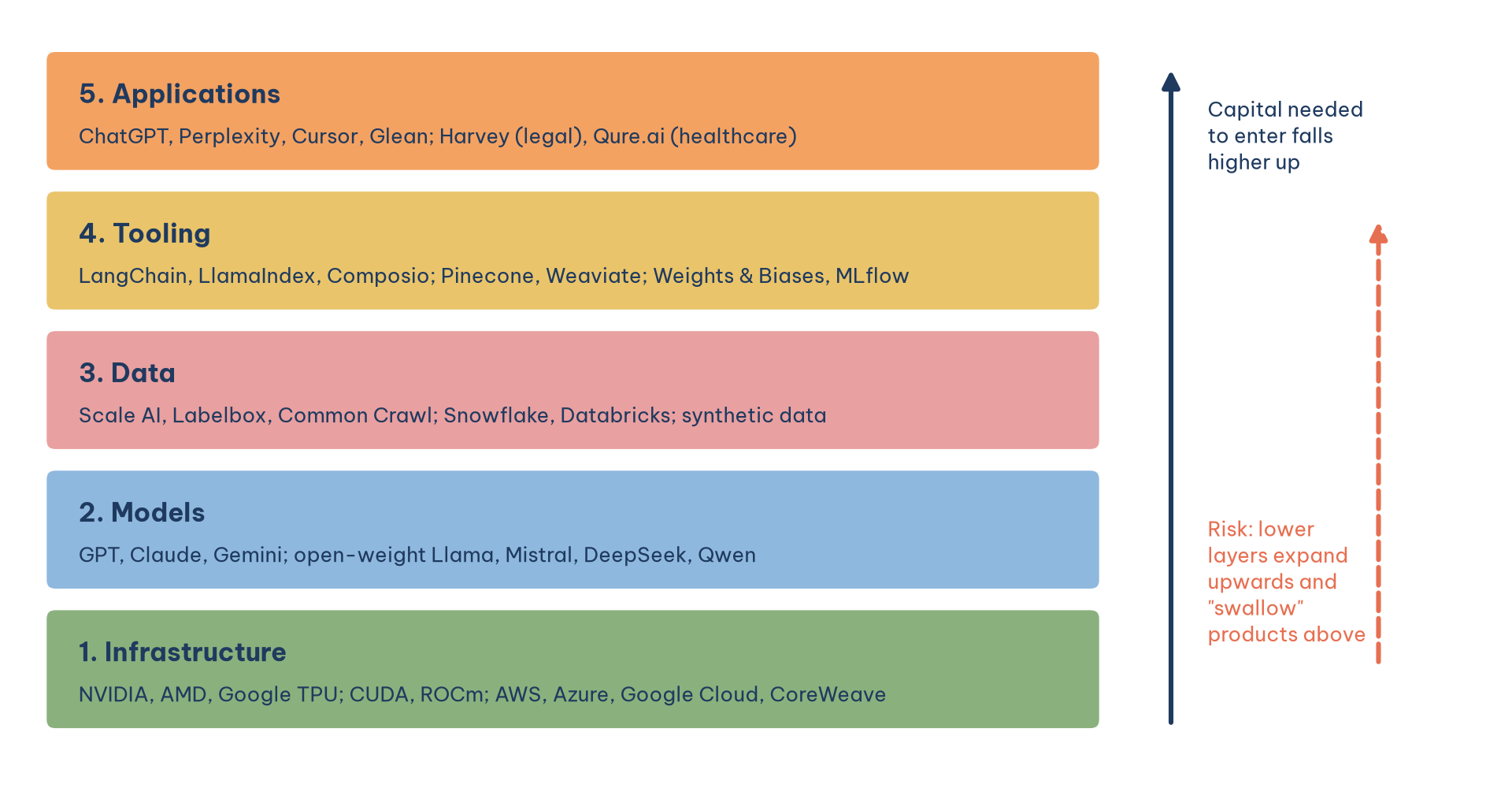
As Figure 1 shows, the lower the layer, the more capital is needed to take part, and lower layers tend to expand into the layers above. Table 1 compares the five layers by role, capital needed to enter and typical moat.
Table 1 reveals a paradox: the easiest layer to enter, applications, is also the most crowded and the most exposed to replacement from below. For a start-up, the question is therefore not only which layer is within reach, but where a moat could come from in that layer.
2. The two foundational layers: infrastructure and models
The two bottom layers supply computing power and the "brain" for everything above.
2.1. Infrastructure
The infrastructure layer comprises AI chips such as GPUs, TPUs and other accelerators; cloud providers renting out GPUs; and low-level software libraries such as NVIDIA's CUDA or AMD's ROCm. The software ecosystem is often underestimated: so many developers are used to CUDA that switching to another chip is costly even when that chip may be cheaper.
Start-up opportunities here exist but are narrow: specialised GPU rental platforms that are more flexible than the hyperscale clouds, such as CoreWeave (listed in 2025) and Runpod; dedicated chips for specific tasks such as on-device AI; and software that cuts inference costs, running the same model on fewer GPUs. This layer solves foundational problems but is extremely capital-intensive, has long research cycles and competes head-on with the world's largest companies. Most student teams should not start here unless they have a very special technical edge.
2.2. Models
The model layer has two kinds of model. Foundation models are trained on very large amounts of data and can be used for many tasks (Bommasani et al., 2021); some are closed, such as GPT, Claude and Gemini, while open-weight models such as Llama, Mistral, DeepSeek and Qwen can be downloaded and fine-tuned. Fine-tuned models are foundation models trained further on specialised data.
Few start-ups have the capital to build a new foundation model. More realistic opportunities are fine-tuning open models for a narrow field, building small models that run on devices, or serving low-resource languages. The biggest risk in this layer is the pace of change: API prices and inference costs fall fast, and low-cost open models keep appearing.
2.3. The lesson of BloombergGPT
In 2023, Bloomberg unveiled BloombergGPT, a model of about 50 billion parameters trained from scratch on a mix of proprietary financial data and general data (Wu et al., 2023). Within the same year, several independent evaluations showed that newer general-purpose models matched or beat it on many financial tasks.
The lesson is that a specialised model can quickly be caught by the next generation of general models. Bloomberg's moat was never the model itself but its financial data and the hundreds of thousands of customers tied to its Terminal. For start-ups, this means investing in data and customer relationships usually lasts longer than investing in training a proprietary model.
3. The data layer
If the model is the brain, data is the fuel.
3.1. Components and opportunities
The data layer has two groups. The first collects and labels large-scale data for training, such as Scale AI, Labelbox and Common Crawl, an open web archive run by a non-profit. The second provides data platforms for fine-tuning and inference, such as Snowflake and Databricks, along with synthetic-data solutions.
Opportunities for start-ups are fairly clear: synthetic data for fields where real data is scarce or sensitive, such as healthcare and finance; real-time data pipelines for AI applications; and, above all, high-quality specialised datasets, especially in languages and domains that global players underserve, such as local law, healthcare or agriculture in non-English-speaking markets. The risks are a crowded tooling market, features easily bundled free by cloud platforms, and copyright and personal-data issues in collection. Wherever the data comes from, collection must comply with local data-protection law, such as the EU's GDPR or Vietnam's 2025 Personal Data Protection Law (National Assembly of Vietnam, 2025a) and its implementing decree (Government of Vietnam, 2025).
3.2. The lesson of Scale AI
Scale AI became a data-labelling supplier to many leading AI companies. In June 2025, Meta invested about USD 14 billion for a 49% stake, and founder Alexandr Wang moved to Meta. Afterwards, the press reported that some large customers who compete with Meta reduced or ended their work with Scale AI.
The lesson is that in the data layer, neutrality towards customers is part of the value. When a supplier becomes tied to a competitor, customers worry that their data and strategy may leak and may leave even if service quality is unchanged. Data start-ups should weigh this when choosing strategic investors.
4. The tooling and agent layer
The tooling layer connects models to data, to external tools and to real-world actions.
4.1. Agents: from giving instructions to giving goals
The central concept of this layer is the agent: instead of giving step-by-step instructions, the user sets a goal and the agent plans and carries it out. For example, a user asks: "Book a flight from Hanoi to Seoul next week, economy class, a well-reviewed airline, under USD 400." The agent interprets the request, searches and compares flights, calls a booking API, and reports back asking for confirmation before paying. That confirmation step matters, because letting AI act on real systems always carries risk.
4.2. Four groups of tools
Agents and AI applications rely on several kinds of supporting tools, summarised in Table 2.
The second group in Table 2 is based on retrieval-augmented generation (RAG), introduced by Lewis et al. (2020): instead of answering only from what it learned in training, the system first retrieves relevant documents and passes them to the model as evidence. It is the most widely used technique when businesses want AI to answer from their own rules, products or records.
4.3. Opportunities and risks
Opportunities in the tooling layer include tools for evaluating agent quality and safety, RAG for documents in underserved languages, and no-code workflow automation for small and medium businesses. The risks lie in three places: the technology is new, so agent reliability is a major challenge; letting AI act on real systems creates security risks; and model providers keep building in agent features, directly threatening simple tools.
5. The application layer
The application layer is where end users get value, and where most AI start-ups play. Table 3 contrasts horizontal and vertical applications.
Horizontal applications compete directly with the big model providers, which also build products for end users. The clearest opportunity for start-ups is vertical applications in industries with complex workflows, specialised data and expensive professional labour. Harvey does not compete with ChatGPT; it competes with lawyers' time, by integrating into the workflow of legal research, review and drafting.
The condition for building a vertical application is understanding the industry very deeply, well enough to know how the real workflow runs and where the most time is lost. That is why founder–problem fit matters especially for AI start-ups. Without that depth, a vertical application also becomes a thin wrapper.
6. The biggest risk: lower layers swallowing upper ones
Start-ups in the upper layers depend on those below, such as models and clouds. When a lower layer expands upwards, a start-up can lose its reason to exist. Model providers add document reading, web search and agent building, replacing many simple RAG and agent tools. Cloud platforms bundle data and model-operations tools. In essence, this is a forward vertical-integration strategy by companies in the lower layers.
The most useful self-check for any AI start-up is: if the model provider launched a feature like ours next month, what reason would customers have to stay? If the answer is "a nicer interface" or "better prompts", the product is a thin wrapper. If the answer is "their data is here" or "it sits inside their daily workflow", the product has a moat.
7. Three sources of a durable moat
If calling an API creates no advantage, where does an AI start-up's advantage come from? Table 4 sets out three durable sources, each with a test question and an example.
The three moats share one feature: they accumulate over time and with the number of users, so a late entrant, even a large corporation, cannot buy them overnight.
8. What the map means for emerging-market start-ups
The five-layer map also helps founders outside the main AI hubs find a realistic position. Vietnam is a useful example. At the infrastructure layer, the country's large technology groups have invested in data centres and GPU capacity: FPT partnered with NVIDIA to build an "AI factory", and Viettel and VNPT have developed cloud services. At the model layer, several Vietnamese-language models have been released, such as VinAI's PhoGPT, and at the end of 2024 NVIDIA announced the acquisition of VinBrain, Vingroup's medical-AI company, a sign that the country's applied AI capability is attracting international attention.
With the capital most local start-ups have, opportunities lie mainly in the data and application layers: specialised local-language data, and vertical applications for workflows specific to the domestic market, such as administrative procedures, accounting and tax for small household businesses, agriculture and education. In such areas, knowledge of local regulations and habits is an advantage global model providers struggle to match. The same logic applies in many other emerging markets.
Regulation is part of the map too. The EU's Artificial Intelligence Act (European Parliament & Council, 2024) imposes obligations according to a system's level of risk and applies to any product sold into the EU. Vietnam's Law on Artificial Intelligence (National Assembly of Vietnam, 2025b), in force from 1 March 2026, is the country's first comprehensive law on developing, supplying and using AI systems, including labelling requirements for AI-generated content that could mislead. AI products also have to comply with data-protection law wherever they operate.
9. Applying the map: positioning an idea
To see how useful the map is, consider a hypothetical idea: a team of accounting and technology students wants to build an AI assistant that helps small household businesses keep their books, prepare tax returns and answer questions about tax rules. Table 5 shows the result of positioning it on the map.
Table 5 shows that the idea's real value lies not in tax Q&A, which any model provider can offer, but in bringing a small business's books and tax returns into one place. The team should start with the workflow, treat Q&A as a secondary feature, and measure inference costs from day one against customer lifetime value and acquisition cost.
Conclusion
The AI ecosystem has five layers: infrastructure, models, data, tooling and applications, and the lower the layer, the more capital-intensive it is. The most realistic opportunities for start-ups usually lie in vertical applications and specialised data, where deep knowledge of an industry and of a local market is an advantage. BloombergGPT and Scale AI show that specialised models can be overtaken quickly, and that neutrality is part of a data supplier's value.
The biggest risk for AI start-ups is the layer below expanding upwards, together with rapidly changing model costs and quality. A durable moat does not come from calling an API but from self-improving data, deep workflow integration and network effects. The question every founder should answer before building is: if the model provider shipped this exact feature next month, what reason would customers have to stay?
References
Bommasani, R., Hudson, D. A., Adeli, E., et al. (2021). On the opportunities and risks of foundation models. arXiv:2108.07258. https://arxiv.org/abs/2108.07258
European Parliament & Council. (2024). Regulation (EU) 2024/1689 (Artificial Intelligence Act). https://eur-lex.europa.eu/eli/reg/2024/1689/oj
Government of Vietnam. (2025). Nghị định số 356/2025/NĐ-CP quy định chi tiết một số điều và biện pháp thi hành Luật Bảo vệ dữ liệu cá nhân [Decree No. 356/2025/ND-CP detailing the Law on Personal Data Protection]. https://chinhphu.vn/?pageid=27160&docid=216387
Lewis, P., Perez, E., Piktus, A., et al. (2020). Retrieval-augmented generation for knowledge-intensive NLP tasks. Advances in Neural Information Processing Systems, 33, 9459–9474. https://arxiv.org/abs/2005.11401
National Assembly of Vietnam. (2025a). Luật Bảo vệ dữ liệu cá nhân số 91/2025/QH15 [Law on Personal Data Protection No. 91/2025/QH15]. https://chinhphu.vn/?pageid=27160&docid=214590&classid=1&typegroupid=3
National Assembly of Vietnam. (2025b). Luật Trí tuệ nhân tạo số 134/2025/QH15 [Law on Artificial Intelligence No. 134/2025/QH15]. https://vneconomy.vn/luat-tri-tue-nhan-tao-se-co-hieu-luc-tu-ngay-132026.htm
Raj Dev, S. (n.d.). The AI stack. https://www.srajdev.com/p/the-ai-stack
Wu, S., Irsoy, O., Lu, S., et al. (2023). BloombergGPT: A large language model for finance. arXiv:2303.17564. https://arxiv.org/abs/2303.17564
Discussion about this post