AI and Jobs: What the Evidence Says
Reading four layers of evidence on AI and employment to separate what is known from the noise of loud forecasts


Key takeaways
Evidence on AI and jobs comes in four layers: exposure, productivity experiments, labor market data and macro estimates. Each answers a different question.
About a quarter of jobs worldwide have some exposure to generative AI, but only about 3.3% fall in the highest-exposure group. Exposure is a ceiling on what is possible, not a forecast.
Controlled experiments show productivity gains of roughly 14% to 40% on suitable tasks, with the largest gains for less experienced workers, but quality drops when people trust AI on tasks outside its ability.
By the end of 2025, earnings and hours of people already employed had barely changed, while early signals appeared in hiring of young workers in the most exposed occupations.
Before reacting to a headline, ask which layer a number belongs to, what "affected" means, who was measured, where and when, and who published it.
Two figures published a few months apart show why talking about AI and jobs is so hard. According to Stanford University's AI Index 2025, the cost of running a model as capable as GPT-3.5 fell more than 280-fold in about two years, from November 2022 to October 2024 (Stanford Institute for Human-Centered Artificial Intelligence, 2025). At the same time, the economist Daron Acemoglu estimated that AI would raise total factor productivity in the U.S. economy by no more than 0.66% over ten years (Acemoglu, 2025). The technology moves very fast; its measurable economic impact arrives slowly.
Between those two figures runs an almost endless stream of headlines: "AI will replace 300 million jobs", "half of office work will disappear", "AI is not taking anyone's job". Each headline usually rests on a real study, but the studies measure very different things. One measures how many tasks a machine could do, another measures how much faster AI users work in a controlled setting, and a third measures how the number of people in work actually changes. Mixing up these three kinds is the source of most wrong conclusions.
This article organizes the evidence available at the end of 2025 into four layers. Section 1 introduces the four layers and the question each can answer. The next four sections take each layer in turn: exposure, productivity experiments, labor market data and macro estimates. Section 6 offers a list of questions for reading any news story about AI and jobs and suggests what workers and managers can do now.
1. Four layers of evidence
This section sets up the frame for the rest of the article: each layer of evidence answers its own question and has its own limits.
The first layer is exposure: how many tasks in an occupation AI could, technically, perform or assist. The second is productivity experiments: when workers are given AI, how much faster or better they do a specific task. The third is labor market data: how employment, hours and wages actually change in occupations and firms that use AI. The fourth is macro estimates: the effect on productivity and employment across the whole economy. Figure 1 arranges the four layers by their distance from "possible" to "has happened".
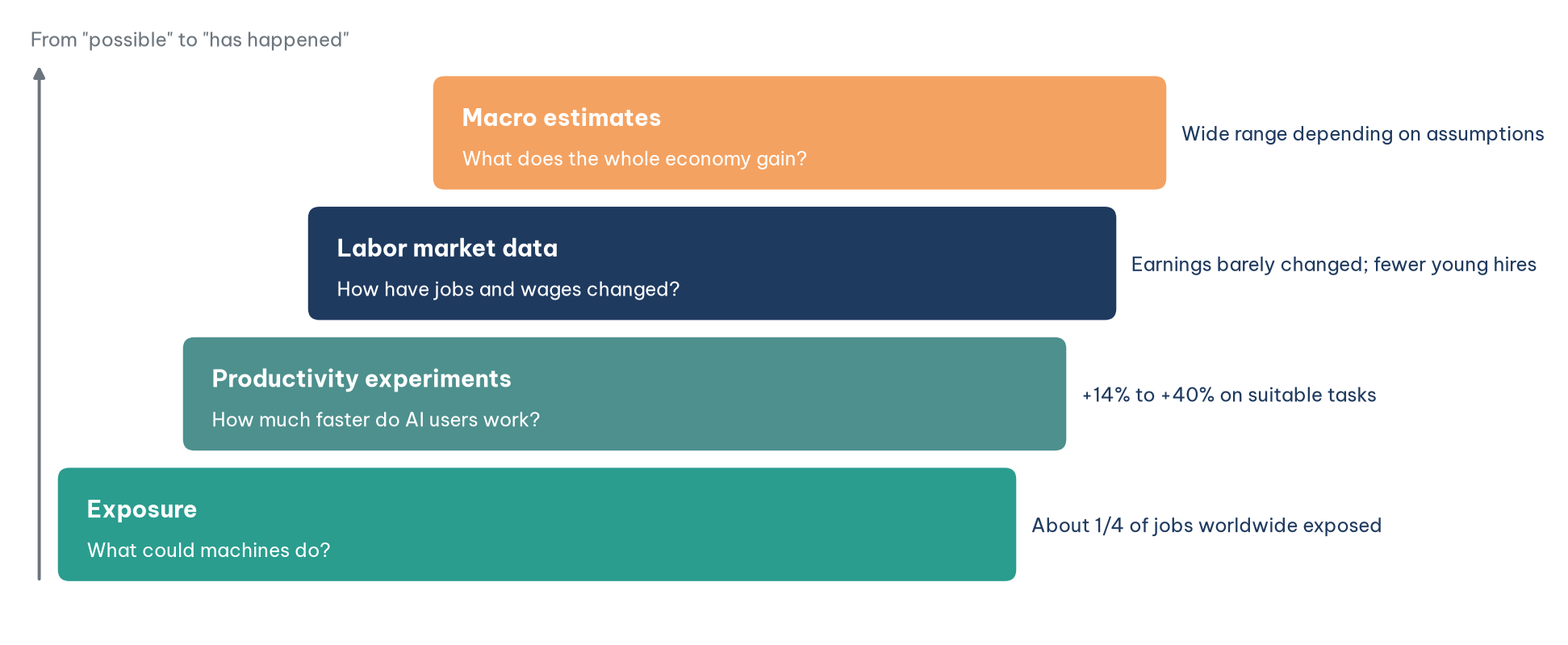
The most common misreading is using a number from a lower layer to answer a question from a higher one. "A quarter of jobs are exposed to AI" answers the first layer, but it is often read as "a quarter of jobs will be lost", a statement about the third layer that the number does not measure at all.
2. The first layer: exposure
Exposure studies are the source of most of the big numbers in the press. This section shows what they measure and what they do not.
The common method is to break each occupation into tasks and score whether AI could perform each task or substantially shorten the time it takes. Eloundou et al. (2024) applied this method to the U.S. labor market and arrived at two very different figures. If workers use a language model only through a simple chat interface, about 1.8% of jobs have more than half their tasks affected. If software built on the models and integrated into workflows is also counted, the figure rises to more than 46%. The gap between the two figures says that exposure depends heavily on whether businesses invest in integration, not only on the capability of the model.
At the global scale, the International Labour Organization (ILO) and Poland's National Research Institute updated an exposure index in 2025 based on nearly 30,000 tasks. According to this index, about a quarter of the world's jobs are in occupations with some degree of exposure to generative AI, but only about 3.3% are in the highest-exposure group (Gmyrek et al., 2025). Clerical occupations have the highest exposure. Exposure rises with national income, from about 11% of jobs in low-income countries to about 34% in high-income countries, and it is higher for women, who make up a large share of clerical work.
Exposure studies are useful for knowing which occupations should prepare first. But their authors stress that their figures are a ceiling on what is possible, not a forecast of what will happen. A highly exposed occupation may be augmented rather than replaced; which way it goes depends on business decisions, costs, regulation and the response of workers themselves. That is why the useful unit of analysis for any single role is the task, not the job title.
3. The second layer: productivity experiments
If the first layer asks what machines could do, the second asks what happens when workers actually use AI. This is the layer with the strongest evidence, thanks to experiments with control groups.
Table 1 summarizes the three most-cited studies, each in a different setting.
Figure 2 places the results of Table 1 side by side to show both their size and their downside.
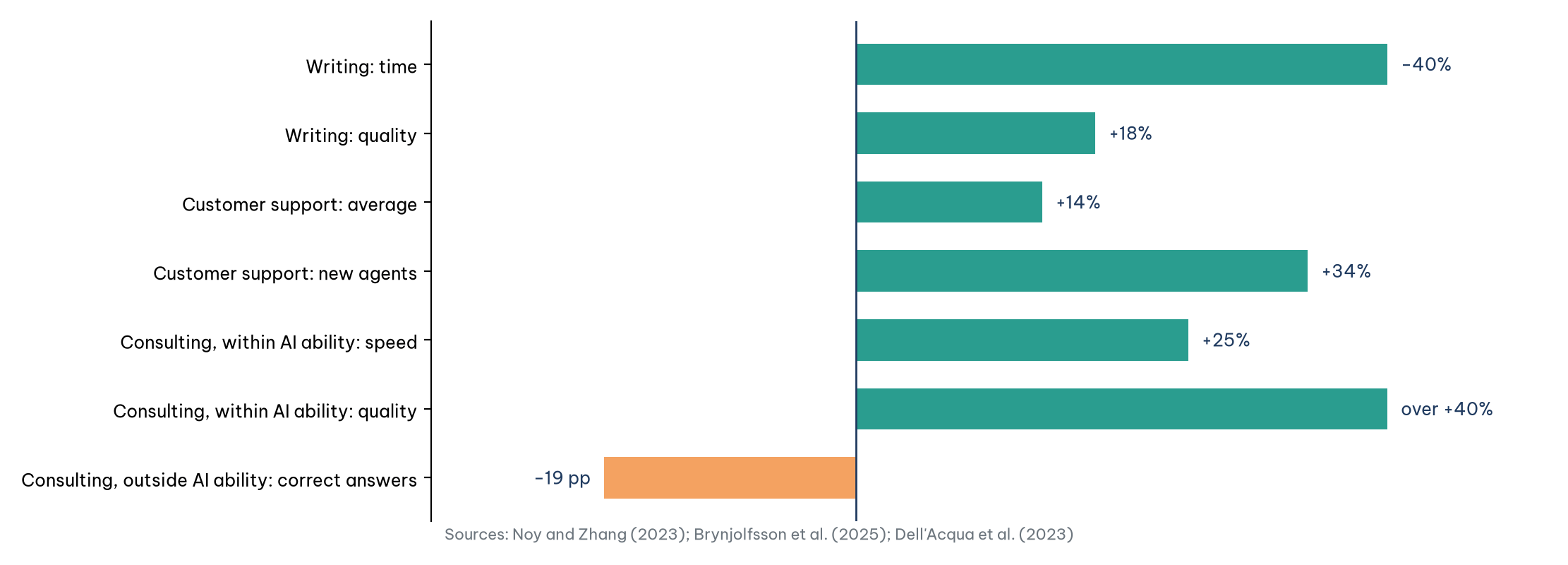
Figure 2 yields three lessons. First, the effect is real and not small, from about 14% to 40% depending on the task. Second, less experienced people usually gain the most, the opposite of the familiar fear that technology benefits only the skilled. Third, and most important for managers, AI has a "jagged frontier": surprisingly good at one task and surprisingly poor at another that looks equally easy, and users do not always know which side of the frontier they are on (Dell'Acqua et al., 2023). The orange bar in Figure 2 is the price of trusting the machine in the wrong place.
This layer of evidence also has limits. Experiments measure productivity on a well-defined task, usually over a few hours or a few months. They cannot say whether businesses will use the extra productivity to do more work with the same people or the same work with fewer people. That question belongs to the third layer.
4. The third layer: labor market data
This is the layer that directly answers the question everyone actually cares about: have jobs and wages changed yet? By the end of 2025, two large studies painted pictures that seem to conflict.
The first, by Humlum and Vestergaard (2025), used Danish administrative data, linking surveys of AI chatbot use to the earnings and hours records of about 25,000 workers at 7,000 workplaces, in 11 occupations often considered vulnerable to automation, such as accountants, software developers and customer support staff. The result was close to zero: two years after chatbots became widespread, there was no significant change in earnings or hours, even among heavy users, at workplaces that invested heavily or among new entrants. The time savings workers reported were only a few percent of working hours, and part of that time was absorbed by new tasks that AI itself created, such as checking the machine's output.
The second, by Brynjolfsson, Chandar and Chen (2025), used payroll data from a large U.S. payroll processing company covering millions of workers. They found that young workers aged 22 to 25 in the occupations most exposed to AI, such as software development and customer service, saw employment fall by about 16% relative to less exposed groups, after controlling for firm-level shocks. Older workers in the same occupations were not similarly affected. The decline was concentrated in occupations where AI mainly automates tasks, not in those where it mainly augments them. Wages of the young group barely changed, suggesting that firms hired fewer newcomers rather than cutting pay.
The two results are not really contradictory. They measure two countries, two kinds of data and two different questions: one asks how people already employed were affected, the other shows that the effect may arrive through the hiring door, among people not yet employed. Side by side, they suggest a cautious picture: by the end of 2025, AI had not significantly changed the earnings of people in work, but there were early signals at the entry point of occupations for young people. This is exactly the "apprenticeship ladder" that managers need to protect when redesigning work. Both studies are recent, both were working papers not yet fully peer-reviewed when published, and both may be revised as more data arrives; the second study itself revised its figure from 13% in its August version to 16% in its November 2025 version.
5. The fourth layer: macro estimates
The last layer asks what the whole economy gains and loses. It is the layer with the greatest uncertainty, and this section explains why.
The estimate by Acemoglu (2025) at the start of this article is built from the bottom up: take the share of exposed tasks from the first layer, multiply by the cost savings per task from the experiments in the second layer, then calculate the effect on economy-wide productivity. The result, no more than 0.66% of total factor productivity over ten years, is far below popular expectations, because only part of the exposed tasks will be converted profitably within the next decade. Other estimates, using more optimistic assumptions about the speed of diffusion, give much higher figures; the differences between estimates come mostly from assumptions, not from data.
The World Economic Forum's Future of Jobs Report 2025, based on a survey of more than a thousand large employers, expects that by 2030 about 170 million new jobs will be created and 92 million displaced, a net gain of about 78 million, with AI and information technology among many drivers (World Economic Forum, 2025). The positive net figure hides a very large shift: 92 million people will have to change jobs, and those who lose jobs are often not those who get the new ones. It is also worth remembering that these are employers' expectations, not measured data. Table 2 summarizes the four layers of evidence.
6. Reading a news story about AI and jobs
The four layers of evidence can be packed into a few questions for reading any news story. This section offers that list and suggests what to do.
Table 3 lists five questions to ask whenever you meet a headline about AI and jobs.
For workers, the evidence suggests that the useful question is not "will my job be replaced?" but "which tasks in my work are changing, and am I learning to do the part the machine does poorly?". For managers, the evidence from the second and third layers suggests two things: measure productivity on your own business's tasks instead of trusting an average figure, and keep a learning path open for newcomers when automating the easiest tasks. For businesses in middle-income economies, remember too that most of the evidence comes from high-income countries; occupational structure, labor costs and adoption speed differ, so the timing and size of the effects may differ as well.
Conclusion
The evidence on AI and jobs, as of the end of 2025, paints a picture less dramatic than either "AI takes every job" or "nothing changes". Exposure is broad, about a quarter of jobs worldwide. Productivity on suitable tasks rises clearly, especially for newcomers. But earnings and hours of people in work have barely changed, and the estimated macro effect remains modest. The most notable signal lies where it is discussed least: the entry door for young people in occupations where AI automates tasks.
Reading the four layers of evidence is also a skill that lasts longer than any number in this article. The figures will keep changing as new data arrives, as one of the studies cited here revised itself within a few months. What changes less is the habit of asking which layer a number belongs to, whom it measured, where and when, before letting it decide your worries or your plans.
References
Acemoglu, D. (2025). The simple macroeconomics of AI. Economic Policy, 40(121), 13–58. https://doi.org/10.1093/epolic/eiae042
Brynjolfsson, E., Chandar, B., & Chen, R. (2025). Canaries in the coal mine? Six facts about the recent employment effects of artificial intelligence [Working paper]. Stanford Digital Economy Lab. https://digitaleconomy.stanford.edu/publications/canaries-in-the-coal-mine
Brynjolfsson, E., Li, D., & Raymond, L. (2025). Generative AI at work. The Quarterly Journal of Economics, 140(2), 889–942. https://doi.org/10.1093/qje/qjae044
Dell'Acqua, F., McFowland, E., III, Mollick, E. R., Lifshitz-Assaf, H., Kellogg, K., Rajendran, S., Krayer, L., Candelon, F., & Lakhani, K. R. (2023). Navigating the jagged technological frontier: Field experimental evidence of the effects of AI on knowledge worker productivity and quality (Working Paper No. 24-013). Harvard Business School. https://www.hbs.edu/faculty/Pages/item.aspx?num=64700
Eloundou, T., Manning, S., Mishkin, P., & Rock, D. (2024). GPTs are GPTs: Labor market impact potential of LLMs. Science, 384(6702), 1306–1308. https://doi.org/10.1126/science.adj0998
Gmyrek, P., Berg, J., Kamiński, K., Konopczyński, F., Ładna, A., Nafradi, B., Rosłaniec, K., & Troszyński, M. (2025). Generative AI and jobs: A refined global index of occupational exposure (ILO Working Paper No. 140). International Labour Organization. https://doi.org/10.54394/HETP0387
Humlum, A., & Vestergaard, E. (2025). Large language models, small labor market effects (NBER Working Paper No. 33777). National Bureau of Economic Research. https://www.nber.org/papers/w33777
Noy, S., & Zhang, W. (2023). Experimental evidence on the productivity effects of generative artificial intelligence. Science, 381(6654), 187–192. https://doi.org/10.1126/science.adh2586
Stanford Institute for Human-Centered Artificial Intelligence. (2025). The AI index 2025 annual report. Stanford University. https://hai.stanford.edu/ai-index/2025-ai-index-report
World Economic Forum. (2025). The future of jobs report 2025. https://www.weforum.org/publications/the-future-of-jobs-report-2025/
Discussion about this post