AI Agents for Small Businesses and How Much Authority to Give Them
What AI agents are, where they help a small business, what they really cost and how much authority to hand them


Key takeaways
An AI agent is a system that uses a language model to plan, pick tools, observe results and loop until a goal is met. It differs from a chatbot because it acts, and from a fixed workflow because it decides its own steps.
Many small-business tasks need only an assistant with tools or an AI-assisted workflow with human review. A full agent is worth it only when the steps cannot be fixed in advance and the gain exceeds the cost of oversight.
The real cost of an agent includes model usage, integration, supervision and the cost of its mistakes, not just the subscription fee.
Long chains of actions compound error: an agent that is right 95% of the time at each step completes a 10-step task correctly only about 60% of the time.
Before an agent touches live systems, place it on one of five autonomy levels, put a human checkpoint before every irreversible step and answer an eight-question authorization sheet.
Since 2025, "AI agent" has become one of the most repeated phrases in technology, as vendors relabel their products and keynotes promise "digital employees" that never sleep. A small-business owner has simpler questions: how is an agent different from the chatbot I already use, what can it do for my company, what does it cost and what can go wrong?
The excitement has come with plenty of disappointment. In a June 2025 press release, Gartner (2025) predicted that more than 40% of agentic AI projects would be canceled by the end of 2027 because of escalating costs, unclear business value or inadequate risk controls. Gartner also warned of "agent washing", in which older tools such as chatbots or robotic process automation are simply relabeled as agents. None of this means agents are useless; it means a business must understand them before picking the right job for one.
This article has six sections. Section 1 defines an AI agent and separates it from chatbots, assistants and automated workflows. Section 2 describes the components of an agent. Section 3 presents six applications that suit small businesses, with a worked example. Section 4 analyzes costs and risks. Section 5 proposes a step-by-step way to start. Section 6 answers the hardest question once a business has decided to use an agent: how much authority to give it.
1. What is an AI agent?
The word "agent" is used loosely, so this section gives a definition precise enough to draw lines, then places agents on a spectrum of automation.
1.1. A working definition
In computer science, an agent has long been understood as a system that perceives its environment and acts on it to achieve goals (Russell & Norvig, 2021). In today's generative AI context, an AI agent is a system that uses a large language model to plan on its own, choose and use tools (such as web search, sending email, reading a spreadsheet or calling other software), observe the results and adjust, repeating the cycle until it completes an assigned goal.
In its guide to building agents, Anthropic (2024a) distinguishes two kinds of system. An AI-assisted workflow follows steps that people have defined in advance, with AI handling some of those steps. An agent lets the model decide the steps and how to use tools. The difference lies in who decides the next step: a person in advance, or the model while it runs.
1.2. From chatbot to agent
AI systems can be arranged on a spectrum according to how much the AI decides for itself, as Figure 1 shows.
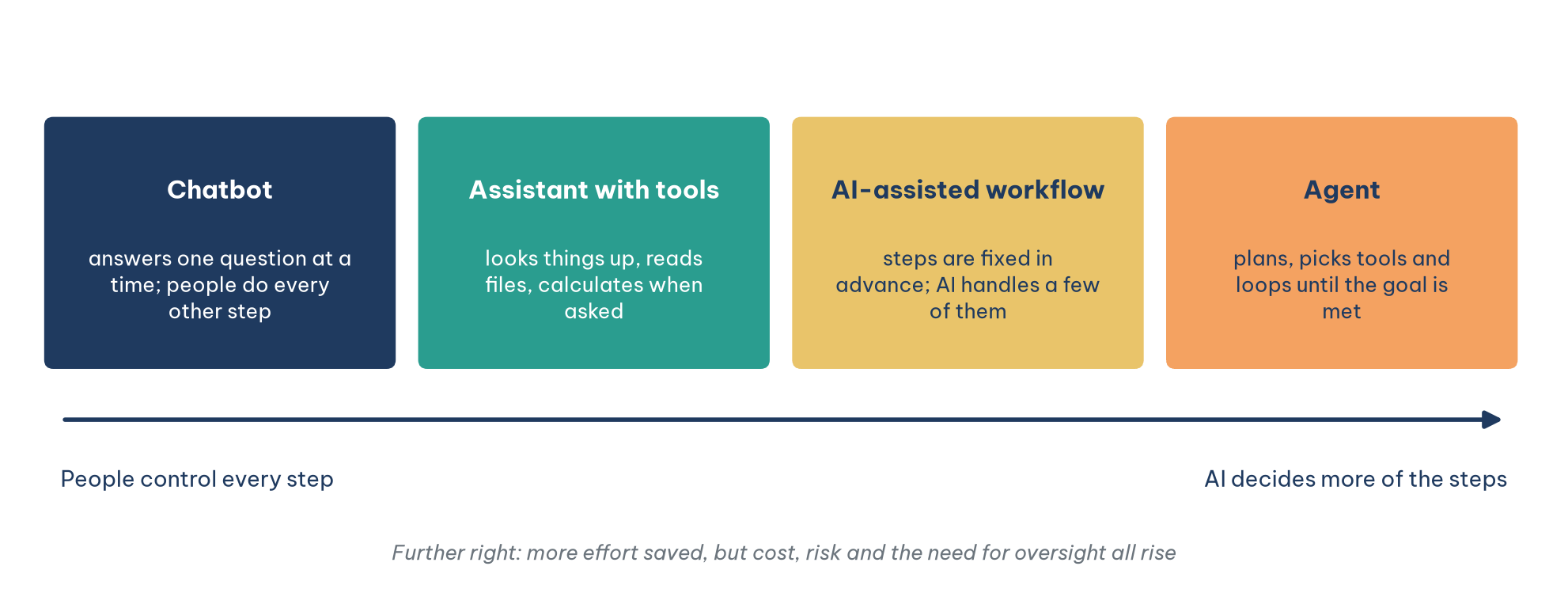
Table 1 compares the four levels in Figure 1 on the same task: handling a customer email asking about the status of an order.
For many small-business tasks, the second or third level in Table 1 is enough and safer. A full agent is worth it only when the steps are genuinely hard to define in advance and the benefit outweighs the cost of supervising it, which matches the advice of Anthropic (2024a) to start with the simplest solution and add complexity only when needed.
2. The components of an agent
Whatever platform it is built on, an agent has the same basic parts. This section describes each part and the role people play in the system.
2.1. The general architecture
Figure 2 shows four components arranged around the language model, which acts as the agent's brain.
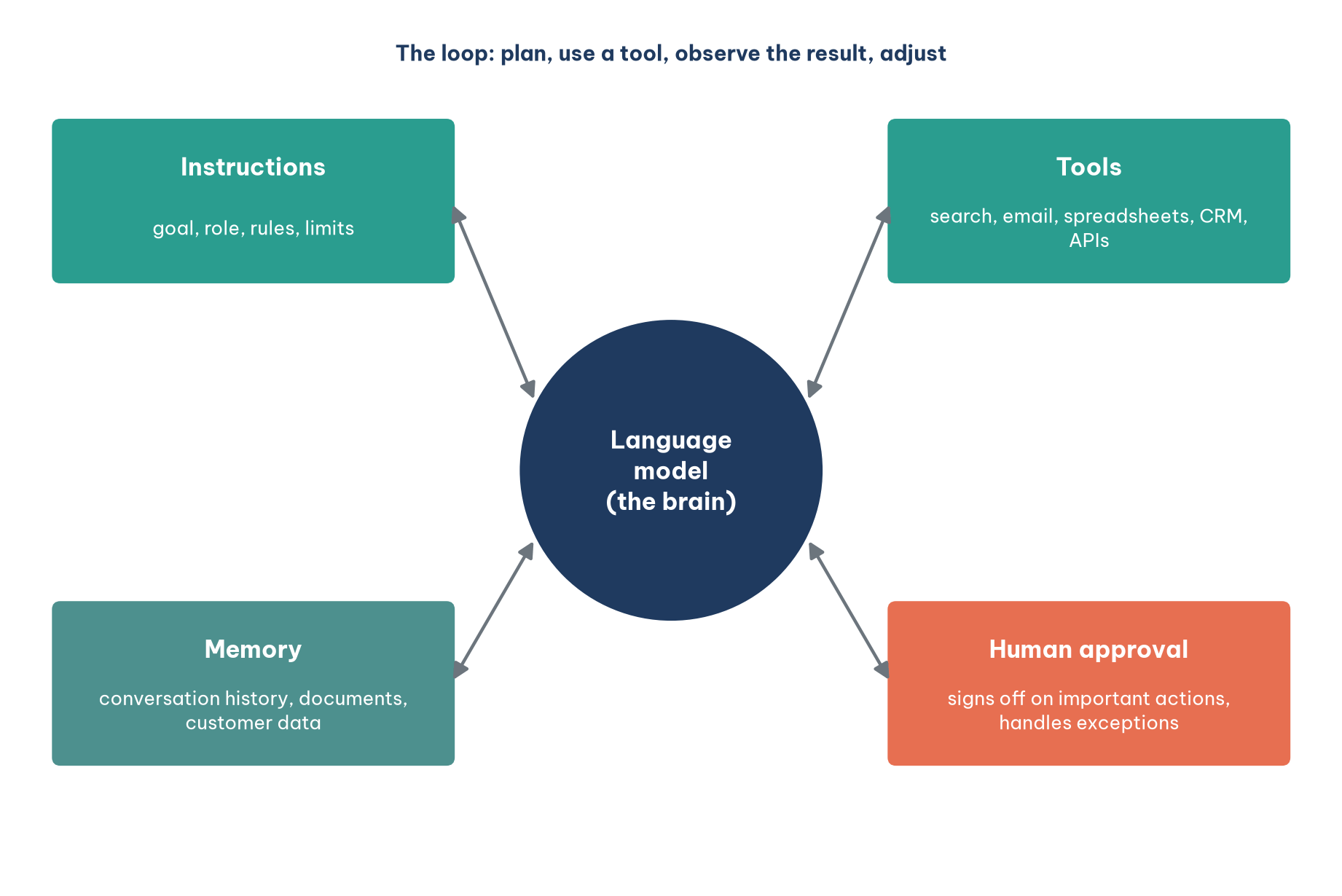
Each component in Figure 2 shapes one aspect of quality and risk. Table 2 summarizes them.
The "tools" and "human approval" rows in Table 2 decide whether an agent is safe. An agent that can only read data makes wrong answers; an agent that can send email, move money or delete records makes wrong actions.
2.2. Connecting tools
For an agent to use a company's software, it needs a way to connect. In late 2024 Anthropic released the Model Context Protocol (MCP), an open standard for connecting AI models with tools and data sources (Anthropic, 2024b), which other vendors went on to support. For a small business, the practical meaning is that more and more familiar software, such as email, calendars, spreadsheets and customer relationship management (CRM) systems, comes with ready-made connections for agents, without custom programming.
3. Six applications for small businesses
A small business does not need a complex agent to see value. This section presents six suitable applications, the recommended level of automation for each and the points where people must stay in control.
3.1. Six applications
Table 3 lists the six applications in order of rising risk.
The last row of Table 3 deserves special attention. Letting an agent reject candidates on its own carries risks of bias and legal liability, because a model can learn unfair patterns from data. Many jurisdictions also treat automated decisions about people more strictly than other uses of software.
3.2. A worked example: an online fashion store
Consider a hypothetical online fashion store with three staff and about 40 orders a day from its website and social media. Each day someone spends about two hours answering messages about sizes, shipping fees and order status, plus an hour matching orders against the carrier's records. The store starts with two steps. The first is an assistant that answers common questions from the size chart, the returns policy and the shipping fee table, and hands every out-of-scope question to a staff member. The second, after a stable month, is an automated workflow that each morning checks late orders and drafts update messages, which staff simply review and send.
The approach is cautious: nothing may issue compensation or cancel orders on its own, only reading and drafting are automated and people stay at every point where the business makes a commitment.
4. Costs and risks
Agents are neither free nor harmless. This section breaks down the components of cost and the main risks a small business should understand before deploying one.
4.1. Costs
The cost of an agent has more components than the subscription price, as Table 4 shows.
Model usage deserves a closer look, because part of today's AI pricing is subsidized by providers competing for market share and may rise as the market matures. Set a monthly spending cap and track the cost per completed task, not just the total bill.
4.2. Risks
Agents carry all the risks of language models, plus the risks that come from being allowed to act. Table 5 summarizes five main risks and how to reduce them.
The second risk in Table 5 is specific to agents and often underestimated; the OWASP Foundation (2025) ranks prompt injection first among the top ten risks for applications built on language models. The simplest principle is to treat everything an agent reads from outside (emails, web pages, customer documents) as data, never as commands.
5. How to start
For a small business, the best start is small, measurable and reversible. This section proposes five steps for deployment and the skills needed to run an agent.
5.1. Five steps
The first step is to choose a task that is repetitive, time-consuming, governed by fairly clear rules and not too costly when it goes wrong, such as a weekly report or answering common questions. The second step is to measure the current state: how many hours a week the task takes and how often it goes wrong. Without a baseline, there is no way to know whether the agent helps. The third step is to start at the lowest level of automation that does the job, following Figure 1, usually an assistant with tools or a workflow with human review. The fourth step is a trial of two to four weeks that records every error and every intervention. The fifth step is to widen permissions or extend to other tasks only when the error rate is acceptable and the benefit exceeds the cost of supervision.
5.2. The skills needed
The person running an agent does not need to code but needs three skills: writing clear instructions (a good prompt at the scale of a whole process), knowing the business's own processes well enough to tell which steps can be automated and keeping a habit of checking, by reading samples of the output and never fully trusting a system that seems to run well.
6. How much authority to give an agent
Once a business decides to use an agent, the hardest question is no longer which software it can connect to, since standards such as MCP have made that much easier. The question is how much authority to grant it. This section presents five levels of autonomy, explains why longer chains of work need more checkpoints and offers an eight-question authorization sheet.
6.1. Five levels of autonomy
Within an agent, autonomy is itself a range that can be split into five levels, loosely modeled on the levels of self-driving cars. Each step up moves another share of the decision from person to machine and needs another layer of control. Table 6 illustrates the five levels with the returns process of the fashion store from Section 3.2.
For a small business, Levels 1 and 2 in Table 6 are a sensible starting point. Move to Level 3 only when the logs are long enough to show an acceptable error rate, as in the fifth step of Section 5.1. The risk lies less in the technology than in the share of the decision that has moved from people to the machine.
6.2. Why longer chains need more checkpoints
A wrong answer is just a wrong answer. A chain of actions is different: the agent must get every step right for the final result to be right. If each step is correct with the same probability p, and errors at different steps are independent, the probability that a chain of n steps is entirely correct is p to the power n. Figure 3 plots this for three levels of per-step accuracy.
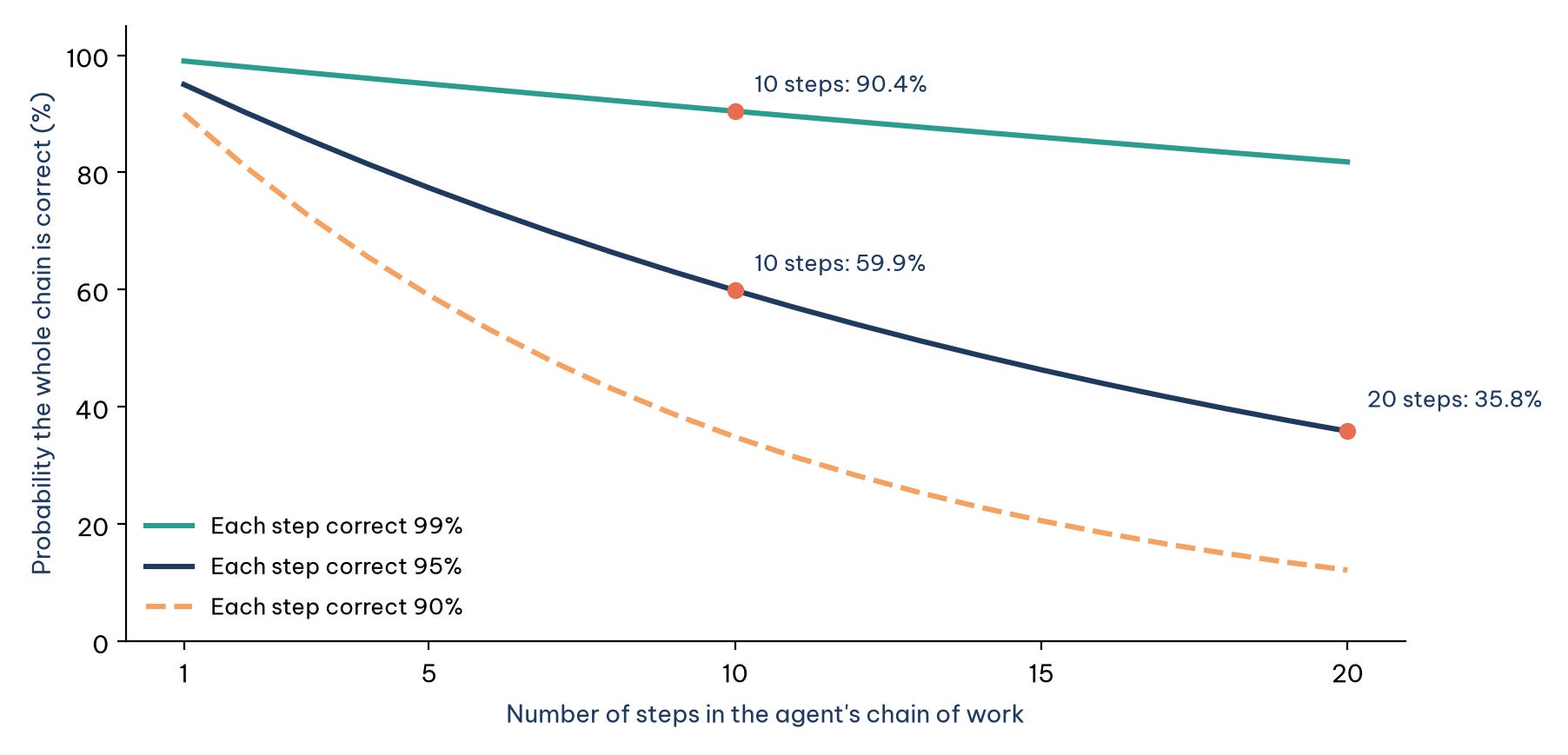
Figure 3 shows that an agent that is right 95% of the time at each step, which sounds very good, completes a 10-step process fully correctly only about 60% of the time and a 20-step process only about 36% of the time. Raising per-step accuracy to 99% brings the 10-step process to about 90%. Real figures differ, because errors are not independent (an agent that misreads the goal fails at every step) and the observation loop lets an agent fix some errors. The lesson holds: the longer the chain, the more it needs checkpoints, placed right before irreversible steps such as moving money or notifying customers. It also explains why demos mislead: one successful run says nothing about how often the agent succeeds in ten real runs.
6.3. An eight-question authorization sheet
Before an agent is given access to live systems, the owner and whoever handles technology (or the vendor) should answer the eight questions in Table 7 together. The sheet turns the vague question "should we use an agent?" into a series of concrete decisions, each with someone accountable. The last column gives sample answers for the after-sales agent of the fashion store in Section 3.2.
Question 4 in Table 7 connects directly to the risk of manipulation through input in Table 5. An attacker can hide instructions in a message that staff never see but the agent reads; security researchers have shown that applications built on language models blur the line between data and instructions (Greshake et al., 2023). The defense does not lie in telling the agent to be careful, because there is no way to guarantee that it will be. It lies in architecture: separating the part that reads outside content from the permission to take actions involving money.
Questions 7 and 8 are reminders that handing work to an agent does not hand away responsibility. In 2024 the Civil Resolution Tribunal of British Columbia, Canada, ordered Air Canada to compensate a customer because the airline's chatbot had misstated its fare policy, and it rejected the argument that the chatbot was a separate entity responsible for its own words (Moffatt v. Air Canada, 2024). Whatever an agent says or does in the name of a business, the business owns it.
Conclusion
An AI agent uses a language model to plan, use tools, observe results and repeat until it reaches a goal. It differs from a chatbot because it acts and from an automated workflow because it decides its own steps. Of its components, tool permissions and human checkpoints decide how safe it is.
For a small business, many tasks such as periodic reports, answering common questions, processing documents and after-sales care can be supported well, usually at the level of an assistant or an automated workflow with human review, without a full agent. The real cost includes integration, supervision and mistakes, and the risks run from wrong information and prompt injection to leaked data and runaway bills. Starting small, measuring before and after and granting minimum permissions is the way to avoid joining the canceled projects that Gartner predicts.
Once a business chooses to use an agent, it should settle the agent's authority in writing: place the agent on one of the five autonomy levels, put a checkpoint before every irreversible step and answer all eight questions of the authorization sheet before the agent touches a live system. The longer the chain of work, the denser the checkpoints need to be.
References
Anthropic. (2024a, December 19). Building effective agents. https://www.anthropic.com/engineering/building-effective-agents
Anthropic. (2024b, November 25). Introducing the Model Context Protocol. https://www.anthropic.com/news/model-context-protocol
Gartner. (2025, June 25). Gartner predicts over 40% of agentic AI projects will be canceled by end of 2027 [Press release]. https://www.gartner.com/en/newsroom/press-releases/2025-06-25-gartner-predicts-over-40-percent-of-agentic-ai-projects-will-be-canceled-by-end-of-2027
Greshake, K., Abdelnabi, S., Mishra, S., Endres, C., Holz, T., & Fritz, M. (2023). Not what you've signed up for: Compromising real-world LLM-integrated applications with indirect prompt injection. In Proceedings of the 16th ACM Workshop on Artificial Intelligence and Security (pp. 79–90). Association for Computing Machinery. https://doi.org/10.1145/3605764.3623985
Moffatt v. Air Canada, 2024 BCCRT 149. https://decisions.civilresolutionbc.ca/crt/crtd/en/525448/1/document.do
OWASP Foundation. (2025). OWASP top 10 for LLM applications 2025. https://genai.owasp.org/llm-top-10/
Russell, S., & Norvig, P. (2021). Artificial intelligence: A modern approach (4th ed.). Pearson. https://aima.cs.berkeley.edu/
Discussion about this post