Agentic Commerce: When the Buyer Is Software
When an AI assistant searches, compares and orders on a customer’s behalf, small sellers must get their data, policies and bot handling ready


Key takeaways
Agentic commerce runs on a ladder of four delegation levels, from suggesting products to buying within a spending limit. The first two are common today; the last two still need new layers for authorization and identity.
Forecasts are large and deserve careful reading: even an optimistic 2030 scenario equals only a small share of total retail, and the leading platform pulled back its in-chat checkout in 2026.
A protocol stack is forming. Sellers mainly need to care about three layers: product and transaction data, spending authorization and agent identity.
Structured, consistent product data decides whether a product exists for an agent at all. Information that lives only in the owner's head does not exist.
The four cheapest preparations are useful in every scenario: consistent product data, machine-readable policies, a credible footprint beyond the website and a clear post-purchase process.
One Monday morning, the owner of a small specialty coffee brand receives an order on the website that looks perfectly ordinary: a regular customer reordering the same beans as last time. Only the order note is unusual. The order was placed by the customer's AI assistant, following an instruction given weeks earlier: "reorder the coffee when it's running low, under US$16." No one in the shop spoke to the customer, no one gave advice, no one ran an ad. A piece of software found the shop, read the product page, compared prices and placed the order.
The scenario is hypothetical, but not far off. AI assistants have begun to search, compare and, in some cases, complete transactions on behalf of their users. Sellers are no longer selling only to people but also to software acting for people. That software is not persuaded by a beautiful photo or a clever slogan; it reads data, and if the data is missing, the product effectively does not exist.
This article has five sections. Section 1 defines agentic commerce and shows how to read the forecasts about its size. Section 2 describes four levels of delegation, from suggestion to autonomous purchase. Section 3 explains the emerging protocol stack and which layers a seller needs to care about. Section 4 proposes four preparations in order of increasing investment, together with the problem of recognizing agents. Section 5 looks at where agentic commerce meets business-to-business buying.
1. What agentic commerce is
Agentic commerce is buying and selling in which an AI agent, software that can carry out a chain of actions on its own to reach a goal set by a user, searches, compares and may complete a transaction for that user. This article looks at it from the seller's side: what changes when a customer sends an agent instead of coming in person.
1.1. Where agents change buying behaviour
Agents do not change every kind of purchase equally. Heinemann (2026) points out that consumers are especially keen to stop buying everyday, repeat products themselves; agents search and compare in an instant, automate repeat purchases and may raise conversion rates because fewer carts are abandoned. In other words, routine replenishment, such as coffee, milk, toilet paper or pet food, is where agents arrive first. Purchases that need inspiration, such as choosing a gift or a dress, will change more slowly.
1.2. Reading the size forecasts with care
Numbers about agentic commerce are often very large and need careful reading. Heinemann (2026) cites expert forecasts that by 2030 more than 30% of e-commerce orders will be placed by AI agents, and argues that agentic commerce could trigger a paradigm shift in the industry. Another widely quoted forecast says AI agents could be involved in about US$9 trillion of global online spending by 2030. But because e-commerce is only about 20% of global retail, even that optimistic scenario equals roughly 5% of total retail sales, and shoppers who use AI assistants for research still use other channels along the way (Tidio, 2026).
Real-world rollout has not been a straight line either. In March 2026, OpenAI stopped its checkout feature inside ChatGPT and sent the payment step back to the seller's app or website (Forrester, 2026). The lesson for small sellers is that preparing for agents is worthwhile, but no plan should bet everything on a single platform or protocol. A forecast is not a fact.
2. Four levels of delegation
Agentic commerce is not a yes-or-no matter but a ladder of delegation. Each higher rung moves part of the decision from the user to the agent, as Figure 1 shows.
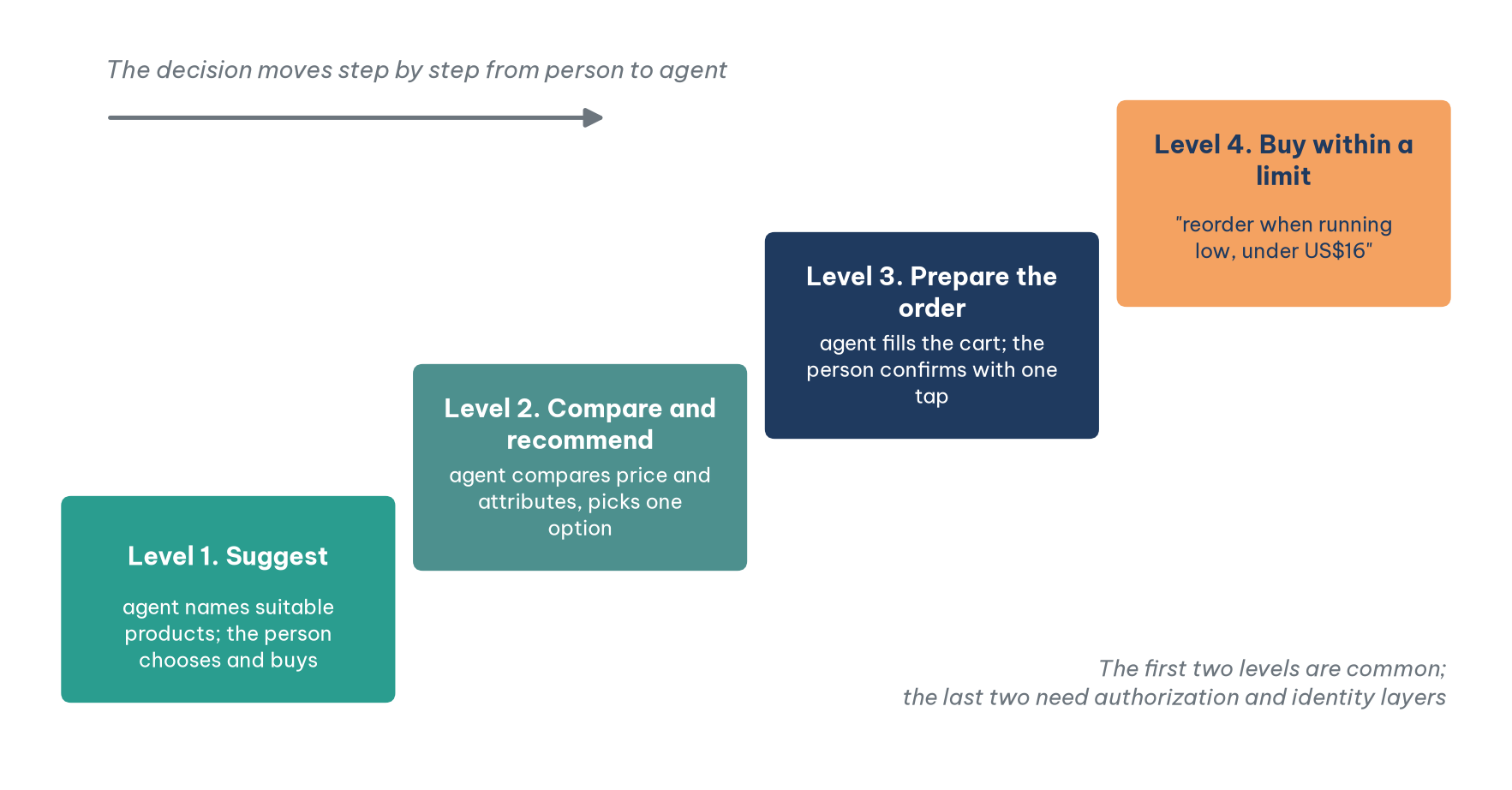
At the lowest level, the agent suggests products and the user chooses and buys. At level two, the agent compares and recommends one option. At level three, the agent prepares the order and the user confirms with one tap. At the highest level, the agent buys within a limit the user has set, like the instruction "reorder when running low, under US$16" at the start of this article. The first two levels are already common in today's AI assistants; the last two remain limited and require new layers of infrastructure for authorization and identity. The higher the level, the more evidence sellers and banks need that the agent is genuinely permitted and acts only within that permission.
Each level asks the seller to prepare something different. At levels one and two, what matters is being seen and compared correctly by the agent: product information must be complete and consistent. At levels three and four, the agent must also be able to place the order: price, stock and policies must be accurate in real time, and the payment system must recognize a payment made by an agent as legitimate.
3. The protocol stack
For an agent to buy something, many parties must speak the same language: agent to tools and data, agent to agent, agent to the seller's systems, agent to the bank. Between late 2024 and early 2026, a series of open protocols appeared, each covering one layer. Figure 2 arranges them as a stack, with what a seller needs to prepare at each layer.
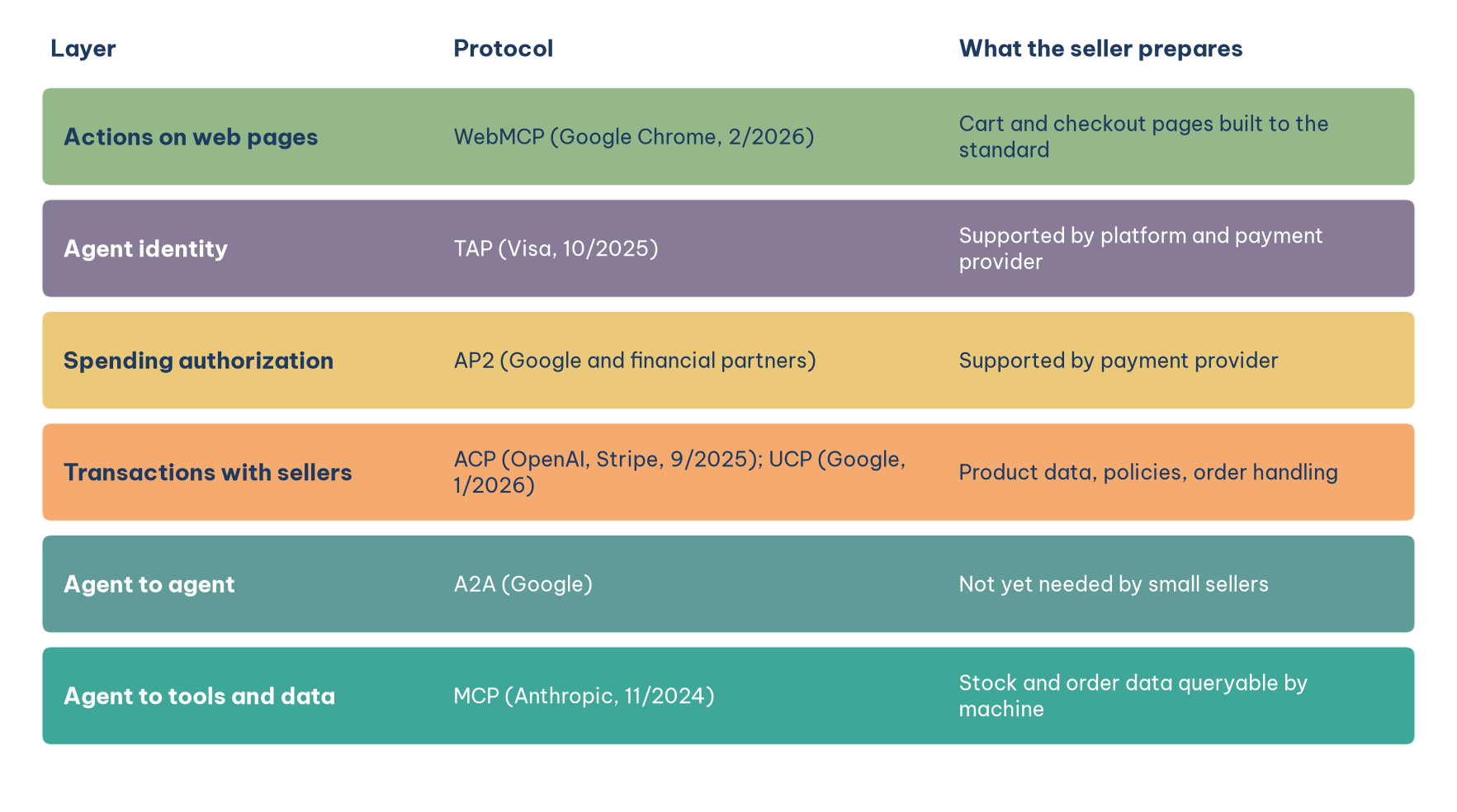
Sellers do not need to understand the technical details of each protocol in Figure 2, but they need to know which layers require their own data and which layers the platform or payment provider takes care of. These protocols are designed so that users keep the purchase decision while sellers keep control over fulfilment, customer data and the customer relationship; the agent is an intermediary, not a replacement for either side (Tidio, 2026). Three layers matter most to sellers:
The product and transaction data layer (ACP, UCP) decides whether a product is visible to an agent and can be ordered. This is the layer where sellers must do the most preparation themselves, and it is the subject of Section 4.
The authorization layer (AP2) uses a digitally signed "intent mandate" that works like a power of attorney: it lets an agent spend up to an amount, with specified sellers or categories, possibly for a set period. Proof of the mandate travels with each transaction, so the bank and the seller know the payment is legitimate and the user can revoke it (Tidio, 2026).
The identity layer (TAP) helps sellers tell legitimate agents from malicious bots and scrapers.
The lowest layer, MCP, was released by Anthropic in late 2024 as an open standard for connecting AI assistants to the systems where a business's data lives (Anthropic, 2024). For a small seller, it is enough to know whether stock and order data can be queried by a machine; the connection is usually handled by the e-commerce platform provider.
4. Getting ready for agents
When AI assistants become a gateway to shopping, structured product data decides whether a product appears in an AI's suggestions at all and whether an agent can order it correctly (Tidio, 2026). Unlike traditional search, there is no second page to fall to: when information is missing, the AI simply recommends a competitor with complete data. This section presents four preparations and then discusses how to recognize agents.
4.1. Four preparations
Table 1 orders the four preparations by increasing investment, with examples for a coffee brand.
The third preparation in Table 1 is often overlooked. According to an analysis cited by Tidio (2026), a brand's own website makes up only about 5–10% of the sources AI search engines draw on when composing an answer; the rest are news outlets, user-generated content and affiliate sites. The fourth preparation is the hardest to operate and the least standardized in current protocols: if an agent orders the wrong item, who pays for the return?
Back to the coffee brand at the start. Suppose that, when the team reviews its data through the eyes of an agent, it finds three gaps: the product page describes the roast sometimes as "medium roast" and sometimes as "city roast"; the roast date is printed only on the bag and is not in the data; and the return policy is written as long prose with two contradictory statements about the return window. Fixing these three gaps might take two weeks and cost almost nothing. A fact that "everyone knows" in the seller's head but that is not in the data does not exist for an agent.
AI itself can play the agent to audit the data. A sample prompt: "You are an AI shopping assistant. Below are the product data and policy page of a shop: [paste data]. Please (1) list which attributes are missing or inconsistent across products; (2) point out any policy sentences that are vague or contradictory; (3) try to answer the following three customer questions using only the data provided, and mark where you had to guess: [three questions]." The AI may invent plausible attributes to fill the gaps, so every suggested attribute must be checked against the real product. Never put cost prices, customer data or contract terms into the prompt.
4.2. Recognizing agents: serve or block
Non-human traffic is growing very fast. According to figures compiled by Tidio (2026), by late 2025 publisher sites received one AI bot visit for every 31 human visits, compared with one in 200 at the start of the year. Sellers must learn to tell legitimate shopping agents, which should be served well, from price scrapers and fraud bots, which should be blocked. Block too hard and you lose customers who arrive through agents; open too wide and you lose data and invite abuse. This is a new security problem, and identity layers such as TAP exist to solve it.
5. Where wholesale meets agentic commerce
Agentic commerce does not happen only in retail. The purchases that businesses have long wanted to automate, such as reordering stock, comparing quotes and monitoring inventory for automatic replenishment, are exactly what AI agents do well: repetitive, rule-based and data-rich. A café chain might give an agent the task "keep every café stocked with 5 kg of beans, order from approved suppliers, stay within the monthly budget." The roaster then no longer sells to the café manager but to the chain's agent, and the criteria for choosing a supplier shift from personal relationships to trustworthy data: is the price clear, is the stock real, is delivery on time as promised?
This cuts both ways for sellers. The good side is that the cost of selling each wholesale order falls sharply and orders become steadier. The hard side is that agents compare more coldly than people do, so the advantage of relationships weakens and the advantage of measured reliability grows: on-time delivery rate, consistency of quality, transparency of origin. A small roaster can still compete in that world if it turns what it does well into verifiable data. Lasting advantage lies in what competitors find hard to copy.
Conclusion
Agentic commerce changes who the seller must persuade. When an AI assistant searches, compares and orders on a customer's behalf, what decides whether a product is chosen is data: complete and consistent attributes, accurate price and stock, clear and machine-readable policies, and a credible footprint beyond the website. The four levels of delegation and the protocol stack show that this journey is at an early stage: the first two levels are already common, while the last two await mature authorization and identity layers.
For small sellers, the sensible approach is to do the cheap preparations that pay off even if agents are slow to spread: standardize product data, rewrite policies clearly and build a trustworthy footprint beyond the website. Protocol integration can wait until the e-commerce platform and payment provider support it. Forecasts in the trillions of dollars should be read with care, but a clean catalogue has value in every scenario.
References
Anthropic. (2024, November 25). Introducing the Model Context Protocol. https://www.anthropic.com/news/model-context-protocol
Forrester. (2026). What it means that the leader in "agentic commerce" just pulled back. Forrester Blogs. https://www.forrester.com/blogs/what-it-means-that-the-leader-in-agentic-commerce-just-pulled-back
Heinemann, G. (2026). Der neue KI-Commerce: Intelligenter E-Commerce und KI-basierte Plattformlösungen im Online-Handel. Springer Gabler. https://doi.org/10.1007/978-3-658-51173-9
Tidio. (2026). AI in e-commerce in 2026: The new shopping funnel. https://www.getlyro.ai/reports/ai-in-ecommerce
Discussion about this post