After the AI Subsidy: Which Moats Survive?
As AI providers tighten subscription plans and API prices rise, what defensible advantage can businesses built on someone else’s platform still count on


Key takeaways
Flat-rate AI subscriptions rely on cross-subsidy: light users pay for heavy ones. Agents that run nonstop break that arithmetic.
Besides cost, providers need observability: they cannot optimize or protect traffic they cannot see.
AI is entering the familiar platform cycle of subsidize, arbitrage, reprice, and probably faster than Web2 did, because each AI call has a real marginal cost.
Vertical and horizontal platform strategies respond differently, but indefinite subsidy of agent loops is unlikely to last on either side.
An AI bill can be worked out from list prices per million tokens. In a worked example, even a threefold API price rise leaves an AI assistant about twice as cheap per conversation as a human agent, so the real question is the cost of a wrong answer.
The durable moat is not access to a cheap model. It is orchestration (smart routing, caching, cross-checking, fallback) plus proprietary workflow logic.
How to read this article. The sections on Anthropic's reasons (cost, system observability) are the author's analysis based on platform economics, not the company's official explanation. Predictions about what providers will do next are only predictions. Readers should consult each provider's official announcements and terms of service.
Anthropic's decision to block third-party agentic tools such as OpenClaw from using Claude Pro subscriptions is not just a passing policy change. From the standpoint of systems architecture and platform strategy, it is an important signal: the era of subsidized AI is drawing to a close.
Over the past few years, many developers and startups have built products on a comfortable assumption: the enormous computing power of frontier AI models could be tapped at very low cost through flat-rate subscriptions. But unit economics catch up sooner or later. When prices move closer to real cost, products that live only on the price gap will struggle, and products that create real value will need an advantage other than "access to a cheap model".
This article analyses that shift in seven parts. Part 1 explains the economic loophole in subscriptions when the user is an AI agent. Part 2 discusses the technical reason: system observability and reliability. Part 3 places the event in the familiar cycle of technology platforms. Part 4 compares the strategies of model providers. Part 5 proposes how businesses can build a moat after the subsidy ends. Part 6 works out an AI bill at list prices and builds price scenarios, and Part 7 looks at what this means for companies in emerging markets.
1. The economic loophole in subscriptions
To understand why a model provider would redraw the boundaries of use, look at the nature of the subscription software-as-a-service (SaaS) business model, and at what changed once the user was no longer human.
Flat-rate subscriptions, such as the roughly USD 20 per month individual plans for ChatGPT or Claude, are built on cross-subsidization. Ordinary users, who occasionally ask AI to write an email or summarize an article, pay more than the cost they actually incur, and the surplus covers the heavy users. The model works well when users are people, because people need time to read, think and type: their usage is naturally limited.
AI agent systems have no such biological limit. When a developer connects a tool such as OpenClaw to a subscription, they are not typing. They run automated loops that operate continuously, calling the model again and again to plan, write code, check for errors and fix them. Figure 1 illustrates this with hypothetical figures.
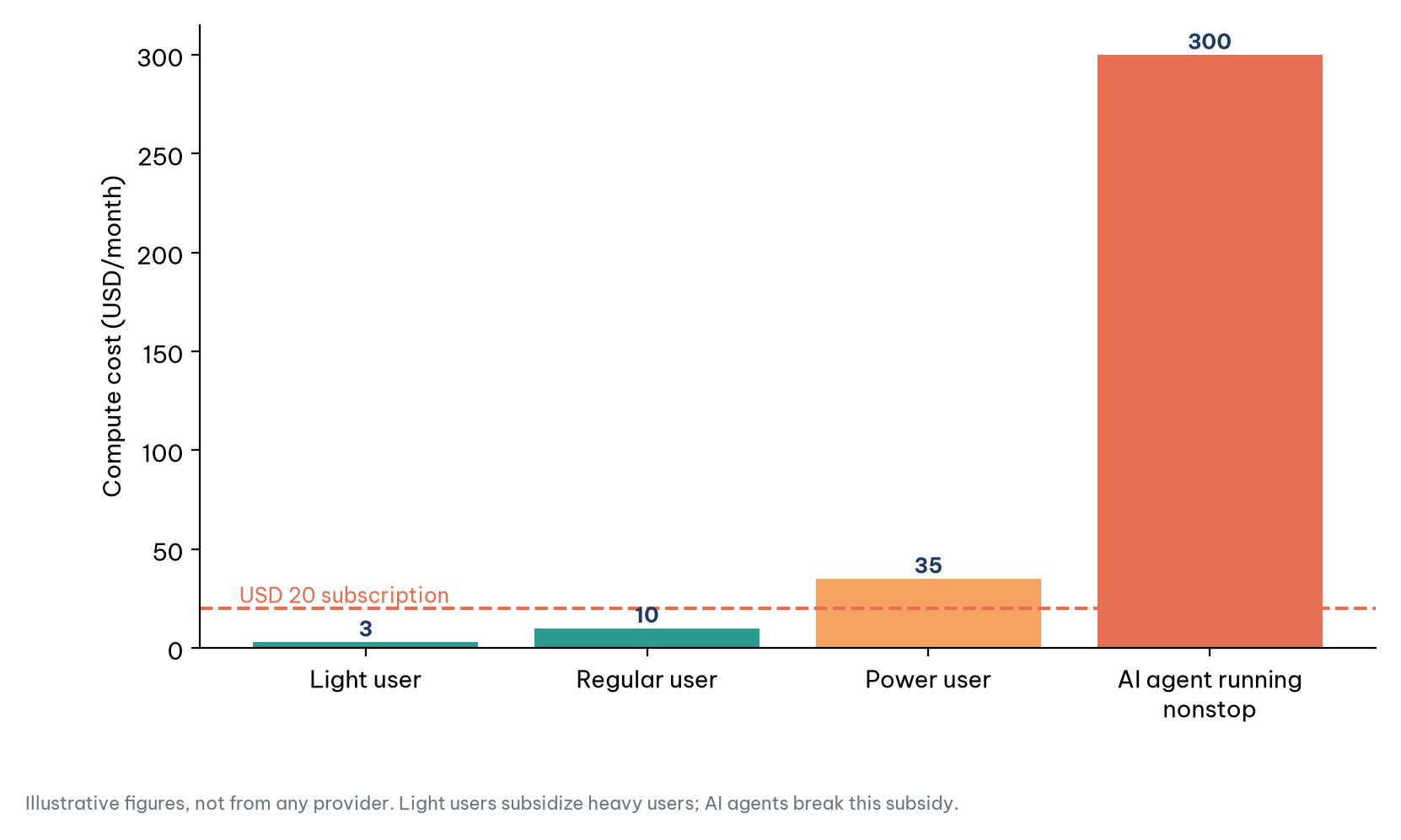
According to estimates shared in the developer community, comparing the tokens used through subscriptions with public API prices, a subscription account running agents continuously can consume compute worth many times the subscription price. This is no longer "heavy use"; it is structural arbitrage: buying something at a price designed for one kind of use, then using it for a completely different kind.
From an economic viewpoint, closing the loophole protects the pricing model. From the developers' viewpoint, what caused resentment was the abruptness of the change and the lack of transparency about usage limits. Both viewpoints have merit: providers need financial sustainability, and builders need clear, stable rules. But cost is not the whole story.
2. A systems blind spot: observability and reliability
Beyond the financial problem, a technical reason may also explain the decision. This is the author's inference, based on the principles of running large-scale systems.
Observability is the ability of engineering teams to "see inside" a system's internal state (which data flows are running and how they are structured) through logs and metrics. It is what allows them to ensure reliability, the ability to keep the system stable in the face of traffic fluctuations.
When tens of thousands of third-party agents pass through a subscription gateway designed for ordinary users, they create a large "black box". The provider loses much of its ability to classify the load being run, with consequences in three areas. The first is lack of observability: agents send large volumes of complex requests, but the system records only "a user chatting", so engineers struggle to know how the prompts are structured. The second is reliability: without classifying load, the provider finds it hard to plan capacity and to apply optimizations such as prompt caching (Anthropic, n.d.-b), which stores repeated context so it need not be recomputed from scratch. Expensive GPU servers end up processing the same work repeatedly, risking local overload and slowing the system for other users. The third is safety risk: high-speed automated flows that are hard to monitor leave the system more exposed to jailbreaks and usage-policy violations.
Systems engineering has a familiar principle: you cannot optimize, or protect, what you cannot see. By moving high-intensity agent traffic to the official API, where every request is classified, metered and rate-limited, the provider regains observability. This is a reasonable way to manage load, but not the only one; for example, providers could publish the usage limits of each plan transparently. Whatever the reason, the story is not new: it repeats a pattern seen many times in the history of platforms.
3. The illusion of free and the platform cycle
The developer community's strong reaction reflects a deeply rooted expectation in tech: the expectation of permanent subsidy. It formed during the zero-interest-rate period (ZIRP, zero interest rate policy), when companies were willing to use venture capital to offer services free or below cost to win market share.
Silicon Valley's history shows a recurring pattern: many platforms, after using a "free lunch" to build an ecosystem, turn to extracting value from the very people who helped them grow. The writer Cory Doctorow (2023) calls this process enshittification. Two Web2 examples show the pattern clearly.
At Twitter (now X), in the early years the company encouraged developers to build third-party clients to attract users. In early 2023, Twitter cut off API access for these apps, and popular clients such as Tweetbot and Twitterrific stopped working almost immediately, pushing users back to the official ad-supported app (Perez, 2023). At Reddit, in summer 2023, the company announced new API fees; Apollo, a well-known third-party Reddit app for iOS, announced it would shut down because, by its developer's calculation, the API bill would reach about USD 20 million a year (Peters, 2023).
The common pattern can be described as a three-stage cycle (Figure 2). In stage 1, the platform opens cheap or free APIs to attract developers who build use cases and bring in new users. In stage 2, startups and developers build entire business models on that subsidized price, as agent tools did with subscriptions. In stage 3, once the platform is big enough or financial pressure rises, it reprices the service close to real cost, and products that live on the price gap are weeded out.
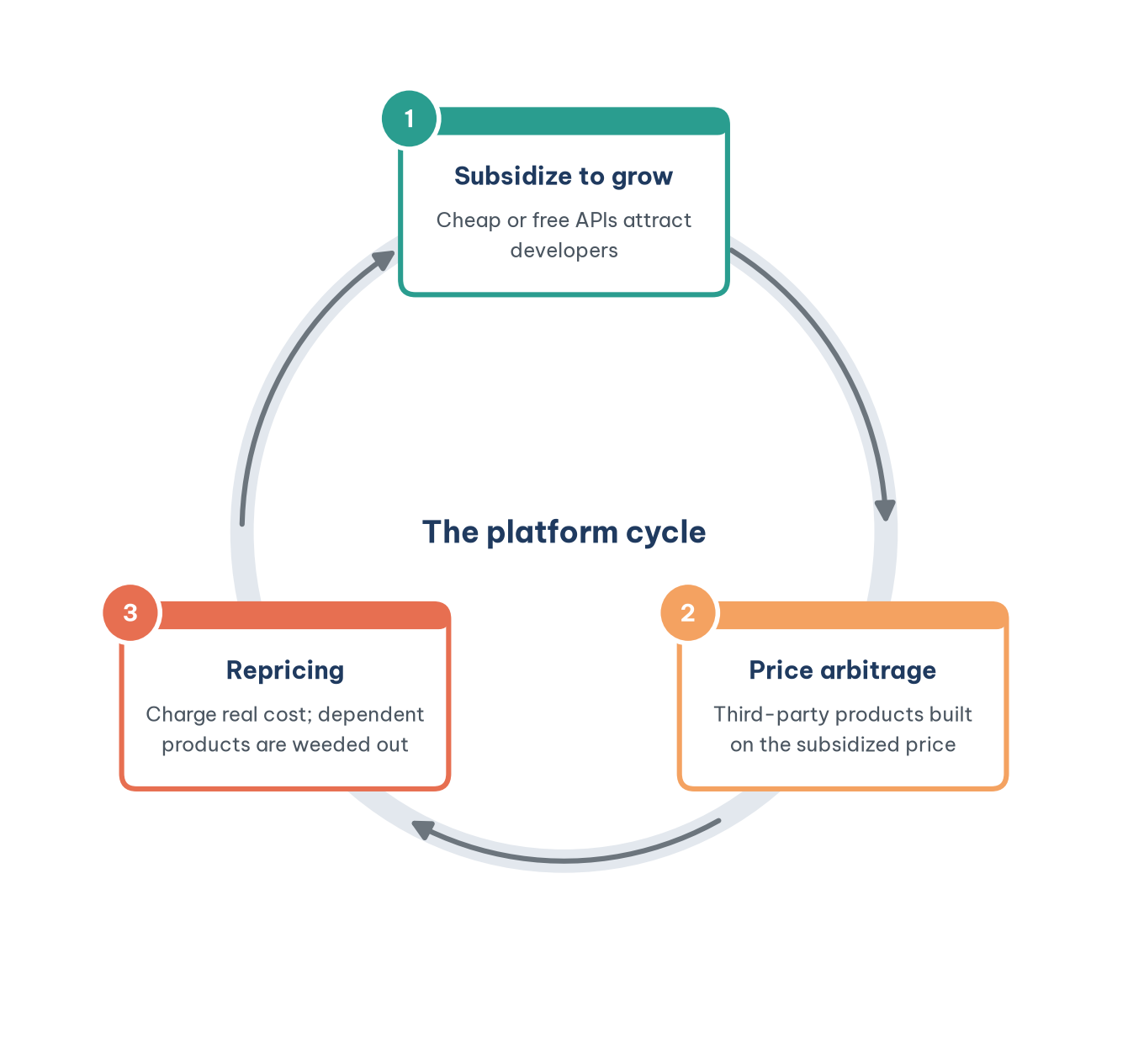
The AI market shows signs of entering stage 3, and possibly faster than Web2 did. The core difference is marginal cost. A Twitter or Reddit API call is mostly a database query with a tiny cost. A call to a frontier large language model requires billions of matrix multiplications on expensive GPU clusters. AI inference costs are orders of magnitude higher than traditional computing, even though they are falling fast with each generation of models and hardware. Table 1 compares the three cases.
Because the physical costs are large, AI companies have far less "staying power" for subsidies. Anthropic's decision is therefore unlikely to be an isolated case. But not every provider responds the same way, and how they respond reveals their long-term strategy.
4. The strategic chessboard of model providers
Right after Anthropic tightened its subscriptions, OpenAI invited users of agent tools to move to its Codex plans. In business terms this is a classic "judo" move: using the pressure created by a rival's unpopular decision to win users. But at a deeper level, the episode reveals two different philosophies of platform building.
A vertical stack strategy, which Anthropic appears to pursue, controls the whole experience: from the core model and caching layer to its own tools (such as Claude Code) and the safety layer. Drawing boundaries with third parties helps optimize internal performance, ensure observability and protect margins. By contrast, a horizontal stack strategy, which OpenAI's move suggests, aims to become the default infrastructure layer beneath third-party agent tools, accepting high short-term costs in exchange for ecosystem reach. Table 2 compares the two strategies.
Winning users on price, however, comes with two problems. The first is very low loyalty: the engineering community is sensitive to price and convenience. Many people switching from one provider to another within a short time shows they are attached to the tool (OpenClaw) rather than to the platform. A provider that treats developer goodwill as a "moat" may be misreading the signal. The second problem is unit economics: by absorbing these users, a provider also takes on exactly the kind of load its rival just removed, agents running continuous loops under a fixed subscription price.
The author's prediction: even with OpenAI's very large infrastructure, subsidizing agent loops indefinitely is hard to sustain. Within 12 to 18 months, providers following the horizontal strategy are likely to reprice or set clearer limits too, unless inference costs fall fast enough. Part of the community may then move to open-weight models such as Llama, DeepSeek and Qwen, self-hosted or on rented infrastructure. The cycle may continue until the market accepts a price that reflects actual compute cost. For builders, the practical question is: how do you avoid depending on that cycle?
5. Building a moat after the subsidy
The lesson for engineers, founders and companies building AI products can be summed up in one sentence: calling the strongest, most expensive model for every task is not an engineering strategy; it is waste. When the free lunch ends, competitive advantage no longer lies in which model you can use, because anyone can buy API access. The economic moat lies in two layers: orchestration architecture and the company's proprietary workflow logic.
5.1. Layer 1: smart routing
A good routing architecture classifies workloads by difficulty to balance quality and cost (Figure 3). Instead of sending every request to the same model, a router estimates the difficulty of each request and sends it to the right model; repeated context is kept in a cache; important results are cross-checked by a cheaper model; and when one provider has an outage, the system switches automatically to another.
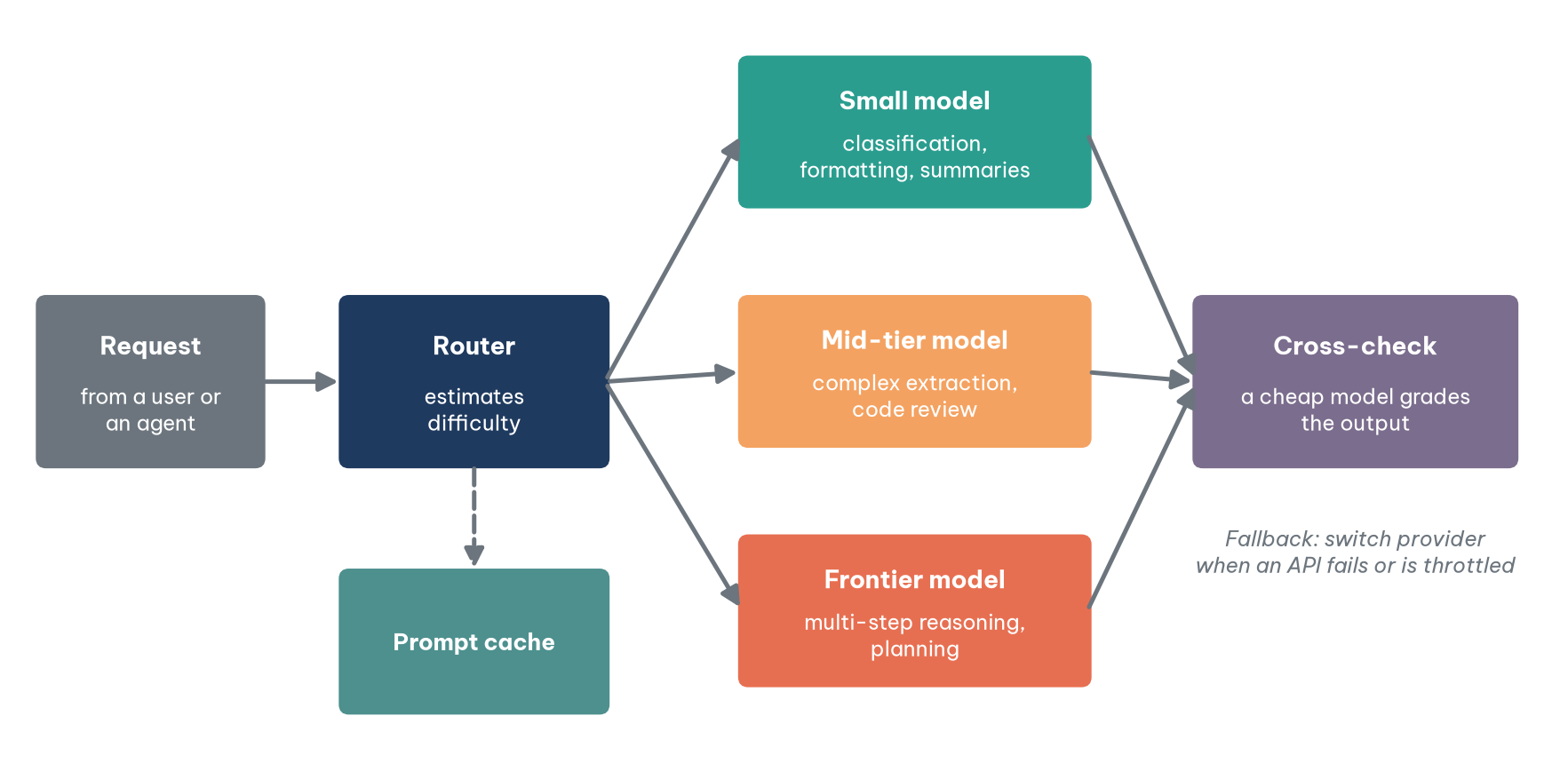
Table 3 describes three common tiers of tasks and the kind of model that suits each.
The effectiveness of routing has been studied. With the RouteLLM framework, Ong et al. (2024) used a small router model to decide whether to send a query to GPT-4 or a smaller model (Mixtral), and reported cost reductions of more than 85% while still reaching 95% of GPT-4's quality on the MT-Bench benchmark. The figure depends on the type of query; each product needs to measure on its own data. Prompt caching on providers' APIs is also part of the moat: according to Anthropic's published pricing, input read back from the cache costs about 90% less than regular input, which especially benefits long, repeated contexts.
5.2. Layer 2: proprietary workflow logic
Routing is gradually becoming a common feature, built into many platforms. The deeper moat lies in how a company assembles core technologies to solve its own specific problem. Three components stand out. The first is deep retrieval-augmented generation (RAG) integration: how internal data are cleaned, vectorized and retrieved, which no foundation model has. The second is cross-checking and self-evaluation: model A produces a result and model B (smaller, cheaper) reviews and scores it before it reaches the user. The third is fallback: switching automatically to another provider when an API fails or is rate-limited, keeping the system highly available.
Core technology can be bought, but how you design the architecture to solve an industry's specific problem is what competitors find hard to copy. This is especially true for companies in markets far from the major AI labs.
6. Working out the AI bill and planning for price scenarios
The question at the end of this article, "would the product still stand if we paid the real cost", can only be answered by a business that can calculate its own AI bill. This section works through a calculation at list API prices, then uses it to plan for price changes.
6.1. The bill is counted in tokens
Model providers list prices per million tokens, with input tokens (text sent to the model) and output tokens (text the model generates) priced separately; output tokens typically cost five times as much as input tokens. A month's bill is input tokens times the input price plus output tokens times the output price, and token counts equal conversations times turns per conversation times tokens per turn.
Take an illustrative online shop in Vietnam whose AI assistant handles 30,000 conversations a month, 6 turns each, with 2,000 input tokens and 300 output tokens per turn. That is 360 million input tokens and 54 million output tokens a month. Input far exceeds the customer's actual question because each turn also carries the system instructions, the conversation history and retrieved product information: context, not the question, drives most input cost. Table 4 prices the bill at Anthropic's API list prices as checked on 5 November 2026, at 26,000 VND to the dollar (Anthropic, n.d.-a).
Table 4 shows a gap of about 40 times between tiers. This is the arithmetic behind the routing architecture in Section 5.1: sending each request to the right tier matters more than any provider discount. List prices change quickly, so the numbers hold only at the time of checking; the method does not change.
6.2. Three levers and a benchmark
Figure 4 sets five design options against a human customer-service agent paid 9 million VND a month who handles about 2,000 conversations, or 4,500 VND per conversation.
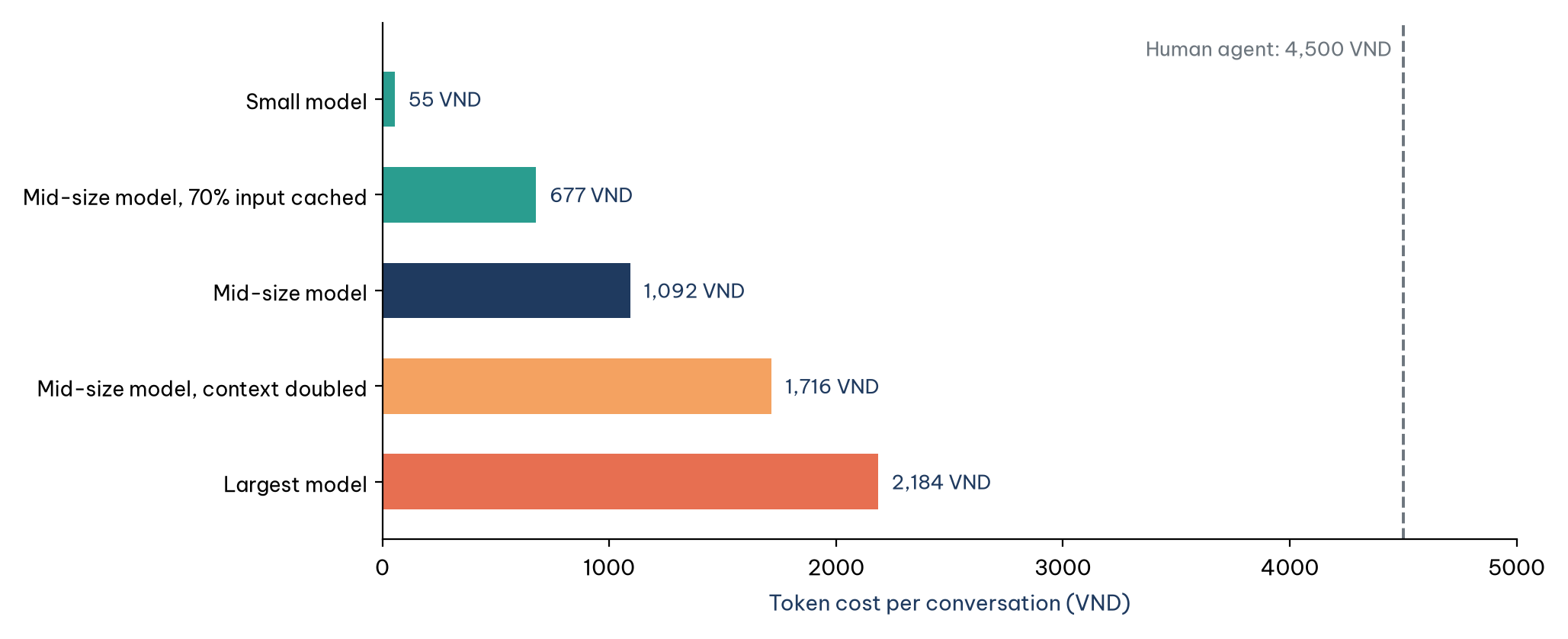
Three levers stand out in Figure 4. Model choice: moving from the mid-size to the largest tier doubles the cost. Prompt caching: system instructions and product information repeated across turns can be cached, and for the mid-size tier a cache read costs only 5% of the input price (Anthropic, n.d.-a; Anthropic, n.d.-b). With 70% of input tokens cached, the cost per conversation falls from about 1,092 to about 677 VND; the calculation ignores cache-write charges, which are small when context is reused many times. Context control: a careless design that sends 4,000 tokens per turn instead of 2,000 pushes the cost to about 1,716 VND.
Even the most expensive option costs about half as much as a human agent, so the deciding question is usually not the token price but the cost of a wrong answer: one wrongly promised refund can cost a hundred thousand VND to fix and a one-star review. The right yardstick for choosing a model is the cost per correctly resolved conversation, measured by scoring a sample of real conversations.
6.3. Scenarios for the post-subsidy era
Nobody knows whether API prices will keep falling as hardware gets cheaper or rise as providers stop subsidising. When the future cannot be forecast, scenario planning replaces "what will happen" with "if this happens, what should we do" (Schoemaker, 1995). Table 5 applies that thinking to the mid-size option with caching, plus half of one staff member's time (4.5 million VND a month) to review difficult conversations.
In the case in Table 5, API prices would have to rise about 6.4 times before the assistant cost as much as a person. The strategic lesson lies not in any one scenario but in the moves that are right in all of them: routing by difficulty, caching context, and designing so that the provider can be switched without rewriting the system. These are "no-regret moves". By contrast, a thin-margin product, such as a flat-rate subscription sold to users who run agents, as described in Section 1, could swing from profit to loss in the doubled scenario. The safeguard is to write down two or three early signals for each scenario, such as a pricing change announcement, new usage limits or the retirement of a model version, and review them regularly instead of assigning a probability to one "most likely" scenario.
7. What this means for businesses in emerging markets
Most startups and companies building AI products in emerging markets, Vietnam among them, rely on APIs from foreign providers. The post-subsidy era raises some specific issues for them.
The first is a currency mismatch in the cost structure: API costs are priced in U.S. dollars, while revenue is usually earned in local currency, and the prices local users accept are much lower than in the United States or Europe. A small API price increase for a U.S. company can wipe out the entire margin of a product in such a market. Tiered routing and caching are therefore not cosmetic optimizations but conditions for survival. The second is single-provider dependency: a change in one provider's terms can stop a product overnight, as with the Twitter and Reddit apps; a multi-provider fallback architecture and the ability to switch to open-weight models are necessary insurance. The third is data and compliance: sending customer data abroad for processing must comply with personal-data protection rules, including requirements on cross-border transfers, such as those in Vietnam's 2025 Personal Data Protection Law (National Assembly of Vietnam, 2025). This is one more reason to consider self-hosting small models for routine tasks involving sensitive data.
On the positive side, the competitive advantage of local companies usually lies exactly in layer 2: understanding local customers, processes, language and regulation. A local startup can hardly compete on foundation models, but it can build a moat from industry data and workflow logic fitted to its market, which global providers have little incentive to build.
Conclusion
Providers tightening their subscription plans is not a step backwards for the AI industry. It is more like a bitter but necessary pill that brings the ecosystem back to real economics. The market is moving from a phase of "subsidized experimentation" to one of "priced infrastructure". Products that exist only by exploiting the loopholes of flat-rate subscriptions will struggle; products that create more economic value than the compute they consume will stand.
This article has examined the shift through the lenses of economics (cross-subsidy and structural arbitrage), engineering (observability), platform history (the three-stage cycle) and strategy (vertical and horizontal stacks). What these lenses share is that an advantage based on someone else's low price does not last. A durable moat lies in orchestration architecture and workflow logic tied to a specific problem.
For a founder, CTO or lead engineer, the question to ask today is not "How do I find a cheaper API?", but: *"If tomorrow we had to pay 100% of the real compute cost of our whole system, would the value our product creates be large enough to cover the bill?"* If the answer is yes, the product stands on real value. If not, it is time to rethink the architecture and the business model, because sooner or later the real bill will arrive.
References
Anthropic. (n.d.-a). Pricing. Claude Docs. Retrieved November 5, 2026, from https://platform.claude.com/docs/en/about-claude/pricing
Anthropic. (n.d.-b). Prompt caching. Claude Docs. https://docs.anthropic.com/en/docs/build-with-claude/prompt-caching
Doctorow, C. (2023, January 23). The 'enshittification' of TikTok. Wired. https://www.wired.com/story/tiktok-platforms-cory-doctorow/
National Assembly of Vietnam. (2025). Law on Personal Data Protection No. 91/2025/QH15. https://chinhphu.vn/?pageid=27160&docid=214590&classid=1&typegroupid=3
Ong, I., Almahairi, A., Wu, V., Chiang, W.-L., Wu, T., Gonzalez, J. E., Kadous, M. W., & Stoica, I. (2024). RouteLLM: Learning to route LLMs with preference data. arXiv. https://arxiv.org/abs/2406.18665
Parker, G. G., Van Alstyne, M. W., & Choudary, S. P. (2016). Platform revolution. W. W. Norton.
Perez, S. (2023, January 19). Twitter officially bans third-party clients after cutting off prominent devs. TechCrunch. https://techcrunch.com/2023/01/19/twitter-officially-bans-third-party-clients-after-cutting-off-prominent-devs/
Peters, J. (2023, June 8). Apollo, the popular third-party Reddit app, is shutting down. The Verge. https://www.theverge.com/2023/6/8/23754183/apollo-reddit-app-shutting-down-api
Schoemaker, P. J. H. (1995). Scenario planning: A tool for strategic thinking. Sloan Management Review, 36(2), 25–40. https://sloanreview.mit.edu/article/scenario-planning-a-tool-for-strategic-thinking/
Discussion about this post