Product-Led, Sales-Led, Community-Led and More: A Map of Growth Models
Every led-growth label answers the same question: which force pulls customers through the buying journey, and how that force changes over time


Key takeaways
Every "-led growth" label answers one question: what is the main force that moves customers from awareness to trial, payment, expansion and referral?
Three questions decode any model: what the engine is, where trust comes from (the company speaks, customers try it themselves or others speak for it) and which stage of the customer life cycle it serves.
The labels fall into four groups: classic go-to-market engines, engines built on external networks, philosophies of growth from existing customers and newer terms that are mostly supporting levers rather than engines.
Product-led growth works for a minority of companies; McKinsey finds that only a select few product-led firms truly outperform, and the hybrid of product and sales is the common reality.
Successful companies run one main engine with a few secondary ones and change the mix as they move from founding to maturity. Many statistics on these models come from vendors that sell tools for them, so read them critically.
Over the past decade, the business world, and the software-as-a-service (SaaS) industry above all, has produced a steady stream of terms with the same shape, "X-led growth": product-led, sales-led, marketing-led, community-led, ecosystem-led, experience-led, customer-led, advocacy-led, content-led, founder-led. Every year a few more labels appear at conferences, in newsletters and in LinkedIn posts. Founders, marketers and students entering the field can easily feel that they are facing a long menu and must pick exactly the right dish or fall behind.
This article organizes those concepts, tracing where each came from, how it works, what real examples look like and how it differs from its neighbors. The central argument is simple. Every "-led" term really answers a single question: what is the main engine that moves a customer through the journey from awareness to trial, payment, expansion and referral? Seen through that question, the models stop being disconnected fashions and become options that can be combined, depending on the product, the customer and the company's stage of development. Instead of choosing one label, a company places a dozen labels on one map and decides which ones to drive.
The article proceeds as follows. Section 1 explains why so many "-led growth" terms exist and in what spirit to read them. Section 2 sets out three questions that decode any model and sorts the terms into four groups. Sections 3 to 6 walk through each group in turn: the classic go-to-market engines, the engines built on external networks, the philosophies of growth from existing customers and the newer terms. Section 7 compares the models side by side and shows how they evolve over a company's life cycle. Section 8 illustrates the ideas with a hypothetical start-up, and Section 9 offers recommendations for choosing.
1. Why there are so many "-led growth" terms
This section explains where the "-led" vocabulary came from and why readers should treat it with some caution.
The suffix "-led" carries a simple idea. Every company has several functions that contribute to revenue, but there is always one function or one asset that acts as the locomotive. Before the 2010s the default answer for business software was the sales team. Blake Bartlett, then a partner at the venture fund OpenView, called the 2000s the "era of the executive" in B2B software: senior managers, often without technical expertise, decided which tools entered the company, so vendors relied on cold calls, return-on-investment presentations and trade-show demonstrations (Rice, 2020).
The rise of cloud computing, subscriptions, freemium pricing and a "try before you buy" culture overturned that order. Employees found tools on their own, used the free plan, invited colleagues and only signed an enterprise contract once a whole department was already hooked. In 2016 Bartlett and OpenView coined the term product-led growth (PLG) for companies that grow through the product itself rather than through a sales force (Asplund, 2023; Poyar, 2022). The term's success created a template. Tool vendors, consultants and investors began coining variants: community-led tied to community management platforms, ecosystem-led tied to partner data-sharing platforms, customer-led tied to customer success software.
That leads to an important methodological caution from the outset: many "-led" terms are both management concepts and positioning devices for the organization that coined them. OpenView invested in PLG companies; Common Room sells a platform for community-led growth; Crossbeam sells a platform for ecosystem-led growth; Gainsight sells software for customer-led growth. Readers should therefore receive the figures these organizations publish with a critical eye. This article repeats the caution each time it cites a number from a vendor.
2. Three questions that decode any "-led" model
To compare the models consistently, the article uses three axes of analysis. This section presents the axes, then uses them to sort the terms into four groups and place them on a single map.
2.1. Three axes of analysis
The first question is what the main engine is. It may be people (sellers, founders), messages (marketing, content), the product or an external network (community, partners, customers). This question determines where the company must put most of its resources.
The second question is where trust comes from. There are three possibilities: the company speaks for itself (advertising, sales pitches), customers experience it themselves (trying the product) or others speak on its behalf (communities, partners, customers who refer). This axis matters because buyers are increasingly skeptical of what companies say about themselves.
The third question is at which stage of the customer life cycle the model has the most effect: acquiring new customers, converting them, retaining them or expanding revenue from existing customers. Many models sound alike but actually serve opposite ends of the life cycle.
2.2. Four groups of terms
Using these three axes, the terms fall into four groups, as shown in Table 1. Group A contains the classic go-to-market engines, group B relies on external networks, group C focuses on customers the company already has and group D gathers newer labels that are not yet standardized.
Figure 1 places the models of the first three groups on two axes: the horizontal axis is the source of trust, and the vertical axis is the customer group the model affects most. Color shows the group. The models do not sit on top of one another but cover different cells of the map, which suggests that they complement each other more than they replace each other.
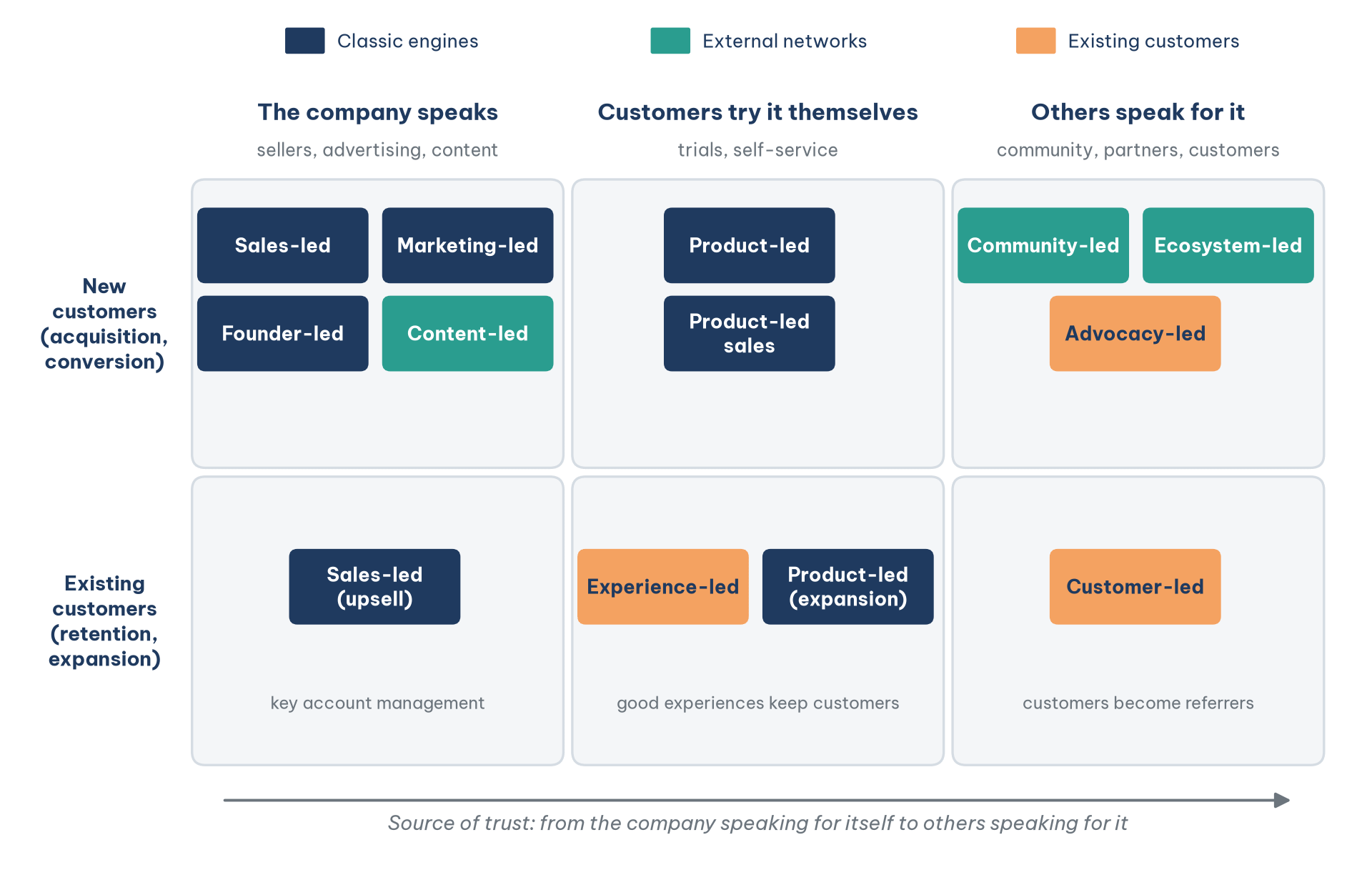
Sections 3 to 6 go through each cell of this map, starting with the most familiar group.
3. Group A: the classic go-to-market engines
Group A contains three "pure" engines (sales, marketing and product) and two special forms: the hybrid product-led sales and the stage-specific founder-led sales. This is the group most companies must choose from first, because it determines the structure of the team and the cost of winning a customer.
3.1. Sales-led growth
In sales-led growth (SLG), the sales team sits at the center of the buying journey: finding prospects, demonstrating the product, advising, negotiating and closing. The model relies on the sales force, relationship building and the ability to turn opportunities into customers; sellers work closely with buyers, learn their specific needs and tailor the proposal to close the deal (Fajardo Pires, 2025).
The mechanics of SLG are intuitive. Revenue grows as the company adds sellers and raises their productivity. Trust is built through personal relationships, advisory skill and the assurance of a contract. Vendors of enterprise resource planning (ERP) software, core banking systems or cybersecurity solutions for large corporations usually run on SLG: sales cycles last many months, many people take part in the decision, contract values are high and customization requirements are heavy.
SLG fits when the product is complex, contract values are high, the customers are large organizations or the market is tightly regulated. Its weaknesses are a high customer acquisition cost (CAC), difficulty scaling beyond a linear path and dependence on individuals. SLG is therefore sustainable only when customer lifetime value is large enough to carry the cost of selling.
3.2. Marketing-led growth
Marketing-led growth (MLG) relies on marketing activity such as advertising, content, events and brand to create demand, then turns that demand into marketing-qualified leads (MQLs) for the sales team or an online sales channel. The model requires a focus on positioning and messaging, building sales enablement material and close coordination with the product team; it is especially effective in competitive markets, where educating customers and building relationships through content and brand create differentiation (Fajardo Pires, 2025).
MLG and SLG share a notable feature. Both rely on human intervention to persuade the customer, marketers through messages and sellers through conversations. In PLG, described in the next subsection, it is the product that does the talking. Consumer brands, personal finance apps and software for small and medium-sized businesses often use performance marketing, webinars and content campaigns as their main engine.
MLG fits when the market is broad, the product needs to be explained or positioned and the purchase decision depends heavily on brand awareness. Its biggest weakness is that advertising costs tend to rise over time, and when spending stops, the flow of customers usually drops quickly.
3.3. Product-led growth
In the definition OpenView uses, PLG is a go-to-market strategy that relies on the product itself as the primary driver of customer acquisition, conversion and expansion; sales may still exist, but they are not a precondition for a customer to start using the product (Asplund, 2023). The term spread further through the book by Bush (2019), who argues that the product, rather than an expensive sales team, can become the main vehicle for acquiring, converting and retaining customers, and who guides companies in weighing a free trial, freemium or another model.
PLG works like a flywheel. Users sign up on their own, experience value quickly (often called the "aha moment"), use the product regularly, invite colleagues or share, upgrade to a paid plan and then expand the number of seats or the volume of use. Each turn leaves more users for the next turn, so PLG is often linked to virality and network effects. Bartlett stresses the benefit to the vendor: for the seller, self-service means automation (Asplund, 2023).
Slack, Zoom and Calendly are often cited as companies that succeeded through PLG (Asplund, 2023; Rice, 2020). Other familiar examples include Dropbox, Canva, Figma and Notion, where individual users start for free and then spread the product into their teams and organizations. The key PLG metrics are the activation rate, time-to-value, the free-to-paid conversion rate, cohort retention, net revenue retention (NRR) and the viral coefficient. PLG fits when users can experience value on their own quickly, end users have the authority to choose their own tools and the cost of serving one more user is low.
PLG is not a cure-all. A McKinsey analysis of more than a hundred listed B2B SaaS companies shows that although product-led companies perform better than sales-led companies on average, only a select few truly outperform. The leading PLG companies spend about 10 percentage points more on marketing, sales and R&D than the leading sales-led companies, with annual recurring revenue (ARR) growth about 10 percentage points higher and valuation multiples about 50% higher. Meanwhile, average PLG companies carry significantly higher operating costs than average sales-led companies but fare only marginally better (Alaghband et al., 2023). In other words, simply bolting a free trial onto a product designed to be sold through sellers does not make a company product-led.
3.4. Product-led sales, the hybrid of product and sales
Product-led sales (PLS) is how mature PLG companies attach a sales team back onto the self-service funnel. The product attracts and activates users; product usage data is used to identify product-qualified leads (PQLs), accounts that have already experienced value and show signs of readiness to buy at scale. Only then do sellers step in. McKinsey argues that a PLG strategy often has to be complemented by elements of the traditional enterprise sales model to succeed, and that doing PLS well, whether a company starts from PLG or from SLG, is what separates leaders from laggards (Alaghband et al., 2023).
Bartlett also argues that companies no longer have to pick one lane between product and sales; PLG should be seen as a foundation to build on (Asplund, 2023). He notes that large listed PLG companies such as Atlassian, Datadog and Snowflake earn the majority of their revenue from big enterprise sales deals (Asplund, 2023). In such companies, sellers usually enter after the product is already widely used, to handle upgrades, expansion contracts and high-value deals (Rice, 2020).
The meaning of PLS is that the boundaries between "-led" models are increasingly blurred. The right question is not "product-led or sales-led" but "at which point in the customer journey do people create the most value?"
3.5. Founder-led sales
In his book Founding Sales, Pete Kazanjy defines founder-led sales as the process in which founders discover, refine and scale the product's initial sales motion (as cited in Rework, 2026). The definition implies two things. It is both a learning process about the market and a phase designed to end, once the company has a sales process that others can run. It also helps to distinguish founder-led sales (who sells in the early phase) from a founder-led company (a company still run by its founder, sometimes long after the start-up phase) (Rework, 2026).
In most early-stage B2B start-ups, the founders themselves call prospects, run demos and close the first customers. Beyond sales, the concept is increasingly extended to founder-led marketing or founder-led brand: founders build a personal brand on social media to pull customers toward the company.
Founder-led selling fits when the company has not yet reached product-market fit and its messaging and ideal customer profile (ICP) are still changing. Its weakness is that it does not scale; if it lasts too long, the founder becomes a bottleneck.
4. Group B: engines built on external networks
What this group shares is that trust does not come from the company speaking about itself but from third parties (user communities, partners) or from expertise the company demonstrates through content. In Figure 1, group B sits mainly in the "others speak for it" column.
4.1. Community-led growth
Community-led growth (CLG) uses a community of users as the engine for acquisition, retention and product development. The community may be a forum, a Slack or Discord group, user events or a network of experts. CLG is often built on top of PLG: once the product is easy enough for users to try on their own, the community becomes the place where they learn to use it better and pull in new people.
The mechanism of CLG lies in members' behavior. They answer each other's questions, share templates, write tutorials, give product feedback and introduce the product into their workplaces. The company gains three benefits: lower support costs, a product improved by real feedback and new demand arising through word of mouth. The community-contributed template libraries of Notion and Figma, the open-source user communities around developer tools and the developer communities of cloud platforms are familiar examples.
On effectiveness, Common Room reports that at one of its customers, 72% of community-sourced deals closed within 90 days, compared with 42% of deals led by sales and marketing (Common Room, 2022). The figure is worth noting, but remember that it comes from a single unnamed customer and is published by a vendor of CLG tools.
CLG fits when the product has a craft quality (users want to learn from one another), an extended ecosystem (plugins, templates, integrations) or a passionate user base. Its weaknesses are that it needs long-term investment, is hard to translate into revenue and can turn against the company if commercialization goes too far.
4.2. Ecosystem-led growth
The term ecosystem-led growth (ELG) is closely tied to the book Ecosystem-Led Growth by Bob Moore, co-founder and CEO of Crossbeam (Moore, 2024). At its core, ELG means using the data and relationships in a partner ecosystem to acquire, convert and grow customers. Partner-led growth is the broader predecessor: growth through resellers, system integrators, distribution channels or app marketplaces.
What ELG adds to the traditional partner model is data. Two partner companies can match their lists of customers and prospects (account mapping) to find shared customers and referral opportunities, rather than relying only on personal relationships between partnership managers. Crossbeam's original idea was an independent, secure platform acting as a kind of "data escrow" service between collaborating companies (Asplund, 2024).
Salesforce's AppExchange and the Shopify App Store show the power of an ecosystem: thousands of outside developers both make the core product more useful and bring customers to the platform. On a smaller scale, an accounting software vendor may be introduced to clients through partner accounting firms. ELG fits when the product must integrate with many other systems, customers buy a "stack" of tools or the company wants to enter a market where partners already hold trust. Its weaknesses are dependence on partners' motivation, limited control over the customer experience and the security issues that arise when data is shared.
4.3. Content-led growth
Content-led growth treats valuable content (articles, research, podcasts, videos, free tools) as the main engine for attracting and nurturing customers. Sequel (2024) distinguishes two levels. Content-led marketing is the tactic of using content as the main channel to reach and convert buyers, giving priority to a library of compounding assets over short-term campaigns. Content-led growth is the strategy and the outcome when that tactic works well and spreads into sales enablement, retention and expansion.
HubSpot is often cited as the classic case: the company built its brand and customer base largely by popularizing the idea of "inbound marketing" together with a huge library of educational content on marketing and sales. People learning how to do marketing met HubSpot's content before they met HubSpot's sellers.
Content-led growth can be seen as a specialized form of marketing-led growth. The difference is that it relies on content assets accumulated over the long term, with a compounding effect, rather than on campaign-based ad spending. That is why, in Figure 1, content-led sits in the "company speaks" column but carries the color of group B: trust comes from expertise demonstrated over time, not from advertising claims.
5. Group C: growth from existing customers
If groups A and B mainly answer "how do we get new customers?", group C focuses on "how do we get current customers to buy more, stay longer and refer others?" The three models in this group are very close to one another, so this section pays special attention to what separates them.
5.1. Experience-led growth
McKinsey uses the term experience-led growth (XLG) for a strategy of creating a distinctive, consistent and proactive customer experience (CX) so that existing customers keep choosing the brand. To succeed, a company starts by defining the financial outcomes it wants and then prioritizes the CX improvements that deliver them (Bough et al., 2023).
The foundational argument of XLG rests on two figures. To make up for the value of one lost customer, a company may have to acquire three new ones. And at the most successful growth companies, about 80% of value creation comes from the core business, mainly new revenue from existing customers (Bough et al., 2023).
The authors propose three pillars. The first is setting a clear growth aspiration and purpose, along with a roadmap that links CX to value. The second is transforming the business through decisive action by redesigning customer journeys, products, services and business models. The third is enabling the transformation through new mindsets, capabilities, technologies, governance and effective CX measurement (Bough et al., 2023).
McKinsey's example is a mobile operator facing a churn crisis. It eliminated binding contracts, extended all offers to existing customers, improved its network and renewed its services. As a result, customer satisfaction rose from last to first in the industry, churn fell by 75% and revenue nearly doubled over three years (Bough et al., 2023). XLG fits companies that already have a large customer base, such as banks, telecom operators, insurers, utilities and airlines, especially when digital competitors are attacking them.
5.2. Customer-led growth
Customer-led growth has been promoted by Gainsight, a customer success software company, as one of three strategies for durable growth, alongside product-led and community-led (Gainsight, 2022). In the Japanese market, Gainsight describes the model as resting on three elements: customer success, co-creation with customers and customer enthusiasm (Gainsight, 2024).
Customer-led and experience-led are very close. Experience-led can be understood as the approach from the side of the company designing the experience, while customer-led stresses customers taking an active part: succeeding with the product, giving input on the product roadmap, acting as advocates and expanding their contracts. That is why, in Figure 1, experience-led sits in the "customers try it themselves" column while customer-led sits in the "others speak for it" column.
A notable integrated framework comes from a Harvard Business Review Analytic Services report sponsored by Gainsight. As Gainsight summarizes it, the most successful digital B2B companies combine product-led growth for acquisition and adoption, customer-led growth for expansion and retention and community-led growth for advocacy and engagement, with the product experience as the common thread running through all three (Spear, 2023). The framework illustrates the main point of this article: "-led" models are complementary layers, not mutually exclusive choices.
5.3. Advocacy-led growth
Advocacy-led growth is a very recent term. Golden Communication Group, a communications agency in Vietnam, presented the model at the MMA Impact 2026 marketing conference, and the trade site Brands Vietnam republished it in October 2026. The starting point is a phenomenon the agency calls the "Silent Trust Gap", the gap between the trust customers actually place in a brand and the support they express publicly. Many customers are loyal, satisfied and buy repeatedly, yet never write a review or recommend the product. The agency argues that in its home market the gap has widened for two reasons. First, new rules have tightened the liability of advertisers and of paid influencers, known in Asian marketing as key opinion leaders (KOLs) and key opinion consumers (KOCs). Second, after a series of product quality scandals, publicly "vouching" for a brand carries a high reputational risk for the person who speaks up (Golden Communication Group, 2026). The diagnosis deserves attention elsewhere too, because the same gap between private trust and public praise appears wherever buyers distrust paid endorsements.
On this view, advocacy-led growth is a model that converts customers' existing trust into voluntary advocacy and runs it as a continuous system rather than a short-term campaign (Golden Communication Group, 2026). The agency proposes a closed four-step cycle, shown in Table 2.
The idea that advocacy drives growth is not new. A study by BCG of more than 300 brands in 12 industries built a Brand Advocacy Index (BAI). The index measures the actual recommending and disparaging behavior of both customers and non-customers, subtracting negative advocacy from positive advocacy. The results showed that the BAI correlates very strongly with revenue growth (a coefficient of about 0.81) and that the average growth gap between the highest-scoring and lowest-scoring brands was 27 percentage points (Knox et al., 2013).
What is new in advocacy-led growth is how execution is organized. Advocacy is treated as a system that accumulates over time rather than a series of disconnected word-of-mouth or viral campaigns. The same view appears elsewhere in the industry: an analysis by Duel (2026) argues that brand advocacy programs fail when run as campaigns, when what they really need is a system.
Advocacy-led growth is closely related to three other models. Compared with customer-led growth, it can be seen as the "amplification layer": Mark Organ, founder of Eloqua and Influitive, treats customer advocacy as a growth engine within the customer-led growth movement (Gamson, 2024). Compared with community-led growth, the community is the place where advocacy happens, while advocacy-led growth focuses on the behavior of speaking up publicly, whether in the brand's community or on the user's own channels. Compared with influencer marketing, which usually starts from paid celebrities, advocacy-led growth starts from people who already trust the brand and only then amplifies their voices to more influential tiers.
A critical note is also needed. The model was presented by a communications agency in the context of promoting its services. The figures accompanying the article, cited from WARC, PwC and Edelman, are secondary data and should be checked against the original reports before use.
6. Group D: emerging and unstandardized terms
Beyond the concepts above, readers will meet many other variants. Most have no academic definition or clear "original author", so they should be used with care. Table 3 summarizes seven common terms and indicates whether each is closer to an engine or to a lever.
A useful test follows from Table 3: if a "-led" term cannot answer the question what pulls the customer through the buying journey and only describes a supporting capability (data, AI, design), it should be understood as a lever, not an engine. In the case of AI, the story is bigger than a growth label, because AI is changing business models themselves, not only the way customers are acquired.
7. A side-by-side comparison
Having walked through each group, this section places the models next to each other in three ways: a comparison table on common criteria, three contrasting pairs that deepen understanding and an evolutionary path across the company life cycle.
7.1. Comparing the main models
Table 4 compares eleven main models along the three axes of Section 2, together with key metrics and typical examples. The examples column is only illustrative; a real company usually runs several models at once.
7.2. Three contrasting pairs
Table 4 has many columns, but the three contrasting pairs below are where the models really part ways. Each pair corresponds to a question managers must answer when designing their growth machine.
The first pair is high-touch versus low-touch. SLG and founder-led selling sit at the high-touch extreme, where every customer needs a person. PLG sits at the low-touch extreme, where most of the journey happens automatically. PLS is the balance point: low-touch for the many, high-touch for high-value accounts. The choice on this axis depends mainly on the average contract value and the complexity of the product, the same logic by which companies match their sales method to customer lifetime value.
The second pair is the company speaks versus others speak for it. SLG, MLG and content-led growth all build trust on the company's own account. CLG, ELG, customer-led and advocacy-led growth rely on trust "borrowed" from peers, partners and customers. As buyers grow more skeptical of advertising, the "others speak for it" group tends to be more cost-effective but slower and harder to control.
The third pair is new customers versus existing customers. Most models in groups A and B are optimized for acquisition. XLG and customer-led growth are optimized for retention and expansion. McKinsey's argument that losing one customer may require acquiring three new ones to compensate (Bough et al., 2023) is a reminder that a growth strategy focused only on the top of the funnel is rarely sustainable.
7.3. How the models evolve over a company's life cycle
Instead of asking "which model is best?", managers should ask "which model fits at this stage?" Figure 2 sketches a typical path for a SaaS company through four stages, each with one main engine (solid block) and a few secondary engines (outlined blocks).
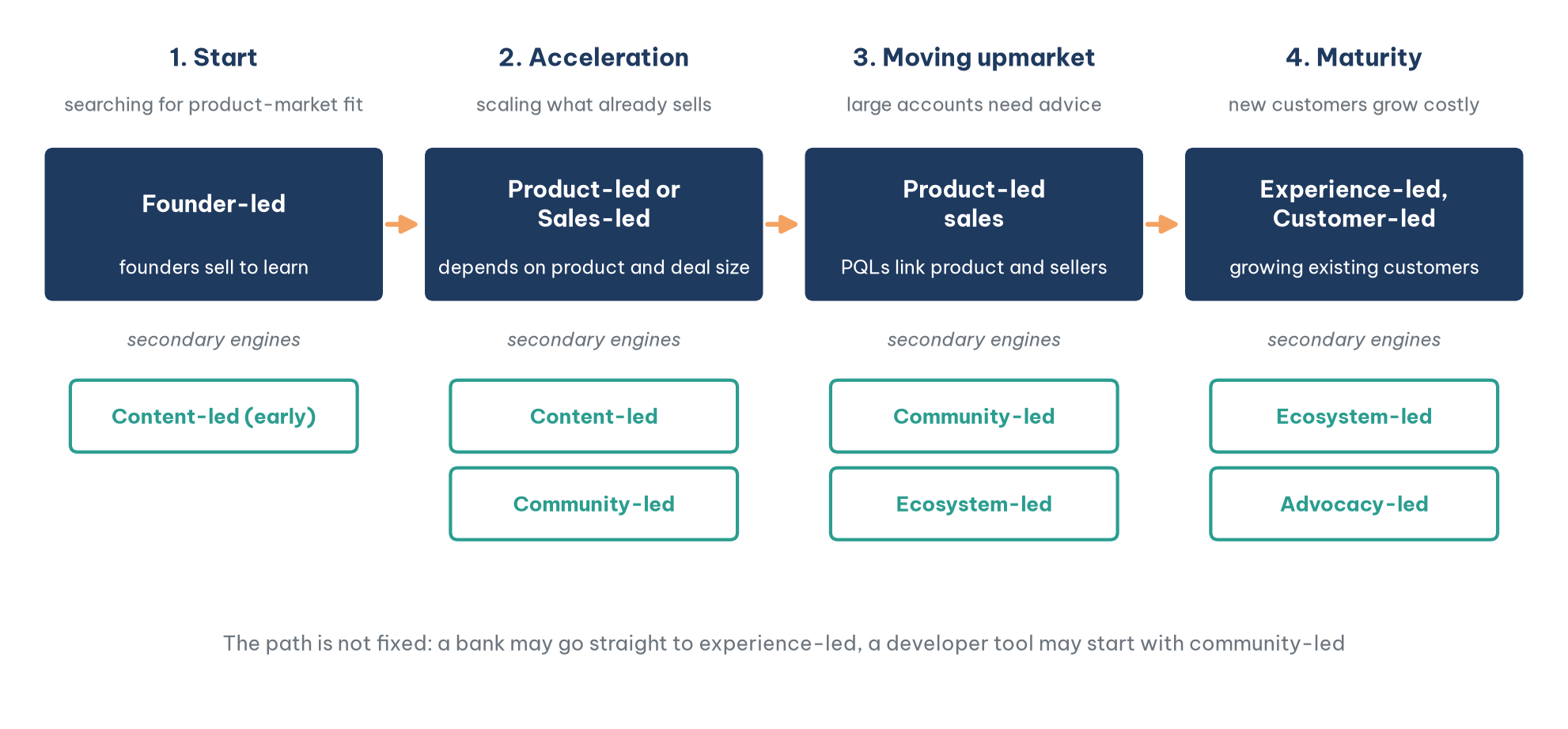
At the start, the founders sell themselves to learn about customers and find product-market fit; content can begin early because it needs time to compound. In the acceleration stage, depending on the product, the company chooses product-led or sales-led as the main engine for scaling; content-led and community-led engines are often added early because their effects accumulate. When moving upmarket to large enterprises, the company attaches a sales team to the product foundation, using PQLs as the bridge, in other words shifting to product-led sales. At maturity, when the cost of acquiring new customers rises, the company draws on partners and its existing customer base through experience-led and customer-led growth, with ecosystem-led and advocacy-led engines in support.
This path is not rigid. A traditional bank may go straight to experience-led growth; a developer tool may begin with community-led growth from day one.
8. A hypothetical start-up
The case below is hypothetical, meant to illustrate how the models can be combined rather than to describe a real company. A start-up develops sales management software (point of sale, inventory and invoicing) for small independent shops and family-run stores in a fast-growing emerging market. Table 5 summarizes its main engine and concrete actions over its first four years.
Read by row, Table 5 shows the main engine changing each year. Read down the columns, it shows that old engines do not disappear: the community group set up in year 2 is still a source of referrals in year 4, and usage data from the free plan becomes raw material for the sales team. A company therefore usually runs several "-led" models at once, with one main engine and secondary engines that shift over time.
9. Recommendations for choosing a model
From the analysis above, five recommendations follow for founders and managers. They are not formulas but questions worth asking before putting a "-led" label on a strategy.
The first recommendation is to start from the product and the customer, not from the term. Can users feel the value on their own within minutes? Who makes the purchase decision? What is the average contract value? These three answers already rule out most of the options.
The second recommendation is to choose one main engine and a few secondary ones. Spreading investment across every model at once easily means that none of them reaches critical mass. The third recommendation is to design the handoff points: where the product hands over to sellers, where the community hands over to support. These junctions are where revenue usually leaks, much like the blockages in a sales funnel.
The fourth recommendation is to measure each model with its own metrics. PLG cannot be judged by the number of MQLs, nor can CLG be judged only by direct revenue in a single quarter. The final recommendation is to read vendor statistics critically, because many figures on the effectiveness of "-led" models are published by the very companies that sell tools for those models.
Conclusion
The explosion of "-led growth" terms reflects a real shift: the buying journey has fragmented, buyers have more autonomy and companies have more growth levers than ever before. Yet beneath the varied vocabulary, the models differ in only three respects: what the main engine is, where trust comes from and at which stage of the customer life cycle the model has the most effect.
Product-led growth has shown the power of a product that sells itself, but the evidence also shows that only a select few truly outperform and that the hybrid model of product-led sales is the common reality (Alaghband et al., 2023). Community-led, ecosystem-led and content-led growth add trust from outside; experience-led, customer-led and advocacy-led growth remind us that durable growth lies with the customers a company already has. The successful company is not the one that picks exactly the right single "-led" label, but the one that combines its engines deliberately, in a way that fits its product, its customers and its stage of development.
References
Alaghband, M., Panagiotidou, N., Roche, P., & Schneider, J. (2023, August). From product-led growth to product-led sales: Beyond the PLG hype. McKinsey & Company. https://www.mckinsey.com/industries/technology-media-and-telecommunications/our-insights/from-product-led-growth-to-product-led-sales-beyond-the-plg-hype
Asplund, J.-E. (2023, June 27). Blake Bartlett, partner at OpenView, on the future of product-led growth [Interview]. Sacra. https://sacra.com/research/blake-bartlett-openview-future-product-led-growth
Asplund, J.-E. (2024, August 7). Bob Moore, CEO and co-founder of Crossbeam, on ecosystem-led growth [Interview]. Sacra. https://sacra.com/research/bob-moore-crossbeam-partnerships-ecosystem
Bough, V., Ehrlich, O., Fanderl, H., & Schiff, R. (2023, March 23). Experience-led growth: A new way to create value. McKinsey & Company. https://www.mckinsey.com/capabilities/growth-marketing-and-sales/our-insights/experience-led-growth-a-new-way-to-create-value
Bush, W. (2019). Product-led growth: How to build a product that sells itself. Product-Led Institute. https://productled.com/book/product-led-growth
Common Room. (2022, November 1). How to get started with a community-led growth platform. https://www.commonroom.io/blog/how-to-get-started-with-a-community-led-growth-platform/
Duel. (2026, January 14). The state of brand advocacy in 2026: Why systems, not campaigns, will define the next era. https://www.duel.tech/blog/the-state-of-brand-advocacy-in-2026
Fajardo Pires, J. (2025, July 21). Mastering product-led, sales-led, and marketing-led strategies: The definitive guide. Product Marketing Alliance. https://www.productmarketingalliance.com/product-led-sales-led-and-marketing-led-strategies/
Gainsight. (2022, December 5). HBR Analytic Services report in association with Gainsight finds product experience drives durable business growth [Press release]. https://www.gainsight.com/press/release/hbr-analytics-services-report-in-association-with-gainsight-finds-product-experience-drives-durable-business-growth/
Gainsight. (2024, September 25). Customer-Led Growth(顧客主導の成長)を加速する新製品「Gainsight Customer Hub」発表 [Gainsight announces Gainsight Customer Hub, a new product to accelerate customer-led growth] [Press release]. ASCII STARTUP. https://ascii.jp/elem/000/004/223/4223711/
Gamson, N. (2024, October 30). Customer-led growth and customer advocacy 2.0: Insights from Mark Organ's Obsession 2024 keynote. Base. https://www.base.ai/blog/customer-led-growth-and-customer-advocacy-2-0-insights-from-mark-organs-obsession-2024-keynote
Golden Communication Group. (2026, October 30). Advocacy-led growth: Khi niềm tin cần được vận hành như một hệ thống tăng trưởng [Advocacy-led growth: When trust needs to be run as a growth system]. Brands Vietnam. https://www.brandsvietnam.com/advocacy-led-growth-niem-tin-can-van-hanh-nhu-mot-he-thong-tang-truong
Knox, S., Sánchez-Rodríguez, V., Visser, J., & Esquivias, P. (2013, December 2). Fueling growth through word of mouth. Boston Consulting Group. https://www.bcg.com/publications/2013/brand-strategy-marketing-fueling-growth-word-mouth-brand-advocacy-index
Moore, B. (2024). Ecosystem-led growth: A blueprint for sales and marketing success using the power of partnerships. Wiley. https://www.wiley.com/en-us/Ecosystem-Led+Growth%3A+A+Blueprint+for+Sales+and+Marketing+Success+Using+the+Power+of+Partnerships-p-9781394226832
Poyar, K. (2022, May 4). Inventing product-led growth. Growth Unhinged. https://www.growthunhinged.com/p/inventing-product-led-growth
Rework. (2026). What is founder-led sales? Retrieved November 11, 2026, from https://resources.rework.com/libraries/startup-fundamentals/what-is-founder-led-sales
Rice, M. (2020, May 28). Product-led growth won't replace sales. Built In. https://builtin.com/articles/product-led-growth-and-sales
Sequel. (2024, October 29). What is content-led growth & how does it impact marketers? https://sequel.io/content-led-growth/
Spear, A. (2023, January 6). The ultimate list of product experience resources for 2023. Gainsight. https://www.gainsight.com/blog/the-ultimate-list-of-product-experience-resources-for-2023/
Discussion about this post